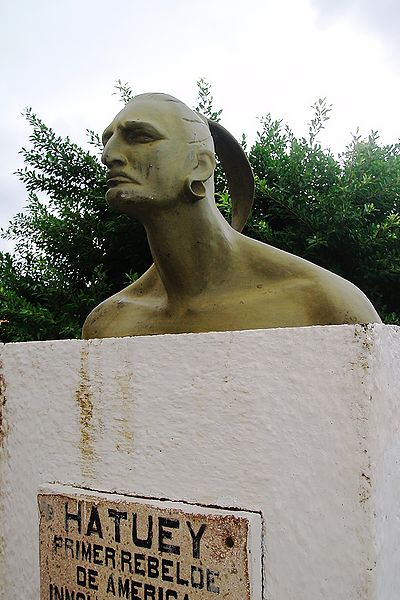
In Cuba, today's "History of" country.
Facts of the CaseMore info here: Baby Girl was 27 months old and had been living with the adoptive couple since birth when South Carolina Supreme Court told them that they were "ideal parents" but they had to turn the the child over to the biological father she had never met. Under state law, the child would stay with the parents, but the federal law "calls for special procedures rooted in the sovereignty of Indian nations and a history of abusive child welfare practices involving Indian children."
When the biological mother of Baby Girl became pregnant she did not live with the father and the father did not support the mother financially. The mother sent the father a text message asking if he would rather pay child support or relinquish his parental rights. He sent a text back, saying that he would relinquish his rights, though he later testified that he thought he was relinquishing his rights only to the mother. The biological father was a registered member of the Cherokee Nation. The biological mother attempted to verify this status, but spelled the father’s name wrong and misrepresented his birthday in the request, so the Nation could not locate the father’s registration. The mother listed Baby Girl’s ethnicity as “Hispanic” instead of “Native American” on the birth certificate. The mother decided to put Baby Girl up for adoption because she had two other children that she struggled to support.
Adoptive Couple, who resided in South Carolina, began adoption proceedings in that state. The Cherokee Nation finally identified the father as a registered member and filed a notice of intervention, stating that Baby Girl was an “Indian Child” under the Federal Indian Child Welfare Act (ICWA). The father stated that he did not consent to the adoption and would seek custody of Baby Girl. After trial, the family court denied Adoptive Couple’s petition for adoption and granted custody to the biological father. The court held that the biological father was a “parent” under the ICWA because of his paternity and pursuit of custody as soon as he learned that Baby Girl was being put up for adoption. Adoptive Couple did not follow the procedural directives in the ICWA to obtain the father’s consent prior to initiating adoption proceedings. The Supreme Court of South Carolina affirmed.
Question
Can a non-custodial parent invoke ICWA to block an adoption voluntarily and lawfully initiated by a non-Indian parent under state law?
Does ICWA define “parent” to include an unwed biological father who has not complied with state law rules to attain legal status as a parent?
The Bahamas held little of interest to the Spanish other than as a source of slave labor. Nearly the entire population of Lucayans (almost 40,000 people total) were deported over the next 30 years. When the Spanish decided to evacuate the remaining Lucayans to Hispaniola in 1520, they could find only eleven in all of the Bahamas. The islands remained abandoned and depopulated for 130 years afterwards....English settlers began arriving in 1648. The first, who called themselves Eleutherians, were farmers who didn't do too well. The New Providence settlement, begun in 1666 "made their living from the sea, salvaging (mainly Spanish) wrecks, making salt, and taking fish, turtles, conchs and ambergris."
Pro players who take on controversial social debates are gone, replaced by athletes whose goal is to not offend... There is no Muhammad Ali, who lost his heavyweight boxing title as a conscientious objector to the Vietnam War. There is no Jim Brown, arguably the greatest running back in NFL history, who found more meaning in bringing rival L.A. gang members together than in playing on the gridiron, where, he realized, he was just “a highly paid, over-glamorized gladiator.”Sports stars (and other pop culture stars) have clout, but what do they know about the political issues they could influence? Wouldn't the best, most ethical stance be to acknowledge their lack of qualification outside of their field of expertise?
There is no Arthur Ashe, the late tennis champion and civil rights activist, who in 1985 was arrested outside the South African Embassy in Washington during an anti-apartheid rally. There’s not even a Curt Flood, the St. Louis Cardinal who didn’t accept a trade to another team in 1969, appealing to the U.S. Supreme Court in a landmark case that paved the way for free agency.
“Have you thought about what it’s like to play for a team that’s named the Redskins?” I asked. “Because a lot of American Indians and others feel that’s a derogatory term.”Isn't that exactly right? Shouldn't more celebrities do that?
“I’m not qualified to speak on that,” Griffin said. “I didn’t even mean to stir up the other thing, so I’m not going to touch that one.”
The Catholic Encyclopedia does make it clear that the European invaders had some difficulty identifying and differentiating between the various native peoples they encountered.So maybe it's not just a Wikipedia problem. But you'd think by now they'd have sorted out who replaced whom, when, and how. Maybe not. Maybe my expectations for archaeology are excessive. And then there's the question: how/why did they leave?
No researcher has conclusively proven any of these causes as the real reason for the destruction of West Indian natives.Christopher Columbus arrived in 1493, but the Caribs defended themselves. It was England that colonized the islands 1632.
Settlers raised tobacco, indigo, ginger, and sugarcane as cash crops.... [T]he sugar industry became so profitable that many farmers replaced other crops with sugar, making it the economic backbone of the islands.The English brought in African slaves to work in the sugar plantations.
During the 18th century, Antigua was used as the headquarters of the British Royal Navy Caribbean fleet....
... Antiguan slaves were emancipated in 1834, but remained economically dependent upon the plantation owners....
The islands achieved independence from the United Kingdom in 1981, becoming the nation of Antigua and Barbuda. It remains part of the Commonwealth of Nations, and remains a constitutional monarchy, with Queen Elizabeth II as Queen of Antigua and Barbuda.
"The members of this tribe have never forgotten where they came from and we are excited to be able to help them come back," [said said Michael Freund, chairman of the Shavei Israel group which helped organise the journey for the Bnei Menashe members.]There were 10 lost tribes in all. Were these people one of them? They maintained an oral tradition — dating back to the 8th century B.C. — telling of their migration through Persia, Afghanistan, Tibet, China, and ultimately to settle in northeastern India. Should skepticism be aimed at these people, or is it better to honor them and welcome them as symbolizing the idea of the lost tribes — which itself may be only a myth?
But some critics say the Bnei Menashe's link to Judaism are "historically untenable". They accuse the community of using their status to escape poverty India.
In the Book of Mormon, Lehi (Hebrew לחי Léḥî / Lāḥî "jawbone") was an ancient prophet who lived around 600 BC...
Shortly before the destruction of Jerusalem, Lehi escaped with his family, along with his friend Ishmael and his family, and another man named Zoram. Together, Lehi led them south down the Arabian Peninsula until they reached a fertile coastal region they named Bountiful. There, they built a ship, and sailed across the ocean to the Americas. Lehi's sons Nephi and Laman are said to have established themselves and to have founded Israelite nations: the Nephites and the Lamanites....
Many Mormons consider Native Americans to be descendants of the Lamanites. Officially, The Church of Jesus Christ of Latter Day Saints appears to accept this position....
He rose to national attention as a leader of the American Indian Movement in 1970 by directing a band of Indian protesters who seized the Mayflower II ship replica at Plymouth, Mass., on Thanksgiving Day. The boisterous confrontation between Indians and costumed “Pilgrims” attracted network television coverage and made Mr. Means an overnight hero to dissident Indians and sympathetic whites.Theatrical protests...
Later, he orchestrated an Indian prayer vigil atop the federal monument of sculptured presidential heads at Mount Rushmore....

DOES ELIZABETH WARREN HAVE A LAW LICENSE PROBLEM?If you keep scrolling, beyond my screen grab, there's also:
... On defensive again over heritage claimAnd a picture of a stink bug...

The delegates extended an invitation to Warren to appear at their caucus meeting tomorrow, just before she is slated to give a prime-time address on the convention stage....Well, that timing gives her an easy way to say no, but her cause is damaged by the simple spectacle of DNC delegates questioning her openly like this.
Geronimo’s wife, Karen, also an Apache from New Mexico, said she and other Indians carry an ID card as proof of their heritage, and believes every person claiming American Indian heritage should do the same.Another ID card issue!
Asked whether she would ever vote for someone who misrepresented themselves as American Indian, she was adamant.
“No, not at all,” Karen Geronimo said.
To find the opposing view, one needs only to drive five miles west from Browning, past the casino, heading straight toward the mountains, and pull off at the red gate on the right. There, on a recent summer afternoon, over mugs of horsemint tea, Pauline Matt and a handful of Blackfeet women were trying to find a way to persuade the tribal leaders to stop the drilling.You just know Ron Crossguns is not the NYT's idea of an authentic Indian. You know, and he knows, and he's calling
“It threatens everything we are as Blackfeet,” she said...
“You see this butterfly, you hear those birds?” asked Crystal LaPlant, as she sat on Ms. Matt’s back porch one evening, the meadows alive with sound. “Once they start drilling, we aren’t going to have those things anymore.”
Ron Crossguns, who works for the Blackfeet tribe’s oil and gas division, has oil leases on his land, a 10-foot cross in his yard, and little patience for that kind of pastoral veneration. He called it “movie Indian” claptrap, divorced from modern realities. Mountains, he said, are just mountains.
“They’re just big rocks, nothing more,” Mr. Crossguns said. “Don’t try to make them into nothing holy. Jesus Christ put them there for animals to feed on, and for people to hunt on.”
The residence hall will have features that recognize the influence and importance of tribal culture and of the lakes.Here's the Wikipedia article about the Ho-Chunk, AKA Winnebago:
A fire circle will be located on the building’s north side facing the lake, with bronze plaques representing the 11 Indian Nations in Wisconsin. Inside, on the first floor, embedded in the terrazzo floor, will be images of four of the campus effigy mound groups; Observatory Hill, Willow Drive, Picnic Point and Eagle Heights....
The term "Winnebago" originally came from an exonym, that is, a name given to the people by the neighboring Algonquian-speaking tribes.... This name has been variously translated as, "people of the stinking water," "people of the filthy water," "people of the stagnant water'" and "people of the smelly waters."
The Algonquian words do not have the negative overtones attached to the French word puant and the English word "stinky." The French translated and shortened the name to simply les puants (or les puans), which was translated into English as "the Stinkards." Many researchers believe that the waters referred to were either stagnant waters of Green Bay or the aromatic, algae-filled waters of the rivers or lakes where the Winnebago were living in the mid-17th century....
Ho-Chunk is the tribe's name for itself, or autonym.... Translations include: "the fish eaters," "the trout people," "the big fish people", "the big speech people," "the people of the big voice," "the people of the parent speech", and "the people of the original language." Current elders say it means, "the people of the big voice" or "the people of the sacred language."
Federal statistics like those in the Harvard records, which were compiled for the Department of Labor, rely on a definition of “Native American’’ that requires both ancestry and an official affiliation with a tribe or community. The 1992-93 and 1995-96 Harvard reports indicate the university relied on that definition during those years as well as the years since.
Warren has not met any of those standards. Though she continues to consider herself Native American, she has not provided any genealogical evidence....
Professor Charles Fried, who sat on the committee that recruited Warren, reiterated to the Globe on Wednesday that he was unaware of Warren’s minority status when she was hired. He said that the committee never discussed it and that he does not consult the legal directory in which Warren had listed herself as a minority.
However, Fried acknowledged Wednesday to the Globe, it seemed strange that the issue of her heritage would not come up during the hiring process since she was recruited in the early 1990s, when the school was under intense pressure to diversify its faculty....
... Now that he’s one of us, he’ll need to learn more to help us.
The US Department of Labor requires large employers to collect diversity statistics annually and suggests they be based on employees’ classification of themselves. In cases in which employees do not self-identify, federal regulations allow some administrators to make judgment calls on the correct categories using “employment records or observer identification.’’The linked article also recounts the history of Harvard Law's perceived diversity problem circa 1990, just before Warren arrived. Lawprof Derrick Bell had gone on "strike" (unpaid leave) to protest, some students brought a lawsuit (unsuccessful), and the U.S. Department of Labor audited what the article calls "Harvard's diversity practices" and found 10 violations. Warren arrived in 1992 (as a visiting professor), at which point she "had been listing herself for seven years as a minority in a legal directory often used by law recruiters to make diversity-friendly hires." She was still on that list when Harvard Law gave her a permanent position in 1995.
The administrator responsible for Harvard Law School’s faculty diversity statistics from 1996 to 2004, the period in question, was Alan Ray, a citizen of the Cherokee Nation who, like Warren, has fair skin, blue eyes, and Oklahoma roots.
But Ray, now president of Elmhurst College in Illinois, said in a statement that he “did not encourage the Law School to list any faculty member as one particular race or ethnicity, including Professor Warren.’’ He further said through a spokeswoman that he “never encouraged any faculty member to list himself or herself in a particular way.’’ Ray added that Harvard “always accepted whatever identification a faculty member wanted to provide,’’ a characterization another highly placed former Harvard administrator backed up.
In 1996, law school news director Mike Chmura, speaking to the Harvard Crimson, identified Warren as a Native American professor.I find it hard to believe that — after all the uproar over diversity in 1990 — that the law school could quietly pass off Warren as its "first woman of color." There were so many people who were genuinely angry over the lack of diversity. Why would they have tolerated the school making such a lame assertion? Wouldn't they have wanted to keep up the pressure? If you were at Harvard in the 1990s, what do you remember about this?
In 1997, the Fordham Law Review, citing Chmura, referred to Warren as Harvard Law’s “first woman of color.’’
"Because my mother told me so. This is how I live. My mother, my grandmother, my family. This is my family. Scott Brown has launched attacks on my family. I am not backing off from my family.”So it seems the argument is: She believes something she heard from her family, and if you question the factual soundness of what she believes — or ask additional questions about the consequences of the fact believed — that you are attacking her family.

 :.
:.
