Pages

Labels

Showing posts with label theater. Show all posts

Friday, January 4, 2013

Dubbing in movie musicals fell into disrepute.

Present-day preference is for "real" screen actors, with an acceptance of their vocal imperfections. But in the old days:
Classically trained singers like Betty Noyes, Betty Wand, and Marni Nixon made careers out of singing for some of Hollywood’s most famous actresses, including Audrey Hepburn and Leslie Caron. One of the greatest movie musicals, West Side Story, dubbed three of its leads—Natalie Wood, Richard Beymer, and Rita Moreno—because their voices weren’t trained for the operatic score. The film was better for it. (Russ Tamblyn and George Chakiris, whose singing was not dubbed, had less challenging vocal parts.) Similarly, the men behind Singin’ in the Rain, a movie partly about dubbing in the movies, had no problem dubbing Debbie Reynolds for a couple of songs. The King and I, Gigi, and My Fair Lady are other prominent musicals that used dubbing without shame.
Everything in those old movies was more "false," but within n comprehensive environment of falseness, it made sense. It's false that people are singing at all. There's falseness to any stage show. But in a stage show, the actors are really singing, not lip-synching. I'd rather not watch lip-synching, whether it's the actor's own voice or not.

Anyway, the new move "Les Miserables" has the actors singing, not lip-synching to their own or somebody else's vocals. Some people are annoyed by the low-quality singing, and I don't know how bad it is. I think my taste is for real actors singing, but I doubt if I'll see this movie. (I have seen the stage show.) My problem isn't the way actors sing. It's the way actors act. I don't know exactly why, but over the years, I grew less and less interested in seeing human beings pretend to be characters, and at some point, I started to find it actively annoying. I especially dislike long, tight closeups — as if every mediocre actor should be treated like Falconetti in  "The Passion of Joan of Arc."

Actually, I can pinpoint the beginning of my awareness of this annoyance: a particular film that came out in 1997. Once you let yourself see that maybe you don't like something that you've assumed you love — people love movies — then all sorts of distracting perceptions disrupt your pleasure. The end stage is: You anticipate these disruptions and become so averse to them that you resist the experience altogether. The question becomes: Why should you spend time at the movies? Time is precious. The default position is: No.

Thursday, December 27, 2012

"Audience Participation Cues for the My Dinner with Andre Midnight Screening."

When those "Rocky Horror" events leave you feeling empty and questioning your very existence, it's time to move on to the Andre scene...
When André tells the story of his attempt to workshop a production of The Little Prince, and how he found himself eating sand in the Sahara desert with a Buddhist monk, eat some sand.

Throw a banana at the screen every time André mentions his wife Chiquita....

When André and Wally discuss the lamentable state of the theater and wonder if it’s possible to create a theatrical experience that would shake people out of their complacency, ask yourself: Is attending this screening/performance of My Dinner With André making you less complacent, or does it allow you to wrap yourself in yet another protective layer of ironic detachment? Is endlessly reenacting My Dinner With André a way for members of The MDWA Midnight Madness Troupe to hide behind a mask of performance and avoid exposing who we really are? Are we really saying anything with this show, or is it just an excuse for people to get drunk and dress up on a Friday night?

Treat yourself to a nice amaretto when Wally orders an after-dinner drink....

Thursday, December 13, 2012

Wednesday, December 5, 2012

"Palin Rejects 'Seventh Python' Claim in Court Case."

That's Michael Palin... testifying in a case about whether the producer of "Monty Python and the Holy Grail" deserves a share of the profits from "Spamalot," the Broadway show based on the movie.
Of [Mark] Forstater, Palin said: "He was not the creator of the film. The film had been created by the Python team entirely. Mark was not part of our team."...

[Eric] Idle and [Terry] Jones, who sat at the back of the small, modern courtroom in central London, occasionally chuckled at what was being said, but mostly Idle had his eyes closed and Jones could not resist a yawn.
How do you know he couldn't resist?

Sunday, November 18, 2012

"The fact is with a musical you can't have an ounce of cynicism, and I do have a bit, I suppose."

"I have never had to worry much about the emotional arc thing before."

Jennifer Saunders, the creator of "Absolutely Fabulous," talking about her new musical, which is based on the songs of The Spice Girls.

Meanwhile, in Milwaukee: "The Sound of Music."
With all due respect to Julie Andrews' matchless soprano and iconic performance, [24-year-old Elizabeth] Telford's Maria therefore gets closer to what this show is really about — and why Maria is irresistible, to the Captain and to us.

While Andrews opens by gracefully twirling through the countryside, a much earthier Telford - with fuller, less angular features and an unruly mop of hair - moves with an ungainly, off-kilter physicality, reinforced by flailing arms and legs reflecting her irrepressible and untutored joy....

Saturday, November 17, 2012

"A drunk guy vomited over the railing onto about a dozen audience members seated in the orchestra..."

"... right in the middle of one of [Paul] Rudd’s big monologues on Wednesday... There was mass chaos for several minutes, but the cast played right on through, ignoring the disruption."
"Given the severity of the situation, and the number of people affected, it’s pretty amazing that the show was able to go on uninterrupted...."
I guess the show, called "Grace," wasn't much about what happens to other people. Carry on! Don't notice the troubles that fall upon your fellow human being. That tends to be the message of great art, I think. Or do I have it backwards?

Thursday, October 25, 2012

"I have to suspend my brain and mingle the subtle essence of my mind with this air..."

"... which is of the like nature, in order clearly to penetrate the things of heaven. I should have discovered nothing, had I remained on the ground to consider from below the things that are above; for the earth by its force attracts the sap of the mind to itself. It's just the same with the watercress."

Socrates, in "The Clouds," by Aristophanes.

Monday, September 24, 2012

I've been thinking a lot today about about the verb "to like."

First, I was struck by the Democratic pollster who said, about Romney, "Ultimately, people don’t like this guy. If they don’t like someone, it’s hard to get people to vote for him — particularly to fire someone they do like."

And then later today, I overheard a professor — I won't say who — telling students they will be meeting representatives of 2 groups, one conservative and one liberal, and that they "would like" the liberals. These particular conservatives, he said, were more effective pursuing their aims — some field of policy that I won't identify — but the liberals, you will like.

And it got me thinking about this word "like." What is this liking that we do — or are told to do or assert that we do — these days? You can "like" somebody on Facebook. It's a social thing. Politically, it's about liberals. Liberals are likeable. Barack Obama is — it's drummed into our heads — likeable. He's so likeable. He got ahead of Hillary Clinton for being so darned likeable, and he famously said "You're likeable enough" to her on his way to beating her to the nomination.

It occurred to me that that liberals have quite effectively insinuated the message into our brains that they are likeable, and, in particular, Barack Obama is likeable. And that doesn't just mean that any given individual likes him, subjectively. He is likeable, objectively. If you don't like him, what's wrong with you? You don't seem likeable. You'd better like him or no one will like you. All the likeable people are liberal, so you'd better be liberal or no one will like you.

That sounds very schoolyard, or like a shallow adult. Maybe if you're old like me, you remember the Arthur Miller play "Death of a Salesman," in which a pathetic man was way too concerned about whether he was well liked. Years ago, when we Baby Boomers were young, it seemed pathetic to dwell on being liked. It was a distraction for small minds, for conventional people.

Consider the etymology of the verb "to like":
O.E. lician "to please, be sufficient," from P.Gmc. *likjan (cf. O.N. lika, O.Fris. likia, O.H.G. lihhen, Goth. leikan "to please"), from *lik- "body, form; like, same." The basic meaning seems to be "to be like" (see like (adj.)), thus, "to be suitable." Like (and dislike) originally flowed the other way: It likes me, where we would say I like it. The modern flow began to appear late 14c.
The modern flow! I like Obama would pre-14c be expressed: Obama likes me. He pleases me. And why? Because he's like me? I see myself in him? Is that what we are doing? Looking in a mirror? If it feels as though we are looking in a mirror, we like him?

I'm reading the long Oxford English Dictionary entry for "like" — sorry, it's not linkable — and I run across the line in "Uncle Tom's Cabin": "I may like him well enough; but you don't love your servants." I can link to the full context:
"Would you think you were well off, if there were not one creature in the world near you to love you?"

"I?—Well, of course not."

"And you have taken Dodo away from all the friends he ever had, and now he has not a creature to love him;—nobody can be good that way."

"Well, I can't help it, as I know of. I can't get his mother and I can't love him myself, nor anybody else, as I know of "

"Why can't you?" said Eva.

"Love Dodo! Why, Eva, you wouldn't have me! I may like him well enough; but you don't love your servants."

"I do, indeed."

"How odd!"

"Don't the Bible say we must love everybody?"

"O, the Bible! To be sure, it says a great many such things; but, then, nobody ever thinks of doing them,—you know, Eva, nobody does."
Eva did not speak; her eyes were fixed and thoughtful for a few moments.
Now, I certainly don't think we ought to love our political leaders. "He loved Big Brother" is the last line of George Orwell's "1984":
He gazed up at the enormous face. Forty years it had taken him to learn what kind of smile was hidden beneath the dark moustache. O cruel, needless misunderstanding! O stubborn, self-willed exile from the loving breast! Two gin-scented tears trickled down the sides of his nose. But it was all right, everything was all right, the struggle was finished. He had won the victory over himself. He loved Big Brother.
Horrifying. But this liking of Obama — not loving, liking — what is it? Is it racist? You like him. You really, really like him. Or something's wrong with you. Do you twinge with anxiety that you might be racist if you don't like him? Better like him. Why suffer the cruel, needless misunderstanding, the stubborn, self-willed exile from the likeable breast! Everything can be all right. The struggle can be finished. Surrender to the victory over yourself. You like Barack Obama.

But only like. You don't love....

Love... it's so old fashioned and retrograde. It's what the Baby Boomers talked about, back when they were hippies.
It's so fine, It's sunshine
It's the word, love
Everywhere I go I hear it said
In the good and the bad books that I have read
Not anymore. Now, the word is: LIKE

Sunday, July 22, 2012

Fighting for reelection, Obama spent $58 million — $38 million on TV ads alone.

According to this L.A. Times article, which is illustrated, for some reason, with a photograph of Sheldon Adelson — a Romney donor — gesturing at some lit-up models of what are presumably models of casinos. (He's identified as a "casino mogul.")

A "mogul," which originally referred to "the successive heads of the Muslim dynasty founded by Zahīr-ud-Dīn Muḥammad Bābur (1483–1530), which ruled an empire covering a large part of South Asia from the 16th to the 19th centuries," now denotes "An important, influential, or dominant person; an autocrat," according to the OED, which gives the early example "I am the Sultan of this place: Mr. Limberham is the Mogol of the next Mansion" — a line spoken by a character named Brainsick, in the play "Limberham (or The Kind Keeper)," by John Dryden.

The photo of Adelson in the L.A. Times makes him seem capable of moving skyscrapers like big chess pieces. What a manipulative fellow! He gave $10 million in June to a Romney super PAC called Restore Our Future. ("Restore" means to bring back. Back to the future.) Restore Our Future raised $20.6 million in June. Meanwhile, Obama's super PAC, Priorities USA Action took in only $6 million.

Romney's campaign raised much more money than did Obama — $106 million to $70 million (in June). So Obama is lagging in the fundraising and also spending much more.
Heading into July, Romney and his party allies were left with nearly $170 million on hand, while Obama and the Democrats had $147 million.
That's not that huge of a difference, but Obama is such a big spender. And what did he get for all that spending? I think the idea was to frame Romney as an evil capitalist, and it hasn't worked out that well. 1. Despite the heavy attack on Romney, Obama hasn't moved up in the polls, and 2. The attack on capitalism went too far and touched off an effective counterattack. Not only has Obama depleted his funds, he's depleted his argument against Romney.
The Obama campaign’s attempt to portray Mitt Romney as the villainous Bane from “The Dark Knight Rises” appears to be a big flop. And the problem for Obama is, he really doesn’t have a Plan B.
 ADDED: The Obama campaign spent more than $2.6 on polling alone, just in June. What are they finding out? Why isn't that information giving them more useful ideas about how to win? Reminds me of the stimulus program, dumping huge amounts of money on things that done even pan out.

Wednesday, June 13, 2012

The theme of the opening ceremony for the London Olympics is "green and pleasant."

We will see a representation of "the mythical British countryside: meadows, maypoles, picnicking families, toiling farmers, cricketers on the village green. There will be twelve horses and three sheepdogs. There will be Elgar, and the world’s largest harmonized bell, inscribed with the line 'Be not afeard, the isle is full of noises,' from 'The Tempest.'"

It will be — by design — quite the contrast to the big show they did in Beijing back in 2003.  It will be "a bit warmer, and more inclusive, and more involving."

What do you think of the "green and pleasant" approach?
  
pollcode.com free polls 

Monday, May 21, 2012

"Friends, Romans, countrymen..."

This amused me. Cowboy style. I ran across it because I was looking for the text to the famous Mark Antony speech, which I'd been forced to memorize in junior high school, many decades ago. (Here's Marlon Brando doing it, not amusingly.) And what got me testing my own memory was something I'd just read about Barack Obama, which someone had emailed me, a propos of the recent "born in Kenya" dustup. It's a GQ article from November 2009 called "Barack Obama's Work in Progress."
Over the past few years, we’ve gotten to know our president as a lot of different things: campaigner, lawyer, father, basketballer. But what if Obama’s first and truest calling—his desire to write—explains more about him than anything else? Robert Draper recounts the untold story of the first man since Teddy Roosevelt to serve as author in chief.
I haven't combed through that whole article looking for the Kenya connections, but I noticed this bit about Shakespeare:
Sometime in 2002, the young state senator pays a daytime visit to the Chicago Shakespeare Theater. The artistic director, Barbara Gaines, is happy to show the politician around. Watching the carpenters erect the set, he asks Gaines which play is about to be performed. “Julius Caesar,” she tells him.

At first, Obama doesn’t say anything. Then, in a very soft voice, he begins to recite some twenty lines from the play. As he does so, he places his hand on his heart, as if stricken by the words’ transcendent beauty.

The director is agog. She has never heard an elected official quote Shakespeare in such a way.
Now, wait a minute. Who, upon mention of "Julius Caesar," doesn't start going "Friends, Romans, countrymen, lend me you ears..."? If it was some other 20 lines from the play, I might be impressed. The fact that he went on for 20 lines is sort of cool as a demonstration of memory. It's more than I can do without missing some words, but then, I learned it during the LBJ administration. But who goes on for 20 lines, putting on a memory show? Maybe you would if you saw that you were getting the director of the Chicago Shakespeare Theater agog.

And would you put your hand on your heart? (Cf., Obama not putting his hand over his heart during the National Anthem.)

Back to GQ:
Later, she tells a co-worker, “I just had the most amazing experience. I met the first politician to have the soul of a poet.” (The first, she means, since Abe Lincoln, who quoted lines from Macbeth less than a week before his assassination: I think our country sinks beneath the yoke…)
The soul of a poet. Doesn't anyone remember Eugene McCarthy?


Many women loved this Senator from Minnesota, who challenged LBJ in 1968, and the poetry was part of it. My maternal grandmother loved him because he was a poet. 1968 — there was a year. Bobby Kennedy pushes Senator McCarthy — the good Senator McCarthy — aside, LBJ declines to run, Martin Luther King is shot down, 2 months later Bobby follows him, and Nixon becomes inevitable.

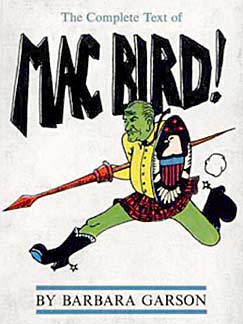
By the way, speaking of MacBeth and LBJ, they made a play back then: MacBird!


The playwright, Barbara Garson said:
"People used to ask me then, 'Do you really think Johnson killed Kennedy?'... I never took that seriously. I used to say to people, 'If he did, it's the least of his crimes.' It was not what the play was about. The plot was a given."

Monday, March 19, 2012

"Making people care" — Mike Daisey's justification for folding fake drama into a more or less true story.

David Carr analyzes the theater/journalism borderline, looking at Daisey's "The Agony and the Ecstasy of Steve Jobs" (the subject of this week's "Retraction" on "This American Life") and "Kony 2012" (the viral video whose producer, Jason Russell, was found, last Friday, naked and ranting on the streets of San Diego). Daisey says he "was terrified" that if he "untied" the fake parts of his theater monologue (to meet the standards of "This American Life") that "the work, that I know is really good, and tells a story, that does these really great things for making people care... would come apart in a way where, where it would ruin everything."

I listened to the "Retraction" episode of "This American Life," and was captivated and repulsed by the replays of the "The Agony and the Ecstasy," with Daisey's heavy-handed phrasing and gulping passionate voice. He injects Apple is eeeevvvilll directly into the theatergoer's brain. You hear the audience reaction and feel them in his manipulative hands. This is art! But it's journalism too. All you have to do is say it has fictionalized elements, and you're in the powerful realm of "Uncle Tom's Cabin" and "The Jungle."

Carr says:
I am a longtime fan of “This American Life,” but I have never assumed that every story I heard was literally true. The writer and monologist David Sedaris frequently tells wonderful personal yarns on the show that may not be precisely true in every detail....
Yes, what exactly is the difference between Sedaris and what Daisey did? One is humor and the other drama? But both humor and drama employ exaggerations, composites, and invention. One is only trying to entertain and the other is trying to incite political action? That's more like it. One is an author telling stories on himself (and his friends and family) and the other has identified a target and intends a vicious attack that will cause real harm. That matters.

Now, Daisey stresses the victims of his victim: the workers in China, the people he made the audience care about by making up dramatic scenes that, it turns out, never happened, like the man with a hand that was mangled making an iPad who gets to touch, with that mangled hand, a finished iPad, and he strokes it and calls it "magical." This is a version of what is the classic melodramatic encapsulation of the plight of the factory worker: He labors over the creation of a product that he can never own.

Carr — writing in the NYT — turns to the NYT journalists who published a series of articles "investigating Apple’s suppliers... that may have contained a bit less drama, but landed hard." I presume these articles are accurate, but how do I know? Carr anticipates the reader's skepticism about the trustworthiness of professional journalists (who can't make the I'm-an-artist defense when they are caught faking). He ends his article with a coy reference to "an e-mail to someone I know who is an expert on journalistic malfeasance [askins] if, in a complicated informational age, there was a way to make sure that someone telling an important story had the actual goods." We get a quote from this character, a quote that's only worth quoting to get to the revelation that it's Jayson Blair. Somehow the NYT expects you to remember who Blair is... or they're hoping we've forgotten.

I put that link on Blair's name. It's not in Carr's article — and it's even a link to the NYT. Blair's articles seemed so good because they included vivid details that extracted empathy from the reader:
Some of Mr. Blair's articles in recent months provide vivid descriptions of scenes that often occurred in the privacy of people's homes but that, travel records and interviews show, Mr. Blair could not have witnessed.

On March 24, for example, he filed an article with the dateline Hunt Valley, Md., in which he described an anxious mother and father, Martha and Michael Gardner, awaiting word on their son, Michael Gardner II, a Marine scout then in Iraq.

Mr. Blair described Mrs. Gardner ''turning swiftly in her chair to listen to an anchor report of a Marine unit''; he also wrote about the red, white and blue pansies in her front yard. In an interview last week, Mrs. Gardner said Mr. Blair had spoken to her only by phone.
Why lie about pansies? Red, white and blue pansies. To make you care. You can't be relied upon to care based on journalistic facts alone. Those who would manipulate your political opinions know they need to pull at your heart. They give you flowers. They give you an old man with a shaking, mangled hand.

From the "This American Life" transcript (boldface added):
Mike Daisey: And everything I have done in making this monologue for the theater has been toward that end – to make people care. I’m not going to say that I didn’t take a few shortcuts in my passion to be heard. But I stand behind the work. My mistake, the mistake that I truly regret is that I had it on your show as journalism and it’s not journalism. It’s theater. I use the tools of theater and memoir to achieve its dramatic arc and of that arc and of that work I am very proud because I think it made you care, Ira, and I think it made you want to delve. And my hope is that it makes – has made — other people delve....

And I stand by it as a theatrical work. I stand by how it makes people see and care about the situation that’s happening there. I stand by it in the theater. And I regret, deeply, that it was put into this context on your show.
Make people care. This is the what we are exposed to when we encounter text. An author is trying to make you care. And maybe you feel that upwelling of caring — empathy... ah, the twinges of humanity. Aren't you a good person to surrender to the injection of caring about the thing you've been manipulated into caring about?

Make people care. May I suggest that you shift your focus from "care" to "make"? Someone is trying to make you feel/think what they want you to feel/think. They'd like you to directly internalize the viewpoint they have chosen and do not want to try to prove on facts and reason alone. Resist!

There. Was that dramatic enough to make you care about resisting the writers who are out to make you care?

Sunday, March 18, 2012

"Yeah. We have different worldviews on some of these things. I agree with you truth is really important."

Says Mike Daisey to Ira Glass, who responds: "I know but I feel like I have the normal worldview. The normal worldview is somebody stands on stage and says 'this happened to me,' I think it happened to them, unless it's clearly labeled as 'here's a work of fiction.'"

Some artists (and propagandists) will disagree, but I hope Glass is right.

ADDED: You can listen to the new "Retraction" episode of "This American Life" here (where there is also a link to the transcript PDF).
Ira Glass: You put us in this position of going out and vouching for the truth of what you were saying and all along, in all of these ways, you knew that these things weren’t true. Did you ever stop and think, okay these things aren’t true and you have us vouching for their truth?

Mike Daisey: I did, I did. I thought about that a lot.

Ira Glass: And just what did you think?

Mike Daisey: I felt really conflicted. I felt... trapped.
Fascinatingly, it turns out that Daisey had once done a story about that "Million Little Pieces" guy, James Frey, who got into so much trouble for palming off a fictionalized story as a memoir. A big part of the trouble was that Oprah Winfrey had promoted Frey's book. The section of the interview where Glass brings up Frey ends like this:
Ira Glass: I have such a weird mix of feelings about this, because I simultaneously feel terrible, for you, and also, I feel lied to. And also I stuck my neck out for you. You know I feel like, I feel like, like I vouched for you. With our audience. Based on your word.
I was your Oprah!
Mike Daisey: I’m sorry.

Thursday, March 1, 2012

Restaging a famous fiasco.

The original "Carrie" Broadway musical was savaged, lost $8 million, and closed after 5 performances.
Where the Broadway version had Carrie singing a song while the objects on her make-up table levitated around her, the off-Broadway version makes do with just a few magic tricks — a tiny figurine of Jesus levitates between the girl's hands and a couple of chairs move...

And... here's no stage blood spilled in the climactic scene at the prom, when Carrie violently erupts. The carnage is implied with red lights, projections and stylized movement. Director Arima says it's an artistic rather than a financial choice.
That's the expedient thing for the director to say. But better work can spring from limitations. Copious financing can lead to horrible work. Ugh! Suddenly, I'm thinking about the government!

Wednesday, February 29, 2012

You can use "a name of your choice" to reserve a spot at the play about the Sterling Hall bombing.

And you won't need to show an I.D. at the door. I was wrong about that, I've been informed.
You simply need to get your name on their list and then tell them your name at the door. And if you don't want your real name on their list, you can use "a name of your choice."  Like... I don't know... Robert Fassnacht... or Leo Burt.
With no I.D. requirement, appropriated names suggested, and a play whose playwright asks "why do most of us think that [those who broke the social norm] weren’t [justified]?," wouldn't you expect some theatergoers without reservations to attempt to get in using a name they think somebody else might have chosen?

Tuesday, February 28, 2012

"New play uses oral history to craft story of the 1970 Sterling Hall bombing."

"Uncivil Disobedience, a new play from Madison’s Forward Theatre Company, examines an important event in Wisconsin’s history...."
When a bomb exploded just outside Sterling Hall in the early morning hours of August 24, 1970, it was a thunderous event in the history of Wisconsin. Intended to destroy the Army Mathematics Research Center, it caused enormous damage to the building and killed physics researcher Robert Fassnacht and injured three other people....

Mike Lawler of the Wisconsin Story Project, in conjunction with Troy Reeves of the Oral History Program at the University of Wisconsin–Madison, has spent several years conducting interviews and collecting stories from people who were there – and those whose lives were profoundly changed by the aftermath. These stories form the basis of a theatrical piece exploring the impact of the bombing on campus, and also within the larger protest movement of the 60s and 70s.
More information here, including this:
Underneath the story of the bombing and the effort to affect government policy in Vietnam, Lawler believes there is a bigger issue to explore. "For me," he says, "the central question of the story we’re telling is not ‘were the bombers justified?’ but rather, ‘why do most of us think that they weren’t [justified]?"
"Partially underwritten by the Dane County Cultural Affairs Commission."

ADDED: I'd like to go to this play so I can tell you about it, but I'm extremely put off by this:
Due to limited seating in Rotunda Studio, reservations are strongly encouraged... To reserve your seats, please email fhonts@forwardtheater.com.
They're collecting names and addresses, and you'll have to I.D. yourself at the door to be seated. I want to buy tickets anonymously and not be identified! I live in a city where people point me out and announce to the group: "Ann Althouse is here." And not in a nice way. It's creepy.

And imagine if a right-wing group were doing a play that pushed left-wing buttons as hard as that suggestion that the Sterling Hall bombers were justified.

AND: I received email from the theater group's communications director saying that you won't need an I.D. at the door. You simply need to get your name on their list and then tell them your name at the door. And if you don't want your real name on their list, you can use "a name of your choice."  Like... I don't know... Robert Fassnacht... or Leo Burt.

I said:
I didn't think of the idea of using a fake name. I can't imagine emailing and making a reservation under a pseudonym or showing up and giving a fake name. I mean, now that you've suggested it, I can think about it and see that it's not something I personally can do. I have never in my life tried to get into some place using a fake name, and as someone who gets recognized in this town (and confronted!), I'd be afraid of finding myself in an embarrassing situation.

Monday, February 20, 2012

"Ah, Godspell. How you shaped our ’70s Catholic school childhoods by influencing an entire generation..."

"... of semi-closeted nuns to pick up their guitars and force us to learn half the songbook. Do they still have guitar masses? Or did all those Birkenstock’d nuns finally drop the veil and head off to the Lilith Fair?"

The first paragraph of Tom and Lorenzo's recap of the most recent episode of "Project Runway All Stars."

Are you watching this season? I am. I still can't tell you the names of the 2 people they've got in the Heidi and Tim positions, but they're doing a decent job helping us deal with being deprived of familiar things.

And, as long as I'm rummaging around at Tom and Lorenzo's, check out these stiletto-heeled ice skates.