At the end of the debate on Wednesday. Video at the link, where the headline reads "Ron Paul Fans Outraged At Hearty Post-Debate Handshake." I watched the video, and you don't have to be a Ron Paul fan to be outraged. I had to wonder about Santorum's sanity. That wasn't just a hearty handshake. That was... evil. There is evil in the world. Could it be... Satan?
Hey, Rick. Take a lesson from a master:
IN THE COMMENTS: Chip Ahoy said:
Ron Paul was ready for Santorum at the fifty-seventh debate and wore a prop rubber arm. At the end of the debate when Santorum vigorously shook Ron Paul's prop arm it warbled and stretched right out of the jacket sleeve. Ron Paul yelled "Ow! WTF, you freak?!" The rubber arm snapped back and 2% of Santorum's vote flowed over to Ron Paul in repulsion to the aggression but in a twist 1% of Ron Paul's votes and 3% of Gingrich's votes, and 2% of Romney's votes flowed to Santorum because those voters thought the sight of pulling out Ron Paul's arm was awesome.
By the time the fifty-eighth debate rolled around Ron Paul's supporters had fashioned an electrified arm to use on Santorum at the end of the debate but that was detected at the debate entrance and viewers were denied the chance of seeing Santorum electrified by his own aggressive handshake.
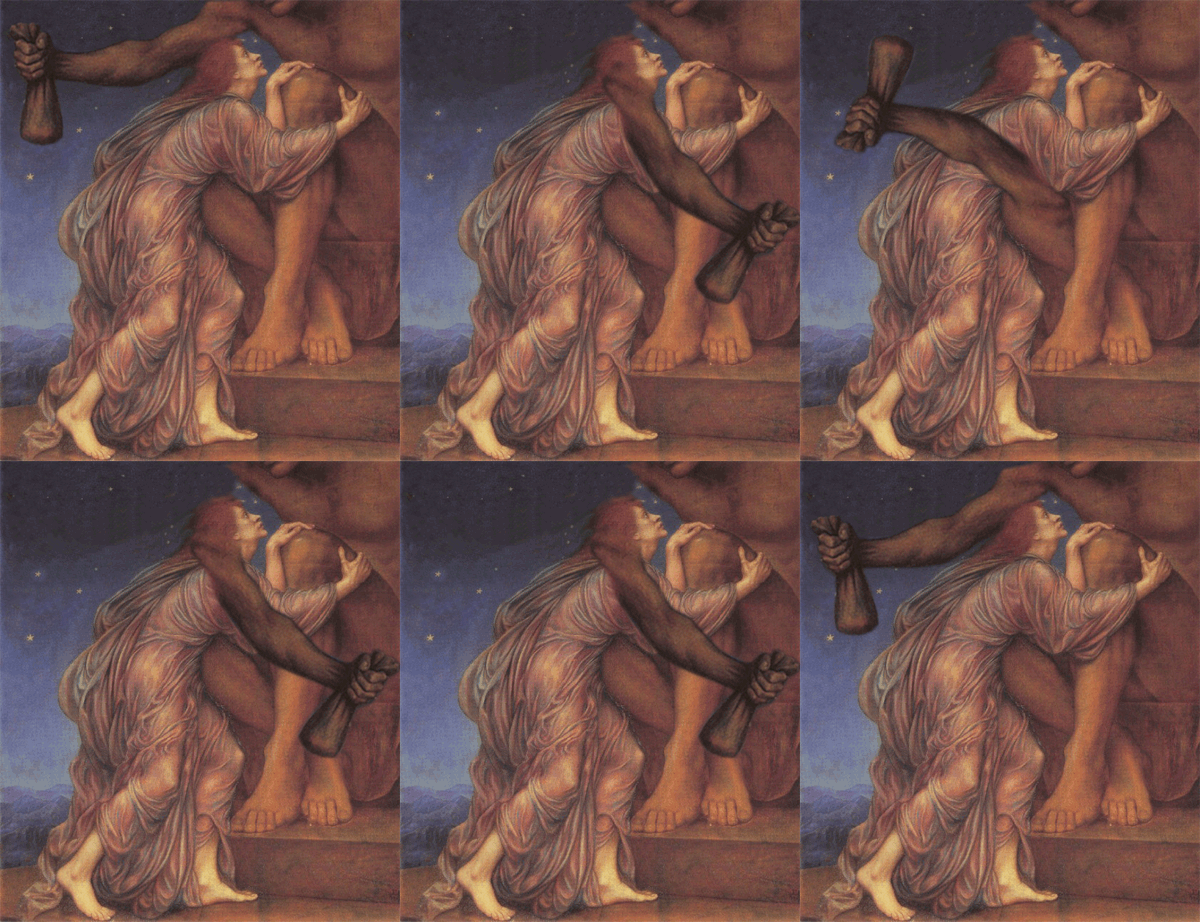
And perhaps for the 59th debate, the prop arm might pull out altogether, creating an image something like the animation Chip made for us yesterday, when we were trying to understand not Satan, but Mammon (one of the 7 princes of Hell), and a painting by Evelyn De Morgan called "The Worship of Mammon" had a strangely meaningful extended arm. The illuminating animation:
And the lesson we learn, at long last? The man who gives an extremely vigorous, super-macho handshake — what is it, really, that he is afraid of?
1. AIRPLANE! (1980) 2. ALL THE PRESIDENT'S MEN (1976) 3. THE BARGAIN (1914) 4. CRY OF JAZZ (1959) 5. ELECTRONIC LABYRINTH: THX 1138 4EB (1967) 6. THE EMPIRE STRIKES BACK (1980) 7. THE EXORCIST (1973) 8. THE FRONT PAGE (1931) 9. GREY GARDENS (1976) 10. I AM JOAQUIN (1969) 11. IT'S A GIFT (1934) 12. LET THERE BE LIGHT (1946) 13. LONESOME (1928) 14. MAKE WAY FOR TOMORROW (1937) 15. MALCOLM X (1992) 16. MCCABE AND MRS. MILLER (1971) 17. NEWARK ATHLETE (1891) 18. OUR LADY OF THE SPHERE (1969) 19. THE PINK PANTHER (1964) 20. PRESERVATION OF THE SIGN LANGUAGE (1913) 21. SATURDAY NIGHT FEVER (1977) 22. STUDY OF A RIVER (1996) 23. TARANTELLA (1940) 24. A TREE GROWS IN BROOKLYN (1945) 25. A TRIP DOWN MARKET STREET (1906)
List the ones you've seen in the order of their what you think is their cultural/historical/aesthetic significance. Here's mine:
1. It's a Gift 2. Grey Gardens 3. McCabe and Mrs. Miller 4. Saturday Night Fever 5. THX 1138 6. All the President's Men
The first 2 on my list have long been high on my personal list of favorite moves. The 3d one is also on my list of favorite movies, but not so high.
That line appears at 1:58 in this clip from the great Marx Brothers movie "Duck Soup":
It's a funny scene with all sorts of things in it, such as Harpo surreptitiously cutting off the man's pocket and using it as a bag for his peanuts. (Yeah, count the phallic symbols.) But that line — "Will you quit annoying me?" — has stuck with me for many years as a particular type of funniness. I was IM-ing my son John about it this morning.
Me:
do you remember the line "stop annoying me" --- finding that really funny? what movie and how would you explain why we thought it was so funny?
John:
"would you quit annoying me!!!"
Duck Soup [+ link to the above clip]
similar to W.C. Fields in It's a Gift saying, "I hate you"*
In a comedy you expect wit, wisecracks, innuendo .... So it's funny if someone blatantly says the obvious thing you've been watching for several minutes.
Me:
thanks!!!
it's the element of surprise, but the surprising thing is it's flatfootedness
it's surprisingly ordinary
John:
Also, it's funny for someone to openly say what they think of someone as if there are no social inhibitions
Reminds me of a scene in The Office (last episode of season 2) where Michael Scott is talking to everyone in the office about they're going to have a gambling night in the warehouse....
Michael Scott: Oh, and another fun thing. We, at the end of the night, are going to give the check to an actual group of Boy Scouts. Right, Toby? We're gonna...
Toby: Actually, I didn't think it was appropriate to invite children since it's, uh, you know, there's gambling and alcohol. And it's in our dangerous warehouse. And it's a school night. And, you know, Hooters is catering. Is that enou-is that enough? Should I keep going?
Michael Scott: Why are you the way that you are? Honestly, every time I try to do something fun or exciting, you make it not... that way. I hate... so much about the things that you choose to be.
Ha ha.
Speaking of analyzing exactly why something is funny, I put a lot of thought into the title of that blog post last night with the praying mantis. Originally, I had "Non Compos Mentis Campus Mantis," then, thinking it might be off-putting to start in Latin, I made it "Campus Mantis: Non Compos Mentis." Then, this morning, I was sorry I switched it. "Non Compos Mentis Campus Mantis" seemed much better — kind of like a 3 Stooges title. Looking at all the 3 Stooges titles, I'm not really sure why.
_________
* The key segment is at 4:40:
CORRECTION: "Praying" changed to "campus" 3 times.
But, actually, to be fair, that is worse than the hypothetical McCain scenario. British Prime Minister Gordon Brown was caught on tape insulting a particular individual — Gillian Duffy — calling her a "bigot" right after talking to her, and her reaction to hearing about it (and then listening to it) is caught on video.
More of Gillian Duffy's amazing real-time response here. (I like when she gets a cell phone call and the reporters can't believe she'd take a phone call while she's on live TV.) Brown has now given Duffy an in-personal apology, but as you can see in that video she says she doesn't want that. She wants to know why her comments were counted as bigotry.
IN THE COMMENTS: Class factotum said:
Josephine the Plumber has been born.
Hey! Wait a minute! Josephine the Plumber? Jane Withers!
When my mother saw those Comet ads, she's always exclaim about how mean Jane Withers was to Shirley Temple. She was the child actress who was most emphatically not Shirley Temple:
And the actor in the wheelchair is Charles Sellon — or as I insist on calling him, Mr. Muckle. Now, open the door for Mr. Muckle:
That's the headline to the NY Post article that begins "Gov. Paterson didn't see the humor in a 'Saturday Night Live' bit that mocked his blindness." Yeah, he shouldn't criticize it if he didn't see it.
Video of the 2 Paterson sketches at the link. Chris Danielsen, spokesman for the National Federation of the Blind, is quoted saying:
"We have 70 percent unemployment - and it's not because we can't work. Obviously, the governor of New York is blind, and he's doing the job. Whenever you have a portrayal that calls the basic capacity of [blind people] into question, that's a potential problem."
Danielsen claims "SNL" has a long history of mocking the blind - going back to Eddie Murphy's Stevie Wonder impression and, more recently, a "Weekend Update" one-liner that hybrid cars are dangerous to blind people because they can't hear the engine.
Now, wait, there really were news stories, plenty of them, that reported that hybrid cars were dangerous to blind people. Like this one. Notice anything? It quotes Christopher S. Danielsen, a spokesman for the National Federation of the Blind. It looks as though "SNL" may have read his organization's press release... and it got a laugh.
Maybe Danielsen needs to get a sense of humor...
... like Stevie Wonder, seen here standing right next to Eddie Murphy as Eddie imitates him.
To make "The Pink and Blue Project" images, I visit the child's room, where I display and rearrange his/her colored accessories. I ask my models to pose for me with their pink or blue objects, in an effort to show the viewer the extent to which children and their parents, knowingly or unknowingly, are influenced by advertising and popular culture. I first lay out the larger items, blankets or coats, and then spread smaller articles on top of the clothes. This method references objects that are displayed in a museum collection. In some pictures, the children even look like dolls.
Via Andrew Sullivan, who calls the kids "children who would only wear and buy gender specific clothes and toys." Do the kids deserve that? I see a pink shovel and a blue vacuum cleaner. To have a favorite color -- the color the culture assigns to your sex -- is not necessarily to want only sex-typed toys and clothes. Are these children stereotypes or are we adults stereotypers?
Consider the possibility that children have powerful aesthetic principles, that they love color as color, and that they perceive order in monochrome.
[F]or centuries, all European children were dressed in blue because the color was associated with the Virgin Mary. The use of pink and blue emerged at the turn of the century, the rule being pink for boys, blue for girls. Since pink was a stronger color it was best suited for boys; blue was more delicate and dainty and best for girls. And in 1921, the Women's Institute for Domestic Science in Pennsylvania endorsed pink for boys, blue for girls.
There's a W.C. Fields movie -- maybe "The Bank Dick" -- where a woman annoys him -- women annoy him in every movie -- by fretting over whether pink is for boys and blue for girls or the other way around. That would have been around 1940.
Surely, there are children who latch onto colors other than blue or pink. I remember my mother deciding that orange was the right color for me, and I believed that for a while.
"... inside the life of the sky and inside the soul of heaven. May he stimulate and illuminate our minds. Lead us from the unreal to real, from darkness to light, and from death to immortality. May we be protected together. May we be nourished together. May we work together with great vigor. May our study be enlightening."
Beautiful Hindu prayer, spoken as the invocation in the Senate yesterday. The Hindu priest was Rajan Zed of Reno, Nevada. Unfortunately, the reason I'm reading about this -- in the Times of India (via Memeorandum) -- is because some idiots -- from the anti-abortion group Operation Save America -- interrupted him:
"Lord Jesus, forgive us father for allowing a prayer of the wicked, which is an abomination in your sight," the first protester shouted. "This is an abomination. We shall have no other gods before You."
Democratic Senator Bob Casey, who was serving as the presiding officer for the morning, immediately asked the sergeant-at-arms to restore order. But they continued to protest as they were headed out the door by the marshals, shouting, "No Lord but Jesus Christ!" and "There's only one true God!"
What a shame to insult the priest that way!
There are invocations in the Senate, and the way to handle that properly is to give representatives of different groups the chance to offer a prayer. Look how well the priest did at choosing a prayer that would enhance mutual respect among religious groups and between the religious and the irreligious.
Zed showed the best side of religion -- a prayer of manifest literary value that invokes the presence of the diety and pulls the human beings who hear it to a higher plane.
Why doesn't the invocation violate the Establishment Clause? Here is the Supreme Court case on the subject, Marsh v. Chambers:
The opening of sessions of legislative and other deliberative public bodies with prayer is deeply embedded in the history and tradition of this country. From colonial times through the founding of the Republic and ever since, the practice of legislative prayer has coexisted with the principles of disestablishment and religious freedom....
Although prayers were not offered during the Constitutional Convention, [n6] the First Congress, as one of its early items of business, adopted the policy of selecting a chaplain to open each session with prayer....
On September 25, 1789, three days after Congress authorized the appointment of paid chaplains, final agreement was reached on the language of the Bill of Rights, S.Jour., supra, at 88; H.R.Jour., supra, at 121. Clearly the men who wrote the First Amendment Religion Clauses did not view paid legislative chaplains and opening prayers as a violation of that Amendment, for the practice of opening sessions with prayer has continued without interruption ever since that early session of Congress. ...
...John Jay and John Rutledge opposed the motion to begin the first session of the Continental Congress with prayer.... [But that only demonstrates] that the subject was considered carefully and the action not taken thoughtlessly, by force of long tradition and without regard to the problems posed by a pluralistic society. Jay and Rutledge specifically grounded their objection on the fact that the delegates to the Congress "were so divided in religious sentiments . . . that [they] could not join in the same act of worship." Their objection was met by Samuel Adams, who stated that
he was no bigot, and could hear a prayer from a gentleman of piety and virtue, who was at the same time a friend to his country.
C. Adams, Familiar Letters of John Adams and his Wife, Abigail Adams, during the Revolution 37-38, reprinted in Stokes, at 449.
This interchange emphasizes that the delegates did not consider opening prayers as a proselytizing activity or as symbolically placing the government's "official seal of approval on one religious view." Rather, the Founding Fathers looked at invocations as "conduct whose . . . effect . . . harmonize[d] with the tenets of some or all religions." McGowan v. Maryland, 366 U.S. 420, 442 (1961). The Establishment Clause does not always bar a state from regulating conduct simply because it "harmonizes with religious canons." Id. at 462 (Frankfurter, J., concurring)....
In light of the unambiguous and unbroken history of more than 200 years, there can be no doubt that the practice of opening legislative sessions with prayer has become part of the fabric of our society. To invoke Divine guidance on a public body entrusted with making the laws is not, in these circumstances, an "establishment" of religion or a step toward establishment; it is simply a tolerable acknowledgment of beliefs widely held among the people of this country. As Justice Douglas observed, "[w]e are a religious people whose institutions presuppose a Supreme Being." Zorach v. Clauson, 343 U.S. 306, 313 (1952).
The Operation Save America protesters were thus not only rude and intolerant, they were demonstrating an attitude toward the invocations that, if it were accepted, would render the practice unconstititional. Government cannot elevate one religion over another. One of the primary values of the Establishment Clause is preventing divisiveness. These benighted characters would like to foment religious strife.
Operation Save America issued a statement saying the Senate chamber "was violated by a false Hindu god":
"The Senate was opened with a Hindu prayer placing the false god of Hinduism on a level playing field with the One True God, Jesus Christ," the statement said, adding, "This would never have been allowed by our Founding Fathers."
That is precisely at odds with constitutional law (and good moral sense).
The Hindu prayer was also questioned by a Christian historian who maintained that since Hindus worship multiple gods, the prayer will be completely outside the American paradigm, flying in the face of the American motto "One Nation Under God."...
"In Hindu (sic), you have not one God, but many, many, many, many, many gods," the Christian historian David Barton maintained. "And certainly that was never in the minds of those who did the Constitution, did the Declaration [of Independence] when they talked about Creator -- that's not one that fits here because we don't know which creator we're talking about within the Hindu religion."
More exactly-backwards constitutional law. The motto isn't in the Constitution, and if you want to interpret it to authorize discriminating against groups that are not monotheistic, you are asking for the motto to be declared unconstitutional, not providing the basis for discrimination you (foolishly) want.
I hope when people read this news story, in this country and around the world, especially in India, that they focus not on the three protesters, but on our traditional benign approach to religion. Sometimes we exclude religion from government activities -- and we argue about how far we must go with that exclusion -- but when we include it, we don't favor one sect over another and we certainly don't identify one religion as true and another as false.
We do declare true and false constitutional doctrine, however, and these fundamentalist Christians have a false interpretation of the Constitution... and a very bad idea of how to make the world a better place.
I don't think much of their idea of Christianity either. Since when do Christians go around yelling "No Lord but Jesus Christ!"?
And here's an interesting post from Reader_Iam (who frequently comments on this blog):
Perhaps these protestors fancied themselves as Jesus in the temple, scattering the money-changers desecrating a holy space. But the Senate chamber is not a temple....
Read the whole thing.
Thursday, April 22, 2004
"Reticulated"? That's reticulatus! Justice Scalia conspicuously used the word "reticulated" in the oral argument yesterday. Let's examine this. Now, we know Scalia cares a lot about text in legal interpretations, and he seems generally to have an interest in language and etymology. So when he comes out with an unusual word like that, we should do more than laugh and think "That's ridiculous" or nod and think "He's really smart."
He asked, as I noted yesterday, whether the Supreme Court ought to be in the business of "draw[ing] up this reticulated system to preserve our military from intervention by the courts."
To the Dictionary. And if you've read his opinions, you know he likes to cite dictionaries. Let's look up "reticulate" in the American Heritage Dictionary:
ADJECTIVE:Resembling or forming a net or network: reticulate veins of a leaf.
TRANSITIVE VERB: 1. To make a net or network of. 2. To mark with lines resembling a network.
INTRANSITIVE VERB: To form a net or network.
ETYMOLOGY: Latin reticulatus, from reticulum, diminutive of rete, net.
OTHER FORMS:
re·ticu·late·ly —ADVERB re·ticu·lation —NOUN
First, a tiny point. "Reticulate" is already an adjective, so he could have simply said "this reticulate system." But a good number of listeners would have heard that as "this ridiculous system"--it would even have gone into transcripts and print articles in that form.
But here's the real question: why use a big word that a lot of people don't know? I can think of a number of reasons: to try to appear learned, to exclude the uneducated, to be funny, to achieve an aesthetic effect, and to attain precision that can't be attained with more common words. The first two reasons are almost never justified.
How about the comedic use? Polysyllabic humor has it's place--picture W.C. Fields calling a nose a proboscis--and it actually was pretty funny. Would it be inappropriate for Justice Scalia to have been funny in the middle of an argument about the Guantanamo detainees? Justice is serious business. I think mild humor was justified in this context, which was to emphasize the ineptitude of judges in this area. The word might have been used to draw a cartoon in our heads of a judge with an overinflated opinion of his own powers, drawing all the wrong lines in an area of great importance.
How about the aesthetic use for choosing an unusual word? One might pick a different word for rhythm or alliteration. (For example, if you wanted to refer to some people who were nattering, you might want to call them nabobs.) But quite aside from the poetics of the sound of a word, there may be aesthetic appeal to saying something in an unusual way. If nothing else, it may be striking and memorable. The statement Scalia made that contained the word "reticulated" stuck a memory marker in your head. I actually don't think I will ever forget it!
The best reason for using an unusual word is that it has a precise meaning that is what you really want to say, and no simpler words do what is needed. (The weird word won't work, however, if listeners don't understand it.) Here, we need to ask, does "reticulated" mean what Scalia wanted to say, and was there really no other word that means that? I think he meant to say something like "detailed, delicate, and nuanced." But "reticulated" means having lines on it in the pattern of a net. Most people who know the word "reticulated," I would hazard to guess, know it because they've heard of the reticulated giraffe. So is the legal framework the judges would have to draw up similar to the a pattern of lines on a giraffe? I'd say the pattern of lines on a giraffe is rather regular and easy to map out once you get started. The etymological root of "reticulated" is the Latin word for "net." A net pattern can be graphed, so a judge tasked with drawing a legal framework in a "reticulated" form really could rely on abstract reasoning neatly within the judicial capacity. Therefore, "reticulated" is surely not an odd word justified by its unique, precise meaning. It isn't even the right word at all.



 :.
:.
