After Michelle Obama got criticized for horning in on the Oscars, her communications director issues that as a response.
I loathe that kind of PR — so saccharine and insincere. Look at all the assertions crammed into that sentence. 1. MO is a movie lover. 2. MO was honored. 3. MO was honored as a movie lover. 4. MO presented the award in order to celebrate the artists. 5. Hollywood movie people are artists. 6. Artists do art for the purpose of inspiring everybody. 7. Hollywood movies are made for the purpose of inspiring people. 8. Hollywood movies actually succeeding in inspiring all of us. 9. Young people are especially inspired by movies.
It's such an inane load of nonsense that it seems low and peevish of me to point out so many distinct elements. It was only ever intended to waft over you as a vague fog of a feeling that something appropriately lofty and bland has been said. That's the only relevant meaning.
Oh, wait. Look at this. Something else is being said. We have here a professor of women’s history from Ohio University who has delved into the study of First Ladies. This comes not from the PR department but from academia. Professor Katherine Jellison says: "I get the feeling that she is for the first time maybe really relaxing and enjoying her celebrityhood."
For the first time in my adult lifetime, I’m really proud of my celebrityhood...
Showing posts with label movies. Show all posts
Showing posts with label movies. Show all posts
Tuesday, February 26, 2013

Monday, February 25, 2013
"Miss Wallis, you are young and talented and deserve better. All of us at The Onion are deeply sorry."
The Onion actually apologizes.
There actually is a line that even humor can't cross, and this is evidence of where that line is:

We get how this is a joke, but it's aimed at a particular child. Quvenzhané Wallis is the 9-year-old who had a Best Actress nomination for "Beasts of the Southern Wild." Wallis will also star in the new film version of "Annie," taking the part that Willow Smith declined on the ground that she preferring just being a kid.
Speaking of sex jokes aimed at young girls — and speaking of girls named Willow — this reminds me of the way David Letterman had to apologize for making a joke about Willow Palin. (To his credit, Letterman was under the impression that he was making a joke about Bristol Palin who was 18 at the time.)
There actually is a line that even humor can't cross, and this is evidence of where that line is:
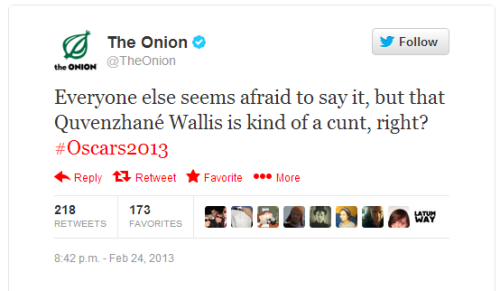
We get how this is a joke, but it's aimed at a particular child. Quvenzhané Wallis is the 9-year-old who had a Best Actress nomination for "Beasts of the Southern Wild." Wallis will also star in the new film version of "Annie," taking the part that Willow Smith declined on the ground that she preferring just being a kid.
Speaking of sex jokes aimed at young girls — and speaking of girls named Willow — this reminds me of the way David Letterman had to apologize for making a joke about Willow Palin. (To his credit, Letterman was under the impression that he was making a joke about Bristol Palin who was 18 at the time.)
"Were the Oscars always this sexist, or are we spoiled by Tina Fey and Amy Poehler's Golden Globes?"
"Host Seth MacFarlane has been leaning on sexist punchlines all night, and people are noticing. Here are the transcripts, so you can calibrate your outrage and/or eye rolls accordingly...."
That's Maureen O'Connor at The Atlantic. Maybe she's just looking for traffic or a neat framework for presenting some of the jokes from last night's big show, but how can you judge how sexist the jokes are when only the jokes about women are taken out of context? What was said about men?
I know there was a big song-and-dance number naming lots of actresses and the movies where they bared their breasts, but what was said about male nakedness? All of those women chose to display their boobs — to use the word in the song lyrics (which you can read at the link above (video here)) — and they got whatever admiration or career advancement they got. Having taken the advantages offered — perhaps including ousting some other actress with more modesty or less impressive attributes — they're not immune from jokes at their expense.
We make fun of men all the time. It would be sexist to have a rule that you can only make fun of men. So, were there jokes about male genitalia? But male actors don't normally go waggling their willies around in big Hollywood pictures, so it's hard to say what the parallelism would be for "I Saw Your Boobs." (It looks funny to write "male actors," but "actors" is used these days for both sexes. Maybe we could use "mactors" or — I know, it's taken — "malefactors.")
Now, it might have been impolite or in bad taste to call out the names of actresses who were there, proudly seated at this ritual of self-celebration, and to sing out "I saw your boobs" at particular individuals, right when they wanted everyone to think they were such goddesses, in their lovely ball gowns, which were quite possibly designed to make a special show of the very boobage that the song was about.
But that's not the topic of sexism. That's the topic of whether you want the Oscars host to display respect and reverence to the assembled dignitaries or would you rather have some broad comedy that might appeal to the big TV audience? It's a question of taste and a desire to maximize the size of the audience, which was the same question that led to the baring of the boobs in the first place.
ADDED: I don't really think Maureen O'Connor cares about sexism one way or the other. If she really thought McFarlane's jokes deserved condemnation, she wouldn't have written "are we spoiled by Tina Fey and Amy Poehler's Golden Globes?" — which is also a joke about boobs. I'd condemn that joke for being so stale.
Who was the first person to equate "Golden Globes" and actresses' breasts? The Golden Globes were first presented in January 1944, so I'm betting the joke goes back to 1943. We needed some sexy laughs back in 1943. I'll bet just about anything you might say about breasts was either sexy or funny or both back in 1943. But today? It's hard to say something new. Maureen O'Connor doesn't seem to know how to say something new. McFarlane did. Gasping about how that might have been sexist is really incredibly dull. One thing that actually makes some people sexist is the unwillingness of (some!) women to laugh at themselves. Come on. Laugh at women. Laugh at men. We all deserve it.
That's Maureen O'Connor at The Atlantic. Maybe she's just looking for traffic or a neat framework for presenting some of the jokes from last night's big show, but how can you judge how sexist the jokes are when only the jokes about women are taken out of context? What was said about men?
I know there was a big song-and-dance number naming lots of actresses and the movies where they bared their breasts, but what was said about male nakedness? All of those women chose to display their boobs — to use the word in the song lyrics (which you can read at the link above (video here)) — and they got whatever admiration or career advancement they got. Having taken the advantages offered — perhaps including ousting some other actress with more modesty or less impressive attributes — they're not immune from jokes at their expense.
We make fun of men all the time. It would be sexist to have a rule that you can only make fun of men. So, were there jokes about male genitalia? But male actors don't normally go waggling their willies around in big Hollywood pictures, so it's hard to say what the parallelism would be for "I Saw Your Boobs." (It looks funny to write "male actors," but "actors" is used these days for both sexes. Maybe we could use "mactors" or — I know, it's taken — "malefactors.")
Now, it might have been impolite or in bad taste to call out the names of actresses who were there, proudly seated at this ritual of self-celebration, and to sing out "I saw your boobs" at particular individuals, right when they wanted everyone to think they were such goddesses, in their lovely ball gowns, which were quite possibly designed to make a special show of the very boobage that the song was about.
But that's not the topic of sexism. That's the topic of whether you want the Oscars host to display respect and reverence to the assembled dignitaries or would you rather have some broad comedy that might appeal to the big TV audience? It's a question of taste and a desire to maximize the size of the audience, which was the same question that led to the baring of the boobs in the first place.
ADDED: I don't really think Maureen O'Connor cares about sexism one way or the other. If she really thought McFarlane's jokes deserved condemnation, she wouldn't have written "are we spoiled by Tina Fey and Amy Poehler's Golden Globes?" — which is also a joke about boobs. I'd condemn that joke for being so stale.
Who was the first person to equate "Golden Globes" and actresses' breasts? The Golden Globes were first presented in January 1944, so I'm betting the joke goes back to 1943. We needed some sexy laughs back in 1943. I'll bet just about anything you might say about breasts was either sexy or funny or both back in 1943. But today? It's hard to say something new. Maureen O'Connor doesn't seem to know how to say something new. McFarlane did. Gasping about how that might have been sexist is really incredibly dull. One thing that actually makes some people sexist is the unwillingness of (some!) women to laugh at themselves. Come on. Laugh at women. Laugh at men. We all deserve it.
Sunday, February 24, 2013
"Live-Snarking The Oscars."
Nikki Finke.
(Me, I'm not watching. I just completely do not care. I used to care, but I don't anymore. I value my time in a way that doesn't leave a place for going to the movies, let alone watching the awards show. I really don't care who wins anything at all.)
(Me, I'm not watching. I just completely do not care. I used to care, but I don't anymore. I value my time in a way that doesn't leave a place for going to the movies, let alone watching the awards show. I really don't care who wins anything at all.)
"The best in business is on 'Argo' right now. She’s like Rahm Emanuel."
A non-random sentence from an article with the first sentence: "Political movies are expected to rake in the trophies at Sunday night’s Academy Awards ceremony."
So... "political movies" is supposed to refer to movies with political subject matter, but they win awards because people wage a political campaign for the award.
Too much politics! Remember when it seemed like movies were counterculture or art or something like that?
The "she" in the quote in this post's title is Sasha Stone, who's quoted predicting the award winners this year won't appropriate the occasion and make political remarks: "You don’t want to turn off half of America by making jokes about Republicans."
So... "political movies" is supposed to refer to movies with political subject matter, but they win awards because people wage a political campaign for the award.
Too much politics! Remember when it seemed like movies were counterculture or art or something like that?
The "she" in the quote in this post's title is Sasha Stone, who's quoted predicting the award winners this year won't appropriate the occasion and make political remarks: "You don’t want to turn off half of America by making jokes about Republicans."
Saturday, February 23, 2013
Now that we're talking about the 1927 silent film "King of Kings," we must take note of Ayn Rand.
We were talking about "King of Kings," because we were talking about what Jesus wrote in the sand, because various blogs were talking about an Islamist Facebook page with a cartoon showing how to carry out a stoning. I started to wonder whether the first commenter who mentioned "King of Kings" was talking about the 1927 Cecil B. DeMille picture or the 1961 Nicholas Ray flick. So I'm over here on the King of Kings (1927 film) page at Wikipedia, and I see:
I also found this 2009 New Yorker article about Ayn Rand that covers the "King of Kings" phase:
Sally Rand, before becoming notorious for her "fan dance" at the 1933 World's Fair, was an extra in the film.I couldn't find a YouTube clip of Ayn Rand in "King of Kings," but I did find Sally Rand and her notorious World's Fair fan dance:
Ayn Rand (no relation to Sally Rand) also was an extra in the film, and met her future husband Frank O'Connor on set.
I also found this 2009 New Yorker article about Ayn Rand that covers the "King of Kings" phase:
Rand... left the U.S.S.R. for America.... Her vision of the U.S. had already been shaped by obsessive moviegoing.... Even before leaving the Soviet Union, she had published a pamphlet on the silent-film actress Pola Negri, and like a movie star herself she now refashioned “Rosenbaum” into her own new name. Heller and Burns both knock down the myth that a Remington-Rand typewriter inspired the rechristening.How do you feel about all those connections? The Soviet Union, the love of movies, immigration to the land of movies, name-changing, finding the love of your life on a movie set in Hollywood, strippers performing what is only the illusion of nakedness, and... Jesus.
There is a greater factual basis to the legend of Rand’s having met Cecil B. DeMille before she worked as an extra on his production of “The King of Kings” (1927). On the set, Rand persuaded a costume director to promote her from a crowd of beggars to a crowd of patricians, and DeMille had his story chief look at her film scenarios, which were soon judged over the top. Rand achieved steadier success working in the R.K.O. wardrobe department, and then had a writerly breakthrough with a courtroom murder drama called “Night of January 16th.” Thanks to a gimmick that allowed each night’s audience to serve as the jury and thereby choose the ending, the play made it to Broadway, where Rand railed against the producers’ subordination of its incidental messages about the beauty of unbridled individualism.
Settling in New York with her husband, Frank O’Connor (another “King of Kings” extra), Rand set seriously to work on the first of her two major novels, “The Fountainhead.”....
"In the military they have $5.2 million they spent on goldfish — studying goldfish to see how democratic they were..."
"... and if we could learn about democracy from goldfish. I would give the president the authority to go ahead and cut all $5 million in goldfish studies."
Said Rand Paul, and Princeton professor Iain Couzin protests.
It's not goldfish, it's golden shiner fish. And: "Our work aims to understand the principles of collective control in animal groups and what this can inform us about collective robotics. It has nothing at all to do with human politics."
Or... oh, wait!... was that already a movie with Don Knotts? "The Incredible Mr. Limpet"! Knotts is a little man who tries to enlist in the Navy in 1941. Rejected, he wanders down a pier, falls into the water, and turns into a fish. As a fish, he's able to join the Navy, and he helps locate and torpedo Nazi submarines. How do you like that, you doubter of science, Senator Paul?
Ah, but Mr. Limpet was a heroic individual superfish, and Professor Couzin is interested in fish because of the way they act in the collective. Typical left-wing elite university ideology. The value of studying fish is that they've evolved past individualism. They give us a way to look at how the collective of a whole can solve problems in ways individuals cannot. But this has nothing at all to do with human politics. This is about collective robotics. Nothing to worry about here. The collective. Robots. Nothing to do with humans.
___________________________
*Yes, I know. It's not goldfish, it's golden shiner fish. That makes me think of a movie too.
Said Rand Paul, and Princeton professor Iain Couzin protests.
It's not goldfish, it's golden shiner fish. And: "Our work aims to understand the principles of collective control in animal groups and what this can inform us about collective robotics. It has nothing at all to do with human politics."
"If you think about it, schools of fish have been on the planet for much longer than we have and they’ve evolved to find solutions to problems. They can sense the environments in ways that we simply didn’t know how to do that.... From ant colonies to schooling fish, it’s not that complicated but the feats they can achieve are extraordinary. The collective of a whole can solve problems in ways individuals cannot."I'm glad he mentioned the ants, because if there is one tag that I love to get the opportunity to use on a blog post, it's "insect politics." The tag is based on the 1986 movie "The Fly," in which a scientific experiment — which I doubt Rand Paul would vote to fund — merged a scientist with a fly. Toward the bitter end, the fly/scientist — played by Jeff Goldblum — started raving about insect politics:
Have you ever heard of insect politics? Neither have I. Insects... don't have politics. They're very... brutal. No compassion, no compromise. We can't trust the insect. I'd like to become the first... insect politician. Y'see, I'd like to, but... I'm afraid, uh...But now, apparently, the human politicians are funding not just insect politics but fish politics (and robots!). I'd love to see a movie called "The Fish," in which Jeff Goldblum does a science experiment that turns him into a crazy, raving Goldblum/Goldfish* and rants about fish politics.
Or... oh, wait!... was that already a movie with Don Knotts? "The Incredible Mr. Limpet"! Knotts is a little man who tries to enlist in the Navy in 1941. Rejected, he wanders down a pier, falls into the water, and turns into a fish. As a fish, he's able to join the Navy, and he helps locate and torpedo Nazi submarines. How do you like that, you doubter of science, Senator Paul?
Ah, but Mr. Limpet was a heroic individual superfish, and Professor Couzin is interested in fish because of the way they act in the collective. Typical left-wing elite university ideology. The value of studying fish is that they've evolved past individualism. They give us a way to look at how the collective of a whole can solve problems in ways individuals cannot. But this has nothing at all to do with human politics. This is about collective robotics. Nothing to worry about here. The collective. Robots. Nothing to do with humans.
___________________________
*Yes, I know. It's not goldfish, it's golden shiner fish. That makes me think of a movie too.
Speaking of being called to a higher law and speaking of speaking....
In the previous post, we're talking about what Jesus wrote in the sand and what he said out loud, in the New Testament story where the scribes and Pharisees present Jesus with the question of what to do with a woman who was caught in the act of adultery. In the Gospel text, we're told Jesus that wrote on the ground, but not what he wrote, and we're told that he subsequently spoke and said "Let him who is without sin among you be the first to throw a stone at her."
I'm putting up a separate post because I found the scene that sydney said he loved in the movie "The King of Kings." Made in 1927, it's a silent movie, so no one is saying anything out loud. We see what Jesus says written out on the intertitles, and we also see what he writes in the sand.
Beautiful filmmaking, particularly as the sand-words, not written in Roman letters, transform into our English words, naming the sins that the men in the crowd realize they've committed, and that's why they all turn and walk away.
That's not an accurate depiction of what happens in the biblical text though. The movie shows a mob on the verge of stoning the woman and Jesus intervenes and announces his rule about casting the first stone. Only thereafter, does he write the names of the sins in the sand. But in the Bible story, there is no angry mob with stones in hand. There are scribes and Pharisees demanding that Jesus deliver a legal opinion. Jesus bends down and writes on the ground instead of answering the question. Only after they persist does he stand up and pronounce his new rule, which causes the scribes and Pharisees to walk away — "beginning with the older ones." The movie would have you see the members of the mob acknowledging their sins and their consequent lack of qualification to cast the first stone. But the text has intellectuals trying to box Jesus in on a question of law, and Jesus getting the better of a conversation he didn't want to have in the first place.
It's not surprising that a movie plays up the visible drama, and it's also not surprising that when I — a law professor — read the text, I see something akin to a law school class. The professors try to stump the student and the student transcends their tricky game. To me, the part where Jesus bends over and writes in the sand is like what happens in a law school class when the lawprof poses a difficult hypothetical and the students bend their heads down and go through motions of writing. They don't want to answer. It's not that they're writing something magically revelatory and startling. But if the lawprof keeps pushing and calls on someone, an answer will be spoken out loud.
I guess the law-professorly interpretation of the text isn't terribly cinematic. It's no wonder the movies present an angry mob with stones in hand and Jesus miraculously knowing and changing the hearts of the sinners. (And the adulteress is an actress evincing exactly the form of sexiness that was fashionable in the year the movie was made. I love the eyeliner!)
But to me the lawprof interpretation is thrilling and dramatic. The professors think they've got the upper hand. They know the legal text and it's tough. And then the brilliant student who will soon be the greatest professor of all gets on top of the dialogue and says something they must accept as correct: If you're going to have strict rules and severe mechanisms of enforcement, you must apply them equally to everyone. This is the structural safeguard of equal protection of the laws that is the necessary component of a democratic system. If there can't be exceptions and special treatment for preferred people, legislatures will resist imposing harsh rules and painful punishments.
In this context, let me give you my favorite Justice Scalia quote, which happens to include one of the key words of Christianity: "Our salvation is the Equal Protection Clause, which requires the democratic majority to accept for themselves and their loved ones what they impose on you and me."
I'm putting up a separate post because I found the scene that sydney said he loved in the movie "The King of Kings." Made in 1927, it's a silent movie, so no one is saying anything out loud. We see what Jesus says written out on the intertitles, and we also see what he writes in the sand.
Beautiful filmmaking, particularly as the sand-words, not written in Roman letters, transform into our English words, naming the sins that the men in the crowd realize they've committed, and that's why they all turn and walk away.
That's not an accurate depiction of what happens in the biblical text though. The movie shows a mob on the verge of stoning the woman and Jesus intervenes and announces his rule about casting the first stone. Only thereafter, does he write the names of the sins in the sand. But in the Bible story, there is no angry mob with stones in hand. There are scribes and Pharisees demanding that Jesus deliver a legal opinion. Jesus bends down and writes on the ground instead of answering the question. Only after they persist does he stand up and pronounce his new rule, which causes the scribes and Pharisees to walk away — "beginning with the older ones." The movie would have you see the members of the mob acknowledging their sins and their consequent lack of qualification to cast the first stone. But the text has intellectuals trying to box Jesus in on a question of law, and Jesus getting the better of a conversation he didn't want to have in the first place.
It's not surprising that a movie plays up the visible drama, and it's also not surprising that when I — a law professor — read the text, I see something akin to a law school class. The professors try to stump the student and the student transcends their tricky game. To me, the part where Jesus bends over and writes in the sand is like what happens in a law school class when the lawprof poses a difficult hypothetical and the students bend their heads down and go through motions of writing. They don't want to answer. It's not that they're writing something magically revelatory and startling. But if the lawprof keeps pushing and calls on someone, an answer will be spoken out loud.
I guess the law-professorly interpretation of the text isn't terribly cinematic. It's no wonder the movies present an angry mob with stones in hand and Jesus miraculously knowing and changing the hearts of the sinners. (And the adulteress is an actress evincing exactly the form of sexiness that was fashionable in the year the movie was made. I love the eyeliner!)
But to me the lawprof interpretation is thrilling and dramatic. The professors think they've got the upper hand. They know the legal text and it's tough. And then the brilliant student who will soon be the greatest professor of all gets on top of the dialogue and says something they must accept as correct: If you're going to have strict rules and severe mechanisms of enforcement, you must apply them equally to everyone. This is the structural safeguard of equal protection of the laws that is the necessary component of a democratic system. If there can't be exceptions and special treatment for preferred people, legislatures will resist imposing harsh rules and painful punishments.
In this context, let me give you my favorite Justice Scalia quote, which happens to include one of the key words of Christianity: "Our salvation is the Equal Protection Clause, which requires the democratic majority to accept for themselves and their loved ones what they impose on you and me."
Friday, February 22, 2013
"Vito."
A documentary about Vito Russo, which you can pre-order or watch — as I just did — on HBO (on Demand). Very nicely done, though much of it is about Russo's wonderful movie "Celluloid Closet," which has been around for more than a decade.
Sunday, February 17, 2013
Tony Kushner thinks it's fine for a movie to "manipulate a small detail in the service of a greater historical truth."
"History doesn’t always organize itself according to the rules of drama. It’s ridiculous. It’s like saying that Lincoln didn’t have green socks, he had blue socks."
The green/blue sock equivalent ridiculousness in Kushner's screenplay was having Connecticut vote against the abolition of slavery when in fact it voted for.
The green/blue sock equivalent ridiculousness in Kushner's screenplay was having Connecticut vote against the abolition of slavery when in fact it voted for.
Saturday, February 9, 2013
"Willow was supposed to be doing 'Annie,' we got Jay-Z to do the movie, got the studio to come in..."
"... and Willow had such a difficult time on tour with 'Whip my Hair' and she said, 'You know Daddy, I don't think so... I said, 'Baby, hold up!' I said, 'No, no, no, listen; you'll be in New York with all of your friends and Beyoncé will be there. You will be singing and dancing,' and she looked at me and said, 'Daddy, I have a better idea, how about I just be 12.'"
Wednesday, February 6, 2013
"[U]ntil recently DFW was in that place in the dusty warehouses of my attention economy occupied by the things people have been a little too insistent I should check out..."
"... a place also occupied by Hemingway, Khalil Gibran, 'E.T.,' 'The Rocky Horror Picture Show,' and for reasons that would take a lot of tedious explaining, Cointreau."
DFW = David Foster Wallace.
What are you keeping in the dusty warehouses of your attention economy? And what, by your insistence are you causing other people to store in their warehouses?
DFW = David Foster Wallace.
What are you keeping in the dusty warehouses of your attention economy? And what, by your insistence are you causing other people to store in their warehouses?
Saturday, February 2, 2013
"In discussions of the film 'Groundhog Day' on this blog, I’ve noticed a couple of people questioning..."
"... why the Bill Murray character would find Andie McDowell’s Rita deserving of all those years of his devotion and energy. For example, '…[W]hat, exactly, made the lovely but, let’s face it, vapid Rita worthy of Phil’s centuries of effort?'"
Was it centuries? I haven't seen that movie since it came out. I didn't remember the extent of the time frame. I can't picture myself in the mood — ever — to rewatch that one, but I do have a special affinity for stories and, especially, humor that has to do with extravagant comparisons or variations in size. So, here, that would be what appears to be a day is reframed as a century. The single funniest thing I ever heard in my life was: I was cutting someone's hair and I noticed a bright red dot on his scalp. I said: "What's this red dot?" And he said: "That's my Santa Claus hat."
I wish I'd made a tag for this concept long ago, because it would have collected a lot of different things that are impossible to put together retrospectively. It's not like, for example, deciding after 9 years of blogging that I ought to have an Andie McDowell tag. I could easily do a search. Also, that tag could only have one possible name. This other tag... what would I call it? Size? That size thing I like? Size-osity? Big and small? I have a "light and shade" tag, so I think I'd do big and small. Too late now. But not a century too late. Only 9 years. Oh, what the hell. I'll start now.
That reminds me: Have you ever seen this? It's the best graphic representation of all time (and all space).
Was it centuries? I haven't seen that movie since it came out. I didn't remember the extent of the time frame. I can't picture myself in the mood — ever — to rewatch that one, but I do have a special affinity for stories and, especially, humor that has to do with extravagant comparisons or variations in size. So, here, that would be what appears to be a day is reframed as a century. The single funniest thing I ever heard in my life was: I was cutting someone's hair and I noticed a bright red dot on his scalp. I said: "What's this red dot?" And he said: "That's my Santa Claus hat."
I wish I'd made a tag for this concept long ago, because it would have collected a lot of different things that are impossible to put together retrospectively. It's not like, for example, deciding after 9 years of blogging that I ought to have an Andie McDowell tag. I could easily do a search. Also, that tag could only have one possible name. This other tag... what would I call it? Size? That size thing I like? Size-osity? Big and small? I have a "light and shade" tag, so I think I'd do big and small. Too late now. But not a century too late. Only 9 years. Oh, what the hell. I'll start now.
That reminds me: Have you ever seen this? It's the best graphic representation of all time (and all space).
"Perhaps we could design 'love drugs,' pharmaceutical cocktails that could boost affection between partners..."
"... whisking them back to the exquisite set of pleasures that colored their first years together. The ability to do this kind of fine-tuned emotional engineering is beyond the power of current science, but there is a growing field of research devoted to it. Some have even suggested developing 'anti-love drugs' that could dissolve abusive relationships, or reduce someone's attachment to a charismatic cult leader. Others just want a pill to ease the pain of a wrenching breakup."
What's to prevent your abusive-relationship person from committing further abuse by slipping the drug to his/her victim Oberon-style?
What's to prevent your abusive-relationship person from committing further abuse by slipping the drug to his/her victim Oberon-style?
What thou seest when thou dost wake,IN THE COMMENTS: furious_a said:
Do it for thy true-love take,
Love and languish for his sake:
Be it ounce, or cat, or bear,
Pard, or boar with bristled hair,
In thy eye that shall appear
When thou wakest, it is thy dear:
Wake when some vile thing is near.
Artificially aroused men pursuing artificially enhanced women under the influence of artificially induced emotions.Kevin said:
Who says "Romance is dead"?
I wonder if they watched Eternal Sunshine of the Spotless Mind and are going forward in spite of, or are going forward because of.
Friday, February 1, 2013
"Vote for Cuomo, not the homo."
A campaign slogan from 1978. Noted in the new documentary "Koch," which opens today, the day Ed Koch died.
[Filmmaker Neil] Barsky... doesn’t varnish Koch’s shift rightward in 1978 against mayoral opponents like Mario Cuomo. But he does make you sympathize with Koch’s 1978 beard-and-pony show, in which he held hands with Bess Myerson, the first Jewish Miss America, and broadly hinted at a marriage announcement after the election. Flyers reading “Vote for Cuomo, not the homo” had been plastered all over the place...
Barsky poses the right questions to Koch but doesn’t bother asking them a second, third, or fourth time. He knows there are places the man won’t — or can’t — go. Bess Myerson was Koch’s good friend, and there was never anything more! Whether he’s gay or not is no one’s damn business! It would have been easier to cave in to pressure from the African-American community — maybe he should have — but he stuck to his principles! Blah blah blah....
Thursday, January 24, 2013
Sunday, January 20, 2013
"Thriller, Beat it, and Bad all in one video!"
"When ever I get angry, this is what I feel like doing."
Apt comments at a YouTube video I turned up in the process of trying to write a bit more to this post that ends with "kinda like Mr. Gower, the drugstore man, in 'It's a Wonderful Life.'" I wanted to add: or Doc at the candy store in "West Side Story."
Apt comments at a YouTube video I turned up in the process of trying to write a bit more to this post that ends with "kinda like Mr. Gower, the drugstore man, in 'It's a Wonderful Life.'" I wanted to add: or Doc at the candy store in "West Side Story."
The Sandy Hook massacre should "force us to confront yet again the ways in which ever more of our lives are lived on a screen, in the cloud, via our computers and phones and tablets...."
Says Michael S. Rosenwald, noting that:

Except for using the bathroom and eating his meals, getting a haircut was just about the only thing Lanza couldn’t do online.Adam Lanza got haircuts, went to the bathroom, and ate food. Are we not forced to confront yet again our eating of food, getting of haircuts, and going to the bathroom?
[Lanza] seems to have found “an illusion of companionship without the demands of friendship”.... Lanza didn’t need to trek out into his town....Now, it's a problem that we don't spend enough time schlepping around at the mall? The cashiers at The Gap and Banana Republic were supposedly keeping us minimally socialized? Or is it that "tightknit Newtown" had shop owners who reinforced the social structure of the picture-book town — kinda like Mr. Gower, the drugstore man, in "It's a Wonderful Life"...
Shop owners in tightknit Newtown didn’t know him, I think, because he had no reason to know them. Amazon could deliver anything he wanted to his door by the next day.
The time we spend shopping is in decline.... The local stores we once loved visiting have been replaced by UPS drivers we rarely see....

Saturday, January 19, 2013
"I don’t think we should talk about Lincoln’s underwear..."
"It’s not appropriate for someone so iconic. Even in the bedroom, Lincoln is never shown in his pajamas. He’s in his shirt and pants."
Joanna Johnston, movie costume designer.
"But even the President of the United States/Sometimes must have to stand naked."
Bob Dylan.
"How many Bob Dylan songs have the word 'naked' and how many of them can you name?" I challenge Meade with a Bob Dylan test, as I tend to do when I've done a search at bobdylan.com (as I did for the "It's Alright Ma" quote, above).
Meade immediately says "even the President of the United States sometimes must have to stand naked," then none of the others — not even "You see somebody naked and you say who is that man?" — and makes 2 wrong guesses:

Beards. Fidel Castro made a beard as off limits to an American president — in spite of Lincoln — as Hitler made the mustache. And here I want to go back to that "Becoming Adolf" article by Rich Cohen that were were talking about a couple days ago:
Pick one:


Joanna Johnston, movie costume designer.
***
"But even the President of the United States/Sometimes must have to stand naked."
Bob Dylan.
***
"How many Bob Dylan songs have the word 'naked' and how many of them can you name?" I challenge Meade with a Bob Dylan test, as I tend to do when I've done a search at bobdylan.com (as I did for the "It's Alright Ma" quote, above).
Meade immediately says "even the President of the United States sometimes must have to stand naked," then none of the others — not even "You see somebody naked and you say who is that man?" — and makes 2 wrong guesses:
MEADE: "'Mr. Tambourine Man'... just to dance beneath the naked sky..."In "Motorpsycho Nightmare," Bob Dylan is just trying to get some sleep — no sign that he's sleeping naked — when Rita — "Lookin’ just like Tony Perkins" (i.e., the murderer in "Psycho") importunes him to take a shower. He's freaked out: "Oh, no! no! I’ve been through this [movie] before." Afraid of getting knifed to death, but unwilling to run off unless her father (the farmer) throws him out (because he promised the farmer he'd milk the cows in the morning), his sees his only option as saying "something to strike him very weird." What he says is: "I like Fidel Castro and his beard."
ME: "That's 'diamond sky.'"
MEADE: "The one where the farmer is chasing him out of his house."
ME: "'Motorpsycho Nightmare?' No."
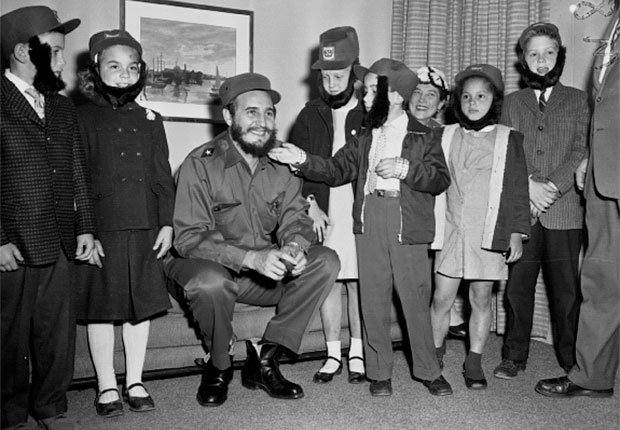
Beards. Fidel Castro made a beard as off limits to an American president — in spite of Lincoln — as Hitler made the mustache. And here I want to go back to that "Becoming Adolf" article by Rich Cohen that were were talking about a couple days ago:
[Y]ou could not wear any kind of mustache after [WWII], because, running from Hitler, you might run into Stalin. Hitler plus Stalin ended the career of the mustache in Western political life. Before the war, all kinds of American presidents wore a mustache and/or beard. You had John Quincy Adams, with his muttonchops...Are we going to decide who deserves out trust based on they look? Come on, Abe. Lose the beard. Okay.
You had Abe Lincoln, whose facial hair...
... like his politics, was the opposite of Hitler's: beard full, lip bare. You had James Garfield, who had the sort of vast rabbinical beard into which whole pages of legislation could vanish.
You had Rutherford B. Hayes...
Grover Cleveland...
... and Teddy Roosevelt, whose asthma and elephant gun were just a frame for his mustache.
You had William Howard Taft — the man wore a Walrus!
After the war, the few American politicians who still wore a mustache were those who had made their name before Hitler and so had been grandfathered in. Like Thomas Dewey.
Dewey was Eliot Spitzer. He was a prosecutor in New York in the 1930s (and later governor), the only guy with the guts to take on the Mob. For Dewey, the rise of Hitler was a fashion disaster. Because Dewey wore a neat little mustache. Dewey ran for president twice — losing to F.D.R., losing to Truman. In my opinion, without the mustache, the headline in the Chicago Daily Tribune (Dewey Defeats Truman) turns true. One of the few prominent American politicians to wear facial hair in recent memory is Al Gore, who grew a Grizzly Adams beard after he lost to George Bush, in 2000. The appearance of this beard was taken to mean either (1) Gore would never again run for office, or (2) Gore had gone completely mental.
The decision to grow a mustache or a beard is all by itself reason to keep a man away from the nuclear trigger.
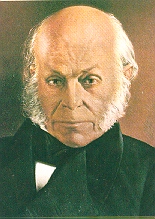

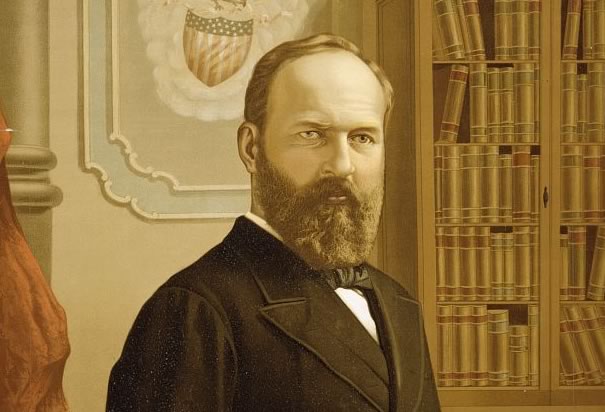


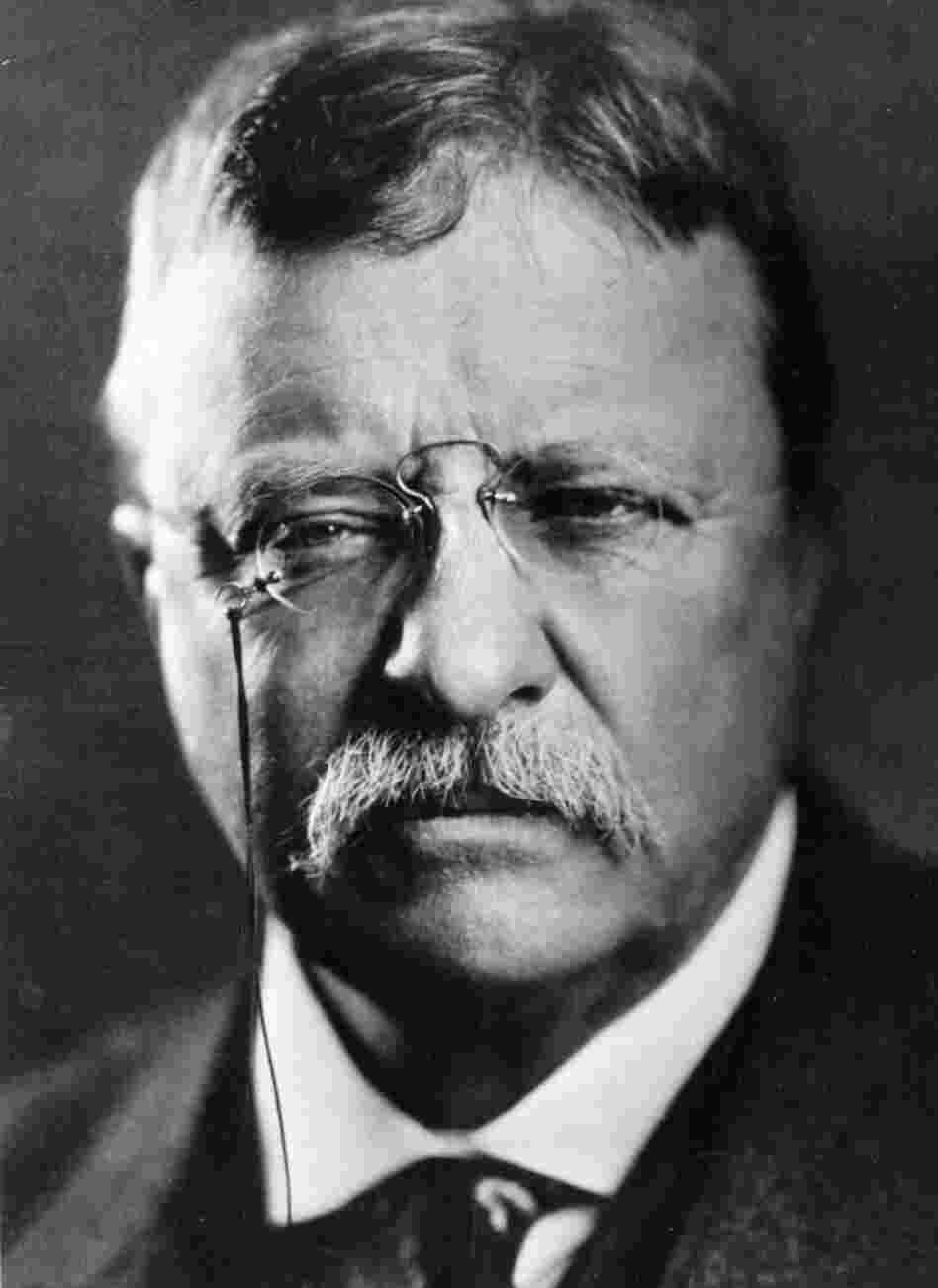
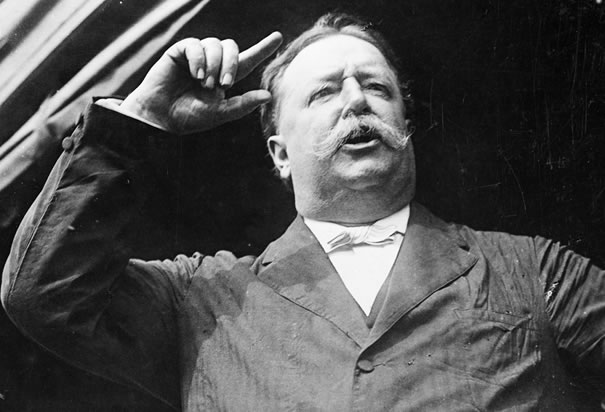


Pick one:


Friday, January 18, 2013
"Who of a certain age could forget when a bookish black woman named Anita Hill addressed a Senate committee of 14 white men..."
"... and candidly spoke of graphic sexual harassment by then-Supreme Court nominee Clarence Thomas? The explosive, race-tinged hearings in 1991 had all of America, especially black America, captivated. Sexual politics became part of the lexicon, and Hill became a divisive figure. We know what became of Thomas — now we get a rare glimpse into Hill's private life with friends and family, who stood by her through it all."
From "14 Films That Matter at Sundance" at The Root.
From "14 Films That Matter at Sundance" at The Root.
Subscribe to:
Posts (Atom)
 :.
:.