

In the '70s... "there were high-level conversations about adding marijuana to tobacco, creating a line of marijuana cigarettes, and being ready to jump in and market this."Want legal marijuana? Write to the President:
As recently as 1993, when it looked like France was poised to legalize marijuana, Philip Morris trademarked the name "Marley." But when the estate of Bob Marley complained, the company claimed it had nothing to do with the reggae singer.
"Philip Morris said, 'No no, it could be any kind of Marley,... like Jacob Marley, the cheap, cantankerous teetotaler from A Christmas Carol.'"...
Showing posts with label Dickens. Show all posts
Showing posts with label Dickens. Show all posts
Sunday, November 25, 2012
"Now that legal pot is here, will cigarette companies dust off their old plans for mass commercialization?"
NPR explores the coming of legal marijuana:

Thursday, July 12, 2012
The 200 greatest novels, stories, and poems...
... for $2.99. (The Complete Harvard Classics Shelf of Fiction, "carefully selected by the world's leading experts on literature and philosophy at Harvard University.")
Thecomplete works of Tolstoy for $1.99.
The complete works of Dickens for $2.99.
And here are the complete works of Ralph Waldo Emerson & Henry David Thoreau — together at last — for $1.99.
What a world we live in! You can carry it all with you in a 6-ounce device. (Or something fancier.)
Somebody asked recently if I can see what it is you buy when you enter Amazon through my links, and the answer is yes. For example, somebody bought a compressor. Thanks!
ADDED: It's not the complete works of Leo Tolstoy, but — as revealed at the link once you get past the mistranscribed titled — 25+ works by Leo Tolstoy. It's missing some things I like, including "What Is Art?" I'm guessing the omissions have to do with the lack of translations. I'm always wary of these low-priced editions of literature to be read in translation. Personally, I bought all the items linked in this post except the Tolstoy. But note: there are some works in translation in the Harvard Classics collection (e.g., "Old Goriot").
The
The complete works of Dickens for $2.99.
And here are the complete works of Ralph Waldo Emerson & Henry David Thoreau — together at last — for $1.99.
What a world we live in! You can carry it all with you in a 6-ounce device. (Or something fancier.)
***
Somebody asked recently if I can see what it is you buy when you enter Amazon through my links, and the answer is yes. For example, somebody bought a compressor. Thanks!
ADDED: It's not the complete works of Leo Tolstoy, but — as revealed at the link once you get past the mistranscribed titled — 25+ works by Leo Tolstoy. It's missing some things I like, including "What Is Art?" I'm guessing the omissions have to do with the lack of translations. I'm always wary of these low-priced editions of literature to be read in translation. Personally, I bought all the items linked in this post except the Tolstoy. But note: there are some works in translation in the Harvard Classics collection (e.g., "Old Goriot").
Tuesday, February 7, 2012
"The witches’ brew of predator-prey arms races: eye of newt, fenny snakes and resistance to a deadly poison."
The title of a lecture, one of many events here at the University of Wisconsin campus this week — in observance of the birthday of Charles Darwin. (We do a whole week for "Darwin Day," apparently. The great man's actual birthday was February 12, 1809.)
My mind is dragged back to the fascinating story in the previous post. Trent Arsenault has the ideal Darwinian strategy, doesn't he? He's perfecting and maximizing his genetic material and its distribution, including the likelihood that his offspring will be healthy and well-protected and well-reared to adulthood.
If you do come to Madison this weekend, perhaps to take in some Darwin-related things, make sure to drop by the Chazen Museum and see the Art Department's faculty show. Meade and I loved it. I couldn't do photographs of that exhibit, but there's a slide show at the link. My favorite thing was "Stoney's Tiny Tattoo" ("a painted-wood structure by Assistant Professor Fred Stonehouse... Inside, graduate student Ben Grant tattoos himself"). No one was doing tattoo performance when we were there. I just loved all the faux-primitive drawings inside the booth.
But wait! Why am I talking about Darwin's birthday today? It's not the 12th, it's the 7th. And it's not a big centenary birthday for Darwin. That was 3 years ago. Today is the 200th anniversary of the birth of another great Charles D: Charles Dickens. And the reason I noticed this is the usual reason people these days notice things like that: I saw a mysterious Google Doodle and clicked on it. I've read a lot of Dickens, but there's only one Dickens book I've read twice:
If you're coming to Madison for DarwinDay Weekend — and maybe the faculty art show — you can also sojourn in and around the protest commemorations. I don't know what's in store, but check out the Capitol Square for some hope and despair and epochal belief and incredulity.
My mind is dragged back to the fascinating story in the previous post. Trent Arsenault has the ideal Darwinian strategy, doesn't he? He's perfecting and maximizing his genetic material and its distribution, including the likelihood that his offspring will be healthy and well-protected and well-reared to adulthood.
If you do come to Madison this weekend, perhaps to take in some Darwin-related things, make sure to drop by the Chazen Museum and see the Art Department's faculty show. Meade and I loved it. I couldn't do photographs of that exhibit, but there's a slide show at the link. My favorite thing was "Stoney's Tiny Tattoo" ("a painted-wood structure by Assistant Professor Fred Stonehouse... Inside, graduate student Ben Grant tattoos himself"). No one was doing tattoo performance when we were there. I just loved all the faux-primitive drawings inside the booth.
But wait! Why am I talking about Darwin's birthday today? It's not the 12th, it's the 7th. And it's not a big centenary birthday for Darwin. That was 3 years ago. Today is the 200th anniversary of the birth of another great Charles D: Charles Dickens. And the reason I noticed this is the usual reason people these days notice things like that: I saw a mysterious Google Doodle and clicked on it. I've read a lot of Dickens, but there's only one Dickens book I've read twice:
It was the best of times, it was the worst of times, it was the age of wisdom, it was the age of foolishness, it was the epoch of belief, it was the epoch of incredulity, it was the season of Light, it was the season of Darkness, it was the spring of hope, it was the winter of despair, we had everything before us, we had nothing before us, we were all going direct to Heaven, we were all going direct the other way....Oh, yes... that reminds me, it's just about exactly the 1-year anniversary of the start of the Wisconsin protests, our own special Wisconsin season of darkness/spring of hope/winter of despair.
If you're coming to Madison for Darwin
Friday, October 21, 2011
Writing with dashes.
Do you like dashes? I do. There are certain ways of using dashes that I particularly admire. Rather than try to explain what I like so much, I'll give you an example. This is from the Charles Dickens novel, "Bleak House." The narrator is encountering the mother of a child who has just fallen down a flight of stairs.
I like sentences like that — I think — because I like conversational side roads especially when they get you back to the main road. That relates to the way I feel about blogging. For example, the reason I was out there in Project Gutenberg searching for "Africa" on a webpage that contained the entire text of what is — in paperback — a 544-page book is that — like everyone else who checked Memeorandum today — I got waylaid by a NY Post story titled "Florida banker's wife left family to join Wall Street protesters."
Mrs. Jellyby, whose face reflected none of the uneasiness which we could not help showing in our own faces as the dear child's head recorded its passage with a bump on every stair — Richard afterwards said he counted seven, besides one for the landing — received us with perfect equanimity.Doesn't that sentence make you feel like diagramming it... just for fun?
I like sentences like that — I think — because I like conversational side roads especially when they get you back to the main road. That relates to the way I feel about blogging. For example, the reason I was out there in Project Gutenberg searching for "Africa" on a webpage that contained the entire text of what is — in paperback — a 544-page book is that — like everyone else who checked Memeorandum today — I got waylaid by a NY Post story titled "Florida banker's wife left family to join Wall Street protesters."
A married mother of four from Florida ditched her family to become part of the raggedy mob in Zuccotti Park -- keeping the park clean by day and keeping herself warm at night with the help of a young waiter from Brooklyn.
“I’m not planning on going home,” an unapologetic Stacey Hessler, 38, told The Post yesterday.
“I have no idea what the future holds, but I’m here indefinitely. Forever,” said Hessler, whose home in DeLand sits 911 miles from the tarp she’s been sleeping under.
Hessler — who ironically is married to a banker — arrived 12 days ago and planned to stay for a week, but changed her plans after cozying up to some like-minded radicals, including Rami Shamir, 30, a waiter at a French bistro in Cobble Hill, Brooklyn.Hey, check the dashes: "— who ironically is married to a banker —." Ironic? Or not ironic at all? It's just what you'd expect if you were reading a novel about a woman married to a banker. Stacey Hessler immediately called to mind Mrs. Jellyby. Remember Mrs. Jellyby? She's a minor character in "Bleak House." Here's a summary/spoiler:
[Mrs. Jellyby] resolutely devotes every waking hour to the “Borrioboola-Gha venture.” The reader never discovers the details of the endeavor except that it involves the settlement of impoverished Britons among African natives with the goal of supporting themselves through coffee growing.Like a sentence with well-deployed dashes, it all comes together in the end.
Mrs. Jellyby is convinced that no other undertaking in life is so worthwhile, or would solve so many problems at a stroke. Dickens’s interest is not in the project, however, but rather in Mrs. Jellyby, who is so wedded to her work that she has no time for her several children, with the exception of Caddy, a daughter she has conscripted as her secretary. Ink-spattered Caddy puts in nearly as many hours as her mother in the daily task of answering letters and sending out literature about Borrioboola-Gha.
Caddy, however, has come to hate the very word “Africa” or any word that has the remotest suggestion of causes. For her, causes simply mean the ruin of family life. Mrs. Jellyby’s husband eventually becomes suicidal and, though surviving despair, is last seen in the book with his head resting despondently on a wall.
In the book’s postscript, we discover that the Borrioboola-Gha project failed after the local king sold the project’s volunteers into slavery in order to buy rum. Mrs. Jellyby quickly found another cause to occupy her time, “a mission with more correspondence than the old one,” thus providing a happy ending for a permanent campaigner.
Tuesday, January 4, 2011
Michael Steele says his favorite book is “War and Peace” and he quotes the first line as: “It was the best of times, it was the worst of times.”
D'oh! Bad times for Michael Steele. The 5 candidates for RNC were asked, in their debate, what's their favorite book? It's not like anybody else said anything good. ("To Kill a Mockingbird" — give me a break!)
The actual opening lines of "War and Peace":
The actual opening lines of "War and Peace":
"Well, Prince, so Genoa and Lucca are now just family estates of the Buonapartes. But I warn you, if you don't tell me that this means war, if you still try to defend the infamies and horrors perpetrated by that Antichrist — I really believe he is Antichrist — I will have nothing more to do with you and you are no longer my friend, no longer my 'faithful slave,' as you call yourself! But how do you do? I see I have frightened you- sit down and tell me all the news.""Here's "A Tale of Two Cities":
It was the best of times, it was the worst of times, it was the age of wisdom, it was the age of foolishness, it was the epoch of belief, it was the epoch of incredulity, it was the season of Light, it was the season of Darkness, it was the spring of hope, it was the winter of despair, we had everything before us, we had nothing before us, we were all going direct to Heaven, we were all going direct the other way — in short, the period was so far like the present period, that some of its noisiest authorities insisted on its being received, for good or for evil, in the superlative degree of comparison only.Pretty much the same thing, no? Close enough for RNC work.
Saturday, October 16, 2010
"Great Expectations, the Miss Havisham Cake" — banned from the Melbourne Cake Show.
In bad taste?

But it's literary!
A reading, from Charles Dickens:
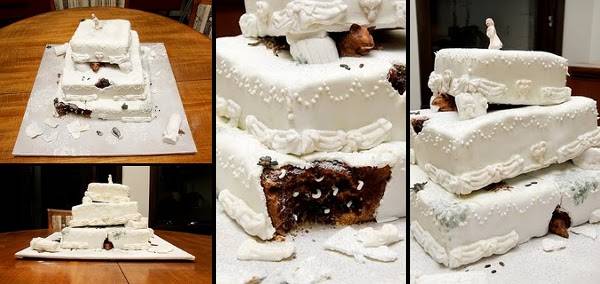
But it's literary!
A reading, from Charles Dickens:
The most prominent object was a long table with a tablecloth spread on it, as if a feast had been in preparation when the house and the clocks all stopped together. An epergne or centre-piece of some kind was in the middle of this cloth; it was so heavily overhung with cobwebs that its form was quite undistinguishable; and, as I looked along the yellow expanse out of which I remember its seeming to grow, like a black fungus, I saw speckle-legged spiders with blotchy bodies running home to it, and running out from it, as if some circumstances of the greatest public importance had just transpired in the spider community.
I heard the mice too, rattling behind the panels, as if the same occurrence were important to their interests. But the black beetles took no notice of the agitation, and groped about the hearth in a ponderous elderly way, as if they were short-sighted and hard of hearing, and not on terms with one another.
These crawling things had fascinated my attention, and I was watching them from a distance, when Miss Havisham laid a hand upon my shoulder. In her other hand she had a crutch-headed stick on which she leaned, and she looked like the Witch of the place.
"This," said she, pointing to the long table with her stick, "is where I will be laid when I am dead. They shall come and look at me here."
With some vague misgiving that she might get upon the table then and there and die at once, the complete realization of the ghastly waxwork at the Fair, I shrank under her touch.
"What do you think that is?" she asked me, again pointing with her stick; "that, where those cobwebs are?"
"I can't guess what it is, ma'am."
"It's a great cake. A bride-cake. Mine!"
Wednesday, December 31, 2008
"Any unbigoted or bigoted books on God or merely religion, as written by persons whose last names begin with any letter after H..."
"... to stay on the safe side, please include H itself, though I think I have mostly exhausted it. ... The complete works again of Count Leo Tolstoy. ... Charles Dickens, either in blessed entirety or in any touching shape or form. My God, I salute you, Charles Dickens!"
The books Seymour asked to have sent to him, in "the longest, most pretentious (and least plausible) letter from camp ever written," the last thing J.D. Salinger published. Salinger turns 90 on New Year's Day, which provides an occasion for pondering the oft-pondered question: What's he been doing all these years?
Hey, I wonder if Richard Hasn't-Slept-With-Althouse Cohen is impressed by Seymour's book list?
Have you noticed that Instapundit always has a post that goes up in the middle of the night? Think he's really up and writing then? I'm really up now, writing. Maybe old J.D. is up and writing, adding one more sheet to the stack of pages he started piling up more than 40 years ago.
UPDATE: Instapundit awakens and answers my question:
Read the whole blog, Being and Nothingness, where the tags are:
The books Seymour asked to have sent to him, in "the longest, most pretentious (and least plausible) letter from camp ever written," the last thing J.D. Salinger published. Salinger turns 90 on New Year's Day, which provides an occasion for pondering the oft-pondered question: What's he been doing all these years?
***
Hey, I wonder if Richard Hasn't-Slept-With-Althouse Cohen is impressed by Seymour's book list?
***
Have you noticed that Instapundit always has a post that goes up in the middle of the night? Think he's really up and writing then? I'm really up now, writing. Maybe old J.D. is up and writing, adding one more sheet to the stack of pages he started piling up more than 40 years ago.
UPDATE: Instapundit awakens and answers my question:
Those are scheduled posts, for the benefit of people in the other hemisphere, or people who are up late and bored.Tigerhawk razzes:
Is there any person with more regard for his fellow man than Glenn Reynolds? He is actually concerned with the welfare of bored people all around the world! And I agree. What with all the people worried about starvation, disease, war, and poverty, somebody has to speak out for the bored. Glenn has put his stake in the ground and said "the boredom stops here!," and I am down with that.Much as I'm gratified by the instaänswer and tigerhawkswoopery, I'm a little sad that this discussion of boredom has occurred on the J.D. Salinger post and not yesterday's Camus post where boredom — ennui — would have fit so nicely. In Reynoldsian theory, the French existentialists must rank high, as they attend to the great problem of boredom. In Althousian theory, the blogger is not here to help you with your boredom, but to delight at serendipitous juxtapositions. So here is something Jean-Paul Sartre's blogged last October:
My sleep continues to be troubled by odd dreams. Last night I dreamt that I was a beetle, clinging to the slick surface of a water-soaked log as it careened down a rain-swollen stream toward a waterfall. A figure appeared on the horizon, and as the log drew closer I could see that it was Camus. He held out a hand and I desperately reached for it with my tiny feeler. Just as the log drew abreast of Camus he suddenly wihdrew his hand, swooped it through his hair and sneered "Too slow," adding superfluously: "Psych."
It is my belief that the log symbolizes the precariousness of Existence, while the tiny feeler represents Man's essential powerlessness. And Camus represents Camus, that fatuous ninny.
Read the whole blog, Being and Nothingness, where the tags are:
bleakness
despair
ennui
existence
meaninglessness
the bourgeoisie
Monday, January 10, 2005
Niching down.
Here's a piece in the new Atlantic that approves of the media decentralization represented by blogs. The author William Powers compares this "niching down" to the media in the 19th century:
The nineteenth century was a time of intense national growth and fervent argument about what direction the country should take. Numerous political parties appeared (Democratic, Whig, Republican, Free Soil, Know-Nothing), and the views and programs they advocated all found expression in sympathetic papers. In fact, the parties themselves financially supported newspapers, as did the White House for a time. ... [B]y the middle of the nineteenth century 80 percent of American newspapers were avowedly partisan.Funny how much Dickens's joke names for newspapers sound like things people would actually call their blogs. Anyway, Powers's point is that it's for the good:
This partisanship was not typically expressed in high-minded appeals to readers' better instincts. As Tocqueville wrote, "The characteristics of the American journalist consist in an open and coarse appeal to the passions of his readers; he abandons principles to assail the characters of individuals, to track them into private life and disclose all their weaknesses and vices." When Martin Chuzzlewit, the central character of the Dickens novel by the same name, arrives in the New York City of the early 1840s, he is greeted by newsboys hawking papers with names like the New York Stabber and the New York Keyhole Reporter. "Here's the New York Sewer!," one newsie shouts. "Here's the Sewer's exposure of the Wall Street Gang, and the Sewer's exposure of the Washington Gang, and the Sewer's exclusive account of a flagrant act of dishonesty committed by the Secretary of State when he was eight years old."
[E]ven though the media of this period were profuse, partisan, and scandalously downmarket, they were at the same time a powerful amalgamator that encouraged participatory democracy and forged a sense of national identity.
Subscribe to:
Posts (Atom)
 :.
:.
