"... and the chatter of frozen breath and the hands waving overhead as we caught sight of old acquaintances, and the matchings of invitations: 'Are you going to the Ordways'? the Herseys'? the Schultzes'?' and the long green tickets clasped tight in our gloved hands."
That other sentence — "At the hookah bar, Jordan and Emily Wernet, a 25-year-old freelance illustrator of comics and tattoos, joked about the grotesqueness of a hand appearing inside a belly and about 'parasites,' 'popping one out,' and 'horrible little grubs' in the midst of more serious conversation about their fears of relinquishing sole ownership of one’s own body" — made some readers feel that there was a "Gatsby" sentence gestating somewhere inside the womb of my Blogger account, so I thought I'd better pop out this post. I hope you don't find it grotesque, this string of words that F. Scott Fitzgerald, in full possession of the autonomy of authorship, determined to be, in fact, a sentence, worthy of a place in the pages of "The Great Gatsby."
And I hope it's not horrible that I ripped it out of his context and put it in my context as I, clasping tightly to my bloggerly autonomy, decided that this — this! — is a blog post. It is not for the professors, journalists, and literary critics to resolve the difficult question of when some quotes from this-or-that tossed together with some connective prose amount to a blog post. It's enough to say there's a divergence of thinking on this most sensitive and difficult question, and therefore it's up to me to decide what is worthy of publication here. My blog, my choice.
This "Gatsby" sentence has a simple structure. The subject is "I" and the predicate is "remember." How many sentences in the history of humanity begin "I remember...."? There's no end to where you can go from there (especially if you're not hung up on nonfiction and truthtelling). So string along the memories — the memorabilia, the "things... worthy of being remembered."
I remember the Michael Jackson memorabilia, the Bruce Lee memorabilia, the Martin Luther King Jr. memorabilia, Malcolm X memorabilia, the Jimi Hendrix memorabilia, the $43,350 Rolex watch, the fur capes and parkas....
I mean... I remember the fur coats.... They — the girls returning from Miss This-or-That’s — weren't wearing their fur in cape or parka form back in 1922.
Things remembered: fur coats, chatter, hands waving, matchings of invitations, and long green tickets. These remembered things give the reader a sense of the incompletely delineated human beings. Who are the unnamed girls and who are the "we"? There's the overspecificity of the people offstage, Ordways, the Herseys, and the Schultzes. There's the silly half-specificity of Miss This-or-That. These people — or, really, places (hence the possessive) — are, like fur coats and gloves, appurtenances to the human beings we are trying to see in this picture.
This is a mass of faceless humanity, cluttered with hands, waving and clasping. Hands appears twice in the sentence — the grotesqueness of a hand appearing — first, waving (connecting with others), and second, clasping a ticket (intent on getting to one's predetermined destination). The hands of the others reaching out are grubby and horrible and we've got a fear of relinquishing sole ownership of our long green tickets.
Showing posts with label abortion. Show all posts
Showing posts with label abortion. Show all posts
Wednesday, February 20, 2013

Friday, February 15, 2013
"Lots of people are opposed to the kind of late-term abortion that preceded the death of a woman in Maryland last week...."
"But everyone should be opposed to the blatantly illegal violation of her privacy and the exploitation of her death by protesters using it to make their point."
Writes Petula Dvorak in the WaPo.
I don't understand the "blatantly illegal" part. Dvorak is only guessing that someone in the clinic leaked the information, so shouldn't "blatantly" be something like "possibly"? Dvorak's opinion goes beyond the question of whether any law was broken. She portrays what happened to the woman as something intensely private that ought to have been mourned within her circle of family and friends and never disclosed to the rest of us, who have various opinions about a matter of important public concern related to this death.
To shift the topic slightly: Remember the immediate aftermath of the Benghazi attacks, when we kept hearing — from Hillary Clinton and others — that the primary concern is for the families of the men who died.
I think we need to be a little skeptical when we hear the argument this is private, this is for the families.
What belongs securely in the private realm and what should come out into the public light? Consider the old slogan: The personal is political.
When we hear the statement this is private, we need to test its truth with the opposite proposition: This belongs in the public debate. And consider whether we are looking at something that can be divided up into private and public. We can be respectful to the family, we can avoid using the woman's name and photographs and and so forth, and extract the part of the story that properly belongs in the public debate. Those who demand absolute privacy may have complex motives. They may say: What I care about is the very personal suffering of the victim's family and friends. Why would they give voice to less admirable motivations?
Writes Petula Dvorak in the WaPo.
I don't understand the "blatantly illegal" part. Dvorak is only guessing that someone in the clinic leaked the information, so shouldn't "blatantly" be something like "possibly"? Dvorak's opinion goes beyond the question of whether any law was broken. She portrays what happened to the woman as something intensely private that ought to have been mourned within her circle of family and friends and never disclosed to the rest of us, who have various opinions about a matter of important public concern related to this death.
To shift the topic slightly: Remember the immediate aftermath of the Benghazi attacks, when we kept hearing — from Hillary Clinton and others — that the primary concern is for the families of the men who died.
I think we need to be a little skeptical when we hear the argument this is private, this is for the families.
What belongs securely in the private realm and what should come out into the public light? Consider the old slogan: The personal is political.
When we hear the statement this is private, we need to test its truth with the opposite proposition: This belongs in the public debate. And consider whether we are looking at something that can be divided up into private and public. We can be respectful to the family, we can avoid using the woman's name and photographs and and so forth, and extract the part of the story that properly belongs in the public debate. Those who demand absolute privacy may have complex motives. They may say: What I care about is the very personal suffering of the victim's family and friends. Why would they give voice to less admirable motivations?
Sunday, February 3, 2013
"What gives the mayor the right to decide, without adequate notice, to give our children drugs that will impact their bodies and their psyches?"
The drug is Plan B (the "morning-after pill") and the mayor is Bloomberg.
About 40 separate “school-based health centers” doled out 12,721 doses of Plan B in 2011-12, up from 10,720 in 2010-11 and 5,039 in 2009-10....
The city says about 6,300 NYC girls had unplanned pregnancies last year, and more than half had abortions. Of those who give birth, the city says, about 70 percent drop out of school, making their futures bleak.
Sunday, January 27, 2013
"[T]he best pro-choice rebuttal to the young idealists at the March for Life or the professional women who lead today’s anti-abortion groups isn’t that they’re too reactionary..."
"... it’s that they’re too utopian, too radical, too naïve," says the NYT's conservative columnist Ross Douthat.
This means that the abortion rights movement, once utopian in its own fashion, is now at its most effective when it speaks the language of necessary evils, warning Americans that while it might be pretty to think so, the equality they take for granted simply can’t be separated from a practice they find troubling.
For its part, if the pro-life movement wants not only to endure but to triumph, then it needs an answer to this argument. That means something more than just a defense of a universal right to life. It means a realist’s explanation of how, in policy and culture, the feminist revolution could be reformed without being repealed.
Thursday, January 24, 2013
Gallup poll: 64% of Americans agree that "The decision to have an abortion should be made solely by a woman and her physician."
In the summer of 1972, half a year before the Supreme Court decided Roe v. Wade.
(Feel free to relate this post to the previous post about Second Amendment rights, which Democrats don't believe in.)
A majority of all identified groups, including Catholics, agreed with that statement. There was almost no difference between men and women. The group expressing the strongest agreement – 68 percent – was made up of Republicans. George Gallup’s syndicated column discussing the poll results, “Abortion Seen Up to Woman, Doctor,” ... was... in Justice Blackmun’s files.And Justice Blackmun, the Nixon appointee who wrote the Roe v. Wade opinion, had that column in his files. Also in his files:
[A]n account by Dr. Jane E. Hodgson, a Mayo Clinic-trained obstetrician/gynecologist, of her arrest in St. Paul in 1970 for performing a first-trimester abortion for a patient who had contracted German measles in the fourth week of pregnancy. (In those days before immunization eradicated the threat posed to pregnant women by German measles, the disease commonly caused serious birth defects.) Justice Harry A. Blackmun, formerly the Mayo Clinic’s lawyer, knew Dr. Hodgson’s story; I had found her account, published in the clinic’s alumni magazine, in the justice’s files at the Library of Congress.That's from a long column by Linda Greenhouse, referencing historical materials collected here. The column also talks about the post-Roe political strategy of the Republican Party, which we were just discussing a couple days ago here. The idea is that Republicans were for it before they were against it.
(Feel free to relate this post to the previous post about Second Amendment rights, which Democrats don't believe in.)
Wednesday, January 23, 2013
Anti-abortion man, who yelled from a tree at the Inauguration, is charged with a crime.
Rives Miller Grogan was charged "with violating a previous order to stay away from the U.S. Capitol, and with violating laws that require authorities to 'preserve the peace and secure the Capitol from defacement,' and with 'preventing any portion of the Capitol Grounds and terraces to used [sic] as playgrounds ... to protect the public property, turf and grass from destruction.'
What are the limits of protest?
ADDED: This story reminds me of an old Sunday School song:
I remember singing that as a child and feeling embarrassed by how cute the adults found it whenever a child did the spoken-word part, "Zacchaeus, you come down." Are children's songs written to amuse children or to lure children into performances that will amuse adults? If the latter, is it wrong?
Here's the Bible story, in chapter 19 of Luke:
What is the proper tax rate for the rich? The Bible implies that it's 50% and that the spending should go toward alleviating poverty. And that's not a 50% income tax, by the way, Mr. Buffet. That's a wealth tax. You should cough up about $15 billion to get right with God.
He had just been arrested and charged with disorderly conduct last week, after police said he shouted from the gallery of the U.S. Senate. He’s been convicted five times in the District since 2009, mostly on charges of disorderly conduct and disobeying police....Some of this reminds me of our tenacious Wisconsin protesters, whose deep convictions and emotive righteousness have led them to specialize in loud annoyingness and innumerable petty violations. Grogan is different from them too. He's driven by religious fervor, and he's not on the left.
Police said Grogan once dropped to the ground in the Capitol Rotunda while clutching a doll and screamed in front of 60 visitors. Another time, police said, he paced the Capitol steps holding a bible and shouting, “Stop killing the babies.”....
Officer Shennell S. Antrobus, a U.S. Capitol Police spokesman, said officials decided to leave Grogan in the tree until after the swearing in to avoid disruptions. Police said he came down on his own after five hours.
What are the limits of protest?
ADDED: This story reminds me of an old Sunday School song:
I remember singing that as a child and feeling embarrassed by how cute the adults found it whenever a child did the spoken-word part, "Zacchaeus, you come down." Are children's songs written to amuse children or to lure children into performances that will amuse adults? If the latter, is it wrong?
Here's the Bible story, in chapter 19 of Luke:
Jesus entered Jericho and was passing through. A man was there by the name of Zacchaeus; he was a chief tax collector and was wealthy. He wanted to see who Jesus was, but because he was short he could not see over the crowd. So he ran ahead and climbed a sycamore-fig tree to see him, since Jesus was coming that way.Jesus looked with favor on the tax collector, it was his method to conspicuously reach out to those who seemed conspicuously to be sinners when there was a more subtle point that all are sinners and he is reaching out to all of us.
When Jesus reached the spot, he looked up and said to him, “Zacchaeus, come down immediately. I must stay at your house today.” So he came down at once and welcomed him gladly.
All the people saw this and began to mutter, “He has gone to be the guest of a sinner.”
But Zacchaeus stood up and said to the Lord, “Look, Lord! Here and now I give half of my possessions to the poor, and if I have cheated anybody out of anything, I will pay back four times the amount.”Lefties and righties can argue about what (if anything) Jesus meant to say about taxation. One might say, as I suggested above, that Zacchaeus was chosen because the people had a stereotype equating tax collection with sin, so he easily became The Sinner, for Jesus to bounce his lesson off of. But you might say that Zacchaeus's conversion shows the importance of taxation when it is used to take accumulated wealth from the rich and to distribute it to the poor. That's not the way the taxation of the time was used, and Zacchaeus had become wealthy through his tax collection work. So he's more like a typical rich man, and he is declared saved because he instantly gave half his possessions to the poor, without regard to whether that wealth was ill-gotten. Zacchaeus makes a second promise, to give quadruple restitution of any ill-gotten gains.
Jesus said to him, “Today salvation has come to this house, because this man, too, is a son of Abraham. For the Son of Man came to seek and to save the lost.”
What is the proper tax rate for the rich? The Bible implies that it's 50% and that the spending should go toward alleviating poverty. And that's not a 50% income tax, by the way, Mr. Buffet. That's a wealth tax. You should cough up about $15 billion to get right with God.
Tuesday, January 22, 2013
Where are you on the Roe v. Wade matrix?

(From "Why Republicans should stop talking about Roe v. Wade.")
I'm in the 18%. I'm surprised I have so much company!
Linda Greenhouse and Reva Siegel "say one of the things that really politicized the abortion issue was the efforts of those working to re-elect President Richard Nixon in 1972."
"His aides, including future Republican presidential candidate Patrick Buchanan, wanted to lure Northern Catholic voters, who had traditionally voted Democratic, over to the Republican Party."
Nixon "was strongly advised by his strategists ... to make a play for a Northern urban Catholic Democratic vote," says Greenhouse. "A kind of Northern strategy that mirrored the Southern strategy."
In fact, up until then, top Republicans tended to be more in favor of abortion rights than Democrats, including, for much of his first term, Nixon himself....
So, taking his aides' advice, Nixon switched sides on abortion, even reversing an earlier relaxation of an abortion ban in military facilities.
40 years ago today, the Supreme Court issued its opinion in Roe v. Wade.
Justice Blackmun wrote:
Pre-viability, the decision whether to continue with a pregnancy would rest with the woman within whose body the mysterious process was taking place, and it would not be the role of the state to make that decision for her, no matter how firmly the majority of the people believe they have solved the mystery and they know that what she is doing is murdering a child.
The Constitution does not explicitly mention any right of privacy. In a line of decisions, however... the Court has recognized that a right of personal privacy, or a guarantee of certain areas or zones of privacy, does exist under the Constitution. In varying contexts, the Court or individual Justices have, indeed, found at least the roots of that right in the First Amendment.... or in the concept of liberty guaranteed by the first section of the Fourteenth Amendment.... These decisions make it clear that only personal rights that can be deemed "fundamental" or "implicit in the concept of ordered liberty"... are included in this guarantee of personal privacy....Was the state's interest in protecting the unborn child sufficient to permit some regulation? The answer was yes, but not before the "viability" of the unborn. As to whether the killing of that pre-viable entity ought to be seen as the killing of a human being, justifying rescue by the state, the Court refused "to endorse any theory that life, as we recognize it, begins before live birth," since "those trained in... medicine, philosophy, and theology are unable to arrive at any consensus."
This right of privacy, whether it be founded in the Fourteenth Amendment's concept of personal liberty and restrictions upon state action, as we feel it is, or, as the District Court determined, in the Ninth Amendment's reservation of rights to the people, is broad enough to encompass a woman's decision whether or not to terminate her pregnancy. The detriment that the State would impose upon the pregnant woman by denying this choice altogether is apparent. Specific and direct harm medically diagnosable even in early pregnancy may be involved. Maternity, or additional offspring, may force upon the woman a distressful life and future. Psychological harm may be imminent. Mental and physical health may be taxed by child care. There is also the distress, for all concerned, associated with the unwanted child, and there is the problem of bringing a child into a family already unable, psychologically and otherwise, to care for it. In other cases, as in this one, the additional difficulties and continuing stigma of unwed motherhood may be involved. All these are factors the woman and her responsible physician necessarily will consider in consultation.
Pre-viability, the decision whether to continue with a pregnancy would rest with the woman within whose body the mysterious process was taking place, and it would not be the role of the state to make that decision for her, no matter how firmly the majority of the people believe they have solved the mystery and they know that what she is doing is murdering a child.
Monday, January 21, 2013
Monday, January 14, 2013
"If he could smile and play and feel then despite his disabilities he deserved to enjoy whatever life he had left, no matter how short."
Friday, January 11, 2013
This gun control controversy is a real gift to Republicans.
It got them out of the morose election postmortem. Now, they're in their zone. Guns! — such invigorating shift from having to talk about Mitt Romney.
Righties should be sending thank you notes to Joe Biden.
ADDED: Biden actually said: "There is nothing that has pricked the consciousness of the American people (and) there is nothing that has gone to the heart of the matter more than the image people have of little 6-year-old kids riddled - not shot, but riddled, riddled - with bullet holes in their classroom."
Like it's all a matter of the capacity to visualize gore.
If we picture a bloody mincemeat of fetuses, then do we get to take away abortion rights?
Righties should be sending thank you notes to Joe Biden.
ADDED: Biden actually said: "There is nothing that has pricked the consciousness of the American people (and) there is nothing that has gone to the heart of the matter more than the image people have of little 6-year-old kids riddled - not shot, but riddled, riddled - with bullet holes in their classroom."
Like it's all a matter of the capacity to visualize gore.
If we picture a bloody mincemeat of fetuses, then do we get to take away abortion rights?
Thursday, January 3, 2013
"40 years ago, abortion-rights activists won an epic victory with Roe v. Wade..."
"They've been losing ever since," says the new cover of Time Magazine:

You need a subscription to read the article, but here's a shorter post by the author, Kate Pickert:

You need a subscription to read the article, but here's a shorter post by the author, Kate Pickert:
The pro-life cause has been winning the abortion war, in part, because it has pursued an organized and well-executed strategy. But public opinion is also increasingly on their side. Thanks to prenatal ultrasound and advanced neonatology, Americans now understand what a fetus looks like and that babies born as early as 24 weeks can now survive....
The prochoice establishment has also been hampered by a generational divide within the cause. Young abortion rights activists today complain that the leaders of feminist organizations, who were in their 20s and 30s when Roe was decided, aren’t eager to pass the torch to a new generation whose activism is more nimble and Internet-based.In what form are these metaphorical torches passed? When and where do elder leaders step down and cede power to youngsters? If their activism is so "nimble," why can't they grab the power they want? Or is this a special "feminist" theory that the older women ought to get out of the way? Back in the day, expecting older women to get out of the way was regarded as an anti-feminist notion. Well, too bad I don't have a Time subscription or I'd investigate the details of these young activists and their whiny ways.
Thursday, December 27, 2012
Why was that prop so important to David Gregory?
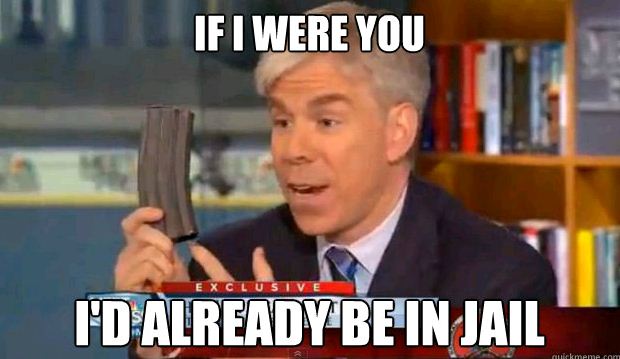
"Yeah, asking for permission is pretty damning when you ignore what you are told directly from the law enforcement authority and do it anyway."
But what it tells us is that the prop was really, really important to Gregory. Let's think about why. He knew he was going to have NRA CEO Wayne LaPierre across the table and that he'd push him with one question after another, building the pressure. Here's how that moment looked:
You hear the tension in Gregory's voice as he's about to confront LaPierre with the prop — actually 2 props: the high-capacity magazine and then the smaller one. At the point when Gregory picks up the first prop, you see his eyes dart over to the side. He doesn't have the script memorized, but the precise text is important as he displays one prop and then the other. He need the prompter.
Of course, if this prop display is supposed to be explosive, it doesn't work, because LaPierre is good at not getting agitated. Predictably good, so Gregory's routine looks silly to me. But maybe it inflamed some people in the "Meet the Press" viewership. Maybe there were lots of folks at home going "OMG that thing is huge!!"
I'm trying to think of other examples in political/policy debates when somebody whipped out a prop for dramatic effect. Especially examples where it really worked. I remember President Clinton waggling his pen. Anything else?
ADDED: I was thinking about the value of a fetus replica for a pro-lifers, and, googling, happened upon this 3D-printed replica made from an MRI image.
UPDATE: I figured it out!
Monday, December 17, 2012
"Our gun culture promotes a fatal slide into extreme individualism."
"It fosters a society of atomistic individuals, isolated before power — and one another — and in the aftermath of shootings such as at Newtown, paralyzed with fear. That is not freedom, but quite its opposite. And as the Occupy movement makes clear, also the demonstrators that precipitated regime change in Egypt and Myanmar last year, assembled masses don’t require guns to exercise and secure their freedom, and wield world-changing political force. Arendt and Foucault reveal that power does not lie in armed individuals, but in assembly — and everything conducive to that."
So writes Firmin DeBrabander, who is a philosophy prof at the Maryland Institute College of Art, in the corner of the NYT called "The Stone," which calls itself "a forum for contemporary philosophers on issues both timely and timeless."
I'm not familiar with Firmin DeBrabander but I would like to know if he extends his principle generally to all of the individual rights currently protected in the various interpretations that have emanated from the Supreme Court.
Does our abortion culture/free speech culture promote a fatal slide into extreme individualism? Do abortion rights/free speech rights foster a society of atomistic individuals, isolated before power — and one another. Would Professor DeBrabander say that abortion rights and free speech rights are not freedom but the opposite?
Let me offer a bonus literary reading to sharpen the question. It's from a famous book. I've added some boldface to stress things relevant to DeBrabander's philosophy:
So writes Firmin DeBrabander, who is a philosophy prof at the Maryland Institute College of Art, in the corner of the NYT called "The Stone," which calls itself "a forum for contemporary philosophers on issues both timely and timeless."
I'm not familiar with Firmin DeBrabander but I would like to know if he extends his principle generally to all of the individual rights currently protected in the various interpretations that have emanated from the Supreme Court.
Does our abortion culture/free speech culture promote a fatal slide into extreme individualism? Do abortion rights/free speech rights foster a society of atomistic individuals, isolated before power — and one another. Would Professor DeBrabander say that abortion rights and free speech rights are not freedom but the opposite?
Let me offer a bonus literary reading to sharpen the question. It's from a famous book. I've added some boldface to stress things relevant to DeBrabander's philosophy:
"You are thinking... that my face is old and tired. You are thinking that I talk of power, and yet I am not even able to prevent the decay of my own body. Can you not understand, Winston, that the individual is only a cell? The weariness of the cell is the vigour of the organism. Do you die when you cut your fingernails?...
"We are the priests of power.... God is power. But at present power is only a word so far as you are concerned. It is time for you to gather some idea of what power means. The first thing you must realise is that power is collective. The individual only has power in so far as he ceases to be an individual. You know the Party slogan: "Freedom is Slavery." Has it ever occurred to you that it is reversible? Slavery is freedom. Alone— free — the human being is always defeated. It must be so, because every human being is doomed to die, which is the greatest of all failures. But if he can make complete, utter submission, if he can escape from his identity, if he can merge himself in the Party so that he is the Party, then he is all-powerful and immortal. The second thing for you to realise is that power is power over human beings. Over the body— but, above all, over the mind....
"We control matter because we control the mind. Reality is inside the skull. You will learn by degrees, Winston. There is nothing that we could not do. Invisibility, levitation— anything. I could float off this floor like a soap bubble if I wished to...."
Friday, November 30, 2012
The hippie commune where "birth control was frowned upon, and abortions were prohibited; childbearing was seen as a natural, beautiful and wholly spiritual undertaking for a woman."
The Farm... it's still around.
I was amazed to see that article in The Daily Mail (in the news because there's a new documentary movie), because just a week ago I referred to The Farm here:
I was amazed to see that article in The Daily Mail (in the news because there's a new documentary movie), because just a week ago I referred to The Farm here:
Meade says there was a hippie pro-life movement. He remembers hippies urging women not to have abortions and saying give your babies to us and we'll give them back to you whenever you want. I don't remember that iteration of hippie values, I don't know how the urging would have been done in pre-internet days, and my Googling fails again as I try to research the hippie pro-life movement.Later, Meade told me the place was called The Farm, and I read about it in Wikipedia.
Saturday, November 24, 2012
"After years of holding steady... the United States abortion rate has fallen to an all-time low."
"It dropped 5 percent between 2008 and 2009, the most recent years for which data is available, the largest decline in the past decade."
Why? One suggestion is that the bad economy has caused people to be more careful about contraception. Another is that more women are using birth control devices that eliminate the user-error factor.
Why? One suggestion is that the bad economy has caused people to be more careful about contraception. Another is that more women are using birth control devices that eliminate the user-error factor.
Friday, November 23, 2012
God — "one of most popular words in urban dictionary."
"Did you know that the word god has over 500 definitions?" That's definition #6 (of 647, as of just now).

She will not learn language/nor will she bear scorn/but she is the best little dog
that ever was born.
That song and another song on Meade's live-concert CD had lyrics about unborn babies, and I said that abortion rights ideology — which says that any given pregnant woman holds the sovereign power to determine the humanity of the entity within — has eclipsed the old cultural expressions magnifying the unborn child. "God Dog" has "I have lain in the womb of the rocks cold and chill/while she speaks in my heart with the voice of the hill." And the other song — sorry I haven't successfully Googled the lyrics — spoke of an unborn baby safe and warm within the womb, which made me think about how the womb isn't — within abortion rights ideology — a safe place to be anymore. It's a place where your humanity depends on the will of the Goddess of the small universe you still inhabit. She, being autonomous and free, has the power "to define [her] own concept of existence, of meaning, of the universe, and of the mystery of human life." In that legal landscape, there are no wandering hippie minstrels singing songs about unborn babes.
Meade says there was a hippie pro-life movement. He remembers hippies urging women not to have abortions and saying give your babies to us and we'll give them back to you whenever you want. I don't remember that iteration of hippie values, I don't know how the urging would have been done in pre-internet days, and my Googling fails again as I try to research the hippie pro-life movement. As I'm writing this paragraph, Meade phones in from Frautschi Point, where he's walked with Zeus. He's returning my call, which I made to get permission to publish the photograph (above). I don't extract the needed reminiscences about hippie times when there were subcultures in the counterculture. I was stranded in the north country (Ann Arbor) and he'd sojourned into the backwoods of North Carolina.
I can see from my window that it's blustery in the backyard, and it must be raw out there on the Lake Mendota landscape. Are Meade and the god dog cold? Meade laughs and says little. The god/dog — who will not learn language/doesn't talk much to us anymore — says nothing.
1. God 1805 up, 425 downI arrived at that page in Urban Dictionary because I Googled "God Dog." It's a song title. Here's the song, by The Incredible String Band. If you were in existence back in the 1960s, maybe you had "5000 Spirits Or The Layers Of The Onion," "Hangman's Beautiful Daughter," and "Wee Tam and the Big Huge" (which you can buy — in one $35 boxed set — at Amazon, along with all your other Black Friday items). Me, I still have all of that on vinyl, and yesterday Meade dug up some old live-concert CD — old, but not as old as the vinyl — and got the iMac playing "God Dog," because we'd just been out on a long Thanksgiving walk with our (borrowed) dog-named-after-a-God Zeus:
An entity whose opinions on the consumption of pork has been a matter of hot debate amongst the world's religions...
2. God 392 up, 110 down
Universal scapegoat.
When people can't justify their actions through reality, they justify their actions through God
3. God 22594 up, 9000 down
A guy who talked to some Jewish guys, some Christian guys, and some Islam guys, and accidentaly caused more people to die than anyone else in human history. And people wonder why he doesn't talk much to us anymore.
4. god 1301 up, 539 down
dog backwards.
person1:"Hey look its god"
person 2: "No thats a dog"
She will not learn language/nor will she bear scorn/but she is the best little dog
that ever was born.
That song and another song on Meade's live-concert CD had lyrics about unborn babies, and I said that abortion rights ideology — which says that any given pregnant woman holds the sovereign power to determine the humanity of the entity within — has eclipsed the old cultural expressions magnifying the unborn child. "God Dog" has "I have lain in the womb of the rocks cold and chill/while she speaks in my heart with the voice of the hill." And the other song — sorry I haven't successfully Googled the lyrics — spoke of an unborn baby safe and warm within the womb, which made me think about how the womb isn't — within abortion rights ideology — a safe place to be anymore. It's a place where your humanity depends on the will of the Goddess of the small universe you still inhabit. She, being autonomous and free, has the power "to define [her] own concept of existence, of meaning, of the universe, and of the mystery of human life." In that legal landscape, there are no wandering hippie minstrels singing songs about unborn babes.
Meade says there was a hippie pro-life movement. He remembers hippies urging women not to have abortions and saying give your babies to us and we'll give them back to you whenever you want. I don't remember that iteration of hippie values, I don't know how the urging would have been done in pre-internet days, and my Googling fails again as I try to research the hippie pro-life movement. As I'm writing this paragraph, Meade phones in from Frautschi Point, where he's walked with Zeus. He's returning my call, which I made to get permission to publish the photograph (above). I don't extract the needed reminiscences about hippie times when there were subcultures in the counterculture. I was stranded in the north country (Ann Arbor) and he'd sojourned into the backwoods of North Carolina.
I can see from my window that it's blustery in the backyard, and it must be raw out there on the Lake Mendota landscape. Are Meade and the god dog cold? Meade laughs and says little. The god/dog — who will not learn language/doesn't talk much to us anymore — says nothing.
Thursday, November 22, 2012
"Marco Rubio’s Deceptively Pro-Science Answer on the Age of the Earth."
"Though asserting that science and theology disagree on the age of the earth... Rubio's opinion on the matter does slip through."
The meme-ready "I'm not a scientist, man" and the later "I'm not a scientist. I don't think I'm qualified to answer a question like that" may serve as convenient dodges, but they also indicate that Rubio thinks that science, as opposed to a theology, is the right way to answer the question, which it has.ADDED: Rubio's answer reminds me of Obama's "above my pay grade" maneuver when asked about the humanity of the unborn. Both men said it's not my job to avoid conflict with religious people.
Friday, November 16, 2012
"Freedom From Religion Foundation sues IRS for not enforcing electioneering restrictions on churches."
"The lawsuit cites 'open and notorious violations' of these electioneering restrictions by churches since 2008, including 'blatantly partisan full-page ads' from the Billy Graham Evangelistic Association that ran in papers throughout the country leading up to the Nov. 6 election."
In the ad, Graham urges people to vote "for those who protect the sanctity of life and support the biblical definition of marriage between a man and a woman."Full text of complaint at the link.
Annie Laurie Gaylor, co-president of the Freedom From Religion Foundation, says, "Everybody knows what he was talking about: Obama endorsing same-sex marriage."
Subscribe to:
Posts (Atom)
 :.
:.
