That's today's "Gatsby" sentence.
Amount/can challenge/what. That's the subject/predicate/object. The most important word is heart. The heart is modified by ghostly. It's a man's ghostly heart which is a storehouse — a storehouse invulnerable to new things. New things come in the form of the opposite of stored-up ghostliness: fire and freshness.
A ghost is the opposite of a living person. What is perceived here is the impossibility of living. (The impossibility of living once you have lived.)
Showing posts with label F. Scott Fitzgerald. Show all posts
Showing posts with label F. Scott Fitzgerald. Show all posts
Sunday, February 24, 2013

"Americans are always talking about the American Dream."
"They refer to it in all their books and the concept has become a symbol of American culture. This is what made me want to read more about it. Can we apply its principles in Saudi Arabia and how can we achieve a better way of life?"
I was already in the middle of blogging this Saudi Gazette opinion piece by Samar Fatany, when I got about 2/3 of the way into it and saw:
I was already in the middle of blogging this Saudi Gazette opinion piece by Samar Fatany, when I got about 2/3 of the way into it and saw:
Since the 1920s, several authors, such as F. Scott Fitzgerald, have ridiculed the chase for the American Dream. In his book "The Great Gatsby", Fitzgerald, reflects upon the American Dream’s demise, and the pessimism of contemporary Americans.Gatsby! He's everywhere!
Friday, February 22, 2013
"A phrase began to beat in my ears with a sort of heady excitement: 'There are only the pursued, the pursuing, the busy, and the tired.'"
That's today's sentence from "The Great Gatsby," here in what we call the "Gatsby" project, where we look at a single sentence out of context and say whatever we want about. Let it beat in your ears for a while until you reach a sort of heady excitement, which is to say, you've got to work yourself into a bit of a mental frenzy wherein it seems really important to arrive at the conviction that there are exactly 4 kinds of people in the world: the pursued, the pursuing, the busy, and the tired.

Thursday, February 21, 2013
"It was sharply different from the West, where an evening was hurried from phase to phase toward its close..."
"... in a continually disappointed anticipation or else in sheer nervous dread of the moment itself."
And by "West," F. Scott Fitzgerald meant the Midwest. He meant Wisconsin, and I'm here in Wisconsin, hammering out the latest post in the "Gatsby" project (wherein we isolate and chew over one sentence from "The Great Gatsby" every day... more or less). And I'm feeling hurried and disappointed and sheer nervous dread. Should I be here, in this post, or off onto the next post, or am I already sorry about that one, but — yeesh — this thing right here is so... horrible?
And by "West," F. Scott Fitzgerald meant the Midwest. He meant Wisconsin, and I'm here in Wisconsin, hammering out the latest post in the "Gatsby" project (wherein we isolate and chew over one sentence from "The Great Gatsby" every day... more or less). And I'm feeling hurried and disappointed and sheer nervous dread. Should I be here, in this post, or off onto the next post, or am I already sorry about that one, but — yeesh — this thing right here is so... horrible?
Wednesday, February 20, 2013
"I remember the fur coats of the girls returning from Miss This-or-That’s..."
"... and the chatter of frozen breath and the hands waving overhead as we caught sight of old acquaintances, and the matchings of invitations: 'Are you going to the Ordways'? the Herseys'? the Schultzes'?' and the long green tickets clasped tight in our gloved hands."
That other sentence — "At the hookah bar, Jordan and Emily Wernet, a 25-year-old freelance illustrator of comics and tattoos, joked about the grotesqueness of a hand appearing inside a belly and about 'parasites,' 'popping one out,' and 'horrible little grubs' in the midst of more serious conversation about their fears of relinquishing sole ownership of one’s own body" — made some readers feel that there was a "Gatsby" sentence gestating somewhere inside the womb of my Blogger account, so I thought I'd better pop out this post. I hope you don't find it grotesque, this string of words that F. Scott Fitzgerald, in full possession of the autonomy of authorship, determined to be, in fact, a sentence, worthy of a place in the pages of "The Great Gatsby."
And I hope it's not horrible that I ripped it out of his context and put it in my context as I, clasping tightly to my bloggerly autonomy, decided that this — this! — is a blog post. It is not for the professors, journalists, and literary critics to resolve the difficult question of when some quotes from this-or-that tossed together with some connective prose amount to a blog post. It's enough to say there's a divergence of thinking on this most sensitive and difficult question, and therefore it's up to me to decide what is worthy of publication here. My blog, my choice.
This "Gatsby" sentence has a simple structure. The subject is "I" and the predicate is "remember." How many sentences in the history of humanity begin "I remember...."? There's no end to where you can go from there (especially if you're not hung up on nonfiction and truthtelling). So string along the memories — the memorabilia, the "things... worthy of being remembered."
I remember the Michael Jackson memorabilia, the Bruce Lee memorabilia, the Martin Luther King Jr. memorabilia, Malcolm X memorabilia, the Jimi Hendrix memorabilia, the $43,350 Rolex watch, the fur capes and parkas....
I mean... I remember the fur coats.... They — the girls returning from Miss This-or-That’s — weren't wearing their fur in cape or parka form back in 1922.
Things remembered: fur coats, chatter, hands waving, matchings of invitations, and long green tickets. These remembered things give the reader a sense of the incompletely delineated human beings. Who are the unnamed girls and who are the "we"? There's the overspecificity of the people offstage, Ordways, the Herseys, and the Schultzes. There's the silly half-specificity of Miss This-or-That. These people — or, really, places (hence the possessive) — are, like fur coats and gloves, appurtenances to the human beings we are trying to see in this picture.
This is a mass of faceless humanity, cluttered with hands, waving and clasping. Hands appears twice in the sentence — the grotesqueness of a hand appearing — first, waving (connecting with others), and second, clasping a ticket (intent on getting to one's predetermined destination). The hands of the others reaching out are grubby and horrible and we've got a fear of relinquishing sole ownership of our long green tickets.
That other sentence — "At the hookah bar, Jordan and Emily Wernet, a 25-year-old freelance illustrator of comics and tattoos, joked about the grotesqueness of a hand appearing inside a belly and about 'parasites,' 'popping one out,' and 'horrible little grubs' in the midst of more serious conversation about their fears of relinquishing sole ownership of one’s own body" — made some readers feel that there was a "Gatsby" sentence gestating somewhere inside the womb of my Blogger account, so I thought I'd better pop out this post. I hope you don't find it grotesque, this string of words that F. Scott Fitzgerald, in full possession of the autonomy of authorship, determined to be, in fact, a sentence, worthy of a place in the pages of "The Great Gatsby."
And I hope it's not horrible that I ripped it out of his context and put it in my context as I, clasping tightly to my bloggerly autonomy, decided that this — this! — is a blog post. It is not for the professors, journalists, and literary critics to resolve the difficult question of when some quotes from this-or-that tossed together with some connective prose amount to a blog post. It's enough to say there's a divergence of thinking on this most sensitive and difficult question, and therefore it's up to me to decide what is worthy of publication here. My blog, my choice.
This "Gatsby" sentence has a simple structure. The subject is "I" and the predicate is "remember." How many sentences in the history of humanity begin "I remember...."? There's no end to where you can go from there (especially if you're not hung up on nonfiction and truthtelling). So string along the memories — the memorabilia, the "things... worthy of being remembered."
I remember the Michael Jackson memorabilia, the Bruce Lee memorabilia, the Martin Luther King Jr. memorabilia, Malcolm X memorabilia, the Jimi Hendrix memorabilia, the $43,350 Rolex watch, the fur capes and parkas....
I mean... I remember the fur coats.... They — the girls returning from Miss This-or-That’s — weren't wearing their fur in cape or parka form back in 1922.
Things remembered: fur coats, chatter, hands waving, matchings of invitations, and long green tickets. These remembered things give the reader a sense of the incompletely delineated human beings. Who are the unnamed girls and who are the "we"? There's the overspecificity of the people offstage, Ordways, the Herseys, and the Schultzes. There's the silly half-specificity of Miss This-or-That. These people — or, really, places (hence the possessive) — are, like fur coats and gloves, appurtenances to the human beings we are trying to see in this picture.
This is a mass of faceless humanity, cluttered with hands, waving and clasping. Hands appears twice in the sentence — the grotesqueness of a hand appearing — first, waving (connecting with others), and second, clasping a ticket (intent on getting to one's predetermined destination). The hands of the others reaching out are grubby and horrible and we've got a fear of relinquishing sole ownership of our long green tickets.
Monday, February 18, 2013
"Occasionally a line of gray cars crawls along an invisible track, gives out a ghastly creak, and comes to rest..."
"... and immediately the ash-gray men swarm up with leaden spades and stir up an impenetrable cloud, which screens their obscure operations from your sight."
Yesterday, I told you I'd heard myself mutter "ah, there's a great gatsby sentence," and I'd wondered if I'd said "a 'Great Gatsby' sentence" or "a great 'Gatsby' sentence." I told you it was a doozy... a daisy. And now, it's today, and that's the sentence. Isn't it quite something?
A spooky gray, ghastly, ash-gray, swarming, leaden, impenetrable, obscure thing happens. We see... that we can't see it. It's invisible, out of sight, obscure, screened, clouded, and impenetrable. So much about unseen sights and the one — only one — sound, a ghastly creak. What's going on? It's an operation, done with shovels. An obscure operation.
Occasionally an Obscure Operation. You can use that for the title of your next novel.
Yesterday, I told you I'd heard myself mutter "ah, there's a great gatsby sentence," and I'd wondered if I'd said "a 'Great Gatsby' sentence" or "a great 'Gatsby' sentence." I told you it was a doozy... a daisy. And now, it's today, and that's the sentence. Isn't it quite something?
A spooky gray, ghastly, ash-gray, swarming, leaden, impenetrable, obscure thing happens. We see... that we can't see it. It's invisible, out of sight, obscure, screened, clouded, and impenetrable. So much about unseen sights and the one — only one — sound, a ghastly creak. What's going on? It's an operation, done with shovels. An obscure operation.
Occasionally an Obscure Operation. You can use that for the title of your next novel.
Sunday, February 17, 2013
"Sometimes, in my mind, I followed them to their apartments on the corners of hidden streets..."
"... and they turned and smiled back at me before they faded through a door into warm darkness. "
This sentence — can you tell it's from "The Great Gatsby"? — is for betamax3000, the upstart genius of the Althouse commentariat, who's vocally jonesing for another "Gatsby" sentence (after a couple of Gatsbyless days on this blog).
On post #1 today — "How the police handled this — they were the judge, the jury and the executioner" — he was all: "Dang. I thought we had segued from Fitzgerald sentences to Mickey Spillane."
And on post #2 — "And down the street is a retro-chic bakery, where... the windows are decorated with bird silhouettes — the universal symbol for 'hipsters welcome'" — he was in full-on "Gatsby" project mode:
This post is for betamax3000 and the rest of the subcategory of commentariat that is coming along for the ride in the careening car that is the isolated, ripped-out-of-context "Gatsby" sentence. Scanning my e-book just now, I hear myself mutter "ah, there's a great gatsby sentence," and I wonder if I'm saying "a 'Great Gatsby' sentence" or "a great 'Gatsby' sentence." But I'm saving that one for tomorrow. It's a doozy. A daisy. Today's sentence is a bit more subtle. Subtle and wan and vague and faded and sadly smiling over all the things that might have been but were never pursued.
Here's this woman with whom the narrator not only has no relationship, he only imagines following her off the main avenue down the hidden street where her apartment would presumably be on a corner. By not following her, you don't have to see that she would not turn back at you and smile. But in your mind, she could smile. And then even in your fantasy, she goes into her apartment without you. And she doesn't even forthrightly go in — she fades through. And there isn't even a real interior space where real people could embrace. There's only warm darkness.
Ah! But warm darkness... fading into... hidden street... We're not talking about the the landscape of the city at all, are we? It's the landscape of the female body. And, of course, when you see a woman walking on the avenue, you can only imagine traversing that place.
This sentence — can you tell it's from "The Great Gatsby"? — is for betamax3000, the upstart genius of the Althouse commentariat, who's vocally jonesing for another "Gatsby" sentence (after a couple of Gatsbyless days on this blog).
On post #1 today — "How the police handled this — they were the judge, the jury and the executioner" — he was all: "Dang. I thought we had segued from Fitzgerald sentences to Mickey Spillane."
And on post #2 — "And down the street is a retro-chic bakery, where... the windows are decorated with bird silhouettes — the universal symbol for 'hipsters welcome'" — he was in full-on "Gatsby" project mode:
"There is no confusion like the confusion of a simple mind, and as we drove away Brad Pitt was feeling the hot antlers of panic."...Don't understand the references? Maybe this post is not for you.
"She went out of the room calling 'Pitt!' and returned in a few minutes accompanied by an embarrassed, slightly worn young man, with shell-rimmed glasses and scanty blond goatee."...
"They knew that presently dinner would be over and a little later the antlers, too, would be over and casually put away."
This post is for betamax3000 and the rest of the subcategory of commentariat that is coming along for the ride in the careening car that is the isolated, ripped-out-of-context "Gatsby" sentence. Scanning my e-book just now, I hear myself mutter "ah, there's a great gatsby sentence," and I wonder if I'm saying "a 'Great Gatsby' sentence" or "a great 'Gatsby' sentence." But I'm saving that one for tomorrow. It's a doozy. A daisy. Today's sentence is a bit more subtle. Subtle and wan and vague and faded and sadly smiling over all the things that might have been but were never pursued.
Here's this woman with whom the narrator not only has no relationship, he only imagines following her off the main avenue down the hidden street where her apartment would presumably be on a corner. By not following her, you don't have to see that she would not turn back at you and smile. But in your mind, she could smile. And then even in your fantasy, she goes into her apartment without you. And she doesn't even forthrightly go in — she fades through. And there isn't even a real interior space where real people could embrace. There's only warm darkness.
Ah! But warm darkness... fading into... hidden street... We're not talking about the the landscape of the city at all, are we? It's the landscape of the female body. And, of course, when you see a woman walking on the avenue, you can only imagine traversing that place.
Wednesday, February 13, 2013
"It is invariably saddening to look through new eyes at things upon which you have expended your own powers of adjustment."
That's today's sentence from "The Great Gatsby." What do you think? Talk about it, would you? I'll help you out, by cheating on the usual rules (which require us to look at one sentence in isolation). Here's the sentence just before that one:
What have you looked at in a new way today — forced, somehow, after having already expended your powers of adjustment? The Wisconsin Supreme Court? The holes in the macaroni noodles? The Belgians? Women's magazines? The slug's penis? Black food? A glass of frackingwater? Charred human remains? An 89-year-old Senator? A humanizing glass of water? The toilet?
Or perhaps I had merely grown used to it, grown to accept West Egg as a world complete in itself, with its own standards and its own great figures, second to nothing because it had no consciousness of being so, and now I was looking at it again, through Daisy’s eyes.Perspectives! Keep shifting them!
What have you looked at in a new way today — forced, somehow, after having already expended your powers of adjustment? The Wisconsin Supreme Court? The holes in the macaroni noodles? The Belgians? Women's magazines? The slug's penis? Black food? A glass of frackingwater? Charred human remains? An 89-year-old Senator? A humanizing glass of water? The toilet?
Monday, February 11, 2013
"And as the time passed and the servants came in and stood waiting in the hall, his eyes began to blink anxiously, and he spoke of the rain in a worried, uncertain way."
I figured that "ducks will have something to eat" post has got you screaming please, please, give me a "Gatsby" sentence. I know many of you don't like or don't get the "Gatsby" project, in which we isolate and munch on a single, possibly turgid, sentence from "The Great Gatsby," more or less every day around here on the Althouse blog. But now, perhaps, you'd love one as an amuse bouche. The moods are orchestrated here on Althouse.
This sentence has us suspended in time. Time passed, servants waited, standing around, and the man is there, being awkward. Blink is a good word in relation to time. It expresses the shortest kind of time, and anxious eye blinking contrasts to the waiting around of the servants. They are patient and he is nervous, and then — cutting through the awkwardness — the man speaks — but his speech piles on more awkwardness, as he talks about the weather — rain — and we need to be told that this isn't relaxing talk-about-the-weather small talk. His weather-talk has a specific, unsettling attitude: He spoke of the rain in a worried, uncertain way.
How is the weather where you are? Is there much rain? Please watch out for the ducks... the hungry, hungry ducks.
This sentence has us suspended in time. Time passed, servants waited, standing around, and the man is there, being awkward. Blink is a good word in relation to time. It expresses the shortest kind of time, and anxious eye blinking contrasts to the waiting around of the servants. They are patient and he is nervous, and then — cutting through the awkwardness — the man speaks — but his speech piles on more awkwardness, as he talks about the weather — rain — and we need to be told that this isn't relaxing talk-about-the-weather small talk. His weather-talk has a specific, unsettling attitude: He spoke of the rain in a worried, uncertain way.
How is the weather where you are? Is there much rain? Please watch out for the ducks... the hungry, hungry ducks.
Saturday, February 9, 2013
"Sometimes she and Miss Baker talked at once, unobtrusively and with a bantering inconsequence..."
"... that was never quite chatter, that was as cool as their white dresses and their impersonal eyes in the absence of all desire."
This is today's sentence from "The Great Gatsby." (As you may have noticed, one of many quirks of the Althouse blog is the "Gatsby" project: Every day we zero in on one sentence — freeze it, personalize it, polarize it — go at it in isolation. The sentence may say: "Why do you center on me when there are other sentences that might put me in context and give me support?" Our hearts are hardened to that pathetic plea.
In today's sentence, we have talking that is both a lot and a little. It's a lot because because 2 women are talking at the same time. But it's also little, because it is unobtrusive, bantering, and inconsequential. So it's neither too much nor too little. It's not too much because it is too little. They talk over each other, but in such a gentle, light manner that it's not annoying. It doesn't even rise to the level of chatter.
Maybe the women's voices are like 2 instruments playing. The sound is described as cool, and you might think of jazz. It is 1922— The Jazz Age. But the use of the word cool to describe jazz — if I am to believe the Oxford English Dictionary — dates back only to 1948:
This is today's sentence from "The Great Gatsby." (As you may have noticed, one of many quirks of the Althouse blog is the "Gatsby" project: Every day we zero in on one sentence — freeze it, personalize it, polarize it — go at it in isolation. The sentence may say: "Why do you center on me when there are other sentences that might put me in context and give me support?" Our hearts are hardened to that pathetic plea.
In today's sentence, we have talking that is both a lot and a little. It's a lot because because 2 women are talking at the same time. But it's also little, because it is unobtrusive, bantering, and inconsequential. So it's neither too much nor too little. It's not too much because it is too little. They talk over each other, but in such a gentle, light manner that it's not annoying. It doesn't even rise to the level of chatter.
Maybe the women's voices are like 2 instruments playing. The sound is described as cool, and you might think of jazz. It is 1922— The Jazz Age. But the use of the word cool to describe jazz — if I am to believe the Oxford English Dictionary — dates back only to 1948:
1948 Bridgeport (Connecticut) Telegram 13 July 9/1 Hot jazz is dead. Long live cool jazz!.. The old-school jazz created a tension, where the new jazz tries to convey a feeling of rhythmic relaxation.Maybe Daisy and Jordan Baker were getting out ahead of their hot jazz era, presaging the new sound, devoid of inflamed passion. They are full of the absence of all desire. All is emptiness: their not-quite-chatter speech, their colorless clothes, their impersonal eyes.
Thursday, February 7, 2013
"Beauty and the Beast... Loneliness... Old Grocery Horse... Brook’n Bridge...."
That's it! That's today's sentence from "The Great Gatsby" — taken out of context. That is really out of context. It's impossible to locate yourself in whatever meaning it would have in the book. I'm tempted to scroll back one sentence to get some footing, and I do, but it sends me reeling:
"Beauty and the Beast... Loneliness... Old Grocery Horse... Brook’n Bridge...." Pictures of old New York, it seems. The Brooklyn Bridge, we understand. What's a "grocery horse"? A horse pulling a wagon full of groceries. Beauty and the Beast — perhaps this very man with his woman. And loneliness, that's as universal and abstract as you can get, completely the opposite of a man sitting up between the sheets, clad in his underwear.
... I was standing beside his bed and he was sitting up between the sheets, clad in his underwear, with a great portfolio in his hands.Reeling, because I'm confronted with a man in his underwear. But he's in bed, sitting up between the sheets, so his underpants aren't really the issue. It's more of a way to say T-shirt, don't you think? He's looking at a portfolio, and there are quote marks around Beauty and the Beast... Loneliness... Old Grocery Horse... Brook’n Bridge... so that's him talking, naming the photographs in the portfolio.
"Beauty and the Beast... Loneliness... Old Grocery Horse... Brook’n Bridge...." Pictures of old New York, it seems. The Brooklyn Bridge, we understand. What's a "grocery horse"? A horse pulling a wagon full of groceries. Beauty and the Beast — perhaps this very man with his woman. And loneliness, that's as universal and abstract as you can get, completely the opposite of a man sitting up between the sheets, clad in his underwear.
If your teenaged son had nightmares after reading "Beloved" in Advanced Placement English class...
... can you imagine responding by seeking to get the book removed from the classroom, engaging in public activism that included talking about the boy's dreams? Quite aside from the censorship angle, is this any way to treat your son?
IN THE COMMENTS: I said:
I've said this already, but I don't keep repeating it as I've blogged about isolated sentences from "The Great Gatsby" in my "Gatsby" project. So let me point out one place where I made the point clearly:
IN THE COMMENTS: I said:
The book is a pain to read if you're not into [it]. I would never force anyone to read that book. The writing style is enough to give nightmares.Robert Cook said:
Oh, rather like THE GREAT GATSBY, eh?Let me answer that here on the front page, because this is important. Yes. It is like "The Great Gatsby." Neither book should be forced on anyone. It's destructive of the capacity to appreciate exactly what is most notable, the strange locutions. If you are not in the mood to get inside those sentences and luxuriate and ideate, it's a damned pain. If you've been assigned the book and so you feel like powering through it, everything that's good about it will feel like a speed bump. People hate speed bumps. These English teachers who imagine they are serving up delight are making it hateful.
I've said this already, but I don't keep repeating it as I've blogged about isolated sentences from "The Great Gatsby" in my "Gatsby" project. So let me point out one place where I made the point clearly:
My initial motivation was love. I thought of all the high school students — I remember being one — who were assigned this book and made to read the whole thing. That being the task, the really interesting sentences are speed bumps. They're completely annoying. You can't take the time to figure them out. What should be loved is hated. Later in life, I reread the book and enjoyed it, because of the worthiness of individual sentences.The writing style of "Beloved" is, in my opinion, much, much worse than "The Great Gatsby." Chances are, a high school student will resist the project of reading this material, especially since the teacher might not emphasize the artistry of the style. It may be administered medicinally, by a teacher who wants her presumably bland and cosseted students to vicariously inhabit the condition of slavery. This is a terrible idea. Recommend "Beloved" for optional, outside reading and give the students the 19th century narratives written by Americans who were themselves enslaved. That's real and that's free of the pretensions of poetry.
Wednesday, February 6, 2013
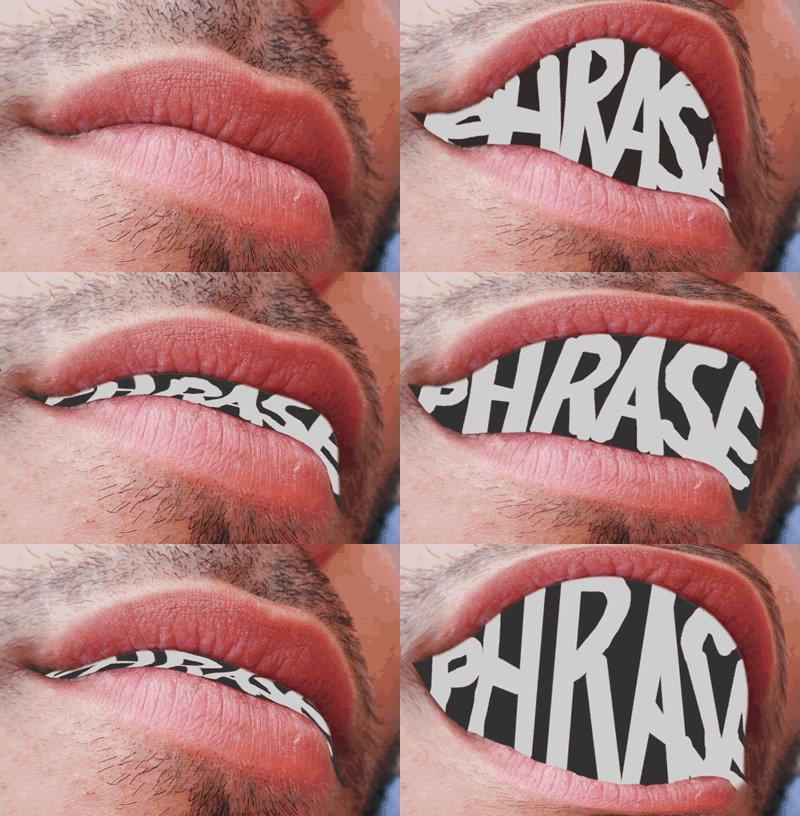
"For a moment a phrase tried to take shape in my mouth and my lips parted like a dumb man’s..."
"... as though there was more struggling upon them
than a wisp of startled air."
That's today's sentence in the "Gatsby" project, in which we isolate one sentence, each day, from "The Great Gatsby" and try to figure out what the hell is going on.
This one isn't hard. It's just a guy trying to talk. Imagine how you would write this sentence if you only wanted to express: I had trouble talking. There's only a slight chance you'd end up with a sentence this long. And if you did, could you have sustained the drama like this, from moment to air? What lightness in moment and a phrase trying to take shape, then blah blah blah wisp of started air.
The narrator is struggling to speak, and the author is struggling to drag out a long sentence about this struggle. It's a sentence that begins and ends in lightness and that has heaviness in the middle. I'm counting 3 things as heavy: 1. the near redundancy of mouth and lips (each with its own my), 2. the intrusion of the unwanted character a dumb man, and 2. more struggling upon them than.
There was nothing but air on the man's mouth-and-lips, but it seemed like more could be there, struggling.
ADDED: Chip Ahoy animates the sentence:

than a wisp of startled air."
That's today's sentence in the "Gatsby" project, in which we isolate one sentence, each day, from "The Great Gatsby" and try to figure out what the hell is going on.
This one isn't hard. It's just a guy trying to talk. Imagine how you would write this sentence if you only wanted to express: I had trouble talking. There's only a slight chance you'd end up with a sentence this long. And if you did, could you have sustained the drama like this, from moment to air? What lightness in moment and a phrase trying to take shape, then blah blah blah wisp of started air.
The narrator is struggling to speak, and the author is struggling to drag out a long sentence about this struggle. It's a sentence that begins and ends in lightness and that has heaviness in the middle. I'm counting 3 things as heavy: 1. the near redundancy of mouth and lips (each with its own my), 2. the intrusion of the unwanted character a dumb man, and 2. more struggling upon them than.
There was nothing but air on the man's mouth-and-lips, but it seemed like more could be there, struggling.
ADDED: Chip Ahoy animates the sentence:
Tuesday, February 5, 2013
"He knew that when he kissed this girl, and forever wed his unutterable visions to her perishable breath..."
"... his mind would never romp again like the mind of God."
That's a challenging one, today's sentence in the "Gatsby" project (wherein we examine, each day, one sentence, out of context, from "The Great Gatsby").
I'm seriously intimidated, because I can't bust out of the sentence to get a grasp of how it can be that his mind is, pre-kiss, romping like the mind of God. Oh, but suddenly it's clear! If he kisses her, he enters the concrete word, where one specific thing after another will happen. But before he takes that action, he exists within imagination — his unutterable visions. There's so much to gain and so much to lose. Within imagination, he is like God, fully free. Anything — everything — can happen. You throw that all away if you kiss her. To kiss her is not to marry her, but there is a wedding: of the mind to the body, the perishable breath.
And quite aside from the man and the resisted kiss, there's an assertion about God. God has a romping mind.
ADDED: Chip Ahoy animates the sentence:

That's a challenging one, today's sentence in the "Gatsby" project (wherein we examine, each day, one sentence, out of context, from "The Great Gatsby").
I'm seriously intimidated, because I can't bust out of the sentence to get a grasp of how it can be that his mind is, pre-kiss, romping like the mind of God. Oh, but suddenly it's clear! If he kisses her, he enters the concrete word, where one specific thing after another will happen. But before he takes that action, he exists within imagination — his unutterable visions. There's so much to gain and so much to lose. Within imagination, he is like God, fully free. Anything — everything — can happen. You throw that all away if you kiss her. To kiss her is not to marry her, but there is a wedding: of the mind to the body, the perishable breath.
And quite aside from the man and the resisted kiss, there's an assertion about God. God has a romping mind.
ADDED: Chip Ahoy animates the sentence:

Monday, February 4, 2013
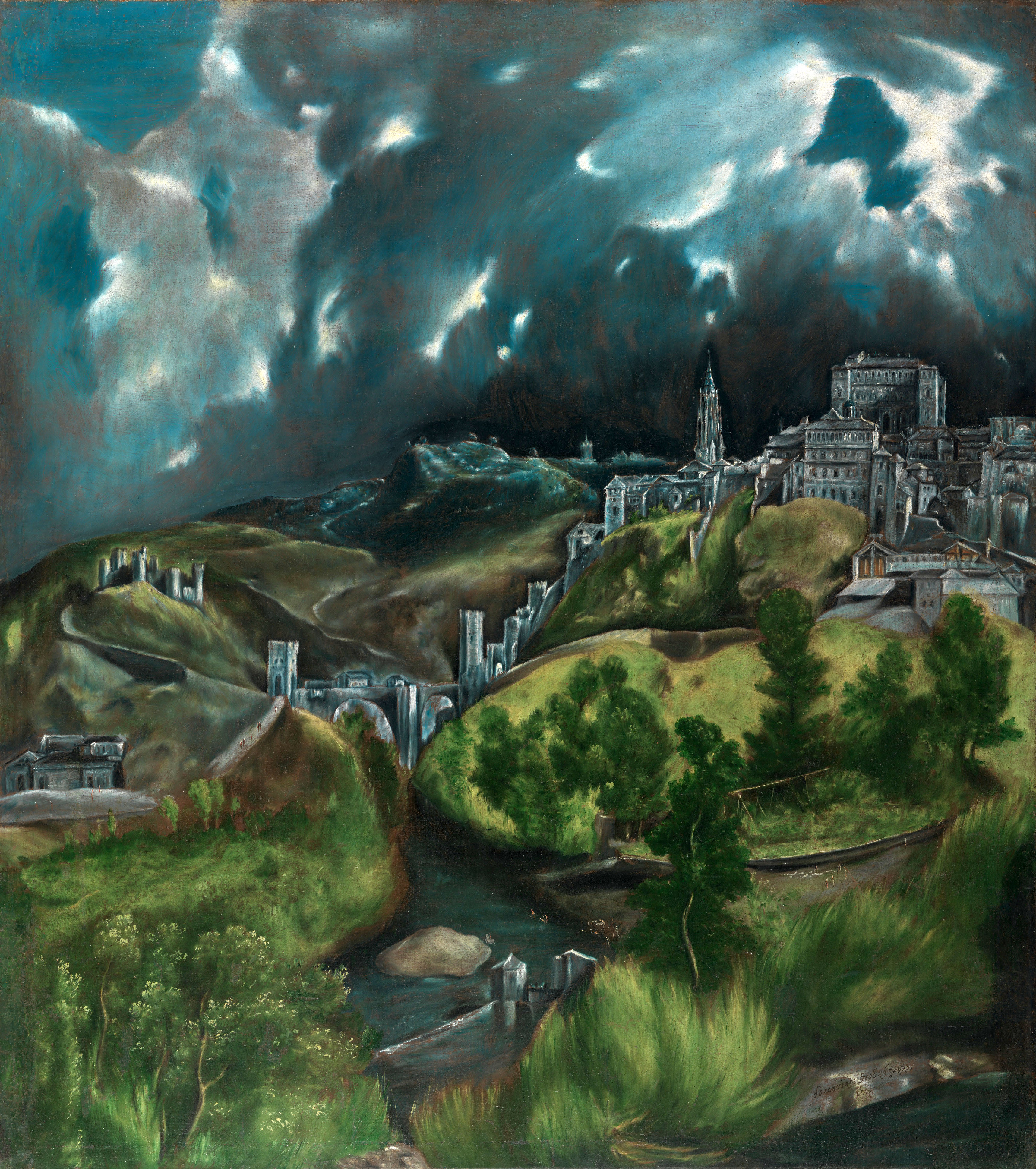
"I see it as a night scene by El Greco: a hundred houses, at once conventional and grotesque, crouching under a sullen, overhanging sky and a lustreless moon.
This is the picture — I assume — that F. Scott Fitzgerald had in his head...

... when he wrote that sentence, which is today's sentence from "The Great Gatsby." (Every day we isolate and talk about one sentence from "The Great Gatsby.")
El Greco painted that "View of Toledo" circa 1600. That seems too long ago for a man to have been painting like that. It's hard to understand how that could have happened. But maybe you are thinking: Toledo!? Was that part of the Ohio Inquisition we were just talking about?
I'll remind you once again of the look for the light question that almost always works in "Gatsby" sentences. Here we've got the absence of light. After last night, when Gatsby was his own light source...

(GIF by Chip Ahoy.)
.... tonight we have the moon and it is lustreless.
Lustre is a lovely word, evoking lust, though its lineage is different. Lust comes from the Germanic, and lustre comes from the Latin and is all about illumination. "The quality or condition of shining by reflected light; sheen, refulgence; gloss," says the OED. But here there is no light to the moon. Lustreless. It's a night scene. There are houses, here in America, not off in Spain, but you get the picture. It's like that El Greco. And in case you don't see it clearly — F. Scott Fitzgerald has a bunch of adjectives to make the point: conventional, grotesque, crouching, sullen, overhanging, and — as noted — lustreless.
Even as there is contradiction in depriving the moon of its light, we've got contradiction in conventional and grotesque. It's an ordinary scene, houses on a landscape at night. But see it as grotesque. Put your El Greco distortion glasses on. Did you know that the etymology of the word grotesque has to do with painting and that, like El Greco's painting, it goes back to 1600?
... when he wrote that sentence, which is today's sentence from "The Great Gatsby." (Every day we isolate and talk about one sentence from "The Great Gatsby.")
El Greco painted that "View of Toledo" circa 1600. That seems too long ago for a man to have been painting like that. It's hard to understand how that could have happened. But maybe you are thinking: Toledo!? Was that part of the Ohio Inquisition we were just talking about?
I'll remind you once again of the look for the light question that almost always works in "Gatsby" sentences. Here we've got the absence of light. After last night, when Gatsby was his own light source...
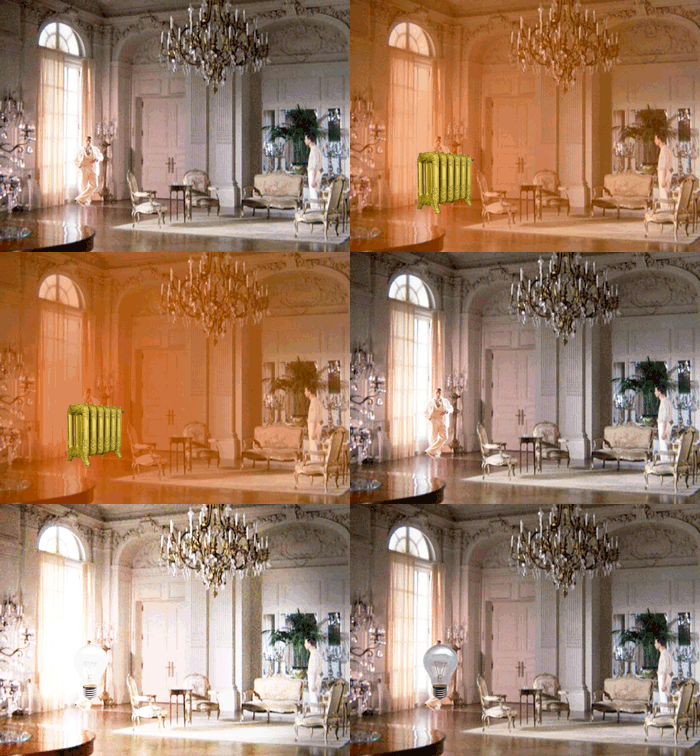
(GIF by Chip Ahoy.)
.... tonight we have the moon and it is lustreless.
Lustre is a lovely word, evoking lust, though its lineage is different. Lust comes from the Germanic, and lustre comes from the Latin and is all about illumination. "The quality or condition of shining by reflected light; sheen, refulgence; gloss," says the OED. But here there is no light to the moon. Lustreless. It's a night scene. There are houses, here in America, not off in Spain, but you get the picture. It's like that El Greco. And in case you don't see it clearly — F. Scott Fitzgerald has a bunch of adjectives to make the point: conventional, grotesque, crouching, sullen, overhanging, and — as noted — lustreless.
Even as there is contradiction in depriving the moon of its light, we've got contradiction in conventional and grotesque. It's an ordinary scene, houses on a landscape at night. But see it as grotesque. Put your El Greco distortion glasses on. Did you know that the etymology of the word grotesque has to do with painting and that, like El Greco's painting, it goes back to 1600?
c.1600s, originally a noun (1560s), from Middle French crotesque (16c., Modern French grotesque), from Italian grottesco, literally "of a cave," from grotta (see grotto). The usual explanation is that the word first was used of paintings found on the walls of basements of Roman ruins (Italian pittura grottesca), which OED finds "intrinsically plausible." Originally "fanciful, fantastic," sense became pejorative after mid-18c.Grotesque was a happier concept 300 years ago. Who knows what happened in grottoes back then?
Sunday, February 3, 2013
"He literally glowed; without a word or a gesture of exultation a new well-being radiated from him and filled the little room."
There's today's sentence from "The Great Gatsby," in the long-running Althouse blog show called The "Gatsby" Project.
Where do we go with this one? Must we dither over the old hobby-horse "literally"? Did Gatsby literally glow? Was he heated to the point of incandescence? I'd say that F. Scott Fitzgerald continually uses metaphor, asserting that things are other than what they are, without the prissy distance of clutter words like like and as if, so what does it matter if he intensifies one of these assertions with literally?
He glowed. And he radiated. It filled the room. He's an incandescent light-bulb. There are, I assure you, no fluorescent bulbs in "Gatsby." There are a few candles, including 4 that Daisy snaps out with her fingers. There's particularity about lighting in this book. Daisy prefers the sun. Literally.
I've said before that one thing I've learned, reading "Gatsby" sentences, is that if you're having trouble finding a way in: Look for the light. Today, the light source is obvious: It's the man himself, Gatsby.
But, the truth is, I'm not having trouble finding a way into this sentence. It jumped out at me because of the word "exultation," which is there in the negative: There isn't any exultation, not in word or gesture. It's a situation where Gatsby might have exulted, and the glowing/radiation came right out of his skin.
We were just talking about exulting. We were mock exulting at a minor tribulation that afflicted someone we sometimes slightly pretend we don't like, and then we were mock chiding each other for inappropriate exultation. It was nothing, really. Just some passing amusement at the idea of the flimsy sin of exultation.
The original meaning — OED — of exult, now obsolete, is "To spring or leap up; to leap for joy." That physical image is lost now, and it means — literally, now — "To rejoice exceedingly, be elated or glad; to triumph."
Where do we go with this one? Must we dither over the old hobby-horse "literally"? Did Gatsby literally glow? Was he heated to the point of incandescence? I'd say that F. Scott Fitzgerald continually uses metaphor, asserting that things are other than what they are, without the prissy distance of clutter words like like and as if, so what does it matter if he intensifies one of these assertions with literally?
He glowed. And he radiated. It filled the room. He's an incandescent light-bulb. There are, I assure you, no fluorescent bulbs in "Gatsby." There are a few candles, including 4 that Daisy snaps out with her fingers. There's particularity about lighting in this book. Daisy prefers the sun. Literally.
I've said before that one thing I've learned, reading "Gatsby" sentences, is that if you're having trouble finding a way in: Look for the light. Today, the light source is obvious: It's the man himself, Gatsby.
But, the truth is, I'm not having trouble finding a way into this sentence. It jumped out at me because of the word "exultation," which is there in the negative: There isn't any exultation, not in word or gesture. It's a situation where Gatsby might have exulted, and the glowing/radiation came right out of his skin.
We were just talking about exulting. We were mock exulting at a minor tribulation that afflicted someone we sometimes slightly pretend we don't like, and then we were mock chiding each other for inappropriate exultation. It was nothing, really. Just some passing amusement at the idea of the flimsy sin of exultation.
The original meaning — OED — of exult, now obsolete, is "To spring or leap up; to leap for joy." That physical image is lost now, and it means — literally, now — "To rejoice exceedingly, be elated or glad; to triumph."
1856 E. K. Kane Arctic Explor. II. viii. 90 We..exult to think we need no catering for the morrow.Don't confuse exult with exalt, which means "to raise up... to lift up" and "to praise, extol, magnify." The elevation-related physical image survives:
1865 A. C. Swinburne Satire to C. in Poems & Ballads 50 As plague in a poisonous city Insults and exults on her dead.
1823 C. Lamb Mod. Gallantry in Elia 184 Exalting his umbrella over her poor basket of fruit.And the metaphorical meaning works too:
1832 Blackwood's Edinb. Mag. Feb. 287 Let the rogues swing, And thus be exalted.
1611 Bible (A.V.) Psalms xxxiv. 3 O magnifie the Lord with me, and let vs exalt his name together.There's one other appearance of exult in "The Great Gatsby." It's not the absence of exultation, and it's not Gatsby, it's Tom. He's talking "incessantly, exulting and laughing." Much better to silently incandesce. Exalt appears once:
I stayed late that night, Gatsby asked me to wait until he was free, and I lingered in the garden until the inevitable swimming party had run up, chilled and exalted, from the black beach, until the lights were extinguished in the guest-rooms overhead.Ah, but that's a whole other fat, juicy sentence. We've had our "Gatsby" sentence today, and it's time to snap out the lights on this post. Figuratively.
Saturday, February 2, 2013
At the Cabin-Fever Café...

... we finally got the snow that reopened the ski trails, but it's 4.6 °F — "Feels Like -11 °F" — here in Madison, and that's beyond the point where you can say to yourself be tough, be strong. Not for mere recreation or the general principle of getting out of the house.
Within this shut-in-ism, let me offer another exam in my capacity as Freewheeling Lawprof of the Internet. Open the door to the exam room carefully....
The last exam was in media bias, and some excellent answers were turned in there. This is a difficult assignment for a class in Creative Misinterpretation. You've got to get up to speed with the "Gatsby" project sentences. I think there are about 30 or so of them by now. If you've been following along, you have your favorite phrases — "leaking isolated and unpunctual tears," "contiguous to absolutely nothing," "a puddle of water glaring tragically," "I suppose it is the latest thing to sit back and...," "stirred the gray haze," "warm human magic,""mashed potatoes and coffee," "hot whips of panic," "the frosted wedding cake of the ceiling," "shadows... rouged and powdered," the "continually smouldering" nerves under the "spotted dress," the "crowded hams," cooking things through bewitchery, "suck on the pap of life," "tortuously, fashionably," "the real snow, our snow," nibbling "at the edge of stale ideas," "a Christmas tree of Gatsby’s enormous garden," and — of course — running out of a room calling "Ewing!" and returning with "an embarrassed, slightly worn young man, with shell-rimmed glasses and scanty blond hair."
Either you've been following along or you haven't. If you haven't, you could try to catch up, or you might want to run right out of the room, in which case, just humor me by calling "Ewing!" as you go.
Now, what happened yesterday was that I toyed with the idea, suggested by Original Commenter Genius Palladian, that we should abandon "Gatsby" and switch to "Paradise Lost." I only veered into that because the "Gatsby" sentence included "rivulets," and I looked up "rivulet" in the OED and saw a quote from "Paradise Lost." I found the entire "rivulet" sentence — 18 lines! — and reprinted it in the post, and that led Upstart Commenter Genius betamax3000 to riff in a strange manner:
"The tears coursed down her cheeks — not freely, however, for when they came into contact with her heavily bedded buttocks they assumed an inky color. She went out of the room calling 'Ewing!' and returned in a few minutes accompanied by an embarrassed, slightly worn young man, with shell-rimmed glasses and scanty blond hair. Tears coursed down his cheeks, too, an indefinite procession of cheeks, that rouged and powdered on an invisible ass...."It goes on, collecting and repurposing sentence fragments from past posts (into which we are borne back ceaselessly). That gave me the idea for a new exam. You can decide if you want to compete at the basic or the advanced level. At the basic level, you need only combine fragments from the "Gatsby" project sentences in any way that you think might amuse us.
If you would like to compete at the advanced level, I'm a little worried. You'll have to be very tough. At this altitude, it's 4.6 °F and feels like -11 °F. You have to take the 18 lines of "Paradise Lost" and redo them using the fragments from "Gatsby" project sentences. You know, Gatsby is the snake, trying to get Daisy alone. Daisy is futzing with the drooping flour/flower stalks. The Garden of Eden becomes the "Christmas tree of Gatsby’s enormous garden."
Time limit: You have until the temperature hits 32° in Madison. Answers may be submitted in the comments. Grades will be arbitrary or nonexistent or the incomparable milk of wonder.
Friday, February 1, 2013
"The tears coursed down her cheeks — not freely, however..."
"... for when they came into contact with her heavily beaded eyelashes they assumed an inky color, and pursued the rest of their way in slow black rivulets."
That's the sentence from "The Great Gatsby" today, in the "Gatsby" project.
Tears coursed. The subject and the predicate are right up there at the outset. No teasing about where the foundation of this sentence is. Course is a strange verb for ran. There are reasons to choose the odder word. Course, for example, is more woody, less tinny than ran. The tears coursed, but not freely, because they got stuck on the woman's mascaraed eyelashes. It's thickly applied black mascara. We know it's thickly applied, because it's the excess blobs of mascara that give the impression of beads, and inky means black. So the tears got stuck on the blobs and became a coagulated black liquid, slowed down, but still, on each cheek, a little river, a rivulet.
Is rivulet a strange word? Classical Latin had the word rīvulus and there's rivoletto in Italian. John Milton used rivulet, in 1667, in "Paradise Lost," one of the books my readers urge upon me as they imagine they see the light at the end of the "Gatsby" tunnel. "As my train emerged from the tunnel into sunlight...," I found the rivulet sentence in "Paradise Lost":
No, no, no! I'm too smart to succumb to that temptation. I am not a stooping, drooping blogger. I'm shrinking back into my "Gatsby" tunnel. Tomorrow is Groundhog Day, but I've seen my shadie shadow this evening. I'm frightened, terrified. The unfree tears course down my cheeks, slowed by the speed bumps of inky mascara.
That's the sentence from "The Great Gatsby" today, in the "Gatsby" project.
Tears coursed. The subject and the predicate are right up there at the outset. No teasing about where the foundation of this sentence is. Course is a strange verb for ran. There are reasons to choose the odder word. Course, for example, is more woody, less tinny than ran. The tears coursed, but not freely, because they got stuck on the woman's mascaraed eyelashes. It's thickly applied black mascara. We know it's thickly applied, because it's the excess blobs of mascara that give the impression of beads, and inky means black. So the tears got stuck on the blobs and became a coagulated black liquid, slowed down, but still, on each cheek, a little river, a rivulet.
Is rivulet a strange word? Classical Latin had the word rīvulus and there's rivoletto in Italian. John Milton used rivulet, in 1667, in "Paradise Lost," one of the books my readers urge upon me as they imagine they see the light at the end of the "Gatsby" tunnel. "As my train emerged from the tunnel into sunlight...," I found the rivulet sentence in "Paradise Lost":
In Bowre and Field he sought, where any tuftOh, come on now! That sentence is absurdly long! And the spelling is so perverse — Bowre and Flour for bower and flower. I like the Roses bushing round as the Snake finds EVE alone. The gay flowers — flours — drooping... interestingly vulnerable. But storn... what is it? Storn! I know it's woody.
Of Grove or Garden-Plot more pleasant lay,
Thir tendance or Plantation for delight,
By Fountain or by shadie Rivulet
He sought them both, but wish'd his hap might find
EVE separate, he wish'd, but not with hope
Of what so seldom chanc'd, when to his wish,
Beyond his hope, EVE separate he spies,
Veild in a Cloud of Fragrance, where she stood,
Half spi'd, so thick the Roses bushing round
About her glowd, oft stooping to support
Each Flour of slender stalk, whose head though gay
Carnation, Purple, Azure, or spect with Gold,
Hung drooping unsustaind, them she upstaies
Gently with Mirtle band, mindless the while,
Her self, though fairest unsupported Flour,
From her best prop so farr, and storn so nigh.
No, no, no! I'm too smart to succumb to that temptation. I am not a stooping, drooping blogger. I'm shrinking back into my "Gatsby" tunnel. Tomorrow is Groundhog Day, but I've seen my shadie shadow this evening. I'm frightened, terrified. The unfree tears course down my cheeks, slowed by the speed bumps of inky mascara.
Thursday, January 31, 2013
Althouse unfair to F. Scott Fitzgerald?
Midway through my journey of isolating and writing about sentences from "The Great Gatsby," I find myself confronted by one creeley23 — a commenter within the confines of this Althouse blog — who says: "Hmm... rereading the first ten pages of Gatsby I see that Ann is picking klunky, atypical sentences out of the text."
I have chosen things like: "Sometimes a shadow moved against a dressing-room blind above, gave way to another shadow, an indefinite procession of shadows, that rouged and powdered in an invisible glass." And: "A breeze blew through the room, blew curtains in at one end and out the other like pale flags, twisting them up toward the frosted wedding-cake of the ceiling, and then rippled over the wine-colored rug, making a shadow on it as wind does on the sea."
But, in my defense, I have also chosen: "A breeze stirred the gray haze of Daisy’s fur collar." And: "Americans, while occasionally willing to be serfs, have always been obstinate about being peasantry."
Remember, the original idea was:
Here's a way the book could be taught in a high school class. (But maybe they'd fire you!) Class, this is a book with some very weird sentences. Who can find one? Students read individual sentences out loud and the teacher cuts and pastes the sentences, so they are projected on the board. Encourage the students to pull out things that are the most outlandish and impossible to understand. Encourage laughter. Email the list of sentences to the class and have them reply to the email cutting out all but one sentence, the sentence they'd most like to talk about. Quickly read the email and pick a sentence that got a lot of attention. Puzzle through what it might mean with the students so that they appreciate the fun of getting wrapped up inside one sentence. Give them 20 minutes to write about one of the other sentences.
Must they read the book? Tell them they can read the book if they want. But tell them they can go to Wikipedia and read the plot summary and the list of characters there. The idea is to spend time with particular sentences and to figure out why someone would write like that. Must they love F. Scott Fitzgerald? No! They can be like Palladian — the original commenter genius of the Althouse blog — who said:
watchword watchphrase of this blog has long been "cruel neutrality." And, indeed, I see that even before I responded to Original Commenter Genius Palladian, he was responded to by Upstart Commenter Genius betamax3000, who said:
But is today the last day? Is it time to move on to "Paradise Lost" or "The Divine Comedy"?
If the assignment were — in this non-existent high school class — to read straight through "The Great Gatsby," you would know when you were done. The hard task your real teacher tasked you with has a knowable end. It's not interminable, even though the word "ceaselessly" is the 4th-to-the-last word. You get to "ceaselessly" and there's "into the past" and you are done. Your reading of "Gatsby" has receded into the past, like last night's huge, hard-to-digest dinner. You wake up with a stomachache. You can't take too much. You only want to nibble at the edges of some stale ideas, like maybe a blog post, a blog post about one sentence. You can nibble, and — in the comments — you can dribble. Like betamax3000 on last night's "Something was making him nibble" post :
I have chosen things like: "Sometimes a shadow moved against a dressing-room blind above, gave way to another shadow, an indefinite procession of shadows, that rouged and powdered in an invisible glass." And: "A breeze blew through the room, blew curtains in at one end and out the other like pale flags, twisting them up toward the frosted wedding-cake of the ceiling, and then rippled over the wine-colored rug, making a shadow on it as wind does on the sea."
But, in my defense, I have also chosen: "A breeze stirred the gray haze of Daisy’s fur collar." And: "Americans, while occasionally willing to be serfs, have always been obstinate about being peasantry."
Remember, the original idea was:
What I like [about "The Great Gatsby"] is that each sentence is good, on its own. Seriously. Test it out. "As my train emerged from the tunnel into sunlight, only the hot whistles of the National Biscuit Company broke the simmering hush at noon." Every sentence is a writer's inspiration....I didn't start a new blog, obviously, only a daily discipline on this blog. I confess to not proceeding by random selection. But I haven't gone searching for "klunky" sentences. I've flipped around in near-random style, though. I don't use the first thing I see. Opening up Chapter 1 right now, I see "I told him" and "We talked for a few minutes on the sunny porch." These are examples of non-"klunky" sentences that I would reject, but not because I'm gunning for F. Scott. My initial motivation was love. I thought of all the high school students — I remember being one — who were assigned this book and made to read the whole thing. That being the task, the really interesting sentences are speed bumps. They're completely annoying. You can't take the time to figure them out. What should be loved is hated. Later in life, I reread the book and enjoyed it, because of the worthiness of individual sentences.
I feel like starting a blog devoted to individual sentences in "The Great Gatsby," chosen randomly, and continuing until all the sentences have been used up.
Here's a way the book could be taught in a high school class. (But maybe they'd fire you!) Class, this is a book with some very weird sentences. Who can find one? Students read individual sentences out loud and the teacher cuts and pastes the sentences, so they are projected on the board. Encourage the students to pull out things that are the most outlandish and impossible to understand. Encourage laughter. Email the list of sentences to the class and have them reply to the email cutting out all but one sentence, the sentence they'd most like to talk about. Quickly read the email and pick a sentence that got a lot of attention. Puzzle through what it might mean with the students so that they appreciate the fun of getting wrapped up inside one sentence. Give them 20 minutes to write about one of the other sentences.
Must they read the book? Tell them they can read the book if they want. But tell them they can go to Wikipedia and read the plot summary and the list of characters there. The idea is to spend time with particular sentences and to figure out why someone would write like that. Must they love F. Scott Fitzgerald? No! They can be like Palladian — the original commenter genius of the Althouse blog — who said:
Has anyone calculated how long this Gatsby project is going to go on? How many sentences are in the book? How many sentences have been covered so far?I said:
I ask partially out of curiosity and partly because I hate "The Great Gatsby". Why couldn't we have done Chaucer or "Paradise Lost" or something?
I don't think the project asks you to like "The Great Gatsby." It should work for the haters. Bring that hate!Palladian said:
That's true! I think the general tone of the comments on these threads led me to think of them as reverential, but your writing about them is actually neutral and occasionally negative.The
"the Inquisition that goes on forever. Interminably."(That's a quote from the post, which is about a "Gatsby" sentence that includes "interminable inquisitions.")
Ann has gone full Althouse Snow Globe Theory now:And there betamax3000 is quoting himself, from this earlier thread, about one of the least "klunky" sentences that has ever found its way into the "Gatsby" project:
"She sets the Snow Globe with cruel neutrality for us to shake and see patterns from the flitter. There is not the expectation of sentimentality. She is asking us to look, together; however, often there is no resolution, each reader seeing only his own flitter of understanding."
"They knew that presently dinner would be over and a little later the evening, too, would be over and casually put away."When can we put this "Gatsby" project away, like a dinner and an evening consumed blandly and casually in the Midwest, where all the Gatsby characters belong?
"I see now that this has been a story of the West, after all — Tom and Gatsby, Daisy and Jordan and I, were all Westerners, and perhaps we possessed some deficiency in common which made us subtly unadaptable to Eastern life."That's a sentence I've been saving, in my holding pen of sentences — "klunky" and not-"klunky" — that might get the nod some day on this project, and I guess I've given that one the nod today.
But is today the last day? Is it time to move on to "Paradise Lost" or "The Divine Comedy"?
If the assignment were — in this non-existent high school class — to read straight through "The Great Gatsby," you would know when you were done. The hard task your real teacher tasked you with has a knowable end. It's not interminable, even though the word "ceaselessly" is the 4th-to-the-last word. You get to "ceaselessly" and there's "into the past" and you are done. Your reading of "Gatsby" has receded into the past, like last night's huge, hard-to-digest dinner. You wake up with a stomachache. You can't take too much. You only want to nibble at the edges of some stale ideas, like maybe a blog post, a blog post about one sentence. You can nibble, and — in the comments — you can dribble. Like betamax3000 on last night's "Something was making him nibble" post :
Re: "Oh! For a minute there, I saw 'nimble,' and I was flummoxed."Is your tummy feeling better now? Maybe saltines and ginger ale would help. That's what my midwest-born-and-raised mother would offer me when I was feeling queasy. But you've got to eat something. You must go on — ceaselessly, interminably — when the project is one sentence a day. One day at a time. One sentence at a time. One nibble at a time. One blog post at a time.
I like nibble better. Not just because it makes me think of squirrels nibbling on a nosh. I often find myself nibbling at the edge of stale ideas. Of course, it is easier to nibble at the edges when the stale idea is square-shaped, like a behind-the-sofa-cushion Cheez-It: there are corners. Corners are the perfect nibble starters. Plus, Cheez-Its -- and the non-square Cheeto, for that matter -- leave your fingers orangey, like all the best ideas, stale or not.
So one morning when the sun was warm
I rambled out of New York town
Pulled my cap down over my eyes
And headed out for the western skies
So long New York
Howdy, East Orange*.
(*"Even when the East excited me most with sprawling, swollen orange fingers: you're gonna have to take notes faster, friends)
Which brings us back to a point: Naked Dylan Robot would love to hear Fitzgerald try to sing some of Fitzgerald's sentences. Naked Dylan Robot would laugh and laugh.
"Everybody's sturdy physical egotism must get stoned."
"When the winds of changes shift
May your malnourished peremptory heart always be joyful
And may your song always be sung
May you stay forever slightly worn, young man, with shell-rimmed glasses and scanty blond hair."
For a writer whose rep is based in large part on making words sing his words just don't... sing. Maybe Naked Albanian Phonetical Dylan Robot could give a try, but I don't think it would get there. Nor Naked Phoenician Dylan Robot, for that matter*.
(*this is -- of course -- self-contradictory: per Wikipedia "in Phoenician writing, unlike that of most later abjads such as those of Aramaic, Biblical Hebrew and Arabic, even long vowels remained generally unexpressed, and that regardless of their origin". No Naked Dylan Robot of any proud heritage could forsake the long vowels: exps: oooohhhhhmaaa-ma is this reaaaaaaally the eeeeend, etc etc).
Perhaps Naked Dylan Fitzgerald Cow could make a go of the following:
Now you see this one-eyed midget
Shouting the word "MOO
And you say, "For what reason ?"
And he says, "Hoo?"
And you say, "What does this mean ?"
And he screams back, "You're a cow
Give me some milk
Or else go home".
-- but Naked Dylan Fitzgerald Cow is a Talent. And not afraid to nibble, stale or no. Someone should make a Snow Globe for Naked Dylan Fitzgerald Cow: Ann could put it next to her Robot on her desk and take a picture. I would call in sick to work the next day.
Subscribe to:
Posts (Atom)
 :.
:.

