Pages

Labels

Showing posts with label David Gregory. Show all posts

Sunday, February 10, 2013

Is Eric Cantor making a conscious attempt to talk like Barack Obama?

It really struck me today on "Meet the Press," and when I commented on it, Meade said he'd already been thinking that. I know the exact point in the transcript when the realization occurred to me. David Gregory was questioning Cantor about whether the GOP needs something more than "re-branding": "Isn't it some of the central beliefs in the Republican Party that have hurt it with the electorate?"

Cantor said (transcript, video):

David, what I talked about this week at AEI was the need for us to connect our conservative principles with helping people and making their life work again. And I've talked about a man who is a dad here in the inner city of the District of Columbia who, all he wanted was to find a safe place for his kids to learn. He's got four kids.

And he discovered, after having fought with the local school system....

I talked about working parents who are hourly wage earners who are having a tough time getting through the month right now. Those are the things that people-- that we've got to be concerned about. I don't think that Joseph Kelly, the dad here in The District of Columbia, cares one iota about re-branding the Republican or the Democratic Party.
That sentence I've boldfaced is the one that struck me as perfectly Obamaesque. The yellow highlighting marks a key Obamaesque repetition.
I think what we care about, and what he cares about, is his kids. And that's where Washington really needs to remember is these are real problems. These people are having a tough time. And we ought to be about providing relief to those who don't have a job and those who do... making their life work again...
You know, I've got a constituent, she's 12 years old, her name is Katie. She was diagnosed with cancer at age one. I mean can you imagine? That is a parent's nightmare, the worst nightmare.

And the federal government's got a role in research, in basic medical research, trying to find cures for disease. We can work together on something like that.... you've got so many millions of Americans who feel that they have become an afterthought. My purpose in saying this is we have conservative principles that actually can work for their life again....
The work-life-again combination can be switched around. The words are so generic. People have lives and the lives need to work. The GOP can make their lives work, and the GOP can work for their lives. Again.

The GOP, working for your life again, so your life can work again.

Monday, January 14, 2013

"Must you always be out in that ghastly clown suit, running around annoying people?"

Says Pretty Alice to the Harlequin in Harlan Ellison's "Repent Harlequin!' Said The Ticktockman," which I read on the urging of commenter Icepick because of the way it reflected on the recent news stories about Aaron Swartz, David Gregory, and the Boston ban on drinking games.

I downloaded this Orson Scott Card collection — "Masterpieces: The Best Science Fiction of the 20th Century" — which included "Repent Harlequin," because I wanted to understand this harlequin/ticktockman distinction, and lo and behold here's the harlequin — actually, what do you expect? he's a harlequin — wearing a clown suit, when just 5 days ago, the bloggism of the day was clown suits. We were pimping clown suits.


It's weird how these themes seem to coagulate on their own.


IN THE COMMENTS: Astro said points out that my Picasso clown isn't a harlequin. I need to be better about specifying the Commedia dell'arte characters. Here's a Picasso harlequin (on the right):

Aggressive prosecution #1: California businessman commercially growing medical marijuana.

Adam Nagourney, in the NYT, gives very sympathetic treatment to Matthew R. Davies — "a round-faced 34-year-old father of two young girls" with "graduate-level business skills" who "paid California sales tax and filed for state and local business permits" and got the advice of many lawyers as he set up an enterprise that plainly and overtly is a felony under federal law. Davies told the NYT:
“We thought, this is an industry in its infancy, it’s a heavy cash business, it’s basically being used by people who use it to cloak illegal activity. Nobody was doing it the right way. We thought we could make a model of how this should be done.”
Cloak illegal activity? It is illegal activity. Federal law is real. Haven't you heard?!

The right way? Cloaking is the right way when you're committing crimes. With your business education, somehow you were all: Hey, what a smart idea I have — being completely out in the open about breaking the law. Why hasn't anybody else thought of this?

And I love the way the NYT suddenly has a pro-business orientation. Davies deserves special grace under the law because he's using the structure of business and because he's excited about making big profits! Compare that to all the articles anguishing over Citizens United and how terrible it is to respect free speech rights when the speech comes from a place that is structured as a business.
“Mr. Davies was not a seriously ill user of marijuana nor was he a medical caregiver — he was the major player in a very significant commercial operation that sought to make large profits from the cultivation and sale of marijuana,” [said a letter from United States attorney for the Eastern District of California, Benjamin B. Wagner, a 2009 Obama appointee.] Mr. Wagner said that prosecuting such people “remains a core priority of the department.”...

“It’s mind-boggling that there were hundreds of attorneys advising their clients that it was O.K. to do this, only to be bushwhacked by a federal system that most people in California are not even paying attention to,” said William J. Portanova, a former federal drug prosecutor and a lawyer for one of Mr. Davies’s co-defendants. “It’s tragic.”
Yes, and it is mind-boggling that those who argue for the broad interpretation of federal power and who scoff at the idea of the 10th Amendment and reserving powers to the state somehow can't grasp the meaning of their general propositions when they encounter an issue where they prefer the state policy to the federal policy. The NYT and other drivers of elite opinion ought to have to face up to the reality of what their legal propositions entail.

And quite aside from the problem of the allocation of power at the federal and the state levels, how about some consistency about equal justice under the law? Let the law — as written — apply the same way to everyone, whether they have a round face and 2 young daughters or not, whether they've gone to grad school or not, whether they have big visions of massive profits or they are living hand to mouth. If the law is wrong, change the law — for everybody. Don't cry over the people you think are nice — like David Gregory and Aaron Swartz. Nonphotogenic and low-class people deserve equal treatment, and cutting breaks for the ones who pull your heart strings is not justice.

Sunday, January 13, 2013

"I was reckless writing about recklessness."

I say, noting that I got quoted over at Instapundit with a missing "it's" apostrophe: "he’s entirely reckless about what these laws would really mean to ordinary people, and its a recklessness that thrives in the mind of someone who...."

"Oh! It's blogging," says Meade. "It's the internet. Think how many times you've gotten it right."

"And it's more embarrassing to get the apostrophe wrong the other way," I soothe myself, referring to  putting the apostrophe in "its" when it's supposed to be out.

"It's embarrassing to be embarrassed," Meade asserts aphoristically.

"But I was criticizing recklessness at the very point when I was reckless," I brood nonetheless. "It's like the way whenever you mock a misspelling, you end up misspelling something."

I decide to write this post, which — speaking of blogging — is the antidote to embarrassment.

***

On the rooftops they dance
Valentino-type tangos
While the makeup man’s hands
Shut the eyes of the dead
Not to embarrass anyone
The sky is embarrassed
And I must be gone 

Saturday, January 12, 2013

"If there were equal justice under the law, what would be the point of being a Very Important Person?"

Asks Glenn Reynolds after quoting me on David Gregory and equal justice under the law.

I'm working on my song parody:
David Gregory had a high-capacity ammunition magazine
He held it and twirled it 'round his diamond ring finger
At a "Meet the Press" studio society gath’rin’
And the cops weren't called in but the bloggers demanded
That David Gregory should be booked for possession
Take the rag away from your face
Now ain’t the time for your tears....
I've parodied that song before (back when William Zantzinger died).

This isn't parody — this is straight from the original "Lonesome Death of Hattie Carroll":
In the courtroom of honor, the judge pounded his gavel
To show that all’s equal and that the courts are on the level
And that the strings in the books ain’t pulled and persuaded
And that even the nobles get properly handled
Once that the cops have chased after and caught ’em
And that the ladder of law has no top and no bottom
In David Gregory's case, the cops never even considered chasing him. There will be no judge pounding the gavel, because there will be no prosecution. Bob Dylan was outraged that Zantzinger — Zanzinger, to spell it the Dylan way — got a light sentence. At least he went to trial. And he was convicted.

Here, the "noble" David Gregory got special handling, the strings in the books were pulled and persuaded, and the ladder of law obviously has a top.

I'm not saying I want Gregory prosecuted. I only want people to see how unfair it is to have a law that seems ridiculous to enforce against him, when that law is used against others. And Gregory richly deserves to be slapped around on the blogs, because he's making the argument — that's why he was waving that thing around — that there ought to be more invasive gun laws. He wants the government to reach more deeply into the ordinary lives of private citizens, and he's entirely reckless about what these laws would really mean to ordinary people, and it's a recklessness that thrives in the mind of someone who easily and instinctively believed — correctly! — that the law did not apply to him.

And even the nobles get properly handled....

Friday, January 11, 2013

D.C. attorney general confirms that law is for the little people.

No charges will be filed against David Gregory "despite the clarity of the violation of this important law, because under all of the circumstances here a prosecution would not promote public safety in the District of Columbia nor serve the best interests of the people of the District to whom this office owes its trust."

The clarity of the violation of this important law....

Why is the law important? If Gregory clearly violated the law, but there is no interest to be served in prosecuting him, doesn't that prove that the law is not important? If the precise thing that he did — which is clearly what is defined as a crime — raises no interest in prosecution, how can we be satisfied by letting this one nice famous man go? Rewrite the law so that it only covers the activity that the government believes deserves prosecution, so there is equal justice under the law.

Sunday, December 30, 2012

Obama seems amenable to the NRA idea of armed guards in schools.

On today's "Meet the Press": David Gregory asked him what he thought of having "armed guards at every school in the country," adding "That's what the NRA believes. They told me last week that could work." Obama said:
You know, I am not going to prejudge the recommendations that are given to me. I am skeptical that the only answer is putting more guns in schools. And I think the vast majority of the American people are skeptical that that somehow is going to solve our problem. 
Of course, we are also skeptical that gun control is going to solve our problem. My only point here is that Obama didn't denounce the idea and treat it as crazy, which seemed to be the left/liberal spin last week after NRA CEO Wayne LaPierre made the proposal. Obama is saying that the idea deserves consideration. And to say you doubt that it's the "only answer" is to imply that it may belong in a package of items that together are the answer. In fact, later, he said: "I'm going to be putting forward a package..."


Obama went on to say that he was going to follow "the old adage of Abraham Lincoln's":
That with public opinion there's nothing you can't do and without public opinion there's very little you can get done in this town. 
That's a paraphrase. What Lincoln actually said was: "In this and like communities, public sentiment is everything. With public sentiment, nothing can fail; without it nothing can succeed. Consequently he who moulds public sentiment, goes deeper than he who enacts statutes or pronounces decisions. He makes statutes and decisions possible or impossible to be executed." I'll leave it to you to decide who's the better wordsmith.

By the way, when did Washington folk acquire the habit of tacking "in this town" onto every other sentence? And don't you think there's an interesting difference between "opinion" and "sentiment"?

Further evidence that liberals have given up on demonizing LaPierre came from Dianne Feinstein on "Fox News Sunday" today. She's going to introduce a bill banning assault weapons and magazines that hold more than 10 rounds of ammunition, and moderator Chris Wallace asked her "Why is that more effective than the NRA proposal to put armed guards in every school?" She said:
Well, in the first place, 1/3 of America's public schools does have armed guards. 
Ha! No wonder the spin has shifted. You can't call it sheer lunacy if it's happening in 1/3 of the schools already. Too bad the liberal sentiment molders didn't check the facts first. Too bad they had a hair trigger.

On "Meet the Press" today, Obama mostly came across as the moderate, pragmatic politician I like.

Now, I'm not a sucker for mere posing, and in fact, I get suspicious when I hear what are simply assertions of pragmatism:
But generally if you look at how I've tried to govern over the last four years and how I'll continue to try to govern, I'm not driven by some ideological agenda. I am a pretty practical guy. And I just want to make sure that things work. And one of the nice things about never having another election again, I will never campaign again, is I think you can rest assured that all I care about is making sure that I leave behind an America that is stronger, more prosperous, more stable, more secure than it was when I came into office.
Well, no, I'm not going to rest assured. Much as I would love these statements to be true, they make me nervous. And that assurance came right after the most partisan thing he said in the whole interview. The moderator, David Gregory, had asked Obama how "frustrated" he was about the difficulty of getting things done with Congress. Gregory asserted that people were constantly coming up to him saying "Don't they realize, all of them, the president, Republicans and Democrats, how frustrated we all are?" And President Obama showed a little irritation:
Well, I think we're all frustrated. The only thing I would caution against, David, is I think this notion of, "Well, both sides are just kind of unwilling to cooperate." And that's just not true. I mean if you look at the facts, what you have is a situation here where the Democratic party, warts and all, and certainly me, warts and all, have consistently done our best to try to put country first.
Country first. Where'd he come up with that slogan?


Then Obama started inching away from this assertion that the Democrats are better. He shifts to more neutral boilerplate about trying "to work with everybody involved to make sure that we've got an economy grows" and "Make sure that it works for everybody. Make sure that we're keeping the country safe." Then he retreats again, making abstract concessions (in question form):
And does the Democratic party still have some knee jerk ideological positions and are there some folks in the Democratic party who sometimes aren't reasonable? Of course. That's true of every political party.
So are the Democrats better or not? He's melted into squishy blandness. And it's exactly here that he does the not-an-ideologue/practical-guy riff that appears at the beginning of this post.

Friday, December 28, 2012

"Gregory had no intent to commit a crime; he was committing journalism instead."

"Gun owners often say they want the government to leave them alone; why then are some clamoring for Gregory to be prosecuted?"

Asks Howard Kurtz, with amazing naivete. The implied argument is quite weird and perverse.

First, he's got this either/or premise: If you're doing one thing, you're not doing something else. If you're doing journalism, you can't also be doing something else. That might make sense if the crime in question had a required mental element that would be negated by the intent to "commit journalism," but it doesn't. Mere possession is enough. The most virtuous individuals with the best intentions get stuck with this law applying to them. If you don't like that, then you don't like this law. You've got an objection to the law, and yet, ironically, Gregory was arguing for more laws like that! That was the nature of the "journalism" he was "committing." He ought to be the first one prosecuted, not the last.

Second, Kurtz, a journalist himself, is mired the same sense of entitlement that people are objecting to in Gregory. He thinks journalists are special people who float above it all, who don't live in reality. You are the very people who are supposed to be observing reality, understanding it, and explaining it. But you don't even see that you are part of it. You have less awareness of it than the people you're getting paid to inform. Maybe you think you're just too important to have your time wasted by consequences that would befall ordinary people. You need to be free to continue to sit there mouthing outrage about the next terrible thing that befalls some ordinary person out there in the real world.

Third, Kurtz thinks he's caught others in hypocrisy. If gun owners want the government to leave them alone, why would they want Gregory to be prosecuted? It's like Kurtz wants us to laugh in his face. Yet he seems to think he's being quite clever. Why would he think that? Puzzling, isn't it? My only answer is that he does not believe in the rule of law. It doesn't occur to him that what gun owners who "want the government to leave them alone" want is for legislatures to refrain from passing laws and to repeal existing laws and for courts to declare laws null under the Second Amendment. Why should these people like it if one privileged, prominent man escapes prosecution? The laws remain, affecting everyone else, even as the oppressiveness of the laws is falsely minimized.

I finally figured out what David Gregory displaying that prop reminds me of.

Yesterday, I was asking: Why was that prop so important to David Gregory? If possession of that high-capacity magazine was a crime, and the NBC folk knew it and had even contacted the police and thus even knew they'd created rock-hard evidence that they knew it, why did they go ahead and have Gregory flaunt that illegal possession on television? They had to have thought it was a devastatingly powerful prop. My first guess was that they imagined that viewers — some viewers, at least — would find the object itself scary.

Now, I've got to show you another one of Chip Ahoy's little riffs, because it's what jogged my thinking on the subject for some reason. Here's Chip in the comments thread to that other post, the one where I showed those David Gregory masks (designed by Chip). This is a little dialogue:
"No. It doesn't look that threatening to me. If that's what you were thinking. No. It just doesn't."

"What do you mean? Are you insane? This magazine holds thirty rounds."

"So."

"So? So? So? Is that all you got? It holds thirty!"

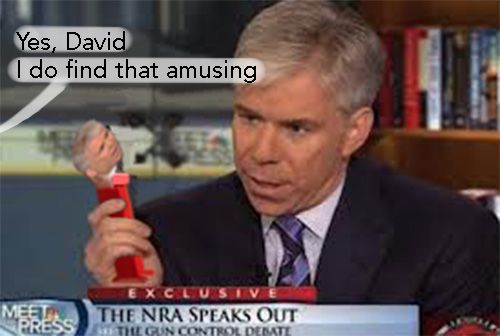
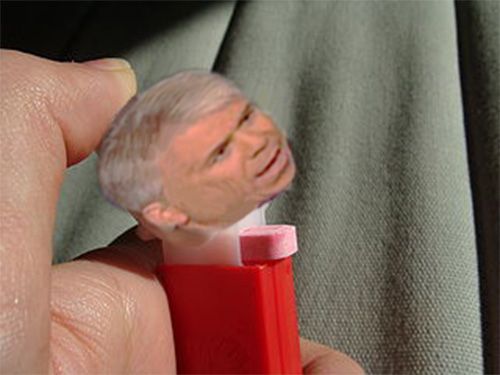
"So. It's small. Looks like a PEZ dispenser to me."

"WHAT? So, this is amusing to you? You find this amusing."


Caption: "It holds 30." I'm not sure exactly why that jogged my thinking, but suddenly I understand the drama Gregory (and his people) were trying to enact. It's a deep psychic memory of childhood. Gregory sought dominance over his interlocutor, NRA CEO Wayne LaPierre, and the idea — in the act of picking up that magazine and beginning an interrogation about it — was that Gregory would become (subliminally) a parent figure who would push LaPierre into the subordinate role of the little boy, the cowering child confronted with undeniable evidence of his wrongdoing. What's THIS I found in your room?

The plan was for LaPierre to babble lamely, scrambling to explain it away, like the kid trying to concoct some cockamamie reason why that (whatever) got into his room. He'd look foolish and guilty, as Dad continues to hold up the item which the kid knows will be the defeat of every idea that flashes through his stupid, stupid brain.

The scenario didn't play out as scripted. LaPierre is a stolid veteran of many a confrontational interview. He's not going to let the interviewer get the upper hand that easily. Somebody needs to tell Gregory: We all want the hand. Hand is tough to get.

Thursday, December 27, 2012

"Tired of being stopped at airports? Can you do without all the hassles of unreasonable arrests?"

"Had it up to here )) skeet (( *cut at the neck* with all those intolerable fines and inconsistently applied regulations and restrictions?" asks Chip Ahoy, offering these Official Washington, D.C. Gun Passes in sturdy laminate/sun proof colors/long lasting bands/Large holes for clear vision/slip proof:


Why was that prop so important to David Gregory?


"Yeah, asking for permission is pretty damning when you ignore what you are told directly from the law enforcement authority and do it anyway."

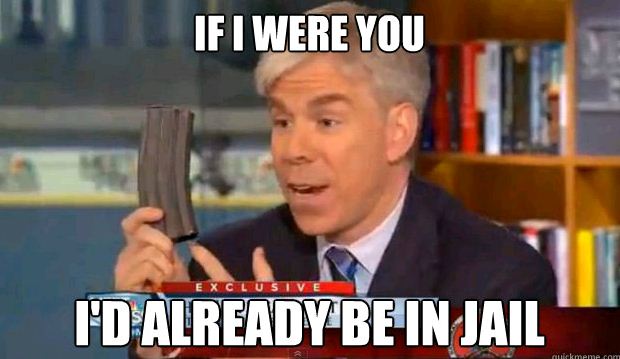
But what it tells us is that the prop was really, really important to Gregory. Let's think about why. He knew he was going to have NRA CEO Wayne LaPierre across the table and that he'd push him with one question after another, building the pressure. Here's how that moment looked:


You hear the tension in Gregory's voice as he's about to confront LaPierre with the prop — actually 2 props: the high-capacity magazine and then the smaller one. At the point when Gregory picks up the first prop, you see his eyes dart over to the side. He doesn't have the script memorized, but the precise text is important as he displays one prop and then the other. He need the prompter.

Of course, if this prop display is supposed to be explosive, it doesn't work, because LaPierre is good at not getting agitated. Predictably good, so Gregory's routine looks silly to me. But maybe it inflamed some people in the "Meet the Press" viewership. Maybe there were lots of folks at home going "OMG that thing is huge!!"

I'm trying to think of other examples in political/policy debates when somebody whipped out a prop for dramatic effect. Especially examples where it really worked. I remember President Clinton waggling his pen. Anything else?

ADDED: I was thinking about the value of a fetus replica for a pro-lifers, and, googling, happened upon this 3D-printed replica made from an MRI image.

UPDATE: I figured it out!

Wednesday, December 26, 2012

"NBC's David Gregory, the subject of a now-popular police investigation..."

Politico's Dylan Byers seems to think the deliberate flouting of D.C. gun laws — committing a crime, knowingly, right there on network TV — is some kind of absurd winger obsession.

Tuesday, December 25, 2012

The DC police are investigating the David Gregory incident "to determine if the magazine was in fact real."

Breitbart.com reports (and quotes the criminal statute).

What's to investigate? Here's the "Meet the Press" transcript. Gregory said:
Let's widen the argument out a little bit. So here is a magazine for ammunition that carries 30 bullets. Now isn't it possible that, if we got rid of these, if we replaced them in said, "Well, you could only have a magazine that carries five bullets or ten bullets," isn't it just possible that we can reduce the carnage in a situation like Newtown?
Either he violated the criminal law or he lied. He certainly expected us to believe he held in his hand what he said he held. What made him think he could do that (or appear to do that)? He must think the law doesn't apply to him, or he wouldn't even pretend to break it.

IN THE COMMENTS: rhhardin said:
It seems like a chickenshit complaint, and a chickenshit law.

But Gregory is advocating that, which reaches mostly into humor.

He has to pretend to take seriously what he doesn't take seriously.

Monday, December 24, 2012

"Certainly, if LaPierre had shown up with that magazine, there would be howls of gotcha, and widespread media demands for prosecution.

"Why should NBC News and its star be above the law?"

David Gregory, neatly tweaked...

... by Drudge (in Christmas colors):


The links are: "Did David Gregory Violate DC Gun Law On National TV?" and "Mocks NRA Chief for Proposing Armed Guards; Sends Kids to High-Security School..."

And here's the transcript for the whole interview. We watched it. Gregory was all heated up, eager to extract his sound bites from LaPierre, in the typical style of recent gun control debates I've seen, like this one between Bob Wright and Jacob Sullum. The one who wants gun control cranks up the emotion, and the gun control opponent stolidly stands his ground.

It's like they intended to make an implicit argument, premised on the question: This is what a human being is like; do you want people to have guns? The gun control advocate models the answer "no" (because people run on emotion and might do unpredictable, regrettable things). The gun control opponent models the answer "yes" (because people are stable and rational).

It's all about control: Do you think people are self-controlled or is government control needed? And now, I see this post is about to bust loose into a much more general set of observations about politics, and I don't want to do that. This is a blog post, the first of the day, and it needs to come to an end. So let me leave you with 3 brief bonus observations:

1. David Gregory was not appearing on "Meet the Press" as a gun control advocate. He's the moderator... some sort of "journalist."

2. If a new federal gun control program includes a buy-back of some newly banned "assault" weapons, it will be like Cash for Clunkers. I hated Cash for Clunkers.

3. The post-Newtown gun control advocates have been emphasizing the gun, rather than the person, on the theory that a person may have murderous impulses but if he doesn't have a gun, he won't be able to do as much damage. But in real life, if you had someone in you midst who was bent on murder, you would not think: Well, at least he doesn't have a gun. If he goes off, what's the worst he can do, maybe 4 or 5 kids, max?

Sunday, November 18, 2012

Lindsey Graham was on fire on "Meet the Press" today.

About the Benghazi attack and the statements various people made about it:
... I think one of the reasons that Susan Rice told the story she did, if the truth came out a few weeks before the election that our consulate in Benghazi, Libya, had been overrun by an al Qaeda sponsored or affiliated militia, that destroys the narrative we’ve been hearing for months that al Qaeda has been dismantled, bin Laden is dead, we’re safer.... [T]he story she told reinforced a political narrative helpful to the president, but disconnected from reality....

The president said, why pick on her? She didn’t know anything about Benghazi. She was the most politically compliant person they could find.... Would this White House mislead the American people about national security events? I think they might simply because when the bin Laden raid occurred, they leaked every detail about the raid....

There are 10 militia groups all over Benghazi. I blame the president for…making this a death trap. I blame the president for not having assets available to help these people for eight hours. We need a select committee not only to look at intelligence failures...
Also in today's MTP transcript:  the House and Senate intelligence chairs Congressman Mike Rogers and Senator Dianne Feinstein. Feinstein is clear that on Sept. 14th, David Petraeus said the Benghazi attack was terrorism. Why did Susan Rice say otherwise on Sept. 16th? Rogers says:
The intelligence community had it right, and they had it right early.  What happened was it worked its way up through the system of the so-called talking points, which everyone refers to, and then it went up to what’s called a deputy’s committee... that’s populated by appointees from the administration.  That’s where the narrative changed.  And so how that thing got back to Senator Rice, I think, is probably another question.
Feinstein says the White House did not change the talking points (other than to change the word "consulate" to "mission").  Rogers says:
[T]here was no one in the professional intelligence community could tell us who changed what.  So that-- there-- there goes the disconnect.  So the intelligence community said this is-- this was a terrorist act.
The moderator, David Gregory, says he doesn't get it: "Why not just call it what it was?  Who-- why are we protecting?" Feinstein says she doesn't know, and she seems to be really struggling to understand (even though I assume she's trying to protect her party's interests). Gregory asks "was there a cover-up?" And "Do you believe that the president or anybody serving the president deliberately misled the American people about the true nature of this attack for political reasons?" And Feinstein says "no, no." She's the Democrat. The Republican, Rogers, says:
Well, this is what I know.  I know the narrative was wrong and the intelligence was right.  Now, getting between there and there, I think you have to be careful about making those accusations.... But there were some policy decisions made based on the narrative that was not consistent with the intelligence that we had.

Thursday, October 4, 2012

"He didn’t bring up the 47%!"

"He had a whole, you know, area to discuss the role of government and he didn’t talk about a philosophical divide!"

Obama must have determined in advance not to use the 47% material. The question is why. Perhaps the thinking was: Everyone will perk up, this will be the sound bite of the debate, and Romney's expecting it. He'll be prepared. He knows what you'll say, but you don't know what he'll say, in whatever excellent remarks he'll have planned. You'll have to think on the spot, and his whole plan will be to have something you'll stumble over on the spot, perhaps something you once said that you might stammer over explaining, as this sound bite of the evening is being recorded for exploitation everywhere.

He played it safe, which you may say wasn't really safe. But you're not seeing what would have happened down the road not taken.

***

I shall be telling this with a sigh   
Somewhere ages and ages hence:   
Two roads diverged in a debate, and I—   
I took the easy one to travel by,   
And that has made all the difference.

Sunday, September 9, 2012

Romney on "Meet the Press."

Video here. Transcript here. Romney's performance, responding to tough (but nice) questioning by David Gregory, made me think Romney would appeal to moderate voters when he goes up against Obama in the debates. There are a lot of similarities between the 2 men, in that both seem rather low-key and temperate.

I wanted to highlight the discussion of Mormons:
GREGORY:  I want to ask you something a little bit more personal.  You-- you both are guarded about in your faith.  You talked more about it in the course of the convention.  We came across a-- a quote from a biography written about your father in 1968 and he said about being a Mormon, "I’m a member of a religion that is among the most persecuted minority groups in our history."  And here you are, the First Mormon to be the nominee of the Republican Party, you could be the first Mormon president.  I wonder how much pride that gives you, how much pride you think it gives others in the church?  Is it similar to what many Catholics felt with President Kennedy?

MR. ROMNEY:  Well, I can’t speak for all the members of the church, but I’m sure a number of members of my faith are proud of the fact that someone of my faith and our faith is able to run for president.  My own reaction is I’ve got so many challenges ahead of me I don’t think so much about the impact this has on-- on the church day to day but more about what kind of impact I want to have on-- on the electorate and what it takes to become elected president.  But I’m-- I’m convinced that-- that my background and my heritage and my faith has made me the person I am to a great degree.  The Judeo-Christian ethics that I was brought up with, the-- the-- the sense of obligation to one’s fellowman, an-- an absolute conviction that we are all sons and daughters of the same God and therefore in a-- a human family is one of the reasons I am doing what I’m doing.  It would have been very easy for me to just stay in business.  I like business.  That’s fun.  But when the Olympic request came along, Ann said you’ve got to do this, this is important.  And when I ran for governor, this is important, and now when I’m running for president.  I think that comes in part from this Judeo-Christian ethic of-- of service and commitment to one’s fellowman.

GREGORY:  Mrs. Romney, do you think that-- that Mormons in America and around the world, for that matter, have gotten past a level of persecution that they can very openly be-- be proud of what the two of you are doing?... This journey that you're on?

MS. ROMNEY:  …I -- I certainly hope so.  I mean it's always wonderful when milestones like that are accomplished.  And I think that was why we were all so pleased with so many Americans.  We’re so pleased with the -- the last election and seeing that a black man was elected as president of the United States.  It made us proud as Americans to know that those prejudices that we've had in the past are -- are falling away.
There will be a first, whichever way it goes, either the election of the first Mormon President or the first black President to be denied reelection reelected.  I loved Ann's all the prejudices are falling away as a complement to Mitt's we're all in this Judeo-Christian ethic together. And Gregory himself supplied a component of the discussion — through George Romney — that neither Mitt nor Ann needed to say — the victimology part: "I’m a member of a religion that is among the most persecuted minority groups in our history." (Note the moderation in George's statement, by the way. The "among" was unnecessary, but it avoids any fighting for the worst victim slot.)

ADDED: The strikeout in the last paragraph is a correction (for the obvious reason).

Tuesday, July 17, 2012

"No Apologies: Why Mitt Romney Should Own His Rapaciousness."

That's the headline provided by email from The New Republic for this article by Timothy Noah, which, at the page, is headlined "Mitt Romney, Crybaby Capitalist."

I know, Noah is irritating if you're not rooting against Romney, but isn't there something to this point? It's something David Gregory kept trying to bring out on "Meet the Press" last Sunday. First, he was talking to Ed Gillespie (Senior Adviser, Romney 2012 Campaign/Former Chair, Republican National Committee), and I'll just ignore Gillespie's evasions. Here's Gregory, spliced together:
[Does Romney] stand by business decisions that were made by the firm he created?... But, so he-- he stands beside-- behind decisions the company has made… about call centers or about... outsourcing which in the lot of circles is considered good business.... Does Mitt Romney believe that outsourcing is a legitimate decision for companies to make, to make them stronger companies more efficient companies?...

I mean, you know, outsourcing is a tough political topic. But if you are a business man there’s a real need for outsourcing jobs.... Mitt Romney is somebody who’s-- who is in the private sector who understands it. So would-- would he not stand by the practice of outsourcing?...

All right. So just one more try at this. Does he believe that outsourcing is a legitimate business practice?... In the creation of a healthy economy?...

But clearly he’s sensitive about the outsourcing issue because it’s a politically-charged issue. In that same vein, does he have a problem as somebody who ran the Olympics before with Olympic uniforms not being made in America, being manufactured in China, Congress is taking this up now, it seems to be a bipartisan sense of outrage. Where is Mitt Romney on this?
Gillespie won't say what is obvious, that sewing fabric together is a job that ought to be done in China, and we've got lots of incredibly cheap clothing that we all benefit from because it's made in China. What do you think your clothes would cost if they weren't made in China? Imagine if we suddenly had to start buying American-made — "Look for the union label" — clothes! All Gillespie (and others, who got the talking points) will say is we shouldn't politicize the Olympics.

Later, Gregory was talking to Senator Jon Kyl (R-AZ/Assistant Republican Leader) and he continued to push for a serious acknowledgement of how business works:
Do you consider [outsourcing] a legitimate business practice that should not be politicized?
Even later, with his "roundtable" guests, Gregory said:
But the reality is that in politics everything gets politicized in all these decisions. And Bob Woodward, the idea of when he was at Bain, when he left Bain is perhaps less material than whether, you know, somebody who was in private equity will or will not stand behind some of, you know, decisions that are made in the global economy including outsourcing as much as it gets uncomfortable in political campaign....

Would he do better to say, look, I am very wealthy, it is complex, there are a lot of investments. Have a look at all of this and now we can get back to-- to talking about jobs?
Should Romney and his people be less coy about what business is?

ADDED: "Rapacious" is a great word, with powerful associations to "rape" and "raptor." Here's the etymology from the OED:
< classical Latin rapāci-, rapāx predatory, inordinately greedy ( < rapere to seize (see rape v.2) + -āx : see -acious suffix) + -ous suffix. Compare Middle French, French rapace (c1310 in Old French), Occitan rapace, rapaço, Catalan rapaç (15th cent.), Spanish rapaz (c1140), Portuguese rapaz (1253), Italian rapace (1313).
With sense 2 compare French rapaces (plural noun) birds of prey (1768), scientific Latin Rapaces (alternative to Raptores Raptores n.), and their etymon classical Latin rapaces beasts of prey.
Obviously, Romney shouldn't admit to rapaciousness.