Pages

Labels

Showing posts with label rabies. Show all posts

Saturday, July 21, 2012

"No one pretends that better laws would prevent all tragedies, but if that were the standard, then we wouldn't pass any laws at all."

On NPR last evening, the topic was the Aurora movie-theater murders, and the NPR host, Robert Siegel, invited WaPo's E.J. Dionne to comment on "mass shootings, guns and politics." Siegel quoted something Dionne had written, that events like this cause "our whole public reasoning process [to go] haywire." That is, other people go crazy and can't think straight, so let's check out the quality of Dionne's thinking.
What I mean by that is that the NRA and the rest of the gun lobby have such a firm hold on our political system that no one can bring up the notion, which we bring up with every other kind of tragedy, that maybe we can do better. Maybe there are laws we could pass that would prevent something like this.

No one pretends that better laws would prevent all tragedies, but if that were the standard, then we wouldn't pass any laws at all. We have the most permissive gun laws pretty much in the industrialized world. And I hope, but I have no confidence, that we won't make the same mistake again.

I'd like to think that one time, we could say: Oh, let's open this up. Let's talk about the assault weapons ban. Let's talk about ways in which we might reduce the chances that someone with mental problems might get a gun. And I'm just worried that we're going to revert right back to our usual sort of giving and saying, well, the gun lobby controls Washington, so we can never do anything about things like this.
Maybe we can do better.... laws can't solve everything... but if that were the standard, then we wouldn't pass any laws at all... so... so, what? Since we do sometimes pass laws, we must think that laws can sometimes help when there's a problem. And there's a problem, so... so... what?  Let's open this up. Let's talk about it.  E.J. Dionne is afraid we'll just knee-jerk do nothing, instead of knee-jerk propose gun control... I mean think and think with thoughtful contemplation and talk about and around and through and through and arrive at the solution that immediately popped into E.J. Dionne's mind.

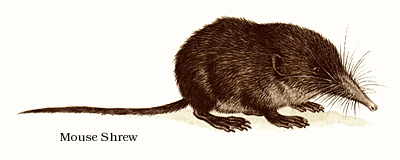
I'm fascinated by this notion that we do sometimes pass laws and therefore that means that we should pass laws. The resistance to passing laws is some nasty dysfunction caused by a nefarious interest group — here, the NRA — but good people want to do something. This do something orientation is characteristic of the modern liberal mind. I heard Dionne saying that on the radio yesterday evening, but it came back to me as I was reading about rabies and marveling at the crazy — desperate — ideas for a cure: "you burn a hair from the dog that bit you and insert the ashes into the wound... [a] maggot from a dead dog's body... a linen cloth soaked with menstrual blood of a female dog... [c]hicken excrement, 'if it is of a red color'... [a]shes from the tail of a shrew-mouse...."

When is it that reasoning goes haywire? After Dionne presented his patchwork of liberal logic, the host called upon David Brooks. (Don't say NPR doesn't balance liberals and conservatives!) He said...
Well, I'm no fan of the NRA, I'm not really an opponent of gun control or an assault weapon ban...
That sounds like a necessary preface for the NPR listeners, but I'm going to give Brooks credit for subtly deactivating the bogeyman Dionne inserted into his call to action, because Brooks continues with:
... but, you know, public policy is based on evidence and data and whether it would work. 
Brooks is displaying the pin with which he is about to puncture the liberal's inflated self-image.
This is one of the most studied things in criminology. And the weight of the evidence is pretty clear that there's no relationship between gun control and violent crime. Areas with higher gun control do not have less violent crime. Over the last few years, the number of new guns entering the country has been about four million a year. 
So you've got to look at evidence, not your instinctive notions about what just might work. Put down that shrew mouse's tail now, E.J.
At the same time, violent crime has plummeted by about 41 percent a year.
Brooks's "evidence and data" dump seemed really powerful until he got to that implausible percentage. What is it, 41% a decade, I don't know what to make of this point-counterpoint style radio presentation. There are no links to click on, so I'm just forced to be suspicious of Brooks's I've-got-the-facts posturing. [ADDED: Meade suggests that the percentage of decline has increased by 41% a year.]

Brooks concludes:
So I'm not necessarily opposed to the policy, I don't really think it would matter in violent crime generally, and I really don't think it would matter too much in the case of lunatics or whatever who are committed to this sort of pre-planned massacre.
So Brooks retreats to reassuring the NPR audience: He's not opposed to gun control, he just doesn't think it would work.  He began with the assertion that "public policy is based on evidence and data and whether it would work," explained why he didn't think it would work, but nevertheless won't oppose the policy. Brooks isn't a conservative by my standard. I think to be conservative, you should have the instinctive orientation: do nothing. You have to convince us what you've got there is better than nothing. And what have you got there? A bucket of red chickenshit? A dog's tampon?!!

Now, how will the very very thoughtful E.J. Dionne deal with Brooks's argument from evidence! and data! He's got to demonstrate that he's one of the smart people, the non-haywire people, your betters who proposed open and thorough debate about solutions to problems (after the bogeymen are kicked out of the room):
DIONNE: If we had better background checks, yes we'll miss some lunatics, but with real background checks, we could reduce the number of lunatics who get guns. And there's also a spillover. If you have permissive laws in one state - as Mayor Bloomberg has shown, Mayor Bloomberg of New York, who has proposed a lot of very practical remedies, not sweeping remedies but practical remedies - he's shown how loose laws in one state can send guns into a state that may have stricter laws. So I don't think we should throw up our hands and say it's impossible...

BROOKS: Yeah, one area of agreement, I do think people who have history of mental health issues, and this came up with the Loughner case, that...

SIEGEL: The shooting of Gabby Giffords...

BROOKS: That should show up when you're trying to buy a gun. And legally, that's supposed to happen, but it doesn't always happen.

SIEGEL: We don't know all that much about the suspect. So far no indication that any such record would have shown up. We just don't know yet.

DIONNE: Right, and my argument is not that you can prevent every one of these things, but when I heard this this morning, like everybody else, I was, you know, sick about it. And I just thought that every time this happens, people say, well, there are very particular factors in this case, so let's not talk about gun control, gun control wouldn't solve it. Well, maybe it would, or maybe it wouldn't in a particular case, but it would prevent some of these things in the future.
And there you have it, the liberal mind at work, in real time.

"The first symptom is... this tingling sensation at the site of the wound."

"Like, you didn't have it before, all that time that rabies was crawling up to the brain. Usually the wound has even healed at this point. But once your brain is infected, you'll often start to feel something odd at the site: a tingling, an itch, a stabbing pain. It sounds almost supernatural, but apparently it's true."

Rabies. Much more at the link, including the origin of the phrase "the hair of the dog."
Pliny the Elder... suggested that you burn a hair from the dog that bit you and insert the ashes into the wound... But he also rattled off this mindblowing series of other possible remedies. A maggot from a dead dog's body, or a linen cloth soaked with menstrual blood of a female dog. Chicken excrement, "if it is of a red color." Ashes from the tail of a shrew-mouse!
Something strong is needed. What do we have around here that's strong? (Reminds me of the way some people today think about politics!)

Here's the book: "Rabid: A Cultural History of the World's Most Diabolical Virus." I just bought it myself.

Thursday, June 21, 2012

"Skunk that bit person at Maryland restaurant was rabid."

Oh, good lord.

And I was just reading some Zagat article called "Worst Meal Ever: 21 Tales of Disastrous Dinners." Most were about things like a tuft of hair in the food or insects in the vinegar. Just a skunk in the restaurant is worst than all that. But the skunk in the restaurant bites you. And then on top of all that it's rabid!

Maybe we should eat in.

Tuesday, August 11, 2009

"So many were so invested in the notion that by thinking peaceful thoughts they could will into existence a state of peaceful affairs..."

"... that they ignored the evidence right in front of them, which tended to suggest that cougars were quite happy to eat anything that was juicy, delicious, and unlikely to fight back."

From an old book review I googled up after yesterday's encounter with a mountain lion on Hermosa Creek Trail. In the comments on my post about the incident, Michael McNeil said:
While actually encountering a mountain lion on a trail might certainly be expected to inspire concern, it is not sensible to be overly worried that “he was going to pounce on me.”

Folks might like to peruse this page from the California Department of Fish and Game listing all verified mountain lion attacks in the state over the last almost 120 years — this in a state of (now) more than 35 million people, millions of whom live in relatively remote suburbs where tens of thousands of mountain lions roam in close proximity.

Notice the number: a grand total of 16, only six of which were fatal, while two of those were due to rabies.

Clearly, it takes a mountain lion that is extremely seriously deranged by their standards — such as sick with rabies (which obviously not very many are) — not just hungry or even starving — for it to attack a human. Thus, there's no reason for inordinate concern even if one does see a lion.

Glenn Reynolds posts every now and then about mountain lions, and while they're obviously capable of harming people, he talks as if in fact they're an extremely dangerous threat that should be exterminated from all human-occupied areas (i.e., nearly everywhere these days). Given the foregoing statistics, that's plain nuts.

Note that I live in a neighborhood in California where a lion was seen just a month or two ago, so I'm not just blithely talking from some locale remote from the “danger.” Personally I find those statistics quite reassuring, as should we all.
I searched the Instapundit archive for "mountain lion" and think Glenn is talking not about extermination but self-defense, the reduction of numbers through hunting, and preserving the animals' fear of people (which is presumably the reason why, in the past, there have been so few attacks). Glenn is also interested in something I'm fascinated by: human sentimentality about animals. And then there is the more general human problem of the way sentimentality interferes with the perception of danger:
One need only look at the treatment of such other topics as crime, terrorism, and warfare to see examples of the same sort of misplaced sentimentality and willful ignorance. Tolerance of criminality leads to more crime; tolerance of terrorism leads to more terrorism; efforts to appear defenseless lead to war....

The effort to remake the world so that it is safe for predators seems rather odd to me. What sort of person would rather be prey? The sort who lives in upscale neighborhoods, and campaigns against hunting, apparently. I suspect that over the long term this isn't a viable evolutionary strategy in a world where predators abound.
The challenge is to get into the zone of clear thinking. We need to be alert but not paranoid. Our ancestors survived — and we therefore exist — because they noticed things and acted. Maybe they overdid it and stamped out various animals and human beings who triggered their innate edginess. The mellowest humans lost out in the evolutionary struggle, and we have inherited a tendency to overreact to things that feel dangerous, like a big cat slipping across the trail 150 feet away. But we have the capacity to gather accurate information and to think about exactly how dangerous a cat at that distance is. We also have the ability to think about whether our love for beautiful animals means we can welcome them in our yard or our house. We have instincts and we have big brains, and we need to use them.

Saturday, August 1, 2009

Sports headlines toy with the brains of nonfans.

I've long been annoyed by the NYT blog called "Bats." I was bitten by a bat once and had to get rabies shots. And I've had other run-ins with the leathery-winged fiends. Actually, I love them when they are outside, eating mosquitoes and so forth. I might like reading a blog about bats. But Bats is not about bats. It's about baseball. (Maybe if I cared about baseball, I'd still hate the blog title "Bats," either because it disrespects pitchers or because I would still think it was about bats.)

Now, today, The Washington Post has a front-page teaser: "Do Juicers Belong in the Hall of Fame?" And I'm thinking, so there's an Appliances Hall of Fame? Where is it? What was the first inductee? Refrigerator! I'll bet it's refrigerator! But I click to the article —which is (obscurely) re-titled "Do Juicers Belong in Canton?" — and see that it's about drug users and the Baseball Football Hall of Fame. Oh, I don't know. But if there's an Appliances Hall of Fame, it's scraping to low too let in the juicers.

Wednesday, November 5, 2008

"Jogger runs mile with rabid fox locked on her arm."

Jogger runs mile with rabid fox locked on her arm!

***

After the fox bit her on the foot, she decided to catch it and bring it in for testing. This led to additional biting. That was a bad move. She had some hope of avoiding rabies shots, if she successfully brought the animal in for testing and it was not rabid, but do you know that if you are bitten badly enough, the rabies shots might not save your life? I learned this from expert doctors who interviewed me at the UW Hospital after I was bitten by a bat. I wanted to know if the shots ever failed, and they cited some cases in which a person received large, tearing bites from a wolf. Don't tangle with a wild animal. Just get the shots. They are not that bad.

Thursday, July 5, 2007

5-year-old boy, bitten by a rabid fox, holds the animal down for more than a minute to protect 6 other children...

Rayshun McDowell. Very impressive.
Rayshun's stepfather, Ryan Thompson, pulled the boy off the animal and kicked it. A neighbor fired a handgun three times but the fox continued to advance.

Thompson, wearing a cast because of a broken leg, said he used a stick and his crutch to beat the fox to death.

This story should be on Fox News, but I got it from CNN.

IN THE COMMENTS: Politics! This seems to be a political story for some reason.

... We have met the rabid animal, and he is us.

MORE: Video of the boy.

Sunday, June 24, 2007

"What makes Michael B. Nifong different" from all the many prosecutors who don't pay a harsh price for their abuses?

Asks Adam Liptak:
“The very same facts that made this case attractive to a prosecutor up for election and a huge publicity magnet — race, sex, class, lacrosse stars, a prominent university — also led to his undoing when the case collapsed and his conduct was scrutinized in and beyond North Carolina,” said Stephen M. Gillers, a law professor at New York University and the author of “Regulation of Lawyers: Problems of Law and Ethics.”...

Prosecutors say they seldom face discipline because conduct like Mr. Nifong’s in this sexual-assault case is exceptional.

“Nifong’s case is rarer than human rabies, which is one reason it is such huge news,” said Joshua Marquis, the district attorney in Clatsop County, Ore., and a vice president of the National District Attorneys Association. “The defense bar is piling on and trying to claim this is typical behavior.”...

“A prosecutor’s violation of the obligation to disclose favorable evidence accounts for more miscarriages of justice than any other type of malpractice, but is rarely sanctioned by the courts, and almost never by disciplinary bodies,” Bennett L. Gershman wrote in his treatise, “Prosecutorial Misconduct.”

Mr. Gershman, a former prosecutor in Manhattan who teaches law at Pace University, said the Nifong case was handled differently because of the publicity. “The fact that it resulted in national exposure,” he said, “had to have put the disciplinary body and the entire system of justice under the spotlight.”

“You have rogue prosecutors all over the country who have engaged in far, far more egregious misconduct, and in a pattern of cases,” he added. “And nothing happens.”
So did Nifong's case get out attention because his behavior was that much worse that the usual cases of prosecutorial misconduct or because of the "publicity magnet" factors? The best way to find out the answer to that question is to continue to pay attention to the abuses of prosecutors. If we can't maintain our attention long enough to see the extent of the problem, then we will know we cared because of the sports and the sex and the race and the elite university.

Sunday, June 3, 2007

Audible Althouse #85.

A new podcast... about an old tree, a fat and pompous politician, a girl who survived rabies, a record album from 40 years ago, a possibly evil artist, and succulent flowers and puffy clouds.

You don't need an iPod. You can stream it right through your computer here.

But all the rational people subscribe on iTunes:
Ann Althouse - Audible Althouse

"There will always be a tomorrow, whether on this Earth or not."

Says Jeanna Giese, the Wisconsin girl who survived rabies. She just went to the prom and graduated from high school.
On Sept. 12, 2004, the then-15-year-old was bitten by a bat after picking it up by its wings inside St. Patrick Catholic Church in Fond du Lac....

More than a month later, Giese was admitted to Children's Hospital with a fever of 102 degrees, double vision, slurred speech and jerking in her left arm.....

In the fall, she will be a freshman at Marian College, where she plans to major in biology with an emphasis on zoology. Her goal is to work with large cats at a zoo.

Giese says the bat bite has only strengthened her desire to work with animals, which she does daily with her own pets - Pepper the rabbit, pheasants Chicken and Duckie, dogs Maggie and Peanut. If she has her way, she'll soon have a goat and baby duck.
Beautiful. Great perspective. She hasn't turned against the animals (or, I assume, from the church).

Saturday, May 13, 2006

Rabid.

If one of these things...


... flies in your window, while you're napping and brushes against you, don't just catch it in a towel and throw it out the window. You may assume it hasn't bitten you, but you might be wrong. A 16-year-old boy in Texas just died of rabies.

Here is my own personal bat story. I ended up with a lot of rabies shots, because we could not be sure that the bat I caught and threw out the window was not rabid.

Sunday, November 6, 2005

About killing that mockingbird.

Jeremy Freese is taking a poll about whether Truman Capote wrote "To Kill a Mockingbird."

And I promise you I wrote that sentence without the slightest thought of adding to today's blog theme! Man, I have got to be careful if I venture out of the house today. I think the animals are...

I start thinking about the song "Animals" again:
I know the animals...Are laughing at us
They don't even know...What a joke is
I won't follow...Animal's advice
I don't care...If they're laughing at us.

They're never there when you need them
They never come when you call them
They're never there when you need them
They never come when you call them down down down down.

They say they don't need money
They're living on nuts and berries
They say animals don't worry
You know animals are hairy?
They think they know what's best
They're making a fool of us
They ought to be more careful
They're setting a bad example
They have untroubled lives
They think everything's nice
They like to laugh at people
They're setting a bad example
(Go ahead) Laugh at me.
I heard a squirrel skittering around up there -- what was it? -- on the roof? Or was it the attic? Or the extra bedroom? You know all the leaves fell from the oak trees in one day yesterday, and now it looks all desolate out there... I've got to be more careful. Are there squirrel holes in the house that I'm not seeing? Is that a cracked nut? Is that a rabid dog loping down the street?

Is it time to record podcast #18?

Hey, did you know I wrote a little law review article about "To Kill a Mockingbird"? Here, you can read it. I'm responding to Steven Lubet, who wrote a feminist attack on Atticus Finch for the way he cross-examined the woman who accused Tom Robinson of rape. An excerpt from my piece:
Atticus deeply believes in the law and as he performs his duty, he patiently waits for the day when the others who work in the system will also perform their duty. Law is not a lofty institution, but a "working reality" that necessarily depends on the routine performance of duty by good people like Atticus and the lawyers he inspires.

Atticus accepts the Robinson case just as earlier in the book he accepts the job Sheriff Tate asks him to do: shoot a rabid dog. Indeed, his handling of the trial parallels the shooting of the rabid dog. Atticus possesses extraordinary skills - as a lawyer and as a marksman - but he does not seek occasions to display them or profit by them. The sheriff calls on Atticus when a dog must be taken down in one shot, and the judge comes to him when an inflammatory case needs a lawyer. A neighbor tries to explain the restraint of this man who had avoided using his shooting skills for thirty years:
"[H]e's civilized in his heart ... I think maybe he put his gun down when he realized that God had given him an unfair advantage over most living things. I guess he decided he wouldn't shoot till he had to, and he had to today."

Thursday, November 25, 2004

Rabies.

Read the amazing story of the doctors--here in Wisconsin--saving the teenage girl who developed rabies after being bitten by a bat. It is the first time a human being has survived rabies without receiving the vaccination. Sometimes people don't go in for treatment because they don't realize they've been bitten, but this young woman did know. A bat flew into her church during a service:

"As society has developed, people have forgotten the folklore about don't play with stray animals, or stay away from bats," Dr. Willoughby explained. The bat drew blood, he said, but the bite was quick and small, so Jeanna thought she had just been scratched. Her fellow churchgoers assumed that only healthy bats could fly, so they picked it up after it flew into a window and threw it out the door.
The girl was not taken to a doctor, or she would have received the vaccination. Ah! People need to know not to touch a bat!


I used to have problems with bats getting into my house. As I later figured out, they came in through the attic. More than once, I went up to my bedroom at night, turned on the light, and had a bat swoop right at me. I always scream, quite hysterically, but then I try to figure out a solution. One night, a few years ago, I had already prepared a box to trap the next bat. It was a shoe box with one edge of the lid removed so that the box could be placed over the bat when it landed on a surface and the lid slid under. Then, I planned to toss the box out the window. The first time I tried this maneuver, the bat squiggled its way out as I was trying to get the lid under. It flew lengthwise figure eights in the room over and over and never found the open window. Finally, it flopped onto a table, I got it in the box, and I threw the box out the window, feeling quite triumphant. I closed the window and went to wash my hands and saw a tiny wound --- just four little lines -- on the back of my right ring finger.


It took me a few hours to decide I ought to go to the hospital. It was such a tiny wound. I knew even a scratch could lead to rabies, but I kept thinking maybe I had scraped my finger on the sand-textured wall. What made me go to the hospital was the observation that the four little lines were symmetrical, like this: | '' |. That is the pattern of teeth. The wall might, by chance, produce such a symmetrical pattern, but that was much less likely. I felt silly going into the emergency room with such a tiny wound, especially when a moaning boy with gauze wrapped over his eyes came in. Later, I was in a room where the opthamalogist came in to get some equipment, and we talked for a moment. I asked what happened to that poor boy, and he said "I'm not at liberty ... someone poked him. He's going to need surgery."


I was apologetic when I arrived at the emergency room. I said things like "maybe I'm overreacting," but I also mentioned over and over again something I'd read in a Harper's Magazine Index about how many people die from rabies after they don't realize they've been bitten. In fact, as is usually the case, there were very few people using the emergency room at the University of Wisconsin Hospital. I was quickly seen by a nurse, then a doctor, then a second doctor. All three had me tell my elaborate story and expound my symmetry theory, and all three spent a lot of time puzzling over the wound. Doctor 1 thought maybe it was from the wall. Doctor 2 said it was my choice, but he'd get the treatment. He said, you could get 1000 bat bites and do nothing and nothing might happen, but considering that you would die if you bet wrong and the treatment, done now, is 100% effective, you should get the treatment. This puzzling over the wound process took three hours for some reason. Slow night? State law required them to call the police when an animal bites someone, and that call resulted in a long visit from police officer, who took pages of notes, apparently about how I caught the bat in a box and threw the box out the window and so forth.


Finally, I got the treatment. And the rabies shots, which were given in the arm, did not hurt any more than a tetanus shot. It did hurt to get one of the immunoglobulin shots that preceded the rabies shots, because it was injected at the site of the wound. It is damn hard to find a place to put anything in the middle of the back of a finger! But they did. Afterwards, I felt faint and they had me rest for another twenty-five minutes. At midnight, the nurse said "The witching hour," and I said "I'm going to turn into a bat."


The next day, when I came home from work, I found a legal notice posted on my door. It was a formal demand for me to surrender the animal that, according to a police report, had bitten a person. I had to call animal control and explain how I had thrown the bat, in a box, out of a three-story window. The person I talked to was very chatty, and I had a long interesting discussion about rabies and bats. She told me about Americans who get rabies shots before traveling to certain parts of the world where there is great danger of exposure and difficulty obtaining treatment. (The linked article notes that "rabies kills tens of thousands of people in Asia, Africa, and Latin America.")


Later, I was asked to come in and talk to two doctors at the UW Hospital who specialized in infectious disease research, and these two men also talked to me for a long time. I heard all sorts of stories about rabies. I asked if it was true that if you had the vaccination there is zero chance of getting the disease, and they told me that there are cases of people with very deep, tearing bites from wolves who still get the disease. The disease creeps slowly up through your nerves to your brain, and that time gives the vaccine a chance to work. But with the large wolf bites, the disease reaches the brain much too soon. In the cured case in Wisconsin, the treatment consisted of using drugs to induce a coma, to deliberately shut down the girl's brain while the disease passed through.


So, wonderfully, there is now hope for those who fail to get treatment, but it is much better, still, to go in for treatment, even for a tiny scratch. Once the symptoms appear, as in this recent case, it is too late to prevent the disease. The other thing I learned from my rabies experience was to catch a bat in a little plastic margarine container, with a snap-on lid, and take the bat in for testing. It wasn't that long after my experience, that I woke up one morning hearing that leathery flapping sound, and I tried to convince myself that I was still dreaming. Then I felt that leathery wing brush my hand, did some preparatory screaming, then got the margarine container and caught the bat against the window. I snapped on the lid and took it over to the animal testing lab. When I handed the container to the woman at the counter, she asked "How long has it been dead?" I said, "It's alive."


Not long after that, I spent $800 having the house bat-proofed. The bat proofing guy told me all the houses in my nicely wooded neighborhood probably had bats, unless efforts had been made to seal out the bats. I know he was in the business of providing that service, but based on my experience, I'd say get an older house bat-proofed. I haven't had a bat in the house since I did. I do still worry, though, when I hear a little noise in the night, and many times I've turned on the light to look around for a bat!


UPDATE: Let me add that awful as a bat in the house is, bats outdoors are perfectly excellent. Here's a bat conservation website. And here's a cool blog entirely devoted to bats.

Wednesday, June 23, 2004

Three signs.

Today started out lively with a two-hour class about the political question doctrine--with a room assignment screw-up to cut the seriousness of it all at midpoint. Then things got dreary as I spent the next three hours looking for some old letters that could either be in any one of the many places in my office where I engage in my real world paper filing practices (piling things on horizontal surfaces) or in one of the several computers in my office. I did find some of what I was looking for and got two side benefits: 1. my office became incredibly neat, and 2. our tech guy hooked my second-newest desktop unit, whose monitor had died, to my newest desktop. It's now easy to reach back into the documents and emails of the years 1999-2002 that didn't seem important enough to transfer to my newest computer when I first set it up. It's a little like going up into the attic and rooting around in the papers up there.


(Actually, I haven't gone into my attic in many years, even though all it takes is opening a door and walking up an ordinary staircase. I used to find a bat flying around my house from time to time. The insane hijinks that took place when we used to try to capture one of these creatures would take several pages to describe. Let's just say rabies shots were involved! Finally, I had a bat guy--a bat man--out to the house to solve the problem, which he did. I came to understand that the attic was the source of the problem, and I haven't gone up there since, even though there aren't any bats up there anymore.)


But the point is: I haven't found today very conducive to blogging, so let me photoblog. Here are three signs: a paper poster (for Cinematheque--the UW's film series), a classic neon bar sign, and a nice example of the home-style painted-on type.