Showing posts with label cartoons. Show all posts
Showing posts with label cartoons. Show all posts
Friday, February 22, 2013

"See Cartoon Instructions For How To Stone Adulterers."
"An Islamist Facebook page uploaded a cartoon explaining how to stone adulterers on Wednesday that is getting a decent reaction on the Web so far, garnering over 120 'likes' and 500 Facebook shares as well as 500 comments."
Buzzfeed.
"The scribes and the Pharisees brought a woman who had been caught in adultery, and placing her in the midst they said to him, 'Teacher, this woman has been caught in the act of adultery. Now in the Law Moses commanded us to stone such women. So what do you say?' This they said to test him, that they might have some charge to bring against him. Jesus bent down and wrote with his finger on the ground. And as they continued to ask him, he stood up and said to them, 'Let him who is without sin among you be the first to throw a stone at her.'"
Buzzfeed.
***
"The scribes and the Pharisees brought a woman who had been caught in adultery, and placing her in the midst they said to him, 'Teacher, this woman has been caught in the act of adultery. Now in the Law Moses commanded us to stone such women. So what do you say?' This they said to test him, that they might have some charge to bring against him. Jesus bent down and wrote with his finger on the ground. And as they continued to ask him, he stood up and said to them, 'Let him who is without sin among you be the first to throw a stone at her.'"
Friday, February 15, 2013
"Oscar Pistorius held his head in his hands and wept openly in court Friday as prosecutors said they would pursue a charge of premeditated murder..."
"Chief Magistrate Desmond Nasir delayed Pistorius' bail hearing until next Tuesday and Wednesday and ruled that the 26-year-old Pistorius would be held at a police station in Pretoria until then. Police have said they oppose the granting of bail."
Is it okay to make politically incorrect jokes about whether he's a flee risk? Are we now released from all the old restrictions of etiquette?
Too bad John Callahan isn't still around to make he won't get far on foot jokes.

Meanwhile, Nike's "I Am The Bullet In The Chamber" ad is shot to hell.
Is it okay to make politically incorrect jokes about whether he's a flee risk? Are we now released from all the old restrictions of etiquette?
Too bad John Callahan isn't still around to make he won't get far on foot jokes.

Meanwhile, Nike's "I Am The Bullet In The Chamber" ad is shot to hell.
Sunday, February 10, 2013
"I'm a lot like Baby Huey. I'm fat. I'm ugly. But if you push me down, I keep coming back."
So said President Bill Clinton (in 1993).

Remember Baby Huey?

Remember Baby Huey?
He would see his peers playing, and would immediately get excited. Whenever he tried to involve himself in the activities of his peers (also anthropomorphic ducklings) he would often inadvertently cause more problems, and as a result they would drive him away through trickery (and into tears). A hungry fox would show up, originally intending to eat Huey's peers, but upon seeing Huey as a bigger meal and overhearing the distraught duck's desires to play with someone, would feign friendship and set traps along the way, all of which would prove ineffective on Huey and/or backfire on the fox. At first Huey was blissfully unaware of the fox's true agenda. But as his peers watched the annoyed fox in action from a safe distance (and fearing for his safety just as they did their own), Huey would come to realize the truth about his predator and dispose of him, usually by saying: "Hey, you! You're the fox! And I think you're trying to kill me!", and would finish the fox.Bizarre for a President of the United States to equate himself to that!
Saturday, February 9, 2013
Why does a telephone have 1-2-3 at the top instead of at the bottom, like a calculator?
Because "a modest man" with "variegated accomplishments (he had a doctorate in mathematical psychology, was trained in electrical engineering and had been a professional violinist)" applied behavioral science to telephone design. He was John E. Karlin, who died on January 28th at the age of 94.
Karlin also determined "the optimal length for a phone cord":
I'm old enough to have lived through the big switch from named "exchanges" to all numbers. There was a lot of anguish, back then, over whether the human individual was being turned into a number. It was also in the 60s — 1963 to be exact — that the post office forced ZIP codes on us. Before then, you had a number in between the city and the state names. I remember the last line of my address being Wilmington 3, Delaware. The government tried to soothe us by personifying the number as a human character, Mr. ZIP:

It's hard to imagine the government today using such an obvious, laughable technique as it pushes us into a life of regimentation. Mockery would be made. But those were simpler times.
Karlin also determined "the optimal length for a phone cord":
Telephone company executives wondered whether the standard cord, then about three feet long, might be shortened. Mr. Karlin’s staff stole into colleagues’ offices every three days and covertly shortened their phone cords, an inch at time. No one noticed, they found, until the cords had lost an entire foot.Despite these efforts at helping, he found himself referred to as "the most hated man in America," because his name was attached to the decision — made in the 1960s — to switch to all-digit phone numbers instead of things like PEnnsylvania 6-5000." The phone system was running out of numbers made from pronounceable words, and it was Karlin figured out that people would be able to remember 7 digits.
From then on, phones came with shorter cords.
Mr. Karlin also introduced the white dot inside each finger hole that was a fixture of rotary phones in later years. After the phone was redesigned at midcentury, with the letters and numbers moved outside the finger holes, users, to AT&T’s bewilderment, could no longer dial as quickly.
With blank space at the center of the holes, Mr. Karlin found, callers no longer had a target at which to aim their fingers. The dot restored the speed.
I'm old enough to have lived through the big switch from named "exchanges" to all numbers. There was a lot of anguish, back then, over whether the human individual was being turned into a number. It was also in the 60s — 1963 to be exact — that the post office forced ZIP codes on us. Before then, you had a number in between the city and the state names. I remember the last line of my address being Wilmington 3, Delaware. The government tried to soothe us by personifying the number as a human character, Mr. ZIP:

It's hard to imagine the government today using such an obvious, laughable technique as it pushes us into a life of regimentation. Mockery would be made. But those were simpler times.
Thursday, February 7, 2013
"I'm not sure why, but it seems like straight women are more interested in gay sex than gay men are."
"So I've decided to answer five of the most common questions I've been asked about gay sex by straight women."
(Via Buzzfeed.)
(Via Buzzfeed.)
Wednesday, January 16, 2013
A cartoon from 1233.
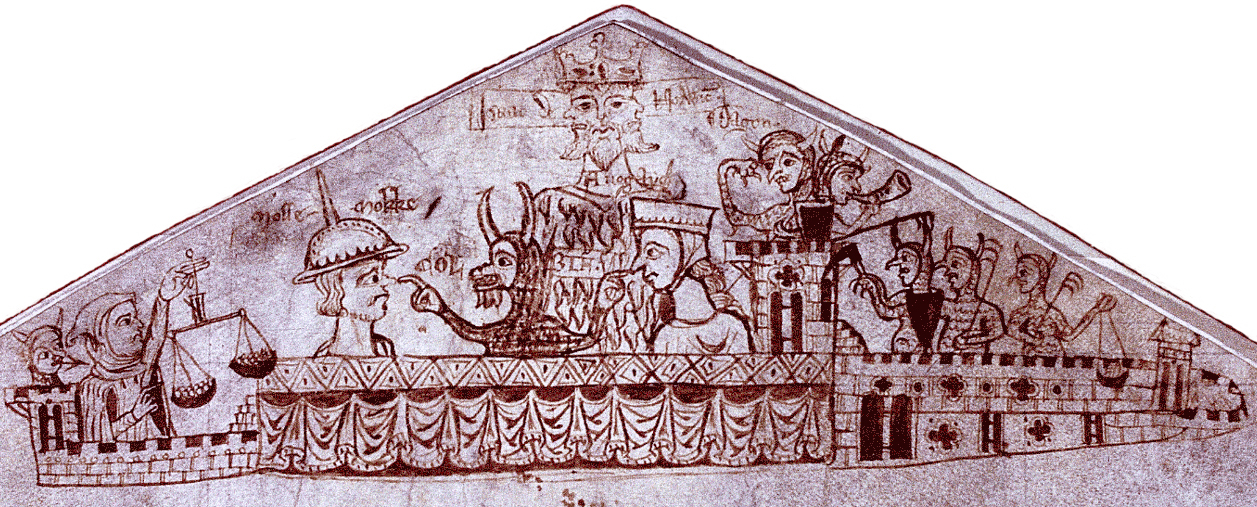
I'm fascinated by the school lesson material at the U.K. National Archive site. That cartoon is from one titled "A Medieval Mystery" that asks students to "decode the dark secrets of this cartoon" and offers tips on things to look for (e.g., devils) and prompts with questions like "How has the cartoonist shown that the man and the woman are Jewish?"
Monday, January 14, 2013
"Steamboat Willie overdubbed with the Koyaanisqatsi theme."
"The Disney classic paired with Phillip Glass' classic theme. Oddly unsettling on a number of levels."
Hmm. I don't know. I clicked through and watched it a bit, and the main thing I thought was what a great cartoon, full of weirdness and sadism that was always there and not something new injected by the mysterious-serious soundtrack. The injection — which might feel good to druggies — is aggressive nudging that only serves the purposes of those too numb to see what is there in life as it already is.
The second thing I thought was every time those spooky voices incant "Koyaanisqatsi," what I hear is "[unintelligible] Wisconsin."
By the way, Meade happened to glance over at 0:50 and laughed out loud, not because of anything about the added soundtrack, but the original comic idea. I said: "What? This is 'Steamboat Willie,' the oldest cartoon in the world." But his laugh meant — as I immediately realized — that this is something perfectly great, perfectly timeless, and utterly — udderly — unimprovable.
Friday, January 11, 2013
Champagne chair...
... contest.
IN THE COMMENTS: Lauderdale Vet said:
>
There must be a comical drawing of a woman as a chair or an actual chair in the form of a woman. I looked for furniture in human form, and found some stuff in the general neighborhood — the Dali-inspired lips sofa — and this amused me:

And you can unburden yourself here:

IN THE COMMENTS: Lauderdale Vet said:
I passed that along to my wife, who seems interested :) She'd make a nice chair, I think.Which made me think of this famous Thurber drawing:
>
There must be a comical drawing of a woman as a chair or an actual chair in the form of a woman. I looked for furniture in human form, and found some stuff in the general neighborhood — the Dali-inspired lips sofa — and this amused me:
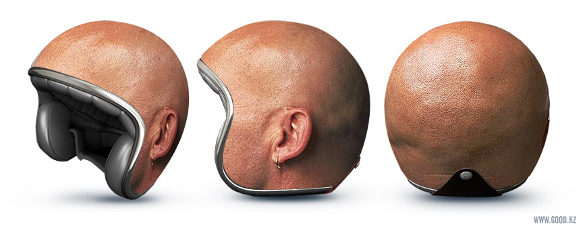
And you can unburden yourself here:

Wednesday, January 9, 2013

Sunday, January 6, 2013
What's the difference between Kwanzaa and Kwanza?
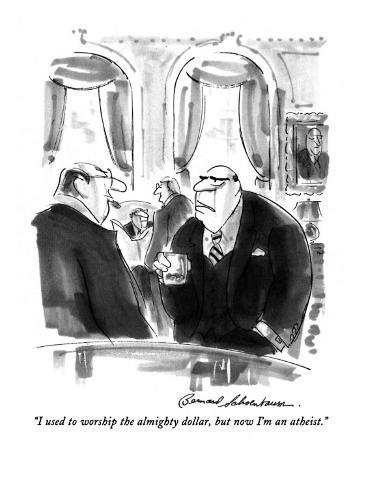
Kwanzaa is that religionish holiday we were just talking about. Kwanza is the unit of currency in Angola, our "History of" country today. Before getting to the history of Angola, I pause to think of the holidays we could invent by taking the names of the world currencies. Here's a list of the currencies currently circulating in the world. Following the Kwanzaa model, you could add a letter or change the word slightly as you take off on your flight of inspirational fancy. Now, what should we do for Dollaro? Worship the Almighty Dollar is a common enough phrase.

But let's get back to the history of Anglola, as quickly scanned via the "History of Angola" Wikipedia page, in accordance with our 206-day project. The name Angola comes from "N'gola," the Kimbundu word for king.
But let's get back to the history of Anglola, as quickly scanned via the "History of Angola" Wikipedia page, in accordance with our 206-day project. The name Angola comes from "N'gola," the Kimbundu word for king.
The first ones to settle were the Bushmen, great hunters, similar to Pygmies in stature. This changed at the beginning of the sixth century AD, when the Bantu, already in possession of metal-working technology, ceramics and agriculture began one of the greatest migrations in history.... The first large political entity in the area, known to history as the Kingdom of Kongo, appeared in the thirteenth century and stretched from Gabon in the north to the river Kwanza in the south, and from the Atlantic in the west to the river Cuango in the east....In 1482, the Portuguese arrived:
The Portuguese colony of Angola was founded in 1575 with the arrival of Paulo Dias de Novais with a hundred families of colonists and four hundred soldiers. Luanda was granted the status of city in 1605....The Portuguese took over again and stayed until 1975, after a coup d'etat in Portugal that installed President António de Spínola.
After undertaking various journeys [Queen Jinga] succeeded in 1635 in forming a grand coalition with the states of Matamba and Ndongo, Kongo, Kassanje, Dembos and Kissamas. At the head of this formidable alliance, she forced the Portuguese to retreat.
Meanwhile, Portugal had lost its King and the Spanish took control of the Portuguese monarchy.... Jinga entered into an alliance with the Dutch... In 1648, after Portugal has regained its independence from the Spanish rulers... a large Portuguese force from Brazil under the command of Salvador Correia de Sá retook Luanda, leading to the return of the Portuguese in large numbers.
The Spínola government agreed to give all of Portugal's colonies independence, and handed power in Angola over to a coalition of the three largest separatist movements, the MPLA, UNITA, and the FNLA, through the Alvor Agreement. The coalition quickly broke down, however, and the country descended into civil war....Cuba involved itself, and the U.S. had difficulties with that involvement. An accord was signed in 1988 and another in 1991. There were democratic elections, but the results were questioned and more war followed. It seems that the conflict ended 2002.
Thursday, January 3, 2013
"It was my first trip to Detroit, Michigan, so naturally..."
"I convinced a local to give me the 'ruins porn' tour."
ADDED: That comic got me interested in finding some photos of the Heidelberg Project. I recommend this (and then click the "older" button for more).
ADDED: That comic got me interested in finding some photos of the Heidelberg Project. I recommend this (and then click the "older" button for more).
Wednesday, January 2, 2013
"A paparazzo hoping to get a picture of Justin Bieber in his Ferrari after the vehicle was pulled over by police in Los Angeles got struck and killed by an SUV instead."
"And as it turned out, the 18-year-old singer wasn't even in the sports car."
This seems to be an occasion for wheeling out that horrible old saying: He died doing what he loved. He thought he had Justin Bieber set up for a shot. The photographer was swelling with delight and then — blam — not from a Ferrari but an SUV. Let's hope he never knew what hit him — to coin a phrase — and never knew that Bieber wasn't even in that car. He died doing what he loved! He had his peak of paparazzi ecstasy and then... annihilation. A consummation. It's over.
But wait! Justin Bieber wants to speak:
Now, should we also get on Bieber's case for calling what happened a "tragedy"?
ADDED: The more apt term is poetic justice — "a literary device in which virtue is ultimately rewarded or vice punished, often in modern literature by an ironic twist of fate intimately related to the character's own conduct." The key is the self-contained logic of the story. It makes sense. There should be no call for legislation to find meaning. The meaning is already there. What happened is exactly right: poetic justice. The Wikipedia page I just linked has some examples, and since we were just talking about Wile E. Coyote, I enjoyed seeing him first on the list of poetic justice in TV and film: "Wile E. Coyote always sets traps for Road Runner, only to end up in the traps themselves." The phrase "hoist with his own petard" expresses the concept. Did you know it's from "Hamlet":
This seems to be an occasion for wheeling out that horrible old saying: He died doing what he loved. He thought he had Justin Bieber set up for a shot. The photographer was swelling with delight and then — blam — not from a Ferrari but an SUV. Let's hope he never knew what hit him — to coin a phrase — and never knew that Bieber wasn't even in that car. He died doing what he loved! He had his peak of paparazzi ecstasy and then... annihilation. A consummation. It's over.
But wait! Justin Bieber wants to speak:
"While I was not present nor directly involved with this tragic accident, my thoughts and prayers are with the family of the victim... Hopefully this tragedy will finally inspire meaningful legislation and whatever other necessary steps to protect the lives and safety of celebrities, police officers, innocent public bystanders, and the photographers themselves."Oh, Justin. Not every screw-up is an argument for legislation. Putting "meaningful" in front of "legislation" is itself meaningful, but what does it mean? 1. It means meaninglessness, an empty existential cry in the face of helplessness. 2. It means I would like to soothe myself with the fantasy that if the right laws had been in place, the bad thing that just happened would not have happened. 3. It means that we can express meaning through laws, that laws work as expression, quite aside from whether they have any effect on the bad things we would like to call bad.
Now, should we also get on Bieber's case for calling what happened a "tragedy"?
Tragedy (Ancient Greek: τραγῳδία, tragōidia, "he-goat-song") is a form of drama based on human suffering that invokes in its audience an accompanying catharsis or pleasure in the viewing....Pedants love to say that the word "tragedy" is misused, but I think we may have encountered a correct use of the word. That correct usage seems out of place with the rest of the statement, with its angst about prayer, inspiration, and meaning. One suspects Bieber bumbled into saying something he wouldn't have meant to say. It's meaning without a mind that meant it. We witness human suffering and feel... good!
ADDED: The more apt term is poetic justice — "a literary device in which virtue is ultimately rewarded or vice punished, often in modern literature by an ironic twist of fate intimately related to the character's own conduct." The key is the self-contained logic of the story. It makes sense. There should be no call for legislation to find meaning. The meaning is already there. What happened is exactly right: poetic justice. The Wikipedia page I just linked has some examples, and since we were just talking about Wile E. Coyote, I enjoyed seeing him first on the list of poetic justice in TV and film: "Wile E. Coyote always sets traps for Road Runner, only to end up in the traps themselves." The phrase "hoist with his own petard" expresses the concept. Did you know it's from "Hamlet":
"For 'tis the sport to have the engineer / Hoist with his own petard." (Shakespeare, Hamlet (III.iv.226).)And did you know (again, from Wikipedia):
During the late 17th century, critics pursuing a neo-classical standard would criticize William Shakespeare in favor of Ben Jonson precisely on the grounds that Shakespeare's characters change during the course of the play.... When Restoration comedy, in particular, flouted poetic justice by rewarding libertines and punishing dull-witted moralists, there was a backlash in favor of drama, in particular, of more strict moral correspondence.
Wednesday, December 19, 2012
"How to Be OK Pursuing Happiness as a Warm Friend To a Puppy Not of One's Own but By Borrowing Your Neighbor's Best Friend and Taking Him to Dog Parks Where He Can Make Lots of Friends of His Own."
The title of the book Meade says he would write if he "wanted to write a book motivated purely out of my love for humanity."
It's based on the clichés ("all true"): "If you want a friend, get a dog" and "If you want a friend, be a friend." Also, there were those self-help best sellers from the 60's and 70's "How To Be Your Own Best Friend" and "I'm OK - You're OK" plus, the classic Charles Schulz' "Happiness is a Warm Puppy."
ADDED: I just found 2 Yumi Sakugawa books on Amazon for $1.99: "There Is No Right Way To Meditate" and "Special Message For You Hand-Delivered To You In The Universe." I read some of "There Is No Right Way" out loud to Meade:
It's based on the clichés ("all true"): "If you want a friend, get a dog" and "If you want a friend, be a friend." Also, there were those self-help best sellers from the 60's and 70's "How To Be Your Own Best Friend" and "I'm OK - You're OK" plus, the classic Charles Schulz' "Happiness is a Warm Puppy."
What's stopping me from writing it is I just don't have that much love for humanity. I'd write it for caninity but of course canines don't read. And besides, they don't need self help — they need our help.That's from the comments thread about the cartoon "I Think I Am In Friend-Love With You," by Yumi Sakugawa, which I love. It's spurred a lot of conversation. For example, Meade and I got into a long conversation after he quoted commenter Skyler's remark that the cartoon was "pathetic." Wasn't it only that the character in the cartoon was pathetic — and why was that? — and not the cartoon itself as a work of art? Are comics art? Are comics comical? What is art? It's art because it made us have this conversation about it. Whatever happened to works of art that found their completion in all the many conversations they inspired?
Bob Marley spoke some harsh but true truth when he said: “The truth is, everyone is going to hurt you. You just got to find the ones worth suffering for.”
And he was right!
ADDED: I just found 2 Yumi Sakugawa books on Amazon for $1.99: "There Is No Right Way To Meditate" and "Special Message For You Hand-Delivered To You In The Universe." I read some of "There Is No Right Way" out loud to Meade:
10 Ways to Get Rid of Your Bad MoodMeade said: "This is where Yoko Ono meets Chip Ahoy."
1. Have your doppelganger extract your bad mood from your chest so he/she can make fun sculptures with it.
2. Paint out your bad mood. When you're finished with your painting, set it on fire...
Tuesday, December 18, 2012
"I have a confession to make. I think I'm in friend-love with you."
"I don't want to date you or even make out with you. Because that would be weird. I just so desperately want for you to think that I am this super-awesome person because I think you are a super-awesome person."
An incredibly charming cartoon. Via Metafilter, where bitteroldman says: "Ha - boy did this resonate! For about 10 years now, my only socializing has been with my wife, her friends, her friends' spouses, and people at work."
An incredibly charming cartoon. Via Metafilter, where bitteroldman says: "Ha - boy did this resonate! For about 10 years now, my only socializing has been with my wife, her friends, her friends' spouses, and people at work."
While they're nice, I don't consider them friends - well my wife for sure, but not anyone else. I used to have a handful of friends in college and university, but then things fizzled out the way they do. The only friend I had out of school and work was this one guy, who then "left me" when he met his wife.
While I'm eternally grateful for my wife, i must admit it's been a difficult run, not having a "buddy" with whom I can go out and hang out with or do non-couple stuff with. No one to help move, or help me move; no one to help build their garden shed or help me build my deck. No one with whom I can flip a few burgers and nestle a cold beer (or Pinot Noir). And sometimes you just want to connect on a deeper level with someone who you're not intimately involved with.
It really brought me down in the past, but I'm dealing with it better now. That being said, from time to time, I do meet a person who might possess all of my friend qualifications - same interests as me, similar ethics and morals. So then I'll say to myself, 'maybe I'll ask him out for a beer...'
And honestly, it's like asking someone out on a date - the prepared speech, the sweaty palms, the collar-clutching, the stuttering, kicking he dirt, looking at the ground the whole time. If I do go out, I make sure I'm dressed up nice, check to see if my hair parts the way I like it. Pick out a nice place I'm sure he'd like, and then pray to Good God that we have things in common. I laugh heartily at his jokes, am sure to ask him about himself, and try not to talk about me too much. I try to appear fun and confident. After our "date", if things go well, I wait by the phone for a phone call (which never comes); if I don't feel that connection, well, I let the guy down easy if he wants something more.
It's so silly sometimes, the way I feel about this. And I know i'm not the only one going through this. I cry inside and sometimes outside when I see someone else going through the same emotions as me. YOUR"RE NOT ALONE - I FEEL THE SAME WAY AS YOU! I want to say. But I don't. Because they'd probably be humiliated if they knew that I knew how they felt. But I watch and I see and I know. And I would cheer for them if it worked out for them. But it usually never does.
That need for a connection. That need for a bond. That cursed thing that unites us all and at the same time keeps us apart.
It's been so long. I forgot what a friend is supposed to do or supposed to be.
Sunday, December 16, 2012
Friday, November 23, 2012
Friday, November 16, 2012
The voice of Crusader Rabbit and Smurfette...
... Lucille Bliss has died at the age of 96. She was also Elroy on "The Jetsons."
But her groundbreaking role was in the original "Crusader Rabbit," the first animated series produced specifically for television. Its first incarnation ran on NBC from 1950 to 1952 and was co-created by Jay Ward, who went on to produce such notable franchises as Rocky and Bullwinkle and Dudley Do-Right.
"She was a pioneer in television animation," said Charles Solomon, an author and animation historian. Crusader Rabbit "really set a pattern for a lot of future shows — the smart little character and the big dumb sidekick."
Tuesday, November 6, 2012
Century-old cartoon of the "class-conscious worker" handed out at Obama's Madison rally yesterday.
Not handed out by the official campaign, just by some guy there:

(Enlarge.)
The sturdy, manly worker in overalls is holding a scroll marked "Demands legislated in the Union hall." There is a sun marked "IWW" rising behind him. He's looking askance at "POLITICS/The Great HOCUS-POCUS GAME" behind which hides a short pot-bellied man in a top hat, spats, a big dollar sign on his shirt, and strings on his fingers connected to puppets who are saying "Vote your power into my hands"/"I'll do your fighting for you"/"Vote and be saved." The capitalist puppeteer is saying "I don't think he's wise to the game yet."
It's a 1916 cartoon from Solidarity, to which the caption is added: "How little things have changed."
Monday, November 5, 2012

Subscribe to:
Posts (Atom)
 :.
