Pages

Labels

Showing posts with label kentuckyliz. Show all posts

Saturday, February 23, 2013

What did Jesus write in the sand? (Or: things I should have learned in church that I figured out from the Althouse comments.)

Yesterday, when many blogs were talking about the Islamist Facebook page with a cartoon showing how to stone a person who had committed adultery, I added the New Testament story, from John 8, in which Jesus said: "Let him who is without sin among you be the first to throw a stone at her." Jesus had just been teaching some people, and the scribes and the Pharisees, looking for a way to trip him up — they wanted to bring charges against him — present Jesus with a woman who had been caught in the act of adultery and remind him that the Law of Moses commanded that she should be stoned. "So what do you say?" Instead of answering, Jesus bends over and writes in the dirt. They keep pushing for an answer, and it's only then that he says: "Let him who is without sin among you be the first to throw a stone at her."

I didn't include the next few sentences, but the story was very familiar. After Jesus makes his brilliant remark — which finds a new way into the question — the crowd disperses and Jesus tells the woman to "go and... sin no more."

Some of the commenters focused on what it was that Jesus wrote on the ground. I'd always assumed that what Jesus was writing was irrelevant and that he was simply gesturing I'm not going to talk to you. He invoked his right to remain silent, as we say in the United States of America. He knew whatever he said would be used against him. Later, when he arrives at the New Testament doctrine — the higher law — he speaks up and articulates it pithily. He doesn't write it. Jesus isn't the put-it-in-writing type. The scribes are the bad guys here, and he's about talking to the people. The Word is spoken. (It's only written down later.)

But, reading the comments, I see interest in the subject of what Jesus wrote.

Sydney says: "In the movie The King of Kings, each accuser comes up to Jesus and sees written in the dirt his own sin, and turns and walks away. I love that scene." Is that the standard theory of what Jesus wrote?

And Chip Ahoy, linking here, says: "But what did he write in the sand?" At the link, we get added details from The Urantia Book (which I'd never heard of). There, the idea is that Jesus knew the woman's husband was a "troublemaker" and "perceived" that he'd forced the woman into prostitution and that the husband was now cooperating with the Pharisees to get Jesus to say something that could be used to arrest him. In this version of the story, Jesus doesn't just bend over and write in the dirt right where he is. He walks over to the troublemaker husband and writes something in front of him that makes him rush off. Jesus comes back to his original place and writes on the ground again, and the men, "one by one," leave. Last to go, is "the woman's companion in evil," who gets his own special message written in the dirt.

Kentuckyliz gives us the Old Testament quotes (the law of Moses, which is what the Pharisees threw at Jesus to trip him up):
Deuteronomy 22:22 "If a man is found sleeping with another man's wife, both the man who slept with her and the woman must die."

Leviticus 20:10 "If a man commits adultery with another man's wife — with the wife of his neighbor — both the adulterer and the adulteress must be put to death."
Kentuckyliz adds:
What's interesting about the Jesus scene, is that the law had become misogynistic in practice. The man is not being stoned according to the mandates of the law. In fact, I suspect he was standing in the crowd holding a stone.
Note that even in the extremely concise story told in John 8, we hear that the woman was "caught in the act." Whether he was in the crowd or not, the adulterer was known. Why aren't the authorities proposing to stone both the man and the woman? Kentuckyliz doesn't refer to what Jesus wrote in the sand, but this made me imagine that Jesus wrote "the man and the woman." And if the woman was a prostitute, all of the men who had ever slept with her would deserve stoning too.

In this scenario, Jesus acknowledges the written law of Moses by writing it. That's the Old Testament, which Jesus won't reject, even as his enemies are trying to lure him into rejecting it. He's showing that he knows the law, and in very few words, he's made it obvious to the legal experts that they are getting the law wrong and making them see their own faint-heartedness about equal justice, applying the strict law strictly on its written terms and to everyone. Then Jesus speaks, and the spoken word is the New Testament, calling us to a higher place, above the strict rules, under which we are all sinners. The New Testament demands that we look at our own sins. Go and sin no more.

That ought to keep you busy for the rest of your life. Now, leave other people alone.

ADDED: A second post includes the "King of Kings" clip and more.

Saturday, February 2, 2013

"Am I going to die today? Just give me a percentage."

Senator Mark Kirk tells about his stroke. (The percentage the doctor gave him — in the ambulance — was 98% in favor of not dying.)
I was in my hospital bed when the waves came and I began to lose control of my body and mind. Unbelievable, I thought. I’m only 52. I didn’t even know anyone who’d had a stroke.

More than a week later, I regained a confused consciousness in the intensive care unit. I knew I was lying in a bed. I thought someone was sharing the bed with me, but it was my own leg. I vaguely remember a party the ICU staff had for the Super Bowl and the smell of the food they brought.
Later:
I regarded my left leg as a lifeless appendage. Mike kept insisting that it would bear weight. The moment I realized that it would, and that I could swing it from my hip and propel myself forward, was the breakthrough revelation of my rehabilitation.
IN THE COMMENTS: Someone snarks: "Show me when this paper has done a similar story for a Republican. *crickets*" — only to be told that Kirk is a Republican. I blogged this item without remembering Kirk's party affiliation or caring enough to check. But when the subject came up in the comments, I did check, went to Kirk's website, and saw his statement, released yesterday, rejecting Chuck Hagel as Secretary of Defense:
During yesterday's confirmation hearing, Senator Hagel instinctively called the Iranian government both elected and legitimate.  He initially offered strong support for containment of Iran, rather than President Obama's stated policy of preventing an Iranian nuclear breakout.  He could not clearly explain his past opposition to unilateral sanctions against Iran – opposition as recent as 2008.  And at no time did he state his position on whether the European Union should formally designate Iran's terror proxy, Hezbollah, as a terrorist organization – a critical step to cut off the flow of funds to a group responsible for the murders of some 280 American citizens.
The statement is illustrated with the chilling photograph of "Neda Agha-Soltan who was killed during 2009 Iranian election protests."


Am I going to die today? Just give me a percentage.

Sunday, January 20, 2013

Are we people, persons, or individuals?

I got into a back-and-forth with kentuckyliz in this comments thread. She experienced "individuals" as dehumanizing, and I found "people" irksome unless the reference is to the collective. We both accepted "persons," but I acknowledged that "persons" feels awkward, unnatural, or even incorrect to some... people.

So, let's check the etymology of the 3 words. I'll use the Online Etymology Dictionary.
people (n.)
late 13c., "humans, persons in general," from Anglo-French people, Old French peupel "people, population, crowd; mankind, humanity," from Latin populus "a people, nation; body of citizens; a multitude, crowd, throng," of unknown origin, possibly from Etruscan. The Latin word also is the source of Spanish pueblo, Italian popolo. In English, it displaced native folk.

Meaning "body of persons comprising a community" first recorded late 13c. in Anglo-French; meaning "common people, masses" (as distinguished from the nobility) first recorded c.1300 in Anglo-French. Meaning "one's own tribe, group, etc." is from late 14c. The word was adopted after c.1920 by Communist totalitarian states to give a spurious sense of populism to their governments...

person (n.)
early 13c., from Old French persone "human being, anyone, person" (12c., Modern French personne) and directly from Latin persona "human being, person, personage; a part in a drama, assumed character," originally "mask, false face," such as those of wood or clay worn by the actors in later Roman theater. OED offers the general 19c. explanation of persona as "related to" Latin personare "to sound through" (i.e. the mask as something spoken through and perhaps amplifying the voice), "but the long o makes a difficulty ...." Klein and Barnhart say it is possibly borrowed from Etruscan phersu "mask."...

Of corporate entities from mid-15c. The use of -person to replace -man in compounds and avoid alleged sexist connotations is first recorded 1971 (in chairperson). In person "by bodily presence" is from 1560s. Person-to-person first recorded 1919, originally of telephone calls.

individual (n.)
"single object or thing," c.1600, from individual (adj.). Colloquial sense of "person" is attested from 1742.
A majority can never replace the individual. ... Just as a hundred fools do not make one wise man, a heroic decision is not likely to come from a hundred cowards. [Adolf Hitler, "Mein Kampf," 1933]
Latin individuum meant "an atom, indivisible particle;" in Middle English individuum was used in sense of "individual member of a species" from early 15c.
I see the Online Etymology Dictionary is trying to scare us away from "individual" by quoting Hitler, but how do I know they're not communists? Let me switch to the Oxford English Dictionary (which, unfortunately, I can't link to). It's a much richer source of quotes and it always gives us the earliest quotes that can be found.

The earliest use of the noun "individual" to mean "single human being, as opposed to Society, the Family, etc." is from 1626:
J. Yates Ibis ad Cæsarem ii. 12 (margin) ,   The Prophet saith not, God saw euery particular man in his bloud, or had compassion to say to euery Indiuiduall, Thou shalt liue.
And here's one from 1899:
J. Monro Gibson in Expositor Feb. 144   It will not be as Churches but as individuals that we shall all stand before the Judgment seat of Christ.
The oldest quote for "person," meaning "An individual human being; a man, woman, or child" is from 1225:
Ancrene Riwle (Cleo. C.vi) (1972) 236   Abute sunne liggeð six þinges. þet hit hulieð..Persone. stude. time. Manere. tale. cause. Persone. þe dude þe sunne oðer wið hwam me hit dude.
That's a tad hard to read, but I quoted it anyway, because I liked the "dude." If we crank forward to 1440, we get:
R. Rolle Eng. Prose Treat....   The fifte comandement es þat ‘thou slaa na man..’ And also here es forboden vn-ryghtwyse hurtynge of any persone.
"Person" is interesting in that it has been used to denote "A man or woman of high rank, distinction, or importance" and, alternatively, "An individual considered to be of low rank, status, or worth." An old example of the former is:
1709 J. Addison Tatler No. 116. ¶1   She had a Mind to look as big and burly as other Persons of her Quality.
And the latter:
1704 Swift Tale of Tub Ep. Ded. 2   It is amazing to me, that this Person should have Assurance in the face of the Sun, to go about persuading Your Highness, that our Age is almost wholly illiterate.
Another function of the word "person" is to distinguish a human being from things or from other animals, as in:
1678   T. Sprat Serm. preached before King in Serm. (1710) 168   A zeal for persons is far more easy to be perverted, than a zeal for things.
Finally, "people." I'd forgotten about the singular, colloquial usage, noted in 1891:
J. Maitland Amer. Slang Dict. 201   ‘He is great people’ is used in a commendatory sense of anyone.
OED also quotes "The Sopranos":
1999   J. Cahill Guy Walks into Psychiatrist's Office in Sopranos (television shooting script) 2nd Ser. 24   Lee's good people. He came all the way from the village on an hour's notice.
But basically, "people" is a singular noun and we're interested in it here for the way it's used interchangeably with person/individual when there are more than one persons/individuals. So I have to exclude the definitions that go with quotes like "I speak to the people as one of the people." (1771   ‘Junius’ Stat Nominis Umbra.)

I want the usage that you see in the song "People" when 2 individuals realize that each was a half and they've become whole, they add up to people. So even 2 is enough to make this kind of people. We're not talking about the masses or the populace or "We the People," just any number of human entities exceeding one (or one-half if these entities are the luckiest people, people in love).

I wish I could show you the long page in the OED that I'm combing through. I don't think any of the definitions fit what I'm looking for, even though it is exceedingly common in American speech. 

Saturday, September 1, 2012

"Empty-chair technique or chairwork is typically used in Gestalt therapy to explore patients' relationships with themselves or other people in their lives."

"The technique involves the client addressing the empty chair as if another person was in it, such as President Obama. They may also move between chairs and act out two or more sides of a discussion, typically involving the patient and persons significant to them. A form of role-playing, the technique focuses on exploration of self and is utilized by therapists to help patients self-adjust."

A passage on the Wikipedia entry for Gestalt Therapy, linked to by kentuckyliz in the comments on the previous post. She says:
It was therapy.

I like how "such as President Obama" was added to the wikipedia entry.

LOL!

Since we were all watching, it was group therapy. A primal scream.

Tuesday, March 23, 2010

How do we really feel about Nancy Pelosi?

I think she's going to come out of all of this very well. Here's my salute to her:


In the comments to the "Stump Nightclub" open thread last night, kentuckyliz prodded our resident animator Chip Ahoy: "photoshop this pic with a teabag dangling down into her mouth. Or clip her out and paste her onto the background for The Scream." She meant this picture:


Not my stump picture:

DSC08471

And Chip said: "Gnarly root Medusa tea-bag Pelosi but nobody is allowed to look at it except for kentuckyliz and Rialby. And now I must go and pray to repent for God told me he's going to totally kick my ass."

So, of course, we looked:


Oh, lord! That's so wrong and so right. But that's another kind of salute to the lady who has claimed her place in American history. There was a time when we pulled our punches when a woman was involved. I say Chip's GIF is a landmark in the journey toward equality for women.

And God have mercy on us all.

Wednesday, June 10, 2009

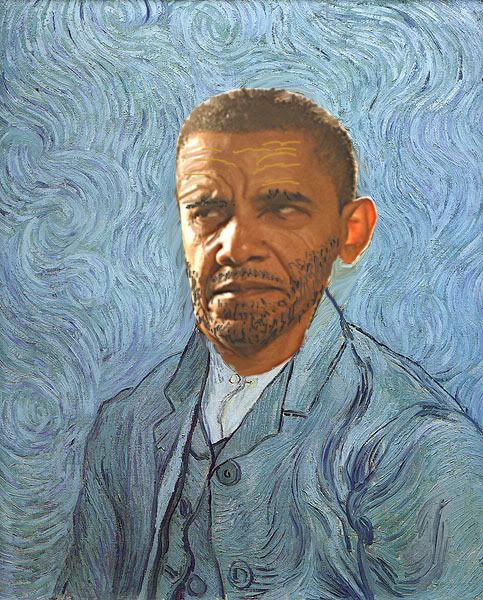
Obamalisa and Obama Van Gogh.

"Mona Lisa. Please, someone do it! The sly smile would be so perfect," said Kentuckyliz, in that post yesterday where I'd asked for Photoshoppings of Obama in French impressionist/post-impressionists paintings.

Palladian gave us this:


Chip Ahoy was all:
Ha ha ha ha ha

I can't stand it. But Palladian, Post- Impressionist? Allow me recommend filter/pixelate/pointillize for Seurat-like dotage to conform Obamalisa, ha ha ha ha ha, that kills me all over again, with our Hostess' bleg.

Nothing like a hilarious anachronism. Let's celebrate with a reprise Chip's delightful Obama Van Gogh:


ADDED: MPH does the Modigliani variation:

Thursday, May 28, 2009

"Republicans would be foolish to fight the nomination of Judge Sonia Sotomayor to the U.S. Supreme Court..."

"...because she is the most conservative choice that President Obama could have made," says E.J. Dionne, whose assertion shouldn't be trusted.

IN THE COMMENTS: traditionalguy said:
Dionne's advice is letting the cat out of the bag. The Progressive wing will gladly push for withdrawal of her nomination if the repubbies continue to posture and vent over a few imperfections in Sonia's speeches. Then Obama could really un-load on them with his next choice. The nomination of Sotomayor needs another "just like Bush" tag.
Ah, yes. Just like Bush did with Harriet Miers and then Samual Alito. As kentuckyliz suggested, we ought to call Sotomayor Sorta-Miers.