Pages

Labels

Showing posts with label Princess Diana. Show all posts

Tuesday, July 7, 2009

"Over the next few months. I will be seeking a more suitable way of combining a meaningful public role, with hopefully, a more private life."

"I hope you can find it in your hearts to understand and give me the time and space that has been lacking in recent years."

Before Sarah Palin, there was Princess Diana. Tina Brown makes the comparison:
Like Princess Diana, who was both an addict of fame and its tormented victim, Palin is at constant war with the exposure she seems to live for. In Diana’s case, it was the raucous tabloids and their pitiless photographers who stalked her every waking hour alone or with her children. In Palin’s case, it’s that malign aristocratic phantom, the “media elite.”

It’s hard to feel as sorry for Palin as one did for Diana. The comely governor is so cocky in her ignorance, so relentless in pursuit of her own rise to fame, her arrogance makes it much harder to see her vulnerability. But that doesn’t mean it isn’t there....
Doesn't mean it is, either. And even if she is like Diana, Diana came back more powerful than ever.

(By the way, Tina Brown's book about Princess Diana, "The Diana Chronicles," is a terrific read, full of apt analysis of media and fame.)

Wednesday, January 14, 2009

Do people become famous because their heads are large, or does celebrity actually cause the head to enlarge?

Over in last night's "American Idol" thread, Trooper York wrote:
The girl that sang "At Last" has an extremely big head. Which is very good since most popular actors have heads out of proportion to their bodies.
This reminds me of something that I read a while back in Tina Brown's excellent book "The Diana Chronicles":
What struck me at lunch was how much celebrity itself had transformed Diana's appearance. I have come to think that being looked at obsessively by people you don't know actually changes the way your face and body are assembled — not just in the obvious ways of enhanced fashion sense or tricks of charm and self-possession, but in the illusion of size. The heads of world-class celebrities literally seem to enlarge. Hillary Clinton's, for instance, has grown enormously since she was the mere wife of the governor of Arkansas. It nods when she talks to you like a balloon in the Macy's Thanksgiving Day parade. The years of limelight so inflated the circumference of Jackie O's cranium, it seemed her real face must be concealed by an oversized Halloween mask. If you looked into her eyes, you could see her in there somewhere, screaming.

Thursday, September 11, 2008

Slate article about John and Sarah that makes me think of Charles and Diana.

The Slate article, by Bill Gifford, is called "McCain's Visit to Palin Country: I Went to a Sarah Palin Rally, But All I Got Was a Lousy Handshake from John McCain":
The fire marshals have said no more people can be allowed into the gym....

Inside, the rally has already started.... [T]he screen flashes on, and there they are: Palin in her blood-red power suit, McCain standing next to her. She goes first, launching into a remixed version of her convention speech; in her squeaky, cheerleader-mom voice, its harsh sentiments come off as almost saucy. The crowd hoots and claps at the screen....

We can't really hear too well, the sound's been turned down so low, but still people clap and cheer. We're happy at last because we've realized we're going to get something far more precious: Palin and McCain will be coming out this side door, and we'll have our own private audience! ....

We wait some more. Finally McCain comes striding around from the back of the building, with a huge grin. But no Palin. The crowd cheers anyway....
McCain and Palin are doing rallies as a team, and it is too obvious that the crowd is genuinely thrilled about her. She is the one they've been waiting for (to vary a phrase).

There's a scene in Tina Brown's "Diana Chronicles." (You can read the passage if you go to that link and use the "search inside" function with "spina bifida" -- trust me -- and read forward.)

It's shortly after the wedding, and Charles and Diana are making an appearance in Wales. Charles, who's been the Prince of Wales all his life and expects the usual adoration, goes down one side of a crowded street and greets people in his usual style and Diana, the new Princess, proceeds down the other side glowing and touching and crouching in her distinctive new way. Occasionally, the couple switch sides, which means that the people waiting their turn are never sure if they are going to get personal contact with Charles or Diana. And every time the switch is made, the side of the street that is about to get Charles sighs with audible disappointment.

As Tina Brown tells it, Diana's superior popularity gets to Charles. It's not the only thing that wrecks the marriage, which was never on solid ground, but it's one of the many things.

What is it like for a man to suddenly find himself conspicuously upstaged and outloved by a woman that he picked out of near-obscurity to stand by him? Can he see it as his own great good fortune and benefit from the positive value, or does it eat at him, sour him, and ruin everything?

Charles, we know, blew it. He retreated into the arms of his comfortable old friend, Camilla Parker-Bowles, the woman he'd wanted all along, whom the family would not allow him to marry.

We don't know how John McCain will handle the country's dazzling, out-of-proportion love for Sarah Palin... other than that we can be quite sure that he won't retreat into the comfortable arms of Joe Lieberman.

Saturday, September 6, 2008

What the women wore on the convention stages.

Robin Givhan observes the fashions of various political women:
It is not sexist to have noticed that Sen. Hillary Clinton delivered her convention speech dressed in head-to-toe mango. Only an obstinately unaware person would have ignored this question: Senator, why are you dressed like a tropical fruit? One assumes it was to ensure an eye-catching photo for the history books and to underscore her "sisterhood of the traveling pantsuits" legacy.
But what about the potential first ladies?
The first lady serves as a reflection of her husband's administration and of womanhood, and one suspects that when there is a first gentleman, he will bear the burden of epitomizing an ideal of manhood and will be forced to wrestle with accusations that he is too much of a metrosexual, a dandy, a he-man or a wimp. Almost certainly, we will obsess about his ties.

When Cindy McCain made her first appearance at the Republican National Convention, she was wearing a buttercup-yellow shirt dress with a flipped-up collar by Seventh Avenue designer Oscar de la Renta. As is the current fashion, the dress looked as though the designer had found some inspiration in the early 1960s world of "Mad Men." It was feminine, reserved and lovely. Ballpark price for a de la Renta dress: $3,000.
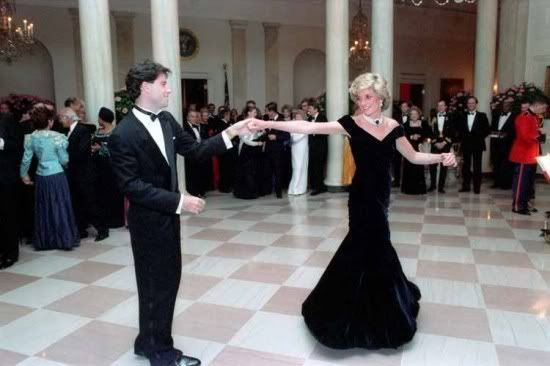
I loved that dress. It is the most distinctive thing any political woman has worn this year. I read some bitching on the liberal blogs about how her outfit cost $300,000, but nearly all of that was the cost of some diamond jewelry. It wasn't a $300,000 dress. But you know, that dress was historically beautiful. And I suppose it's worth $300,000 now. The "off-the-shoulder, ink-blue velvet dinner dress that the Princess of Wales wore when she danced at the White House with John Travolta sold for $222,500" in 1997 (before the princess died).

De la Renta also designed the inaugural gowns worn by Hillary Clinton and Laura Bush and that cream-colored suit Laura Bush wore when she stood next to Cindy McCain at the convention, Givhan notes, pronouncing the Republicans "status quo." Meanwhile, when Michelle joined Barack Obama on the stage, she was "wearing a raspberry, lavender and black print silk dress by American designer Thakoon Panichgul," who is not a heavily established designer:
The dress, with its slim bodice and A-line skirt, came from his 2009 resort collection... [T]he Thakoon dress... was too informal and failed to reflect the significance of the occasion. And with that fabric belt hanging down the back, it resembled a child's special-occasion frock rather than something suitable for a sophisticated 44-year-old. The flats reinforced the tea-party aesthetic
Oops. So we want change... but what kind of change? A change might be for the worse. There's a reason why the status quo is status quo.

Thursday, July 24, 2008

Obama's rally in Berlin.

How strange is it for an American presidential candidate to have a big rally in a foreign country? Why is Obama doing this in Berlin?

This may be a cheap shot, but since it's also thoroughly predictable, why did Obama set it up? The main point of a rally is to generate optics. Why would it seem like a good idea for an American candidate to be seen amid thousands of cheering Germans?

Of course, some American voters long for European love and will warm to these images of German enthusiasm, but presumably these people already support Obama.

ADDED: The German perspective:
So what is motivating Berliners and Germans in general to treat a Democratic presidential hopeful to such a royal welcome?...

In comparison to US elections, German political campaigns are short, stolid and sober affairs that focus as much on party platforms as personalities. In the wake of World War II, many Germans view charismatic leadership with mistrust.
Good call!
That, however, doesn't mean that ordinary Germans or the media are immune to the aura of a politician who knows how to work a crowd.

The current edition of Germany's most serious news weekly, Der Spiegel, features Obama on its cover with the only vaguely ironic headline "Germany Meets the Superstar" -- a play on the title of the German version of the TV show "American Idol."

And many German bloggers do seem to idolize the Illinois senator.

"For me he already is the American president," wrote one user of a Website about Obama's Berlin visit. "He may not be have been elected, but he's the president in people's hearts."
Ick. But it reminds me of the famous interview with Princess Diana:
MARTIN BASHIR: Do you think you will ever be Queen?

DIANA: No, I don't, no.

BASHIR: Why do you think that?

DIANA: I'd like to be a queen of people's hearts, in people's hearts, but I don't see myself being Queen of this country. I don't think many people will want me to be Queen.

Actually, when I say many people I mean the establishment that I married into, because they have decided that I'm a non-starter.

BASHIR: Why do you think they've decided that?

DIANA: Because I do things differently, because I don't go by a rule book, because I lead from the heart, not the head, and albeit that's got me into trouble in my work, I understand that. But someone's got to go out there and love people and show it.
Ah, so there's an angle if somehow Obama doesn't make it in the end. He can always be President of our hearts.

Friday, February 29, 2008

Is it unacceptable for a white comic actor to impersonate Obama on SNL?

Wouldn't it be worse to use the black cast member who doesn't look at all like Obama?
[Lorne] Michaels said that the show auditioned "four to five" actors for the Obama role... "When it came down to it, I went with the person with the cleanest comedy 'take' on" Obama, Michaels said.

Michaels said he liked how [Fred] Armisen caught the tilt of Obama's head, the rhythm of his speaking style, "the essence" of his look. "It's not about race," Michaels insisted via phone....

Todd Boyd, a professor of critical studies at the University of Southern California, says viewers might have a different reaction if the roles were reversed. What if, he says, "SNL" had cast a black woman to portray Hillary Clinton? "Do you think there's ever going to be a day when we start casting Queen Latifah to portray Princess Diana?" he asks. "We just don't have the same representations going in other direction."
Why did the professor of critical studies come up with an example of a large American black woman playing a skinny English white woman? Kind of stacking the deck there, Professor Boyd. Now, if Queen Latifah played Hillary — with a lot of hair and makeup work, I can picture it — the issue would be: Did she do it well and was it funny? Which is the test SNL applied to Arneson. In any case, what is Boyd talking about? We are much more sensitive about a white person wearing blackface than about a black person playing white!

Remember Eddie Murphy in the 1984 SNL sketch "White Like Me"? Could white America have laughed any harder? "I've got a lot of friends, and we've got a lot of makeup. So, the next time you're huggin' up with some really super, groovy white guy, or you met a really great, super keen white chick, don't be too sure. They might be black." Was there any outrage over that?

ADDED: To be fair to Professor Boyd, if the question is whether a black actor would ever get the part of playing a white person, the answer may be that there are always plenty of white actors around to fill the white roles. It's not about whether we find blackface less acceptable than whiteface, but just that black actors don't get the chance to play white. But it's at least as rare for a white actor to get the part of playing a black person. And, as I implied at the beginning of this post, it would be more racially offensive to give the role to a black actor who doesn't look at all like the black person he's supposed to portray. It would represent the view that all black people look alike. 

Tuesday, September 4, 2007

WaPo columnist overwhelmed with meaninglessness....

... on contemplating the death of Princess Diana. It seems that Anne Applebaum, being English, felt she had to write something about the 10 year anniversary of the death of Diana.
[T]he genuinely bizarre aspect of the all-consuming Dianamania that gripped Britain a decade ago this week is how slight a trace it has left. The royal family is pretty much the same, only quieter...

Nor have there been political repercussions. It didn't take long for Britons to tire of Blair's Diana-like emotionalism (some would say Diana-like manipulativeness).
10 years is not long? Here in America, we're committed in advance to being sick of every President after 8 years. We can't consider putting up with a leader for 10 years even hypothetically.
His sober replacement, Gordon Brown -- a man whose name rarely appears in print without the adjective "dour" -- is already more popular. Brown's government is dominated by technocratic types with furrowed brows and by sensible centrists, such as his plain-jane home secretary, Jacqui Smith: No sign of touchy-feeliness there.
Jacqui Smith! The last time I heard about her, WaPo fashion columnist Robin Givhan was comparing her show of cleavage to Hillary Clinton's -- and finding it "a full-fledged come-on." Now, I don't know what to think of Jacqui Smith -- or the U.K. Is it a place where an exuberant show of cleavage is regarded as staid?
One could argue that Diana's truest legacy is the screaming emotionalism of the British tabloids -- except that it long predates Diana and actually helped create her in the first place....

Ironically, nowhere does Dianamania seem more irrelevant than in the place that was meant to be its shrine. Last summer I happened to find myself at the Diana memorial at Althorp, her family's estate....

There was the original, handwritten version of the speech her brother, Charles, gave at her funeral -- framed behind glass and lit as if it were the Magna Carta.

Visitor numbers are way down from 1997, and no wonder: The whole thing feels rather irrelevant. Human beings naturally try to give deeper meaning to pointless tragedies -- even where no meaning is to be found.
Did the columnist trek to Althorp and feel cold and grouchy, or is it really true that the death of Diana caused a fever, which spiked and died away?

CORRECTION: Applebaum is not British! She did, however, write "Like most Britons, I can remember where I was when the BBC announced...."

Thursday, July 12, 2007

Hillary Clinton versus Princess Diana?

Mickey Kaus plots some connectable dots:
Dot 1: Jeff Gerth and Don Van Natta report in their recent book that Hillary Clinton personally
listened to a secretly recorded audiotape of a phone conversation of Clinton critics plotting their next attack. The tape contained discussions of another woman who might surface with allegations about an affair with Bill. Bill's supporters monitored frequencies used by cell phones, and the tape was made during one of those monitoring sessions.
Dot 2: Tina Brown's new Diana Chronicles contains this passage, supporting reports that Princess Di was thinking of marrying U.S. tycoon Ted Forstmann as part of a possible presidential ticket:
Diana built an escape fantasy around Forstmann for a time. "It's a true story," he told me, "that Diana had the idea that we should get married, that I should run for president and she would be First Lady."
Dot 3: Forstmann was in fact seriously mentioned as a Republican opponent for Hillary in the 2000 N.Y. Senate race.

Dot 4: Both Diana (according to Tina Brown) and Forstmann (according to the New York Daily News**) thought they were being bugged.

Dot 5: A British paper reported that Diana and Forstmann and Diana were bugged by some American outfit during the Clinton administration, although the official Lord Stevens inquiry failed to include this allegation despite press predictions that it would.
Bizarre.

Hard to think of Di as a Republican... and as an American First Lady. Oh, the glamour that never was!

By the way, I highly recommend "The Diana Chronicles," which I enjoyed as an audiobook download. There's quite a lot of focus on the development of journalism over the Diana years -- so it's not just escapist reading.

Speaking of glamour... do you think Bill Clinton will make a glamorous First Gentleman? Do you think Barack and Michelle would be a more glamorous First Family?

Thursday, July 5, 2007

"She had used all my underpants and left them dirty in the hamper."

The bad housesitter.

ADDED: Somewhat aimlessly looking for etiquette advice about housesitting, I stumbled on Emily Post's 1922 book "Etiquette," and became engrossed in this chapter about house guests. Here's a bit called "A Room for Every Guest":
It is almost unnecessary to say that in no well-appointed house is a guest, except under three circumstances, put in a room with any one else. The three exceptions are:
  1. A man and wife, if the hostess is sure beyond a doubt that they occupy similar quarters when at home.
  2. Two young girls who are friends and have volunteered, because the house is crowded, to room together in a room with two beds.
  3. On an occasion such as a wedding, a ball, or an intercollegiate athletic event, young people don’t mind for one night (that is spent for the greater part “up”) how many are doubled; and house room is limited merely to cot space, sofas, and even the billiard table.
But she would be a very clumsy hostess, who, for a week-end, filled her house like a sardine box to the discomfort and resentment of every one.

In the well-appointed house, every guest room has a bath adjoining for itself alone, or shared with a connecting room and used only by a man and wife, two women or two men. A bathroom should never (if avoidable) be shared by a woman and a man. A suitable accommodation for a man and wife is a double room with bath and a single room next.
A suitable accommodation for a man and wife is a double room with bath and a single room next. And you must never assume that a man and his wife want to sleep in the same bedroom. I love this consideration about sleeping arrangements -- which most people today don't even make for themselves, even in their own houses. They just go on thinking that it's required for the husband and wife to sleep in the same room -- in the same bed. How much suffering could be avoided if people got past this narrow conception of married life. (I'm quite serious!)

I guess this is a good point for me to confess that I've been listening -- on my wide-ranging summer walks around Madison -- to the audiobook of "The Diana Chronicles" by Tina Brown. Why would I "read" such a thing? I was impressed by this WSJ review:
Only Ms. Brown could deploy such words as "hottie" and "propinquity" in the same sentence. In her hands, a trashy (if delicious) tale is rendered vividly mordant. She writes with the feline flair of a woman who has met, but not necessarily liked, most of the characters in her book and who has an uncommonly good way with characterization. Diana, in the early period of her marriage, "was a work in progress, while Charles was a work in aspic." Later, on a hot night in August -- the last night of her life -- Diana sets off in a car in Paris "pursued by the farting motorbikes of the international press." The princess, an aristocrat by birth (her daddy was that "truncheon-faced old buffer," the eighth Earl Spencer), now believed only in "the aristocracy of exposure."

The book's greatest attraction, however, is its sheer wealth of detail, by turns salacious, vinegary, depressing and hilarious. Did you know that Queen Elizabeth is referred to below-stairs as "Betty Battenberg"? (It is a dig at her Germanic origins.) Or that the bulimic Diana's waist shrank from 29 inches to 23½ between the first and last fittings of her wedding dress? The eating disorder was, it seems, triggered by a stray comment from Charles about how "chubby" Diana felt when he put his hand on her waist.

One learns that in November 1983, two years later, the royal couple had an almighty row over Charles's "refusal to spend money on a tennis court [at his Highgrove estate], thereby depriving Diana of her sole outdoor activity." And their sex together wasn't terribly good either, we read, being merely a "roll on, roll off" affair. His Royal Highness, Ms. Brown writes, "had difficulty locating her erogenous zones." But Diana was nothing if not game: To make herself alluring to Charles after the birth of their second son, Harry, she "tried to dance her way into his heart." We are told that "she would put on sexy lingerie and low music and attempt to tantalize him with a striptease he is said to have only 'mildly enjoyed.'"
It's not easy to write like that.

BONUS: Movie recommendation: "Housesitter."


Looks cheesy -- and both actors are too old for their roles -- but I really enjoyed this story -- in the "Bringing Up Baby" mode -- of a free-spirited woman annoying a very straitlaced man until he understands what it means to be alive. And the house -- which the man built to for another woman -- seems quite wonderful. Though it's probably crazy to have an uncurtained glass corridor connecting the bedroom to the rest of the house, this movie made me want one. Along with a big bathtub right in the bedroom....

Monday, January 1, 2007

About those pop culture law school exam fact patterns.

I'm always basing my Civil Procedure II exam on some pop culture thing. CivPro2 here at UW covers jurisdiction and related topics, and I always need a fact pattern -- it doesn't matter what the substantive law is -- that involves a lot of people and places so I can generate some questions about who can join together in a lawsuit and where they can bring the suit and so forth.

In any given year, students could take bets on what pop culture phenomenon will turn up on the exam. If they'd done it this year, it would have been terribly easy to guess. It's "Borat." I changed the name, but basically it's a comedian traveling across the country provoking encounters... and sowing the seeds of lawsuits. It never matters whether the claims are sound or not. (I hope they're not!) I've simply got to create a controversy that has a somewhat complicated mix of people and places.

Does it add some fun to exam-taking, or is it annoying? I hope that, afterwards, it doesn't spoil the fun of the movie for the students. Ack! That was my Civil Procedure exam! I don't mean to do that.

Here's a list of a few things I've used for CivPro2 exams in the past: "The Apprentice," "The Blair Witch Project," "America's Funniest Home Videos," the Beach Boys' legal problems with Eugene Landy, "Supersize Me," "The Real World," the Cat in the Hat balloon at the Macy's Thanksgiving Parade, paparazzi and the deaths of Princess Diana and Sonny Bono, stage diving at the Rave, the U.S. News law school rankings.

Sunday, September 24, 2006

Imaginative filmmaking about living public figures.

Two weeks ago we were talking -- and talking -- about whether it was wrong for filmmakers -- in "The Path to 9/11" -- to make up scenes and dialogue depicting real public figures engaged in historical events. Here's another example of that sort of thing:
In Stephen Frears’s new movie, “The Queen,” Elizabeth II is shown driving a Range Rover at her family’s remote Scottish retreat, trapped in an unpleasant conversation with her eldest son, Prince Charles.

The subject is Diana, Princess of Wales, whose death that week has sent Britain into a convulsion of collective grief (not shared by the royal family). When an emotionally confused Charles begins to babble about what a good mother Diana was — physically affectionate, full of love — it is clear what he is really saying: “You never hugged me as a child.”

That’s it for him. Abruptly the queen gets out of the car and opens the back door, liberating a passel of eager dogs. Her voice lifts. “Walkies!” she trills.

The situation is of course imagined, the pair played by actors (Helen Mirren as the queen, Alex Jennings as Charles), the dialogue wholly made up and the filmmaker’s undertaking a daring one.
Imagine Queen Elizabeth demanding that the movie be yanked -- britted? -- the way Clinton did about "The Path to 9/11."