Pages

Labels

Showing posts with label posters. Show all posts

Thursday, September 20, 2012

"Amazed nobody at Obama HQ noticed this, especially with all the hand-stuff."

Yes, but... pointing it out...

Too far?

ADDED: I got a few emails this morning pushing me to do a Drudgtaposition post based on the bloody handmark photograph and the Obama flag graphic. But Drudge didn't put up the handprint photograph next to the flag graphic. Not that I saw. He put up that flag graphic with the text "OBAMA SELLS 'OUR STRIPES' FLAG...", linking to the campaign's merchandise page.

ALSO: It seems to be widely believed that the red stripes on the American flag are red to represent blood (the "blood of patriots"). 

UPDATE: I'm sorry. It was too subtle for me even with multiple emails pointing me to it. Drudge did have the handprint next to the flag. Here's the screen grab:


Saturday, August 18, 2012

"We expect Mitt Romney and the Republicans to outspend us. What I will not abide..."

"... is getting outspent by a margin that negates all the hard work our volunteers are doing."

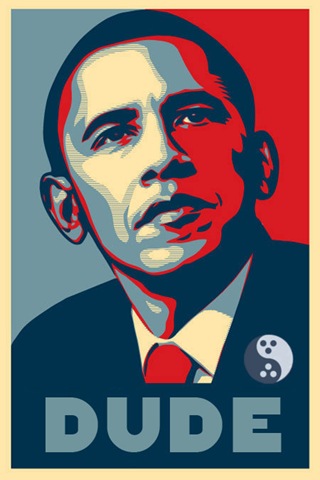
Email from Barack Obama. I read it out loud and repeat I will not abide. Meade says "The dude abides."

Here's a discussion from English Language & Usuage:
I'm unfamilar with the word "abide" which is famously used the the movie quote "The Dude abides" (The Big Lebowski).

Looking it up in a German/English dictionary makes me believe it's "The Dude lives on", but I heard the word used on a way that makes it seem to be a variant of "approve," as in "The Dude does not abide this behavior."

I hear it used as "to obey" a lot, as in "we must all abide by the rules".

Can someone shed some light into the meaning of "The Dude abides" in the context it's been used?
Here's the top-rated answer:
Some discussions of the movie reference a peaceful, almost zen acceptance, as well as the idea that
The Dude will always be around.
A discussion on Reddit of what "the Dude abides" means has some consensus that it's an
Intentionally vague phrase hinting at the fact that The Dude Lives, in his unperturbable state of dudeness, somewhere.
and that the definitions "accept" and "continue" make sense in this context.

As @wfaulk points out, today we usually use abide transitively to mean things like trusting in, accepting or obeying; so it doesn't mean The Dude accepts or endures a particular thing, but I agree that the phrase still can imply a sense of patience or toleration, even if it's just the way someone waits or continues.

If you look at the etymology of abide, you can see how some of these meanings emerge:
O.E. abidan, gebidan "remain, wait, delay, remain behind," from ge- completive prefix (denoting onward motion; see a- (1)) + bidan "bide, remain, wait, dwell" (see bide). ... Meaning "to put up with" (now usually negative) first recorded 1520s.
Biden!
and going back to bide:
O.E. bidan "to stay, continue, live, remain," also "to trust, rely" (cognate of O.N. biða, O.Fris. bidia, Goth. beidan "to wait"), apparently from PIE *bheidh-, an extended stem of one root of O.E. biddan (see bid), the original sense of which was "to command," and "to trust" (cf. Gk. peithein "to persuade," pistis "faith;" L. fidere "to trust," foedus "compact, treaty," O.C.S. mmi>beda "need"). Perhaps the sense evolved in prehistoric times through "endure," and "endure a wait," to "to wait."
I think you're right: The Dude endures; The Dude lives on.
But The Dude will not abide... or will he? And will he abide Biden?

Should I not call the President "The Dude"? Obama is famous for calling a little boy "dude" when he said "Touch it, dude." And Jon Stewart famously called him "dude." That was back in 2010. It was much debated at the time. Here's Parker and Spitzer — remember them? — batting it around. And here's a WSJ blog:
Was it disrespectful for Stewart to address the president using a term that’s more commonly exchanged between two college guys sharing a bong?
Chooming.
Since the days of George Washington, America’s top leader has been addressed as “Mr. President.” Even Martha Washington called her husband “Mr. President.” Congress at one point considered the loftier title of “His Highness the President of the United States of America and Protector of their Liberties.”...

Then again, Thomas Jefferson once said that he hoped that “the terms of excellency, honor, worship and esquire will forever disappear from among us.”
Yes, it's really not too American to worship the President.


Odd that "The Big Lebowski" has become our prime association with "abide." There was a time, not so long ago, when it would have been the great hymn"Abide With Me":
Abide with me; fast falls the eventide;
The darkness deepens; Lord with me abide.
When other helpers fail and comforts flee,
Help of the helpless, O abide with me.....

Saturday, May 12, 2012

An inquiry into the 3 times Obama called people "faceless" in "Dreams From My Father."

"Dreams From My Father" is, according to its subtitle "A Story of Race and Inheritance," and this post is a story of facelessness — a bloggish riff undertaken without any particular goal in mind. I'd been struck yesterday by Obama's use of the word "faceless" to describe the children who, long ago, surrounded him in the playground and, with a bit of mockery, inspired him to shove the little black girl Coretta.

My search for facelessness was not as long nor as painstaking as Obama's search for his father's dreams. I have the Kindle edition of "Dreams," and I did a word search. I found 2 other appearances of  "faceless." Here is the first one, from his college days as Occidental.
There were enough of us [black students] on campus to constitute a tribe, and when it came to hanging out many of us chose to function like a tribe, staying close together, traveling in packs....

I had stumbled upon one of the well-kept secrets about black people: that most of us weren’t interested in revolt; that most of us were tired of thinking about race all the time; that if we preferred to keep to ourselves it was mainly because that was the easiest way to stop thinking about it, easier than spending all your time mad or trying to guess whatever it was that white folks were thinking about you.
By the way, in the section about Coretta, his reaction to his own behavior is to avoid other people. (He describes this passively: "I was left mostly alone.") He goes home after school, does his homework, and watches a lot of television while eating "the latest snack food" with "Gramps." Obama describes himself as "[n]ested in the soft, forgiving bosom of America’s consumer culture" where he "felt safe. " It was "as if I had dropped into a long hibernation."

Back to the college scene:
So why couldn’t I let it go?

I don’t know. I didn’t have the luxury, I suppose, the certainty of the tribe.... I hadn’t grown up in Compton, or Watts. I had nothing to escape from except my own inner doubt. I was more like the black students who had grown up in the suburbs, kids whose parents had already paid the price of escape. You could spot them right away by the way they talked, the people they sat with in the cafeteria.

When pressed, they would sputter and explain that they refused to be categorized. They weren’t defined by the color of their skin, they would tell you. They were individuals.
Note the potential sarcasm in the use of the word "individuals." Individuality is the opposite of facelessness.
That’s how Joyce liked to talk.
 Uh-oh. Here she comes. It's Joyce. Is she real? Is she concocted? Is she composite and compressed? 
She was a good-looking woman, Joyce was, with her green eyes and honey skin and pouty lips. We lived in the same dorm my freshman year, and all the brothers were after her. One day I asked her if she was going to the Black Students’ Association meeting. She looked at me funny, then started shaking her head like a baby who doesn’t want what it sees on the spoon.

“I’m not black,” Joyce said. “I’m multiracial.”
Do you believe there was really a Joyce who talked like this — so disgustingly disgusted? It doesn't matter. She's a literary device. She's a stereotype — the stereotype of the person who thinks she's an individual.
Then she started telling me about her father, who happened to be Italian and was the sweetest man in the world; and her mother, who happened to be part African and part French and part Native American and part something else. “Why should I have to choose between them?” she asked me. Her voice cracked, and I thought she was going to cry. “It’s not white people who are making me choose. Maybe it used to be that way, but now they’re willing to treat me like a person. No—it’s black people who always have to make everything racial. They’re the ones making me choose. They’re the ones who are telling me that I can’t be who I am….” They, they, they.

That was the problem with people like Joyce. They talked about the richness of their multicultural heritage and it sounded real good, until you noticed that they avoided black people. It wasn’t a matter of conscious choice, necessarily, just a matter of gravitational pull, the way integration always worked, a one-way street. The minority assimilated into the dominant culture, not the other way around.
Have reporters located this "Joyce" person who embodied exactly what he needed a character to embody at this point in the memoir? Or is she really Barack Obama, in the guise of a beautiful lady after whom all the "brothers" lusted?
Only white culture could be neutral and objective. Only white culture could be nonracial, willing to adopt the occasional exotic into its ranks. 
I wonder if that last sentence expresses what he thinks of himself now, about Americans having voted him into the presidency: He's the occasional exotic the white culture adopted.
Only white culture had individuals. And we, the half-breeds...
Half-breed! That's all I ever heard!
... and the college-degreed, take a survey of the situation and think to ourselves, Why should we get lumped in with the losers if we don’t have to? We become only so grateful to lose ourselves in the crowd, America’s happy, faceless marketplace...
The marketplace, where you can hibernate in the forgiving bosom of America’s consumer culture. Notice the flip: If you think of yourself as an individual, paradoxically, you'll melt into the crowd. You'll be faceless.
... and we’re never so outraged as when a cabbie drives past us or the woman in the elevator clutches her purse, not so much because we’re bothered by the fact that such indignities are what less fortunate coloreds have to put up with every single day of their lives—although that’s what we tell ourselves—but because we’re wearing a Brooks Brothers suit and speak impeccable English and yet have somehow been mistaken for an ordinary nigger.

Don’t you know who I am? I’m an individual!
This is a vicious rejection of the desire to be seen as an individual. He equates it to the subordination of black people. Individuality is a con. If you fall for it, you might imagine yourself to be happy and special, but you are really faceless. You've been duped by — by whom? — the "marketplace"? The "consumer culture"? But Obama's truth is: To have identity, you must identify with your identity group.

The final use of the word "faceless," comes up in Chicago as he interacts with a character — composite? — he calls Ruby.  She was a woman in the community he was trying to "organize." As he describes it, she has a lack of self-esteem borne of racial subordination.
If the language, the humor, the stories of ordinary people were the stuff out of which families, communities, economies would have to be built, then I couldn’t separate that strength from the hurt and distortions that lingered inside us. And it was the implications of that fact, I realized, that had most disturbed me when I looked into Ruby’s eyes. 
Ruby has eyes and therefore a face, but she exists in the book to embody a component of a larger entity that needs to "be built." That's what community organizing is: Getting individuals to find identity as a component of the whole. They are "the stuff out of which" things are "built."
The stories that I had been hearing from the leadership, all the records of courage and sacrifice and of great odds, hadn’t simply arisen from struggles with pestilence or drought, or even mere poverty. They had arisen out of a very particular experience with hate. That hate hadn’t gone away; it formed a counternarrative buried deep within each person and at the center of which stood white people—some cruel, some ignorant, sometimes a single face, sometimes just a faceless image of a system claiming power over our lives. I had to ask myself whether the bonds of community could be restored without collectively exorcising that ghostly figure that haunted black dreams. Could Ruby love herself without hating blue eyes?
He "looked into Ruby’s eyes" and he was "disturbed," because he saw "buried" inside her a "ghostly" white person. Looking back out of Ruby's eyes were the blue eyes of that white person, who sometimes had no face at all... and maybe wasn't even a person, but "a system." For the Rubys of Chicago to suffice as the raw material — "the stuff" — out of which the larger entity could "be built," that blue-eyed/faceless white person/system would need to be exorcised.

Notice the connection between facelessness and ghostliness. In yesterday's post — about the incident with the faceless white kids in the playground — I said "It's like he's sleepwalking in ghost world, where human beings are apparitions." And now, I'm seeing that he goes on to say: "For the rest of the afternoon, I was haunted by the look on Coretta’s face...." Faces haunt him.

In the Ruby incident, he speaks of a ghost haunting dreams, and "dreams" is the key word in the book: He's searching for dreams from his father. The good dreams, the dreams he seeks, are the dreams of the black side of his genetic heritage. He would like to exorcise the white component, which is oppressing him, or maybe not really him, but all those other black people with whom he needs to ally — alliance, as opposed to the fraud of being an individual — so he can build something, build something out of the people who have been turned into good building blocks by having the whiteness within extracted.

By conceptualizing a white person buried inside the subordinated black person — Ruby — Obama has found a way to think of all black people as needing the process that he — the half-black person — felt he needed.

Who are these people — Coretta, Joyce, and Ruby? Are they all really Barack, projected onto a female alter ego? He's created faces of females — each time in a context of faceless ghost characters. Who are they... and who is this mysterious man who revealed himself in this haunted-dreams book that we all feel we've almost read, but never very closely? He went on to become that face...


... the face that drew us in.

Saturday, April 28, 2012

"Occupy Student Debt."


Nice poster... but what's going on? There's this:
The Occupy Student Debt Campaign, organised by members of Occupy Wall Street, planned rallies in at least a dozen cities including the college towns of Ann Arbor in Michigan, Madison in Wisconsin, and Newark in Delaware, the home of the lender Sallie Mae.
Madison, Wisconsin? Here we go again...

Friday, March 23, 2012

The Most Inappropriate Nausea of the Day.

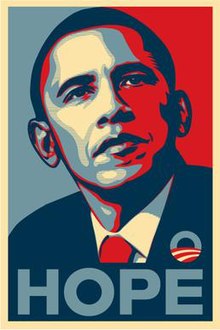
A writer over at Pajamas Media whose name appears in an unreadable font — Jebuda? Jehuda? — assumes we readers will all want to puke when we see that Shepard Fairey — the artist behind the famous Obama "Hope" poster — is working on a new movie version of George Orwell’s 1984.
That’s right: we may soon see in screens big and small a movie that could very well be advertised as “From the Dishonest Propagandist Who Brought You the Obama ‘Hope’ Poster.”

There’s something very fitting about a dishonest propagandist pushing for a whole new 1984 movie, but coming from Obama booster Ron Howard and Shepard Fairey, this project might amount to – if it’s ever produced – a version of 1984 that would make George Orwell spin in his grave.
First, I think what would make Orwell "spin in his grave" is your use of the phrase "spin in his grave." Good lord, you purport to care about Orwell, yet you blithely violate one of the most memorable rules in his famous essay "Politics and the English Language": "Never use a metaphor, simile, or other figure of speech which you are used to seeing in print."

Second, Shepard Fairey is a brilliant graphic artist. Look at his cover for "The Medium Is the Massage." This is exactly the talent you want to create a visualization of a novel that is — in large part — about posters!
The hallway smelt of boiled cabbage and old rag mats. At one end of it a coloured poster, too large for indoor display, had been tacked to the wall. It depicted simply an enormous face, more than a metre wide: the face of a man of about forty-five, with a heavy black moustache and ruggedly handsome features. Winston made for the stairs. It was no use trying the lift. Even at the best of times it was seldom working, and at present the electric current was cut off during daylight hours. It was part of the economy drive in preparation for Hate Week. The flat was seven flights up, and Winston, who was thirty-nine and had a varicose ulcer above his right ankle, went slowly, resting several times on the way. On each landing, opposite the lift shaft, the poster with the enormous face gazed from the wall. It was one of those pictures which are so contrived that the eyes follow you about when you move. BIG BROTHER IS WATCHING YOU, the caption beneath it ran.
That's paragraph 2 of the novel.
Outside, even through the shut window-pane, the world looked cold. Down in the street little eddies of wind were whirling dust and torn paper into spirals, and though the sun was shining and the sky a harsh blue, there seemed to be no colour in anything, except the posters that were plastered everywhere. The black-moustachio'd face gazed down from every commanding corner.
That's paragraph 4. Later:
Down in the street the wind flapped the torn poster to and fro, and the word INGSOC fitfully appeared and vanished. Ingsoc. The sacred principles of Ingsoc. Newspeak, doublethink, the mutability of the past.... He took a twenty-five cent piece out of his pocket. There, too, in tiny clear lettering, the same slogans were inscribed, and on the other face of the coin the head of Big Brother. Even from the coin the eyes pursued you. On coins, on stamps, on the covers of books, on banners, on posters and on the wrapping of a cigarette packet— everywhere. Always the eyes watching you and the voice enveloping you. Asleep or awake, working or eating, indoors or out of doors, in the bath or in bed— no escape. Nothing was your own except the few cubic centimetres inside your skull.
On and on. Government graphics are central to Orwell's work, and Shepard Fairey made that crazy Orwellian poster that made us love Big Brother Obama. It's utterly thrilling to think of Fairey applying himself to this project. Where's the danger that it will be noisome pro-Obama propaganda? The danger, if any, cuts in the opposite direction.

BONUS: More poster passages from "1984":
As soon as all the corrections which happened to be necessary in any particular number of the Times had been assembled and collated, that number would be reprinted, the original copy destroyed, and the corrected copy placed on the files in its stead. This process of continuous alteration was applied not only to newspapers, but to books, periodicals, pamphlets, posters, leaflets, films, soundtracks, cartoons, photographs — to every kind of literature or documentation which might conceivably hold any political or ideological significance. Day by day and almost minute by minute the past was brought up to date....

'Did I ever tell you, old boy,' he said, chuckling round the stem of his pipe, 'about the time when those two nippers of mine set fire to the old market-woman's skirt because they saw her wrapping up sausages in a poster of B.B.? Sneaked up behind her and set fire to it with a box of matches....

Then he saw the girl standing at the base of the monument, reading or pretending to read a poster which ran spirally up the column....

Winston's evenings were fuller than ever. Squads of volunteers, organised by Parsons, were preparing the street for Hate Week, stitching banners, painting posters, erecting flagstaffs on the roofs and perilously slinging wires across the street for the reception of streamers....

A new poster had suddenly appeared all over London. It had no caption, and represented simply the monstrous figure of a Eurasian soldier, three or four metres high, striding forward with expressionless Mongolian face and enormous boots, a sub-machine-gun pointed from his hip. From whatever angle you looked at the poster, the muzzle of the gun, magnified by the foreshortening, seemed to be pointed straight at you. The thing had been plastered on every blank space on every wall, even outnumbering the portraits of Big Brother. The proles, normally apathetic about the war, were being lashed into one of their periodical frenzies of patriotism.... There were further angry demonstrations, Goldstein was burned in effigy, hundreds of copies of the poster of the Eurasian soldier were torn down and added to the flames, and a number of shops were looted in the turmoil....

Without words said, a wave of understanding rippled through the crowd. Oceania was at war with Eastasia! The next moment there was a tremendous commotion. The banners and posters with which the square was decorated were all wrong! Quite half of them had the wrong faces on them. It was sabotage! The agents of Goldstein had been at work! There was a riotous interlude while posters were ripped from the walls, banners torn to shreds and trampled underfoot....

What was the most horrible, sickening thing of all? He thought of Big Brother. The enormous face (because of constantly seeing it on posters he always thought of it as being a metre wide), with its heavy black moustache and the eyes that followed you to and fro, seemed to float into his mind of its own accord. What were his true feelings towards Big Brother?

Friday, October 28, 2011

Posters, with window reflections.

Some interesting sayings, especially for Madison:


(Enlarge.)


(Enlarge.)

Inside the Overture Center, it was a demonstration of poster printing.

ADDED: I enlarged a photograph enough to see the printer's name "Kennedy Prints," and Googling, I got here and found this trailer for a documentary about Amos Paul Kennedy Jr.:


Wow! Click on the last link in the post for a picture of Kennedy. Click through to the enlargements. The aphorisms on the posters are really terrific.

Thursday, December 30, 2010

Rosie the Riveter, AKA Geraldine Doyle...

... has died at the age of 86.
[T]he woman in the patriotic poster...


... was never named Rosie, nor was she a riveter. All along it was Mrs. Doyle, who after graduating from high school in Ann Arbor, Mich., took a job at a metal factory, her family said.

One day, a photographer representing United Press International came to her factory and captured Mrs. Doyle leaning over a piece of machinery and wearing a red and white polka-dot bandanna over her hair.

In early 1942, the Westinghouse Corp. commissioned artist J. Howard Miller to produce several morale-boosting posters to be displayed inside its buildings. The project was funded by the government as a way to motivate workers and perhaps recruit new ones for the war effort.

Smitten with the UPI photo, Miller reportedly was said to have decided to base one of his posters on the anonymous, slender metal worker - Mrs. Doyle.

For four decades, this fact escaped Mrs. Doyle, who shortly after the photo was taken left her job at the factory. She barely lasted two weeks.

A cellist, Mrs. Doyle was horrified to learn that a previous worker at the factory had badly injured her hands working at the machines. She found safer employment at a soda fountain and bookshop in Ann Arbor, where she wooed a young dental school student and later became his wife.
Oh, the irony! She couldn't do it. But she could inspire others to do it. And she could do other things, like play the cello and rear 6 children. "We" can do it, each in our own way. You work the machines, I'll help people find the right books.

Here's the Norman Rockwell version of Rosie, who's not nearly so glamorous and is clearly not based on Mrs. Doyle:
The 52-by-40-inch oil on canvas depicts "Rosie" on lunch break, her riveting gun on her lap as she uses a dog-eared copy of Mein Kampf as a foot stool.
Great symbolism, Norman. And I don't mean the book. I mean the manly power tool.
Rockwell's Rosie is posed as an homage to Michelangelo's frescoed depiction of the prophet Isaiah from the Sistine Chapel ceiling.
Here's Michelangelo's Isaiah, who's more respectful of his book, which is about God, not his struggle against lies, stupidity and cowardice.

Wednesday, November 4, 2009

"You know, I work on my hair a long time and you hit it. He hits my hair."

2 minutes at the "Saturday Night Fever" dinner table:


We watched the beginning last night. I accidentally clicked and paid $2.99 for this movie that I only meant to look at part of and only if it was free. So we watched about 15 minutes. Great opening. The song, the feet walking down the street, the can of paint, the great interest in shirts, the hair-brushing, the shots peering up from John Travolta's crotch to the awesome expanse of his hairy torso, the Farrah Fawcett poster on the wall, the father eyeing (poor, dead) Farrah's nipple, the pork chops, the entire family hitting each other around the dinner table.... Who can take much more than 15 minutes of such riches? $2.99 well spent!

Saturday, October 17, 2009

Sheperd Fairey admits to deception in the litigation about the photograph he used to make the Obama "Hope" poster.

To make the poster he needed to "reference" — his verb — a photo of Obama, and now he wants to defend that use under the Copyright Law. To promote the acceptance of a broad definition of "fair use," it would help if he were thought of as a good guy — the artist, who should be supported in his creative endeavors and given access to the raw materials that he uses for the general benefit of society. And now we see that he has infected his repution with wrongdoing:
"Throughout the case, there has been a question as to which Mannie Garcia photo I used as a reference to design the HOPE image," Fairey said. "The AP claimed it was one photo, and I claimed it was another."

New filings to the court, he said, "state for the record that the AP is correct about which photo I used...and that I was mistaken. While I initially believed that the photo I referenced was a different one, I discovered early on in the case that I was wrong. In an attempt to conceal my mistake I submitted false images and deleted other images."

In February, the AP claimed that Fairey violated copyright laws when he used one of their images as the basis for the poster.  In response, the artist filed a lawsuit against the AP, claiming that he was protected under fair use. Fairey also claimed that he used a different photo as the inspiration for his poster.
The copyright issue itself should remain the same, and it's an important one indeed. It's a damned shame that the banner for expansive fair use is being carried by someone who was dishonest and who tried to play the legal system. Why is he admitting his deception now? Presumably, he knew the manipulations would come to light one way or the other, and it was a strategic decision to reveal it this way.

Obviously, this is also an occasion to craft jokes analogizing the Fairey mess to what the subject of the poster is doing, with all the usual sarcasm over the word "hope." Not that any of that mess is poor Obama's fault.

Sunday, October 4, 2009

What movie are we seeing?


Hey, I love that poster, but:
....I am looking forward to Capitalism: A Love Story. But I think he’s sort of an idiot positioning the film as anti-capitalist. Capitalism has its problems, but when a title lack that and posters like this, no one but fans are going to take him seriously, and everyone else will immediately dismiss him as an actual communist, which I don’t believe he is.

Yes, it gives the film a nice visual style with the “propaganda theme,” but I think it could have been better handled and less alienating.
I can deal with the alienation. My big question is: Is it funny? Moore is a funnyman, in my book. The trailer won me over, as I said back here. Come back later for an opinion of the actual movie.

Saturday, September 5, 2009

Monday, August 10, 2009

Shepard Fairey — who made the famous Obama "Hope" poster — thinks the Joker Obama poster is "great."

"The artwork is great in that it gets a point across really quickly. The Joker is a sinister, evil character that can't be trusted. And if they want to make that parallel with Obama — bam."

Somehow the L.A. Times sees fit to headline the article "Shepard Fairey has 'doubts' about intelligence of Obama Joker artist." The intelligence doubt is actually a "grammar" point, that the caption should be "socialist," not "socialism," because it's a picture of a man, not his belief system. Hmmm... but Mr. Fairey, your poster of Obama has the word "Hope" as the caption. If it's an error, you made it too. If it's a sign of low intelligence, why should I listen to you, a man of low intelligence?

Wednesday, July 1, 2009

Now, here is a bold and original movie poster!


Via Awards Daily.

There's also this poster for the movie. Good, but very much trying to be Saul Bass. Maybe the one I like so much is also in the style of someone else, and I just don't know it. And if you're going to try to be somebody, and you're a poster designer, be Saul Bass. He's so iconic, it's not a ripoff but an homage. And it's so refreshing to see movie posters that aren't actors' faces.

Sunday, June 14, 2009

Gender difference feels good in Paris.

Nina says:
[A]t least in Paris (in my opinion), women of all shapes and sizes and importantly, of all ages, seem to understand their beauty and valor, their unique beauty and their unique valor. They walk with pride (and so I, too, walk with pride). As if they know they’re being watched, admired, respected. For what they bring to the table.
Read the whole thing to get the hang of the argument, which is made impressionistically, with pictures interspersed. I especially like this one:


DSC03958_2, originally uploaded by Nina Camic.

You don't normally see faces all lined up nicely like that in real life. In movie posters you see it. To great excess. But try actually getting a candid shot of strangers lined up in an interesting environment. Not easy!

Monday, April 27, 2009

"Take your hand off my hand."

"Take your hand off my hand."

Thanks to Palladian for syncing the audio and video on this clip I wanted to post yesterday — over here.

I'm will bet this is the funniest 3 minutes of comic acting that you've never seen by an actress you've never heard of or seen before:


The movie is "Husbands," and the actress — assuming the role is "The Countess" — is Dolores Delmar. This Wikipedia entry makes me suspect that "Dolores Delmar" is a pseudonym. So who is that lady, about whom Palladian wrote:
What a face that actress has, like it's made of latex, and that gaping mouth. Watch her lip movements. Very, very odd, and compelling.
Anyway, I haven't watched this movie in years, but I loved it when it came out in 1970 and enjoyed parts of it, despite the rambling length, when I watched it a couple decades later. If I was putting together a film series called "Studies of the Male Human Animal," I'd include "Husbands." (And what else?)

Look at the very cool poster: