

Showing posts with label dolphins. Show all posts
Showing posts with label dolphins. Show all posts
Tuesday, January 22, 2013
Things I would only be willing to do only if I had gone deaf.
Go out on one of those boats that take you to look at dolphins or whales. Seriously, the human vocalizations on this video of people getting a look at a "super-pod" of dolphins — "a rare dolphin stampede" — are simply horrifying to me. Even if I were deaf, I would resist this activity, because I don't enjoy intruding on animals, but maybe if you paid me, I'd go along. But I'd rather listen to fingernails on a blackboard than hear human adults squeal over the dolphins and shout inane things like "They're coming over to us" and "I can't believe it."

Sunday, December 2, 2012
"I am such an overprotective parent that if I knew my child might get bitten, I would not have even let my daughter do this."
"But I felt safe. Everyone just imagines dolphins as smiling, non-biting animals with knobby teeth. You forget these are wild animals."
Ugh. Human beings and their attitudes about dolphins. Everyone just imagines dolphins as smiling... No. Some people realize that's just the shape of their mouth. Meanwhile, a little 8-year-old girl is bitten because she impulsively does exactly what the kids are told not to do: moves the paper tray of fish. The dolphins are all just fine taking fish from kids, but when the paper tray is moved, a dolphin immediately jumps up to grab it, biting the child.
Ugh. Human beings and their attitudes about dolphins. Everyone just imagines dolphins as smiling... No. Some people realize that's just the shape of their mouth. Meanwhile, a little 8-year-old girl is bitten because she impulsively does exactly what the kids are told not to do: moves the paper tray of fish. The dolphins are all just fine taking fish from kids, but when the paper tray is moved, a dolphin immediately jumps up to grab it, biting the child.
Wednesday, October 17, 2012
Dolphins can sleep in one brain hemisphere at a time...
... and thereby remain alert continuously.
[A]s the experiment wore on -- three, four, five days straight -- their performance waned only slightly. In fact, the female dolphin was tested for 15 days straight with no apparent effect on performance.
Wednesday, August 1, 2012
Saturday, February 27, 2010
Life with dolphins.
American pop culture has its helpful friend dolphin, Flipper...
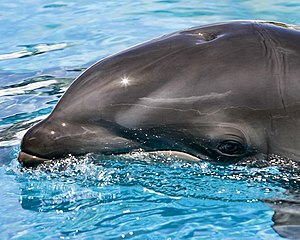
That's the delusion, built on the accidental smile.
"To be fair, they should have also had a bad dolphin: Zipper!"
But really, the dolphin is neither "ever so kind and gentle" (Flipper) or "surly" and "uncaring" (Zipper). It has its own ways.
Killer whales — like the one that killed Dawn Brancheau at SeaWorld — are dolphins (the largest dolphins).
In starting to write this post, after that last one, my idea was to develop the theme of dolphin rape, but I got grossed out by many YouTube videos showing people at dolphin shows being set up — legs spread — to receive a dolphin, who — not understanding the lines human beings draw with respect to bodily interactions — leaps up and performs according to its own standards.
And, amongst dolphins, the standard is what we would classify as rape — gang rape:
Presumably, a dolphin who managed to learn our morality would find it repugnant — and he would argue for his position with reasons that would outrage us. Maybe if that learned dolphin were confined to an aquarium — where, like a human prisoner in solitary confinement with nothing to do but read — he might take advantage of his knowledge to create some structure of asceticism around his deprivation. Then it wouldn't be so painful. I'll leave it to you to imagine how that analogy works from the perspective of a human woman who had to live in a society controlled by dolphins.
That's the delusion, built on the accidental smile.
"To be fair, they should have also had a bad dolphin: Zipper!"
But really, the dolphin is neither "ever so kind and gentle" (Flipper) or "surly" and "uncaring" (Zipper). It has its own ways.
Killer whales — like the one that killed Dawn Brancheau at SeaWorld — are dolphins (the largest dolphins).
***
In starting to write this post, after that last one, my idea was to develop the theme of dolphin rape, but I got grossed out by many YouTube videos showing people at dolphin shows being set up — legs spread — to receive a dolphin, who — not understanding the lines human beings draw with respect to bodily interactions — leaps up and performs according to its own standards.
And, amongst dolphins, the standard is what we would classify as rape — gang rape:
In order to coerce the reluctant females, males form groups of two or three – often remaining together in their search for sexual gratification for well over a decade. When they find a suitable female they literally force her to mate with one or more of the group, and have even been known to herd their unwilling consorts for months at a time, basically using them as their personal sex-slaves.
Although dolphins are not alone in the animal world of gang-rapists, research suggests they’ve the perfected the art to a degree unseen in any other species, and it seems they don’t limit their advances to their female partners, either: there are several reports claiming divers and swimmers have also been accosted.
Studies would suggest the behaviour is likely to be undertaken for reasons of pleasure as much as reproduction, as dolphins are known to enjoy sexual activity in cases when reproduction would be physically impossibleIn real life, the dolphin is more Zipper than Flipper. Leave him to the ocean where he can do the things he wants to do — unless you think he's so smart he can be convinced to learn principles of human morality. I would be interested in hearing the dolphin's perspective. Perhaps there is complex dolphin reasoning about the sexual slavery of the female, but I have no interest in considering adopting it for human society.
Presumably, a dolphin who managed to learn our morality would find it repugnant — and he would argue for his position with reasons that would outrage us. Maybe if that learned dolphin were confined to an aquarium — where, like a human prisoner in solitary confinement with nothing to do but read — he might take advantage of his knowledge to create some structure of asceticism around his deprivation. Then it wouldn't be so painful. I'll leave it to you to imagine how that analogy works from the perspective of a human woman who had to live in a society controlled by dolphins.
Tuesday, February 23, 2010
How to create and play with a bubble ring under water.
What the dolphins have to teach us:
For the record: I loathe sentimentality about dolphins. I just think this is really cool. Skip the first minute of introductory stuff if you're impatient.
For the record: I loathe sentimentality about dolphins. I just think this is really cool. Skip the first minute of introductory stuff if you're impatient.
Sunday, November 29, 2009
"I am a local artist, who has created sculptings made up Duct-Tape.. 100% no wires, or fillers."
Dennis Gervasio has "created the illusion of pewter." His opposition to "fillers" may explain his shortening of the term "outsider art" to "outside art" and his penchant for the 2-dot ellipsis.

His sign appears in the window of the Albany café called The Daily Grind — a locale also pictured in "Man in green sneakers reads Sartre. Dog arrives."
The sculptings look like this, seen from inside the restaurant...

... and this, seen through window static...

His sign appears in the window of the Albany café called The Daily Grind — a locale also pictured in "Man in green sneakers reads Sartre. Dog arrives."
The sculptings look like this, seen from inside the restaurant...
... and this, seen through window static...
Monday, July 27, 2009
Wednesday, June 17, 2009
Tuesday, April 14, 2009
Wednesday, November 12, 2008
Whales and dolphins suffer a bitter defeat in the Supreme Court
Chief Justice Roberts writes for the majority in Winter v. Natural Resources Defense Council. He begins with a quote from George Washington: "To be prepared for war is one of the most effectual means of preserving peace." And the Navy wins.
Justice Ginsburg dissents, joined by Justice Souter:
The plaintiffs are the Natural Resources Defense Council, Jean-Michael Cousteau (an environmental enthusiast and filmmaker), and several other groups devoted to the protection of marine mammals and ocean habitats. They contend that MFA sonar can cause much more serious injuries to marine mammals than the Navy acknowledges, including permanent hearing loss, decompression sickness, and major behavioral disruptions. According to the plaintiffs, several mass strandings of marine mammals (outside of SOCAL) have been “associated” with the use of active sonar. They argue that certain species of marine mammals—such as beaked whales—are uniquely susceptible to injury from active sonar; these injuries would not necessarily be detected by the Navy, given that beaked whales are “very deep divers” that spend little time at the surface.An enthusiast, eh?
[E]ven if plaintiffs have shown irreparable injury from the Navy’s training exercises, any such injury is outweighed by the public interest and the Navy’s interest in effective, realistic training of its sailors. A proper consideration of these factors alone requires denial of the requested injunctive relief....
For the plaintiffs, the most serious possible injury would be harm to an unknown number of the marine mammals that they study and observe. In contrast, forcing the Navy to deploy an inadequately trained antisubmarine force jeopardizes the safety of the fleet. Active sonar is the only reliable technology for detecting and tracking enemy diesel-electric submarines, and the President—the Commander in Chief—has determined that training with active sonar is “essential to national security.”
Justice Ginsburg dissents, joined by Justice Souter:
Flexibility is a hallmark of equity jurisdiction.... [C]ourts do not insist that litigants uniformly show a particular, predetermined quantum of probable success or injury before awarding equitable relief....(There's also an opinion by Justice Breyer, joined by Justice Stevens, taking a middle position.)
The Navy’s own EA predicted substantial and irreparable harm to marine mammals. Sonar is linked to mass strandings of marine mammals, hemorrhaging around the brain and ears, acute spongiotic changes in the central nervous system, and lesions in vital organs....
In my view, this likely harm—170,000 behavioral disturbances, including 8,000 instances of temporary hearing loss; and 564 Level A harms, including 436 injuries to a beaked whale population numbering only 1,121—cannot be lightly dismissed, even in the face of an alleged risk to the effectiveness of the Navy’s 14 training exercises.
Thursday, July 12, 2007
"I wound up doing time for something I should have been rewarded for. What I did was a community service.... I was punished for political reasons."
"Absolutely meaningless. Was I a criminal? No. I was a good member of society. Only my society and the one making the laws are different." LSD folkhero Owsley speaks. More:
"I never set out to change the world," he rasps in recalling his early manufacture of LSD. "I only set out to make sure I was taking something (that) I knew what it was. And it's hard to make a little. And my friends all wanted to know what they were taking, too. Of course, my friends expanded very rapidly."So some library nerd started it all!
By conservative estimates, Bear Research Group made more than 1.25 million doses of LSD between 1965 and 1967, essentially seeding the entire modern psychedelic movement....
He found the recipe for making LSD in the Journal of Organic Chemistry at the UC Berkeley library.
Bear [AKA Augustus Owsley Stanley III] has always lived in a quite particular world. "He can be very anal retentive, on a certain level, on a genius level," says Paul Kantner of Jefferson Airplane. "I've seen him send his eggs back three times at Howard Johnson's."He's meticulous about what he ingests. On a genius level.
His all-meat diet is a well-known example. When he was younger, Bear read about the Eskimos eating only fish and meat and became convinced that humans are meant to be exclusively carnivorous. The members of the Grateful Dead remember living with Bear for several months in 1966 in Los Angeles, where the refrigerator contained only bottles of milk and a slab of steak, meat they fried and ate straight out of the pan. His heart attack several years ago had nothing to do with his strict regimen, according to Bear, but more likely the result of some poisonous broccoli his mother made him eat as a youth.
As a sound mixer, Bear holds equally strict viewpoints, insisting that the most effective rock concert systems should have only a single source of sound, his argument quickly veering into the realm of psycho-acoustics.I love reason. Especially, on the genius level. I may not understand it, but I like the way it emanates from a single point. Helps me keep my bearings. It's just one guy saying things like that.
"The PA can only be in one spot," he says. "All the sounds have to come from a single place because the human brain is carrying around the most sophisticated sound processing of any computer or living creature. It equals the bats that fly by echo. It equals the dolphins. It equals the owls that hunt at night without any daylight at all. It is a superb system for locating and separating one sound from everything else."
Bear left Northern California in the early '80s, convinced that a natural disaster was imminent.
He predicted at the time that global warming would lead to a six-week-long ultra-cyclone that could cover the Northern Hemisphere with a new ice age. Determining that the tropical northern side of Australia would be the most likely region to survive, Bear made a beeline for Queensland and says he felt at home the moment he set foot on the new continent.He might be wrong.
"I might be right about the ice age thing," he allows. "I might be wrong."
Thursday, December 14, 2006
The tallest man in the world saves dolphins...
... by reaching down into their stomachs with his extra long arms and pulling out the shards of plastic they'd swallowed:
The mammals had lost their appetite and were suffering depression, aquarium officials said.So he's saved -- and cheered up -- the dolphins. Thanks, world's tallest man. How tall is he? He's 7 foot 8.95, just 2 mm taller than the guy who -- before Bao grew -- was the world's tallest man. That's got to be annoying for Mr. Second Tallest. I'll bet from day to day your height varies a millimeter or so. He must brood about remeasuring. He could save the dolphins too. Does Bao really have the world's longest arms?
The heads of the dolphins were held back and towels wrapped around their teeth so [Bao Xishun] could not be bitten.
Sunday, November 5, 2006
When dolphins walked the earth.
50 million years ago, dolphins and whales -- they say -- were four-legged creatures lumbering about like hippos. And now, they seem inclined to evolve those legs again. Scary!
(You don't think dolphins are scary? You need to listen to this, about the evil version of Flipper: Zipper. "Oh, Zipper's surly. He is uncaring.")
(You don't think dolphins are scary? You need to listen to this, about the evil version of Flipper: Zipper. "Oh, Zipper's surly. He is uncaring.")
Thursday, June 29, 2006
"What Shamu Taught Me About a Happy Marriage."
That's the title of a "Modern Love" essay by Amy Sutherland that has sat at the top of the NYT "Most E-Mailed" list all week. I skipped over it on Sunday -- just not in the mood for "Modern Love" -- but its staying power on the "Most E-Mailed" list is truly impressive, so I'm at long last compelled. Let's begin:
Why is this article so emailed? It's funny and well-written, full of detail about animal training and human behavior, including a precise description of a husband who's a distinct individual but who also seems a lot like someone we know or are. And it's got a specific idea that you either feel you can use or want to launch into criticizing.
Thinking back on why I rejected this article reflexively last Sunday, I can see that it made me think of a 50s housewife, the kind who would inspire what was once a trite wisecrack: "She's got him well trained." But I liked the piece a lot and am grateful for the "Most E-Mailed" list, which is a good backup to my ordinary instincts on what to read and what not to read as I flip through the New York Times each morning. (And, yes, I expect comments telling me I shouldn't read the NYT at all. I got email yesterday providing me with a list of NYT "media Business Units" and telling me that "[a]ll of these should be in the cross hairs of any boycott.")
I do wonder about the good of the techniques described in the essay. One is "least reinforcing syndrome (L. R. S.)":
But I take it the animal trainer uses multiple techniques and remains ever focused on the goal of producing the desired behavior. If ignoring wrong behavior did not eradicate it, the animal trainer would try something else.
Is it wrong to treat a person as an animal to be trained? Perhaps a better question is whether it is wrong to blunder along doing things that encourage your loved ones in their bad behavior. The image of the "full-blown angst-ridden drama starring the two of us and our poor nervous dog" really struck me. It may take more wit and nerve than you have to turn down that role if you've got a fired-up, scenery-chewing emoter in your house insisting that you co-star.
As I wash dishes at the kitchen sink, my husband paces behind me, irritated. "Have you seen my keys?" he snarls, then huffs out a loud sigh and stomps from the room with our dog, Dixie, at his heels, anxious over her favorite human's upset.Read the whole thing. It's not obnoxious, as you might jump to think. The author was writing a book about animal training and got the idea to use the techniques on her husband. At some point, she tells him what she's been doing and he's amused. Later, he uses it on her and she notices and is amused.
In the past I would have been right behind Dixie. I would have turned off the faucet and joined the hunt while trying to soothe my husband with bromides like, "Don't worry, they'll turn up." But that only made him angrier, and a simple case of missing keys soon would become a full-blown angst-ridden drama starring the two of us and our poor nervous dog.
Now, I focus on the wet dish in my hands. I don't turn around. I don't say a word. I'm using a technique I learned from a dolphin trainer....
The central lesson I learned from exotic animal trainers is that I should reward behavior I like and ignore behavior I don't. After all, you don't get a sea lion to balance a ball on the end of its nose by nagging. The same goes for the American husband.
Why is this article so emailed? It's funny and well-written, full of detail about animal training and human behavior, including a precise description of a husband who's a distinct individual but who also seems a lot like someone we know or are. And it's got a specific idea that you either feel you can use or want to launch into criticizing.
Thinking back on why I rejected this article reflexively last Sunday, I can see that it made me think of a 50s housewife, the kind who would inspire what was once a trite wisecrack: "She's got him well trained." But I liked the piece a lot and am grateful for the "Most E-Mailed" list, which is a good backup to my ordinary instincts on what to read and what not to read as I flip through the New York Times each morning. (And, yes, I expect comments telling me I shouldn't read the NYT at all. I got email yesterday providing me with a list of NYT "media Business Units" and telling me that "[a]ll of these should be in the cross hairs of any boycott.")
I do wonder about the good of the techniques described in the essay. One is "least reinforcing syndrome (L. R. S.)":
When a dolphin does something wrong, the trainer doesn't respond in any way. He stands still for a few beats, careful not to look at the dolphin, and then returns to work. The idea is that any response, positive or negative, fuels a behavior. If a behavior provokes no response, it typically dies away.My mother did something like this -- not that she picked it up from dolphin trainers. I think it allowed us to think that some bad things we did passed unnoticed and caused no pain. Much later, I realized how deluded it was to think she lacked normal perceptions and feelings. Of course she saw and of course we hurt her.
But I take it the animal trainer uses multiple techniques and remains ever focused on the goal of producing the desired behavior. If ignoring wrong behavior did not eradicate it, the animal trainer would try something else.
Is it wrong to treat a person as an animal to be trained? Perhaps a better question is whether it is wrong to blunder along doing things that encourage your loved ones in their bad behavior. The image of the "full-blown angst-ridden drama starring the two of us and our poor nervous dog" really struck me. It may take more wit and nerve than you have to turn down that role if you've got a fired-up, scenery-chewing emoter in your house insisting that you co-star.
Tuesday, July 26, 2005
Monkey in the Middle.
What's in the monkey's mind when he looks in a mirror? Higher minds -- human beings, great apes, dolphins -- figure out, when they are looking in a mirror, that they are seeing themselves. Other animals, it's long been thought, think they're seeing a stranger. But a new study shows that the monkey occupies a middle position, where it doesn't see itself, but it doesn't see a stranger either. The monkey sees a "Puzzling Other."
And there's a sex difference. The males are disturbed by the Puzzling Other. The females try to flirt.
P.S. Did you use to play "Monkey in the Middle"? That was a very common kid's game when I was growing up. I suppose it would be considered too mean today. But it was a pretty fun game for three kids to play with just one small rubber ball. (There was also a similar game called "keep away.")
And there's a sex difference. The males are disturbed by the Puzzling Other. The females try to flirt.
P.S. Did you use to play "Monkey in the Middle"? That was a very common kid's game when I was growing up. I suppose it would be considered too mean today. But it was a pretty fun game for three kids to play with just one small rubber ball. (There was also a similar game called "keep away.")
Monday, November 29, 2004
Seinfeld on "Oprah."
Jerry comes out to a huge ovation. He looks at the audience and says: "This is something. You do this every day?"
The audience constantly over-applauds. Oprah notes that she and Jerry are the same age (50), and the audience goes wild.
Jerry's response is perfect: "I love being 50. It means I'm almost done." Oprah goes into no! no! mode and Jerry has to say "it's just a joke" and a few other things until he finally lands on "it doesn't matter how old you are," and the audience goes wild again.
Oprah asks why they've only released the first three seasons on DVD, and Jerry says, "That's 40 episodes. How much time do you have?" There's a very distinctively Seinfeld way to say "How much time do you have?" and you've got to imagine it to find it funny. It's impossible to render in type. Something like: "How … much time … do you … have?"
Oprah asks him what he finds funny on TV today, and he says he watches a lot of "Sesame Street," and he thinks about how people tell him he should do another show: "I sit there and I watch this Elmo guy. And he is so likeable and so funny and so charming. And I sit there with my daughter, and I think: let him bust his little red ass."
Jerry's wife is there (and moved to tears by the experience of being 20 feet away from Oprah), so the conversation turns to marriage. Jerry says he was surprised at all the questions. He thought "Do you take this woman?" would be the last one. But now it's "How long are you going to sit there watching TV?": "I wish I knew the answer to that one myself."
Jerry's wife tells us he's "sweet," but can't come up with much of an answer to Oprah's request for a story. He's nice to his kids.
Oprah asks him about his obsessions: dolphins (they have "nice smiles"), Bic pens ("Every joke for the Seinfeld show was written with a Bic pen"), sneakers ("I'm wearing shoes just for you.")
The Puffy Shirt is being put in the Smithsonian, we're told.
Seinfeld's wife says has not seen all the episodes of "Seinfeld."
Oprah brings out Jason Alexander. The crowd acts pretty thrilled, even though it's just Jason Alexander.
Oprah brings out Julia Louis-Dreyfus. Clearly, the audience (nearly all women) likes her more than Jason. She looks great, Oprah tells her. Truthfully! Oprah shows Julia a clip of several audience members imitating Elaine's little steps dance [added: technically, it's "The Little Kicks."]. Julia says "wow" but doesn't seem that enthused. She seems not to be so much like the people in the audience, even though they identify with Elaine. Jerry helps out with a joke: "It's really true that girls just wanna have fun."
Oprah brings out Michael Richards. His hair is slicked down. He describes looking for "little things" in the script, ad libbing "the sound effects," practicing lines off by himself, and feeling that Kramer was playing him and that what he needed to do was to "get out of the way."
We're told Jerry bought Billy Joel's house in the Hamptons and we're shown some photos of him and his wife and kids on a windswept beach and in a sparkling, white kitchen. The audience goes "aaah!"
Talking about the last "Seinfeld" show, Jason Alexander says that, as they were about to shoot, Jerry said to them, "For the rest of our lives, when anyone thinks of any one of us, they'll think of all four." The audience goes "awwww." Oprah goes, "That is sweet." When the show ended, Jerry took some parts of the set (which he keeps with his Porsches). He took the door, the couch, and one of the booths from the restaurant. Michael Richards and Jason Alexander just took their shoes and (Alexander only) his glasses. Julia Louis-Dreyfus took her wardrobe, and jokes that she doesn't know why. (On the DVD commentary, she often talks about how bad Elaine's clothes were, and also how bad Jerry's clothes were. George's clothes were always intended to look bad. Kramer's clothes were supposed to be strange, and it's noted in the DVD commentary that only Kramer's clothes look good now. That vintage look aged well.)
After the final commercial break, there's only time enough to push the DVD one more time and say good-bye, but Oprah whips the crowd back up into a hysterical, jubilant cheer. As the closing credits roll, Oprah hugs each of the "Seinfeld" castmembers, kicking one leg up when she hugs Jerry and again when she hugs Michael Richards.
UPDATE: The group continues, more casually, on "Oprah After the Show." Oprah talks about how Jerry and his wife invited her to dinner but she had to refuse because she's on a diet that has a rule against eating after 7:30 at night.
We're shown photos of Julia Louis-Dreyfus's house, which has a retractable roof is dedicated to ecological principles. "It has sustainable woods" causes Jerry to say "What does that mean?" The question isn't answered. It's a joke. The tile, we're told, is made from recycled carpet. "It is a totally green house," Louis-Dreyfus says. Much applause.
Jerry offers this piece of advice: "If you never make a career choice based on money, you'll always have money." Hey, it worked for him!
Oprah asks what's your favorite episode. Jerry: "The Marine Biologist." Jason: "The Parking Garage." Michael: "The Parking Garage." Julia: wasn't asked.
They talk about Jerry's favorite comedian, Bill Cosby. When he walks down the street, Jerry says, he's happy to meet everyone who comes up to him. Oprah tells us that when he appeared on her show, he was dropped off alone! She clearly thinks this is flat-out amazing.
What comedian does Michael Richards love? Charlie Chaplin, Stan Laurel, Jacques Tati, the early Peter Sellers. Good answer! So good it almost makes me cry to think that more roles have not come Richards' way. He adds: "And I love the great Red Skelton." Ah! I loved Red Skelton so much when I was a child. I loved him in that deep, childlike way where you completely believe that everyone loves him.
Julia Louis-Dreyfus? "I think Ellen DeGeneres is unbelievably funny." She also loves the funny actresses, specifically, Mary Tyler Moore and Lucy.
Jason? Jon Stewart. And Jerry.
The audience constantly over-applauds. Oprah notes that she and Jerry are the same age (50), and the audience goes wild.
Jerry's response is perfect: "I love being 50. It means I'm almost done." Oprah goes into no! no! mode and Jerry has to say "it's just a joke" and a few other things until he finally lands on "it doesn't matter how old you are," and the audience goes wild again.
Oprah asks why they've only released the first three seasons on DVD, and Jerry says, "That's 40 episodes. How much time do you have?" There's a very distinctively Seinfeld way to say "How much time do you have?" and you've got to imagine it to find it funny. It's impossible to render in type. Something like: "How … much time … do you … have?"
Oprah asks him what he finds funny on TV today, and he says he watches a lot of "Sesame Street," and he thinks about how people tell him he should do another show: "I sit there and I watch this Elmo guy. And he is so likeable and so funny and so charming. And I sit there with my daughter, and I think: let him bust his little red ass."
Jerry's wife is there (and moved to tears by the experience of being 20 feet away from Oprah), so the conversation turns to marriage. Jerry says he was surprised at all the questions. He thought "Do you take this woman?" would be the last one. But now it's "How long are you going to sit there watching TV?": "I wish I knew the answer to that one myself."
Jerry's wife tells us he's "sweet," but can't come up with much of an answer to Oprah's request for a story. He's nice to his kids.
Oprah asks him about his obsessions: dolphins (they have "nice smiles"), Bic pens ("Every joke for the Seinfeld show was written with a Bic pen"), sneakers ("I'm wearing shoes just for you.")
The Puffy Shirt is being put in the Smithsonian, we're told.
Seinfeld's wife says has not seen all the episodes of "Seinfeld."
Oprah brings out Jason Alexander. The crowd acts pretty thrilled, even though it's just Jason Alexander.
Oprah brings out Julia Louis-Dreyfus. Clearly, the audience (nearly all women) likes her more than Jason. She looks great, Oprah tells her. Truthfully! Oprah shows Julia a clip of several audience members imitating Elaine's little steps dance [added: technically, it's "The Little Kicks."]. Julia says "wow" but doesn't seem that enthused. She seems not to be so much like the people in the audience, even though they identify with Elaine. Jerry helps out with a joke: "It's really true that girls just wanna have fun."
Oprah brings out Michael Richards. His hair is slicked down. He describes looking for "little things" in the script, ad libbing "the sound effects," practicing lines off by himself, and feeling that Kramer was playing him and that what he needed to do was to "get out of the way."
We're told Jerry bought Billy Joel's house in the Hamptons and we're shown some photos of him and his wife and kids on a windswept beach and in a sparkling, white kitchen. The audience goes "aaah!"
Talking about the last "Seinfeld" show, Jason Alexander says that, as they were about to shoot, Jerry said to them, "For the rest of our lives, when anyone thinks of any one of us, they'll think of all four." The audience goes "awwww." Oprah goes, "That is sweet." When the show ended, Jerry took some parts of the set (which he keeps with his Porsches). He took the door, the couch, and one of the booths from the restaurant. Michael Richards and Jason Alexander just took their shoes and (Alexander only) his glasses. Julia Louis-Dreyfus took her wardrobe, and jokes that she doesn't know why. (On the DVD commentary, she often talks about how bad Elaine's clothes were, and also how bad Jerry's clothes were. George's clothes were always intended to look bad. Kramer's clothes were supposed to be strange, and it's noted in the DVD commentary that only Kramer's clothes look good now. That vintage look aged well.)
After the final commercial break, there's only time enough to push the DVD one more time and say good-bye, but Oprah whips the crowd back up into a hysterical, jubilant cheer. As the closing credits roll, Oprah hugs each of the "Seinfeld" castmembers, kicking one leg up when she hugs Jerry and again when she hugs Michael Richards.
UPDATE: The group continues, more casually, on "Oprah After the Show." Oprah talks about how Jerry and his wife invited her to dinner but she had to refuse because she's on a diet that has a rule against eating after 7:30 at night.
We're shown photos of Julia Louis-Dreyfus's house, which has a retractable roof is dedicated to ecological principles. "It has sustainable woods" causes Jerry to say "What does that mean?" The question isn't answered. It's a joke. The tile, we're told, is made from recycled carpet. "It is a totally green house," Louis-Dreyfus says. Much applause.
Jerry offers this piece of advice: "If you never make a career choice based on money, you'll always have money." Hey, it worked for him!
Oprah asks what's your favorite episode. Jerry: "The Marine Biologist." Jason: "The Parking Garage." Michael: "The Parking Garage." Julia: wasn't asked.
They talk about Jerry's favorite comedian, Bill Cosby. When he walks down the street, Jerry says, he's happy to meet everyone who comes up to him. Oprah tells us that when he appeared on her show, he was dropped off alone! She clearly thinks this is flat-out amazing.
What comedian does Michael Richards love? Charlie Chaplin, Stan Laurel, Jacques Tati, the early Peter Sellers. Good answer! So good it almost makes me cry to think that more roles have not come Richards' way. He adds: "And I love the great Red Skelton." Ah! I loved Red Skelton so much when I was a child. I loved him in that deep, childlike way where you completely believe that everyone loves him.
Julia Louis-Dreyfus? "I think Ellen DeGeneres is unbelievably funny." She also loves the funny actresses, specifically, Mary Tyler Moore and Lucy.
Jason? Jon Stewart. And Jerry.
Monday, July 26, 2004
A car that shows its feelings
is being developed by Toyota. (Via Drudge.) I need this car, because the car I drive won't stop smiling. It's the dolphin of cars. And another thing about my car: it is the car chosen for the kooky gift shop worker on "Curb Your Enthusiasm" who had the delusion that Larry David was following her. On the other hand, if "Curb Your Enthusiasm" had an episode with a character that drove that emotive Toyota, that character would not come off well.
But at least the new Toyota would allow people who like cute cars to respond somehow to all the people out there who have deliberately selected "angry face" cars.
But at least the new Toyota would allow people who like cute cars to respond somehow to all the people out there who have deliberately selected "angry face" cars.
Subscribe to:
Posts (Atom)
 :.
:.
