Showing posts with label Obama economics. Show all posts
Showing posts with label Obama economics. Show all posts
Tuesday, February 26, 2013

Monday, February 25, 2013
Sunday, February 24, 2013
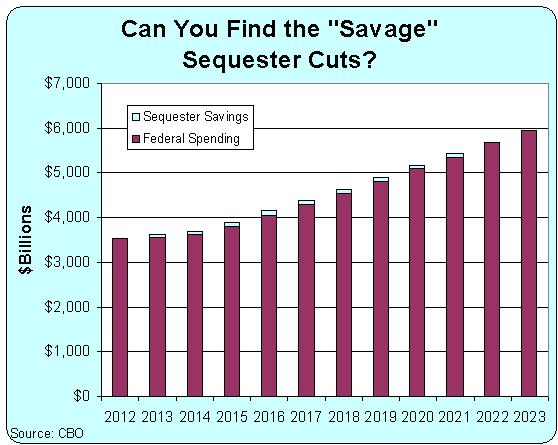
The stock market says "sequestration will not happen."
According to Jim Cramer on "Meet the Press" this morning:
I do think that the stock market itself is saying this isn’t going to happen. The defense index on Wednesday, it is all-time high. That says sequestration will not happen. The fact that the stock market is doing well despite the fact the gasoline prices are much higher, that’s hurting the consumer, payroll tax holiday goes away, that’s hurting the consumer. Again says that maybe something is not-- not drastic. Nothing drastic will come of this. Even despite the scare-- scare tactics, government by freak out. How right is that? I still feel pretty good.
"The worst-case scenario for us is the sequester hits and nothing bad really happens. And Republicans say: See, that wasn’t so bad."
Says a Democratic lobbyist, causing Instapundit to say: "So I guess we can expect the Administration to make it as bad as it can."
That's about the size of it. That's why I haven't been blogging the pre-sequester hysteria. It's less amusing than the Mayan apocalypse.
That's about the size of it. That's why I haven't been blogging the pre-sequester hysteria. It's less amusing than the Mayan apocalypse.
Friday, February 1, 2013
"Birth Control Rule Altered to Allay Religious Objections."
"Under the proposal, female employees could get free birth control coverage through a separate plan that would be provided by a health insurer."
But if the social engineers are thinking about fewer births, they must also be thinking about more deaths. What better way to avoid costs than for the aging people to depart? How can they not be thinking about that too? At least they're sensitive enough not to spit it in our faces the way they celebrate the savings inherent in fewer births.
And do you really understand the new plan to accommodate religion? Do you see how the religious objectors are absolved from their connection to what they see as sin? Isn't it all sleight of hand? But what is absolution?
The institution objecting to the coverage would not pay for the contraceptives. The costs would instead be paid by the insurance company, with the possibility of recouping the costs through lower health care expenses resulting in part from fewer births.Is the system better with fewer births? You know, they are babies at first, but eventually they will be workers and therefore taxpayers, and we're especially going to need young workers to be the health care providers for the aging population that will need more and more care.
But if the social engineers are thinking about fewer births, they must also be thinking about more deaths. What better way to avoid costs than for the aging people to depart? How can they not be thinking about that too? At least they're sensitive enough not to spit it in our faces the way they celebrate the savings inherent in fewer births.
And do you really understand the new plan to accommodate religion? Do you see how the religious objectors are absolved from their connection to what they see as sin? Isn't it all sleight of hand? But what is absolution?
Wednesday, January 30, 2013
Thomas Friedman calls on Obama to stress "the private side..., a lot more entrepreneurship, a lot more start-ups and a lot more individual risk-taking..."
"... things the president rarely speaks about."
Somehow, this column is called "It’s P.Q. and C.Q. as Much as I.Q." It's some lingo that replaces entrepreneurship and individualism:
Somehow, this column is called "It’s P.Q. and C.Q. as Much as I.Q." It's some lingo that replaces entrepreneurship and individualism:
The winners won’t just be those with more I.Q. It will also be those with more P.Q. (passion quotient) and C.Q. (curiosity quotient) to leverage all the new digital tools to not just find a job, but to invent one or reinvent one, and to not just learn but to relearn for a lifetime. Government can and must help, but the president needs to explain that this won’t just be an era of “Yes We Can.” It will also be an era of “Yes You Can” and “Yes You Must.”
Wednesday, January 23, 2013
Friday, January 18, 2013
"Obama unveils 'Organizing for Action.'"
I read the Politico headline out loud.
Meade immediately improvises a song, and I have the wit and the skill to transcribe as he sings:
Meade immediately improvises a song, and I have the wit and the skill to transcribe as he sings:
Organize for actionADDED: "You in?"
Organize for some action, baby
Organize! Organize!
Organize my organ
Activate my organ for organizing
A little girly action
Organize for action
Friday, January 11, 2013
"The Charmin corporate Twitter account got in on it with a surprisingly trenchant commentary on the disposability of American currency."
That's the way Slate — displaying the winners of its design-a-$1-trillion-coin contest — refers to the symbolism here:

"Surprisingly trenchant commentary." Come on! I like delicate toilet paper, but why the delicacy talking about toilet paper? What, exactly, is the commentary? I assumed it was: American currency is something you may as well wipe your ass with. But then I thought the idea was: Uh, oh, we just pooped ourselves.
Maybe you're wracking your brain for a way to use the old "Don't Squeeze the Charmin" slogan, but that was the 1960s. The current slogans — if I am to believe the Charmin Wikipedia page — are: "Enjoy the Charmin experience" and "Enjoy The Go." Enjoy the go?! Put that on the coin. Hell, make that the national motto. "In God We Trust" is getting old. It's divisive. And, frankly, it's unfair to God.
"Enjoy the Go"... I looked it up to see how they were playing this slogan in the commercials:
The relief. The calm. The clean. The comfort.
See? That's the way you'll feel after that $1-trillion is deposited in thetoilet bank. This image evokes Sigmund Freud:
(I'm riffing on the toilet paper topic topic Meade introduced late last night. That was Meade — did you notice? — not me.)

"Surprisingly trenchant commentary." Come on! I like delicate toilet paper, but why the delicacy talking about toilet paper? What, exactly, is the commentary? I assumed it was: American currency is something you may as well wipe your ass with. But then I thought the idea was: Uh, oh, we just pooped ourselves.
Maybe you're wracking your brain for a way to use the old "Don't Squeeze the Charmin" slogan, but that was the 1960s. The current slogans — if I am to believe the Charmin Wikipedia page — are: "Enjoy the Charmin experience" and "Enjoy The Go." Enjoy the go?! Put that on the coin. Hell, make that the national motto. "In God We Trust" is getting old. It's divisive. And, frankly, it's unfair to God.
"Enjoy the Go"... I looked it up to see how they were playing this slogan in the commercials:
The relief. The calm. The clean. The comfort.
See? That's the way you'll feel after that $1-trillion is deposited in the
Freud suggested that children in the anal stage of development regard the release of their feces as a gift to the parent — a gift that can be given or withheld. Children will release the feces if given sufficient love and withhold them if not. In Freudian thought, fecal matter becomes a type of currency in the parent-child relationship, which can be withheld or dispensed, thus giving the child a sense of control. The word currency is appropriate in this context; Freud assumed that the human unconscious makes a symbolic equation between feces and money. In a 1911 paper on dreams in folklore, he noted that according to ancient Eastern mythology, “gold is the excrement of hell” (Freud & Oppenheim, 1911/1958, p. 157).Hell!
(I'm riffing on the toilet paper topic topic Meade introduced late last night. That was Meade — did you notice? — not me.)
Wednesday, January 9, 2013
That's a clown suit question, bro.
Did you see the comment by Patrick that Glenn linked to?
14.5 2.1 million federal government employees — starting at the top with the President — made to wear clown suits every day for, say, the next four years? Would it be worth as much as a trillion dollar coin? More? I propose we find out:
Step 1: Purchase14.5 2.1 million clown suits through the Althouse Amazon Associates portal, natch.
Step 2: Make federal government employees wear them every day for 4 years.
Step 3: ???
Step 4: Pay off national debt!
“I think it would be the ultimate act of honesty to dress the Secretary of the Treasury in a clown costume. I have no objection to that at all.”Well that gave me an idea. What would be the value of having all
Step 1: Purchase
Step 2: Make federal government employees wear them every day for 4 years.
Step 3: ???
Step 4: Pay off national debt!
Hope and change... into a clown costume.
Paul Krugman responds to the pushback he's received on "the trillion-dollar-coin thing":
So, anyway:
He continues:
Krugman turns to the second objection, as if it's unconnected to the first one:
Does the trick work if the magician points to the hand that's doing the sleight?
There seem to be two kinds of objections. One is that it would be undignified. Here’s how to think about that....The professor is about to teach us how to think. Get ready!
... we have a situation in which a terrorist may be about to walk into a crowded room and threaten to blow up a bomb he’s holding.Okay. A hypothetical. I'm up for hypotheticals. And it's an analogy, because the trillion-dollar-coin thing isn't promoted as a solution to terrorism. But terrorism is something that you can picture quite concretely and you understand it as very real and scary — unlike the debt ceiling problem which is awfully abstract. (Even to say "ceiling" is to resort to metaphor.)
So, anyway:
It turns out, however, that the Secret Service has figured out a way to disarm this maniac — a way that for some reason will require that the Secretary of the Treasury briefly wear a clown suit. (My fictional plotting skills have let me down, but there has to be some way to work this in).In this hypothetical, you have to accept that the Secret Service has found "a way." It will work. The professor is telling you how to think, so you're going off track if you want an explanation for why that would work or if you — much more likely — would be thinking what the hell is going on in this country when the people in charge are figuring out solutions involving clown suits and believing that clown-suit solutions work? Krugman reveals that he knows his hypothetical is horribly flawed, and he tries to paper it over by confessing to second-rate "plotting skills." There has to be some way to work this it. The professor is teaching us how to think — use this analogy — but he can't piece together the hypothetical. How's that supposed to help us think?
He continues:
And the response of the nervous Nellies is, “My god, we can’t dress the secretary up as a clown!” Even when it will make him a hero who saves the day?Wait. The normal people who go with the working theory that the government has gone mad are "nervous Nellies"? Yes, because Krugman's hypothetical locks it in that the solution works. So the people aren't supposed to be thinking that sounds crazy. It's posited that they know it will work, so all they can realistically be concerned with is that the secretary will look undignified dressed like a clown.
Krugman turns to the second objection, as if it's unconnected to the first one:
The other objection is the apparently primordial fear that mocking the monetary gods will bring terrible retribution.Why weren't the people who say it looks crazy credited with having some fear that it wouldn't work? Because in the clown-suit hypothetical it was posited that it would work? These "nervous Nellies" were mocked in Part I of Krugman's krushing of all adversaries. In Part II, we see troglodytes who imagine a "god" who will punish us for doing something wrong.
What the hysterics see is a terrible, outrageous attempt to pay the government’s bills out of thin air. This is utterly wrong, and in fact is wrong on two levels.So it's a trick, but it's not that different from other tricks. It's just weirder looking. Like a clown suit. Which gets back to the point I made when I criticized Krugman a couple days ago:
The first level is that in practice minting the coin would be nothing but an accounting fiction, enabling the government to continue doing exactly what it would have done if the debt limit were raised....
It's strange that it's come to this, but I don't believe the President of the United States would choose to do something that will strike the people as so bizarre, even if he feels capable of articulating the legal theory with a straight face. The President must maintain the people's trust and confidence. He must be comprehensible as normal, sound, and sane to ordinary folks.Krugman's response to these ordinary folks — the people upon whom the President's power depends — is: They're hysterical and ill-informed. Well, how did this President — how does any President — get elected in the first place? It was by generating confidence. He's a con man. Let's say the management of the national debt has been a lot of trickery for a long, long time. What then does it matter if we do something that is quite obviously a trick, that everyone will see as a trick?
Does the trick work if the magician points to the hand that's doing the sleight?
Monday, January 7, 2013
"Should President Obama be willing to print a $1 trillion platinum coin if Republicans try to force America into default?"
"Yes, absolutely. He will, after all, be faced with a choice between two alternatives: one that’s silly but benign, the other that’s equally silly but both vile and disastrous. The decision should be obvious."
Says Paul Krugman.
It's strange that it's come to this, but I don't believe the President of the United States would choose to do something that will strike the people as so bizarre, even if he feels capable of articulating the legal theory with a straight face. The President must maintain the people's trust and confidence. He must be comprehensible as normal, sound, and sane to ordinary folks.
ADDED:
Says Paul Krugman.
It's strange that it's come to this, but I don't believe the President of the United States would choose to do something that will strike the people as so bizarre, even if he feels capable of articulating the legal theory with a straight face. The President must maintain the people's trust and confidence. He must be comprehensible as normal, sound, and sane to ordinary folks.
ADDED:
Boehner: "At one point several weeks ago... the president said to me, 'We don't have a spending problem.' "
"They blame all of the fiscal woes on our health-care system."
Boehner's repeated response to that was: "Clearly we have a health-care problem, which is about to get worse with ObamaCare. But, Mr. President, we have a very serious spending problem."
There's lots more in that article (in the Wall Street Journal). I was interested in this little bit at the end:
Boehner's repeated response to that was: "Clearly we have a health-care problem, which is about to get worse with ObamaCare. But, Mr. President, we have a very serious spending problem."
[T]oward the end of the negotiations, the president became irritated and said: "I'm getting tired of hearing you say that."And then there's Harry Reid:
"Those days after Christmas," [Boehner] explains, "I was in Ohio, and Harry's on the Senate floor calling me a dictator and all kinds of nasty things. You know, I don't lose my temper. I never do. But I was shocked at what Harry was saying about me. I came back to town. Saw Harry at the White House. And that was when that was said," he says, referring to a pointed "go [blank] yourself" addressed to Mr. Reid.It's best, by the way, if you're going to say "Go fuck yourself" never to say it in anger.
There's lots more in that article (in the Wall Street Journal). I was interested in this little bit at the end:
[Boehner] sees debt as almost a moral failing, noting that when he grew up in a "little middle-class, blue-collar neighborhood" outside of Cincinnati, "nobody had debt. It was unheard of. I just don't do debt."If he's not bullshitting, he's revealing a shocking lack of sophistication. Should families pay rent on apartments until they can put down the entire purchase price of a house? Should businesses expand only through the cash they have on hand? But it's the WSJ that inserts the phrase "almost a moral failing," so I shouldn't read too much into Boehner's simple-Cincinnati-guy posing. He didn't say debt is immoral. Only that he comes from a background where the norm was to follow a budget and pay your bills. How sophisticated is he now about the good use of debt as opposed to the bad? Who knows?
Friday, January 4, 2013

Thursday, January 3, 2013
Paul Krugman is "feeling so despondent."
Why? "Because of the way Obama negotiated" the fiscal cliff deal.

That was back in July. Was Romney "just too insecure to be President"? Meade and I were just talking this morning about exactly that. There were 2 crucial points when Romney failed to stand his ground. He crumpled under intimidation. One was when the 47% video leaked out. Romney went beta, instead of doubling down, getting hardcore. The other was during the second debate, when he was going big on Benghazi, and Obama and Candy Crowley performed their check-the-transcript routine, and Romney deflated into oh, am I wrong?
So, anyway... is Obama just too insecure to be President?
He gave every indication of being more or less desperate to cut a deal before the year ended....He did? Funny, Rush Limbaugh kept saying Obama wanted to go over the cliff. It was his preference. The idea was to get rid of the hated Bush tax cuts and the cliff was there as a device to make it possible to blame the GOP. Back to Krugman:
The only thing that might save this situation is the fact that Obama has to be aware just how much is now riding on his willingness to finally stand up for his side; if he doesn’t, nobody will ever trust him again, and he will go down in history as the wimp who threw it all away.The wimp?! Hey, remember when they were calling Romney a wimp?

That was back in July. Was Romney "just too insecure to be President"? Meade and I were just talking this morning about exactly that. There were 2 crucial points when Romney failed to stand his ground. He crumpled under intimidation. One was when the 47% video leaked out. Romney went beta, instead of doubling down, getting hardcore. The other was during the second debate, when he was going big on Benghazi, and Obama and Candy Crowley performed their check-the-transcript routine, and Romney deflated into oh, am I wrong?
So, anyway... is Obama just too insecure to be President?
Wednesday, January 2, 2013
Yes, yes, I know, fiscal cliff jumped back from.
We'd gone off, we were told yesterday, but somehow, from mid-air, we scrambled back. We were Wile E. Coyote out off the cliff, suspended, despite gravity, but unlike Wile E. Coyote, we already knew it, we'd been obsessing and blabbing about it for weeks. Unlike Wile E. Coyote, we didn't stay up because of ignorance of where we were and realization of where we were didn't make us plummet. We were somehow able to get back on the cliff, and it was exactly as if we'd never gone off the cliff.
It's almost as if there was never a cliff!

It's almost as if there was never a cliff!

Tuesday, January 1, 2013
"Under the agreement, tax rates would jump to 39.6 percent from 35 percent for individual incomes over $400,000 and couples over $450,000..."
"... while tax deductions and credits would start phasing out on incomes as low as $250,000, a clear win for President Obama, who campaigned on higher taxes for the wealthy."
Is that a "clear win"? Good lord, whatever happens, the NYT will spin it as a win for Obama. I thought his number was $250,000 for couples, and now, it's way up at $450,000. That should be called a clear compromise. How hard it must be for the Republicans to compromise, when even clear compromises are declared clear wins for the other side.
Is that a "clear win"? Good lord, whatever happens, the NYT will spin it as a win for Obama. I thought his number was $250,000 for couples, and now, it's way up at $450,000. That should be called a clear compromise. How hard it must be for the Republicans to compromise, when even clear compromises are declared clear wins for the other side.
Sunday, December 30, 2012
On "Meet the Press" today, Obama mostly came across as the moderate, pragmatic politician I like.
Now, I'm not a sucker for mere posing, and in fact, I get suspicious when I hear what are simply assertions of pragmatism:

Then Obama started inching away from this assertion that the Democrats are better. He shifts to more neutral boilerplate about trying "to work with everybody involved to make sure that we've got an economy grows" and "Make sure that it works for everybody. Make sure that we're keeping the country safe." Then he retreats again, making abstract concessions (in question form):
But generally if you look at how I've tried to govern over the last four years and how I'll continue to try to govern, I'm not driven by some ideological agenda. I am a pretty practical guy. And I just want to make sure that things work. And one of the nice things about never having another election again, I will never campaign again, is I think you can rest assured that all I care about is making sure that I leave behind an America that is stronger, more prosperous, more stable, more secure than it was when I came into office.Well, no, I'm not going to rest assured. Much as I would love these statements to be true, they make me nervous. And that assurance came right after the most partisan thing he said in the whole interview. The moderator, David Gregory, had asked Obama how "frustrated" he was about the difficulty of getting things done with Congress. Gregory asserted that people were constantly coming up to him saying "Don't they realize, all of them, the president, Republicans and Democrats, how frustrated we all are?" And President Obama showed a little irritation:
Well, I think we're all frustrated. The only thing I would caution against, David, is I think this notion of, "Well, both sides are just kind of unwilling to cooperate." And that's just not true. I mean if you look at the facts, what you have is a situation here where the Democratic party, warts and all, and certainly me, warts and all, have consistently done our best to try to put country first.Country first. Where'd he come up with that slogan?

Then Obama started inching away from this assertion that the Democrats are better. He shifts to more neutral boilerplate about trying "to work with everybody involved to make sure that we've got an economy grows" and "Make sure that it works for everybody. Make sure that we're keeping the country safe." Then he retreats again, making abstract concessions (in question form):
And does the Democratic party still have some knee jerk ideological positions and are there some folks in the Democratic party who sometimes aren't reasonable? Of course. That's true of every political party.So are the Democrats better or not? He's melted into squishy blandness. And it's exactly here that he does the not-an-ideologue/practical-guy riff that appears at the beginning of this post.
Monday, December 24, 2012
What Obama said about mass murder after the Aurora massacre, at the second presidential debate.
This is interesting, considering what he's saying now, after the Newtown massacre, after reelection:
We’re a nation that believes in the Second Amendment, and I believe in the Second Amendment. We’ve got a long tradition of hunting and sportsmen and people who want to make sure they can protect themselves....If reelection gives special weight to Obama's policy preferences, we should hold him to what he said to the voters. Now, there's a little something for everyone in those remarks, as my boldfacing highlights. I know — because I live-blogged — that what jumped out at me was the idea of getting "into these communities and making sure we catch violent impulses before they occur." That seems spookily invasive, like the movie "Minority Report." But after Newtown, I'm drawn to ideas about identifying and stopping those who manifest dangerous mental illness. And yet, if you examine the words from the debate closely, he wasn't talking about finding people with violent impulses and doing something to control them. He was talking about the usual social welfare schemes that promise "opportunity" to "young people." If only they had enough wealth and education, violent impulses would not arise. And so mass murder becomes another reason for the economic policies he already supports anyway.
[M]y belief is that, (A), we have to enforce the laws we’ve already got, make sure that we’re keeping guns out of the hands of criminals, those who are mentally ill. We’ve done a much better job in terms of background checks, but we’ve got more to do when it comes to enforcement.
But I also share your belief that weapons that were designed for soldiers in war theaters don’t belong on our streets. And so what I’m trying to do is to get a broader conversation about how do we reduce the violence generally. Part of it is seeing if we can get an assault weapons ban reintroduced. But part of it is also looking at other sources of the violence. Because frankly, in my home town of Chicago, there’s an awful lot of violence and they’re not using AK-47s. They’re using cheap hand guns.
And so what can we do to intervene, to make sure that young people have opportunity; that our schools are working; that if there’s violence on the streets, that working with faith groups and law enforcement, we can catch it before it gets out of control.
And so what I want is a -- is a comprehensive strategy. Part of it is seeing if we can get automatic weapons that kill folks in amazing numbers out of the hands of criminals and the mentally ill. But part of it is also going deeper and seeing if we can get into these communities and making sure we catch violent impulses before they occur.
Thursday, December 20, 2012
"At News Conference, Reporters Skip Past Gun Control and Face Instant Criticism."
The reporters wanted to get back to the fiscal cliff.
Is it "unbelievable" and "shameful" that the press corps wanted to talk about the fiscal cliff? Or has the Newtown massacre been a diversion from the fiscal cliff?
I use the word "diversion" here with circumspection. The word connotes amusement and entertainment, and the murder of children is terrible and serious. Nevertheless, our fixation on something is not immunize from criticism on the ground the thing we are focused on is terrible and serious. Our fascination with it may be morbid and prurient.
This is the 4th definition of the word "diversion" in the OED: "The turning away of the thoughts, attention, etc., from fatiguing or sad occupations, with implication of pleasurable excitement; distraction, recreation, amusement, entertainment."
What is the fatiguing/sad occupation and what is functioning as a diversion? The media and the American public were energized by the massacre and spurred into to producing/consuming copious media. Politicians, including and especially the President, seized the opportunity to demagogue massacre.
So I would honor the professionalism of the press corps in dragging our attention back to the fatiguing and sad occupation of attending to the federal budget.
Is it "unbelievable" and "shameful" that the press corps wanted to talk about the fiscal cliff? Or has the Newtown massacre been a diversion from the fiscal cliff?
I use the word "diversion" here with circumspection. The word connotes amusement and entertainment, and the murder of children is terrible and serious. Nevertheless, our fixation on something is not immunize from criticism on the ground the thing we are focused on is terrible and serious. Our fascination with it may be morbid and prurient.
This is the 4th definition of the word "diversion" in the OED: "The turning away of the thoughts, attention, etc., from fatiguing or sad occupations, with implication of pleasurable excitement; distraction, recreation, amusement, entertainment."
What is the fatiguing/sad occupation and what is functioning as a diversion? The media and the American public were energized by the massacre and spurred into to producing/consuming copious media. Politicians, including and especially the President, seized the opportunity to demagogue massacre.
So I would honor the professionalism of the press corps in dragging our attention back to the fatiguing and sad occupation of attending to the federal budget.
Subscribe to:
Posts (Atom)
 :.
:.
