One outside expert, Joseph V. DeMarco, an Internet lawyer and former head of the cybercrime unit in the United States attorney’s office in Manhattan, said in a recent interview that beyond its sensationalism, the Valle case highlighted the fact that there were “dark corners” of the Internet “where a whole range of illegal and immoral conduct takes place, and the general public has only a vague and fleeting knowledge that these places exist.”IN THE COMMENTS: Nonapod said: "Real space? The term meatspace is often used as a silly antonym to the cyberspace, but this gives it a whole new meaning."
He noted that the Internet, as a medium of expression and communication, also made it possible for people with interests as benign as stamp collecting or as grisly as cannibalism to find and validate one another in community forums.
“If you were someone mildly interested in cannibalism 30 years ago, it was really hard to find someone in real space to find common cause with,” Mr. DeMarco noted. “Whereas online, it’s much easier to find those people, and I think when you have these communities forming, validating each other, encouraging each other, it’s not far-fetched to think that some people in that community who otherwise might not be pushed beyond certain lines might be.”...
Ms. Gatto, Officer Valle’s lawyer, said in her opening statement that if the jurors had been scared by what the prosecution had described, “who could blame you?” The allegations were shocking and gruesome, she said, “the stuff that horror movies are made of. They share something else in common with horror movies,” she added. “It’s pure fiction. It’s pretend. It’s scary make-believe.”
Ms. Gatto suggested that the stakes for Officer Valle, who has been charged with conspiracy to commit kidnapping, a charge that carries a maximum sentence of life in prison, went far beyond his case. She said cases like his test “bedrock principles, the freedom to think, the freedom to say, the freedom to write even the darkest thoughts from our human imagination.”
Showing posts with label writing. Show all posts
Showing posts with label writing. Show all posts
Tuesday, February 26, 2013
"When does a fantasized crime become an actual crime?"
"A federal prosecutor, Randall W. Jackson, told jurors that [New York City police officer Gilberto Valle] had been plotting real crimes to kill actual victims, while Officer Valle’s lawyer, Julia L. Gatto, contended that he had merely been living out deviant fantasies in Internet chat rooms, with no intention of carrying them out."

Sunday, February 24, 2013
"No amount of fire or freshness can challenge what a man will store up in his ghostly heart."
That's today's "Gatsby" sentence.
Amount/can challenge/what. That's the subject/predicate/object. The most important word is heart. The heart is modified by ghostly. It's a man's ghostly heart which is a storehouse — a storehouse invulnerable to new things. New things come in the form of the opposite of stored-up ghostliness: fire and freshness.
A ghost is the opposite of a living person. What is perceived here is the impossibility of living. (The impossibility of living once you have lived.)
Saturday, February 23, 2013
Speaking of being called to a higher law and speaking of speaking....
In the previous post, we're talking about what Jesus wrote in the sand and what he said out loud, in the New Testament story where the scribes and Pharisees present Jesus with the question of what to do with a woman who was caught in the act of adultery. In the Gospel text, we're told Jesus that wrote on the ground, but not what he wrote, and we're told that he subsequently spoke and said "Let him who is without sin among you be the first to throw a stone at her."
I'm putting up a separate post because I found the scene that sydney said he loved in the movie "The King of Kings." Made in 1927, it's a silent movie, so no one is saying anything out loud. We see what Jesus says written out on the intertitles, and we also see what he writes in the sand.
Beautiful filmmaking, particularly as the sand-words, not written in Roman letters, transform into our English words, naming the sins that the men in the crowd realize they've committed, and that's why they all turn and walk away.
That's not an accurate depiction of what happens in the biblical text though. The movie shows a mob on the verge of stoning the woman and Jesus intervenes and announces his rule about casting the first stone. Only thereafter, does he write the names of the sins in the sand. But in the Bible story, there is no angry mob with stones in hand. There are scribes and Pharisees demanding that Jesus deliver a legal opinion. Jesus bends down and writes on the ground instead of answering the question. Only after they persist does he stand up and pronounce his new rule, which causes the scribes and Pharisees to walk away — "beginning with the older ones." The movie would have you see the members of the mob acknowledging their sins and their consequent lack of qualification to cast the first stone. But the text has intellectuals trying to box Jesus in on a question of law, and Jesus getting the better of a conversation he didn't want to have in the first place.
It's not surprising that a movie plays up the visible drama, and it's also not surprising that when I — a law professor — read the text, I see something akin to a law school class. The professors try to stump the student and the student transcends their tricky game. To me, the part where Jesus bends over and writes in the sand is like what happens in a law school class when the lawprof poses a difficult hypothetical and the students bend their heads down and go through motions of writing. They don't want to answer. It's not that they're writing something magically revelatory and startling. But if the lawprof keeps pushing and calls on someone, an answer will be spoken out loud.
I guess the law-professorly interpretation of the text isn't terribly cinematic. It's no wonder the movies present an angry mob with stones in hand and Jesus miraculously knowing and changing the hearts of the sinners. (And the adulteress is an actress evincing exactly the form of sexiness that was fashionable in the year the movie was made. I love the eyeliner!)
But to me the lawprof interpretation is thrilling and dramatic. The professors think they've got the upper hand. They know the legal text and it's tough. And then the brilliant student who will soon be the greatest professor of all gets on top of the dialogue and says something they must accept as correct: If you're going to have strict rules and severe mechanisms of enforcement, you must apply them equally to everyone. This is the structural safeguard of equal protection of the laws that is the necessary component of a democratic system. If there can't be exceptions and special treatment for preferred people, legislatures will resist imposing harsh rules and painful punishments.
In this context, let me give you my favorite Justice Scalia quote, which happens to include one of the key words of Christianity: "Our salvation is the Equal Protection Clause, which requires the democratic majority to accept for themselves and their loved ones what they impose on you and me."
What did Jesus write in the sand? (Or: things I should have learned in church that I figured out from the Althouse comments.)
Yesterday, when many blogs were talking about the Islamist Facebook page with a cartoon showing how to stone a person who had committed adultery, I added the New Testament story, from John 8, in which Jesus said: "Let him who is without sin among you be the first to throw a stone at her." Jesus had just been teaching some people, and the scribes and the Pharisees, looking for a way to trip him up — they wanted to bring charges against him — present Jesus with a woman who had been caught in the act of adultery and remind him that the Law of Moses commanded that she should be stoned. "So what do you say?" Instead of answering, Jesus bends over and writes in the dirt. They keep pushing for an answer, and it's only then that he says: "Let him who is without sin among you be the first to throw a stone at her."
I didn't include the next few sentences, but the story was very familiar. After Jesus makes his brilliant remark — which finds a new way into the question — the crowd disperses and Jesus tells the woman to "go and... sin no more."
Some of the commenters focused on what it was that Jesus wrote on the ground. I'd always assumed that what Jesus was writing was irrelevant and that he was simply gesturing I'm not going to talk to you. He invoked his right to remain silent, as we say in the United States of America. He knew whatever he said would be used against him. Later, when he arrives at the New Testament doctrine — the higher law — he speaks up and articulates it pithily. He doesn't write it. Jesus isn't the put-it-in-writing type. The scribes are the bad guys here, and he's about talking to the people. The Word is spoken. (It's only written down later.)
But, reading the comments, I see interest in the subject of what Jesus wrote.
Sydney says: "In the movie The King of Kings, each accuser comes up to Jesus and sees written in the dirt his own sin, and turns and walks away. I love that scene." Is that the standard theory of what Jesus wrote?
And Chip Ahoy, linking here, says: "But what did he write in the sand?" At the link, we get added details from The Urantia Book (which I'd never heard of). There, the idea is that Jesus knew the woman's husband was a "troublemaker" and "perceived" that he'd forced the woman into prostitution and that the husband was now cooperating with the Pharisees to get Jesus to say something that could be used to arrest him. In this version of the story, Jesus doesn't just bend over and write in the dirt right where he is. He walks over to the troublemaker husband and writes something in front of him that makes him rush off. Jesus comes back to his original place and writes on the ground again, and the men, "one by one," leave. Last to go, is "the woman's companion in evil," who gets his own special message written in the dirt.
Kentuckyliz gives us the Old Testament quotes (the law of Moses, which is what the Pharisees threw at Jesus to trip him up):
In this scenario, Jesus acknowledges the written law of Moses by writing it. That's the Old Testament, which Jesus won't reject, even as his enemies are trying to lure him into rejecting it. He's showing that he knows the law, and in very few words, he's made it obvious to the legal experts that they are getting the law wrong and making them see their own faint-heartedness about equal justice, applying the strict law strictly on its written terms and to everyone. Then Jesus speaks, and the spoken word is the New Testament, calling us to a higher place, above the strict rules, under which we are all sinners. The New Testament demands that we look at our own sins. Go and sin no more.
That ought to keep you busy for the rest of your life. Now, leave other people alone.
ADDED: A second post includes the "King of Kings" clip and more.
I didn't include the next few sentences, but the story was very familiar. After Jesus makes his brilliant remark — which finds a new way into the question — the crowd disperses and Jesus tells the woman to "go and... sin no more."
Some of the commenters focused on what it was that Jesus wrote on the ground. I'd always assumed that what Jesus was writing was irrelevant and that he was simply gesturing I'm not going to talk to you. He invoked his right to remain silent, as we say in the United States of America. He knew whatever he said would be used against him. Later, when he arrives at the New Testament doctrine — the higher law — he speaks up and articulates it pithily. He doesn't write it. Jesus isn't the put-it-in-writing type. The scribes are the bad guys here, and he's about talking to the people. The Word is spoken. (It's only written down later.)
But, reading the comments, I see interest in the subject of what Jesus wrote.
Sydney says: "In the movie The King of Kings, each accuser comes up to Jesus and sees written in the dirt his own sin, and turns and walks away. I love that scene." Is that the standard theory of what Jesus wrote?
And Chip Ahoy, linking here, says: "But what did he write in the sand?" At the link, we get added details from The Urantia Book (which I'd never heard of). There, the idea is that Jesus knew the woman's husband was a "troublemaker" and "perceived" that he'd forced the woman into prostitution and that the husband was now cooperating with the Pharisees to get Jesus to say something that could be used to arrest him. In this version of the story, Jesus doesn't just bend over and write in the dirt right where he is. He walks over to the troublemaker husband and writes something in front of him that makes him rush off. Jesus comes back to his original place and writes on the ground again, and the men, "one by one," leave. Last to go, is "the woman's companion in evil," who gets his own special message written in the dirt.
Kentuckyliz gives us the Old Testament quotes (the law of Moses, which is what the Pharisees threw at Jesus to trip him up):
Deuteronomy 22:22 "If a man is found sleeping with another man's wife, both the man who slept with her and the woman must die."Kentuckyliz adds:
Leviticus 20:10 "If a man commits adultery with another man's wife — with the wife of his neighbor — both the adulterer and the adulteress must be put to death."
What's interesting about the Jesus scene, is that the law had become misogynistic in practice. The man is not being stoned according to the mandates of the law. In fact, I suspect he was standing in the crowd holding a stone.Note that even in the extremely concise story told in John 8, we hear that the woman was "caught in the act." Whether he was in the crowd or not, the adulterer was known. Why aren't the authorities proposing to stone both the man and the woman? Kentuckyliz doesn't refer to what Jesus wrote in the sand, but this made me imagine that Jesus wrote "the man and the woman." And if the woman was a prostitute, all of the men who had ever slept with her would deserve stoning too.
In this scenario, Jesus acknowledges the written law of Moses by writing it. That's the Old Testament, which Jesus won't reject, even as his enemies are trying to lure him into rejecting it. He's showing that he knows the law, and in very few words, he's made it obvious to the legal experts that they are getting the law wrong and making them see their own faint-heartedness about equal justice, applying the strict law strictly on its written terms and to everyone. Then Jesus speaks, and the spoken word is the New Testament, calling us to a higher place, above the strict rules, under which we are all sinners. The New Testament demands that we look at our own sins. Go and sin no more.
That ought to keep you busy for the rest of your life. Now, leave other people alone.
ADDED: A second post includes the "King of Kings" clip and more.
Wednesday, February 20, 2013
"I remember the fur coats of the girls returning from Miss This-or-That’s..."
"... and the chatter of frozen breath and the hands waving overhead as we caught sight of old acquaintances, and the matchings of invitations: 'Are you going to the Ordways'? the Herseys'? the Schultzes'?' and the long green tickets clasped tight in our gloved hands."
That other sentence — "At the hookah bar, Jordan and Emily Wernet, a 25-year-old freelance illustrator of comics and tattoos, joked about the grotesqueness of a hand appearing inside a belly and about 'parasites,' 'popping one out,' and 'horrible little grubs' in the midst of more serious conversation about their fears of relinquishing sole ownership of one’s own body" — made some readers feel that there was a "Gatsby" sentence gestating somewhere inside the womb of my Blogger account, so I thought I'd better pop out this post. I hope you don't find it grotesque, this string of words that F. Scott Fitzgerald, in full possession of the autonomy of authorship, determined to be, in fact, a sentence, worthy of a place in the pages of "The Great Gatsby."
And I hope it's not horrible that I ripped it out of his context and put it in my context as I, clasping tightly to my bloggerly autonomy, decided that this — this! — is a blog post. It is not for the professors, journalists, and literary critics to resolve the difficult question of when some quotes from this-or-that tossed together with some connective prose amount to a blog post. It's enough to say there's a divergence of thinking on this most sensitive and difficult question, and therefore it's up to me to decide what is worthy of publication here. My blog, my choice.
This "Gatsby" sentence has a simple structure. The subject is "I" and the predicate is "remember." How many sentences in the history of humanity begin "I remember...."? There's no end to where you can go from there (especially if you're not hung up on nonfiction and truthtelling). So string along the memories — the memorabilia, the "things... worthy of being remembered."
I remember the Michael Jackson memorabilia, the Bruce Lee memorabilia, the Martin Luther King Jr. memorabilia, Malcolm X memorabilia, the Jimi Hendrix memorabilia, the $43,350 Rolex watch, the fur capes and parkas....
I mean... I remember the fur coats.... They — the girls returning from Miss This-or-That’s — weren't wearing their fur in cape or parka form back in 1922.
Things remembered: fur coats, chatter, hands waving, matchings of invitations, and long green tickets. These remembered things give the reader a sense of the incompletely delineated human beings. Who are the unnamed girls and who are the "we"? There's the overspecificity of the people offstage, Ordways, the Herseys, and the Schultzes. There's the silly half-specificity of Miss This-or-That. These people — or, really, places (hence the possessive) — are, like fur coats and gloves, appurtenances to the human beings we are trying to see in this picture.
This is a mass of faceless humanity, cluttered with hands, waving and clasping. Hands appears twice in the sentence — the grotesqueness of a hand appearing — first, waving (connecting with others), and second, clasping a ticket (intent on getting to one's predetermined destination). The hands of the others reaching out are grubby and horrible and we've got a fear of relinquishing sole ownership of our long green tickets.
Tuesday, February 19, 2013
"There are some short transitory passages between the various sexual episodes..."
"... but, for the most part, they only set the scene and identify the participants for the next orgy, or make smutty reference and comparison to past episodes."
An amusing sentence from Justice Clark's dissenting opinion in the 1966 case Memoirs v. Massachusetts, attempting to explain what is in the text of "Memoirs of a Woman of Pleasure," because he is "obliged to portray the book's contents, which causes me embarrassment." He avoids actual quotations from the book because it would "debase" the set of volumes that contain U.S. Supreme Court opinions. I was also amused by: "The pubic hair is often used for a background to the most vivid and precise descriptions of the response, condition, size, shape. and color of the sexual organs before, during and after orgasms."
The narrator in "Memoirs" is a prostitute named Fanny Hill, and Justice Clark, addressing actual legal arguments made in this First Amendment case, writes: "To say that Fanny is an 'intellectual' is an insult to those who travel under that tag. She was nothing but a harlot — a sensualist.... As an empiricist, Fanny confines her observations and 'experiments' to sex, with primary attention to depraved, lewd, and deviant practices."
I was also amused by Clark's dismay that one expert at trial had claimed that the book had literary merit because the verb "waddles" was used instead of "walks" to describe a fat woman entering a room and that another expert said that the 18th century book contributed to an understanding of history through its repeated descriptions of "the male sexual organ as an engine... which is pulling you away from the way these events would be described in the 19th or 20th century."
It's funny now, when you can get the book through a simple click. Feel free to read just the dirty parts, in other words — if I am to believe Justice Clark's opinion and as they say in the blogosphere — read the whole thing.
ADDED: I love the idea of insulting those who "travel under the tag" "intellectual." That's something I know I try to do whenever I can. And I'm fascinated by the expert's inadvertently causing us to picture a giant penis-locomotive dragging us into the past. That's quite a time machine you've got there! And the notion of pubic hair as a background for a visualization of male genitalia. It's like pubic hair is to cock as black velvet is to Elvis.
AND: Why the sudden interest in Justice Tom Clark? My conlaw casebook has a squib on this case:
[I]n Memoirs v. Massachusetts, 383 U.S. 413 (1966), a plurality of three (Warren, Brennan, and Fortas) restated Roth as follows:I'm counting: Warren, Brennan, Fortas, Black, Douglas, Harlan, Stewart. That's only 7. Somebody's not getting any respect. The other unmentioned Justice? Byron White.[T]hree elements must coalesce: it must be established that (a) the dominant theme of the material taken as a whole appeals to a prurient interest in sex; (b) the material is patently offensive because it affronts contemporary community standards relating to the description or representation of sexual matters; and (c) the material is utterly without redeeming social value.As Chief Justice Burger later noted in Miller, “While Roth presumed ‘obscenity’ to be ‘utterly without redeeming social importance,’ Memoirs required that to prove obscenity it must be affirmatively established that the material is ‘utterly without redeeming social value,’ [a] burden virtually impossible to discharge under our criminal standards of proof.” Nevertheless, this formulation was the most widely applied, even though no majority of the Court could agree on a standard to determine what constituted obscenity. Warren, Brennan, and Fortas subscribed to the Memoirs variation; Black and Douglas asserted that obscenity was constitutionally protected; Harlan held to his Roth view; and Stewart thought that both federal and state governments could suppress “hard-core” pornography. Justice Stewart’s famous epigram in his concurrence in Jacobellis v. Ohio, 378 U.S. 184 (1964), dramatized the problem of defining “obscenity.” Speaking of hard-core pornography, Stewart said: “I know it when I see it.”
Sunday, February 10, 2013
The editors of the Wall Street Journal: "Ben Carson for President."
Another egregious example of GOP types who gush with embarrassing enthusiasm in the presence of a black person who says some conservative things.
I have 2 problems with Ben Carson:
1. He had the opportunity to speak at a prayer breakfast with President Obama alongside him on the dais, and he used it to deliver a political lecture. I don't think that's right. Whatever your opinion of Obama's politics or the process by which he became President — which included plenty of embarrassing enthusiasm in the presence of a black person— he is the President, and — especially at a formal occasion like this — he deserves the respect embodied in the office of the President.
2. Ben Carson read a speech. It was a good speech — though, as noted above, it was not appropriate for the occasion — but it was a written speech. Carson is a pediatric neurosurgeon, not an economist or a health care policy wonk or a speechwriter. We don't know what contribution he made to the writing of the speech. I don't know how that speech got into his hands, but once he had that position on the dais at the prayer breakfast, those hands were very valuable hands in which to put a speech. Who is the speechwriter? If it was Carson himself, alone, I'd be extremely impressed. And extremely surprised.
Friday, February 8, 2013
"The truth is, I have never sat at my desk and thought, 'Today, I shall pen a mighty portrait of coitus!'"
"No, these imaginative encounters seem to creep up on me in the first draft, sort of like when two people fall in love, or lust. One minute you're chatting away about the legacy of Robert Bork and the next you're trying to meld your bodies into one ecstatic pulsating organism. When it's happening on the page, though, things get tricky. We might have the tendency to quickly cover up from the embarrassment of seeing our characters in the buff or else take on the role of salacious puppeteer. The prose can suffer from these reactions, as well as from overly clinical description, or, in some notorious cases, overcooked metaphor. Being caught with your aesthetic pants down can be a writer's worst fear."
From "The Smitten Word: The awkward art of writing about sex," by Sam Lipsyte.
Salacious puppeteer... what a phrase! I had to Google to see if anyone had ever put those 2 words together and....

One minute you're chatting away about the legacy of Robert Bork...

From "The Smitten Word: The awkward art of writing about sex," by Sam Lipsyte.
Salacious puppeteer... what a phrase! I had to Google to see if anyone had ever put those 2 words together and....

One minute you're chatting away about the legacy of Robert Bork...

Sunday, February 3, 2013
"He literally glowed; without a word or a gesture of exultation a new well-being radiated from him and filled the little room."
There's today's sentence from "The Great Gatsby," in the long-running Althouse blog show called The "Gatsby" Project.
Where do we go with this one? Must we dither over the old hobby-horse "literally"? Did Gatsby literally glow? Was he heated to the point of incandescence? I'd say that F. Scott Fitzgerald continually uses metaphor, asserting that things are other than what they are, without the prissy distance of clutter words like like and as if, so what does it matter if he intensifies one of these assertions with literally?
He glowed. And he radiated. It filled the room. He's an incandescent light-bulb. There are, I assure you, no fluorescent bulbs in "Gatsby." There are a few candles, including 4 that Daisy snaps out with her fingers. There's particularity about lighting in this book. Daisy prefers the sun. Literally.
I've said before that one thing I've learned, reading "Gatsby" sentences, is that if you're having trouble finding a way in: Look for the light. Today, the light source is obvious: It's the man himself, Gatsby.
But, the truth is, I'm not having trouble finding a way into this sentence. It jumped out at me because of the word "exultation," which is there in the negative: There isn't any exultation, not in word or gesture. It's a situation where Gatsby might have exulted, and the glowing/radiation came right out of his skin.
We were just talking about exulting. We were mock exulting at a minor tribulation that afflicted someone we sometimes slightly pretend we don't like, and then we were mock chiding each other for inappropriate exultation. It was nothing, really. Just some passing amusement at the idea of the flimsy sin of exultation.
The original meaning — OED — of exult, now obsolete, is "To spring or leap up; to leap for joy." That physical image is lost now, and it means — literally, now — "To rejoice exceedingly, be elated or glad; to triumph."
1856 E. K. Kane Arctic Explor. II. viii. 90 We..exult to think we need no catering for the morrow.Don't confuse exult with exalt, which means "to raise up... to lift up" and "to praise, extol, magnify." The elevation-related physical image survives:
1865 A. C. Swinburne Satire to C. in Poems & Ballads 50 As plague in a poisonous city Insults and exults on her dead.
1823 C. Lamb Mod. Gallantry in Elia 184 Exalting his umbrella over her poor basket of fruit.And the metaphorical meaning works too:
1832 Blackwood's Edinb. Mag. Feb. 287 Let the rogues swing, And thus be exalted.
1611 Bible (A.V.) Psalms xxxiv. 3 O magnifie the Lord with me, and let vs exalt his name together.There's one other appearance of exult in "The Great Gatsby." It's not the absence of exultation, and it's not Gatsby, it's Tom. He's talking "incessantly, exulting and laughing." Much better to silently incandesce. Exalt appears once:
I stayed late that night, Gatsby asked me to wait until he was free, and I lingered in the garden until the inevitable swimming party had run up, chilled and exalted, from the black beach, until the lights were extinguished in the guest-rooms overhead.Ah, but that's a whole other fat, juicy sentence. We've had our "Gatsby" sentence today, and it's time to snap out the lights on this post. Figuratively.
Saturday, February 2, 2013
At the Cabin-Fever Café...

... we finally got the snow that reopened the ski trails, but it's 4.6 °F — "Feels Like -11 °F" — here in Madison, and that's beyond the point where you can say to yourself be tough, be strong. Not for mere recreation or the general principle of getting out of the house.
Within this shut-in-ism, let me offer another exam in my capacity as Freewheeling Lawprof of the Internet. Open the door to the exam room carefully....
The last exam was in media bias, and some excellent answers were turned in there. This is a difficult assignment for a class in Creative Misinterpretation. You've got to get up to speed with the "Gatsby" project sentences. I think there are about 30 or so of them by now. If you've been following along, you have your favorite phrases — "leaking isolated and unpunctual tears," "contiguous to absolutely nothing," "a puddle of water glaring tragically," "I suppose it is the latest thing to sit back and...," "stirred the gray haze," "warm human magic,""mashed potatoes and coffee," "hot whips of panic," "the frosted wedding cake of the ceiling," "shadows... rouged and powdered," the "continually smouldering" nerves under the "spotted dress," the "crowded hams," cooking things through bewitchery, "suck on the pap of life," "tortuously, fashionably," "the real snow, our snow," nibbling "at the edge of stale ideas," "a Christmas tree of Gatsby’s enormous garden," and — of course — running out of a room calling "Ewing!" and returning with "an embarrassed, slightly worn young man, with shell-rimmed glasses and scanty blond hair."
Either you've been following along or you haven't. If you haven't, you could try to catch up, or you might want to run right out of the room, in which case, just humor me by calling "Ewing!" as you go.
Now, what happened yesterday was that I toyed with the idea, suggested by Original Commenter Genius Palladian, that we should abandon "Gatsby" and switch to "Paradise Lost." I only veered into that because the "Gatsby" sentence included "rivulets," and I looked up "rivulet" in the OED and saw a quote from "Paradise Lost." I found the entire "rivulet" sentence — 18 lines! — and reprinted it in the post, and that led Upstart Commenter Genius betamax3000 to riff in a strange manner:
"The tears coursed down her cheeks — not freely, however, for when they came into contact with her heavily bedded buttocks they assumed an inky color. She went out of the room calling 'Ewing!' and returned in a few minutes accompanied by an embarrassed, slightly worn young man, with shell-rimmed glasses and scanty blond hair. Tears coursed down his cheeks, too, an indefinite procession of cheeks, that rouged and powdered on an invisible ass...."It goes on, collecting and repurposing sentence fragments from past posts (into which we are borne back ceaselessly). That gave me the idea for a new exam. You can decide if you want to compete at the basic or the advanced level. At the basic level, you need only combine fragments from the "Gatsby" project sentences in any way that you think might amuse us.
If you would like to compete at the advanced level, I'm a little worried. You'll have to be very tough. At this altitude, it's 4.6 °F and feels like -11 °F. You have to take the 18 lines of "Paradise Lost" and redo them using the fragments from "Gatsby" project sentences. You know, Gatsby is the snake, trying to get Daisy alone. Daisy is futzing with the drooping flour/flower stalks. The Garden of Eden becomes the "Christmas tree of Gatsby’s enormous garden."
Time limit: You have until the temperature hits 32° in Madison. Answers may be submitted in the comments. Grades will be arbitrary or nonexistent or the incomparable milk of wonder.
Friday, February 1, 2013
"I don’t ask writers about their work habits. I really don’t care."
"Joyce Carol Oates says somewhere that when writers ask each other what time they start working and when they finish and how much time they take for lunch, they’re actually trying to find out 'Is he as crazy as I am?' I don’t need that question answered."
That's a quote from Philip Roth, which I read just now on rereading one of the books I'd be most inclined to keep if I pared my book-books down to the minimum — "The Writer's Desk." I was going to type out the quote, but I tried Googling roth oates habits and found a whole interview surrounding it — from 1984.
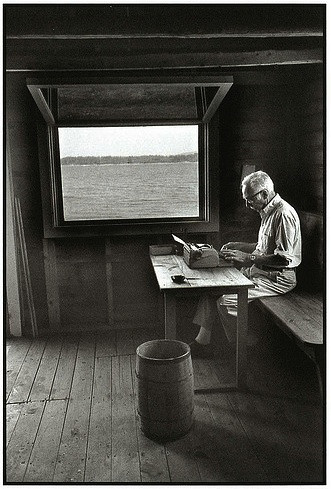
Here's an interview with Jill Krementz, the photographer whose work is collected in the book. My favorite writer-and-desk in the book this one of E.B. White.
Thursday, January 31, 2013
Althouse unfair to F. Scott Fitzgerald?
Midway through my journey of isolating and writing about sentences from "The Great Gatsby," I find myself confronted by one creeley23 — a commenter within the confines of this Althouse blog — who says: "Hmm... rereading the first ten pages of Gatsby I see that Ann is picking klunky, atypical sentences out of the text."
I have chosen things like: "Sometimes a shadow moved against a dressing-room blind above, gave way to another shadow, an indefinite procession of shadows, that rouged and powdered in an invisible glass." And: "A breeze blew through the room, blew curtains in at one end and out the other like pale flags, twisting them up toward the frosted wedding-cake of the ceiling, and then rippled over the wine-colored rug, making a shadow on it as wind does on the sea."
But, in my defense, I have also chosen: "A breeze stirred the gray haze of Daisy’s fur collar." And: "Americans, while occasionally willing to be serfs, have always been obstinate about being peasantry."
Remember, the original idea was:
Here's a way the book could be taught in a high school class. (But maybe they'd fire you!) Class, this is a book with some very weird sentences. Who can find one? Students read individual sentences out loud and the teacher cuts and pastes the sentences, so they are projected on the board. Encourage the students to pull out things that are the most outlandish and impossible to understand. Encourage laughter. Email the list of sentences to the class and have them reply to the email cutting out all but one sentence, the sentence they'd most like to talk about. Quickly read the email and pick a sentence that got a lot of attention. Puzzle through what it might mean with the students so that they appreciate the fun of getting wrapped up inside one sentence. Give them 20 minutes to write about one of the other sentences.
Must they read the book? Tell them they can read the book if they want. But tell them they can go to Wikipedia and read the plot summary and the list of characters there. The idea is to spend time with particular sentences and to figure out why someone would write like that. Must they love F. Scott Fitzgerald? No! They can be like Palladian — the original commenter genius of the Althouse blog — who said:
watchword watchphrase of this blog has long been "cruel neutrality." And, indeed, I see that even before I responded to Original Commenter Genius Palladian, he was responded to by Upstart Commenter Genius betamax3000, who said:
But is today the last day? Is it time to move on to "Paradise Lost" or "The Divine Comedy"?
If the assignment were — in this non-existent high school class — to read straight through "The Great Gatsby," you would know when you were done. The hard task your real teacher tasked you with has a knowable end. It's not interminable, even though the word "ceaselessly" is the 4th-to-the-last word. You get to "ceaselessly" and there's "into the past" and you are done. Your reading of "Gatsby" has receded into the past, like last night's huge, hard-to-digest dinner. You wake up with a stomachache. You can't take too much. You only want to nibble at the edges of some stale ideas, like maybe a blog post, a blog post about one sentence. You can nibble, and — in the comments — you can dribble. Like betamax3000 on last night's "Something was making him nibble" post :
I have chosen things like: "Sometimes a shadow moved against a dressing-room blind above, gave way to another shadow, an indefinite procession of shadows, that rouged and powdered in an invisible glass." And: "A breeze blew through the room, blew curtains in at one end and out the other like pale flags, twisting them up toward the frosted wedding-cake of the ceiling, and then rippled over the wine-colored rug, making a shadow on it as wind does on the sea."
But, in my defense, I have also chosen: "A breeze stirred the gray haze of Daisy’s fur collar." And: "Americans, while occasionally willing to be serfs, have always been obstinate about being peasantry."
Remember, the original idea was:
What I like [about "The Great Gatsby"] is that each sentence is good, on its own. Seriously. Test it out. "As my train emerged from the tunnel into sunlight, only the hot whistles of the National Biscuit Company broke the simmering hush at noon." Every sentence is a writer's inspiration....I didn't start a new blog, obviously, only a daily discipline on this blog. I confess to not proceeding by random selection. But I haven't gone searching for "klunky" sentences. I've flipped around in near-random style, though. I don't use the first thing I see. Opening up Chapter 1 right now, I see "I told him" and "We talked for a few minutes on the sunny porch." These are examples of non-"klunky" sentences that I would reject, but not because I'm gunning for F. Scott. My initial motivation was love. I thought of all the high school students — I remember being one — who were assigned this book and made to read the whole thing. That being the task, the really interesting sentences are speed bumps. They're completely annoying. You can't take the time to figure them out. What should be loved is hated. Later in life, I reread the book and enjoyed it, because of the worthiness of individual sentences.
I feel like starting a blog devoted to individual sentences in "The Great Gatsby," chosen randomly, and continuing until all the sentences have been used up.
Here's a way the book could be taught in a high school class. (But maybe they'd fire you!) Class, this is a book with some very weird sentences. Who can find one? Students read individual sentences out loud and the teacher cuts and pastes the sentences, so they are projected on the board. Encourage the students to pull out things that are the most outlandish and impossible to understand. Encourage laughter. Email the list of sentences to the class and have them reply to the email cutting out all but one sentence, the sentence they'd most like to talk about. Quickly read the email and pick a sentence that got a lot of attention. Puzzle through what it might mean with the students so that they appreciate the fun of getting wrapped up inside one sentence. Give them 20 minutes to write about one of the other sentences.
Must they read the book? Tell them they can read the book if they want. But tell them they can go to Wikipedia and read the plot summary and the list of characters there. The idea is to spend time with particular sentences and to figure out why someone would write like that. Must they love F. Scott Fitzgerald? No! They can be like Palladian — the original commenter genius of the Althouse blog — who said:
Has anyone calculated how long this Gatsby project is going to go on? How many sentences are in the book? How many sentences have been covered so far?I said:
I ask partially out of curiosity and partly because I hate "The Great Gatsby". Why couldn't we have done Chaucer or "Paradise Lost" or something?
I don't think the project asks you to like "The Great Gatsby." It should work for the haters. Bring that hate!Palladian said:
That's true! I think the general tone of the comments on these threads led me to think of them as reverential, but your writing about them is actually neutral and occasionally negative.The
"the Inquisition that goes on forever. Interminably."(That's a quote from the post, which is about a "Gatsby" sentence that includes "interminable inquisitions.")
Ann has gone full Althouse Snow Globe Theory now:And there betamax3000 is quoting himself, from this earlier thread, about one of the least "klunky" sentences that has ever found its way into the "Gatsby" project:
"She sets the Snow Globe with cruel neutrality for us to shake and see patterns from the flitter. There is not the expectation of sentimentality. She is asking us to look, together; however, often there is no resolution, each reader seeing only his own flitter of understanding."
"They knew that presently dinner would be over and a little later the evening, too, would be over and casually put away."When can we put this "Gatsby" project away, like a dinner and an evening consumed blandly and casually in the Midwest, where all the Gatsby characters belong?
"I see now that this has been a story of the West, after all — Tom and Gatsby, Daisy and Jordan and I, were all Westerners, and perhaps we possessed some deficiency in common which made us subtly unadaptable to Eastern life."That's a sentence I've been saving, in my holding pen of sentences — "klunky" and not-"klunky" — that might get the nod some day on this project, and I guess I've given that one the nod today.
But is today the last day? Is it time to move on to "Paradise Lost" or "The Divine Comedy"?
If the assignment were — in this non-existent high school class — to read straight through "The Great Gatsby," you would know when you were done. The hard task your real teacher tasked you with has a knowable end. It's not interminable, even though the word "ceaselessly" is the 4th-to-the-last word. You get to "ceaselessly" and there's "into the past" and you are done. Your reading of "Gatsby" has receded into the past, like last night's huge, hard-to-digest dinner. You wake up with a stomachache. You can't take too much. You only want to nibble at the edges of some stale ideas, like maybe a blog post, a blog post about one sentence. You can nibble, and — in the comments — you can dribble. Like betamax3000 on last night's "Something was making him nibble" post :
Re: "Oh! For a minute there, I saw 'nimble,' and I was flummoxed."Is your tummy feeling better now? Maybe saltines and ginger ale would help. That's what my midwest-born-and-raised mother would offer me when I was feeling queasy. But you've got to eat something. You must go on — ceaselessly, interminably — when the project is one sentence a day. One day at a time. One sentence at a time. One nibble at a time. One blog post at a time.
I like nibble better. Not just because it makes me think of squirrels nibbling on a nosh. I often find myself nibbling at the edge of stale ideas. Of course, it is easier to nibble at the edges when the stale idea is square-shaped, like a behind-the-sofa-cushion Cheez-It: there are corners. Corners are the perfect nibble starters. Plus, Cheez-Its -- and the non-square Cheeto, for that matter -- leave your fingers orangey, like all the best ideas, stale or not.
So one morning when the sun was warm
I rambled out of New York town
Pulled my cap down over my eyes
And headed out for the western skies
So long New York
Howdy, East Orange*.
(*"Even when the East excited me most with sprawling, swollen orange fingers: you're gonna have to take notes faster, friends)
Which brings us back to a point: Naked Dylan Robot would love to hear Fitzgerald try to sing some of Fitzgerald's sentences. Naked Dylan Robot would laugh and laugh.
"Everybody's sturdy physical egotism must get stoned."
"When the winds of changes shift
May your malnourished peremptory heart always be joyful
And may your song always be sung
May you stay forever slightly worn, young man, with shell-rimmed glasses and scanty blond hair."
For a writer whose rep is based in large part on making words sing his words just don't... sing. Maybe Naked Albanian Phonetical Dylan Robot could give a try, but I don't think it would get there. Nor Naked Phoenician Dylan Robot, for that matter*.
(*this is -- of course -- self-contradictory: per Wikipedia "in Phoenician writing, unlike that of most later abjads such as those of Aramaic, Biblical Hebrew and Arabic, even long vowels remained generally unexpressed, and that regardless of their origin". No Naked Dylan Robot of any proud heritage could forsake the long vowels: exps: oooohhhhhmaaa-ma is this reaaaaaaally the eeeeend, etc etc).
Perhaps Naked Dylan Fitzgerald Cow could make a go of the following:
Now you see this one-eyed midget
Shouting the word "MOO
And you say, "For what reason ?"
And he says, "Hoo?"
And you say, "What does this mean ?"
And he screams back, "You're a cow
Give me some milk
Or else go home".
-- but Naked Dylan Fitzgerald Cow is a Talent. And not afraid to nibble, stale or no. Someone should make a Snow Globe for Naked Dylan Fitzgerald Cow: Ann could put it next to her Robot on her desk and take a picture. I would call in sick to work the next day.
Wednesday, January 30, 2013
"A man is only as old as the woman he can feel inside of him trying to express herself."
A translation of the French that was itself a translation of "You’re only as old as the woman you feel" — an old Groucho Marx joke — which had been given as an example of an untranslatable sentence.
Tuesday, January 29, 2013
Take the exam in Althouse's on-line class in media bias.
First, read this post about Dana Milbank's description of the way Senator Marco Rubio looked as he waited his turn to speak about the bipartisan immigration plan. Note the literary techniques he employs. He seems to be describing what he sees, but I implied that his descriptions revealed bias, and, indeed, that Milbank would like to destroy Marco Rubio.
Now, here's a video clip showing Marco Rubio giving his presentation. Feel free to listen to what he says, but I want you to concentrate on Senator Chuck Schumer, who can be seen at the left of the screen. Observe any gestures or expressions, because the assignment will involve describing him, deploying literary techniques of the sort we saw in Milbank's description of Rubio.
Here's the assignment. Write 2 descriptions of Schumer, in the style of Dana Milbank's description of Marco Rubio.
1. You are the equivalent of Milbank, but attuned to the goals of the Republican Party. You would like to impede the advancement of Chuck Schumer.
2. You are a Milbank-style columnist at a place like The Washington Post, and you'd like to further the political career of Senator Schumer.
Cast a critical eye on your work. Are your 2 descriptions equivalent? They should be equally accurate, equally presentable as journalism, equally in service to your political agenda.
What have you learned from this exercise? Has your respect for Milbank grown or shrunken? Explain.
Wednesday, January 23, 2013
"A tray of cocktails floated at us through the twilight, and we sat down at a table with the two girls in yellow and three men, each one introduced to us as Mr. Mumble."
For some reason, that's been my official favorite "Great Gatsby" sentence for a long, long time. I thought I'd bring it out today after getting unreasonably angry at yesterday's "Great Gatsby" sentence (here in our Gatsby project of looking at one "Great Gatsby" sentence each day in absurd isolation). You remember, the crowded hams and the salads of harlequin designs. People said to me, Althouse, you are wrong, this is a perfectly wonderful sentence, it describes sumputuousness and sensuousness. Sumptuousness! I was contemptuous of all this you-us-ness. I said:
Similarly surreal, the tray of cocktails floated at us through the twilight. Don't bother us with the human being carrying the tray. No one thinks there's some magic floating tray. We get it, and we feel woozy with cocktails, so that it's no wonder every man is Mr. Mumble and every woman is a swatch of color — yellow, in the twilight.
1. Any hack writer can use a lot of words and create a picture of a "sumptuous" feast.Then betamax3000 came in with sharp analysis attributed to Naked Advertisement Copywriter Robot:
2. I'm a reader, a consumer of the words, not of the food itself, so it's not like I'm getting a lot to eat here.
3. "Sumptuousness" seems like a corny idea, like something from a Harlequin (!) romance, especially in the effort to make it seem to refer to sexuality.
4. I'm not getting enough of an elite vibe from the food choices. They seem rather awful. It really does make me feel like it's Thanksgiving at Mom's, not a glorious affair at Gatsby's. Crowded hams! Could ya scootch over, Mom?
Naked Advertisement Copywriter Robot has analyzed sentence and determined an 8.6 correlation with:And so forth. And that put me in a cheerful mood and prompted me to whip out the official Althouse favorite sentence. Three men, each one introduced to us as Mr. Mumble. I love that. After reading that, you feel like taking an oath never to say anything as banal as: I was introduced to three men, but I didn't catch a single name. Or: Someone introduced us to three men, but the sound quality in the room was such that they might as well all have been named Mr. Mumble. No, you realize, from now on, I must remember to simply assert that the men were introduced as Mr. Mumble. Let the reader lag for a quarter of a second and imagine that could be their names and then get it. Readers are quick. They get this comic, surreal accuracy.
Appleby's
Suggested improvement: addition of the word "drizzled."
Similarly surreal, the tray of cocktails floated at us through the twilight. Don't bother us with the human being carrying the tray. No one thinks there's some magic floating tray. We get it, and we feel woozy with cocktails, so that it's no wonder every man is Mr. Mumble and every woman is a swatch of color — yellow, in the twilight.
Friday, January 18, 2013
"I always start with physicality when I’m writing as a woman. So I always have a vagina and think about having periods."
Said Will Self, who has a new novel, "Umbrella," the title of which is based on the Joyce quote "A brother is as easily forgotten as an umbrella."
By the way, the first appearance of the word "umbrella" in English, according to the OED (not linkable), came in 1611:
Here's Perry Como singing "Let a Smile Be Your Umbrella."
Fill in the blank: Let a smile be your umbrella. Let a _________ be your vagina.
By the way, the first appearance of the word "umbrella" in English, according to the OED (not linkable), came in 1611:
T. Coryate Crudities sig. Lv, Many of them doe carry other fine things.., which they commonly call in the Italian tongue vmbrellaes... These are made of leather something answerable to the forme of a little cannopy & hooped in the inside with diuers little wooden hoopes that extend the vmbrella in a prety large compasse.That predates the first use of "vagina," which was in 1682:
T. Gibson Anat. Humane Bodies 20 It has passages..for the neck of the Bladder, and in Women for the vagina of the Womb.The etymology of "vagina" is: "Latin vāgīna sheath, scabbard." The etymology of "umbrella" is: "Italian ombrella and ombrello, < ombra < Latin umbra shade."
Here's Perry Como singing "Let a Smile Be Your Umbrella."
Fill in the blank: Let a smile be your umbrella. Let a _________ be your vagina.
Tuesday, January 15, 2013
"There are notes and notes, of course: notes to oneself and notes to others; notes taken, made, jotted, and passed."
"Mash, doctor's, suicide, and condolence notes. Field, class, and case notes; notes for general circulation; foot and head notes, notes of hand. But it's the bookish notes that academics care most about, the ones that intervene between the things we read and the things we write."
Geoffrey Nunberg has notes from his notes as a note-taker at a conference on notes.
Geoffrey Nunberg has notes from his notes as a note-taker at a conference on notes.
For [Walter Benjamin], the rise of note-taking signaled the book's reduction into a purely transitional object, "an obsolete mediation between two different filing systems." Everything that matters, he said, could be found in the card boxes of the researcher who wrote it, which the scholar studying it had merely to incorporate in his own card index.Ha ha. Brilliant. And archaic. Card boxes.
Thursday, January 10, 2013
"The biggest and weirdest myth out there about the $1 trillion platinum coin is..."
Matthew Yglesias debunks a myth without establishing that anyone believes it.
Clue to Matt: No one believes it.
This is one of those glaring examples of the attitude of superiority leading to missing humor and subtlety. You may think you're smart, but it's not smart to assume other people aren't smart too. I recommend a working assumption that other people are smart, and when you think you're reading something ridiculously stupid, go through the exercise of reading it with the thought that the writer is wonderfully clever. This is especially important when you are reading something concise/elliptical. Look at every word. Think before you mock.
"Be a Sadist."
Rule #6 on Kurt Vonnegut's 8 rules for writing a short story:
This is a line of thought that brings me back around to an opinion I've arrived at from other directions as well: Give children nonfiction to read.
No matter how sweet and innocent your leading characters, make awful things happen to them-in order that the reader may see what they are made of.This is a problem I have with fiction. Characters are created for you to care about and the author invents torments for them — for us to enjoy. Have you ever written a fictional story and experienced sick excitement as you contemplated what you were about to do that poor unsuspecting sympathetic character you created? Or do you only read fiction. If you're able to get into fiction, is it because you fully trust the author to deliver the titillation of bad things happening to this sweet leading character?
This is a line of thought that brings me back around to an opinion I've arrived at from other directions as well: Give children nonfiction to read.
"Nobody ever became a writer just by wanting to be one. If you have anything to say..."
"... anything you feel nobody has ever said before, you have got to feel it so desperately that you will find some way to say it that nobody has ever found before, so that the thing you have to say and the way of saying it blend as one matter — as indissolubly as if they were conceived together."
Let me preach again for one moment: I mean that what you have felt and thought will by itself invent a new style so that when people talk about style they are always a little astonished at the newness of it, because they think that is only style that they are talking about, when what they are talking about is the attempt to express a new idea with such force that it will have the originality of the thought.ADDED: For comparison: "Something that you feel will find its own form."
Subscribe to:
Posts (Atom)
 :.