Pages

Labels

Showing posts with label Bible. Show all posts

Saturday, February 23, 2013

What did Jesus write in the sand? (Or: things I should have learned in church that I figured out from the Althouse comments.)

Yesterday, when many blogs were talking about the Islamist Facebook page with a cartoon showing how to stone a person who had committed adultery, I added the New Testament story, from John 8, in which Jesus said: "Let him who is without sin among you be the first to throw a stone at her." Jesus had just been teaching some people, and the scribes and the Pharisees, looking for a way to trip him up — they wanted to bring charges against him — present Jesus with a woman who had been caught in the act of adultery and remind him that the Law of Moses commanded that she should be stoned. "So what do you say?" Instead of answering, Jesus bends over and writes in the dirt. They keep pushing for an answer, and it's only then that he says: "Let him who is without sin among you be the first to throw a stone at her."

I didn't include the next few sentences, but the story was very familiar. After Jesus makes his brilliant remark — which finds a new way into the question — the crowd disperses and Jesus tells the woman to "go and... sin no more."

Some of the commenters focused on what it was that Jesus wrote on the ground. I'd always assumed that what Jesus was writing was irrelevant and that he was simply gesturing I'm not going to talk to you. He invoked his right to remain silent, as we say in the United States of America. He knew whatever he said would be used against him. Later, when he arrives at the New Testament doctrine — the higher law — he speaks up and articulates it pithily. He doesn't write it. Jesus isn't the put-it-in-writing type. The scribes are the bad guys here, and he's about talking to the people. The Word is spoken. (It's only written down later.)

But, reading the comments, I see interest in the subject of what Jesus wrote.

Sydney says: "In the movie The King of Kings, each accuser comes up to Jesus and sees written in the dirt his own sin, and turns and walks away. I love that scene." Is that the standard theory of what Jesus wrote?

And Chip Ahoy, linking here, says: "But what did he write in the sand?" At the link, we get added details from The Urantia Book (which I'd never heard of). There, the idea is that Jesus knew the woman's husband was a "troublemaker" and "perceived" that he'd forced the woman into prostitution and that the husband was now cooperating with the Pharisees to get Jesus to say something that could be used to arrest him. In this version of the story, Jesus doesn't just bend over and write in the dirt right where he is. He walks over to the troublemaker husband and writes something in front of him that makes him rush off. Jesus comes back to his original place and writes on the ground again, and the men, "one by one," leave. Last to go, is "the woman's companion in evil," who gets his own special message written in the dirt.

Kentuckyliz gives us the Old Testament quotes (the law of Moses, which is what the Pharisees threw at Jesus to trip him up):
Deuteronomy 22:22 "If a man is found sleeping with another man's wife, both the man who slept with her and the woman must die."

Leviticus 20:10 "If a man commits adultery with another man's wife — with the wife of his neighbor — both the adulterer and the adulteress must be put to death."
Kentuckyliz adds:
What's interesting about the Jesus scene, is that the law had become misogynistic in practice. The man is not being stoned according to the mandates of the law. In fact, I suspect he was standing in the crowd holding a stone.
Note that even in the extremely concise story told in John 8, we hear that the woman was "caught in the act." Whether he was in the crowd or not, the adulterer was known. Why aren't the authorities proposing to stone both the man and the woman? Kentuckyliz doesn't refer to what Jesus wrote in the sand, but this made me imagine that Jesus wrote "the man and the woman." And if the woman was a prostitute, all of the men who had ever slept with her would deserve stoning too.

In this scenario, Jesus acknowledges the written law of Moses by writing it. That's the Old Testament, which Jesus won't reject, even as his enemies are trying to lure him into rejecting it. He's showing that he knows the law, and in very few words, he's made it obvious to the legal experts that they are getting the law wrong and making them see their own faint-heartedness about equal justice, applying the strict law strictly on its written terms and to everyone. Then Jesus speaks, and the spoken word is the New Testament, calling us to a higher place, above the strict rules, under which we are all sinners. The New Testament demands that we look at our own sins. Go and sin no more.

That ought to keep you busy for the rest of your life. Now, leave other people alone.

ADDED: A second post includes the "King of Kings" clip and more.

Saturday, February 9, 2013

"Faithful is not love. Faithful is a subservient position..."

"... in which insecure people can not accept that, despite their tremendous talents, they might be wrong. That's why I like cats and independent dogs."

So says Dante in at 3:01 a.m. in The Faithful Dog Café.

Faithful is not love? That made me think Love is faithful and kind... But it's "Love is patient and kind..."
Love is patient and kind; love does not envy or boast; it is not arrogant or rude. 
Does that sound like a cat or a dog?
It does not insist on its own way; it is not irritable or resentful....
Cat?
... it does not rejoice at wrongdoing, but rejoices with the truth. 
Cat?!

Love bears all things, believes all things, hopes all things, endures all things.
Cat?!!
Love never ends. 
That sounds like what we mean when we say faithful. (I know Paul goes on to put "love" in a category with "faith" and "hope" and says "love" is the greatest, but the love he describes includes complete faithfulness to the loved one.)

Sunday, February 3, 2013

"He literally glowed; without a word or a gesture of exultation a new well-being radiated from him and filled the little room."

There's today's sentence from "The Great Gatsby," in the long-running Althouse blog show called The "Gatsby" Project.

Where do we go with this one? Must we dither over the old hobby-horse "literally"? Did Gatsby literally glow? Was he heated to the point of incandescence? I'd say that F. Scott Fitzgerald continually uses metaphor, asserting that things are other than what they are, without the prissy distance of clutter words like like and as if, so what does it matter if he intensifies one of these assertions with literally?

He glowed. And he radiated. It filled the room. He's an incandescent light-bulb. There are, I assure you, no fluorescent bulbs in "Gatsby." There are a few candles, including 4 that Daisy snaps out with her fingers. There's particularity about lighting in this book. Daisy prefers the sun. Literally.

I've said before that one thing I've learned, reading "Gatsby" sentences, is that if you're having trouble finding a way in: Look for the light. Today, the light source is obvious: It's the man himself, Gatsby.

But, the truth is, I'm not having trouble finding a way into this sentence. It jumped out at me because of the word "exultation," which is there in the negative: There isn't any exultation, not in word or gesture. It's a situation where Gatsby might have exulted, and the glowing/radiation came right out of his skin.

We were just talking about exulting. We were mock exulting at a minor tribulation that afflicted someone we sometimes slightly pretend we don't like, and then we were mock chiding each other for inappropriate exultation. It was nothing, really. Just some passing amusement at the idea of the flimsy sin of exultation.

The original meaning — OED — of exult, now obsolete, is "To spring or leap up; to leap for joy." That physical image is lost now, and it means — literally, now — "To rejoice exceedingly, be elated or glad; to triumph."
1856   E. K. Kane Arctic Explor. II. viii. 90   We..exult to think we need no catering for the morrow.
1865   A. C. Swinburne Satire to C. in Poems & Ballads 50   As plague in a poisonous city Insults and exults on her dead.
Don't confuse exult with exalt, which means "to raise up... to lift up" and "to praise, extol, magnify." The elevation-related physical image survives:
1823   C. Lamb Mod. Gallantry in Elia 184   Exalting his umbrella over her poor basket of fruit.
1832   Blackwood's Edinb. Mag. Feb. 287   Let the rogues swing, And thus be exalted.
And the metaphorical meaning works too:
1611   Bible (A.V.) Psalms xxxiv. 3   O magnifie the Lord with me, and let vs exalt his name together.
There's one other appearance of exult in "The Great Gatsby." It's not the absence of exultation, and it's not Gatsby, it's Tom. He's talking "incessantly, exulting and laughing." Much better to silently incandesce. Exalt appears once:
I stayed late that night, Gatsby asked me to wait until he was free, and I lingered in the garden until the inevitable swimming party had run up, chilled and exalted, from the black beach, until the lights were extinguished in the guest-rooms overhead.
Ah, but that's a whole other fat, juicy sentence. We've had our "Gatsby" sentence today, and it's time to snap out the lights on this post. Figuratively.

Friday, January 18, 2013

"Then David said to Abigail 'Blessed is your advice and blessed are you.'"

"Mrs. Phillips chose her pen name herself, taking Abigail after the prophetess in the Book of Samuel... and Van Buren for its old-family, presidential ring."

Pauline Phillips — "Dear Abby" — dead at the age of 94.

Tuesday, January 1, 2013

The History of Abkhazia.

"According to The Georgian Chronicles, the first inhabitants of what is now Abkhazia and the whole western Georgia were Egrosians, the descedants of Egros son of Togarmah, grandson of Japhet, son of Noah, who came from the land known as Arian-Kartli."


"... Abkhazia was conquered by Mithridates VI Eupator of Pontus between c. 110 and 63 BC, and then taken by the Roman commander Pompey."

"[T]he kingdoms of Abkhazia and Georgia [were united] into a single Georgian feudal state... reach[ing] the apex of its strength and prestige under the queen Tamar (1184–1213)."

"Towards the end of the 17th century, the principality of Abkhazia broke up into several fiefdoms, depriving many areas of any centralized authority. The region became a theatre of widespread slave trade and piracy. "

"In the Russian revolution of 1905, most Abkhaz remained largely loyal to the Russian rule, while Georgians tended to oppose it. As a reward for their allegiance, tsar Nicholas II officially forgave the Abkhaz for their opposition in the 19th century and removed their status of a 'guilty people' in 1907."

"On 24 October 2008 the railroad bridge of Shamgon-Tagiloni, connecting the city of Zugdidi in Georgia with the Abkhazian Gali district (populated mainly by Georgians) was destroyed. According to Georgian and French sources it was done by Russian army; Abkhazian sources maintained it was a Georgian diversion."

***

And so begins the new year project on this blog, which is to proceed, alphabetically, through the 206 countries of the world, and to read the "History of" page in Wikipedia. The idea is to have had it go through our head, at least once, something of what happened in each place. It is fitting that we start with Abkhazia, which may be an unfamiliar name. Much has happened there! It's touching to see that, to confront one's own persistent, nagging ignorance. But we are all fortunate to have woken up again this morning, still a human being on Planet Earth, and I want to perform a ritual — for the next 206 days — of adding a slight glimmer of awareness of those other human beings who live or who have lived over the long expanses of time and place.

***

It's apt that we encounter Noah on New Year's Day, Noah being our earliest example of an individual overindulging in alcohol.


ADDED: I found a nice Flicker stream of photos from Abkhazia. I recommend beginning here — at Stalin's bathroom — and then clicking to the "newer"/"older" button to see more.

Saturday, December 1, 2012

The Pope with a clown, Susan Rice caught between 2 power-heads, and a heavily tattoo'd quarterback.

I don't know what Matt Drudge is trying to slip into our subconscious today, but it's phantasmagoric. Felliniesque.


Click to enlarge.

The quarterback is Colin Kaepernick, who, not having murdered anybody, seems to be doing comparatively well, NFL-wise. His mother is "annoyed." The body scribblings are Bible verses (we're told). Across the chest it says "Against All Odds." Is that in the Bible? I don't know. Ask the Pope (if he's through clowning around). I've heard of the book of Philipians, so maybe there's a Philcollinsians.

Hillary and Rahm are swirling around Susan Rice. The story is Hillary prefers Kerry as her successor. Fine, but I can't see the Pope+Clown → Tattoo'd Quarterback transition. I hate to think there's no connection, that these are simply the stories that belonged at the top of their respective columns. Drudge means so much more. Tell me what the meaning is.

Here's the story about the Pope meeting 1000s of circus performers at the Vatican:
Benedict, a known cat lover, paid particular attention to a pair of lion cubs that were brought up to him, stroking them and chatting with their trainers. At one point Benedict even bent down to caress one — not an easy feat given the 85-year-old pope has trouble with his knees and occasionally uses a cane.
A gentle scene. Not the first thing that leaps to mind when you think about Christians and lions

Wednesday, November 21, 2012

The Queen is the supreme governor of the Church of England, but...

... its General Synod just voted against permitting women to serve as bishops.
It has been 36 years since the General Synod declared it had no fundamental objection to ordaining women as priests, and 18 years since the first women were ordained. But that change never won universal acceptance in the church, with a determined minority arguing that that the move was contrary to the Bible.

That group, affirming what it sees as the Biblical idea of male “headship,” has demanded special arrangements to shield it from supervision by female bishops.
Don't worry. Being inconsistent is perfectly consistent with the Bible.

Friday, November 2, 2012

Obama's speech is "coming from his loins."

Says Axelrod, apparently noticing how... odd that sounds and adding, jocosely, "I just wanted to say loins. I wanted to see if I could get loins in the story."

Loins. From what part of Axelrod's brain does that arise? I think of the first lines of Vladimir Nabokov's "Lolita": "Lolita, light of my life, fire of my loins. My sin, my soul. Lo-lee-ta: the tip of the tongue taking a trip of three steps down the palate to tap, at three, on the teeth. Lo. Lee. Ta."

Oh. Bah. Mah.

Loins. You see that word in the Bible: "In Biblical translations, often used for 'that part of the body that should be covered and about which the clothes are bound.'"

The word is used conspicuously by God, speaking to Job "out of the whirlwind":
Who is this that darkeneth counsel
By words without knowledge?
Gird up now thy loins like a man;
For I will demand of thee, and declare thou unto me.
Where wast thou when I laid the foundations of the earth?
Indeed, where was Obama when Jehovah laid the foundations of the earth Axelrod laid the foundations of his presidency?

Thursday, October 25, 2012

"The Emptiest Candidate in Presidential Election History: Mitt Romney truly believes in nothing."

They've got nothing on him, so they call him nothing. Ah, well, Obama's opponents call him Zero. that makes it Nothing vs. Zero.

***
Too much of nothing
Can turn a man into a liar
It can cause one man to sleep on nails
And another man to eat fire
Ev’rybody’s doin’ somethin’
I heard it in a dream
But when there’s too much of nothing
It just makes a fella mean
***
"I have heard what the prophets say who prophesy lies in my name. They say, ‘I had a dream! I had a dream!’ How long will this continue in the hearts of these lying prophets, who prophesy the delusions of their own minds?"

Sunday, August 26, 2012

"Althouse and her followers being expelled from the Garden of Bloggen to the Land of HuffPo."

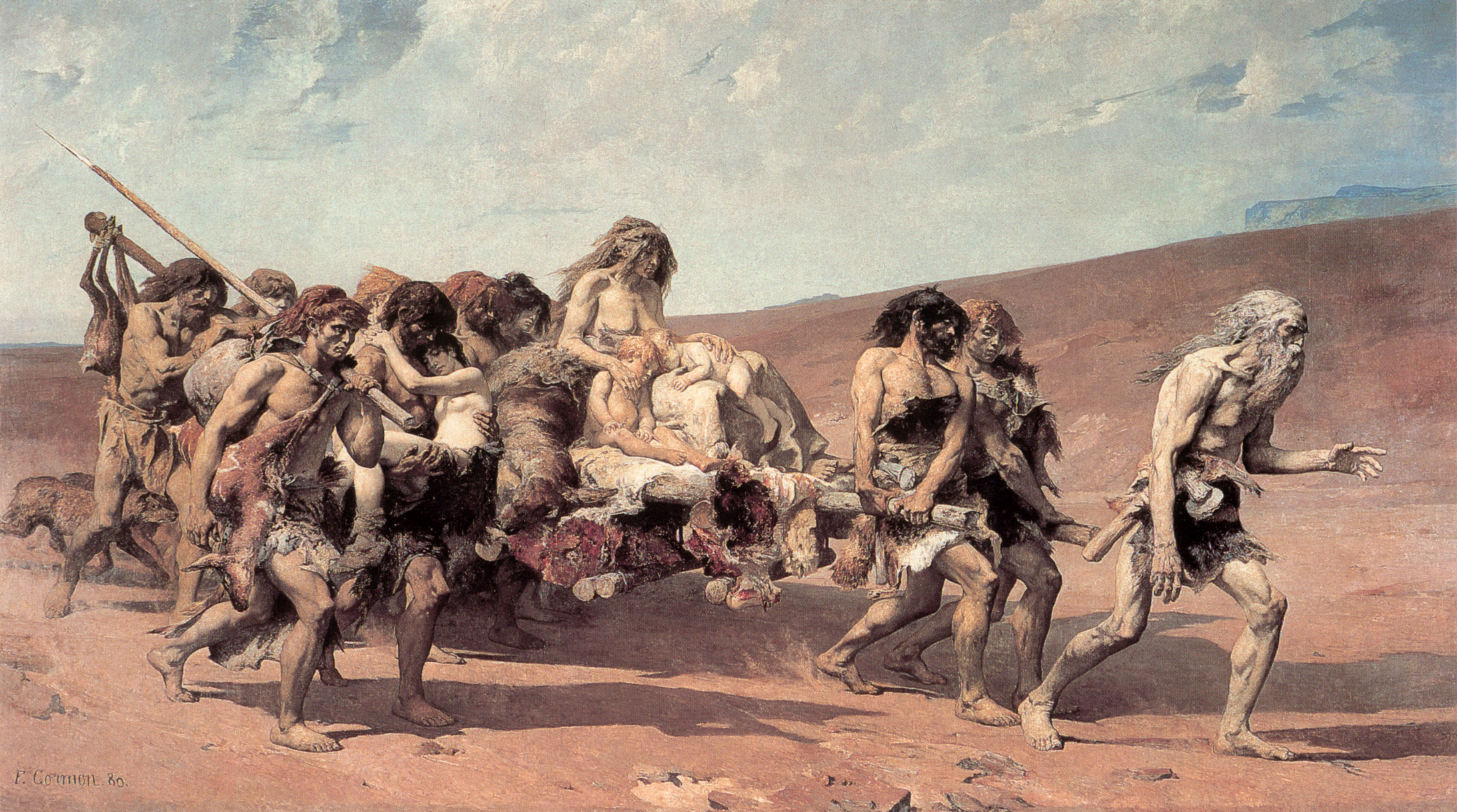
Writes Meade, after I say "So let me slink away and contemplate my own offenses against The Creator." Here's the illustration he sends us to:


(Enlarge.)

What an amazing image! It's an 1880 painting called "Cain flying before Jehovah's Curse," by Fernand Cormon. It's at the Musée d'Orsay (in Paris), so I guess I've seen it, but I don't remember it.
Despite his moment of glory as a Beaux-Arts professor..., [Cormon] was almost forgotten by 1924 when he was run over by a taxi outside his studio, and is barely remembered today save as the teacher of more illustrious pupils.
Here's the relevant passage in the Bible, Genesis 4:16: "And Cain went out from the presence of the LORD, and dwelt in the land of Nod, on the east of Eden." I don't know where he got all those other people going with him or why they looks like cave-folk. I'm guessing Cormon was stoking our doubts — making it look especially bizarre to make us think about how bizarre the Biblical account really is.

Thursday, August 23, 2012

"3 Interesting Moments From Dan Savage's Debate With a Gay Marriage Opponent."

Conor Friedersdorf selects some morsels (and has embedded video of the entire 1-hour debate). I've listened to the whole thing and found Savage's opening statement quite well done. The same-sex marriage opponent, Brian Brown, mostly fails to address Savage's presentation and goes on about the importance of civility (which had more to do with an earlier incident in which Savage called some students "pansies" for walking out on him after he said the Bible contained some "bullshit"). Savage has apologized for the "bullshit"/"pansies" incident, and Brown had accepted Savage's invitation to talk about same-sex marriage after dinner at Savage's house, moderated by journalist Mark Oppenheimer.

Here's Oppenheimer's write-up in The New York Times. He begins:
The ancient Greek symposium, which combined drinking with elevated discussion, was often held in a private house; at Parisian salons, conversation frequently took place in the bedroom. Once upon a time, intellectuals knew they could do their best thinking at home, not in a public venue, and that debate would be helped along by food and drink.
But Oppenheimer was actually not hoping for vigorous, deep debate. He imagined home (and drink) creating an atmosphere of warmth and affinity:
It was my hope, of course, that Mr. Brown might witness a sane, functional, happy family in a bourgeois home, and consider it as another piece of evidence, something more for reason to operate on.
Savage himself thought the home setting made him to "solicitous and considerate" — since it was his home, and he was therefore the host. And it's not surprising that Brown didn't cave on his principles when confronted with the reality of gay partnership in a nice home. So that was that.

By the way, Savage's newest podcast, #304 (downloadable in the sidebar here), begins with a discussion of the shooting at the Family Research Center, which he condemns while standing by the characterization of the FRC as a "hate group." In the course of making the argument — too bad there's no transcript — he quotes this quote:
"I believe that marriage is the union between a man and a woman. Now, for me as a Christian — for me — for me as a Christian, it is also a sacred union. God’s in the mix...."
He mocks that, but says that's not enough to count as hate. He then stuns us with the revelation that the speaker of the quote is...

Barack Obama.

Friday, August 3, 2012

Another idea for delaying aging.

At last night's open thread, the Coal Café, our beloved commenter Lem got inspired to look for updates on that story from a couple weeks ago about the burned fire walkers:
I was looking for news of the bed of hot coal walkers we had fun with and how they might be "getting over it"... when Google gave me this..

Bed warmer... The term is also commonly used in the United Kingdom and Australia for a temporary sexual partner, or a relationship of necessity.
This is not to be confused with Shunamitism, the practice of sharing a bed, but not necessarily engaging in sexual relations, with a young maiden, in hope that the shared warmth and moisture would delay aging.
Clicking through on Shunamitism, I see that the idea was that "the heat and moisture of the young woman would transfer to the old man and revitalize him." The term, Shunamitism, goes back to King David, who had a young woman from Shunem (named Abishag) brought to his bed to keep him warm. 1Kings 1,1. And: "Among scientific physicians, both Thomas Sydenham (17th century) and Herman Boerhaave (18th century) prescribed shunamitism for their patients." That's quite a prescription, if you can get it.

ADDED: I'm imagining Shunamitism as a New Age front for a prostitution business.

Friday, June 15, 2012

Searching for "ample art," I found a cool blog called judith2you.

"Ample art" was the ridiculous phrase used by the pool reporter to describe the room Sarah Jessica Parker had had prepped to receive the President of the United States and 50 of his glamorous friends. Here's the blog post about that. Trying to summon up a picture of "ample art," I thought of those big fat nudes by Botero. I did an image search on his name, which I used as a link in that blog post. But I clicked on the most obvious big fat nude, and it took me to a post at judith2you: "Judith meets Botero." It' a post comparing that Botero to a painting by Marco Palmezzano called "Judith with the Head of Holofernes." The blogger, Judith, comments on the the maid, who "put herself in danger in the midst of the Assyrian Army, she had to carry the bucket with a lifeless head stuffed in rotting meat...."

What is this blog? "That's Judith to you" is what you say when you're named Judith and someone presumes to call you Judy. The blogger's name is Judith, and she says in the sidebar:
... it's time to own my name. to be Shakespearean and wonder "What's in a name?" to learn about the artwork inspired by the name. to contemplate how a widow in a gleaming gown can decapitate a brute - and not muss her nails. join me in the bumpy ride through history and art and social change, all in the name of Judith.
She's been blogging for a year and has blogged about one a day, which substantiates the claim to being a real blog (as I see it). I've written before — I think! — about the idea of choosing one word, setting up a Google alert for it, and blogging based only on that word. What would your word be? In this case, the blogger has chosen her own name, and she's limited her subject to art, although she hasn't limited herself to the news of the day.

Here's her second post, where she contemplates the apocryphal, biblical character Judith:
... the reasons her story have persisted are as varied and complex as the artists who have depicted her.  “strength in weakness” is an overly simplistic explanation: Judith embodies (in political terms) “the people v. tyranny”, (in feminist terms) ”righteous woman vs. marauding man” and (in County Music terms) “git-er done gal v. skunk-drunk asshole.” not to mention, she was not afraid of a little blood and gore to make her point nor adverse to using her feminine charms to advance her true purpose.

... here is a woman you can admire. the men in her city were ninnies, ready to give up and be killed or enslaved. but she looked at her resources, figured she could seduce the guy, made a plan to freak everybody out by detaching and then displaying his head – and it worked. think of all the ways it could have gone wrong —

One - she couldn’t seduce the guy because (a) she over-estimated her charms or (b) he wasn’t interested in her type of womanhood or (c) he wasn’t interested in womanhood at all. “Sorry little lady but you’re just not my type.”...
More at the link! I did a search for Caravaggio — because I knew Caravaggio's painting of the beheading scene — and was delighted to find the Thanksgiving post "Judith demonstrates technique in how to carve a turkey without mussing your gown."

Monday, May 7, 2012

"Ponchos and sombreros: Partygoers don ‘insensitive’ attire despite student efforts."

Imagine! Student efforts failing to sear prick the conscience of the Mifflin Street Block Party people.

The student group that wants respectful seriousness and no horsing around on the subject of Cinco de Mayo calls itself Badgers Against Racism... or "BAR."

IN THE COMMENTS: pduggie said:
"sear the conscience" is the opposite of what you mean.

To have a seared conscience is to have one that is locked out from all claims of injustice.

I think you mean wound or prick.
He refers me to the New Testament, 1 Timothy:
1The Spirit clearly says that in later times some will abandon the faith and follow deceiving spirits and things taught by demons. 2Such teachings come through hypocritical liars, whose consciences have been seared as with a hot iron. 3They forbid people to marry and order them to abstain from certain foods, which God created to be received with thanksgiving by those who believe and who know the truth. 4For everything God created is good, and nothing is to be rejected if it is received with thanksgiving, 5because it is consecrated by the word of God and prayer.
I stand corrected. Prick is a much better word.

And by the way — I'm sure I'm not the first person to notice — there's a nice biblical argument for same sex marriage. St. Paul contemned the bad religionists who "forbid people to marry," and — right at that point — said "For everything God created is good, and nothing is to be rejected if it is received with thanksgiving." Did God not create gay people?

Here we are "in later times." Is your conscience seared or pricked?

AND: Though I've read the New Testament many times (though mostly the Gospels), my experience with searing the conscience is overwhelmingly from something written by Felix Frankfurter, in a passage I've used repeated in my constitutional law classes. The case is Baker v. Carr — a great Warren Court landmark — and Justice Frankfurter articulates what is, to me, the most memorable statement of judicial restraint in the Supreme Court reporters:
We were soothingly told at the bar of this Court that we need not worry about the kind of remedy a court could effectively fashion once the abstract constitutional right to have courts pass on a statewide system of electoral districting is recognized as a matter of judicial rhetoric, because legislatures would heed the Court's admonition. This is not only a euphoric hope. It implies a sorry confession of judicial impotence in place of a frank acknowledgment that there is not under our Constitution a judicial remedy for every political mischief, for every undesirable exercise of legislative power. The Framers, carefully and with deliberate forethought, refused so to enthrone the judiciary. In this situation, as in others of like nature, appeal for relief does not belong here. Appeal must be to an informed, civically militant electorate. In a democratic society like ours, relief must come through an aroused popular conscience that sears the conscience of the people's representatives. In any event, there is nothing judicially more unseemly nor more self-defeating than for this Court to make in terrorem pronouncements, to indulge in merely empty rhetoric, sounding a word of promise to the ear sure to be disappointing to the hope.
I'm quite shocked to discover Frankfurter misused the phrase! But then — did you know? — English was a second language for Felix Frankfurter, who was born in Vienna.

Saturday, April 28, 2012

"Nearly a dozen of high school journalists walked out of a lecture by Dan Savage, the prominent ant-bullying advocate..."

Sorry... I just love the typo: ant-bullying. Is that something done with a magnifying glass?

But... okay... let's talk about the underlying story. Dan Savage was doing his thing....
'People often say that they can’t help with the anti-gay bullying acts because it says right there in Leviticus, it says right there in Timothy, it says right there in Romans, that being gay is wrong,' Mr Savage said.

'We can learn to ignore the bullsh*t in the Bible and what it says about gay people.'

He compared dogmatic acceptance of anti-gay teachings equivalent to adhering to verses about slavery and eating shellfish, two issues that have been reinterpreted in modern day.
My question is whether the school engages in viewpoint discrimination. Does it bring in other speakers who present other interpretations of the Bible? I doubt it.

Friday, April 27, 2012

"Did perpetual happiness in the Garden of Eden maybe get so boring that eating the apple was justified?"

That's the fifth most "liked" quote on the topic of "sin" at goodreads. It's from Chuck Palahniuk, Diary (which is a novel, not a diary). The forth most liked also involves poor old Adam. It's by Mark Twain:
Adam was but human—this explains it all. He did not want the apple for the apple's sake, he wanted it only because it was forbidden. The mistake was in not forbidding the serpent; then he would have eaten the serpent.
But I've heard snake is tough, tougher than dog (and less crunchy than grasshopper).

Sorry for the gratuitous Obama-eats-dog/snake punchline. It was not my motivation to look up quotes. I was actually searching for a quote about boredom, something like the only sin is being boring. Interestingly, the most-liked goodreads quotes on the topic of "boredom" are boring. Seriously, how many ways are there to say If you're bored, it's because you are boring? And now I've lost track of what somebody said that made me what that sin-of-boringness quote, which might not even exist.
“Life is for living and working at. If you find anything or anybody a bore, the fault is in yourself.”
― Elizabeth I
Am I boring you? You must be boring.

IN THE COMMENTS: Sweetbriar and Jody both point me to the answer: Christopher Hitchens, in his memoir, "Hitch-22." Page 13. His mother used to say:  "The one unforgivable sin is to be boring."

And I think what got me looking in the first place was a comment by Patrick over in the "Predictable Althouse Is Predictable" post:
Honestly, when I first came to this blog, back in the day, I assumed that you, a law professor especially at Madison, would be a typical lefty law professor. In fact, I likely put off reading the blog for awhile because I assumed it would be the same old boring lefty stuff. This is a very interesting blog, and your political opinions or votes are part of that, but really, there's a lot more to it. Vote for Ron Paul for all I care, or Dennis Kucinich. Just don't be boring about it!

Friday, March 9, 2012

Jeremiad.

Our first Bible reading of the day, at Meadhouse, was Jeremiah 18, "The Potter and the Clay."

Never mind how it came up in our conversation: What do you make of it?

Thursday, March 8, 2012

"I believe in working with the hearts of people, and not locking them up."

Says Pat Robertson, advocating the legalization of marijuana.
"I really believe we should treat marijuana the way we treat beverage alcohol... I’ve never used marijuana and I don’t intend to, but it’s just one of those things that I think: this war on drugs just hasn’t succeeded."...

Mr. Robertson said he enjoyed a glass of wine now and then — “When I was in college, I hit it pretty hard, but that was before Christ.” He added that he did not think marijuana appeared in the Bible, though he noted that “Jesus made water into wine.”

“I don’t think he was a teetotaler,” he said.
Now, of course, Pat Roberson has said a lot of hare-brained things over the years, — but that doesn't mean he's always wrong. I was going to look up and post about his worst opinions, but I got sidetracked into this question whether marijuana appears in the Bible. You just know there will be pages on the internet talking about marijuana in the Bible. For example:
God said, "Behold, I have given you every herb bearing seed which is upon the face of all the earth.…To you it will be for meat." … And God saw everything that he had made, and, behold, it was very good. (Genesis 1:29-31) The Bible predicts some herb's prohibition. "Now the Spirit speaketh expressly, that in the latter times, some shall … speak lies in hypocrisy … commanding to abstain from meats which God hath created to be received with thanksgiving of them which believe and know the truth. (Paul: 1 Timothy 4:1-3)

The Bible speaks of a special plant. "I will raise up for them a plant of renown, and they shall be no more consumed with hunger in the land, neither bear the shame of the heathen any more." (Ezekiel 34:29) A healing plant. On either side of the river, was there the tree of life, which bare 12 manner of fruits, and yielding her fruit every month; and the leaves of the tree were for the healing of the nations. (Revelations 22:1-2) A gift from God.

Wednesday, October 5, 2011

"Sarah Palin Says She Will Not Seek the Presidency."

Breaking news at the NYT.

ADDED: I've changed the link to get to the specific story, which includes:
“Not being a candidate, you are unshackled and able to be even more active,” she said on... I look forward to using all the tools at my disposal to get the right people in there who have a servant’s heart.”
A servant’s heart! That's new. New to the current political discourse, at least. I can see that it's a standard phrase in the discussion of Christian humility.