

Many images show holey foods or clusters of seeds, like aerated chocolates, the innards of a red bell pepper, and bubbles rising up in pancakes while they cook.The amazing thing is, the link goes to NPR, where there's no mention whatsoever of Sigmund Freud. How radically our culture has changed in the last 30 years!
"I don't like the holes in crumpets or sponges or Swiss cheese," @CourtneySGray said on Twitter. "They all make me shudder and panic."
The trypophobia Facebook page touts nearly 7,000 followers, who commiserate on their "condition" and triggers. "When macaroni noodles stand up straight when I'm boiling them, I wanna cry," Kelcey Piper remarked on Facebook. "Anyone else experienced this?"
Showing posts with label NPR. Show all posts
Showing posts with label NPR. Show all posts
Wednesday, February 13, 2013
"Trypophobia... is an irrational fear of holes, pods or cracks — specifically, clusters of them."
"On Instagram and Reddit, people share photographs of clusters that make them anxious, obsessed and even nauseated."

Friday, January 25, 2013
"Weird things happen when you take price out of the equation for consumers. For one thing, they stop looking for the best price."
Yes. Obvious. I know. But this is NPR talking, which is what struck me.
(The topic is the breast pumps that must be paid for by health insurance companies under Obamacare.)
(The topic is the breast pumps that must be paid for by health insurance companies under Obamacare.)
Thursday, January 24, 2013
"Pentagon officials repeatedly stressed that there will be 'gender-neutral standards' for combat positions."
From NPR's "Women In Combat: 5 Key Questions."
For example, to work in a tank, women will have to demonstrate the ability to repeatedly load 55-pound tank shells, just as men are required to do.No more double standards. I approve.
Infantry troops routinely carry backpacks with 60 or 70 pounds of gear, or even more. The most common injury in Afghanistan is caused by roadside bombs. This raises the question of whether a female combat soldier would be able to carry a 200-pound male colleague who has been wounded.
Wednesday, January 9, 2013
Yoga in public schools — an Establishment Clause problem.
NPR has trouble seeing the objection. This kids are stretching, readying their minds for learning, don't you know? But here's one mother's report:
The school's program was richly funded by the K.P. Jois Foundation, whose Hindu founders connected yoga to their religion.
My position — explained here in the context of Kwanzaa — is that the government should not use schools for exercises that reach into the spiritual aspect of the child's mind. Quite aside from whether courts would see an Establishment Clause violation, it should be rejected as a policy choice. Even where you have trouble deciding whether something is religion or not, if it's a religion substitute, operating like religion, you should be revolted by the government intruding into the sphere that belongs to the individual, parents, and private organizations. And on this ground, I would object to all sorts of indoctrination and idol-worship. Public schools must be committed to teaching real substance of the secular kind. Think: math and science.
ADDED: Imagine if a Christian foundation were handing out huge grants to public schools to adopt a program based on its values, with generic prayer-like incantations led by the teacher. Would NPR and its devotees be nodding calmly at how nice it was?
ALSO: NPR quotes the mother's attempt at paraphrasing the prayer-like incantation. I'd like to see the actual text that the school uses! Here's some material at the Jois website, but it doesn't show the text I'm looking for.
"They were being taught to thank the sun for their lives and the warmth that it brought, the life that it brought to the earth and they were told to do that right before they did their sun salutation exercise"...The woman, Mary Eady, was able to take her son out of the classes — which is an appropriate accommodation but insufficient to solve an Establishment Clause violation. (In the old prayer-in-school cases, excusing the students who chose not to pray did not suffice.)
The school's program was richly funded by the K.P. Jois Foundation, whose Hindu founders connected yoga to their religion.
"It's stated in the curriculum that it's meant to shape the way that they view the world, it's meant to shape the way that they make life decisions," Eady says. "It's meant to shape the way that they regulate their emotions and the way that they view themselves."
"And then the question becomes — if it is religious, which it is, who decides when enough religion has been stripped out of the program to make it legal?" [says Dean Broyles, president and chief counsel of the Escondido-based National Center for Law and Policy]. "I mean, that's the problem when you introduce religion into the curriculum and actually immerse and marinate children in the program."...
"It is the stated goal of both the Jois Foundation and the district itself to prove scientifically that Ashtanga yoga works for kids here in the district and then export it nationally," Broyles says.The Jois Foundation has a director, Eugene Ruffin, who is himself Catholic and who says the values taught in the program aren't specifically Hindu. But making religion generic doesn't solve your problem. Consult the original Warren Court school-prayer case, Engel v. Vitale, which involved a prayer concocted by the state that stripped out all denominational specificity.
My position — explained here in the context of Kwanzaa — is that the government should not use schools for exercises that reach into the spiritual aspect of the child's mind. Quite aside from whether courts would see an Establishment Clause violation, it should be rejected as a policy choice. Even where you have trouble deciding whether something is religion or not, if it's a religion substitute, operating like religion, you should be revolted by the government intruding into the sphere that belongs to the individual, parents, and private organizations. And on this ground, I would object to all sorts of indoctrination and idol-worship. Public schools must be committed to teaching real substance of the secular kind. Think: math and science.
ADDED: Imagine if a Christian foundation were handing out huge grants to public schools to adopt a program based on its values, with generic prayer-like incantations led by the teacher. Would NPR and its devotees be nodding calmly at how nice it was?
ALSO: NPR quotes the mother's attempt at paraphrasing the prayer-like incantation. I'd like to see the actual text that the school uses! Here's some material at the Jois website, but it doesn't show the text I'm looking for.
Monday, December 17, 2012
"3 Books To Read Before The End Of The World."
On the theory, presumably, that it's still amusing to talk about the Mayan apocalypse, NPR picks out some reading material, beginning with "literature's first and perhaps best answer to the question of what to do while waiting to die." The answer is: "Stay up all night, tell stories, make jokes and ignore what's coming."
Whether we're imagining the coming death in apocalyptic form or not, it's good advice and it's the advice most people seem to follow (even if they mix in some religion).
Whether we're imagining the coming death in apocalyptic form or not, it's good advice and it's the advice most people seem to follow (even if they mix in some religion).
Monday, November 12, 2012
"Finnish Underwater Ice Fishing Mystery Finally Solved."
NPR science writer finds something amazing and mystifying, but it's completely obvious!
Watch the video before you scroll down to the part where Robert Krulwich elaborates on how clever it all is. I think by halfway through (at least) you'll find it obvious.
Watch the video before you scroll down to the part where Robert Krulwich elaborates on how clever it all is. I think by halfway through (at least) you'll find it obvious.
Friday, November 9, 2012
"I had been reading about the color indigo, how it had been introduced into the spectrum by [Isaac] Newton rather late..."
"... and it seemed no two people quite agreed as to what indigo was, and I thought I would like to have an experience of indigo. And I built up a sort of pharmacological launchpad with amphetamines and LSD, and a little cannabis on top of that, and when I was really stoned I said, 'I want to see indigo now.' And as if thrown by a paintbrush, a huge pear-shaped blob of the purest indigo appeared on the wall. Again it had this luminous, numinous quality; I leaped toward it in a sort of ecstasy. I thought, 'This is the color of heaven.' ... I thought maybe this is not a color which actually exists on the Earth, or maybe it used to exist or no longer exists. All this went through my mind in 4 or 5 seconds, and then the blob disappeared, giving me a strong sense of loss and heartbrokenness, and I was haunted a little bit when I came down, wondering whether indigo did exist in the real world."
Oliver Sacks, in his new book "Hallucinations," discussed in a nice interview on NPR today.
Oliver Sacks, in his new book "Hallucinations," discussed in a nice interview on NPR today.
Saturday, September 15, 2012
"Obama Polishes His 'Regular Guy' Image With Beer."
NPR chooses a good Saturday to polish Obama's image with a puff piece about the President and beer.
Polls show President Obama has been winning that likeability contest. And he's been raising a lot of frosty mugs on the campaign trail, hoping to press his advantage over the teetotaling Mitt Romney.Did anything else happen this past week? Anything relevant to the election? I mean, more relevant that that Obama drinks beer and the White House has its own homebrew with "a secret recipe [that] was just declassified with a video on the White House website."
The strategy could come to a head in the swing state of Colorado.
As President Obama was holding an outdoor campaign rally in Golden this past week, the signature smell of beer brewing washed over the audience, a reminder of the nearby Coors brewery.
The White House beer is flavored with honey from the first lady's beehive....Speaking of teetotaling Mitt Romney, the beehive is an important symbol to Mormons (and Masons):
Freemasons also used the bee and beehive as symbols of cooperative work, and the images are found in early American art and literature. "Many of the founding fathers were Masons, and America had become the new "promised land" of opportunity," says Staker. Many early Mormons were also Masons, including Joseph Smith.
The Book of Ether in the Book of Mormon tells the story of the Jaredites, a tribe that lived at the time of the Tower of Babel in the Old Testament. According to the Book of Mormon, the Jaredites made a miraculous 344-day voyage across the ocean to North America. They brought with them the "deseret" which means "honey bee" in the language of the Book of Mormon.
When Brigham Young and the Latter-day Saints arrived in Salt Lake Valley in July of 1847, Young chose the name "Deseret" for their new home, and the beehive as its emblem, symbolizing the kind of cooperative work that would be required to make the desert bloom....
Mark Twain commented on the Utah beehive symbol in his book on the 1860s American West, Roughing It, "The Mormon crest was easy. And it was simple, unostentatious and it fitted like a glove. It was a representation of a Golden Beehive, with all the bees at work."
Friday, September 7, 2012
NPR lists "The 7 Coolest Presidents In American History" — and Obama's not on the list.
And George Bush is! What can explain this? Either the world has turned upside down, or it's all about Bill Clinton, who is #1. Or... is it just that Obama is not "in history," because we can't yet say — or would you? — he's history?
Sunday, August 26, 2012
"So if you were to pick one up, you'd be like, 'Oh! This is a homemade Mounds bar.' "
"Basically it's coconut and sugar dipped in chocolate"... but it's not, because it's got potatoes, and it's a needham, the food from Maine that you haven't heard of... or have you?
The origin of needhams is hazy, but lore centers around the late 1800s and a Rev. Needham....This is one article in a series over at NPR — "Americandy: Sweet Land Of Liberty'We're taking a cross-country tour of candies from around the U.S., sampling hometown sweets that deliver a nostalgic sugar rush." I was just looking at the NPR home page and said out loud: "Whatever happened to NPR? It's pretty much irrelevant politically, and all the news seems to be soft news about nice things that feel good to people who don't want to hear about politics. Maybe it's something about what works on the radio." And the next thing you know, I was swept into an article about using Maine potatoes to concoct some Mounds-like candy that not so gummy and sweet, and then on to a whole series of articles about local candy: Buffalo Sponge, Chukar Cherries, Valomilks, etc. etc.
I don't taste the potato, but [some guy in Maine] says that's the idea.
"It's less about tasting potato," he says, "and more about that it's just not really gummy and cloyingly sweet."
Tuesday, July 31, 2012
Saturday, July 21, 2012
"No one pretends that better laws would prevent all tragedies, but if that were the standard, then we wouldn't pass any laws at all."
On NPR last evening, the topic was the Aurora movie-theater murders, and the NPR host, Robert Siegel, invited WaPo's E.J. Dionne to comment on "mass shootings, guns and politics." Siegel quoted something Dionne had written, that events like this cause "our whole public reasoning process [to go] haywire." That is, other people go crazy and can't think straight, so let's check out the quality of Dionne's thinking.
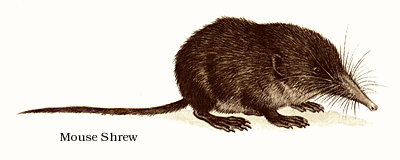
I'm fascinated by this notion that we do sometimes pass laws and therefore that means that we should pass laws. The resistance to passing laws is some nasty dysfunction caused by a nefarious interest group — here, the NRA — but good people want to do something. This do something orientation is characteristic of the modern liberal mind. I heard Dionne saying that on the radio yesterday evening, but it came back to me as I was reading about rabies and marveling at the crazy — desperate — ideas for a cure: "you burn a hair from the dog that bit you and insert the ashes into the wound... [a] maggot from a dead dog's body... a linen cloth soaked with menstrual blood of a female dog... [c]hicken excrement, 'if it is of a red color'... [a]shes from the tail of a shrew-mouse...."
When is it that reasoning goes haywire? After Dionne presented his patchwork of liberal logic, the host called upon David Brooks. (Don't say NPR doesn't balance liberals and conservatives!) He said...
Brooks concludes:
Now, how will the very very thoughtful E.J. Dionne deal with Brooks's argument from evidence! and data! He's got to demonstrate that he's one of the smart people, the non-haywire people, your betters who proposed open and thorough debate about solutions to problems (after the bogeymen are kicked out of the room):

What I mean by that is that the NRA and the rest of the gun lobby have such a firm hold on our political system that no one can bring up the notion, which we bring up with every other kind of tragedy, that maybe we can do better. Maybe there are laws we could pass that would prevent something like this.Maybe we can do better.... laws can't solve everything... but if that were the standard, then we wouldn't pass any laws at all... so... so, what? Since we do sometimes pass laws, we must think that laws can sometimes help when there's a problem. And there's a problem, so... so... what? Let's open this up. Let's talk about it. E.J. Dionne is afraid we'll just knee-jerk do nothing, instead of knee-jerk propose gun control... I mean think and think with thoughtful contemplation and talk about and around and through and through and arrive at the solution that immediately popped into E.J. Dionne's mind.
No one pretends that better laws would prevent all tragedies, but if that were the standard, then we wouldn't pass any laws at all. We have the most permissive gun laws pretty much in the industrialized world. And I hope, but I have no confidence, that we won't make the same mistake again.
I'd like to think that one time, we could say: Oh, let's open this up. Let's talk about the assault weapons ban. Let's talk about ways in which we might reduce the chances that someone with mental problems might get a gun. And I'm just worried that we're going to revert right back to our usual sort of giving and saying, well, the gun lobby controls Washington, so we can never do anything about things like this.
I'm fascinated by this notion that we do sometimes pass laws and therefore that means that we should pass laws. The resistance to passing laws is some nasty dysfunction caused by a nefarious interest group — here, the NRA — but good people want to do something. This do something orientation is characteristic of the modern liberal mind. I heard Dionne saying that on the radio yesterday evening, but it came back to me as I was reading about rabies and marveling at the crazy — desperate — ideas for a cure: "you burn a hair from the dog that bit you and insert the ashes into the wound... [a] maggot from a dead dog's body... a linen cloth soaked with menstrual blood of a female dog... [c]hicken excrement, 'if it is of a red color'... [a]shes from the tail of a shrew-mouse...."
When is it that reasoning goes haywire? After Dionne presented his patchwork of liberal logic, the host called upon David Brooks. (Don't say NPR doesn't balance liberals and conservatives!) He said...
Well, I'm no fan of the NRA, I'm not really an opponent of gun control or an assault weapon ban...That sounds like a necessary preface for the NPR listeners, but I'm going to give Brooks credit for subtly deactivating the bogeyman Dionne inserted into his call to action, because Brooks continues with:
... but, you know, public policy is based on evidence and data and whether it would work.Brooks is displaying the pin with which he is about to puncture the liberal's inflated self-image.
This is one of the most studied things in criminology. And the weight of the evidence is pretty clear that there's no relationship between gun control and violent crime. Areas with higher gun control do not have less violent crime. Over the last few years, the number of new guns entering the country has been about four million a year.So you've got to look at evidence, not your instinctive notions about what just might work. Put down that shrew mouse's tail now, E.J.
At the same time, violent crime has plummeted by about 41 percent a year.Brooks's "evidence and data" dump seemed really powerful until he got to that implausible percentage. What is it, 41% a decade, I don't know what to make of this point-counterpoint style radio presentation. There are no links to click on, so I'm just forced to be suspicious of Brooks's I've-got-the-facts posturing. [ADDED: Meade suggests that the percentage of decline has increased by 41% a year.]
Brooks concludes:
So I'm not necessarily opposed to the policy, I don't really think it would matter in violent crime generally, and I really don't think it would matter too much in the case of lunatics or whatever who are committed to this sort of pre-planned massacre.So Brooks retreats to reassuring the NPR audience: He's not opposed to gun control, he just doesn't think it would work. He began with the assertion that "public policy is based on evidence and data and whether it would work," explained why he didn't think it would work, but nevertheless won't oppose the policy. Brooks isn't a conservative by my standard. I think to be conservative, you should have the instinctive orientation: do nothing. You have to convince us what you've got there is better than nothing. And what have you got there? A bucket of red chickenshit? A dog's tampon?!!
Now, how will the very very thoughtful E.J. Dionne deal with Brooks's argument from evidence! and data! He's got to demonstrate that he's one of the smart people, the non-haywire people, your betters who proposed open and thorough debate about solutions to problems (after the bogeymen are kicked out of the room):
DIONNE: If we had better background checks, yes we'll miss some lunatics, but with real background checks, we could reduce the number of lunatics who get guns. And there's also a spillover. If you have permissive laws in one state - as Mayor Bloomberg has shown, Mayor Bloomberg of New York, who has proposed a lot of very practical remedies, not sweeping remedies but practical remedies - he's shown how loose laws in one state can send guns into a state that may have stricter laws. So I don't think we should throw up our hands and say it's impossible...And there you have it, the liberal mind at work, in real time.
BROOKS: Yeah, one area of agreement, I do think people who have history of mental health issues, and this came up with the Loughner case, that...
SIEGEL: The shooting of Gabby Giffords...
BROOKS: That should show up when you're trying to buy a gun. And legally, that's supposed to happen, but it doesn't always happen.
SIEGEL: We don't know all that much about the suspect. So far no indication that any such record would have shown up. We just don't know yet.
DIONNE: Right, and my argument is not that you can prevent every one of these things, but when I heard this this morning, like everybody else, I was, you know, sick about it. And I just thought that every time this happens, people say, well, there are very particular factors in this case, so let's not talk about gun control, gun control wouldn't solve it. Well, maybe it would, or maybe it wouldn't in a particular case, but it would prevent some of these things in the future.
Tuesday, June 26, 2012
Saturday, June 23, 2012
Why don't more girls sign up for the automotive technology class?
Is that a difficult question? Females were once completely excluded from some things that very few of us wanted to do. That's the way it was when I went to junior high school and the girls were required to study sewing and cooking in the same class period where the boys were forced to do mechanical drawing and shop. Obviously, a few boys would have thrived in sewing and/or cooking (and there are serious careers, full of men, at the end of that line of education). And some girls could have benefited from access to the mechanical drawing/shop track.
It's good that Title IX changed that. But the now-clear wrongness of the total exclusion does not mean that a male/female imbalance is a problem. And yet that's how NPR portrays it in this piece titled "The Shop Class Stigma: What Title IX Didn't Change." See? The assumption is that if male/female balance doesn't ensue, it's because entering a male-dominated field makes females feel stigmatized.
If you really want to know whether females are getting a worse deal than males and you insist on using Zoe as your example of a female, then you must compare her to a male who is challenging the norm in an equivalent way. Take a teenage boy who signs up for the child care classes and tells everyone that's what he loves and where he wants to spend his career. What would his grandfather say about that? Probably the equivalent of Zoe's grandma not being able to picture her taking car engines apart and getting all greasy. I just can't picture Joey changing diapers and getting all poopy.
And if so, there's your gender equity.
It's good that Title IX changed that. But the now-clear wrongness of the total exclusion does not mean that a male/female imbalance is a problem. And yet that's how NPR portrays it in this piece titled "The Shop Class Stigma: What Title IX Didn't Change." See? The assumption is that if male/female balance doesn't ensue, it's because entering a male-dominated field makes females feel stigmatized.
"I think in some of the fields, just the nature of the work that kids see going on in those fields, isn't going to attract that many women. Automotive technology isn't a field that you see women in," [said says Tom Evans, the principal at Eastern Technical High, a magnet school in Essex, Md.]...But wait a minute! Isn't that what Zoe's family is doing? Steering her into engineering rather than working on cars? Working on cars isn't seen as a good enough job, so if you've got an ambitious and talented girl, you may prod her into a more lucrative field. A boy who only wanted to work on cars might be left alone, just as a girl might be allowed to indulge her love for makeup and hair-styling.
"We make a serious attempt at getting girls into engineering. We recruit girls from all over the county, and that's paid off a little bit," he says, "but engineering by itself is a field where I think women are starting to see female engineers."
Zoe says that's why her family tried and failed to get her to switch from automotive technology to the engineering program. "But I think it would be cool if I owned my own shop, like a car shop," Zoe says...
"I can see her owning her own shop as a business woman, but I can't see her out working on a car," says Elayne Digman, Zoe's grandmother. Digman is one of those family members who just can't picture Zoe taking car engines apart and getting all greasy....
Now, for the most part, schools don't discriminate or deny girls educational opportunities. Yet, the conclusion by a National Women's Law Center study a few years ago raised a different point.
Boys are still routinely steered toward courses that lead to higher-paying careers in technology and trades. Meanwhile, 90 percent of students in courses that lead to lower-wage jobs, like child care and cosmetology, are female...
If you really want to know whether females are getting a worse deal than males and you insist on using Zoe as your example of a female, then you must compare her to a male who is challenging the norm in an equivalent way. Take a teenage boy who signs up for the child care classes and tells everyone that's what he loves and where he wants to spend his career. What would his grandfather say about that? Probably the equivalent of Zoe's grandma not being able to picture her taking car engines apart and getting all greasy. I just can't picture Joey changing diapers and getting all poopy.
And if so, there's your gender equity.
Friday, June 8, 2012
"By laughing out loud on the radio, they gave permission for you at home to laugh too."
The "Car Talk" guys are retiring. Did you like them or did they annoy you? If you liked/didn't like them, was their constant laughing part of the reason why?
Thursday, May 17, 2012
NPR says Obama and Romney "wade into" — or "weighed in" on — the Scott Walker recall election.
Wait. The headline says they "wade in" and the text says they "weighed in." Those are transcriptions at the NPR website. I prefer "wade in," because it conveys Wisconsin as... swamp-like.
I was writing a more substantial post, but the raw material at NPR was so lame, I deleted what I had. Just one of the many ways I save you time in your busy day.
I was writing a more substantial post, but the raw material at NPR was so lame, I deleted what I had. Just one of the many ways I save you time in your busy day.
Wednesday, May 9, 2012
Why didn't Don Draper like "Tomorrow Never Knows"?
A pop culture question asked by NPR music critic Ann Powers. Tomorrow doesn't know and I don't know. I could hazard a guess. I don't watch "Mad Men," but maybe Draper isn't the kind of guy who's in the mood to "lay down all thoughts" and "surrender to the void." Regardless of whether "it is shining" or it was shining back in the 1960s, why did Americans ever willingly consume that lyrical nonsense?
By the way, "Mad Men" paid $250,000 to use that recording.
***
By the way, "Mad Men" paid $250,000 to use that recording.
Wednesday, April 11, 2012
"If your Big Mac is going to cost about $100 and your Bug Mac is going to cost only $4, people will change to a Bug Mac."
Says Arnold van Huis, the world's biggest expert on entomophagy (the eating of insects).
There are people who want you to like it, and people who are perversely excited about the way financial pressure is going to help you like it.
Well, so long as it's merely a cash incentive, we can't complain too much. And maybe some day Congress could impose a penalty, collected through your tax return, for people who choose to eat too much meat over insects. Don't worry. Congress isn't going to require you to eat insects. They just wouldn't do that. So don't worry about whether it has the power to do something it's never ever going to do. And, by the way, eating insects is not kosher, but if Congress said everyone had to eat insects, and failed to make an exemption for people who adhere to a kosher diet for religious reasons, it would not violate the Free Exercise Clause. But don't worry. Congress would never require you to eat insects, and if it did, it would offer an exemption for religious folk. I'm sure.
What am I talking about? Have you heard of insect politics? Neither have I!
"Insects don't have politics.... they're very brutal. No compassion.... no compromise. We can't trust the insect. I'd like to become the first insect politician. I'd like to, but.... I'm an insect.... who dreamed he was a man, and loved it. But now the dream is over, and the insect is awake."
See, this is where I end up when I get to thinking about insects and politics. But please. Calm down. Don't worry about the government and it's plans for the insect. Be very cool, like our biggest politician who is famous cool. Watch how calmly he proceeds with his insect politics:
Whaddya think? That was pretty impressive. He got the sucker.
He believes the rising price of meat will help change diets.Help? Why is NPR using the word "help" there?
Van Huis says the challenge is to make it delicious. That's where Marian Peters comes in. For years, as secretary of the Dutch insect breeders association Venik, she's been active in bringing edible insects to consumers' tables. And Peters says the first commercially available bug sandwich will be out soon — a wrap filled with insects and peas.It's easy to make food with bugs in that tastes just fine. We've been eating food all along that has insect parts in it:
The Food Defect Action Levels: Levels of natural or unavoidable defects in foods that present no health hazards for humans is a publication of the United States Food and Drug Administration's Center for Food Safety and Applied Nutrition detailing acceptable levels of food contamination from sources such as maggots, thrips, insect fragments, "foreign matter", mold, rodent hairs, and insect and mammalian feces.It's not a question of whether insects are in your food. It's a question of whether you want to hear about it and consciously embrace the activity — entomophagy — that you've been engaging in all along.
There are people who want you to like it, and people who are perversely excited about the way financial pressure is going to help you like it.
Well, so long as it's merely a cash incentive, we can't complain too much. And maybe some day Congress could impose a penalty, collected through your tax return, for people who choose to eat too much meat over insects. Don't worry. Congress isn't going to require you to eat insects. They just wouldn't do that. So don't worry about whether it has the power to do something it's never ever going to do. And, by the way, eating insects is not kosher, but if Congress said everyone had to eat insects, and failed to make an exemption for people who adhere to a kosher diet for religious reasons, it would not violate the Free Exercise Clause. But don't worry. Congress would never require you to eat insects, and if it did, it would offer an exemption for religious folk. I'm sure.
What am I talking about? Have you heard of insect politics? Neither have I!
"Insects don't have politics.... they're very brutal. No compassion.... no compromise. We can't trust the insect. I'd like to become the first insect politician. I'd like to, but.... I'm an insect.... who dreamed he was a man, and loved it. But now the dream is over, and the insect is awake."
See, this is where I end up when I get to thinking about insects and politics. But please. Calm down. Don't worry about the government and it's plans for the insect. Be very cool, like our biggest politician who is famous cool. Watch how calmly he proceeds with his insect politics:
Whaddya think? That was pretty impressive. He got the sucker.
Monday, April 9, 2012
Once mothers — labeled "refrigerator mothers" — were blamed for autism in their children.
It seems so cruel and retrograde now, but:
Refrigerator mother.
In the absence of any biomedical explanation for what causes autism after the telltale symptoms were first described by scientists, Bruno Bettelheim, a University of Chicago professor and child development specialist, and other leading psychoanalysts championed the notion that autism was the product of mothers who were cold, distant and rejecting, thus deprived of the chance to "bond properly". The theory was embraced by the medical establishment and went largely unchallenged into the mid-1960s, but its effects have lingered into the 21st century....As embarrassing and offensive as that sounds to us today, here comes a new way to blame mothers for autism. Ironically, it's refrigerator-related. NPR reports:
A new study in the journal Pediatrics suggests that moms who are obese or have diabetes are more likely to have a child with autism or another developmental problem....Guilt up again, mothers. It might be your fault. Maybe. Just in case...
Obesity was the most common risk factor, affecting more than 20 percent of mothers with an autistic child. Also, obesity increases the risk that a woman will have diabetes during pregnancy, and can also increase the risk for high blood pressure.
"Obesity really affects the mother's physiology aside from the fact that she's carrying around a lot of extra weight," Hertz-Picciotto says....
"We're talking about a fetal brain that could be suffering from a lack of oxygen," she says.
So it's clearly a good idea for women who are overweight or obese to try to slim down before becoming pregnant, Hertz-Picciotto says.I love how they don't really need to prove anything. Just establish a correlation, and then, why not add more pressure on women to do something we've been leaning on them to do for other reasons anyway? You already know you need to lose weight, so here's a good one: If you have an autistic child after you failed to lose weight, people will always be able to think maybe, just maybe, she did that to her child.
Refrigerator mother.
Saturday, January 14, 2012
"Shame on NPR for reporting only the money Walker is receiving..."
"... and not even mentioning the millions coming from labor unions from outside the state."
(I'm quoting the 5th commenter on here.)
(I'm quoting the 5th commenter on here.)
Subscribe to:
Posts (Atom)
 :.
:.
