The uncleaned toilet of J.D. Salinger, on sale at eBay for $1 million.
That's almost as good as this:
Showing posts with label "Slacker". Show all posts
Showing posts with label "Slacker". Show all posts
Saturday, August 21, 2010

Tuesday, August 10, 2010
"'Krush' (Karl-as-Rush) was the palest simulacrum of a Rush Limbaugh."
Writes Tunku Varadarajan about Rove's guest-hosting on yesterday's show.
Oh, but no one can step in and imitate Rush. With the exception of Mark Steyn, all of Rush's guest-hosts mostly make you think about how much better Rush is and: When is Rush coming back? (Steyn does his own thing, and it's brilliant. I prefer him to Rush.)
It would have been foolish for Rove to go all bombastic and over-confident on his first radio show, so Varadarajan's criticism is lame:
Oh, but no one can step in and imitate Rush. With the exception of Mark Steyn, all of Rush's guest-hosts mostly make you think about how much better Rush is and: When is Rush coming back? (Steyn does his own thing, and it's brilliant. I prefer him to Rush.)
It would have been foolish for Rove to go all bombastic and over-confident on his first radio show, so Varadarajan's criticism is lame:
Rove, by comparison [to Rush], is a lightweight. What we learned today is that he does not have the voice for radio. By that I mean not just that his timbre is too thin, his tenor too brittle, but also that he has little oratorical or rhetorical structure, and no apparent ability to cast a spell over listeners.Ha. He's from Austin, Texas. He sounds like a character from the movie "Slacker." I found that charming ... disarming. Rush gets a lot of his oratorical power from his self-conception as an outsider — actively excluded from the power-elite in Washington. Rove is the opposite — so self-restraint is good.
Reading his weekly column in The Wall Street Journal, one was already aware of the modesty of his mind. In fact, his column has done much to baffle many Americans: How on earth did this man become the dark genius of the liberal imagination? Listening to him riff on the radio, one was filled with retrospective alarm: Was this the mastermind in the Bush White House?Oh, Tunku! Do you really imagine the President, in his confidential, private conversations, listening to a Limbaugh-like blowhard overwhelming him with a big rant? Try to imagine why Rove's style works in the context in which he was highly successful. Gentleness and friendly, quiet, sound advice... is it really such a puzzle?
Tuesday, June 1, 2010
Things watched just now.
There's this really cool Mickey Kaus ad:
I found that via Mickey's Twitter feed, where he thanked Instapundit for embedding it, so why didn't I see it on Instapundit too? Must have been that, scrolling, I got sidetracked by the monitor lizard. Anyway, I was over on Twitter to write:
Thanks for coming over to the other side of the line? What did you think you'd find here? It turns out, it's a passage from an essay by the big old conservative Roger Kimball about Paul Goodman's "Growing Up Absurd":
I found that via Mickey's Twitter feed, where he thanked Instapundit for embedding it, so why didn't I see it on Instapundit too? Must have been that, scrolling, I got sidetracked by the monitor lizard. Anyway, I was over on Twitter to write:
Got M to watch the movie "Slacker," which made us look up "Growing Up Absurd" in Amazon, which recommended we buy the movie "Slacker."We almost never watch movies. We're too fragmented. But "Slacker" is fragmented, and, thinking we could put up with that, we ended up watching the whole thing. In the end of the movie — and I realize I've watched the beginning many times and the end only a few — the camera flashes on the book "Growing Up Absurd." We were trying to remember the author's name, and Meade got it right. We were talking about what a verbal tic it used to be to call everything "absurd."
Thanks for coming over to the other side of the line? What did you think you'd find here? It turns out, it's a passage from an essay by the big old conservative Roger Kimball about Paul Goodman's "Growing Up Absurd":
Goodman said virtually nothing new in Growing Up Absurd. But somehow, his method of recycling received opinions about the problems of youth culture in what he liked to call the “Organized System” struck a chord. His success was due partly to the way he combined the radical clichés of the moment with a traditional language of virtue. “My purpose is a simple one,” Goodman wrote in his first chapter: “to show how it is desperately hard these days for an average child to grow up to be a man, for our present organized system of society does not want men.” (Girls and women do not figure much in Goodman’s scheme of things.)
In other words, Goodman cannily blended rhetoric appropriate to a Marine recruitment poster with portentous fantasies about America being an “unnatural system” that warps young souls. Given current conditions in America, Goodman wonders, “Is it possible, being a human being, to exist? Is it possible, having a human nature, to grow up?” But the pertinent question is whether it really was “desperately hard” for an average child to grow up in the United States in the 1950s—an era of tremendous prosperity, excellent public education, potent national self-confidence. Was it true, as Goodman insisted, that “the young men who conform to the dominant society become for the most part apathetic, disappointed, cynical, and wasted”?
Part of Goodman’s purpose was to sympathize with and exonerate those elements of youth culture that had chosen not to conform to “the dominant society”—the Beats and other fringe groups who believed that “a man is a fool to work to pay installments on a useless refrigerator for his wife.” (Not so useless if one wishes to keep food from spoiling, of course, but Goodman never acknowledges that side of things.)
Thursday, July 3, 2008
There's not always a word for the thing you want to say.
But it's slightly maddening when you feel there's a word, and you just can't pull it out of your brain. A colleague of mine is looking for a word that expresses a phenomenon embodied in these 3 examples:
So is there a word for this?
And do you have any good examples of using this sort of decisionmaking — colorful and exciting rules you've made for yourself? Obviously, there are a lot of standard ways approaches like rolling the dice or consulting the Magic 8 ball, but how about some weird stuff? Or why not make up a rule for yourself about something right now and do it? Got a decision to make? Make it based on something strange and as-yet-undetermined. And tell us about it.
This made me think of "Slacker" — one of my favorite movies. We see 2 women walking along the sidewalk. One says: "The next person who passes us will be dead within a fortnight." But that's not a case of the phenomenon my colleague means – not unless we're supposed to view the speaker as a murderer choosing a victim. The standard interpretation is that she's a psychic.
ADDED: Someone in the comments mentions Dadaism, and that reminds me of "A Book of Surrealist Games." I think example #3 could be seen as a sort of surrealist game. The more we talk about these examples, the more I think they are 3 different things. Several commenters have said that #1 is superstition, and I think it is either superstition — in the form of overvaluing a coincidence — or a sentimental delight in coincidence. #2 seems to be conformity or a rational bet based on a tiny amount of evidence. Someone who is eating here is eating that, so maybe he knows what's good. Only #3 is surrealist and dangerous — but nowhere near as much as if you'd chosen the color of your car based on something other than the color of someone else's car. Chances are it will be an ordinary car color, and at least someone else has seen fit to get a car that color. That said, I saw a bright purple car 2 days ago. It looked like hell. And I love the color purple. It just looks like hell on a car.
1. I go to the track and place a bet on a horse because its name is the same as my son's and the jockey is wearing #5, which is my son's hockey jersey number.Now, I think #1 is distinctly different from 2 and 3, because in #1, she knows what the answer is when she adopts the rule. In #2 and #3, she excitingly adopts the rule and locks herself into a result that is unknown. But all 3 are about adopting a rule to make a decision while knowing that there is nothing about the rule that will improve the quality of the decision. One could superstitiously believe that the rule would make the decision good or religiously believe — in examples 2 and 3 — that God knew you'd adopted the rule and was giving you a sign about what was the right decision. And one could think that the rule would generate randomness where somehow a nonrandom decision seemed bad. But basically, the decisionmaker is being playful or poetic.
2. I can't decide what to order for lunch so I decide that I'll order whatever the person in front of me orders.
3. I'm not sure what color car to purchase so I decide to purchase the color of the next car that drives by my house.
So is there a word for this?
And do you have any good examples of using this sort of decisionmaking — colorful and exciting rules you've made for yourself? Obviously, there are a lot of standard ways approaches like rolling the dice or consulting the Magic 8 ball, but how about some weird stuff? Or why not make up a rule for yourself about something right now and do it? Got a decision to make? Make it based on something strange and as-yet-undetermined. And tell us about it.
***
This made me think of "Slacker" — one of my favorite movies. We see 2 women walking along the sidewalk. One says: "The next person who passes us will be dead within a fortnight." But that's not a case of the phenomenon my colleague means – not unless we're supposed to view the speaker as a murderer choosing a victim. The standard interpretation is that she's a psychic.
ADDED: Someone in the comments mentions Dadaism, and that reminds me of "A Book of Surrealist Games." I think example #3 could be seen as a sort of surrealist game. The more we talk about these examples, the more I think they are 3 different things. Several commenters have said that #1 is superstition, and I think it is either superstition — in the form of overvaluing a coincidence — or a sentimental delight in coincidence. #2 seems to be conformity or a rational bet based on a tiny amount of evidence. Someone who is eating here is eating that, so maybe he knows what's good. Only #3 is surrealist and dangerous — but nowhere near as much as if you'd chosen the color of your car based on something other than the color of someone else's car. Chances are it will be an ordinary car color, and at least someone else has seen fit to get a car that color. That said, I saw a bright purple car 2 days ago. It looked like hell. And I love the color purple. It just looks like hell on a car.
Thursday, April 3, 2008
Pick a movie to design a meal around.
That was the challenge last night on "Top Chef," which this post won't spoil, but there are spoilers at here, where I read about it. (I haven't watched this season of "Top Chef." Maybe I'll catch up with it later. Is it good this time around?) Anyway, Jim Hu, at the link, thinks the contestants made pretty lame movie choices. They should have been less literal, more creative, and more cleverly knowing about the content of a good movie. His choices:
Let me go on to the rest of the favorite movies I list in my Blogger profile:
"Aguirre the Wrath of God." This should not be an opportunity to serve Spanish or Brazilian food. I'd be all about the seaweed. (When they're really hungry they pull algae out from between the logs of the raft.)
"Crumb." The first thing I think of here is a drawing of a can labeled "[unwritable word] Hearts." Next, I think of Maxon Crumb ingesting a long strip of cloth dipped in water (to clean out his innards). Let's skip this movie.
"Grey Gardens." Paté on crackers!
"32 Short Films About Glenn Gould." Pills!
"Limelight." Hmmm. Limes? No, the lime in limelight is not the fruit.
"It's a Gift." Kumquats!
"Dr. Strangelove." To drink: nothing but distilled water. [AND: Pure grain alcohol!] Food: a big buffet table. And every night: a food fight. That's our restaurant gimmick: We encourage the patrons to throw food.
"The Grave of the Fireflies." In this movie, a Japanese animation, children starve. Must skip.
"The Nights of Cabiria." Too easy of an excuse to make Italian food. Nothing specific comes to mind.
"Fast, Cheap & Out of Control." Well, we can't serve lions or mole rats. Robots are not edible. We'd have to come up with some way to make topiary shapes out of things.
"Slacker." Sorting through my memories of this movie, I'm just seeing a lot of coffee.
IN THE COMMENTS: The name Ted Turner comes up, and there's a suggestion that his movie would be "Soylent Green."
Wizard of Oz: Rainbow trout with artichoke hearts and a poppy seed crackers.Commenters, surely you have some ideas! Me? Well, my favorite movie already is about dinner: "My Dinner With Andre." To be creative and knowing, we'd have to get past the potato soup and squab and come up with something from inside the stories Andre tells. Maybe something covered in coarse salt to represent sand — Andre eats sand in the Sahara Desert (and laughs). [ADDED: Actually, he doesn't laugh: "We weren't trying to be funny. I started, and then he started, and we just ate sand, and threw up. That was — that was how desperate we were."
Spartacus. Escargot... and oysters.
Duck Soup. Perhaps an exception to the obviousness rule, but how can you not do this?
The Godfather: Fish baked in parchment.
The main entree could be Dances with Wolves Buffalo steaks. Or you could do Silence of the Lambs, but only if you serve the lamb with fava beans
Citizen Kane Rose sorbet
Let me go on to the rest of the favorite movies I list in my Blogger profile:
"Aguirre the Wrath of God." This should not be an opportunity to serve Spanish or Brazilian food. I'd be all about the seaweed. (When they're really hungry they pull algae out from between the logs of the raft.)
"Crumb." The first thing I think of here is a drawing of a can labeled "[unwritable word] Hearts." Next, I think of Maxon Crumb ingesting a long strip of cloth dipped in water (to clean out his innards). Let's skip this movie.
"Grey Gardens." Paté on crackers!
"32 Short Films About Glenn Gould." Pills!
"Limelight." Hmmm. Limes? No, the lime in limelight is not the fruit.
"It's a Gift." Kumquats!
"Dr. Strangelove." To drink: nothing but distilled water. [AND: Pure grain alcohol!] Food: a big buffet table. And every night: a food fight. That's our restaurant gimmick: We encourage the patrons to throw food.
"The Grave of the Fireflies." In this movie, a Japanese animation, children starve. Must skip.
"The Nights of Cabiria." Too easy of an excuse to make Italian food. Nothing specific comes to mind.
"Fast, Cheap & Out of Control." Well, we can't serve lions or mole rats. Robots are not edible. We'd have to come up with some way to make topiary shapes out of things.
"Slacker." Sorting through my memories of this movie, I'm just seeing a lot of coffee.
IN THE COMMENTS: The name Ted Turner comes up, and there's a suggestion that his movie would be "Soylent Green."
Friday, January 12, 2007
Comfort movies.
Do you have a comfort movie? This would be a movie you rewatch in times of stress, when you want to create a comfortable environment for yourself. My son John says he uses the "Back to the Future" movies to mellow out at exam time. He says a lot of people his age -- mid-20s -- have "The Princess Bride" as their comfort movie? So, what's yours?
When I was in college -- in the days before home video -- one campus cinema always showed Marx Brothers movies at exam time. It was understood that this was what you watched to escape the stress. I was trying to think of what I would have now that fits in this category. I was going to say "My Dinner with Andre," "Slacker," "Fast ,Cheap and Out of Control," and "Grey Gardens." But John is disqualifying these choices on the ground that these are actually movies that I consider great, not the sort of junk food that we're trying to talk about here. It's true that I don't have any not-actually-great movies that I like to rewatch for comfort's sake. He says that I use TV reality shows for this. He's right. You know, the other day I watched three episodes of an old season of "Survivor."
(Song that John is playing that is amusing me while I write this post: "Nuages"... by Django Reinhardt. I'm looking for a YouTube clip of that for you, but what I'm seeing is that everyone tries to play that song.)
HEY: This post has a vlog:
And John never found the clip.
OH: I thought of one -- look, we watched it the day I wrecked my car -- "Serial Mom."
When I was in college -- in the days before home video -- one campus cinema always showed Marx Brothers movies at exam time. It was understood that this was what you watched to escape the stress. I was trying to think of what I would have now that fits in this category. I was going to say "My Dinner with Andre," "Slacker," "Fast ,Cheap and Out of Control," and "Grey Gardens." But John is disqualifying these choices on the ground that these are actually movies that I consider great, not the sort of junk food that we're trying to talk about here. It's true that I don't have any not-actually-great movies that I like to rewatch for comfort's sake. He says that I use TV reality shows for this. He's right. You know, the other day I watched three episodes of an old season of "Survivor."
(Song that John is playing that is amusing me while I write this post: "Nuages"... by Django Reinhardt. I'm looking for a YouTube clip of that for you, but what I'm seeing is that everyone tries to play that song.)
HEY: This post has a vlog:
And John never found the clip.
OH: I thought of one -- look, we watched it the day I wrecked my car -- "Serial Mom."
Sunday, December 24, 2006
Christmas Eve movie decision.
The nominees are:
What did we choose?
ADDED:
"It's a Wonderful Life"
"One Flew Over the Cuckoos Nest"
"Slacker"
"Some Kind of Monster"
What did we choose?
ADDED:
"Your hand is staining my window."...
"I'm talking about form. I'm talking about content. I'm talking about interrelationships. I'm talking about God, the devil, Heaven, Hell. Do you understand?"...
"Play the game, Harding. Play the game. Play the game. Play the game, Harding."...
"I don't think he's overly psychotic, but I still think he's quite sick."...
"What do you think you are, for Chrissake, crazy or something? Well, you're not. You're not. You're no crazier than the average a**h*le out walking around on the streets, and that's it."...
"Time spent alone only increases the feeling of separation."....
"The best thing we can do is go on with our daily routine."
Monday, July 17, 2006
"A Scanner Darkly."
I hadn't gone out to a movie theater, I think, since last December January. (The movie was "Capote.") I'd been considering various movies but never quite got sufficiently motivated until today. It's not just that I wanted to see "A Scanner Darkly." It's that it was also disgustingly hot out, and that pushed me over the edge.
I love Richard Linklater -- the director -- mostly from "Slacker," which will always be one of my very favorite movies. And I'm interested in Philip K. Dick enough to care. I also like flat animation a lot, even thought Linklater's watery, flow-y rotoscoped style, which I'd seen in "Waking Life," is not my favorite thing. But that was enough. I finally went to the movies.
I took some folded up notebook paper in case I wanted to write down quotes for a blog post. Here, let me put this through my scanner (darkly):

The word "bigs" is supposed to be "bugs." I wrote that during the first scene, which was harrowing... and involved bugs. I forgot I'd already written on that side of the fold when I wrote down a sentence from a long conversation three hopeless Substance D addicts had about a guy who wanted to be an imposter -- like the guy Leonardo DiCaprio played in "Catch Me If You Can" -- but he figured out he could just be an imposter imposter: "You could just pose as an imposter, it would be a lot easier."
Despite the seeming charm of that, this is not a film that finds drug use cute. It's very hallucinatory, so it's most likely to draw in an audience that is interested in drugs, but it is devastatingly antidrug, to the point where it made me feel guilty for writing that post last week about psilocybin. Just say no, kids, or you will be scrounging around in the dirt of an endless cornfield trying to pick the little blue flowers of death.
The film was quite brilliant, and if you think about it hard you can figure out what happened. Presumably, it helps to have read the book, which I haven't. It would probably be more enjoyable the second time for me, to notice all the details now that I understand the story.
While I've got the scanner fired up and receiving my handwritten notes, here are the (extensive!) notes I made for podcast #55:

They seem hallucinatory in the afterglow of "A Scanner Darkly."
I love Richard Linklater -- the director -- mostly from "Slacker," which will always be one of my very favorite movies. And I'm interested in Philip K. Dick enough to care. I also like flat animation a lot, even thought Linklater's watery, flow-y rotoscoped style, which I'd seen in "Waking Life," is not my favorite thing. But that was enough. I finally went to the movies.
I took some folded up notebook paper in case I wanted to write down quotes for a blog post. Here, let me put this through my scanner (darkly):
The word "bigs" is supposed to be "bugs." I wrote that during the first scene, which was harrowing... and involved bugs. I forgot I'd already written on that side of the fold when I wrote down a sentence from a long conversation three hopeless Substance D addicts had about a guy who wanted to be an imposter -- like the guy Leonardo DiCaprio played in "Catch Me If You Can" -- but he figured out he could just be an imposter imposter: "You could just pose as an imposter, it would be a lot easier."
Despite the seeming charm of that, this is not a film that finds drug use cute. It's very hallucinatory, so it's most likely to draw in an audience that is interested in drugs, but it is devastatingly antidrug, to the point where it made me feel guilty for writing that post last week about psilocybin. Just say no, kids, or you will be scrounging around in the dirt of an endless cornfield trying to pick the little blue flowers of death.
The film was quite brilliant, and if you think about it hard you can figure out what happened. Presumably, it helps to have read the book, which I haven't. It would probably be more enjoyable the second time for me, to notice all the details now that I understand the story.
While I've got the scanner fired up and receiving my handwritten notes, here are the (extensive!) notes I made for podcast #55:
They seem hallucinatory in the afterglow of "A Scanner Darkly."
Saturday, August 27, 2005
Another face and some meandering about unreadable words.
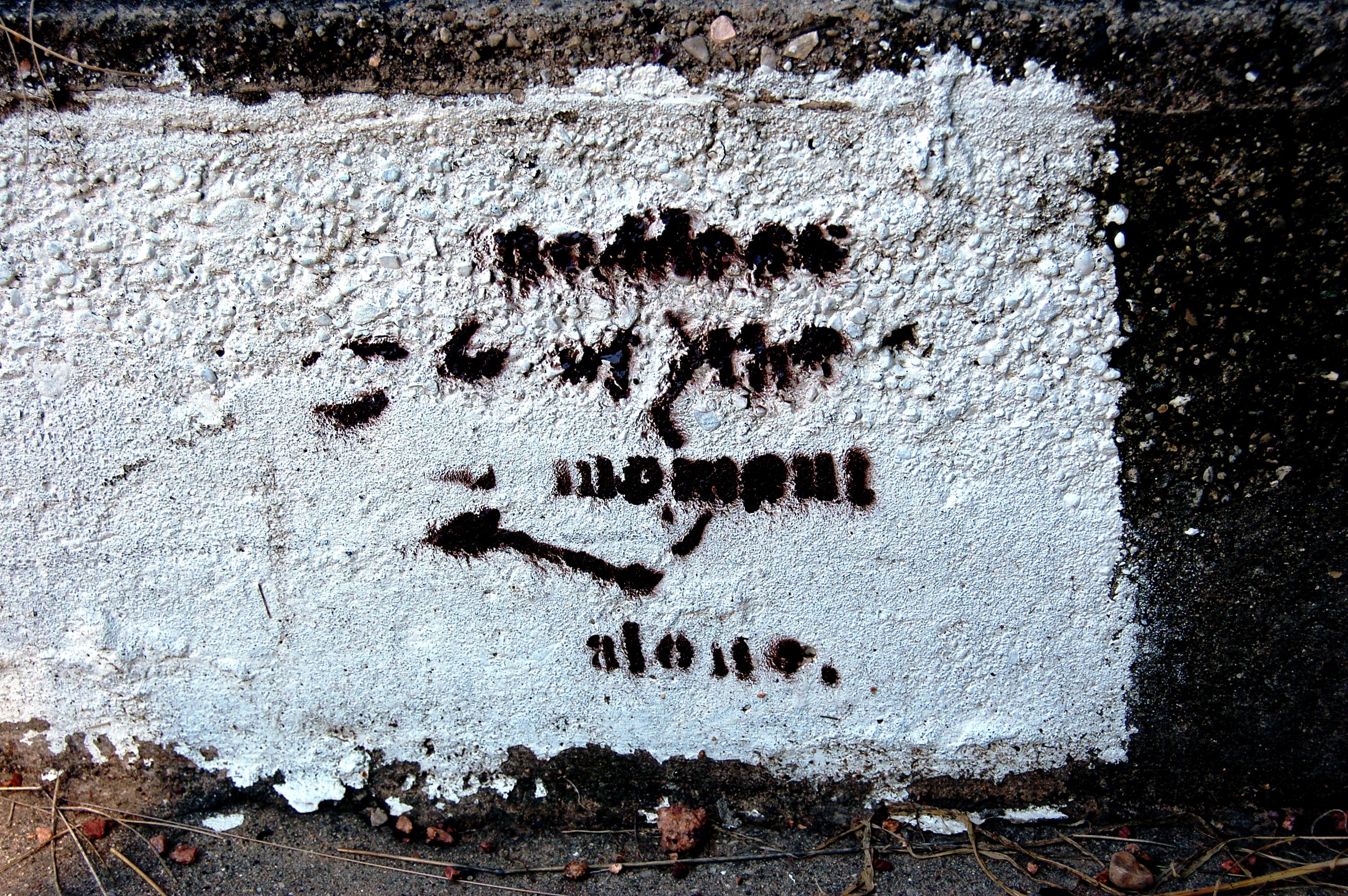
Yesterday, we saw the Face on the Barroom Floor. Here's a face I saw today, stenciled on a curb. What does it say?

(Enlarge.)
I'm fascinated by the almost legible. Have you ever imagined there were words somewhere that you could almost read? That's a theme in the movie "Waking Life," by the way. Did you like that movie? Did you like it as much as "Slacker"? I ask, deviating from the theme in a Slackerish way. In "Waking Life," the subject is the way you can't read in a dream. If you try, you won't be able to make out the words.
Maybe if you're getting a bit psychotic — struggling with that brain asymmetry — or using some psychotropic drugs, you'll think you're seeing letters rising up out of textured surfaces like that curb. Don't lose yourself trying to read those nonexistent words.
This subject is making me think of "The Shining," where the little boy keeps trying to read a word on the wall until finally he can and it's very shocking. Good horror idea! There must be many other stories about mysteriously nearly readable writing.
Here's a picture of my ex-husband from long ago. He's reading a book, and you can almost read the title of the book. Why does near legibility make the book seem so important? Why such fascination with things we can't quite see or understand?
Is there a theme of the day on this blog??
(Enlarge.)
I'm fascinated by the almost legible. Have you ever imagined there were words somewhere that you could almost read? That's a theme in the movie "Waking Life," by the way. Did you like that movie? Did you like it as much as "Slacker"? I ask, deviating from the theme in a Slackerish way. In "Waking Life," the subject is the way you can't read in a dream. If you try, you won't be able to make out the words.
Maybe if you're getting a bit psychotic — struggling with that brain asymmetry — or using some psychotropic drugs, you'll think you're seeing letters rising up out of textured surfaces like that curb. Don't lose yourself trying to read those nonexistent words.
This subject is making me think of "The Shining," where the little boy keeps trying to read a word on the wall until finally he can and it's very shocking. Good horror idea! There must be many other stories about mysteriously nearly readable writing.
Here's a picture of my ex-husband from long ago. He's reading a book, and you can almost read the title of the book. Why does near legibility make the book seem so important? Why such fascination with things we can't quite see or understand?
Is there a theme of the day on this blog??
Sunday, November 14, 2004
"Coffee and Cigarettes."
I loved the movie "Coffee and Cigarettes" (which is newly available on DVD). Keep in mind that two of my favorite movies are "My Dinner With Andre" and "Slacker" before regarding my opinion as a recommendation. Here's the beautiful "Coffee and Cigarettes" website.
When a movie is broken into a series of vignettes as this one is, critics usually can't resist saying which vignette is the best and grousing that some vignettes are better than others. With an ordinary movie, it doesn't seem worth saying that some scenes are better than others! But with each vignette, you get a new set of two or three actors, so it's hard not to single out, for example, Cate Blanchett. Patty Duke style, she plays two cousins who have the same face, but different hair, clothes, mannerisms, attitudes. The final vignette is especially poignant. It features Taylor Mead, so unrecognizably older than he was in the Andy Warhol movies -- like "Lonesome Cowboys" -- where we loved him so much.
I must get back to watching "Dead Man," which, like "Coffee and Cigarettes" is directed by Jim Jarmusch. I watched about a third of that movie once and then got distracted by something -- too long ago to remember what. I'll have to go back to the beginning now. But the gorgeous black and white photography of "Coffee and Cigarettes" -- which looked great on the Sony HDTV -- makes me want to get back to "Dead Man." Longtime readers may remember that I bought "Dead Man" along with four other DVDs back in March when I went on a Johnny Depp-focused buying spree.
When a movie is broken into a series of vignettes as this one is, critics usually can't resist saying which vignette is the best and grousing that some vignettes are better than others. With an ordinary movie, it doesn't seem worth saying that some scenes are better than others! But with each vignette, you get a new set of two or three actors, so it's hard not to single out, for example, Cate Blanchett. Patty Duke style, she plays two cousins who have the same face, but different hair, clothes, mannerisms, attitudes. The final vignette is especially poignant. It features Taylor Mead, so unrecognizably older than he was in the Andy Warhol movies -- like "Lonesome Cowboys" -- where we loved him so much.
I must get back to watching "Dead Man," which, like "Coffee and Cigarettes" is directed by Jim Jarmusch. I watched about a third of that movie once and then got distracted by something -- too long ago to remember what. I'll have to go back to the beginning now. But the gorgeous black and white photography of "Coffee and Cigarettes" -- which looked great on the Sony HDTV -- makes me want to get back to "Dead Man." Longtime readers may remember that I bought "Dead Man" along with four other DVDs back in March when I went on a Johnny Depp-focused buying spree.
Wednesday, September 15, 2004
"Slacker"--on DVD at last!
Ah! The new Critierion Collection DVD of "Slacker" just arrived! How exciting! How many times have I watched my deteriorating old VHS copy of this film, which I never saw in the theater. Nice packaging. Lots of extras. Why isn't this on the list of favorite movies on my profile? I'll add it.
Friday, June 25, 2004
Slacker!
If there is one movie I have been hoping will be released on DVD, it's Slacker. Finally, it's coming out--in August--and, making it worth the wait, it will be a Criterion Collection DVD. This is cause for celebration at my house. Slacker is the movie that is most like my favorite movie, My Dinner With André. Both films are nonstop talk fests, but instead of two old guys sitting in a fancy restaurant talking about art and life through the entire film, Slacker takes us all around Austin, Texas, moving from character to character, mostly but not all young people, talking about art and life and conspiracy and politics.
Subscribe to:
Posts (Atom)
 :.
:.