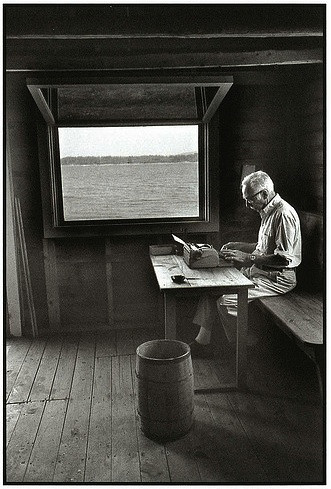
"Joyce Carol Oates says somewhere that when writers ask each other what time they start working and when they finish and how much time they take for lunch, they’re actually trying to find out 'Is he as crazy as I am?' I don’t need that question answered."
That's a quote from Philip Roth, which I read just now on rereading one of the books I'd be most inclined to keep if I pared my book-books down to the minimum — "The Writer's Desk." I was going to type out the quote, but I tried Googling roth oates habits and found a whole interview surrounding it — from 1984.
Here's an interview with Jill Krementz, the photographer whose work is collected in the book. My favorite writer-and-desk in the book this one of E.B. White.
Showing posts with label Philip Roth. Show all posts
Showing posts with label Philip Roth. Show all posts
Friday, February 1, 2013

Friday, November 9, 2012
"I wanted to see if I had wasted my time writing..."
"And I thought it was rather successful. At the end of his life, the boxer Joe Louis said: ‘I did the best I could with what I had.’ This is exactly what I would say of my work: I did the best I could with what I had. And after that, I decided that I was done with fiction. I do not want to read, to write more. I have dedicated my life to the novel: I studied, I taught, I wrote and I read. With the exclusion of almost everything else. Enough is enough! I no longer feel this fanaticism to write that I have experienced in my life."
Philip Roth, at the age of 78, having written one more book, and having just read all his books (in reverse chronological order).
Philip Roth, at the age of 78, having written one more book, and having just read all his books (in reverse chronological order).
Friday, September 7, 2012
Philip Roth fights Wikipedia.
Over what they said about the source material for "The Human Stain." Maybe he should have stayed above all this. The book speaks for itself. But this essay speaks for itself too. Does it not?
My novel “The Human Stain” was described in the entry as “allegedly inspired by the life of the writer Anatole Broyard.”...
This alleged allegation is in no way substantiated by fact. “The Human Stain” was inspired, rather, by an unhappy event in the life of my late friend Melvin Tumin, professor of sociology at Princeton for some thirty years. One day in the fall of 1985, while Mel, who was meticulous in all things large and small, was meticulously taking the roll in a sociology class, he noted that two of his students had as yet not attended a single class session or attempted to meet with him to explain their failure to appear, though it was by then the middle of the semester.
Having finished taking the roll, Mel queried the class about these two students whom he had never met. “Does anyone know these people? Do they exist or are they spooks?”—unfortunately, the very words that Coleman Silk, the protagonist of “The Human Stain,” asks of his classics class at Athena College in Massachusetts.
Almost immediately Mel was summoned by university authorities to justify his use of the word “spooks,” since the two missing students, as it happened, were both African-American, and “spooks” at one time in America was a pejorative designation for blacks, spoken venom milder than “nigger” but intentionally degrading nonetheless. A witch hunt ensued....
Sunday, June 26, 2011
Wednesday, May 18, 2011
Feminist on a panel that chooses winners of the Man Booker International prize withdraws when the panel picks Philip Roth.
The Guardian reports on the sensibilities of Camern Callil:
Dismissing the Pulitzer prize-winning author, Callil said that "he goes on and on and on about the same subject in almost every single book. It's as though he's sitting on your face and you can't breathe"....He's sitting on your face. Sitting on your face!
"I don't rate him as a writer at all. I made it clear that I wouldn't have put him on the longlist, so I was amazed when he stayed there. He was the only one I didn't admire – all the others were fine... Roth goes to the core of [the other judges'] beings. But he certainly doesn't go to the core of mine ... Emperor's clothes: in 20 years' time will anyone read him?"
Subscribe to:
Posts (Atom)
 :.
:.