Pages

Labels

Showing posts with label light and shade. Show all posts

Tuesday, February 5, 2013

"Want to reduce the effects of global warming? Stop working so hard."

"Working fewer hours might help slow global warming, according to a new study released Monday by the Center for Economic Policy and Research."
A worldwide switch to a "more European" work schedule, which includes working fewer hours and more vacation time, could prevent as much as half of the expected global temperature rise by 2100, according to the analysis, which used a 2012 study that found shorter work hours could be associated with lower carbon emissions.
How about good old unemployment? Can we get some credit for that? Offsets of some kind? Or is everyone supposed to back off?

But I love this suggestion! I made my own list of similar suggestions back in 2010, following on an article that said people ought to give up air-conditioning. I had 6 ideas:
1. Your weight should be at the low end of normal, indicating that you are not overconsuming the products of agriculture.

2. You should not engage in vigorous physical exercise, as this will increase your caloric requirements. You may do simple weight-lifting or calisthenics to keep in shape. Check how many calories per hour are burned and choose a form of exercise that burns as few calories as possible.

3. Free time should be spent sitting or lying still without using electricity. Don't run the television or music playing device. Reading, done by sunlight is the best way to pass free time. After dark, why not have a pleasant conversation with friends or family? Word games or board games should replace sports or video games.

4. Get up at sunrise. Don't waste the natural light. Try never to turn on the electric lights in your house or workplace. Put compact fluorescent bulbs in all your light fixtures. The glow is so ugly that it will reduce the temptation to turn them on.

5. Restrict your use of transportation. Do not assume that walking or biking is less productive of carbon emissions than using a highly efficient small car. Do not go anywhere you don't have to go. When there is no food in the house to make dinner, instead of hopping in the car to go to the grocery store or a restaurant, take it as a cue to fast. As noted above, your weight should be at the low end of normal, and opportunities to reach or stay there should be greeted with a happy spirit.

6. If you have free time, such as a vacation from work, spend it in your home town. Read library books, redo old jigsaw puzzles, meditate, tell stories to your children — the list of activities is endless. Just thinking up more items to put on that list is an activity that could be on the list. Really embrace this new way of life. A deep satisfaction and mental peace can be achieved knowing that you are saving the earth.
Harsh, but if people really believed in global warming, they'd have gone in this direction long ago.

Monday, February 4, 2013

"And by the way, Beyonce blew the electric in the Superdome twice, I’m told, during her rehearsals during the week."

Blame Beyonce?

But wasn't it all worth it, to get that monumental outline of her entire body — a colossus — for her to pose in front of and then later to get Easter-Island-sized profiles of her face facing each other? The outage gave us time to reflect on the importance of Beyonce, lest we plunge too soon back into the workaday cares of football.


ADDED: "The halftime show, as the Commissioner said, was running on a 100 percent generated power, which means it was not our grid at all."

"It was a good 15 minutes into the 34-minute game delay before anything was announced."

"And what was that was said to the worried masses? I have no idea. Charlie Brown’s teacher would have been more coherent, waawaawaa–waawaawaaa. Everyone around me laughed at the absurdity. Ten minutes later, another announcement. Was everything ok? Did we need to evacuate? Waawaawaa-waawaawaa. The only thing we were missing was the FEMA trailers."

Sunday, February 3, 2013

"He literally glowed; without a word or a gesture of exultation a new well-being radiated from him and filled the little room."

There's today's sentence from "The Great Gatsby," in the long-running Althouse blog show called The "Gatsby" Project.

Where do we go with this one? Must we dither over the old hobby-horse "literally"? Did Gatsby literally glow? Was he heated to the point of incandescence? I'd say that F. Scott Fitzgerald continually uses metaphor, asserting that things are other than what they are, without the prissy distance of clutter words like like and as if, so what does it matter if he intensifies one of these assertions with literally?

He glowed. And he radiated. It filled the room. He's an incandescent light-bulb. There are, I assure you, no fluorescent bulbs in "Gatsby." There are a few candles, including 4 that Daisy snaps out with her fingers. There's particularity about lighting in this book. Daisy prefers the sun. Literally.

I've said before that one thing I've learned, reading "Gatsby" sentences, is that if you're having trouble finding a way in: Look for the light. Today, the light source is obvious: It's the man himself, Gatsby.

But, the truth is, I'm not having trouble finding a way into this sentence. It jumped out at me because of the word "exultation," which is there in the negative: There isn't any exultation, not in word or gesture. It's a situation where Gatsby might have exulted, and the glowing/radiation came right out of his skin.

We were just talking about exulting. We were mock exulting at a minor tribulation that afflicted someone we sometimes slightly pretend we don't like, and then we were mock chiding each other for inappropriate exultation. It was nothing, really. Just some passing amusement at the idea of the flimsy sin of exultation.

The original meaning — OED — of exult, now obsolete, is "To spring or leap up; to leap for joy." That physical image is lost now, and it means — literally, now — "To rejoice exceedingly, be elated or glad; to triumph."
1856   E. K. Kane Arctic Explor. II. viii. 90   We..exult to think we need no catering for the morrow.
1865   A. C. Swinburne Satire to C. in Poems & Ballads 50   As plague in a poisonous city Insults and exults on her dead.
Don't confuse exult with exalt, which means "to raise up... to lift up" and "to praise, extol, magnify." The elevation-related physical image survives:
1823   C. Lamb Mod. Gallantry in Elia 184   Exalting his umbrella over her poor basket of fruit.
1832   Blackwood's Edinb. Mag. Feb. 287   Let the rogues swing, And thus be exalted.
And the metaphorical meaning works too:
1611   Bible (A.V.) Psalms xxxiv. 3   O magnifie the Lord with me, and let vs exalt his name together.
There's one other appearance of exult in "The Great Gatsby." It's not the absence of exultation, and it's not Gatsby, it's Tom. He's talking "incessantly, exulting and laughing." Much better to silently incandesce. Exalt appears once:
I stayed late that night, Gatsby asked me to wait until he was free, and I lingered in the garden until the inevitable swimming party had run up, chilled and exalted, from the black beach, until the lights were extinguished in the guest-rooms overhead.
Ah, but that's a whole other fat, juicy sentence. We've had our "Gatsby" sentence today, and it's time to snap out the lights on this post. Figuratively.

Saturday, February 2, 2013

At the Cabin-Fever Café...

Untitled

... we finally got the snow that reopened the ski trails, but it's 4.6 °F — "Feels Like -11 °F" — here in Madison, and that's beyond the point where you can say to yourself be tough, be strong. Not for mere recreation or the general principle of getting out of the house.

Within this shut-in-ism, let me offer another exam in my capacity as Freewheeling Lawprof of the Internet. Open the door to the exam room carefully....

The last exam was in media bias, and some excellent answers were turned in there. This is a difficult assignment for a class in Creative Misinterpretation. You've got to get up to speed with the "Gatsby" project sentences. I think there are about 30 or so of them by now. If you've been following along,  you have your favorite phrases — "leaking isolated and unpunctual tears," "contiguous to absolutely nothing," "a puddle of water glaring tragically," "I suppose it is the latest thing to sit back and...," "stirred the gray haze," "warm human magic,""mashed potatoes and coffee," "hot whips of panic," "the frosted wedding cake of the ceiling," "shadows... rouged and powdered,"  the "continually smouldering" nerves under the "spotted dress," the "crowded hams," cooking things through bewitchery, "suck on the pap of life," "tortuously, fashionably," "the real snow, our snow," nibbling "at the edge of stale ideas," "a Christmas tree of Gatsby’s enormous garden," and — of course — running out of a room calling "Ewing!" and returning with "an embarrassed, slightly worn young man, with shell-rimmed glasses and scanty blond hair."

Either you've been following along or you haven't. If you haven't, you could try to catch up, or you might want to run right out of the room, in which case, just humor me by calling "Ewing!" as you go.

Now, what happened yesterday was that I toyed with the idea, suggested by Original Commenter Genius Palladian, that we should abandon "Gatsby" and switch to "Paradise Lost." I only veered into that because the "Gatsby" sentence included "rivulets," and I looked up "rivulet" in the OED and saw a quote from "Paradise Lost." I found the entire "rivulet" sentence — 18 lines! — and reprinted it in the post, and that led Upstart Commenter Genius betamax3000 to riff in a strange manner:
"The tears coursed down her cheeks — not freely, however, for when they came into contact with her heavily bedded buttocks they assumed an inky color. She went out of the room calling 'Ewing!' and returned in a few minutes accompanied by an embarrassed, slightly worn young man, with shell-rimmed glasses and scanty blond hair. Tears coursed down his cheeks, too, an indefinite procession of cheeks, that rouged and powdered on an invisible ass...."
It goes on, collecting and repurposing sentence fragments from past posts (into which we are borne back ceaselessly).  That gave me the idea for a new exam. You can decide if you want to compete at the basic or the advanced level. At the basic level, you need only combine fragments from the "Gatsby" project sentences in any way that you think might amuse us.

If you would like to compete at the advanced level, I'm a little worried. You'll have to be very tough. At this altitude, it's 4.6 °F and feels like -11 °F. You have to take the 18 lines of "Paradise Lost" and redo them using the fragments from "Gatsby" project sentences. You know, Gatsby is the snake, trying to get Daisy alone. Daisy is futzing with the drooping flour/flower stalks.  The Garden of Eden becomes the "Christmas tree of Gatsby’s enormous garden."

Time limit: You have until the temperature hits 32° in Madison. Answers may be submitted in the comments. Grades will be arbitrary or nonexistent or the incomparable milk of wonder.

Tuesday, January 22, 2013

"On buffet tables, garnished with glistening hors d’œuvre, spiced baked hams crowded against salads of harlequin designs and pastry pigs and turkeys bewitched to a dark gold."

That's today's sentence from "The Great Gatsby" (in the practically inexplicable Gatsby project).

I must say this sentence almost makes me angry, and I'm going to calm myself by diagramming it...
hams | crowded
Okay. That's it! That's the action in this sentence. Hams crowded. Got that?

Another calming method I use when ingesting a Gatsby sentence is: Look for the light. Or: Look for the interplay of light and darkness. (I was just explaining that yesterday.)

In today's sentence, we've got "glistening" for the light (located in the hors d’œuvre), and "bewitched to a dark gold" for the darkness. It's interestingly mysterious that the darkness gets to be gold — a metal that normally is seen as glistening, especially when compared to hors d’œuvre, which... WTF?... are they greasy? Is there a spotlight aimed at them? It's also interesting that there's some bewitching going on, but that just seems to be a goofball way of referring to cooking, the cooking of turkeys and pastry pigs. Now, you know, about 9 days ago, I got all bent out of shape over F. Scott calling pork pig. But here it's quite possible that he's not talking about some cut of pork bewitched to a dark gold, but something pastry (with pork) molded into the shape of a pig.


So I'm not going to let that get my...


Are we through yet? Or is something in this insane undertaking requiring me to help you come to terms with the "salads of harlequin designs"? I found some crazy-ass salads Googling "harlequin salad." Like:
1 can of peas
1 can of sliced beets, diced
1/2 cup Miracle Whip
1 chopped onion (optional)

Dice beets and onions and mix all together and refrigerate until cold. I usually quadruple the recipe because it goes fast.
And here's a photograph of something called "Mom Dill's Harlequin Salad":


But we're looking for salads of harlequin designs, and I'm sorry, but there's just no design there. Mom and her ilk are simply using the word "harlequin" to mean multicolored. Harlequin design has got to refer to a much more distinctive diamond shape pattern typical of the Commedia dell'Arte character. Like this:


So I'm picturing some mound of edible material with criss-crossing strips of pimento. Ah! Here: "Fancy Salads of the Big Hotels." That book is from 1921, one year before the events in "The Great Gatsby" are supposed to take place. And here's Robert Salad:
Place two slices of tomato on half a heart of romaine, and on top place two rings of green pepper. Lay a slice of hard boiled eggs in each of the rings and decorate with diamond shaped dice of pimento.
I know. It's really no less disgusting than Mom's concoction. But were we supposed to be licking our chops over this? It's a sentence read in isolation, but I'm guessing we were supposed to think this spread was extravagant and yet... we're happy to stay home with Mom and her ilk after the 4 buckets of Miracle Whip with canned goods have disappeared, down the various household gullets.

Bewitching!

Monday, January 21, 2013

"Her face, above a spotted dress of dark blue crêpe-de-chine, contained no facet or gleam of beauty..."

"... but there was an immediately perceptible vitality about her as if the nerves of her body were continually smouldering."

"The Great Gatsby" is flowing with light and darkness, we've seen time and again in this Gatsby project (where we isolate our sentence of the day and have at it). We can almost always begin with the question: Where is the light? And if not where is the light then: Where is the energy that is like light? Some sentences are just light and darkness chasing each other around. Sometimes we get an overwhelming darkness, but there's a play of light.

Today we have a description of a woman, whose face and body each has its own separate claws clause. There's her face above a spotted dress of dark blue crêpe-de-chine. So the dress, the inanimate thing is the overwhelming darkness. The face, being "above," seems detached...


It's devoid of light — no gleam. None of the gleam that would be beauty. No facet...


So forget that face. How about the body under the dress — the dark, spotted dress?


Here, we find the energy, but it's not light. It's fire. Under the dark dress, there is vitality. It's perceptible, as if we're seeing through the spotted dress down into her nerves, her slowly burning — smouldering — nerves.

Saturday, January 19, 2013

"Sometimes a shadow moved against a dressing-room blind above, gave way to another shadow, an indefinite procession of shadows, that rouged and powdered in an invisible glass."

Earlier today, I made a "café" post out of a photograph of a tablescape that included my small toy robot, and betamax3000 used it as an occasion — a "café" post is an open thread — to speak for the robot, saying Althouse-blog-related things like: "Robot has no need for F. Scott Fitzgerald. Robot has no need for extraneous data." And "Robot would eradicate Gatsby of unnecessary organic units. Story now smaller."

The Althouse blog has an ongoing Gatsby project consisting of quoting and talking about one sentence from "The Great Gatsby" every day. No one remembers why. It's simply a tradition on the Althouse blog. There's talk of switching to "Lady Chatterly's Lover" or "The Little Prince," but these are rumors, borne in on the breeze that sweeps through the windows and makes the curtains swirl upward into the ceiling that seems like a wedding cake.)

So I've chosen a sentence for Robot/betamax3000 with all the organic units pre-eradicated. A shadow moves. That's the action. It moves and gives way to... guess what?!... another shadow. And more and more shadows. A procession of shadows. A shadow parade. Another inanimate thing is the dressing-room blind. And since we've got a dressing room, we can imagine an organic unit putting on makeup — rouge and powder — but our organic units are eradicated, so it's nothing but a shadow, the absence of a living person, and lest you think you see a person in that mirror in the dressing room, F. Scott Fitzgerald will have you know that even the looking-glass is invisible.

Wednesday, January 16, 2013

"A breeze blew through the room, blew curtains in at one end and out the other like pale flags..."

"... twisting them up toward the frosted wedding-cake of the ceiling, and then rippled over the wine-colored rug, making a shadow on it as wind does on the sea."

More wind, water, and light. We've gotten used to it here in this windy, watery, light-and-dark world of the Gatsby project. This sentence seems like a made up imitation of a sentence from "The Great Gatsby," but I assure you it's there.

All that's happening here is a breeze blowing through the room, but we have a traffic jam of metaphor: flags, wedding-cake, and wine. What are we supposed to see here? And good lord, it's a room. Must we really believe that something cataclysmic is going on when a breeze blows the curtains? Maybe we should. Maybe all sorts of crazy stuff happens in a room and it is like an epic storm at sea.

The wine-colored rug stands in for the sea, so I have to assume that we're supposed to think of the  "wine-dark sea" we hear about, repeatedly, in Homer's Iliad and Odyssey. It is an epic, contained in that room. The dark shadows ripple, turning the wine-rug into sea, so I guess the ceiling is the sky. I guess that's a fancy white ceiling with all sorts of fancy woodwork, resembling the ornamentation on a wedding cake. The curtains swirling around the wedding-cake textures are cloud-like, I suppose. So fabric and wood make the erstwhile cake-like ceiling into stormy sky and curtain-driven shadows make the otherwise wine-like carpet into roiling sea.

It's a tempestuous room, containing a marriage. Raise a toast and let's feed each other cake.

Tuesday, January 15, 2013

"He lit Daisy’s cigarette from a trembling match, and sat down with her on a couch far across the room..."

"... where there was no light save what the gleaming floor bounced in from the hall."

Today's sentence, in the Gatsby project, where we read one sentence from "The Great Gatsby" each day.

What jumps out — bounces out — at me here is the dual light action: the lighting of the cigarette and the light bouncing in from the hall. The sources of light: 1. a trembling match, and 2. a gleaming floor. Both light sources go with -ing words. The light that has to do with a person doing something is trembling, and the light whose action has no human agent gleams and bounces. There's a big contrast between the emotional content of the 2 lights, the one — trembling — in the dark, in the intimate relationship between the man's hand and the woman's mouth, and the other — bouncing — off the floor from a shiny, bright place.

I've called attention to the light action that is human and that is not, but in this... light!, it's important to see what is not said. We don't get "trembling hand." We get "trembling match." The man is there in the "He" — "He lit" — but there's something cagey or removed about saying it's the match that's trembling. A trembling hand is only implied. That makes the lights more inanimate, but it also heightens the picture of light. We see the burning match, not the hand. And that puts the man-woman intimacy more deeply in the dark. They get as deep into the dark room and away from the light as they can. Good reason to tremble.

Wednesday, January 2, 2013

"Through this twilight universe Daisy began to move again with the season..."

"... suddenly she was again keeping half a dozen dates a day with half a dozen men, and drowsing asleep at dawn with the beads and chiffon of an evening dress tangled among dying orchids on the floor beside her bed."

We're sticking to sentences, here in our "Gatsby" project. I won't pretend not to know that Daisy is the main female character in the book, but for the purposes of this project, I'm disregarding what we know about her and where she might be in the plot line when this sentence appears. I'd like to follow a rule that excludes all extrinsic evidence, but the phrase "this twilight universe" shows why that rule may be too severe. Nevertheless, I'm going to stick with the no-extrinsic-evidence rule, and accept "this twilight universe" as a mystery. Daisy has been up to something in what is now being referred to as "this twilight universe," and there's something poignant about encountering someone — a flower-named woman — in a mysterious place where she has moved before and is beginning to move again.
That Daisy's renewed movement comes with the season makes us think of the plants that come and go seasonally. One third of the way through the sentence, we are thinking about the annual cycle of the seasons as well as the daily cycle of light and dark that contains twilight. A flower that is a woman moves within the inexorable movements of the universe.

This lone female is suddenly joined by numerous men. Though the unnamed men never get definition as individuals, they presumably get one-on-one dates with her, since the numbers match up: half a dozen dates a day with half a dozen men. This is the kind of "dating" one associates with a prostitute. The "twilight universe" feels more sinister, and the next thing we see is Daisy in bed: drowsing asleep at dawn. The daily sun cycle has turned from twilight to dawn, the 6 dates have somehow been cranked through and (suddenly) there is our wilted flower on her bed, but there is a string of words — like a string of men — that we must experience before we get to to "bed" (the last word of the sentence (she and we must get to bed)).

The words are the things on the floor beside her bed: "the beads and chiffon of an evening dress tangled among dying orchids." Orchids! There is Daisy — the flower we associate with freshness and simplicity — and there, next to her, on the way to the bed, are the complicated flowers whose name, literally, means testicles. So the 6 men were unnamed, but there is a name that bespeaks male sexuality. And there are those testicles, dying (as Daisy is drowsing), dying and all tangled up the pretty tatters — beads and chiffon — of what once was a dress.

Note carefully that it is not a dress that is tangled up with the orchids, it is the beads and chiffon, suggesting that the delicate dress has lost all integrity. And yet our Daisy has disentangled herself from the spewings of sex that lie on the floor. And she's not passed out, dead drunk. She's drowsing, in her presumably pretty nakedness.

It's dawn, and she will emerge again, with the cycle of the new day, fresh and daisy-like again. Remember, she was only beginning to move through this twilight universe, and with the new day, the movement will continue, with 6 more men and another dress to move through. She's not caught in this twilight universe. She moves through it. She gets through the men and through the dresses, and sleeps lightly as the detritus dies on the floor.

Tuesday, December 25, 2012

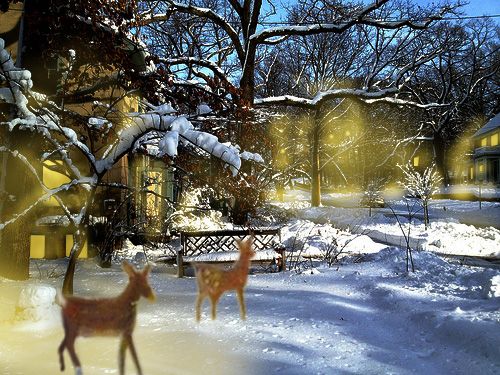
Meadhouse, kinkaidified...

... by Chip Ahoy:


... who explains how he did it here.

This is my original, mere reality, deemed too bleak by those who find fulfillment in the work of Thomas Kinkade:

Untitled

And here's a genuine Kinkade Christmas scene, whose deer look familiar... except it seems that Chip took the trouble to give the older deer an upturned tail to match the fawn's. It's that kind of attention to detail that turns our hearts aglow, like windows in that humble cottage... there, across yon half-frozen stream:

Wednesday, December 12, 2012

5 hours of political television not live-blogged last night.

The Madison Common Council debated and voted on a plan to light the Southwest Bike Path... which is actually called the Southwest Commuter Path, which should tip you off about which side won. The path will be lit. The faction that conceives of a grand plan for upping the percentage of commuters who travel by bike beat the property owners whose land abuts the path that was once a rail line.

The property owners did a fine job of marshaling arguments that would appeal to those who don't live right there. Maybe environmentalists will take their side if they call it "Owlpath" and stress nocturnal wildlife. Experts can explain how pools of light along a dark path make it harder to see and but easier to be seen. There you are lit up as if on stage to be sized up by the robber or rapist hiding in a dark spot.

Over the hours, many citizens spoke, and one phrase jumped out: "commuter corridor." You may think it's your backyard, but it's a commuter corridor. It's not a place to be but a place to move through, and there are so many more people moving through than staying in place. Of course, many more people drive to work, but even those who do are entranced by the fantasy of all those other people biking. Biking year round, despite the cold. It's during the cold times when the lights are most needed. Who knows why winter stops commuters from biking? Maybe it's the darkness.

And there should be gender equity. Why so many more men than women biking in the dark? If there were lights, people would feel safe, and feeling safe is so especially important to women. And making women feel safe is the central function of government, is it not? Making women feel safe coincided with spending tax money to buy a new amenity that will be noticed and will speak continually — to all who pass through the corridor — saying: Government has improved life for everyone. Experts and owls notwithstanding — those property owners are going to lose.

Saturday, December 8, 2012

"Every so often, Grant Risdon looks out his living room window and sees a stranger staring up at him, waving."

"Mr. Risdon isn't a celebrity... But his house has a very public persona..."
Its second floor is almost entirely encased in glass, making it look like a transparent box floating above the more traditional homes in a densely populated Seattle neighborhood.

Mr. Risdon says he wanted to feel connected to the outside but didn't want to leave the city. He says he and his wife don't use blinds—even at night. "I don't feel exposed. I don't worry about it. We have nothing to hide," Mr. Risdon says.
Why not be seen? Bring warmth and humanity to the surrounding streets. It's something like the traditional custom of sitting on front porches, engaging with passersby. It's far from having people into your house, but also far from shutting the place up and depriving the neighborhood of its human presence.

Saturday, December 1, 2012

Darkmonth.

December is upon us. A string of 31 days in a row with just about 9 hours of sunlight up here in The North. Maybe where you are it's not as dark, but what are you doing to deal with the dark?

What I'm doing this year is adapting my sleeping hours so that I experience every bit of the light. Sunrise took place at 7:10 this morning, but the pre-dawn light arrives much earlier, and I was up at 5, absorbing every trace, even imagined glimmers and mere moonlight.

Last Thursday, after class, walking home at 5...

Untitled

... I absorb fading twilight....

Untitled

... over Lake Mendota.


Untitled

Thursday, November 29, 2012

Friday, October 5, 2012

Justice Souter "sort of got the joke about being a Supreme Court Justice."

Says Jeffrey Toobin.
He didn't have an answering machine on his phone. He was late for William Rehnquist's funeral because they couldn't leave a message and find out where he was. He doesn't like electric lights to read. He moves his chair around his office over the course of the day for the sunlight. But the great thing about Justice Souter is that he sort of got the joke about being a Supreme Court Justice and he understood that he was important but it wasn't all about him.
Which might explain his graceful retirement. I sometimes wonder about those Justices who hang on for decades and into extreme old age. Why don't they think there should be more rotation of new individuals into those chambers?

Toobin's new book is "The Oath: The Obama White House and the Supreme Court." It's full of interesting material.  I'm enjoying it.

Friday, June 22, 2012

"We thought if we started calling it the 'Owlpath,' that would help remind people that it gets dark here at night, and that's special...."

Ha ha. You've got to hit these lefties where they feel it.

Oh, owls! l looove owls!

ADDED: Owls were a favorite motif of 1970s females. If you want to revisit that aesthetic, check out this collection of crap at Etsy.

Meade just asked me: "What is it about women and owls?" I blabbered something about:

1. Eyes in front... like a baby... unleashes maternal instinct.

2. It's the bird of prey that — unlike hawks and eagles — doesn't say "bird of prey" to women. (Men like hawks and eagles, which wear their aggressive instinct on the surface. Women, like men, have their aggressive instincts, but they're less out and proud about it.)

AND: Don't forget the decoupage!