Pages

Labels

Showing posts with label metaphor. Show all posts

Thursday, February 21, 2013

"Republican senator John McCain is still raising questions and hackles."

Hackles again! Can't get enough hackles in the big media... when the topic is Republicans.

A few days ago, the NYT lit into Ted Cruz: "Texas Senator Goes on Attack and Raises Bipartisan Hackles." And now, it's John McCain who's ruffling the feathers of big media, whose meme is The GOP died. So, whenever a Republican Senator is anything by docile and deferential, the Death-of-the-GOP meme must be swapped out long enough to discipline the outlier. The standard message is: Nobody likes you. Metaphor of choice: Hackles. You're raising hackles.

Here's my meme for that media discipline: When they say hackles, I say hacks.
The article with the headline quoted in this post title is at The Washington Post. Here's some of the text:
The 76-year-old will be 80 when he is again up for reelection in Arizona in 2016. “I have seen a number of occasions around here where people have stayed too long,” McCain said during a recent interview in his Russell Senate Building office. “I have seen people who were real giants in this institution deteriorate, and unfortunately, we remember them at the end.”

Endings matter in politics. If McCain is approaching the exit, this term could determine how he will be remembered. (“In the way people think of him,” former GOP Arizona senator Jon Kyl said, “in the near term, it matters a great deal.”)

Right now, like it or not, the five-term senator is stuck in “get off my lawn” territory, lashing out at his friend-turned-foe Chuck Hagel, President Obama’s nominee for defense secretary; incessantly tugging at what McCain is convinced is a coverup of the September attack on the U.S. mission in Benghazi, Libya; lambasting the president; and railing against indiscriminate defense cuts. If hard-core conservatives feel burned by McCain’s resurgent reform spirit, the media that he once called his “base” have essentially written him off as an angry and sour loser who once went through a maverick phase but has, in the words of “Daily Show” host Jon Stewart, gone on a “seven-year quest to negate every good thing he’d ever done.”
Wow. That's heavy-handed! They're saying: The GOP is supposed to be dead, and you're at the grave's edge, old man. Old, old man. You look old. Old men when the say what they mean and they say it with passion seem like they're saying "get off my lawn." Har harr. Old man! You're going to die soon.

You don't have to be a genius to extract the bias and see the real message: McCain is effective.

By the way, the hackles article about Cruz depicted him as too young — hadn't been around long enough to be speaking with intensity and passion. 

Hacks!

ADDED: I deleted a line that was in this post for a couple minutes: "by the way, hackles are not feathers." I based that on what I'd read — quickly — in the (unlinkable) Oxford English Dictionary when I wrote the "hackles" post about Cruz:
The hackles of a cock are erected when he is angry; hence with the hackles up, said also of a dog on the point of fighting when the hairs at the top of the neck stand up or of a hound when near the fox and on the point of killing him, also transf. of a man when aroused. Hence hackles is sometimes put for hair, whiskers, etc.
I pictured the cock's comb, but reading more of the OED entry "hackle," I see:
The long shining feathers on the neck of certain birds, as the domestic cock, peacock, pigeon, etc. Also, the feathers on the saddle of a cock. a cock of a different hackle, an opponent of a different character.

Wednesday, February 20, 2013

"At the hookah bar, Jordan and Emily Wernet, a 25-year-old freelance illustrator of comics and tattoos, joked about the grotesqueness..."

"... of a hand appearing inside a belly and about 'parasites,' 'popping one out,' and 'horrible little grubs' in the midst of more serious conversation about their fears of relinquishing sole ownership of one’s own body."

That's quite a sentence. I present it for your analysis, both formal and substantive. Free free to click here and take in the full context, which is quite interesting (and recently pointed at by Instapundit).

I wonder if Emily has designed tattoos for women's bellies that depict the illusion of seeing through to a distended womb with something grotesque inside.

Tuesday, February 19, 2013

"There are some short transitory passages between the various sexual episodes..."

"... but, for the most part, they only set the scene and identify the participants for the next orgy, or make smutty reference and comparison to past episodes."

An amusing sentence from Justice Clark's dissenting opinion in the 1966 case Memoirs v. Massachusetts, attempting to explain what is in the text of "Memoirs of a Woman of Pleasure," because he is "obliged to portray the book's contents, which causes me embarrassment." He avoids actual quotations from the book because it would "debase" the set of volumes that contain U.S. Supreme Court opinions. I was also amused by: "The pubic hair is often used for a background to the most vivid and precise descriptions of the response, condition, size, shape. and color of the sexual organs before, during and after orgasms."


The narrator in "Memoirs" is a prostitute named Fanny Hill, and Justice Clark, addressing actual legal arguments made in this First Amendment case, writes: "To say that Fanny is an 'intellectual' is an insult to those who travel under that tag. She was nothing but a harlot — a sensualist.... As an empiricist, Fanny confines her observations and 'experiments' to sex, with primary attention to depraved, lewd, and deviant practices."

I was also amused by Clark's dismay that one expert at trial had claimed that the book had literary merit because the verb "waddles" was used instead of "walks" to describe a fat woman entering a room and that another expert said that the 18th century book contributed to an understanding of history through its repeated descriptions of "the male sexual organ as an engine... which is pulling you away from the way these events would be described in the 19th or 20th century."

It's funny now, when you can get the book through a simple click. Feel free to read just the dirty parts, in other words — if I am to believe Justice Clark's opinion and as they say in the blogosphere — read the whole thing.

ADDED: I love the idea of insulting those who "travel under the tag" "intellectual." That's something I know I try to do whenever I can. And I'm fascinated by the expert's inadvertently causing us to picture a giant penis-locomotive dragging us into the past. That's quite a time machine you've got there! And the notion of pubic hair as a background for a visualization of male genitalia. It's like pubic hair is to cock as black velvet is to Elvis.

AND:  Why the sudden interest in Justice Tom Clark? My conlaw casebook has a squib on this case:
[I]n Memoirs v. Massachusetts, 383 U.S. 413 (1966), a plurality of three (Warren, Brennan, and Fortas) restated Roth as follows:
[T]hree elements must coalesce: it must be established that (a) the dominant  theme of the material taken as a whole appeals to a prurient interest in sex; (b) the material is patently offensive because it affronts contemporary community standards relating to the description or representation of sexual matters; and (c) the material is utterly without redeeming social value.
As Chief Justice Burger later noted in  Miller, “While  Roth presumed ‘obscenity’ to be ‘utterly without redeeming social importance,’  Memoirs required that to prove obscenity it must be affirmatively established that the material is ‘utterly without redeeming social value,’ [a] burden virtually impossible to discharge under our criminal standards of proof.” Nevertheless, this formulation was the most widely applied, even though no majority of the Court could agree on a standard to determine what constituted obscenity. Warren, Brennan, and Fortas subscribed to the Memoirs variation; Black and Douglas asserted that obscenity was constitutionally protected; Harlan held to his Roth view; and Stewart thought that both federal and state governments could suppress “hard-core” pornography. Justice Stewart’s famous epigram in his concurrence in Jacobellis v. Ohio, 378 U.S. 184 (1964), dramatized the problem of defining “obscenity.” Speaking of hard-core pornography, Stewart said: “I know it when I see it.”
I'm counting: Warren, Brennan, Fortas, Black, Douglas, Harlan, Stewart. That's only 7. Somebody's not getting any respect. The other unmentioned Justice? Byron White.

Sunday, February 17, 2013

"Sometimes, in my mind, I followed them to their apartments on the corners of hidden streets..."

"... and they turned and smiled back at me before they faded through a door into warm darkness. "

This sentence — can you tell it's from "The Great Gatsby"? — is for betamax3000, the upstart genius of the Althouse commentariat, who's vocally jonesing for another "Gatsby" sentence (after a couple of Gatsbyless days on this blog).

On post #1 today — "How the police handled this — they were the judge, the jury and the executioner" — he was all: "Dang. I thought we had segued from Fitzgerald sentences to Mickey Spillane."

And on post #2 — "And down the street is a retro-chic bakery, where... the windows are decorated with bird silhouettes — the universal symbol for 'hipsters welcome'" — he was in full-on "Gatsby" project mode:
"There is no confusion like the confusion of a simple mind, and as we drove away Brad Pitt was feeling the hot antlers of panic."...

"She went out of the room calling 'Pitt!' and returned in a few minutes accompanied by an embarrassed, slightly worn young man, with shell-rimmed glasses and scanty blond goatee."...

"They knew that presently dinner would be over and a little later the antlers, too, would be over and casually put away."
Don't understand the references? Maybe this post is not for you.
This post is for betamax3000 and the rest of the subcategory of commentariat that is coming along for the ride in the careening car that is the isolated, ripped-out-of-context "Gatsby" sentence. Scanning my e-book just now, I hear myself mutter "ah, there's a great gatsby sentence," and I wonder if I'm saying "a 'Great Gatsby' sentence" or "a great 'Gatsby' sentence." But I'm saving that one for tomorrow. It's a doozy. A daisy. Today's sentence is a bit more subtle. Subtle and wan and vague and faded and sadly smiling over all the things that might have been but were never pursued.

Here's this woman with whom the narrator not only has no relationship, he only imagines following her off the main avenue down the hidden street where her apartment would presumably be on a corner. By not following her, you don't have to see that she would not turn back at you and smile. But in your mind, she could smile. And then even in your fantasy, she goes into her apartment without you. And she doesn't even forthrightly go in — she fades through. And there isn't even a real interior space where real people could embrace. There's only warm darkness.

Ah! But warm darkness... fading into... hidden street... We're not talking about the the landscape of the city at all, are we? It's the landscape of the female body. And, of course, when you see a woman walking on the avenue, you can only imagine traversing that place.

Saturday, February 16, 2013

"In 1959 Fred Astaire hired renowned makeup artist John Chambers to work on his television special, Another Evening with Fred Astaire."

"The assignment? Turn Fred Astaire into Alfred E. Neuman. The results were predictably strange."


As they say... The past is a foreign country: they do things differently there.

I can't imagine such a long dance routine on network TV, even with a visual gag. I can't imagine a visual gag going on and on like that. People must have been so much more patient back then. Or much more in love with the idea of themselves as appreciating elevated culture. And yet it was not so elevated, what with the Alfred E. Neuman gag.

And that deadly modern dance. The woman swanning around while men in tuxedos behaved as if they were a single entity and that entity was a pulsating sexual organ. And all in such exquisite taste! Then Neuman/Astaire performs alone, lasts longer than all the rest of them, but in the end, he too loses his erection.

Moral: The ugliest guy might be the best performer.

Did I get that right?

Friday, February 8, 2013

"The truth is, I have never sat at my desk and thought, 'Today, I shall pen a mighty portrait of coitus!'"

"No, these imaginative encounters seem to creep up on me in the first draft, sort of like when two people fall in love, or lust. One minute you're chatting away about the legacy of Robert Bork and the next you're trying to meld your bodies into one ecstatic pulsating organism. When it's happening on the page, though, things get tricky. We might have the tendency to quickly cover up from the embarrassment of seeing our characters in the buff or else take on the role of salacious puppeteer. The prose can suffer from these reactions, as well as from overly clinical description, or, in some notorious cases, overcooked metaphor. Being caught with your aesthetic pants down can be a writer's worst fear."

From "The Smitten Word: The awkward art of writing about sex," by Sam Lipsyte.

Salacious puppeteer... what a phrase! I had to Google to see if anyone had ever put those 2 words together and....


One minute you're chatting away about the legacy of Robert Bork...

Thursday, February 7, 2013

"Lincoln" smears Connecticut.

"I could not believe my own eyes and ears," said Connecticut Congressman Joe Courtney. "Placing the State of Connecticut on the wrong side of the historic and divisive fight over slavery is a distortion of easily verifiable facts."
"It is historical fiction -- a noble genre going back to Shakespeare and well before -- not history," [said Columbia University historian Eric Foner].
And yet we're pressured to go see that movie because of the way it explains history. 

By coincidence, Shakespeare is getting some negative press this week, after bones found under a parking lot in England were determined to have belonged to Richard III, the last of the Plantagenet dynasty, supplanted by the Tudors, whom Shakespeare had reason to flatter as he portrayed Richard III as a villain.
No “bunch-backed toad,” no “slave of nature and the son of hell,” no “bottled spider,” the exhumed Richard is enjoying a remake as a physically challenged fellow with spinal curvature who might have starred in last year’s London Paralympics if given the chance.

Alas he got clobbered several times with a halberd (presumably wielded by a halberdier ignoring late 15th century safety regulations), and may have suffered the ignominy of being sodomized with an unlicensed dagger while being carried naked on horseback to Leicester. ....

“I’ve spoken to scoliosis experts and they say acute scoliosis like that was painful,” Philippa Langley, a Richard III enthusiast, told The Guardian. “So we know that he was working through the pain barrier every day just to do his job.... He had an incredibly powerful, strong work ethic. This man never stopped. He was on a horse every day, fighting skirmishes, doing everything they had to do.”
Imagine a movie about Lincoln that does not cater to the tastes of the present-day dynasty. There's plenty of old material to rake over. He wasn't called "bunch-backed toad" or a "bottled spider," but he was called "The obscene ape of Illinois." And:
The illustrious Honest Old Abe has continued during the last week to make a fool of himself and to mortify and shame the intelligent people of this great nation. His speeches have demonstrated the fact that although originally a Herculean rail splitter and more lately a whimsical story teller and side splitter, he is no more capable of becoming a statesman, nay, even a moderate one, than the braying ass can become a noble lion. People now marvel how it came to pass that Mr. Lincoln should have been selected as the representative man of any party. His weak, wishy-washy, namby-pamby efforts, imbecile in matter, disgusting in manner, have made us the laughing stock of the whole world. The European powers will despise us because we have no better material out of which to make a President. The truth is, Lincoln is only a moderate lawyer and in the larger cities of the Union could pass for no more than a facetious pettifogger. Take him from his vocation and he loses even these small characteristics and indulges in simple twaddle which would disgrace a well bred school boy.

Wednesday, February 6, 2013

Is government an "impetuous vortex" or a "hideous monster [with] devouring jaws"?

Reading the Obamacare case in class preparation today, I notice those 2 metaphors, both taken from the Federalist Papers, both used in the process of saying that the Commerce Power doesn't support the requirement that everyone buy health insurance. "Impetuous vortex" — from The Federalist No. 48, written by James Madison — is quoted in  Chief Justice Roberts's opinion:
The Government’s theory [of the scope of the commerce power] would erode those limits, permitting Congress to reach beyond the natural extent of its authority, “everywhere extending the sphere of its activity and drawing all power into its impetuous vortex.”
The "hideous monster [with] devouring jaws" — written by Alexander Hamilton in The Federalist No. 33 — appears in Justice Scalia's opinion:
If Congress can reach out and command even those furthest removed from an interstate market to participate in the market, then the Commerce Clause becomes a font of unlimited power, or in Hamilton’s words, “the hideous monster whose devouring jaws... spare neither sex nor age, nor high nor low, nor sacred nor profane.” The Federalist No. 33, p. 202 (C. Rossiter ed. 1961).
Many have noted that Scalia (joined by Kennedy, Thomas, and Alito) did not join the Roberts opinion on the Commerce Clause, even though they said basically the same thing about it. Their spirit of resistance shows even through their choice of a different Federalist Paper with a different author and a different metaphor for government's voracious maw.

Tuesday, February 5, 2013

BBC tries to get its mind around the way it seems to be okay in the United States to say...

... kick ass.
Nowhere is this better demonstrated than in Kentucky, where a high-profile campaign has been launched to change the state's official slogan from "Unbridled Spirit" to "Kentucky Kicks Ass."...

According to Griffin VanMeter, one of the marketing professionals behind the rebranding push, the slogan was chosen to encapsulate the area's unpretentious dynamism.

"What it means to us is that instead of physically kicking someone's ass, it's evolved into a rallying cry that people can get behind," he says. "It's also a little risque which makes it that much better."

Sunday, February 3, 2013

"He literally glowed; without a word or a gesture of exultation a new well-being radiated from him and filled the little room."

There's today's sentence from "The Great Gatsby," in the long-running Althouse blog show called The "Gatsby" Project.

Where do we go with this one? Must we dither over the old hobby-horse "literally"? Did Gatsby literally glow? Was he heated to the point of incandescence? I'd say that F. Scott Fitzgerald continually uses metaphor, asserting that things are other than what they are, without the prissy distance of clutter words like like and as if, so what does it matter if he intensifies one of these assertions with literally?

He glowed. And he radiated. It filled the room. He's an incandescent light-bulb. There are, I assure you, no fluorescent bulbs in "Gatsby." There are a few candles, including 4 that Daisy snaps out with her fingers. There's particularity about lighting in this book. Daisy prefers the sun. Literally.

I've said before that one thing I've learned, reading "Gatsby" sentences, is that if you're having trouble finding a way in: Look for the light. Today, the light source is obvious: It's the man himself, Gatsby.

But, the truth is, I'm not having trouble finding a way into this sentence. It jumped out at me because of the word "exultation," which is there in the negative: There isn't any exultation, not in word or gesture. It's a situation where Gatsby might have exulted, and the glowing/radiation came right out of his skin.

We were just talking about exulting. We were mock exulting at a minor tribulation that afflicted someone we sometimes slightly pretend we don't like, and then we were mock chiding each other for inappropriate exultation. It was nothing, really. Just some passing amusement at the idea of the flimsy sin of exultation.

The original meaning — OED — of exult, now obsolete, is "To spring or leap up; to leap for joy." That physical image is lost now, and it means — literally, now — "To rejoice exceedingly, be elated or glad; to triumph."
1856   E. K. Kane Arctic Explor. II. viii. 90   We..exult to think we need no catering for the morrow.
1865   A. C. Swinburne Satire to C. in Poems & Ballads 50   As plague in a poisonous city Insults and exults on her dead.
Don't confuse exult with exalt, which means "to raise up... to lift up" and "to praise, extol, magnify." The elevation-related physical image survives:
1823   C. Lamb Mod. Gallantry in Elia 184   Exalting his umbrella over her poor basket of fruit.
1832   Blackwood's Edinb. Mag. Feb. 287   Let the rogues swing, And thus be exalted.
And the metaphorical meaning works too:
1611   Bible (A.V.) Psalms xxxiv. 3   O magnifie the Lord with me, and let vs exalt his name together.
There's one other appearance of exult in "The Great Gatsby." It's not the absence of exultation, and it's not Gatsby, it's Tom. He's talking "incessantly, exulting and laughing." Much better to silently incandesce. Exalt appears once:
I stayed late that night, Gatsby asked me to wait until he was free, and I lingered in the garden until the inevitable swimming party had run up, chilled and exalted, from the black beach, until the lights were extinguished in the guest-rooms overhead.
Ah, but that's a whole other fat, juicy sentence. We've had our "Gatsby" sentence today, and it's time to snap out the lights on this post. Figuratively.

Wednesday, January 30, 2013

Instapundit reviews Al Gore's new book.

The book is "The Future: Six Drivers of Global Change." Yeesh. What a title. Drivers. But he couldn't just call it "The Future." That would be dumb. And people love lists. Lists make it seem possible to read a whole book.

So Six Drivers. Sounds almost sexy. Six ≈ sex, and driver seems like a way to refer to one's chakra in old songs like "Me and My Chauffeur Blues."

That's all I have to say because I haven't read the book. It just came out today yesterday. Instapundit got to drive into the future, and having read "The Future," can give a substantive account. So go read his review. It's mixed.

Saturday, January 26, 2013

"Buy yourself a shotgun"... maybe not a real shotgun, maybe something metaphorical.

So, yeah, there's Jimi Hendrix, on TV in 1965. Can you even hear him? I want to concentrate on Buddy & Stacy. I'm surprised they got away with dancing like that on television:


Those were different times.

Friday, January 25, 2013

I was so tired when I wrote last night's "Gatsby" post.

It was a real struggle with that sentence:
There was dancing now on the canvas in the garden; old men pushing young girls backward in eternal graceless circles, superior couples holding each other tortuously, fashionably, and keeping in the corners — and a great number of single girls dancing individualistically or relieving the orchestra for a moment of the burden of the banjo or the traps.
You might say I wrestled with that sentence. The commenters — whom I read this morning, after I conked out and slept for 10 hours — helped me make the connection to wrestling. Terry said: "The key phrase, I think, is 'on the canvas.'" That affects how you think of the men pushing the young girls, the gracelessness, and the tortuously. Dancing is like wrestling here. In the "Gatsby" project, we look into one sentence, in isolation, but I just looked back into the text to get a better picture of that canvas, which I took to be a way to transform lawn into dance floor. I get to this sentence:
At least once a fortnight a corps of caterers came down with several hundred feet of canvas and enough colored lights to make a Christmas tree of Gatsby’s enormous garden.
So let that be today's sentence. Lots of Cs: corps, caterers came, canvas, colored, Christmas. Christmas replacing the garden evokes the New Testament supplanting the Old. From the Garden of Eden to the salvation of Christ. By the way, that is the sentence just before the "crowded hams" sentence that made me angry 3 days ago.

I'll leave you to untangle the strands of colored lights that festoon the Christmas tree sentence, because I need to get back to what people said about yesterday's sentence. I must say I laughed out loud when McTriumph said:
Professor Ann, your first thought was musicians using the girls as instruments? You should write a novel, "Fifty Shades of Banjo."
And then betamax3000 introduced Naked Andy Kaufman Robot. Betamax has done this "naked robot" routine before, but the Andy Kaufman iteration blew my mind, because I was still admiring Terry's wrestling insight, with men wrestling/dancing with woman, and then to bring up Andy Kaufman — when Kaufman not only had a comic act that was about wrestling with women, but he had a routine that consisted of taking the stage and reading, in its entirety, "The Great Gatsby." But it's not as if betamax3000 just said, "Hey, this is so Andy Kaufman — the wrestling and 'The Great Gatsby.'" No, betamax did a series of comments that twisted the "Gatsby" text into things that would be said by the Naked Andy Kaufman Robot:
I have pushed many women gracelessly backwards on canvas. It has been both tortuous and fashionable, leaping high from the corners of the ring onto the contestant below: in that moment there is Truth, Sweat and Cheers. Many people assume the urge to wrestle women is sexual. As a wrestler of women I can definitively say that this is untrue. Mostly. In the main it is about the defining moment of being Superior, of recognition of the Pinner and the Pinnee.
A few moments on Etiquette.

A sportsman never uses the Banjo or the Traps on a female wrestler. While he is allowed to use the Piledriver it is not to be done from a height greater than a women's modest skirt: below the knees only, gentlemen.

Danny DeVito did not understand. He would ask "Andy, why don't you stop wrestling women?" and I would reply "Danny, why don't you stop being so short and disheveled?"

Shirt tucked or not, in the ring Danny would've been able to stand as tall as his Courage would allow him to be, but -- sadly --he did not understand.

Tony Danza would argue "I'm a boxer. What would be so different if I boxed women?"

I could only shake my head. He did not comprehend the difference between wrestling and fighting. A punch is anger, but only through grappling do we experience the common ground between the sexes: the canvas ring is where the true colors are painted, like a woman's red nails or a man's 1969 orange Camaro.

I once wrestled a woman who smelled of avocado. In the midst of our grappling a moment was frozen as that scent overpowered my senses, psychically and spiritually. Was the avocado Fear or Power? How could I pin this woman down, this woman who smelled of avocado? How could I keep her soul and buttocks confined beneath me when the Avocado was everywhere? In the end I won the match, but the avocado defeated me on a far grander level.

Every woman has the Avocado inside her -- this, a true wrestler knows -- knows and respects...
And:
The first time I wrestled a woman was practically a religious experience. At the end I laid on the canvas pinned, defeated and euphoric: through my bell-rung eyes I saw God through the rafters wink at me. I do not remember her name but I remember the look of Victory in her eyes and how I peed a little.
And:
Women have soft elbows. When you are elbowed in the solar plexus by a woman it is different than a man's elbow: there is Understanding. There is Forgiveness.
And:
When pinned between a woman's headstrong knees a man has no choice but to understand: it is the Silent Conversation, and the chafing will heal.
And:
To repeat: wrestling a woman is not sexual. Excitement is for the Soul and the Arms and the Thighs, not the Loins. To have an erection in the ring is to give the Devil a Handle.
There's more, but enough of the quoting of the Naked Andy Kaufman Robot. Let's turn to the wonderful commenter Chip Ahoy, crisply quipping:
Later, following the death of Gatz, the same canvas was turned over to modern dance.


But that didn't last. The dancers, bored of dancing set off in pairs to the beach, to break up and pair off again and break up and pair off.

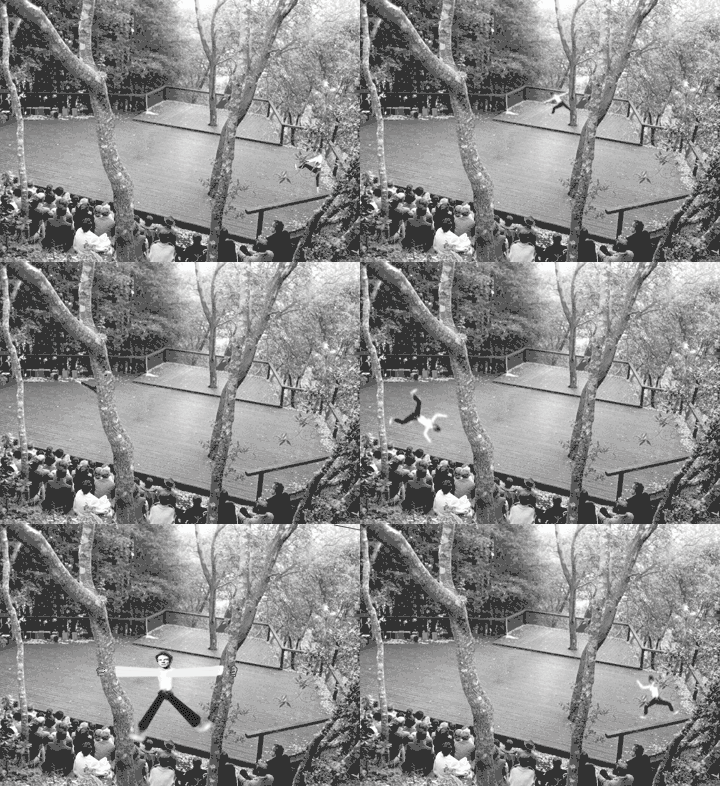
I remember that modern dance GIF. It was back in 2009, when I wrote about "Lawrence Halprin... 'the tribal elder of American landscape architecture'" whose wife was a dancer who, he said, "could not be contained by a rectangle," so he built her a dance deck that was the "odd, improvised shape" you see in the photo. Back then Chip Ahoy said:
I too knew that my wife could not be contained on a rectangular deck for she is uncontainable, so I improvised with an deck area that could be danced on several levels. The outer levels tilt so that anything placed on them slide off toward the center, and built with portals that promise escape but all lead circuitously back to the main dance area, rather like a hamster habitat. I rounded the edges and varied the angles for nature has few straight lines and fewer right angles and my wife is nature personified, and that made the whole deck railing more difficult, you see, which I then electrified because I knew she would make several attempts at an over-the-rail vault. The deck areas are also surrounded by a moat that I populated with piranhas that I feed regularly by dropping in a steak so they're veritably trained to converge en mass, along with back up electric eels and those really gross blood-sucking slugs, all to discourage wandering beyond the safety of boundaries I set forth with my architecture. The deck itself is fitted with sprinklers at its farthermost points that spray a mist with power hose force to warn the little sylph-like dancing scamp whenever her dance gives the appearance of breaking loose or she nears the end of her retractible chain.
And then Chip proceeded to animate a dancer for the odd, improvised dance deck.

And now, it's your turn to dance. Dance all night in the comments, backward in eternal graceless circles, tortuously, fashionably, individualistically.

Monday, January 21, 2013

Michelle and Barack Obama look great in the Inauguration morning outfits.

Very nice. Love the blue. Love the matching clasped hands as — we're told — they approach the Episcopal Church. Michelle's checker-patterned coat is made of "silk jacquard based on a necktie fabric." Beautiful!

In church:
... Pastor Andy Stanley from North Point Community Church in Alpharetta, Ga., delivered the sermon. He spoke of Jesus washing his disciples' feet and saying "now that I, your Lord and teacher, have washed your feet, you should also watch each other's feet." The president, Pastor Stanley said, should follow that example and "leverage" his power for the benefit of others.
IN THE COMMENTS: Erika notes the typo in the blocked quote, which is from NPR.org:  You should also watch each other's feet. Maybe NPR misheard and didn't get what Jesus was supposedly doing. Some commenters thought Pastor Stanley didn't get what Jesus meant.

Palladian: "The washing of the feet was about humility and service, not about 'leveraging power.'"

Cheryl: "I'm pretty sure Jesus didn't need to leverage his power. Biblical teaching like this is why we don't attend Pastor Stanley's church, which is right down the road from us."

Bago20 reacted: "Nooooooooooooooooooooo! Please don't help anymore."

Maguro had a different problem: "I find it disturbing that even southern preachers are using 'leverage' as a verb these days."

MORE IN THE COMMENTS: I said: "The humble servant image is a little edgy when the President is black." And Palladian said: "The humble servant image is a little edgy when the President is a profligate, arrogant, narcissistic asshole."

Wednesday, January 16, 2013

"A breeze blew through the room, blew curtains in at one end and out the other like pale flags..."

"... twisting them up toward the frosted wedding-cake of the ceiling, and then rippled over the wine-colored rug, making a shadow on it as wind does on the sea."

More wind, water, and light. We've gotten used to it here in this windy, watery, light-and-dark world of the Gatsby project. This sentence seems like a made up imitation of a sentence from "The Great Gatsby," but I assure you it's there.

All that's happening here is a breeze blowing through the room, but we have a traffic jam of metaphor: flags, wedding-cake, and wine. What are we supposed to see here? And good lord, it's a room. Must we really believe that something cataclysmic is going on when a breeze blows the curtains? Maybe we should. Maybe all sorts of crazy stuff happens in a room and it is like an epic storm at sea.

The wine-colored rug stands in for the sea, so I have to assume that we're supposed to think of the  "wine-dark sea" we hear about, repeatedly, in Homer's Iliad and Odyssey. It is an epic, contained in that room. The dark shadows ripple, turning the wine-rug into sea, so I guess the ceiling is the sky. I guess that's a fancy white ceiling with all sorts of fancy woodwork, resembling the ornamentation on a wedding cake. The curtains swirling around the wedding-cake textures are cloud-like, I suppose. So fabric and wood make the erstwhile cake-like ceiling into stormy sky and curtain-driven shadows make the otherwise wine-like carpet into roiling sea.

It's a tempestuous room, containing a marriage. Raise a toast and let's feed each other cake.

"Oxygen Media has pulled the plug on 'All My Babies' Mamas,' a reality special... about a musician who has fathered 11 children with 10 different mothers."

The conceived the show. They gave it life. Then they walked away.

ADDED: Rush Limbaugh riffs on the O Media decision:
It's not gonna air now because a bunch of stuffed shirts, a bunch of prisses, a bunch of morality police... objected.... So we were going to expand the definition of a family to include whatever people wanted it to be.... It was a show of love and devotion, how Shawty provides for all, and it's being ripped right out from under him. I mean, who says that this is a marginalized existence?

Sunday, January 13, 2013

"I knew the other clerks and young bond-salesmen by their first names, and lunched with them in dark, crowded restaurants on little pig sausages and mashed potatoes and coffee."

It means something that F. Scott Fitzgerald wrote "pig" instead of "pork." I think about how George Harrison sang about piggies, the bigger piggies, "in their starched white shirts... stirring up the dirt" as well as "the little piggies... crawling in the dirt." (He stirred up Charles Manson to deliver "a damned good whacking.")

Life was "getting worse" for the little piggies, while, by contrast, the bigger piggies "always had clean shirts." Now, I'm not going to veer off into the topic of The Great — big pig — Gatsby's shirts. You know if you've read "The Great Gatsby" or seen the movie that a huge to-do is made at one point about how many beautiful shirts Gatsby had.

But here in this Gatsby project, we look at one sentence in isolation. That way, everyone's on the same footing. You don't have the little readers and the bigger readers. Life isn't getting worse for some of us and just fine for others. We gather here, in the daily post, to consume one sentence, so let's lunch.

Let's know each other by first names. Here we are equals. We have all read the sentence, and we can all very well speak out about it. Here, we actively exclude extrinsic evidence. About the book, I mean. We're free to drag in anything else, such as The Beatles, as betamax3000 did so well in yesterday's Gatsby thread, the one about warm human magic.

So pig, then. Pig, not pork. Which makes us think that the clerks and bond-salesmen are little piggies. The men eating humble food — all the humbler for saying pig, not pork — in a dark, crowded place. A pigsty? Our narrator is crammed in close quarters with them as he chows down. He's on familiar terms with them: He calls them by their first names. He's a member of the herd of little piggies.

Did you notice the words are right there one after the other: little pig? As a competent and tolerant reader, you can tell it's the sausages and not the pigs that are supposed to be little, and as a picky reader, you might say it's bad writing to permit that ambiguity to survive the final draft. But maybe the writer wanted you to see little pig. And the bigger question is why insert the pig at all? We'd presume that sausages were pork. Obviously, Fitzgerald wants us to think about pigs and think about the men as pigs. He wasn't as blunt as Mr. Harrison, but he was calling these guys pigs.

Another reason to throw pig in there, permitting the ambiguity, is to call the sausages little without being too aggressively Freudian about saying little sausages and making us think too quickly — before we'd noticed all these other things — of pricks.

ADDED: Meade, helping me proofread, questioned "herd" as the proper collective term for pigs. I know there are some other options, but I like it because it evokes Jesus:
Some distance from them a large herd of pigs was feeding. The demons begged Jesus, “If you drive us out, send us into the herd of pigs.” He said to them, “Go!” So they came out and went into the pigs, and the whole herd rushed down the steep bank into the lake and died in the water. Those tending the pigs ran off, went into the town and reported all this, including what had happened to the demon-possessed men. Then the whole town went out to meet Jesus. And when they saw him, they pleaded with him to leave their region.

"Rehearsals sap my pep... tell me what I have to do and I'll do it."

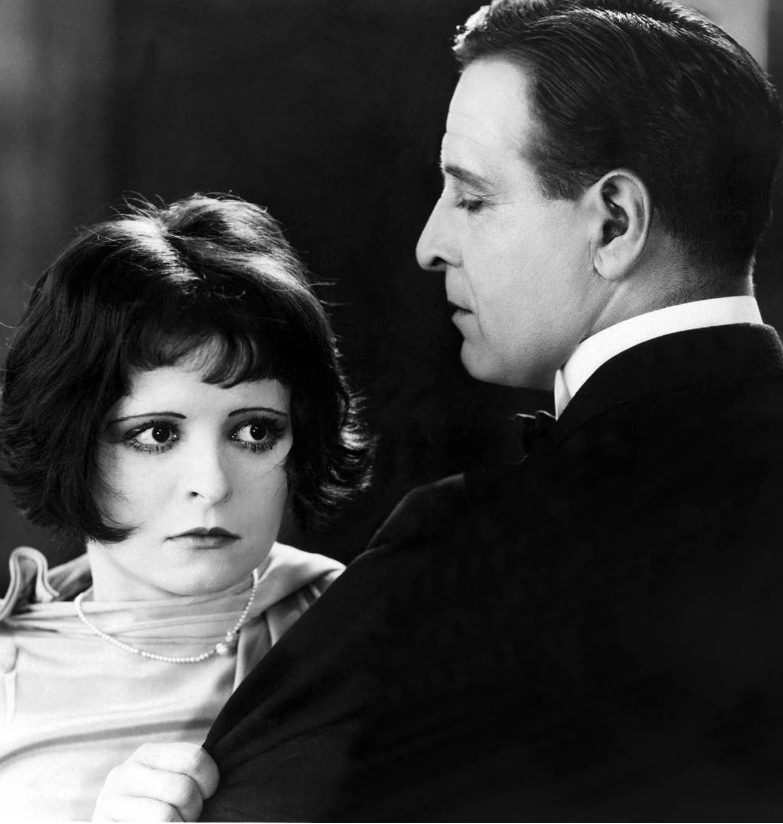
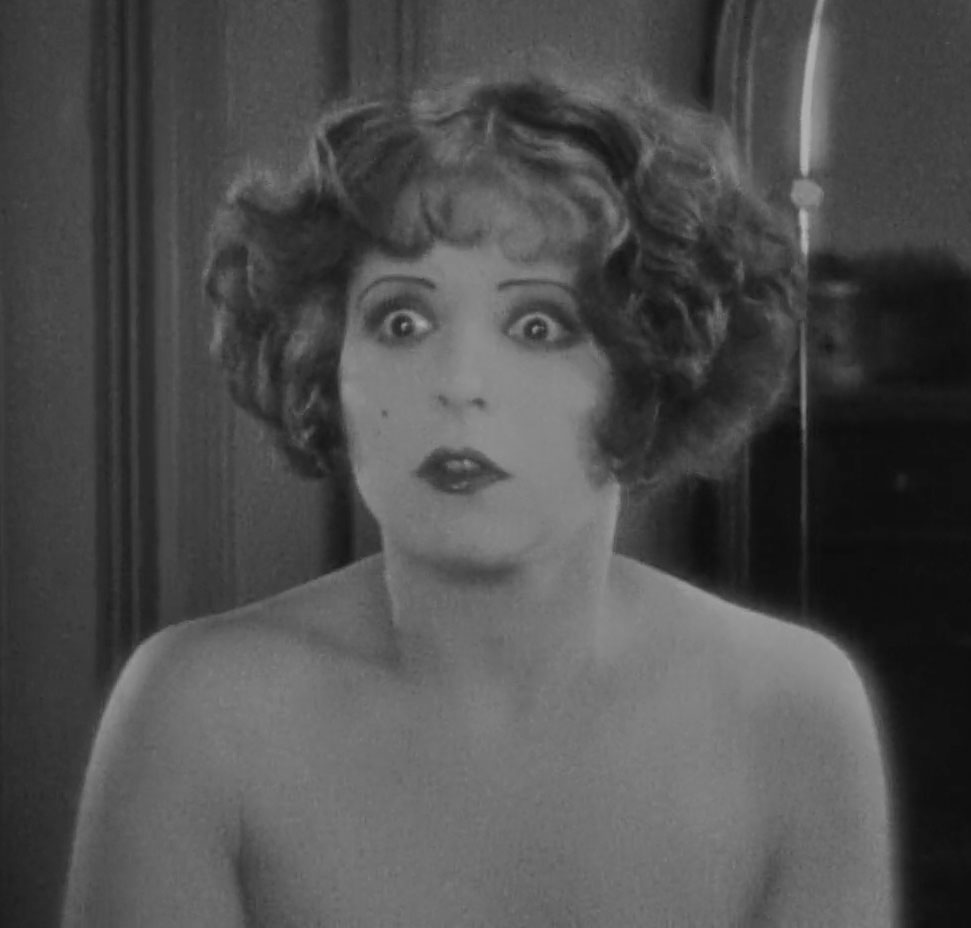
Said the actress Clara Bow (in 1929), who did it like this:


... in "Kittens" (1926). And this:


... in "Wings" (1927), which was the first movie to win the "Best Picture" Oscar. Bow said it was "a man's picture and I'm just the whipped cream on top of the pie." When Bow was criticized for her bohemian ways and "dreadful" manners, she said :
"They yell at me to be dignified. But what are the dignified people like? The people who are held up as examples of me? They are snobs. Frightful snobs... I'm a curiosity in Hollywood. I'm a big freak, because I'm myself!"
In 1931, when she was 26, she got married and retired from acting. She moved to a ranch in Nevada, and lived until 1965.

I'm reading about her this morning, after clicking to her Wikipedia page from the Wikipedia page "Pin-up girl," which has a list of "Notable pin-up girls" sorted by decades, beginning with the 1920s. I was researching the topic of pin-up girls after Meade called attention to this current ad:


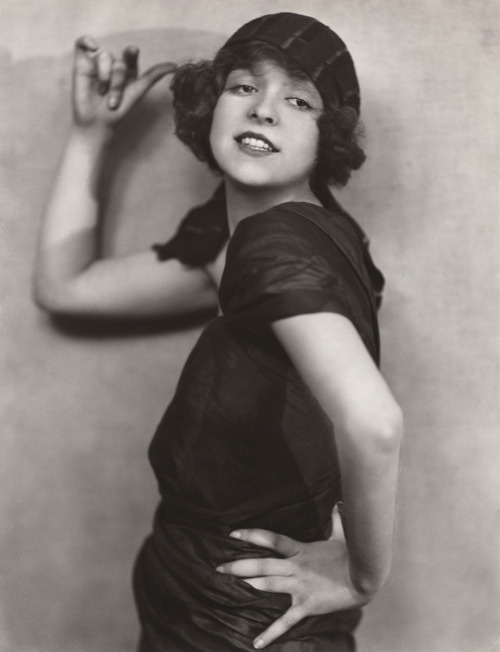
We had a conversation about the nature of 1950s pin-up style, and it got me looking for the classic Betty Grable pin-up, which I think it emulates — peeking back over a raising shoulder and smiling as if to say Go ahead and look at my ass. Grable's pic is the one pic that appears on the Wikipidea "Pin-up girl" page, but I was interested in seeing the first pin-up, and the first couple names on the 1920s list didn't click through to a pin-up style picture. Clara Bow's did. If you count this:


Tell me what I have to do and I'll do it. She's only 15 there. Can you just hear the photographer directing her how to arrange her fingers and where to move her shoulder and even her eyeballs?

"That's how you laughed in the middle of the night."

Said Meade, and I said: "Then Chip Ahoy must have been in my dream."

Because I was just reading his comment: "Melody and Rose broke up the Sweedish contractors and threw change in the tip jar and put on her warm magic apron."

And I laughed not because that is nonsense, but because it's a quite brilliant contribution to a conversation that was pretty far along at that point, including betamax3000's extended interpretation of "The White Album." Beta had said:
Like the White Album perhaps Althouse is telling us there are secret messages to be found, backwards.

"Sweetly up broke voice, her rose melody."

"Upon magic human warm her of little."

"Out tipped change."
It all began with a sentence from "The Great Gatsby," which was about — not a woman laughing — a woman singing. But women laugh all the time in "The Great Gatsby." For example: "She looked at me and laughed pointlessly."

"These 'Gatsby' posts are becoming the new café around here" — "café" posts are open threads  — I say as I drink my coffee and contemplate today's Gatsby sentence, which I'd said will be "I knew the other clerks and young bond-salesmen by their first names, and lunched with them in dark, crowded restaurants on little pig sausages and mashed potatoes and coffee."

I picked that sentence after searching my Kindle copy of "Gatsby" for "potato" after betamax3000 said:
Yesterday was "gulp down the incomparable milk of wonder," today is "tipped out a little of her warm human magic." Is it getting hot in here or is it just me?
And that was funny, because — before getting out of bed this morning — I'd been toying with the idea of saying: In that "Melody rose" sentence, Fitzgerald intended us to think of semen when we read about "warm human magic" that tipped out of the vessel that is the woman.
 

And betamax added:
My God: if we get to the sentence involving Daisy, the potato and the gardener I just don't know what is going to happen.
Which is what had me looking for "potato" in "Gatsby," not finding it, and suspecting that betamax was making a canny reference to "Lady Chatterly's Lover." I buy "Lady Chatterly's Lover" in Kindle just so I can search for "potato"! My literary pursuits are a tad — a tot — bizarre. I find:
"No; my heart's as numb as a potato, my penis droops and never lifts its head up, I dare rather cut him clean off than say 'shit!' in front of my mother or my aunt... they are real ladies, mind you; and I'm not really intelligent, I'm only a 'mental-lifer.'"
And:
"I don't want to fuck you at all. My heart's as cold as cold potatoes just now."