Pages

Labels

Showing posts with label Russia. Show all posts

Saturday, February 23, 2013

Now that we're talking about the 1927 silent film "King of Kings," we must take note of Ayn Rand.

We were talking about "King of Kings," because we were talking about what Jesus wrote in the sand, because various blogs were talking about an Islamist Facebook page with a cartoon showing how to carry out a stoning. I started to wonder whether the first commenter who mentioned "King of Kings" was talking about the 1927 Cecil B. DeMille picture or the 1961 Nicholas Ray flick. So I'm over here on the King of Kings (1927 film) page at Wikipedia, and I see:
Sally Rand, before becoming notorious for her "fan dance" at the 1933 World's Fair, was an extra in the film.

Ayn Rand (no relation to Sally Rand) also was an extra in the film, and met her future husband Frank O'Connor on set.
I couldn't find a YouTube clip of Ayn Rand in "King of Kings," but I did find Sally Rand and her notorious World's Fair fan dance:


I also found this 2009 New Yorker article about Ayn Rand that covers the "King of Kings" phase:
Rand... left the U.S.S.R. for America.... Her vision of the U.S. had already been shaped by obsessive moviegoing.... Even before leaving the Soviet Union, she had published a pamphlet on the silent-film actress Pola Negri, and like a movie star herself she now refashioned “Rosenbaum” into her own new name. Heller and Burns both knock down the myth that a Remington-Rand typewriter inspired the rechristening.

There is a greater factual basis to the legend of Rand’s having met Cecil B. DeMille before she worked as an extra on his production of “The King of Kings” (1927). On the set, Rand persuaded a costume director to promote her from a crowd of beggars to a crowd of patricians, and DeMille had his story chief look at her film scenarios, which were soon judged over the top. Rand achieved steadier success working in the R.K.O. wardrobe department, and then had a writerly breakthrough with a courtroom murder drama called “Night of January 16th.” Thanks to a gimmick that allowed each night’s audience to serve as the jury and thereby choose the ending, the play made it to Broadway, where Rand railed against the producers’ subordination of its incidental messages about the beauty of unbridled individualism.

Settling in New York with her husband, Frank O’Connor (another “King of Kings” extra), Rand set seriously to work on the first of her two major novels, “The Fountainhead.”....
How do you feel about all those connections? The Soviet Union, the love of movies, immigration to the land of movies, name-changing, finding the love of your life on a movie set in Hollywood, strippers performing what is only the illusion of nakedness, and... Jesus.

Friday, February 1, 2013

"Have you ever eaten bread?"/"I have. But they have not. They have never seen it."

"At least he was intelligible. The daughters spoke a language distorted by a lifetime of isolation. 'When the sisters talked to each other, it sounded like a slow, blurred cooing.'"
The old man's name was Karp Lykov, and he was an Old Believer—a member of a fundamentalist Russian Orthodox sect, worshiping in a style unchanged since the 17th century....
[In 1936] Karp; his wife, Akulina; a son named Savin, 9 years old, and Natalia, a daughter who was only 2... had retreated ever deeper into the taiga, building themselves a succession of crude dwelling places, until at last they had fetched up in this desolate spot. Two more children had been born in the wild—Dmitry in 1940 and Agafia in 1943—and neither of the youngest Lykov children had ever seen a human being who was not a member of their family. All that Agafia and Dmitry knew of the outside world they learned entirely from their parents' stories.....

The Lykov children knew there were places called cities where humans lived crammed together in tall buildings. They had heard there were countries other than Russia. But such concepts were no more than abstractions to them.
Video here

Tuesday, January 29, 2013

"One hopes Mr. Obama wouldn't be so eager to come to Mr. Putin's rescue."

"If the rumors are a Kremlin hoax, the U.S. should publicly shoot them down as quickly as possible. To allow them to spread would be a display of weakness — the kind that a bully like Mr. Putin is always eager to exploit. Back in 1961, the perceived weakness of young President John F. Kennedy at his Vienna summit with Soviet Premier Nikita Khrushchev led indirectly to the Cuban missile crisis. Only when Kennedy showed resolve did the Soviets later back down."

Writes Garry Kasparov in the WSJ.

Saturday, January 26, 2013

Joseph Brodsky "used to appall his students by requiring them to memorize something like a thousand lines each semester."

"He felt he was preparing them for the future; they might need such verses later in life. His own biography provided a stirring example of the virtues of mental husbandry. He’d been grateful for every scrap of poetry he had in his head during his enforced exile in the Arctic, banished there by a Soviet government that did not know what to do with his genius and that, in a symbolic embrace of a national policy of brain drain, expelled him from the country in 1972."

From "Why We Should Memorize," by Brad Leithauser.

(In 1972, Brodsky became the poet in residence at the University of Michigan. I was a student there at the time and remember a grand assembly with Brodsky received as a great hero.)

Tuesday, January 1, 2013

The History of Abkhazia.

"According to The Georgian Chronicles, the first inhabitants of what is now Abkhazia and the whole western Georgia were Egrosians, the descedants of Egros son of Togarmah, grandson of Japhet, son of Noah, who came from the land known as Arian-Kartli."


"... Abkhazia was conquered by Mithridates VI Eupator of Pontus between c. 110 and 63 BC, and then taken by the Roman commander Pompey."

"[T]he kingdoms of Abkhazia and Georgia [were united] into a single Georgian feudal state... reach[ing] the apex of its strength and prestige under the queen Tamar (1184–1213)."

"Towards the end of the 17th century, the principality of Abkhazia broke up into several fiefdoms, depriving many areas of any centralized authority. The region became a theatre of widespread slave trade and piracy. "

"In the Russian revolution of 1905, most Abkhaz remained largely loyal to the Russian rule, while Georgians tended to oppose it. As a reward for their allegiance, tsar Nicholas II officially forgave the Abkhaz for their opposition in the 19th century and removed their status of a 'guilty people' in 1907."

"On 24 October 2008 the railroad bridge of Shamgon-Tagiloni, connecting the city of Zugdidi in Georgia with the Abkhazian Gali district (populated mainly by Georgians) was destroyed. According to Georgian and French sources it was done by Russian army; Abkhazian sources maintained it was a Georgian diversion."

***

And so begins the new year project on this blog, which is to proceed, alphabetically, through the 206 countries of the world, and to read the "History of" page in Wikipedia. The idea is to have had it go through our head, at least once, something of what happened in each place. It is fitting that we start with Abkhazia, which may be an unfamiliar name. Much has happened there! It's touching to see that, to confront one's own persistent, nagging ignorance. But we are all fortunate to have woken up again this morning, still a human being on Planet Earth, and I want to perform a ritual — for the next 206 days — of adding a slight glimmer of awareness of those other human beings who live or who have lived over the long expanses of time and place.

***

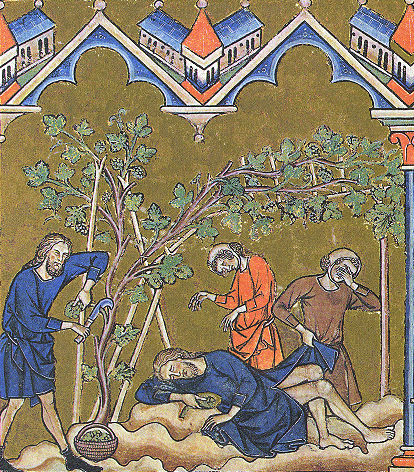
It's apt that we encounter Noah on New Year's Day, Noah being our earliest example of an individual overindulging in alcohol.


ADDED: I found a nice Flicker stream of photos from Abkhazia. I recommend beginning here — at Stalin's bathroom — and then clicking to the "newer"/"older" button to see more.

Wednesday, September 19, 2012

Putin says: "That Mr. Romney considers us enemy number one and apparently has bad feelings about Russia is a minus..."

"... but, considering that he expresses himself bluntly, openly and clearly, means that he is an open and sincere man, which is a plus."
"We will be oriented toward pluses, not minuses... And I am actually very grateful to him for formulating his position in a straightforward manner."
Says a man who is not himself speaking in a straightforward manner, but who presumably perceives an advantage in portraying his opponent as straightforward.

Romney an open and sincere man?

Friday, August 17, 2012

"Who is to blame for the performance at the Cathedral of Christ the Saviour and for our being put on trial after the concert? The authoritarian political system is to blame. What Pussy Riot does is oppositional art or politics."

"Who is to blame for the performance at the Cathedral of Christ the Saviour and for our being put on trial after the concert?"

Political argument in defense at the criminal trial of Pussy Riot in Russia. Also: "To my deepest regret, this mock trial is close to the standards of the Stalinist troikas."

The protesters got a 2-year sentence for "hooliganism." They've gotten a lot of international support, because the government seems to be coming after them for their free speech and their music, but — as the NYT puts it — they "have never released a song or an album, and they do not seem to have any serious aspirations to do so." And the prosecution accused them of acting out of "religious hatred" (as well as "committing 'moral harm' and even of practicing Satanism"). They did "prance around in front of the golden Holy Doors leading into the altar, dancing, chanting and lip-syncing for what would later become a music video of a profane song in which they beseeched the Virgin Mary to rid Russia of Mr. Putin."

Wednesday, August 8, 2012

"Russian Muslim 'catacomb sect' faces cruelty charges."

BBC reports:
Police found 27 children and 38 adults living in catacomb-like cells, dug on eight levels under his home.... Some children had literally never seen the light of day, Russian media report....

According to the Russian website Islam News, [Faizrakhman] Sattarov, 83, declared himself an Islamic prophet in the mid-1960s after interpreting sparks from a trolleybus cable as a divine light from God....
Traditional Muslims regard Muhammad as the last prophet, so these "Faizrakhmanists" are on their own.

We were just talking about the Russian Penal code in connection with the Pussy Riot case (in which the charge is "hooliganism"). In this case, the charge, under Article 330 of the code is "arbitrariness." That is the "unauthorised commission of actions contrary to the order presented by a law or any other normative legal act."

Wednesday, May 30, 2012

Obama's Poland gaffe — you know, it was a Poland gaffe that lost the election in 1976 for Gerald Ford.

What Obama said was "Polish death camps," a terrible misstatement, carelessly referring to the geographic location of the camps without noticing the implication that that the Polish people ran those camps.

What Gerald Ford said, in a crucial debate with Jimmy Carter, was: "There is no Soviet domination of Eastern Europe, an there never will be under a Ford administration." In a 1989 interview, Jim Lehrer asked "why did you say that?"
There's no question I did not adequately explain what I was thinking. I felt very strongly, and I, of course, do so today, that regardless of the number of Soviet armored divisions in Poland, the Russians would never dominate the Polish spirit. That's what I should have said. I simply left out the fact that at that time in 1976, the Russians had about 10 to 15 divisions in Poland. Well, of course the presence of those divisions indicates a domination physically of the Poles, but despite that military occupation of Poland by the Soviets, it never in any way ever destroyed the strong, nationalistic spirit of the Polish people. And I felt, and of course, I'm pleased now the Poles are going to throw the Russians out And the quicker they do it, the better. And I'm proud of what they're doing, and, of course, I get a little satisfaction that maybe I was right in 1976.

JIM LEHRER: Let's go back at the time you said that. I'm sure you've replayed this in your mind a million times. I don't have to remind you what happened. You gave that answer, and then there was a follow-up, and you repeated it, so my question is did you have any idea that you had said something wrong?

PRESIDENT GERALD FORD: Not at the time. Not at the time, because as you may remember, I included Yugoslavia, and Hungary, I believe, and Poland in the initial answer, and I said the Soviet Union does not dominate these countries. They're autonomous, and of course, it related to an earlier comment I had made about the Helsinki accord, which had established the borderlines of all the Eastern and Western European countries. So at the time, I did not feel that I had made an error. In retrospect, obviously, the inclusion of a sentence or maybe a phrase would have made all the difference in the world.

JIM LEHRER: When did you realize that you had made a mistake, or at least or do you honestly believe you made a mistake, now, sitting here now?

PRESIDENT GERALD FORD: Well, I can see that I made a mistake in not adequately explaining what I had in mind. I have never had any doubts, none whatsoever about the strength of the Policy people to throw the Soviet or the Russian forces out, and to reestablish an independent Poland. I felt after the debate was over that I had overall done well because we had pointed out that Mr. Carter had been calling for significant reductions in military expenditures, which, of course, was not the right policy, and I pointed out his lack o experience in foreign policy military decision making. So when I finished the debate, I felt very comfortable. But the press focused in on that one exchange, and I happen to think that most of the press distorted the facts, and overly emphasized something that was not the most substantive issue in the whole debate.

JIM LEHRER: Do you happen to remember that just as the debate was over, when you first talked to your aides, your family, or whatever, did anybody say to you, Mr. President you made a mistake, you did bad on this one statement.

PRESIDENT GERALD FORD: The first comments by my staff were that we had done very, very well overall. But then when the press, in their own analysis --

JIM LEHRER: Immediately, you mean right after the debate.

PRESIDENT GERALD FORD: The press that were making the post debate analysis focused in on that, and made very adverse comments about my comment. Well, when that press reaction became the dominant one, of course, the whole feeling that I had won this debate overall changed quite dramatically.

JIM LEHRER: How important do you think that was to the outcome of the election?

PRESIDENT GERALD FORD: It was a factor. As you also know, we ended up losing by only a point and a half, or maybe two points. So any one of a number of problem in the campaign could have made the difference. The second debate might have made a difference. The pardon of President Nixon might have made a difference. The timing of certain economic news that came out in October that indicated we were not doing as well in coming out of the recession if the news we got in because through mid-November on the economy had come in mid-October, I think we would have won, because through November, economic news was good. The October news just before the election was not very good. So any one of a number of three or four problems, difficulties could have made a difference. We only had to change 6,500 votes in Ohio out of 4 million, and about 20,000, as I recall, in Hawaii and we would have won the election.

JIM LEHRER: When you lost the election, did you ever fly back some night by yourself thinking if I just had not said that in that debate about Poland and Eastern Europe, it might have come out differently? Did it haunt you?

PRESIDENT GERALD FORD: Not at all, Jim. I have always had the attitude, what's gone past you have to forget, and you have to look down the road and build for the future. Of course, Betty and I hated to lose. We did our best. But once the verdict was there by the voters we had no remorse. We didn't sit around and moan and groan. We had a new life to lead, and we started planning whatever our future would be.
By the way, I watched the debate at the time, and I understood what he meant as he said it. I heard how the spinners spun it immediately after the debate and saw how it played in the media and how much it hurt him. If only there had been bloggers back then to push back! 

Monday, March 26, 2012

Obama to Russian President Medvedev: "This is my last election. After my election I have more flexibility."

"On all these issues, but particularly missile defense, this, this can be solved but it’s important for him to give me space," he said, referring to incoming Russian President Vladimir Putin.

Thursday, March 8, 2012

"Russia jails female punk band members."

"The band [Pussy Riot] first gained notoriety performing in Red Square on a cold January afternoon with the song 'Putin wet his pants" performed in dayglo balaclavas and mini dresses."

"The costly web cameras put in place in Russia's polling stations to combat fraud served a dual purpose..."

"... giving viewers an unusual glimpse of the lives of people all over the country — from small Chechen villages to Tyumen nightlife and beyond."
Anyone with an Internet connection could rove the land, spying on a range of buildings that work as polling stations during elections — from schools to sanatoriums and even private homes....

In Tyumen, a party at a polling station quickly went viral as the 60th birthday party of a man called Nikolai was caught on camera, complete with slow "sexy" dancing and vodka-drinking toasts to Nikolai's young age....

One of the most widely discussed polling stations was a private house in the village of Meseda in Chechnya, where one of the elections commission officials, a woman in her 50s, could be seen with her husband and baby, with a blue sheet hung up to hide the voting "booth." The baby proved especially popular among viewers and users of Twitter.

Tuesday, February 7, 2012

"Of course, debates are a completely new form of 'dialogue' for me: a brouhaha. In short, we shouted to our heart's content."

Presidential candidates debate in Russia:
The candidates repeated familiar promises and accusations, with [Communist Gennady] Zyuganov pledging to bring "justice and socialism"... Zyuganov twice invoked Hitler to criticize [businessman Mikhail] Prokhorov

"What moral right do you have to rule after what the Communists did?" Prokhorov said, prompting Zyuganov to later accuse him of disrespecting the accomplishments of the Soviet Union.
The post title is a Twitter post by Prokhorov. For his part Zyuganov tweeted: "Unfortunately, Prokhorov and I were not able to have a normal conversation. He didn't discuss anything; he simply repeated worn-out phrases."

Meanwhile, Vladimir Putin, who is way ahead in the polls, avoided the debate. Not sure if he tweeted.

Sunday, November 27, 2011

Censored political slogan: "Tired of vegetables? Vote for [APPLE]."

The Moscow Times reports:
The head of the Moscow metro ordered election ads for the opposition party Yabloko [Russian for "apple"] to be removed...

"I understand the resentment of Mr. Besedin who was offended by the fact that a category of organisms, to which he belongs, is featured as something people are fed up with," Yabloko leader Sergei Mitrokhin said...

Saturday, November 19, 2011

"During the discussion about the 'propaganda of homosexuality' bill in the St. Petersburg legislature, a city councilor proposed banning the rainbow symbol."

"Russian bloggers started joking that St. Petersburg would next ban the rainbow from nature. I laughed, too, and continued to think that these measures are, above all, ridiculous."
But on Thursday, the day after the St. Petersburg bill was passed and just as Moscow legislators were promising to pass one of their own, my 13-year-old son, who attends a private school with a liberal reputation in Moscow, came home and told me he had removed his new earring after a teacher told him that wearing earrings means you’re gay and is therefore inappropriate.

Wednesday, November 16, 2011

St. Petersburg, Russia, may fine those who are openly gay.

The Moscow Times reports:

The bill proposes fines of 3,000 to 5,000 rubles ($100 to $160) for individuals and up to 50,000 rubles for organizations engaged in "public activities to promote sodomy, lesbianism, bisexualism and transsexuality" that might be observed by children...

"The rising popularity of sexual deviations influences our children in a negative way," said the bill's author, Vitaly Milonov, a United Russia deputy, Fontanka.ru reported.

Another deputy, Yelena Babich of the Liberal Democrat Party, denounced even the rainbow-colored decorations that covered St. Petersburg during its City Day celebrations in May as gay propaganda....

"The bill is passed before elections to boost the popularity of United Russia, which is flagging in St. Petersburg," [said Igor Kochetkov, head of LGBT group Vykhod.] "This bill smacks of the Middle Ages."...
The Constitution allows for the balance of interests in society, limiting rights of a social group if it infringes on the rights of another social group, [said Dmitry Shubin, of the law firm Yustina]. This means that rights of the LGBT community can be limited in favor of those who are not gay, who are in the majority....
Still, the bill is "cleverly worded" because it only bans propaganda of LGBT behavior, not the behavior itself, and because it includes both gay relationships and pedophilia, putting them on the same level in the eyes of the public, Shubin said.