Pages

Labels

Showing posts with label fiction. Show all posts

Thursday, January 10, 2013

"Be a Sadist."

Rule #6 on Kurt Vonnegut's 8 rules for writing a short story:
No matter how sweet and innocent your leading characters, make awful things happen to them-in order that the reader may see what they are made of.
This is a problem I have with fiction. Characters are created for you to care about and the author invents torments for them — for us to enjoy. Have you ever written a fictional story and experienced sick excitement as you contemplated what you were about to do that poor unsuspecting sympathetic character you created? Or do you only read fiction. If you're able to get into fiction, is it because you fully trust the author to deliver the titillation of bad things happening to this sweet leading character?

This is a line of thought that brings me back around to an opinion I've arrived at from other directions as well: Give children nonfiction to read.

Sunday, October 14, 2012

"But people love badgers."

"This is not a campaign against some kind of airborne creepy-crawly, spreading disease as it feeds on the blood of poor, innocent cows. This is Old Brock they are trying to kill, the black-and-white gentleman of the forest, who adds dignity and substance to children’s bedtime stories, from The Wind In The Willows to Fantastic Mr Fox."

I know The Wind In The Willows and Fantastic Mr Fox, but who's Old Brock?

"'Old Brock,' as the badger is affectionately known to country folk, is a familiar part of Britain’s rural scene."


Wikipedia has an incredibly long "List of fictional badgers." These include:
Brock Blueheart... in the graphic novel, Fables...
Brock the Badger in Yours Ever, Sam Pig By Alison Uttley...
Detective Inspector Archie LeBrock, in... Grandville by Bryan Talbot...
Lord Brocktree... in Brian Jacques's Redwall series....
Old Brock... in Watership Down....
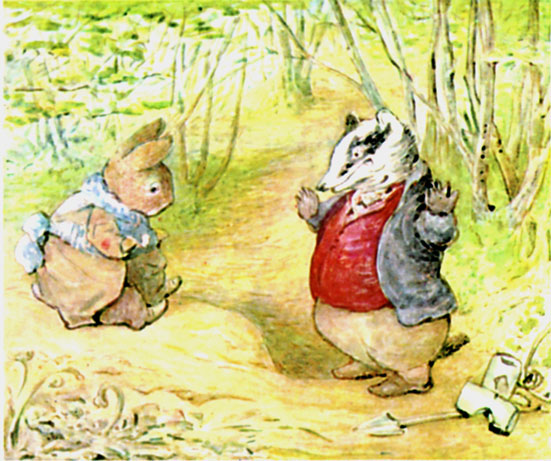
Tommy Brock from The Tale of Mr. Tod
Wikipedia links to a website called "Living With Environmental Change": "The role of badgers in our culture may muddy policy decisions":
Social attitudes to badgers shaped by literature, the media and even heraldry may be clouding debate about their contribution to spreading tuberculosis to cattle....

There are dignified depictions of badgers in heraldry, and an early version of Mr Badger even crops up in an Anglo Saxon poetic riddle from the 11th century, as a noble creature defending its family against attack.  More recent heroic appearances in children’s literature are common, with The Wind in the Willows probably the best known.

So we are familiar with the idea of badgers displaying characteristics that we like to think of as both human and laudable, such as strength, bravery and loyalty, while also being mysterious, nocturnal creatures that are symbolic of the natural world and British countryside.
I support the fight against TB and the vermin that spread it, but I will nevertheless promote the cultural character, the loveable badger. Here, Project Gutenberg has The Tale of Mr. Tod available in its entirety, with all the illustrations. I hope it doesn't further erode whatever foundation in reality you've maintained in your lifetime of exposure to fiction. 


[Mr. Bouncer] sat in the sun, and conversed cordially with Tommy Brock, who was passing through the wood with a sack and a little spud which he used for digging, and some mole traps. He complained bitterly about the scarcity of pheasants' eggs, and accused Mr. Tod of poaching them. And the otters had cleared off all the frogs while he was asleep in winter—"I have not had a good square meal for a fortnight, I am living on pig-nuts. I shall have to turn vegetarian and eat my own tail!" said Tommy Brock.

It was not much of a joke, but it tickled old Mr. Bouncer; because Tommy Brock was so fat and stumpy and grinning.
ADDED: My advice to animals: Get some stripes. People will fixate on your cuteness and let you overrun the place. It's not just badgers. Think of chipmunks. We have chipmunks all over the place here in Madison (where, despite our fictional character, Bucky Badger, we don't have badgers). Without stripes, they'd be more or less rats, and the level of infestation would horrify us.

Thursday, July 19, 2012

"Composite?"/"Compost heap's more like it."

We were watching "A Face in the Crowd" last night. TMC was making a night of Andy Griffith films, and I settled in to watch the Elia Kazan movie that I'd heard about but never seen. I've only watched the first half, partly because I usually watch movies in 2 parts — I have a 1-hour attention span — and partly because it started annoying me — too many absurd leaps forward in the story as our forgotten man "Lonesome" Rhodes becomes a media sensation by cutting through the bullshit and sexing up the ladies. That is, he rejects the bullshit of the sexless men who surround him and spins out his own sort of bullshit, e.g., promoting the inert pill "Vitajex" as some proto-Viagra.

Anyway, I wrote down something that reminded me of Obama. No, not his special appeal for women. It was this passage of dialogue:
Marcia Jeffries: You always drink like that?
Lonesome Rhodes: Not always. Back in Riddle they was pretty strict. Didn't allow us to touch hard liquor till we was 10 or 11.
Marcia Jeffries: Now is there really a town called Riddle?
Lonesome Rhodes: Well, tell you the flat truth, it's just a sort of a whatchacallit, a...
Marcia Jeffries: ... Composite?
Lonesome Rhodes: Compost heap's more like it. 
Composite!  Marcia Jeffries, the woman who discovers him for her radio show called "A Face in the Crowd" offers him the word "composite" to dignify his bullshit, and he does a little word play that rejects euphemism.

Obama's use of "composites" is well-discussed in the David Maraniss biography:

In his introduction [to Dreams from My Father] Obama states, “For the sake of compression, some of the characters that appear are composites of people I’ve known, and some events appear out of precise chronology.” There is more to it than that. The character creations and rearrangements of the book are not merely a matter of style, devices of compression, but are also substantive. The themes of the book control character and chronology. Time and again the narrative accentuates characters drawn from black acquaintances who played lesser roles in his real life but could be used to advance a line of thought, while leaving out or distorting the actions of friends who happened to be white. Sometimes the composites are even more complex; there are a few instances where black figures in the book have characteristics and histories that Obama took from white friends. The racial scene in his family history that is most familiar to the public, the time when he overheard his grandparents in Hawaii argue because his grandmother was afraid of a black man at the bus stop, also happens to be among those he pulled out of its real chronology and fit into a place where it might have more literary resonance. Like many other riffs in the book, it explored the parameters and frustrations of his blackness....

For a few years, in ninth and tenth grade, he shared his frustrations with a student two grades ahead of him named Keith Kakugawa. 178 In his memoir, he reinvented Kakugawa as a character called Ray who served a literary function as a symbol of young blackness, a mix of hot anger and cool detachment, the provocateur of hip, vulgar, get-real dialogues. In fact, Kakugawa was another hapa student, with a black and Native American mother and a Japanese father. Somewhere between pseudonymous and fictitious, Ray was the first of several distorted or composite characters employed in Dreams from My Father for similar purposes. Kakugawa was never in Barry’s closest gang of friends, but they did hang out now and then for those two years, and Barry felt freer to let down his guard around him, enjoying “his warmth and brash humor.” In the memoir Barry and Ray could be heard complaining about how rich white haole girls would never date them. In fact, neither had much trouble in that regard; Kakugawa dated an admiral’s daughter from the officers’ housing near Pearl Harbor and had the keys to her car, which he often drove around with “the Kid,” as he called Barry. In the book, Ray complained about “white folks this or white folks that,” a phrase that Barry found “uncomfortable” in his mouth because he unavoidably thought of his mother’s smile. But the Kid could grouse about his mother nonetheless. “If anyone heard a word from him when he was upset, I did,” Kakugawa recalled. “If I was mad at something he was mad at something. What was upsetting him— that his mother took off again. Seems like she never has time for him anymore— that kind of thing.”

In a less visceral and more lighthearted intellectual fashion, Barry also shared some of his inner thoughts with Tony Peterson, a graduating senior during Barry’s freshman year. 179 Peterson, who came from a military family at Schofield Barracks, was the only black student in his 1976 class and one of a handful at Punahou, counting the hapa students like Kakugawa, Obama, and Rik Smith, whose mother was Indian. (Joella Edwards, who was in Barry’s class, left Punahou in ninth grade.) When Peterson first heard that the black Ray in Obama’s memoir was Kakugawa, he was surprised. “When I think of the black kids at Punahou, I don’t think of Keith because he was half Japanese,” he said later. By his real name or any other, Peterson did not make Obama’s book, although some characteristics of a composite character in the college section fit him. He first met Barry on the basketball court before school, and soon started a regular session with him and Rik Smith that they jokingly called Ethnic Corner....

In his memoir Obama would tell a different story about one of the key moments in his gradual transformation from Barry to Barack. He wrote that he was talking to friends named Marcus and Regina. Marcus, portrayed as Afrocentric, had ridiculed him for reading Joseph Conrad’s Heart of Darkness, and Obama had defended himself by saying that he was reading it to understand “just what it is that makes white people so afraid.” After Marcus left, Regina— rendered in the memoir as astute and comfortable in her black identity— asked Obama what Marcus had called him, some African name. Barack, he told her. She said she thought his name was Barry. Barack was his given name, he explained. His father’s name. His father was Kenyan. Barack meant “blessed” in Arabic. His grandfather was Muslim. “It’s beautiful,” Regina responded, according to the memoir. “Mind if I call you Barack?” Not as long as she pronounced it right, he said.

Eric Moore was not in Dreams from My Father, nor could he recognize precisely who Marcus and Regina were. Hasan Chandoo, who was portrayed in the book (and, in a rare instance, was given his real name), was not sure either. He himself was accurately depicted, but to him the other composites, he said good-naturedly, seemed like “mumbo-jumbo.” At some places in the memoir, the characters were taken from real life but given pseudonyms. At other times they were composites. Marcus and Regina were composites, inspired in part by two upperclassmen, Earl Chew and Sarah Etta-Harris, but displaying characteristics from many other people as well as from the searching, divided soul of Obama himself. Like Regina in the book, Etta-Harris had studied abroad, winning a Thomas Watson fellowship to spend a year in Andalusia in Spain. But in his memoir Obama gave Regina a family history in Chicago, and that did not fit her. Rather, that aspect of Regina was an early iteration of someone Obama had not met at Oxy and would not know for another ten years, Michelle Robinson, to whom he was married by the time he wrote the memoir in the early 1990s. It was not precisely Michelle’s story, but close in many respects, as Obama had Regina telling him about her South Side memories: people so hot in the summer they went out by Lake Michigan to sleep; a vibrant community of taverns, pool halls, churches, kitchen nights with cousins, uncles, grandparents. “A vision,” he wrote, “that filled me with longing— a longing for place, and a fixed and definite history.” When he told Regina that he envied her, she scoffed. “For what?” she asked. “Memories,” he said. That response, Obama wrote, made her laugh and say she wished she had grown up in Hawaii.

This was one of the more telling paragraphs in the book, revealing what Obama thought he had missed out on in his young life and what he so dearly longed for. Though he was writing it in retrospect, long after his Oxy days and after he had finally made his way to Chicago, the early Regina, who existed mostly in his mind, helped trace what would become the arc of his life toward family and home.

Along with Etta-Harris and Michelle Robinson, the Regina character also incorporated a third real-life model. Some of Obama’s scenes of Regina reflected incidents that involved Caroline Boss, who was white. The name Regina itself likely came out of Obama’s discussions with Boss. Regina was the name of her Swiss grandmother, who came up in their discussions about class, race, and gender. Boss was a formidable figure at Oxy, queen of the Cooler rats, star pupil of the school’s noted political science professor, Roger Boesche. As leader of the Democratic Socialist Alliance on campus, she viewed politics from a class-conscious socialist perspective. Boss told Obama that her grandmother Regina spent her life scrubbing floors and doing laundry for the banking community in the small Swiss town of Interlaken. “So when we talked about race and class,” Boss said of her discussions with Obama, “I of course took the position that class was a significant feature.… The class thing really affects the entire population, regardless of race and gender.” Obama incorporated this idea into his memoir. His Regina was black, not white, yet he wrote about “Regina’s grandmother somewhere, her back bent, the flesh of her arms shaking as she scrubbed an endless floor. Slowly, the old woman lifted her head to look straight at me, and in her sagging face I saw that what bound us together went beyond anger or despair or pity.” He went on to link Regina’s grandmother to all women who struggle against the power structure, from the Mexican maids who cleaned up the mess created by the boys at the Haines Hall Annex to his own grandmother, Tut, who rose before dawn every morning to ride the bus to work. “My identity might begin with the fact of my race, but it didn’t, couldn’t, end there,” he wrote.
Composite/compost heap?

Friday, June 15, 2012

"Worse still than real dreams, mine or yours—sandier mouthfuls, ranker lies—are the dreams of characters in books and movies."

Writes Michael Chabon:
Nobody, not even Aunt Em, wants to hear about Dorothy’s dream when she wakes up at the end of The Wizard of Oz. As outright fantasy the journey to Oz is peerless, joyous, muscular with truth; to call it a dream (a low trick L. Frank Baum, who wrote the original story, never stooped to) is to demean it, to deny it, to lie; because nobody has dreams like that. Nobody has dreams like the dreams in Spellbound, either; or like those in Little Nemo in Slumberland, Alice in Wonderland, Inception...

If art is a mirror, dreams are the back of the head. A work of art derives its effects from light, sound, and movement, but dreams unfurl in darkness, silence, paralysis. Like a recipe attempted in an ill-provisioned kitchen, “dreamlike” art relies on substitutions: dutch angles, forced perspective, absurdist juxtapositions, arbitrary transformations, and, as Peter Dinklage’s character points out in the film Living in Oblivion, a lamentable superabundance of dwarfs.
Here's that scene in Living in Oblivion. (Shorter clip here. Buy the whole movie here. It's really good.)

I feel like I should make some wisecrack of that book written by the now-President of the United States, "Dreams From My Father." Who just signed that "Dream" law. Dreams figure big in political speech, for a few reasons.

Monday, March 19, 2012

"Metaphors like 'The singer had a velvet voice' and 'He had leathery hands' roused the sensory cortex..."

"... while phrases matched for meaning, like 'The singer had a pleasing voice' and 'He had strong hands,' did not."

Whip out your metaphors, guys. Science says it's thoroughly arousing, according to this second-most-emailed article in the New York Times. First-most is "Why Bilinguals Are Smarter." You see what's going on? The kind of NYT readers who email articles are entranced by brain science reports that stoke their vanity. Hey, girlfriends, see how smart I am? I loved studying French in college and I am always reading novels. Science says!

Bleh. If you were so smart, you wouldn't be emailing stuff through the NYT at this late date in the history of the computer. These are such stock NYT articles, appealing to the vanity of affluent, college-educated women. I don't for one minute believe these people care about science. I don't think they care about how the brain really works, that they'd read about the elaborate chemistry of the brain or anything like that. They just love the reports that back them up, that compliment them, telling them they must be smart because of some dumb thing that was always true of them — reading stories, playing with language, finding NYT articles that allow them to subtly preen to their friends via email.

Monday, January 30, 2012

"When I read a book, I'm handling a specific object in a specific time and place."

"The fact that when I take the book off the shelf it still says the same thing – that's reassuring."

Jonathan Franzen worries that ebooks — in place of print books — will reorient us in negative ways.
"Someone worked really hard to make the language just right, just the way they wanted it. They were so sure of it that they printed it in ink, on paper. A screen always feels like we could delete that, change that, move it around. So for a literature-crazed person like me, it's just not permanent enough."

For serious readers, Franzen said, "a sense of permanence has always been part of the experience". "Everything else in your life is fluid, but here is this text that doesn't change," he continued. "Will there still be readers 50 years from now who feel that way? Who have that hunger for something permanent and unalterable? I don't have a crystal ball. But I do fear that it's going to be very hard to make the world work if there's no permanence like that. That kind of radical contingency is not compatible with a system of justice or responsible self-government."

The acclaimed author of Freedom and The Corrections – which are published as ebooks – has said in the past that "it's doubtful that anyone with an internet connection at his workplace is writing good fiction". He seals the ethernet port on his own computer to prevent him connecting to the internet while he writes, also removing the card so he is unable to play computer games and wearing noise-cancelling headphones to prevent distraction.
Of course, the internet and the fluidity of etexts have changed us, and the changes should be particularly upsetting to fiction writers. In the future, who will sit down with a tome and become one with the sealed-off complete world created by a novelist? The internet is calling. Who can read a book? To read books now, I load them up in my iPad and read some of one and then another and another. I rotate the texts to give reading books more of a feeling of clicking all over the place on the internet. That feels more exciting and natural to me now.

Does my iPad book mix include any Frantzen? Yeah, I've got "How to Be Alone" — a collection of essays, nonfiction. And my audiobook collection, which I listen to in bits and shreds, includes "The Discomfort Zone" — which is nonfiction, a memoir full of relatively disconnected scenes.

Speaking of impermanence and dissolution, Franzen says:
"One of the consolations of dying is that... 'Well, that won't have to be my problem'... Seriously, the world is changing so quickly that if you had any more than 80 years of change I don't see how you could stand it psychologically."
Well, you could take off the noise-cancellation headphones, plug the ethernet back in, and flow and float through change on a minute-by-minute basis. But that would only deprive you of what Franzen sees as a basis for a positive attitude toward death. You'll still die in the end, but without the consolation of being saved from what you found unbearable — change.

Now, I'm seeing in Franzen's reasoning the notion that we ought to want to curl up with a good long fiction book in order to relinquish our hold on life. Is that what draws us, instead, into the vivid, roiling experience of ever-changing texts on the web? It's life, and we want to live.

Friday, October 21, 2011

Writing with dashes.

Do you like dashes? I do. There are certain ways of using dashes that I particularly admire. Rather than try to explain what I like so much, I'll give you an example. This is from the Charles Dickens novel, "Bleak House." The narrator is encountering the mother of a child who has just fallen down a flight of stairs.
Mrs. Jellyby, whose face reflected none of the uneasiness which we could not help showing in our own faces as the dear child's head recorded its passage with a bump on every stair — Richard afterwards said he counted seven, besides one for the landing — received us with perfect equanimity.
Doesn't that sentence make you feel like diagramming it... just for fun?

I like sentences like that — I think — because I like conversational side roads especially when they get you back to the main road. That relates to the way I feel about blogging. For example, the reason I was out there in Project Gutenberg searching for "Africa" on a webpage that contained the entire text of what is — in paperback — a 544-page book is that — like everyone else who checked Memeorandum today — I got waylaid by a NY Post story titled "Florida banker's wife left family to join Wall Street protesters."
A married mother of four from Florida ditched her family to become part of the raggedy mob in Zuccotti Park -- keeping the park clean by day and keeping herself warm at night with the help of a young waiter from Brooklyn.

“I’m not planning on going home,” an unapologetic Stacey Hessler, 38, told The Post yesterday.

“I have no idea what the future holds, but I’m here indefinitely. Forever,” said Hessler, whose home in DeLand sits 911 miles from the tarp she’s been sleeping under.
Hessler — who ironically is married to a banker — arrived 12 days ago and planned to stay for a week, but changed her plans after cozying up to some like-minded radicals, including Rami Shamir, 30, a waiter at a French bistro in Cobble Hill, Brooklyn.
Hey, check the dashes: "— who ironically is married to a banker —." Ironic? Or not ironic at all? It's just what you'd expect if you were reading a novel about a woman married to a banker. Stacey Hessler immediately called to mind Mrs. Jellyby. Remember Mrs. Jellyby? She's a minor character in "Bleak House." Here's a summary/spoiler:
[Mrs. Jellyby] resolutely devotes every waking hour to the “Borrioboola-Gha venture.” The reader never discovers the details of the endeavor except that it involves the settlement of impoverished Britons among African natives with the goal of supporting themselves through coffee growing.

Mrs. Jellyby is convinced that no other undertaking in life is so worthwhile, or would solve so many problems at a stroke. Dickens’s interest is not in the project, however, but rather in Mrs. Jellyby, who is so wedded to her work that she has no time for her several children, with the exception of Caddy, a daughter she has conscripted as her secretary. Ink-spattered Caddy puts in nearly as many hours as her mother in the daily task of answering letters and sending out literature about Borrioboola-Gha.

Caddy, however, has come to hate the very word “Africa” or any word that has the remotest suggestion of causes. For her, causes simply mean the ruin of family life. Mrs. Jellyby’s husband eventually becomes suicidal and, though surviving despair, is last seen in the book with his head resting despondently on a wall.

In the book’s postscript, we discover that the Borrioboola-Gha project failed after the local king sold the project’s volunteers into slavery in order to buy rum. Mrs. Jellyby quickly found another cause to occupy her time, “a mission with more correspondence than the old one,” thus providing a happy ending for a permanent campaigner.
Like a sentence with well-deployed dashes, it all comes together in the end.

"I felt that women betraying each other was something I was investigating at the time."

Said Tori Amos, explaining the origin of the song "Cornflake Girl":
The idea of that, and how quote-unquote friends can really hurt each other deeply, and the idea that the enemy is out there somewhere, but really, where we get hurt usually comes from people we are close to. So “Cornflake Girl” really was about two women, that one felt that the other had really betrayed her.
The inspiration came from Alice Walker’s book "The Temple Of My Familiar":
In the book, they talked about how young girls would be taken to a place for female circumcision, whether it was out in the desert of Africa or what have you, usually by somebody they trusted. A mother, a grandmother, somebody they loved, and of course the person that was doing this to them, taking them to the whatever you want to call it, the hacker or the mutilator, thought that they were doing the right thing, or else the girl wouldn’t be able to get married. They justify their betrayal, and that was really what prompted the idea of “Cornflake Girl.”
But wait, says Adam (at Throwing Things), what about that story about how "she beat out Sarah Jessica Parker to star in an ad for Kellogg's Just Right cereal?"


Just Right cereal... female genital mutilation... it's hard to imagine a greater disparity in sources for a song. And yet... everything goes into the mix, doesn't it? You read books about all sorts of drastic and dramatic occurrences and your own life ticks on with its miniature but important-to-you events, it all swirls around in your poet-brain, and out pop a song (and, over the years, out pop stories about whether the song came from).

This isn't journalism. It's art, and the only test is: it's a great song.

Tuesday, October 18, 2011

"Sotheby's to sell real drawing by fake artist."

"The London auction house said Monday it is offering a drawing by the talented but fictional American abstract expressionist Nat Tate."

You can see the drawing — "Bridge No. 114" — and read about the creation of Nat Tate by writer William Boyd here.
It all started in 1998. I was on the editorial board of Modern Painters magazine, then a very classy and influential art quarterly, and one day in a meeting the editor of the magazine, Karen Wright, wondered out loud if there was a way we could introduce some fiction into the mix of artists' profiles, exhibition reviews and general essays in which the magazine specialised. I don't know what made me speak out but I said, without really thinking: "Why don't I invent an artist?" And so Nat Tate was born.
So Boyd wrote his story, making Tate an Abstract Expressionist who gets depressed about his art after meeting Picasso* and ends up burning all his artwork and committing suicide.** Boyd allowed his fictional story to be published as a glossy art book with illustrations of artwork, and it was presented as if it were about a real artist. That it, it was a joke — the launch party was on an April Fool's Day 1998 — or, if you prefer, a hoax. People fell for it. The truth was revealed. Boyd professes himself hurt that it was called a hoax and not a joke. (Contemplate the hoax/joke distinction.)

Dogged by the accusations of hoax, Boyd conceived closure:
If this fictional artist could sell an artwork for real money then the Nat Tate story would have reached some kind of apotheosis and consummation. So I "found" another Nat Tate drawing – one from his famous bridge sequence... Sotheby's had form when it came to selling art by fictional artists, having successfully auctioned a Bruno Hat painting some years previously. Hat was a spoof artist that a group of bright young things had invented in 1929 and staged an exhibition of his work in a London town-house.... Hook consulted with colleagues and in due course I was told the sale was on...
Presumably, the form attends to all the incipient legal issues. If you go looking for closure, you surely don't want to touch off litigation. But the notion of closure is also fictional, no? I hadn't remembered the 12-year old story, and now I'm propagating it.

Actually, I like the idea of a fictional artist, and the artwork itself is real. (I've read "The Recognitions" by William Gaddis — "a masterwork about art and forgery, and the increasingly thin line between the counterfeit and the fake.") In the blogosphere, boring, humorless people express outrage when pranksters and artists experiment with "sockpuppets." It's too hard to play in this complex world we've made for ourselves. (Why did we go to all this trouble to exclude play?!)

But Boyd duly anticipates outrage. The proceeds from the sale of "Bridge No. 114" will go to a charity. Artist's Benevolent Institution. Wouldn't it be funny if that the name of William Boyd's bank account? No, you're not laughing? You're one of the killjoys!
_____________________________

*And Braque. Seriously, why kill yourself over Braque? What cherry on the top of a depression sundae is Braque? I'd have to read the book to tell you. There, I just bought the book. I'll tell you later. You, the 2 people who read this blog and want to know how Braque augmented Picasso in the emotional arc toward a fictional suicide.

** He uses the same suicide method — jumping off the Staten Island ferry — used by Spalding Gray. I hope Gray didn't read this book, looking, perhaps for inspiration.

ADDED: From Boyd's book:
... Nat felt vastly more at ease with Braque than with Picasso and gladly accepted when Braque offered to show him around his studio. Braque was then reworking his painting La Terrasse, which he had begun some eleven years earlier, a fact that Tate found astonishing, not to say incomprehensible. He was also deeply moved and captivated by some of the smaller elongated landscapes and seascapes in the studio. Apparently Tate ventured the opinion that they reminded him of van Gogh’s late landscapes. After gently correcting Tate’s pronunciation (‘Van Go? Non, mon ami, jamais’), Braque commented that he ‘regarded van Gogh as a great painter of night.’ The observation seemed to trouble Nat unduly, as if it was prophetic or gnomic in some sinister way... There is a photograph of the fête champêtre that Nat and Barkasian had with Braque and his family and friends during that visit, taken by Barkasian, one assumes, as he is absent from the picture. Braque himself sits at the centre of the table, dappled with autumn sunshine, while the women of the household fuss over the food and the placement. Nat stands close to the master, on his left, a plate in his hand, almost as if he is about to serve him. But his gaze is unfocused, he looks out of frame, at something in the middle distance, or perhaps just lost in his darkening thoughts. Nothing would ever be the same again.
So what was it about Braque that could drive you to suicide? His douchebag pronunciation of "Van Gogh"? His high school French? (I can talk French like that: Oui, mon ami, toujours!) Or was it the fact that — unlike an Abstract Expressionist — he fussed over a painting for 11 years, and — unlike an Abstract Expressionist — he maintained a calm and pretty domestic life? Dammit, that's it! I can't take it anymore!

Sunday, August 28, 2011

"I spent a lot of time thinking about contemporary Christianity, and obviously the rapture kept coming up."

"My first impulse was ... to laugh it off — it's sort of a funny idea, people just floating away. But I kept thinking: What if it did happen? ... I thought, I'm such a skeptic that even if it did happen, I would resist the implications of it, and I also thought that three years later, everyone would have forgotten about it. No matter what horrible thing happens in the world, the culture seems to move on."

Tom Perrotta, author of "Election" (which was made into a terrific movie) has written a novel about life after the rapture called "The Leftovers." Obviously, there's a big fiction genre on this subject, so what's interesting here is that a literary (as they say) novelist is applying his mind and methods to the Rapture.

Listen to the audio at the link. He's extremely insightful. I'm going to read the book. (Use my links please if you feel like buying it too.) Perhaps it irks you to think of a fancy "literary" writer — with access to NPR promotion — appropriating the material that "genre" writers have made their own. But if you listen to the interview, you'll see that he's not full of himself and not disrespectful toward those other writers. He seems genuinely interested in exploring the idea.

Friday, July 1, 2011

What if you soul-searched over an event that — you learn later — didn't happen?

Pity France, which self-critiqued over the Strauss-Kahn case that now seems not to have been what it once appeared to be.
His arrest... led to soul-searching about the treatment of women in France and a new assertiveness challenging male behavior. Responses to the latest news seemed to suggest that the debate had become less clear-cut.

“This is a slap in the face of the feminists,” said Marc Marciano, 53, a trader in Neuilly-sur-Seine, a Paris suburb....
What to do with all that insight gained? This reminds me of the old Tawana Brawley story, which led to soul-searching about racial bigotry and then turned out to be a fraud. One solution back then was to claim the insights are still good, even if the news that triggered the soul-searching was false.

In her book "The Alchemy of Race and Rights," lawprof Patricia J. Williams wrote that Brawley "has been the victim of some unspeakable crime. No matter how she got there. No matter who did it to her and even if she did it to herself."

I vividly remember a job talk at my law school in which the candidate described a racially charged incident with the police. He was questioned about whether the incident really happened that way, and his response — delivered quickly and glibly — was that the anecdote worked as an object of study from which to spin off insights whether it was true or not. The job talk was exceedingly well received.

If that seems terribly wrong to you, explain why, when we consume works of overt fiction — novels and movies and so forth — we feel that we derive insights applicable to the real world. I think some fictions resonate. They seem to speak to real life. They are not purely escapist fantasy. If it isn't wrong to use some works of fiction in our efforts to understand the real world, is it necessarily always wrong to use a news story presented as true that later turns out to be false?

UPDATE: "Dominique Strauss-Kahn was released from house arrest on Friday as the sexual assault case against him moved one step closer to dismissal after prosecutors told a Manhattan judge that they had serious problems with the case."

Monday, June 27, 2011

In the violent video games case, Scalia notes the irony of Alito's strenuous effort to describe the "astounding" violence.

From the majority opinion in the just-decided case of Brown, Governor of California v. Entertainment Merchants Association:
JUSTICE ALITO has done considerable independent research to identify, see post, at 14–15, nn. 13–18, video games in which “the violence is astounding,” post, at 14. “Victims are dismembered, decapitated, disemboweled, set on fire, and chopped into little pieces. . . . Blood gushes, splatters, and pools.” Ibid. JUSTICE ALITO recounts all these disgusting video games in order to disgust us—but disgust is not a valid basis for restricting expression. And the same is true of JUSTICE ALITO’s description, post, at 14–15, of those video games he has discovered that have a racial or ethnic motive for their violence—“‘ethnic cleansing’ [of] . . . African Americans, Latinos, or Jews.” To what end does he relate this? Does it somehow increase the “aggressiveness” that California wishes to suppress? Who knows? But it does arouse the reader’s ire, and the reader’s desire to put an end to this horrible message. Thus, ironically, JUSTICE ALITO’s argument highlights the precise danger posed by the California Act: that the ideas expressed by speech—whether it be violence, or gore, or racism—and not its objective effects, may be the real reason for governmental proscription.
The Court strikes down a California law that prohibits the sale or rental of "violent video games" to minors. The statute defined violent games in a way that "mimics the New York statute regulating obscenity-for-minors that we upheld in Ginsberg v. New York." But sex and violence are different: "obscenity is not protected expression" under the First and Fourteenth Amendments. California was trying "to create a wholly new category of content-based regulation that is permissible only for speech directed at children." "That is unprecedented and mistaken," the Court says today.
California’s argument would fare better if there were a longstanding tradition in this country of specially restricting children’s access to depictions of violence, but there is none. Certainly the books we give children to read—or read to them when they are younger—contain no shortage of gore. Grimm’s Fairy Tales, for example, are grim indeed. As her just deserts for trying to poison Snow White, the wicked queen is made to dance in red hot slippers “till she fell dead on the floor, a sad example of envy and jealousy.” The Complete Brothers Grimm Fairy Tales 198 (2006 ed.). Cinderella’s evil stepsisters have their eyes pecked out by doves. Id., at 95. And Hansel and Gretel (children!) kill their captor by baking her in an oven. Id., at 54.
I was reading that out loud here at Meadhouse, and somebody said: "The Supreme Court needs spoiler alerts!" 
High-school reading lists are full of similar fare. Homer’s Odysseus blinds Polyphemus the Cyclops by grinding out his eye with a heated stake. The Odyssey of Homer, Book IX, p. 125 (S. Butcher & A. Lang transls. 1909) (“Even so did we seize the fiery-pointed brand and whirled it round in his eye, and the blood flowed about the heated bar. And the breath of the flame singed his eyelids and brows all about, as the ball of the eye burnt away, and the roots thereof crackled in the flame”). In the Inferno, Dante and Virgil watch corrupt politicians struggle to stay submerged beneath a lake of boiling pitch, lest they be skewered by devils above the surface. Canto XXI, pp. 187–189 (A. Mandelbaum transl. Bantam Classic ed. 1982). And Golding’s Lord of the Flies recounts how a schoolboy called Piggy is savagely murdered by other children while marooned on an island. W. Golding, Lord of the Flies 208–209 (1997 ed.).
That Homer passage still grosses people out. Even after all the horrible movies and video games they've witnessed.

Alito, by the way, does not dissent. (Remember he was the lone dissenter in the Phelps case, showing the most empathy for sensitive people brutalized by ugly expression.) He thinks that "the experience of playing a video game may be quite different from the experience of reading a book, listening to a radio broadcast, or viewing a movie," and he'd prefer to put off the more difficult free speech questions and  "hold only that the particular law at issue here fails to provide the clear notice that the Constitution requires." That would leave room for legislatures to craft better laws designed to protect minors.

ADDED: The 2 dissenting opinions come from Justices Thomas and Breyer. Thomas relies on originalism: "the founding generation" didn't think First Amendment free speech included a right "to speak to minors (or a right of minors to access speech) without going through the minors’ parents or guardians." I haven't had the chance to read the entire opinion, but I can see that it contains some detailed discussion about the history of ideas about children. I'll leave that for another post.

Justice Breyer's dissenting opinion reject the facial challenge to the law. He says the "case is ultimately less about censorship than it is about education."
Our Constitution cannot succeed in securing the liberties it seeks to protect unless we can raise future generations committed cooperatively to mak­ing our system of government work.... Sometimes, children need to learn by making choices for themselves. Other times, choices are made for children—by their parents, by their teachers, and by the people acting democratically through their governments.

Wednesday, June 15, 2011

Why would the No Child Left Behind emphasis on math and reading leave less time to learn history?

I'm reading this Wall Street Journal article about new history history test scores:
The overall lackluster performance is certain to revive the debate about whether history and other subjects, such as science and art, are being pushed out of the curriculum because of the focus on math and reading demanded under the No Child Left Behind federal education law. The federal law mandates that students be tested in math and reading.
Why is this even a conflict? To learn reading,  you need reading material! Make the reading material nonfiction works about history. Problem solved.

I have discussed this issue before, and I know people have a problem with it, but schoolchildren don't need to read fiction to learn how to read. Let them choose their own fiction books for reading outside of school.

Monday, June 13, 2011

People who believed in the "Gay Girl in Damascus" need to explain why they believed this person was real and not fictional.

I'm not interested in the 40-year-old man who pretended to be young, Syrian, and lesbian. I'm interested in how intelligent people allowed themselves to be taken in.
For nearly a week, the world followed the saga of Amina Arraf, the blogger who was celebrated for her passionate, often intimate writings about the Syrian government’s crackdown on Arab Spring protesters. Those writings stopped abruptly last Monday, and in a posting on her blog, “A Gay Girl in Damascus,” a cousin said Amina had been hauled away by government security agents.

News of her disappearance became an Internet and media sensation. The U.S. State Department started an investigation. But almost immediately skeptics began asking: Had anyone ever actually met Amina? On Wednesday, pictures of her on the blog were revealed to have been taken from a London woman’s Facebook page.
Almost immediately... How slow on the uptake can you be and still get credit for catching on quickly. There are many ways to embarrass yourself in new media. Anthony Weiner made it very clear to us what one way is. He embarrassed himself. In the "Gay Girl in Damascus" incident, it is not the blogger (Tom MacMaster) who embarrassed himself. It's everyone who believed in the fiction and spread it around as truth without checking.
News organizations around the world, including The Washington Post, reported on the blogger’s disappearance Tuesday.
Mainstream media got played. Idiots!

Saturday, April 23, 2011

Recreating an old reality show, with actors playing the parts of the real people...

... who once lived their supposedly real lives in front of the cameras.

Is this something we want to watch now, or do we feel sorry for actors who are stuck with roles like this? Why not watch the original show, "An American Family," which aired in 1973?

HBO's "Cinema Verite" makes me feel the way I felt about the movie "Frost/Nixon." The original is still available. What's the point of actors imitating them? Presumably, there can be some different angles on what was really happening, but, most likely, we'll just be more aware of the phoniness of acting than we usually are.

Meanwhile, speaking of HBO, I'm struggling through the 5 episodes of the mini-series "Mildred Pierce." (I'm not watching alone, but I'm saying "I'm struggling," because I'm the one with the will to watch, and Meade mainly has this thing of hanging out with me when I'm watching one of my shows, which is something I also do for him sometimes (read:  sports).)

Now, "Mildred Pierce," isn't the recreation of something that happened in reality, but it is the recreation of an old and (for some people) very familiar movie. Kate Winslet is playing Joan Crawford. Now, it's not the same as watching Faye Dunaway play Joan Crawford in "Mommie Dearest," because both Joan and Kate were playing this fictional entity Mildred, but, come on. It was Joan Crawford. Winslet has the challenge of getting us to not think about Crawford.

Now, Kate's doing a fine job of not being Joan Crawford, but... the real thing here is melodrama, and Joan was more truly melodramatic, which means that Kate, by trying to be more authentically human, gives us a less genuine melodrama.

Saturday, October 2, 2010

The reason to read fiction: to engage with the mind of someone who isn't trying to sell you anything.

Argues Lorrie Moore (who's not saluting but having trouble keeping the light out of her eyes):


I love the idea that what we want from reading is to intertwine our minds with the mind of another human being and I understand why Moore connects that to freedom from commerce and why she find that purity in fiction. The funny thing is to want to write when you don't want to sell anything — even any ideas. It's not always true of fiction and not only true of fiction, but it is what we really want to read, isn't it?

Saturday, June 12, 2010

Saw the movie "Changeling" last night but I don't like to write movie reviews...

... so let me do what I did for the last Clint Eastwood movie I saw and challenge myself to write a list of 10 things. Here goes:

1. There were several points in this movie where, if I didn't know it was a true story, I would have turned it off. It's incredibly melodramatic. But if it's true, it's not incredible. It's credible.

2. I loathe movies about children in danger, both because I don't enjoy seeing children suffer and because I don't want to watch an actress ham it up pretending to be a mother who is agonizing over her suffering child. But I shielded myself from knowing what the story was going to be because I was told — by my son Chris — that the movie contained the greatest acting performance of the last decade and once I decide I will see a movie, I avoid reading anything about the plot.

3. I'd never seen an Angelina Jolie movie before. Looking at the list of movies she's made, I can see why. Although she seems like the biggest movie star in the world, she hasn't made many movies, and they aren't very good. She's done genres that I don't much follow (anymore). For example, she did one of the voices in "Kung Fu Panda." When I think of "Kung Fu Panda," I think of the Joshua Ferris short story "The Dinner Party":
“They just got their dates wrong, is all,” he said, “and tomorrow, when they call, they’ll tell you how sorry they are. They had to turn their phones off during the late showing of ‘Kung Fu Panda’ or something.”

“So they went to see ‘Kung Fu Panda’ tonight,” she said.

“Or something like it.”

“And they turned their phones off so they wouldn’t ring during ‘Kung Fu Panda.’ ”

“Or,” he said. “Or.” He put his finger up. They were standing near the bedroom doorway. There was dim light coming from the dark room and he was suddenly irrationally afraid, as he had been as a child, that if anyone stepped inside, if she stepped inside, she would plummet to the center of the earth. He lowered his finger. “I’m sorry,” he said. “I don’t think they went to see ‘Kung Fu Panda.’ ”
One wouldn't see "Kung Fu Panda."

4. Jolie emotes. That's for sure. It's what's called for and she does it. She goes all out and does it. She's the female Jack Nicholson. And this movie has a good dose of "One Flew Over the Cuckoo's Nest" in it. Now, take your medication. Or we'll give you an electroshock treatment. "Changeling" also made me think about another great Jack Nicholson movie, "Chinatown." Lots of L.A., lots of corruption.

5. Did Jolie out-act Kate Winslet? Winslet won the Oscar that year — for "The Reader." "The Reader" is also a melodrama, but it presents itself in less of a melodramatic style. Although "The Reader" is set in the Holocaust, the character is fictional, and her story is presented in a more dignified Oscar-worthy vehicle.

6. Quite oddly, there is a scene in "Changeling" in which the main character is listening to the Oscars presentation on the radio and rooting for her favorite movie to win. The movie is "It Happened One Night," and Jolie's character expresses her fondness for Claudette Colbert, who won an Oscar for her role. "It Happened One Night" swept the top 5 categories at the Oscars, and it wasn't until "One Flew Over the Cuckoo's Nest" that another movie swept the Oscars. I wondered what Clint Eastwood thought he was saying to the Academy by putting that Oscars scene in "Changeling." I don't think he was kissing their ass trying to get Oscars. Maybe it was a way to say Oscars are amusement for the people and they don't really matter to me anymore. But it would be pretty funny for Jolie to win an Oscar for a role where we'd have a clip of her in character getting excited about an Oscar win. It would be cute. Maybe she got some votes from Academy members who liked that.

7. Like "The Reader," "Changeling" has a scene that depicts
a hanging and uses a closeup of the hanged person's dangling feet — or is it just the shoes on the floor in "The Reader"? I forget.
(Mouse over Highlight to reveal spoiler.)(I think that's the first time I've used HTML that way.)

8. If you like red lipstick, this is the ultimate red lipstick movie. You've got, first of all, Angelina Jolie's famous, immense lips, and then you've got red red lipstick — of the historically accurate matte texture. And it looks like it was put on amateurishly by the character.

9. You like cloche hats? You will see cloche hats. Angelina Jolie's character seems to require a cloche hat — and gloves. (I couldn't figure out how she avoided getting red lipstick all over her gloves.) This is the ultimate cloche hat movie. What does the cloche hat mean? It speaks of the character's vulnerability and need for armor, which makes it
especially painful for us to see her without its protection when she's thrown into the psycho hospital.

10. What's with Angelina Jolie's hands?

11. Jolie calls Clint Eastwood "very much the ideal man":
Maybe it's generational, but I think we could use more of it. People look up to him. He is absolutely who he is. He doesn't apologize to anybody. He has very, very strong, decisive opinions and is very gracious as a man, as a friend and somebody on set as a director, too.
She tags on the wifely niceness — "Brad knows that he's my ideal man" — but, reading that, I hear the emphasis on "my." Brad may be her ideal man, but Eastwood is the ideal man.

Oh! I went to 11. I thought it would be hard to get to 10. Ha. I guess I enjoyed that movie. Maybe I'll watch it again with somebody who hasn't seen it before. Back in the 80s, we used to love showing "The Terminator" to people who hadn't seen it yet. All the surprises would be new again. Last week, I was flipping channels and came to rest on "From Dusk to Dawn," which had just started. I'd seen it before, but Meade hadn't. Great vicarious fun for me.