Pages

Labels

Showing posts with label Seinfeld. Show all posts

Friday, February 1, 2013

"The tears coursed down her cheeks — not freely, however..."

"... for when they came into contact with her heavily beaded eyelashes they assumed an inky color, and pursued the rest of their way in slow black rivulets."

That's the sentence from "The Great Gatsby" today, in the "Gatsby" project.

Tears coursed. The subject and the predicate are right up there at the outset. No teasing about where the foundation of this sentence is. Course is a strange verb for ran. There are reasons to choose the odder word. Course, for example, is more woody, less tinny than ran. The tears coursed, but not freely, because they got stuck on the woman's mascaraed eyelashes. It's thickly applied black mascara. We know it's thickly applied, because it's the excess blobs of mascara that give the impression of beads, and inky means black. So the tears got stuck on the blobs and became a coagulated black liquid, slowed down, but still, on each cheek, a little river, a rivulet.

Is rivulet a strange word? Classical Latin had the word rīvulus and there's rivoletto in Italian. John Milton used rivulet, in 1667, in "Paradise Lost," one of the books my readers urge upon me as they imagine they see the light at the end of the "Gatsby" tunnel. "As my train emerged from the tunnel into sunlight...," I found the rivulet sentence in "Paradise Lost":
In Bowre and Field he sought, where any tuft
Of Grove or Garden-Plot more pleasant lay,
Thir tendance or Plantation for delight,
By Fountain or by shadie Rivulet
He sought them both, but wish'd his hap might find
EVE separate, he wish'd, but not with hope
Of what so seldom chanc'd, when to his wish,
Beyond his hope, EVE separate he spies,
Veild in a Cloud of Fragrance, where she stood,
Half spi'd, so thick the Roses bushing round
About her glowd, oft stooping to support
Each Flour of slender stalk, whose head though gay
Carnation, Purple, Azure, or spect with Gold,
Hung drooping unsustaind, them she upstaies
Gently with Mirtle band, mindless the while,
Her self, though fairest unsupported Flour,
From her best prop so farr, and storn so nigh.
Oh, come on now! That sentence is absurdly long! And the spelling is so perverse — Bowre and Flour for bower and flower. I like the Roses bushing round as the Snake finds EVE alone. The gay flowers — floursdrooping... interestingly vulnerable. But storn... what is it? Storn! I know it's woody.

No, no, no! I'm too smart to succumb to that temptation. I am not a stooping, drooping blogger. I'm shrinking back into my "Gatsby" tunnel. Tomorrow is Groundhog Day, but I've seen my shadie shadow this evening. I'm frightened, terrified. The unfree tears course down my cheeks, slowed by the speed bumps of inky mascara.

Friday, December 28, 2012

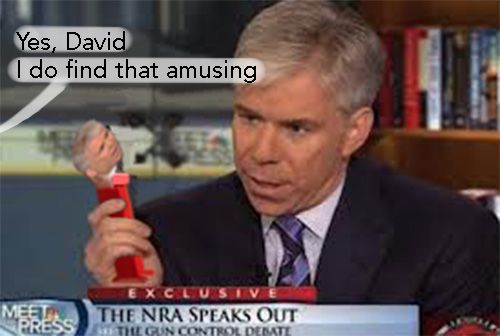
I finally figured out what David Gregory displaying that prop reminds me of.

Yesterday, I was asking: Why was that prop so important to David Gregory? If possession of that high-capacity magazine was a crime, and the NBC folk knew it and had even contacted the police and thus even knew they'd created rock-hard evidence that they knew it, why did they go ahead and have Gregory flaunt that illegal possession on television? They had to have thought it was a devastatingly powerful prop. My first guess was that they imagined that viewers — some viewers, at least — would find the object itself scary.

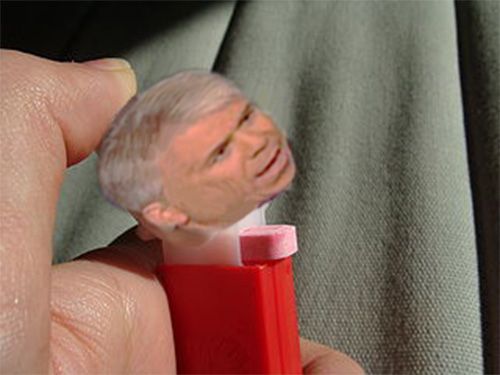
Now, I've got to show you another one of Chip Ahoy's little riffs, because it's what jogged my thinking on the subject for some reason. Here's Chip in the comments thread to that other post, the one where I showed those David Gregory masks (designed by Chip). This is a little dialogue:
"No. It doesn't look that threatening to me. If that's what you were thinking. No. It just doesn't."

"What do you mean? Are you insane? This magazine holds thirty rounds."

"So."

"So? So? So? Is that all you got? It holds thirty!"

"So. It's small. Looks like a PEZ dispenser to me."

"WHAT? So, this is amusing to you? You find this amusing."


Caption: "It holds 30." I'm not sure exactly why that jogged my thinking, but suddenly I understand the drama Gregory (and his people) were trying to enact. It's a deep psychic memory of childhood. Gregory sought dominance over his interlocutor, NRA CEO Wayne LaPierre, and the idea — in the act of picking up that magazine and beginning an interrogation about it — was that Gregory would become (subliminally) a parent figure who would push LaPierre into the subordinate role of the little boy, the cowering child confronted with undeniable evidence of his wrongdoing. What's THIS I found in your room?

The plan was for LaPierre to babble lamely, scrambling to explain it away, like the kid trying to concoct some cockamamie reason why that (whatever) got into his room. He'd look foolish and guilty, as Dad continues to hold up the item which the kid knows will be the defeat of every idea that flashes through his stupid, stupid brain.

The scenario didn't play out as scripted. LaPierre is a stolid veteran of many a confrontational interview. He's not going to let the interviewer get the upper hand that easily. Somebody needs to tell Gregory: We all want the hand. Hand is tough to get.

Sunday, October 14, 2012

"You don't drink coffee, you have coffee... Have is a big word."

"You have sex. You have surgery. You have second thoughts."

What do you have? What have you done?

Tuesday, August 7, 2012

Jerry Seinfeld almost critiques liberal thought.

At one point in this comic conversation with Ricky Gervais (the new episode of "Comedians in Cars Getting Coffee"). This interchange comes after much talk about how the car Jerry's driving is a death trap, and Jerry has just quoted Gary Gilmore's last words ("Let's do it"), which made Ricky laugh and then get introspective:
I really think the death penalty is too depressing to even think about. I don't agree with it that the state can show that sort of form of violence.
Jerry advances the conversation in the conventional way:
What about abortion? Do you agree with that?
Ricky gestures at the stock response:
Yeah, but that's different. Isn't it?
And here's where Jerry almost does the critique of liberal legal analysis:
I guess you can just arrange things the way you like them... when you're rich, famous, like you.
Notice how he had to catch himself and re-orient himself liberally with that when you're rich, famous. The rich must be the problem. They think they can arrange the rules to serve all their interests.

And then the final "like you" is a lifeline to Ricky, who catches it, saying, "Yeah. Unlike you, who's just a guy with an old car going along the highway, laughing maniacally 'cause someone's fear was they're about to die. I should have said 'Let's do it' when I got in this car."

And Jerry is laughing maniacally, clutching the death-trap's steering wheel in helpless hilarity. Scene over. Moving on the the coffee portion of the show.

Side note: All you Althouse blog readers who used to live in Pelham Parkway — check out the signage at 4:37.

Sunday, March 19, 2006

Do you correct people who call CDs "records"?

Well, stop it, because you're wrong. Listen to Jacques Barzun:
"The fallacy behind perpetual recoinage ... is to suppose that words must describe instead of stand for and evoke. For a reasonably stable language, words must continue to cover new details, and they can: we ship goods by truck and plane. We have cash in the bank though it is only a balance and not even written down. The bath room has only a shower stall. The table and bed linen are of cotton thread with some plastic intertwined. A lecture is not necessarily read. I am typing on a computer that uses no type. The man you quote who said record store was 'outdated but still in use' didn't stop to think. What are CD's and DVD's if not records?"
I enjoy observations like this. They're like Seinfeld jokes -- except not funny. Just satisfying.

Wednesday, October 19, 2005

The trouble with making fun of punditry.

A negative view of "The Colbert Report" in The New Republic (free link!):
"The Colbert Report" dragged through long laughless parts. Why? For two reasons: First, the people Colbert is ridiculing are already widely viewed as cartoonish; and second, he has chosen parody, rather than mockery, as the vehicle for making his point....

During his interview with [Stone] Phillips, Colbert complimented his guest's neck, boasted about his own Emmy and Peabody awards, and debated the merits of different tie knots. Basically he teased him. This kind of light banter is key to [Jon] Stewart's interviewing technique, but it's usually inlaid with more sincere questions. The balance of funny and anodyne keeps the report buoyant. But in his parodic mode, Colbert couldn't retreat into normal conversation. And his frantic humor seemed to discomfit Phillips, the audience, and the cameraman (the interview was a series of awkward angles and cuts).

Phillips's uncomfortable turn as a guest raises a question about "The Colbert Report": Is it lampooning newscasters, or is it promoting their senses of humor? Up until the interview segment, the show seemed like a straight-up O'Reilly spoof. But O'Reilly doesn't interview fellow cable newsmen; he talks to officials, congressmen, scandal-ridden citizens. He does so with an inane ferocity, while Colbert interrogated Phillips with a prankish, but gentle, buffoonery. So "The Colbert Report" has a split personality--on the one hand, making fun of punditry; on the other, winking along with it. The scheduling of future guests such as Lesley Stahl indicates that this schism will persist.
It is hard to do the comic character while interacting with real guests. Martin Short was able to do it as Jiminy Glick, but most of his guests were comedians, who had some ability to play along with the game. (Jerry Seinfeld was truly sublime as a guest on that show!) So far, Colbert has had only newsfolk on, and they are so preening about their images and not much good in the acting department.

Tuesday, September 6, 2005

Maynard to God: "You rang?"

So soon after failing to make a public demonstration of mourning upon the death of Chief Justice William Rehnquist, I'm going to have to cry publicly here over the death of one of my favorite television personalities, Bob Denver.

Just yesterday, re-watching the last episode of my favorite TV show, "The Comeback," I said, "Valerie Cherish is my favorite TV character, ever."

"Really? What about Seinfeld?"

"No." I thought back over all the TV characters I could remember to see if anyone meant so much to me and said, "There's only one other person I can think of: Maynard G. Krebs."

All the obits will forefront Gilligan. But I don't care about Gilligan. It's Maynard I love!

Like, I'm getting all misty.

IN THE COMMENTS: "When you think about it, how many actors play two iconic characters in their careers on TV?" He mentions Mary Tyler Moore and Bea Arthur. For me, Lisa Kudrow sprang instantly to mind. Then there's Patty Duke, who did it on one show. Robert Young. William Shatner? Don Knotts?

Monday, November 29, 2004

Seinfeld on "Oprah."

Jerry comes out to a huge ovation. He looks at the audience and says: "This is something. You do this every day?"

The audience constantly over-applauds. Oprah notes that she and Jerry are the same age (50), and the audience goes wild.

Jerry's response is perfect: "I love being 50. It means I'm almost done." Oprah goes into no! no! mode and Jerry has to say "it's just a joke" and a few other things until he finally lands on "it doesn't matter how old you are," and the audience goes wild again.

Oprah asks why they've only released the first three seasons on DVD, and Jerry says, "That's 40 episodes. How much time do you have?" There's a very distinctively Seinfeld way to say "How much time do you have?" and you've got to imagine it to find it funny. It's impossible to render in type. Something like: "How … much time … do you … have?"

Oprah asks him what he finds funny on TV today, and he says he watches a lot of "Sesame Street," and he thinks about how people tell him he should do another show: "I sit there and I watch this Elmo guy. And he is so likeable and so funny and so charming. And I sit there with my daughter, and I think: let him bust his little red ass."

Jerry's wife is there (and moved to tears by the experience of being 20 feet away from Oprah), so the conversation turns to marriage. Jerry says he was surprised at all the questions. He thought "Do you take this woman?" would be the last one. But now it's "How long are you going to sit there watching TV?": "I wish I knew the answer to that one myself."

Jerry's wife tells us he's "sweet," but can't come up with much of an answer to Oprah's request for a story. He's nice to his kids.

Oprah asks him about his obsessions: dolphins (they have "nice smiles"), Bic pens ("Every joke for the Seinfeld show was written with a Bic pen"), sneakers ("I'm wearing shoes just for you.")

The Puffy Shirt is being put in the Smithsonian, we're told.

Seinfeld's wife says has not seen all the episodes of "Seinfeld."

Oprah brings out Jason Alexander. The crowd acts pretty thrilled, even though it's just Jason Alexander.

Oprah brings out Julia Louis-Dreyfus. Clearly, the audience (nearly all women) likes her more than Jason. She looks great, Oprah tells her. Truthfully! Oprah shows Julia a clip of several audience members imitating Elaine's little steps dance [added: technically, it's "The Little Kicks."]. Julia says "wow" but doesn't seem that enthused. She seems not to be so much like the people in the audience, even though they identify with Elaine. Jerry helps out with a joke: "It's really true that girls just wanna have fun."

Oprah brings out Michael Richards. His hair is slicked down. He describes looking for "little things" in the script, ad libbing "the sound effects," practicing lines off by himself, and feeling that Kramer was playing him and that what he needed to do was to "get out of the way."

We're told Jerry bought Billy Joel's house in the Hamptons and we're shown some photos of him and his wife and kids on a windswept beach and in a sparkling, white kitchen. The audience goes "aaah!"

Talking about the last "Seinfeld" show, Jason Alexander says that, as they were about to shoot, Jerry said to them, "For the rest of our lives, when anyone thinks of any one of us, they'll think of all four." The audience goes "awwww." Oprah goes, "That is sweet." When the show ended, Jerry took some parts of the set (which he keeps with his Porsches). He took the door, the couch, and one of the booths from the restaurant. Michael Richards and Jason Alexander just took their shoes and (Alexander only) his glasses. Julia Louis-Dreyfus took her wardrobe, and jokes that she doesn't know why. (On the DVD commentary, she often talks about how bad Elaine's clothes were, and also how bad Jerry's clothes were. George's clothes were always intended to look bad. Kramer's clothes were supposed to be strange, and it's noted in the DVD commentary that only Kramer's clothes look good now. That vintage look aged well.)

After the final commercial break, there's only time enough to push the DVD one more time and say good-bye, but Oprah whips the crowd back up into a hysterical, jubilant cheer. As the closing credits roll, Oprah hugs each of the "Seinfeld" castmembers, kicking one leg up when she hugs Jerry and again when she hugs Michael Richards.

UPDATE: The group continues, more casually, on "Oprah After the Show." Oprah talks about how Jerry and his wife invited her to dinner but she had to refuse because she's on a diet that has a rule against eating after 7:30 at night.

We're shown photos of Julia Louis-Dreyfus's house, which has a retractable roof is dedicated to ecological principles. "It has sustainable woods" causes Jerry to say "What does that mean?" The question isn't answered. It's a joke. The tile, we're told, is made from recycled carpet. "It is a totally green house," Louis-Dreyfus says. Much applause.

Jerry offers this piece of advice: "If you never make a career choice based on money, you'll always have money." Hey, it worked for him!

Oprah asks what's your favorite episode. Jerry: "The Marine Biologist." Jason: "The Parking Garage." Michael: "The Parking Garage." Julia: wasn't asked.

They talk about Jerry's favorite comedian, Bill Cosby. When he walks down the street, Jerry says, he's happy to meet everyone who comes up to him. Oprah tells us that when he appeared on her show, he was dropped off alone! She clearly thinks this is flat-out amazing.

What comedian does Michael Richards love? Charlie Chaplin, Stan Laurel, Jacques Tati, the early Peter Sellers. Good answer! So good it almost makes me cry to think that more roles have not come Richards' way. He adds: "And I love the great Red Skelton." Ah! I loved Red Skelton so much when I was a child. I loved him in that deep, childlike way where you completely believe that everyone loves him.

Julia Louis-Dreyfus? "I think Ellen DeGeneres is unbelievably funny." She also loves the funny actresses, specifically, Mary Tyler Moore and Lucy.

Jason? Jon Stewart. And Jerry.

Wednesday, May 19, 2004

Odd Couples.

As noted yesterday, I didn't watch too many situation comedies after 1969 (Seinfeld and Sex and the City are two exceptions), so I was never interested in the TV show The Odd Couple. One situation comedy that I did watch, pre-1969, was Mr. Peepers, which was on in the 1950s. I was a very little kid at the time, so my memory is only of seeing it and knowing that everyone loved it. Tony Randall wasn't the star, but he was the star's sidekick, and the show made Randall popular. Maybe the attention to Randall right now could lead to a DVD collection of Mr. Peepers. I'd love to see that. People who remember loving The Odd Couple should want to see Mr. Peepers, because it featured two contrasting male characters. In Mr. Peepers they were both high school teachers. (I see the name of the high school was Jefferson, and Randall named his only son Jefferson.) Peepers, played by Wally Cox, was extremely mild-mannered and sweet, and Randall's character was brash and swaggering. Come to think of it, many great TV shows have been built on the idea of two characters who are the same sex but have very different personalities. I suppose it all goes back to Laurel and Hardy (or whoever they got the idea from).