Pages

Labels

Showing posts with label WWII. Show all posts

Thursday, January 3, 2013

And our "History of" country today is...


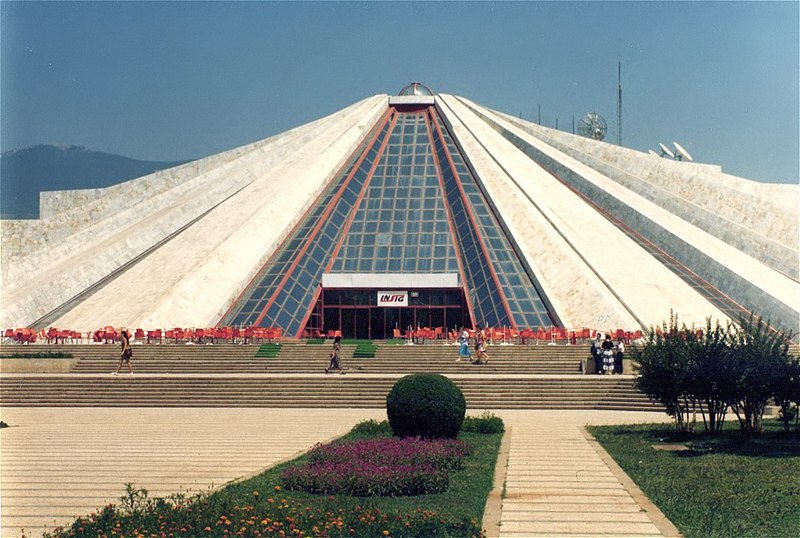
Do you recognize where this is? A clue: That's a photo of what used to be called the Enver Hoxha Mausoleum. If I told you it's in the capital city of Tirana, would you know the country, or is it easy because we are proceeding through the Wikipedia "History of" pages for the 206 countries in the world in alphabetical order?


This is Albania, a region where, in antiquity, the Illyrians lived. There was Roman rule, Byzantine rule, invasions by Visigoths, Huns, and Ostrogoths, the Bulgarian Empire, and the Ottoman Empire:
Part of the Albanian population gradually converted to Islam, with many joining the Sufi Order of the Bektashi. Converting from Christianity to Islam brought considerable advantages, including access to Ottoman trade networks, bureaucratic positions and the army.... The Albanians proved generally faithful to Ottoman rule following the end of the resistance led by [feudal heir] Skanderbeg, and accepted Islam more easily than their neighbors. No fewer than 42 Grand Viziers of the Empire were of Albanian descent....

[I]n the 19th century... an Albanian National Awakening took place and many revolts against the Ottoman Empire were organized...

The Principality [of Albania] was established on 21 February 1914. The Great Powers selected Prince William of Wied, a nephew of Queen Elisabeth of Romania to become the sovereign of the newly independent Albania....
There was WWI, then the rule of King Zog, who initiated reforms (such as ending the custom of making one's region part of one's name) and who was overthrown by the Italians under Mussolini in 1939. Mussolini "saw Albania as a historical part of the Roman Empire" and imposed "a policy of forced Italianization." After the Italian surrender in 1943, Germany occupied Albania. Germany "sought to gain popular support by backing causes popular with Albanians, especially the annexation of Kosovo.... Albanian collaborators... expelled and killed Serbs living in Kosovo."

After the Soviets liberated Albania in 1944, Enver Hoxha, the secretary general of the Albanian Communist Party, became the leader of the Socialist People's Republic of Albania, and he continued on in that role for 41 years, until he died in 1985.
In 1967, the authorities conducted a violent campaign to extinguish religious practice in Albania, claiming that religion had divided the Albanian nation and kept it mired in backwardness. Student agitators combed the countryside, forcing Albanians to quit practicing their faith. Despite complaints, even by APL members, all churches, mosques, monasteries, and other religious institutions had been closed or converted into warehouses, gymnasiums, and workshops by year's end.
The Communists were defeated by the Democratic Party in 1992. Efforts to introduce capitalism — Wikipedia says — "led to the proliferation of pyramid schemes" and "anarchy," which was stabilized by "an EU military mission led by Italy." In 2009, Albania joined NATO.

That's enough from Wikipedia for now. I can't vouch for the accuracy of any of that, but it's a jumping off place that is far beyond anything I'd had in my head before reading it. Enver Hoxha? Previously unfamiliar to me. And his erstwhile mausoleum? Horrific. Looking for better images, I found this nice Flickr stream, and I'll send you to this image first, because I love it. Then you you can click the "newer"/"older" buttons to see what else is there.

Monday, December 17, 2012

"What a liar" — famously muttered into an open mike.

It's the one thing I've always remembered about Daniel K. Inouye.

Dead now, at age 88.

Inouye was a World War II hero and Medal of Honor winner who lost an arm to a German hand grenade during a battle in Italy. He became the first Japanese-American to serve in Congress, when he was elected to the House in 1959, the year Hawaii became a state. He won election to the Senate three years later and served there longer than anyone in American history except Robert Byrd of West Virginia, who died in 2010 after 51 years in the Senate....

In 1968, President Lyndon Johnson urged Vice President Hubert Humphrey, who had won the Democratic nomination for president, to select Inouye as his running mate. Johnson told Humphrey that Inouye's World War II injuries would silence Humphrey's critics on the Vietnam War.

"He answers Vietnam with that empty sleeve. He answers your problems with (Republican presidential candidate Richard) Nixon with that empty sleeve," Johnson said.

But Inouye was not interested.

Wednesday, December 12, 2012

"I'm switching to Polish now, in stores and elsewhere. But I find that I have that American softness to my speech. The Polish melodic inflection is gone too."

"I hear its absence, but I do nothing to force it back. I'm kind of enjoying the reaction. At several points, people think that I am an American who has learned Polish very very well. Nearly perfectly! The accent isn't perfect, but so what! Which brings me to this question that I come back to again and again: why do so many Poles love America so much? Even as that love is not at all reciprocated. I mean, America let them down. Again and again. Thinking back to the war (and I do, every time that I am here)...."

My colleague Nina, in Warsaw, with lots of photographs, including one of a snow-covered statue of Ronald Reagan.

Friday, December 7, 2012

"On Dec. 7, 1941, when Japanese planes attacked Pearl Harbor..."

"... I was working as a reporter for the Hono­lulu Star-Bulletin."
After a week of war, I wrote a story directed at Hawaii’s women; I thought it would be useful for them to know what I had seen. It might help prepare them for what lay ahead. But my editors thought the graphic content would be too upsetting for readers and decided not to run my article. It appears here for the first time.

Wednesday, May 30, 2012

Obama's Poland gaffe — you know, it was a Poland gaffe that lost the election in 1976 for Gerald Ford.

What Obama said was "Polish death camps," a terrible misstatement, carelessly referring to the geographic location of the camps without noticing the implication that that the Polish people ran those camps.

What Gerald Ford said, in a crucial debate with Jimmy Carter, was: "There is no Soviet domination of Eastern Europe, an there never will be under a Ford administration." In a 1989 interview, Jim Lehrer asked "why did you say that?"
There's no question I did not adequately explain what I was thinking. I felt very strongly, and I, of course, do so today, that regardless of the number of Soviet armored divisions in Poland, the Russians would never dominate the Polish spirit. That's what I should have said. I simply left out the fact that at that time in 1976, the Russians had about 10 to 15 divisions in Poland. Well, of course the presence of those divisions indicates a domination physically of the Poles, but despite that military occupation of Poland by the Soviets, it never in any way ever destroyed the strong, nationalistic spirit of the Polish people. And I felt, and of course, I'm pleased now the Poles are going to throw the Russians out And the quicker they do it, the better. And I'm proud of what they're doing, and, of course, I get a little satisfaction that maybe I was right in 1976.

JIM LEHRER: Let's go back at the time you said that. I'm sure you've replayed this in your mind a million times. I don't have to remind you what happened. You gave that answer, and then there was a follow-up, and you repeated it, so my question is did you have any idea that you had said something wrong?

PRESIDENT GERALD FORD: Not at the time. Not at the time, because as you may remember, I included Yugoslavia, and Hungary, I believe, and Poland in the initial answer, and I said the Soviet Union does not dominate these countries. They're autonomous, and of course, it related to an earlier comment I had made about the Helsinki accord, which had established the borderlines of all the Eastern and Western European countries. So at the time, I did not feel that I had made an error. In retrospect, obviously, the inclusion of a sentence or maybe a phrase would have made all the difference in the world.

JIM LEHRER: When did you realize that you had made a mistake, or at least or do you honestly believe you made a mistake, now, sitting here now?

PRESIDENT GERALD FORD: Well, I can see that I made a mistake in not adequately explaining what I had in mind. I have never had any doubts, none whatsoever about the strength of the Policy people to throw the Soviet or the Russian forces out, and to reestablish an independent Poland. I felt after the debate was over that I had overall done well because we had pointed out that Mr. Carter had been calling for significant reductions in military expenditures, which, of course, was not the right policy, and I pointed out his lack o experience in foreign policy military decision making. So when I finished the debate, I felt very comfortable. But the press focused in on that one exchange, and I happen to think that most of the press distorted the facts, and overly emphasized something that was not the most substantive issue in the whole debate.

JIM LEHRER: Do you happen to remember that just as the debate was over, when you first talked to your aides, your family, or whatever, did anybody say to you, Mr. President you made a mistake, you did bad on this one statement.

PRESIDENT GERALD FORD: The first comments by my staff were that we had done very, very well overall. But then when the press, in their own analysis --

JIM LEHRER: Immediately, you mean right after the debate.

PRESIDENT GERALD FORD: The press that were making the post debate analysis focused in on that, and made very adverse comments about my comment. Well, when that press reaction became the dominant one, of course, the whole feeling that I had won this debate overall changed quite dramatically.

JIM LEHRER: How important do you think that was to the outcome of the election?

PRESIDENT GERALD FORD: It was a factor. As you also know, we ended up losing by only a point and a half, or maybe two points. So any one of a number of problem in the campaign could have made the difference. The second debate might have made a difference. The pardon of President Nixon might have made a difference. The timing of certain economic news that came out in October that indicated we were not doing as well in coming out of the recession if the news we got in because through mid-November on the economy had come in mid-October, I think we would have won, because through November, economic news was good. The October news just before the election was not very good. So any one of a number of three or four problems, difficulties could have made a difference. We only had to change 6,500 votes in Ohio out of 4 million, and about 20,000, as I recall, in Hawaii and we would have won the election.

JIM LEHRER: When you lost the election, did you ever fly back some night by yourself thinking if I just had not said that in that debate about Poland and Eastern Europe, it might have come out differently? Did it haunt you?

PRESIDENT GERALD FORD: Not at all, Jim. I have always had the attitude, what's gone past you have to forget, and you have to look down the road and build for the future. Of course, Betty and I hated to lose. We did our best. But once the verdict was there by the voters we had no remorse. We didn't sit around and moan and groan. We had a new life to lead, and we started planning whatever our future would be.
By the way, I watched the debate at the time, and I understood what he meant as he said it. I heard how the spinners spun it immediately after the debate and saw how it played in the media and how much it hurt him. If only there had been bloggers back then to push back! 

Wednesday, February 29, 2012

"A carpenter came with a toolbox and said, ‘I’m a carpenter from the underground... Show me the house and I’ll build a hiding place."

Dr. Tina Strobos hid more than 100 Jews from the Nazis — 4 or 5 at a time. She died this week at the age of 91. She learned her values from her parents, "socialist atheists who took in Belgian refugees during World War I and hid German and Austrian refugees before World War II."
The Gestapo searched the rooming house several times. But Dr. Strobos, a tall, soft-spoken woman, beguiled the Germans with her fluency in their language and her cool, ingenuous pose....

Dr. Strobos rode her bicycle for miles outside the city to carry ration stamps to Jews hiding on farms. She transported radios to resistance fighters and stashed their guns. She created fake identity cards — ones that were not stamped with a J — either by stealing photographs and fingerprinted documents from legitimate guests at the boarding house or making deals with pickpockets to swipe documents from railway travelers.

She was cold and hungry when she took those risks and was interrogated nine times by the Gestapo. Once, she was left unconscious after an official threw her against a wall.

“It’s the right thing to do,” she said when asked why she had taken such gambles. “Your conscience tells you to do it. I believe in heroism, and when you’re young you want to do dangerous things.”

Thursday, June 23, 2011

"The liberals who long to return to the Midcentury Moment seem to forget that it was a time of enormous cultural uniformity that stigmatized being unmarried or unchurched or gay."

Observes Michael Barone, explaining "liberal nostalgia" for what he calls "America's Midcentury Moment":
The huge menu of lifestyle choices from which we can choose today was a very short menu with very few choices then. It could not last. Baby-boom children, raised in prosperity, were not content with being small units in large machines....

Vietnam, urban riots, Watergate, stagflation—all undermined confidence in big government, big business and big labor, and by the late 1970s the Midcentury Moment was long gone....

So the Obama Democrats, partially successful in expanding the size and scope of government, largely unsuccessful in reviving private-sector unions, are on the defensive politically. As Mr. Levison and other liberals recognize, most Americans don't accept Keynesian economics and don't favor expansion of government as they did during the Midcentury Moment....

[T]he Midcentury Moment's confidence in big institutions was inextricably connected with an acceptance of a cultural uniformity that almost all of today's liberals, and probably most non-liberals, would find unacceptable.
Read the whole thing. There's much about the unifying effect of WWII and the military draft. Do you buy this — the notion that belief in big government depends on cultural uniformity?

Tuesday, May 10, 2011

Who does Newt Gingrich think he is?

Eisenhower?
The last guy to be elected president without having won statewide or national office was Dwight D. Eisenhower...
De Gaulle?
... Gingrich is a devotee of the historian Arnold J. Toynbee, who meditated on the concept of “departure and return” — the idea that great leaders have to leave (or be banished from) their kingdoms before they can better themselves and return as conquering heroes. One of Newt’s heroes, the French general and statesman Charles de Gaulle, embodies just this kind of romantic narrative, having spent 12 years out of power before returning to lead his country.
Reagan?
So does Ronald Reagan, who traveled the country after losing his bid for the Republican nomination in 1976, then came roaring back to win it all four years later.
Nixon?
Unlike Mr. Reagan, who even in his lower moments retained a certain celebrity appeal, Mr. Nixon was humiliated and all but exiled after publicly self-destructing in 1962. He then retreated to the sidelines and watched as his party disintegrated, leaving a vacuum of leadership and gravitas on the right that enabled Mr. Nixon to make one of the great comebacks in political history.

Tuesday, June 15, 2010

Let's watch Obama's big speech.

7:06: He's laying out a "battle plan" to fight the leak at the bottom of the Gulf of Mexico. He's "deploying" the military.

7:08: What to do during the "siege." A decision has been made to speak in military terms. Of course, he's not the first President to ask us to think about a nonmilitary problem in military terms. The War on X... the moral equivalent of war....

7:12: To make sure this won't happen again, Obama is establishing a commission.

7:15: We need to "jump start" the "clean energy" future. There's "the potential" to create "millions of jobs" but "only" if we "act together." We need to do something big at the national level to make this happen. Some people say we can't afford this, but he's saying we can't afford not to do it. He's vague about what this will be. The only thing he won't accept is doing nothing. He won't accept the "paltry limits of conventional wisdom." So even though we don't "precisely know" what we need to do, we will do it. Like we did in WWII and in going to the moon. We'll do something. And it will have to be big, but we don't know what it is. Then he drops from that scarily high level of abstraction and the unknown to... shrimpers. Something about shrimp people. We must think BIG and... shrimpy.

7:20: And suddenly, it's getting religious. I think he's bringing this speech in for a landing, because... it's a bit prayer-like. There's a "hand" that will "guide us." And — yes — it is the end: "May God bless America."

7:26: Well, that was a terrible speech! When it wasn't grim and dreary, it was grandiose. But the grandiosity was so vague... and half-hearted. Oh! The malaise!

AND: Here's the text of the speech. This is the part that interested me most:
As we recover from this recession, the transition to clean energy has the potential to grow our economy and create millions of jobs -– but only if we accelerate that transition.  Only if we seize the moment. And only if we rally together and act as one nation –- workers and entrepreneurs; scientists and citizens; the public and private sectors.  
This is the anti-capitalist move. There is all this opportunity, but free enterprise and capitalism can't take advantage of it. We need a top-down, government-imposed scheme, he announces. He doesn't explain why. It's an article of faith.
Now, there are costs associated with this transition [towards energy independence].  And there are some who believe that we can’t afford those costs right now.  I say we can’t afford not to change how we produce and use energy....
This is such embarrassing cliché rhetoric: Some say we can't do it. I say we can't not do it.


He cites a bunch of modest ideas that have been suggested and says we should think about them, then says that we have to do something, even though you could take all those things together, impose them, and still not break what he calls our "addiction" to fossil fuel. He blathers about WWII and the moon landing -- as noted above --  and talks about "what has defined us as a nation": "the capacity to shape our destiny....  Even if we’re unsure exactly what that looks like.  Even if we don’t yet know precisely how we’re going to get there.  We know we’ll get there." That is so hopelessly grandiose and vague, and to keep us from looking at it too long and despairing, he's all: Look! Shrimp!
Each year, at the beginning of shrimping season, the region’s fishermen take part in a tradition that was brought to America long ago by fishing immigrants from Europe.  It’s called “The Blessing of the Fleet,” and today it’s a celebration where clergy from different religions gather to say a prayer for the safety and success of the men and women who will soon head out to sea....
It's the shrimp and religion combo platter. Yummy!

Tuesday, June 8, 2010

"The Japanese have their own eldercare crisis because of the size of their WWII widow population."

"Due to their understanding of the high costs of sufficient and appropriate eldercare, the Japanese government has spent one hundred million dollars ($100,000,000) in grants (to Sanyo, Toshiba, Hitachi, Fujitsu, NEC, etc.) over the last eight to ten years to develop personal robots for their own eldercare crisis, yet no viable solutions have been developed by them to date."

"Viable" is a poignant word to use.
viable

1828, from Fr. viable "capable of life" (1539), from vie "life" (from L. vita "life;" see vital) + -able. Originally of newborn infants; generalized sense is first recorded 1848.
It's a familiar word in the American law relating to abortion.

Is the eldercare problem in Japan really about all the men who died in WWII, or is more about the failure to produce new human beings who might take care of the old?

Tuesday, December 12, 2006

"If we do hear from my great-uncle, I'll be sure to let you know."

"Until then, though, I'll be working under the assumption that the Holocaust happened."

AND: Consider this, from Anne Applebaum:
Unfortunately, Iran is serious—or at least Iran's president, Mahmoud Ahmadinejad, is deadly serious. Holocaust denial is his personal passion, not just a way of taunting Israel, and it's based in his personal interpretation of history. Earlier this year, in a distinctly eerie open letter to German Chancellor Angela Merkel, he lauded the great achievements of German culture and assaulted "the propaganda machinery after World War II that has been so colossal that [it] has caused some people to believe that they are the guilty party." Such views hearken back to the 1930s, when the then-Shah of Iran was an admirer of Hitler's notion of the "Aryan master race," to which Persians were meant to belong. Ahmadinejad himself counts as a mentor an early revolutionary who was heavily influenced by wartime Nazi propaganda. It shows.

Saturday, November 11, 2006

Veterans Day, Madison, Wisconsin.

An American woman:

Veterans Day

The Korean war veteran:

Veterans Day

The Young Marines:

Veterans Day

The Patriot Guard Riders:

Veterans Day

After taking these pictures, I go to my usual café, find a table, and start working on getting them uploaded. I hear a middle aged woman talking to the barista:
What is it? Veterans Day? There are soldiers everywhere.

Her voice drops a note on the words "veterans" and "soldiers." She's got a slight sarcastic tone as if she thinks she's saying something funny.

Imagine. Soldiers. In Madison.

IN CASE IT ISN'T OBVIOUS: To all the veterans, thank you. My parents were WWII veterans. I do not exist except as something that came from veterans. We all owe our world to the service of veterans. Your world is more real than ours. Today, I saw a veteran carrying a banner that said, "Freedom is not free." We know we owe that to you. And we are all humbled by your service. I feel that especially, because I know that I would never have lived if my mother had not felt an insipiration to join the Army and met my father there.

Monday, May 30, 2005

WAC Life.

Both my parents served in the Army in WWII, and one of my personal treasures is War Department Pamphlet 35-3 May 1945: "WAC Life." This is not an entirely appropriate Memorial Day post, but let me offer you three scans from the book.

"Good Soldiering":


"Stay Feminine":


"The Salute":


(Click -- and click a second time on "all sizes" -- to enlarge. The text is readable.)

UPDATE: At my Flickr page, I can see that many more people have clicked on the "Stay Feminine" picture than the other two. Sissy Willis writes about that one. She transcribes this part of the text from my scan and adds boldface:
Keep your hair neat, your make-up fresh, your uniforms tidy. Use deodorant frequently. Check to see whether you have unpleasant breath. Above all, act and think like a person who expects to be liked and admired. Maintaining your feminine appeal will buck up your morale tremendously. When you're happy about life in general, you'll be happy about your life in the Army.

I am stunned, reading this pamphlet, at how clearly and concisely and cogently the Army advised its recruits. "Act and think like a person who expects to be liked and admired" -- that's just brilliant, isn't it?

Maybe we should be teaching our kids that and bolstering our own morale with that idea. Do you fritter away your mental energy worrying about whether people like and respect you? Quit worrying and agonizing and whining. You just need to act and think like a person who expects to be liked and admired.

Friday, April 1, 2005

"I didn't feel guilty because I didn't do anything wrong."

Fred Korematsu died this week, but his name is permanently enshrined in constitutional law. He was one of the hardy souls who resist government action and produce the cases that test the limits of government power. He resisted the order to remove persons of Japanese ancestry from the west coast during WWII. He wanted to be left alone, to continue living and working where he was, and to marry the woman he loved, an Italian-American.
"I didn't feel guilty because I didn't do anything wrong," he told The New York Times four decades later. "Every day in school, we said the pledge to the flag, 'with liberty and justice for all,' and I believed all that. I was an American citizen, and I had as many rights as anyone else."

Sunday, June 6, 2004

D-Day and today.

The lead editorial in today's NYT reads:

It's tempting to politicize the memory of a day so full of personal and national honor, too easy to allude to the wars of our times as if they naturally mirrored World War II. ...


But there are two forms of temptation to politicize the memory of D-Day. One is the temptation to say our war is like that war. The other is to say our war is not like that war and to criticize those who find any similarity.


The Times keeps its indulgence in this temptation quite subtle. I've seen much more heavy-handed politicization of this kind. On Memorial Day, I wrote about WWII without mentioning anything about today's wars, and was harshly criticized on my now-defunct comments page for failing to go on to criticize the Iraq war. Talking about WWII supposedly required setting it apart from the current war. The Times, being far more sophisticated in its expression of opposition to the Iraq war, confines itself to positing proponents who will make the positive comparison between the two wars--as if they, and not the Times editors, had brought up the subject.