

Showing posts with label MLK. Show all posts
Showing posts with label MLK. Show all posts
Monday, January 21, 2013
"Today, on the national day set aside to honor Dr. King, an African American president will ceremonially begin his second term."
"Like presidents before him, he has had his ups and downs, mistakes and triumphs. There is, to be sure, an element of bigotry among some of his enemies, but in general it has had a kind of cowardly, subterranean quality to it. President Obama was assailed mostly for what his critics thought were wrong policies or judgments. In the end, as always, the final verdict was given at the polls; the president was reelected, and his inauguration will be celebrated today — not quite with the rapturous enthusiasm of four years ago but rather with something resembling blessed normality."

Saturday, November 3, 2012
Vote — for revenge... or love?
This clip neatly embodies a reason why I believe Romney will win. He feels like optimism, and Obama — who once owned the word "hope" — seems petulant, divisive, and ungrateful.
ADDED: On love and revenge, read Martin Luther King Jr.'s speech on Accepting the Nobel Peace Prize:
Sooner or later all the people of the world will have to discover a way to live together in peace, and thereby transform this pending cosmic elegy into a creative psalm of brotherhood. If this is to be achieved, man must evolve for all human conflict a method which rejects revenge, aggression and retaliation. The foundation of such a method is love.AND: Here, for comparison, is Barack Obama's speech accepting the Nobel Peace Prize, over which we will puzzle forever. What was it for? He didn't mention revenge, but he did mention King and he did mention love:
The non-violence practiced by men like Gandhi and King may not have been practical or possible in every circumstance, but the love that they preached – their fundamental faith in human progress – that must always be the North Star that guides us on our journey.
Monday, May 21, 2012
"Friends, Romans, countrymen..."
This amused me. Cowboy style. I ran across it because I was looking for the text to the famous Mark Antony speech, which I'd been forced to memorize in junior high school, many decades ago. (Here's Marlon Brando doing it, not amusingly.) And what got me testing my own memory was something I'd just read about Barack Obama, which someone had emailed me, a propos of the recent "born in Kenya" dustup. It's a GQ article from November 2009 called "Barack Obama's Work in Progress."
And would you put your hand on your heart? (Cf., Obama not putting his hand over his heart during the National Anthem.)
Back to GQ:
Many women loved this Senator from Minnesota, who challenged LBJ in 1968, and the poetry was part of it. My maternal grandmother loved him because he was a poet. 1968 — there was a year. Bobby Kennedy pushes Senator McCarthy — the good Senator McCarthy — aside, LBJ declines to run, Martin Luther King is shot down, 2 months later Bobby follows him, and Nixon becomes inevitable.
By the way, speaking of MacBeth and LBJ, they made a play back then: MacBird!

The playwright, Barbara Garson said:
Over the past few years, we’ve gotten to know our president as a lot of different things: campaigner, lawyer, father, basketballer. But what if Obama’s first and truest calling—his desire to write—explains more about him than anything else? Robert Draper recounts the untold story of the first man since Teddy Roosevelt to serve as author in chief.I haven't combed through that whole article looking for the Kenya connections, but I noticed this bit about Shakespeare:
Sometime in 2002, the young state senator pays a daytime visit to the Chicago Shakespeare Theater. The artistic director, Barbara Gaines, is happy to show the politician around. Watching the carpenters erect the set, he asks Gaines which play is about to be performed. “Julius Caesar,” she tells him.Now, wait a minute. Who, upon mention of "Julius Caesar," doesn't start going "Friends, Romans, countrymen, lend me you ears..."? If it was some other 20 lines from the play, I might be impressed. The fact that he went on for 20 lines is sort of cool as a demonstration of memory. It's more than I can do without missing some words, but then, I learned it during the LBJ administration. But who goes on for 20 lines, putting on a memory show? Maybe you would if you saw that you were getting the director of the Chicago Shakespeare Theater agog.
At first, Obama doesn’t say anything. Then, in a very soft voice, he begins to recite some twenty lines from the play. As he does so, he places his hand on his heart, as if stricken by the words’ transcendent beauty.
The director is agog. She has never heard an elected official quote Shakespeare in such a way.
And would you put your hand on your heart? (Cf., Obama not putting his hand over his heart during the National Anthem.)
Back to GQ:
Later, she tells a co-worker, “I just had the most amazing experience. I met the first politician to have the soul of a poet.” (The first, she means, since Abe Lincoln, who quoted lines from Macbeth less than a week before his assassination: I think our country sinks beneath the yoke…)The soul of a poet. Doesn't anyone remember Eugene McCarthy?
Many women loved this Senator from Minnesota, who challenged LBJ in 1968, and the poetry was part of it. My maternal grandmother loved him because he was a poet. 1968 — there was a year. Bobby Kennedy pushes Senator McCarthy — the good Senator McCarthy — aside, LBJ declines to run, Martin Luther King is shot down, 2 months later Bobby follows him, and Nixon becomes inevitable.
By the way, speaking of MacBeth and LBJ, they made a play back then: MacBird!
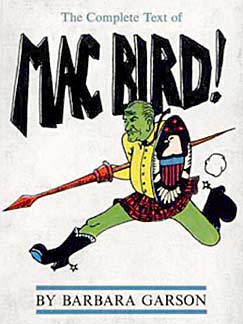
The playwright, Barbara Garson said:
"People used to ask me then, 'Do you really think Johnson killed Kennedy?'... I never took that seriously. I used to say to people, 'If he did, it's the least of his crimes.' It was not what the play was about. The plot was a given."
Saturday, May 12, 2012
"Mitt Romney was not at Chappaquiddick. Mitt Romney has not been accused of rape. "
"Mitt Romney did not have an affair with a mob babe. He didn't have an affair with an actress who committed suicide later on. Mitt Romney did not father a child out of wedlock. Mitt Romney did not support the tapping of Martin Luther King's phone. Mitt Romney was never a member of the Ku Klux Klan. Mitt Romney did not lie about his law school grades."
That's Rush Limbaugh, pithily dramatizing the media's double standard.
That's Rush Limbaugh, pithily dramatizing the media's double standard.
Friday, November 25, 2011
"[Herman] Cain avoided some of the most heated moments of the 1960s, and he said his recollections of that era are hazy."
"He said he doesn't recall being aware of Dr. King, a 1948 graduate of Morehouse, ever visiting the campus, including a convocation during Mr. Cain's senior year at which Dr. King was the featured speaker and the glee club performed. Mr. Cain sang baritone for the glee club all four years at Morehouse."
Excerpt from "Herman Cain's Political Education," in the Wall Street Journal.
Excerpt from "Herman Cain's Political Education," in the Wall Street Journal.
Some Morehouse graduates have criticized Mr. Cain for being disengaged from the civil-rights movement. Horace Bohannon Jr., who sometimes shared lecture notes with Mr. Cain as an underclassman and later became a follower of Stokely Carmichael and his "black power" movement, said he perceived in Mr. Cain a disdain for students who became more deeply involved in the turmoil of those days. "We were hellbent on changing this society and the structure of the South," he said. "There was sort of a resentment toward us by Herman."
But others from that era say that many students at the school focused on preparing for careers, and that some faculty members discouraged open participation in marches and similar activity.
"Most of the Morehouse fellows did not participate," said Wesley D. Clement, a classmate of Mr. Cain who is now an eye surgeon in Charlotte, N.C. "Your main target and goal was to prepare yourself for business and life. Not that we were ignorant of what was going on or didn't favor what was going on. But we were not involved in the things that some people would have called more radical at that time."
Monday, October 17, 2011
Cornel West — protesting Citizens United — gets himself arrested on the steps of the U.S. Supreme Court.
Reported by Susan Brooks Thisltethwaite at the Washington Post's "On Faith" blog:
The Supreme Court was a fitting venue for this demonstration both to honor Dr. King and demonstrate solidarity with the #OWS (Occupy Wall Street) movement. As Dr. West said prior to being arrested, there is “a relation between corporate greed and what goes on too often in Supreme Court decisions.”How is that "far greater detail"? With no reference to Supreme Court at all, it seems like less detail. Or by "detail," did Ms. Thisltethwaite mean verbosity? Thisltethwaite continues:
In Democracy Matters, West makes this point in far greater detail “(The) illicit marriage of corporate and political elites — so blatant and flagrant in our time — not only undermines the trust of informed citizens in those who rule over them. It also promotes the pervasive sleepwalking of the populace, who see that the false prophets are handsomely rewarded with money, status, and access to more power.” (p. 4)
Here’s the point: If you are content to think that corporations are people and money is speech, as the Supreme Court decided in the by a vote of 5-4, in their Citizens United v Federal Election Commission decision, then indeed you are sleepwalking through your citizenship and giving over your faith to false prophets.
I believe, when future accounts of this era are written, historians will judge that the wake up call for many people in America was in early 2010 with that Supreme Court decision. The winter of 2010 is what led to the #OWS demonstrations in the fall of 2011.
Can we as citizens accept this definition of person, and of speech? This is what Dr. West, by his action on the steps of the Supreme Court, is asking us to stop and ponder. Corporation as person? A soulless legal entity as human being? No. We can’t and we must not. As I have written before, God didn’t create corporations.And God didn't create The Washington Post, which is a corporation. Could Congress criminalize WaPo's reporting about political candidates in the 2-month period preceding an election? It would protect us from distorted ravings like yours, Ms. Thisltethwaite. What do you say? You must say yes! I mean, if you care about coherence. And I know you don't.
... Dr. West did not call for anger, he actually called for “deep love” in his remarks before his arrest, and he spoke his solidarity even with the police, those who were about to arrest him.
This is worthy of another jail, at another time. In 1963, Dr. King wrote, in his Letter from Birmingham Jail....
"Uh, officer... Leave those kids alone... I want them to vote for me."

A juxtaposition at Drudge right now, linking to a Financial Times article titled "Obama extends support for protesters." Excerpt:
On Sunday, Mr Obama honoured Martin Luther King at a dedication to a new memorial on National Mall in Washington. Referring to protests that have spread from Wall Street to London, Rome and elsewhere, Mr Obama said: “Dr King would want us to challenge the excesses of Wall Street without demonising those who work there.” Mr Obama had previously said the protests “express the frustration” of ordinary Americans with the financial sector.So that's what counts as "more support"? It sounds to me as though he's undermining the message of the protesters who are demonizing the Wall Street crowd. Of course, he's got lots of friends among the demons, but he wants the protest kids to feel like they're his friends too. If only they would see how we all need each other, then peace will guide the planets, and love will steer the stars.

Tuesday, August 23, 2011
Today's Drudgetapostion: Qaddafi looking up, Obama looking down (and Irene coming up).
I love the kinetic energy here:

Qaddafi's unbowed head aims up and to the right, in the position associated with optimism and progress. Obama's head points in the opposite direction, down and to the left. Qaddafi is wrapped up in his own thoughts in this image, and Obama is all about ice cream. Meanwhile, as we read from right to left and top to bottom, the next image is the path of Hurricane Irene and the lines sweep us back up to the image of Qaddafi.
No one who has laughed at the Michele Bachmann corndog photo can deny that the ice cream functions as a phallic symbol. In this light, one notes that the ice cream is soft-serve. See the swirls? The ice cream swirls harmonize with the swirling pattern of a hurricane and the swirling thoughts in the mind of the Libyan monster.
Does Obama care? — the brilliant Matt Drudge subliminally prods us to ask. Is he childishly preoccupied with a swirly dessert (as he vacations and vacations and vacations)? Look up, Mr. President! Qaddafi is still standing! The hurricane is coming!
The headlines under Obama increase our feelings that he is allowing everything to collapse:
And speaking of the "Nat'l Mall," glance down and to the left a notch, and you'll see the image of the Martin Luther King Jr. memorial, newly unveiled on the National Mall. Martin Luther King marched on Washington, and now he's there permanently. We sent Barack Obama to Washington and — the Drudge images say — he won't stay there, he keeps leaving, and he's not paying attention to the business of Washington. Meanwhile, in Tripoli, Qaddafi is intent on staying put, a strong man 'til the end. Obama is the soft center to a ice-cream manwich, with the hard men on either side — Qaddafi and King... and the violently disruptive woman Irene coming up behind him.
This has been another edition in the ongoing Althouse opus: The Art and Genius of Matt Drudge.
ADDED: Some art theory about lines and directions, from the artist Georges Seurat:

Qaddafi's unbowed head aims up and to the right, in the position associated with optimism and progress. Obama's head points in the opposite direction, down and to the left. Qaddafi is wrapped up in his own thoughts in this image, and Obama is all about ice cream. Meanwhile, as we read from right to left and top to bottom, the next image is the path of Hurricane Irene and the lines sweep us back up to the image of Qaddafi.
No one who has laughed at the Michele Bachmann corndog photo can deny that the ice cream functions as a phallic symbol. In this light, one notes that the ice cream is soft-serve. See the swirls? The ice cream swirls harmonize with the swirling pattern of a hurricane and the swirling thoughts in the mind of the Libyan monster.
Does Obama care? — the brilliant Matt Drudge subliminally prods us to ask. Is he childishly preoccupied with a swirly dessert (as he vacations and vacations and vacations)? Look up, Mr. President! Qaddafi is still standing! The hurricane is coming!
The headlines under Obama increase our feelings that he is allowing everything to collapse:
NATIONAL DEBT RISES BY $3 MILLION EACH MINUTE...(Both links go to the same story.) Above him, we see "Man busted near Nat'l Mall with fireworks-packed car 'fitted with turret, multiple tubes'..." (Scary! But it wasn't — go to the link — a terrorist.) (Addition phallic imagery implied by these explosive tubes.)
Obama sets record: $4,247,000,000,000 debt in just 945 days...
And speaking of the "Nat'l Mall," glance down and to the left a notch, and you'll see the image of the Martin Luther King Jr. memorial, newly unveiled on the National Mall. Martin Luther King marched on Washington, and now he's there permanently. We sent Barack Obama to Washington and — the Drudge images say — he won't stay there, he keeps leaving, and he's not paying attention to the business of Washington. Meanwhile, in Tripoli, Qaddafi is intent on staying put, a strong man 'til the end. Obama is the soft center to a ice-cream manwich, with the hard men on either side — Qaddafi and King... and the violently disruptive woman Irene coming up behind him.
This has been another edition in the ongoing Althouse opus: The Art and Genius of Matt Drudge.
ADDED: Some art theory about lines and directions, from the artist Georges Seurat:
Harmony is the analogy between opposites and the analogy between elements similar in tonal value, color, and line, considered in terms of the dominant, and under the influence of lighting, in gay, calm or sad combinations.More here:
The opposites are... For line, those forming a right angle....
Gaiety... in terms of line, lines above the horizontal.
Calmness in terms... of line, the horizontal.
Sadness in terms... of line, downward directions.
... Seurat believed that lines and angles... important to communication.... Ultimately, if the painting is a performance, it is a type of performance in that Seurat does not clearly give a political or ethical statement in his painting so much as he attempts to elicit one from the viewer (it COULD be about prostitution; it COULD be about the bourgeois and their instability as a social class; but we have no absolute way of knowing). That indeterminacy is probably the most important part of this painting’s autonomy. The idea of the painting as a dream state makes sense in this respect: dreams are ambiguous, and their meanings are speculative.For painting, substitute website montage... and discuss!
Wednesday, February 9, 2011
"God Bless America and the Anthem? And the fly-by? Could you militarize this event just a tad more?"
"And what in the name of the FSM was the point of giving us both Sam Elliott and Michael Douglas for the pregame Heroic Voiceover Brigade? And, Michael Douglas, how exactly do we link JFK's inaugural, MLK's Dream speech, the raising of the flag on Iwo Jima, Ali's KO of Liston in Lewiston, and this football game? A journey? More like a trip, actually. The pregame show was what Leni Riefenstahl would have done had she emigrated here as a child and gone to work for Sterling, Cooper, Draper, Price."
So wrote Charles P. Pierce about the Super Bowl intro, and I almost didn't post that because I had to check the Sterling, Cooper, Draper, Price reference — is it "Mad Men"? yeah, sorry, I still don't want to watch it — not to mention the FSM reference — eh. It flicked my bloggable toggle switch and then came very close to toggling back. But I'm quoting it, really because I agree that they overdid it. Leni would have been much more insidiously subtle. But that's a good thing, right? You can defend against the ridiculously overdone. We can feel patriotic and festive in a mixed up clutter of history and pop culture, and then it's on to the football game.
The Pierce quote is embedded in this James Wolcott blog post. Wolcott is crankier than Pierce:
But let's try to answer Wolcott's question: Does the country require this much self-affirmation now to reassure itself that it's still proud and virile?
I anticipate, instead of real answers, your snarky reframings of the question, asking whether Wolcott needs to reassure himself that he's still proud and virile. Indeed, I got the impression that his paragraph paralleled Pierce's, that he was envious of Pierce's writing prowess and trying to outmatch it. Ending with that limp Fish, he failed, which probably explains the flailing about "the county" and its imagined self-esteem problem. It's so problematic, raising the flag.
So wrote Charles P. Pierce about the Super Bowl intro, and I almost didn't post that because I had to check the Sterling, Cooper, Draper, Price reference — is it "Mad Men"? yeah, sorry, I still don't want to watch it — not to mention the FSM reference — eh. It flicked my bloggable toggle switch and then came very close to toggling back. But I'm quoting it, really because I agree that they overdid it. Leni would have been much more insidiously subtle. But that's a good thing, right? You can defend against the ridiculously overdone. We can feel patriotic and festive in a mixed up clutter of history and pop culture, and then it's on to the football game.
The Pierce quote is embedded in this James Wolcott blog post. Wolcott is crankier than Pierce:
I had the pre-game on mute and every time I glanced up I wondered if we had declared war on Iraq or a hologram of Ronald Reagan was going to materialize on stage, raising a ruddy hand in blessing as Peggy Noonan ascended into heaven. The Super Bowl is bombastic enough without being a fanfare for World War III or IV, but who's counting? Or is it that the country requires this much self-affirmation now to reassure itself that it's still proud and virile? Maybe Stanley Fish can figure this out for us.No link on the Stanley Fish reference, which is not something I can untangle with a Google search. I know who Stanley Fish is. I'm even in the middle of reading his new book, "How to Write a Sentence." (Check it out: I just wrote a sentence!) I'll assume Wolcott means to say something like: All those words and images require interpretation and Fish is the interpretation-meister.
But let's try to answer Wolcott's question: Does the country require this much self-affirmation now to reassure itself that it's still proud and virile?
I anticipate, instead of real answers, your snarky reframings of the question, asking whether Wolcott needs to reassure himself that he's still proud and virile. Indeed, I got the impression that his paragraph paralleled Pierce's, that he was envious of Pierce's writing prowess and trying to outmatch it. Ending with that limp Fish, he failed, which probably explains the flailing about "the county" and its imagined self-esteem problem. It's so problematic, raising the flag.
Thursday, October 28, 2010
A liberal blogger confronts Barack Obama about gay rights... with tediously grim results.
I'm going to pick apart the transcript from Obama's big meetup with the liberal bloggers. The "Q" is Joe Sudbay of Americablog.
Are you trying to say you'd have joined Justice Scalia's dissent in Lawrence v. Texas? Here's Scalia: "What Texas has chosen to do is well within the range of traditional democratic action, and its hand should not be stayed through the invention of a brand-new 'constitutional right' by a Court that is impatient of democratic change. It is indeed true that 'later generations can see that laws once thought necessary and proper in fact serve only to oppress,'; and when that happens, later generations can repeal those laws. But it is the premise of our system that those judgments are to be made by the people, and not imposed by a governing caste that knows best." Hello? That's what Obama is saying about Don't Ask, Don't Tell.
Back to the transcript:
Later, the conversation comes back to DADT, and the President intimates that he will try to push its repeal during the lame duck session of Congress. He makes an effort to shift the blame to the Republicans, especially John McCain, and he indicates that it will be a problem getting the votes for cloture. (He loves that problem, I'll bet. It's so helpful to appear to want to act and have your hands tied.)
He wonders why the Log Cabin Republican are pursuing their court case, when they could instead try to get a few Republican Senators to vote for repeal. He says he doesn't "understand the logic of" using the courts when you could go to Congress, but of course he does. People conceive of their equality in terms of their individual rights — which don't depend on the support of political majorities and supermajorities. As a Harvard-trained lawyer and sometime law professor, he knows that. He knows why people go to courts. I don't buy his understanding of the logic. Or should I say his understandings of the logics?
Q ... do you think that “don’t ask, don’t tell” is unconstitutional?That's exactly what I would ask him. You may remember my dissecting his MTV townhall last week and showing you how evasive he was about that.
THE PRESIDENT: It’s not a simple yes or no question, because I’m not sitting on the Supreme Court. And I’ve got to be careful, as President of the United States, to make sure that when I’m making pronouncements about laws that Congress passed I don’t do so just off the top of my head.See? Infuriating. He's the President. He took an oath to "preserve, protect and defend the Constitution of the United States" — "to the best of [his] ability." He won the Presidency in part because of his high achievement at Harvard Law School. He accepted responsibility for the U.S. military. His administration is fighting to defend DADT in courts. This issue didn't pop up yesterday, so his answer couldn't possibly be "just off the top of [his] head. He sure as hell better have an answer to the question. This preamble to his answer is therefore either a lie or an outrage.
I think that -- but here’s what I can say.Thanks for revealing that you know you are withholding what you really think.
I think “don’t ask, don’t tell” is wrong. I think it doesn’t serve our national security, which is why I want it overturned. I think that the best way to overturn it is for Congress to act. In theory, we should be able to get 60 votes out of the Senate. The House has already passed it. And I’ve gotten the Secretary of Defense and the Chairman of the Joint Chiefs of Staff to say that they think this policy needs to be overturned -- something that’s unprecedented.That's his canned answer, which was also served up at the MTV townhall. It's completely nonresponsive to the question.
And so my hope and expectation is, is that we get this law passed. It is not just harmful to the brave men and women who are serving, and in some cases have been discharged unjustly, but it doesn’t serve our interests -- and I speak as Commander-in-Chief on that issue.If you really believe it is that harmful and unjust, then how do you resist the conclusion, under the case law, that it is unconstitutional? Even at the level of minimal scrutiny, what is the rational basis for this law? You are saying — in so many words — that there is no rational basis, so why do you not conclude that it is unconstitutional? Are you lying when you intone your criticism of DADT, or are you lying when you purport to adhere to the sort of constitutional analysis that is done by the kind of people you nominate to be on the Supreme Court?
Are you trying to say you'd have joined Justice Scalia's dissent in Lawrence v. Texas? Here's Scalia: "What Texas has chosen to do is well within the range of traditional democratic action, and its hand should not be stayed through the invention of a brand-new 'constitutional right' by a Court that is impatient of democratic change. It is indeed true that 'later generations can see that laws once thought necessary and proper in fact serve only to oppress,'; and when that happens, later generations can repeal those laws. But it is the premise of our system that those judgments are to be made by the people, and not imposed by a governing caste that knows best." Hello? That's what Obama is saying about Don't Ask, Don't Tell.
Back to the transcript:
Let me go to the larger issue, though, Joe, about disillusionment and disappointment.Oh, yes! The larger issue is how people feel about Barack Obama. Constitutional rights just aren't that large compared to the grand question of Me. And apparently Joe doesn't have the nerve to stop the President and point out that there has been no answer to the question. The President has called him by name and wants to talk about his feelings.
I guess my attitude is that we have been as vocal, as supportive of the LGBT community as any President in history....But no other President directly inspired the hopes of gay people and won big support with promises like you did. You're not even saying that you're better than all those other Presidents, only that none of them were any better. Your support for "the LGBT community" is as good as George Washington's. Thanks a lot.
On “don’t ask, don’t tell,” I have been as systematic and methodical in trying to move that agenda forward as I could be given my legal constraints, given that Congress had explicitly passed a law designed to tie my hands on the issue.Admit it: You love having your hands tied like that. Because you're fighting against a legal decision that deemed DADT unconstitutional! The rope of legislation was untied, and here you are begging for other judges to tie you back up again. Don't ask me to believe you don't love the bondage.
And so, I’ll be honest with you, I don’t think that the disillusionment is justified.I'll be honest with you... Speaking of Don't Ask, Don't Tell. That's a "tell." He's lying. "I’ll be honest with you" means I'm about to lie to you.
Now, I say that as somebody who appreciates that the LGBT community very legitimately feels these issues in very personal terms. So it’s not my place to counsel patience. One of my favorite pieces of literature is “Letter from Birmingham Jail,” and Dr. King had to battle people counseling patience and time. And he rightly said that time is neutral. And things don’t automatically get better unless people push to try to get things better.Speaking of time, he's really trying to run the clock out on this interview. He's also, I imagine, ashamed of what he finds himself needing to say. He wants to identify with King, but he knows he's on the wrong side of King when he asks gay people to wait longer. Obama sounds like an old man rifling through his memories for something relevant to say. He calls “Letter from Birmingham Jail" "[o]ne of my favorite pieces of literature" — as if it's all about him and people who are waiting for their rights to be recognized are fascinated by what pleasure reading he enjoys. Under the circumstances of this conversation, “Letter from Birmingham Jail” is or should be nagging at his conscience. ("Now is the time to lift our national policy from the quicksand of ... injustice to the solid rock of human dignity.")
So I don’t begrudge the LGBT community pushing...Begrudge! That he would even think of that word suggests these people are annoying him!
... but the flip side of it is that this notion somehow that this administration has been a source of disappointment to the LGBT community, as opposed to a stalwart ally of the LGBT community, I think is wrong.The short answer to Sudbay's original answer was: Don't Ask.
Q So I have another gay question. (Laughter.)I am resisting typing curse words here. Look at Sudbay abasing himself. Now these rights he must care about are reduced to jocose "gay questions." Something to laugh at. There indeed was a time, and it was not too long ago, that the idea of gay rights itself seemed funny to people. And Sudbay allows himself to get pushed back toward that place. The President treats the remark as if it were an apology. He says "It's okay, man." Man. See? He's a cool guy. He's taming Sudbay.
THE PRESIDENT: It’s okay, man. (Laughter.)
Q And this one is on the issue of marriage. Since you’ve become President, a lot has changed. More states have passed marriage equality laws. This summer a federal judge declared DOMA unconstitutional in two different cases. A judge in San Francisco declared Prop 8 was unconstitutional. And I know during the campaign you often said you thought marriage was the union between a man and a woman, and there -- like I said, when you look at public opinion polling, it’s heading in the right direction. We’ve actually got Republicans like Ted Olson and even Ken Mehlman on our side now. So I just really want to know what is your position on same-sex marriage?Another good question. Sudbay came prepared. Let's see if he lets Obama push him back again.
THE PRESIDENT: Joe, I do not intend to make big news sitting here with the five of you, as wonderful as you guys are. (Laughter.) But I’ll say this --
Q I just want to say, I would be remiss if I didn’t ask you this question.Oh, don't beg, Joe. Don't apologize.
THE PRESIDENT: Of course.
Q People in our community are really desperate to know.
THE PRESIDENT: I think it’s a fair question to ask.That's big of him.
I think that -- I am a strong supporter of civil unions. As you say, I have been to this point unwilling to sign on to same-sex marriage primarily because of my understandings of the traditional definitions of marriage.Check out those weird plurals: understandings of the traditional definitions. That's another tell. He is lying, I presume. His opposition to same-sex marriage is, quite simply and obviously, politically expedient. It is impossible for me to believe that Obama, coming from his academic background, is hung-up on the traditional definition — or "definitions" — of marriage. He's posing as a seeker of truth, slowly coming round.
But I also think you’re right that attitudes evolve, including mine.Attitudes? I thought he was into traditional definitions.
And I think that it is an issue that I wrestle with and think about because I have a whole host of friends who are in gay partnerships. I have staff members who are in committed, monogamous relationships, who are raising children, who are wonderful parents.So is he saying that previously he had an attitude that was antagonistic to gay people and by extensive social contact with gay people, he came around to perceiving them as fully human? I just don't believe that. And if I did, I would think less of him.
And I care about them deeply.You know, your position on the rights of others should not depend on whether they are your friends. That's not the way law works. People have rights whether you care about them or not. And rights don't spring into existence because you care about the people who want them.
And so while I’m not prepared to reverse myself here, sitting in the Roosevelt Room at 3:30 in the afternoon, I think it’s fair to say that it’s something that I think a lot about. That’s probably the best you’ll do out of me today. (Laughter.)Laughter. Oh, it's so lovely sitting with the President in the Roosevelt Room. Something that I think a lot about. Men have thought more clearly in jail.
Later, the conversation comes back to DADT, and the President intimates that he will try to push its repeal during the lame duck session of Congress. He makes an effort to shift the blame to the Republicans, especially John McCain, and he indicates that it will be a problem getting the votes for cloture. (He loves that problem, I'll bet. It's so helpful to appear to want to act and have your hands tied.)
He wonders why the Log Cabin Republican are pursuing their court case, when they could instead try to get a few Republican Senators to vote for repeal. He says he doesn't "understand the logic of" using the courts when you could go to Congress, but of course he does. People conceive of their equality in terms of their individual rights — which don't depend on the support of political majorities and supermajorities. As a Harvard-trained lawyer and sometime law professor, he knows that. He knows why people go to courts. I don't buy his understanding of the logic. Or should I say his understandings of the logics?
Monday, September 20, 2010
"Unfortunately, most Americans know little of this progressive history. It isn't taught in most high schools."
Asserts The Nation:
You can't find it on the major television networks or even on the History Channel. Indeed, our history is under siege. In popular media, the most persistent interpreter of America's radical past is Glenn Beck, who teaches viewers a wildly inaccurate history of unions, civil rights and the American left. Beck argues, for example, that the civil rights movement "has been perverted and distorted" by people claiming that Martin Luther King Jr. supported "redistribution of wealth." In fact, King did call for a "radical redistribution of economic power." Using his famous chalkboard, Beck draws connections between various people and organizations, and defines them as radicals, Marxists, socialists, revolutionaries, leftists, progressives or social justice activists—all of which leads inexorably to Barack Obama.A proffered remedy in the form of a list: "The 50 Most Influential Progressives of the Twentieth Century."
Thursday, April 15, 2010
At the Madison Tea Party today.
People sang "God Bless America" in the end.
Some people who interested me:


More pics to come.
Some people who interested me:
More pics to come.
Monday, September 14, 2009
Editor's Note from The Moderate Voice: "The title and URL for this post has been changed from the original."
Ha ha ha. I've got to go after the so-called Moderate Voice again. (Click on the tag below for past dustups.)
Among my many Google alerts — used to turn up bloggable things — is the phrase "freedom from religion." Sorting through my email this morning, I find a hit from The Moderate Voice, with the squib:
Moderate Voice. Calling pro-lifers "American Taliban."
It's a crap post too, by one Kathy Kattenburg. It's 1 sentence of original writing followed by a dump of an entire 349-word Orlando Sentinel news article. From the Sentinel:
You realize that by that standard — if it were applied neutrally — Martin Luther King, Jr. would have to be called "Taliban." But, of course, I don't think TMV would apply the standard neutrally. Which is an additional reason why "moderate" is a deceptive label.
By the way, who is Kathy Kattenburg? And why is she a Moderate Voice author? I don't know. And I looked on the TMV About the Authors page. She's not there. Doesn't someone have to have a moderate voice or a commitment to couching her opinions in a moderate voice to be given access to posting on The Moderate Voice? Oh, it all comes back to me now. There's some concept over there that a mix of extreme voices on difference sides averages out to moderate. If that's "moderate," then the most viciously fought debates are moderate. Sigh.
Among my many Google alerts — used to turn up bloggable things — is the phrase "freedom from religion." Sorting through my email this morning, I find a hit from The Moderate Voice, with the squib:
In my mind, this says that “freedom from religion” is a more important freedom than “freedom of religion”. Therefore I doubt that the Supreme Court will ...I click over and see "New title: 'Anti-Abortion Group Gets Organized in Florida'":
"The title and URL for this post has been changed from the original."Oh, what was the old title? Aha! It will be in that gmail. I click back. Ah ha ha ha ha: "The American Taliban Is Coming to Florida."
Moderate Voice. Calling pro-lifers "American Taliban."
It's a crap post too, by one Kathy Kattenburg. It's 1 sentence of original writing followed by a dump of an entire 349-word Orlando Sentinel news article. From the Sentinel:
A nationwide anti-abortion group launched an effort in Florida Friday to outlaw all abortions and certain types of birth control, including oral contraceptives and the morning-after pill.Religion-infused... So now, when activists have a religious motivation for the political change they want — even though they aren't trying to force anyone to follow a religion but are only seeing secular laws that accord with their religious beliefs — they are "religion-infused," and a blog that self-approvingly deems itself the Moderate Voice will call them "Taliban"?
The religion-infused movement, called “Personhood Florida,” would define conception in Florida’s constitution at the “biological beginnings,” supporters said — when the sperm meets the egg....
You realize that by that standard — if it were applied neutrally — Martin Luther King, Jr. would have to be called "Taliban." But, of course, I don't think TMV would apply the standard neutrally. Which is an additional reason why "moderate" is a deceptive label.
***
By the way, who is Kathy Kattenburg? And why is she a Moderate Voice author? I don't know. And I looked on the TMV About the Authors page. She's not there. Doesn't someone have to have a moderate voice or a commitment to couching her opinions in a moderate voice to be given access to posting on The Moderate Voice? Oh, it all comes back to me now. There's some concept over there that a mix of extreme voices on difference sides averages out to moderate. If that's "moderate," then the most viciously fought debates are moderate. Sigh.
Tuesday, January 20, 2009
Joseph Lowery's benediction.
I missed the benediction during the live-blog, so let me video-blog it now:
1:00: The first thing I notice is that this man is very old. I see that he was born in 1921, and he's been through a lot. I see him as representing a long history and feel inclined to give him the maximum latitude to express whatever it is he feels in his heart.
3:08: "Help us to make choices on the side of love, not hate, on the side of inclusion, not exclusion, tolerance, not intolerance. And as we leave this mountaintop, help us to hold onto the spirit of fellowship and the oneness of our family."
4:40: Here's the black/get back/brown/stick around/yellow/mellow part of the prayer that I heard Rush Limbaugh riffing about. Rush didn't like the airing of old grievances when obviously black people are not being held back today and so forth, but I'd say, this was a light-hearted reference to the wrongs of the past, by a man who could have fulminated about the long civil rights struggle, but chose instead to speak almost entirely of love and unity.
Really, I think it's mean-spirited to complain about anything here. It was done very well.
The Caucus live-blogged the media reaction:
1:00: The first thing I notice is that this man is very old. I see that he was born in 1921, and he's been through a lot. I see him as representing a long history and feel inclined to give him the maximum latitude to express whatever it is he feels in his heart.
3:08: "Help us to make choices on the side of love, not hate, on the side of inclusion, not exclusion, tolerance, not intolerance. And as we leave this mountaintop, help us to hold onto the spirit of fellowship and the oneness of our family."
4:40: Here's the black/get back/brown/stick around/yellow/mellow part of the prayer that I heard Rush Limbaugh riffing about. Rush didn't like the airing of old grievances when obviously black people are not being held back today and so forth, but I'd say, this was a light-hearted reference to the wrongs of the past, by a man who could have fulminated about the long civil rights struggle, but chose instead to speak almost entirely of love and unity.
Really, I think it's mean-spirited to complain about anything here. It was done very well.
The Caucus live-blogged the media reaction:
Juan Williams, a Fox News contributor [said] “He is the real deal. There are other people who might say that they were there with Dr. King, and suffered the indignities, but Joe Lowery really did... There are some times in your life that you just think, ‘What a country. How can that be? I never thought that would happen.’ But there it was, and I just thank God that Joe Lowery was able, in that moment, to talk about the power of the silent tears.”
Sunday, November 30, 2008
"I could hear little Muscovites recite a similar pledge to their hammer-and-sickle flag with equal solemnity."
The Rev. George M. Docherty -- who died on Thanksgiving, at the age of 97 -- sermonized about the Pledge of Allegiance:
[He] was summoned from his native Scotland in 1950 to become pastor of the historic church in downtown Washington, which Abraham Lincoln attended when he was president in the 1860s. Each year on the Sunday closest to Lincoln's birthday, Feb. 12, the church had a special service that was traditionally attended by the president.Those words may grate on some liberals' ears. Remember the oral argument in the Supreme Court case challenging the constitutionality of the words "under God" in the Pledge?
On Feb. 7, 1954, with President Dwight D. Eisenhower sitting in Lincoln's pew, Rev. Docherty urged that the pledge to the flag be amended, saying, "To omit the words 'under God' in the Pledge of Allegiance is to omit the definitive factor in the American way of life."
He borrowed the phrase from the Gettysburg Address, in which Lincoln said, "this Nation, under God, shall have a new birth of freedom."
Rev. Docherty's inspiration for the sermon came from his son's schoolroom experience of reciting the Pledge of Allegiance, which was written in 1892 by Baptist minister Francis Bellamy. When Rev. Docherty realized that it had no reference to God, he later said, "I had found my sermon."
Without mentioning a deity, Rev. Docherty said, the pledge could just as easily apply to the communist Soviet Union: "I could hear little Muscovites recite a similar pledge to their hammer-and-sickle flag with equal solemnity."...
But in 1954, with Eisenhower in the congregation and the threat of communism in the air, Rev. Docherty's message immediately resounded on Capitol Hill. Bills were introduced in Congress that week, and Eisenhower signed the "under God" act into law within four months....
"An atheistic American is a contradiction in terms," he said in his sermon. "If you deny the Christian ethic, you fall short of the American ideal of life."
Michael A. Newdow stood before the justices of the Supreme Court on Wednesday, pointed to one of the courtroom's two American flags and declared: ''I am an atheist. I don't believe in God.''...But Docherty was no arch conservative. From the first link:
Earlier, Dr. Newdow responded to Justice Stephen G. Breyer's suggestion that ''under God'' had acquired such a broad meaning and ''civic context'' that ''it's meant to include virtually everybody, and the few whom it doesn't include don't have to take the pledge.''
''I don't think that I can include 'under God' to mean 'no God,' '' Dr. Newdow replied. ''I deny the existence of God.'' He added, ''Government needs to stay out of this business altogether.''...
[The 9th Circuit court] ruled last year that the addition of ''under God'' turned the pledge into a ''profession of religious belief'' and made it constitutionally unsuitable for daily recitation in the public schools. Congress added the phrase at the height of the cold war in an effort to distinguish the American system from ''Godless Communism.''
During his 26 years as pastor, he became better known for his liberal social activism than for his quest to alter the Pledge of Allegiance. He promoted racial equality and led outreach efforts to feed and educate the city's hungry and poor. His church was often a staging point for civil rights and antiwar demonstrations, and the Rev. Martin Luther King Jr. preached from its pulpit. Rev. Docherty was with King on the Edmund Pettus Bridge during the "Bloody Sunday" civil rights march in Selma, Ala., in 1965.
Monday, November 3, 2008
"Our grandmother, Madelyn Dunham, has died," says Barack Obama.

So sad that she didn't make it that last step! One immediately thinks of the famous line: "And I've seen the promised land. I may not get there with you."
Very sad. Please: no conspiracy theories about the timing of the announcement of the death.
Friday, May 9, 2008
Does this statue of Martin Luther King, Jr. look too much like that statue of Saddam Hussein we pulled down in Baghdad?
WaPo reports:
That said, perceptions of this particular colossus may be affected by 2 things:
1. The knowledge that the sculptor — Lei Yixin — is Chinese and made big statues of Mao Zedong.
2. Racism. You see a black man and you worry that he's angry or on the verge of a violent outburst. This man looks "confrontational."
Now, are these inappropriate considerations that we need to put aside in order to judge the statue properly? It's not obvious.
As to influence #1, the choice of the sculptor has already taken place, and it's not fair to reject him now for what we knew of him then. Nevertheless, we may expect him to express American values and even to exaggerate those values so that an average viewer who knows the sculptor made Mao statues will not see anything Maoist about the MLK statue. The sculptor has got a deficit to make up, and we ought to think about that as we judge his work. That's the argument that it's acceptable to not to overcome influence #1.
As to influence #2, you know very well that you should not be racist. But perhaps we should take into account that people viewing the statue are human and will therefore perceive a statue of a black man through whatever racism remains in their thought patterns. If there is to be a statue honoring a black man, perhaps the sculptor must make a special effort to avoid a depiction that prompts any racist perceptions. That's the argument that it's acceptable not to overcome influence #2 in judging the statue.
Now, with that in mind, what do we think of the Commission's criticism?
But the emerging-from-the-stone problem is less troublesome than the crossed arms. Jackson (the architect) defends the stance, and notes that they had a photograph of MLK with his arms crossed like that. But of course, there are innumerable photos of MLK and most of them, I'm sure, would never suggested themselves as a good model for a large statue. The point is the sculptor and his team liked the attitude of confrontation. They wanted MLK the "warrior." One consultant said they rejected the notion of MLK as "pacifist, placid, kind of vanilla." But crossed arms expressed resistance and even rejection. Much as MLK had cause to express such things in his lifetime, the question is what one expression do we now want carved in stone. Shouldn't he be more positive and welcoming? Shouldn't he love us now that we love him?
Or are we only thinking that way because we haven't gotten used to it?
Would you reject the brooding, downcast Lincoln sculpture if you were seeing it for the first time?

Oh, good Lord, he's so depressed! His clothes are horribly sagging. And he's slumping in that chair with his big, gawky hands hanging over those big Roman fasces. Fascism!
A powerful federal arts commission is urging that the sculpture of Martin Luther King Jr. proposed for a memorial on the Tidal Basin be reworked because it is too "confrontational" and reminiscent of political art in totalitarian states.The sculpture — you can see the model of it at the link — is to be 28 feet tall. That's 8 feet taller than the statue of Abraham Lincoln in the Lincoln Monument, but Lincoln is sitting down, so the scale is somewhat smaller. If you've ever seen the Lincoln statue in person, you know it's huge, much bigger than it seems in photographs. It's actually quite weird, I think. But why shouldn't the MLK monument be on a similar scale? And once you decide you want a large statue of a man, what is going to prevent it from looking like social realist sculptures? It's inherent in the concept. If social realist statues bother you, maybe you shouldn't order a colossus.
The U.S. Commission of Fine Arts thinks "the colossal scale and Social Realist style of the proposed statue recalls a genre of political sculpture that has recently been pulled down in other countries," commission secretary Thomas Luebke said in a letter in April.
By law, no project like the memorial can go forward without approval from the commission, the federal agency that advises the government on public design and aesthetics in the capital.
A model of the statue has been built in China. The project's chief architect, Ed Jackson Jr., huddled with advisers this week in Ann Arbor, Mich., to discuss ways to address the commission's objections before sculpting of the granite statue begins.
"We said: 'Okay, this is what the commission said. How best can we achieve that and retain what we have accomplished thus far?' "
It is the second time in recent months that the memorial to the slain civil rights leader has come under fire. Last year, critics complained after a Chinese sculptor known for his monumental works of figures such as Mao Zedong was selected to create King and other elements of the memorial in China.
That said, perceptions of this particular colossus may be affected by 2 things:
1. The knowledge that the sculptor — Lei Yixin — is Chinese and made big statues of Mao Zedong.
2. Racism. You see a black man and you worry that he's angry or on the verge of a violent outburst. This man looks "confrontational."
Now, are these inappropriate considerations that we need to put aside in order to judge the statue properly? It's not obvious.
As to influence #1, the choice of the sculptor has already taken place, and it's not fair to reject him now for what we knew of him then. Nevertheless, we may expect him to express American values and even to exaggerate those values so that an average viewer who knows the sculptor made Mao statues will not see anything Maoist about the MLK statue. The sculptor has got a deficit to make up, and we ought to think about that as we judge his work. That's the argument that it's acceptable to not to overcome influence #1.
As to influence #2, you know very well that you should not be racist. But perhaps we should take into account that people viewing the statue are human and will therefore perceive a statue of a black man through whatever racism remains in their thought patterns. If there is to be a statue honoring a black man, perhaps the sculptor must make a special effort to avoid a depiction that prompts any racist perceptions. That's the argument that it's acceptable not to overcome influence #2 in judging the statue.
Now, with that in mind, what do we think of the Commission's criticism?
Its general design was approved by the seven-member federal commission that year, based on drawings of the Stone of Hope that showed a more subtle image of King, from the waist up, as if he were emerging organically out of the rock, the commission said....So the large block of stone is crucial to the design. It's abstract and metaphorical. I have to agree that it looks like the sculptor wanted to depict a freestanding human figure and mainly annoyed at the restrictive block of stone connected to it. Yet that itself is metaphorical. Those Michelangelo sculptures Luebke is talking about were slaves. Their oneness with the stone expressed slavery. The MLK image should not relate to the stone in quite the same way. I think the real issue here is whether the thing is well sculpted. To my eye, it is not. The figure-stone relationship is not interesting or beautiful.
Commission members said the sculpture "now features a stiffly frontal image, static in pose, confrontational in character," Luebke wrote. They "recommended strongly that the sculpture be reworked, both in form and modeling" and cited "precedents of a figure emerging from stone in the works of sculptors such as Michelangelo and Rodin."
The commission objected to what it perceived as the loss of the subtle way King seemed to be coming out of the stone in the drawings, Luebke said.
"I think that the metaphor of Dr. King being merged with the natural forces of this stone is absolutely essential to avoid colossal monumentalization," commission member N. Michael McKinnell said at the April 17 meeting.
But the emerging-from-the-stone problem is less troublesome than the crossed arms. Jackson (the architect) defends the stance, and notes that they had a photograph of MLK with his arms crossed like that. But of course, there are innumerable photos of MLK and most of them, I'm sure, would never suggested themselves as a good model for a large statue. The point is the sculptor and his team liked the attitude of confrontation. They wanted MLK the "warrior." One consultant said they rejected the notion of MLK as "pacifist, placid, kind of vanilla." But crossed arms expressed resistance and even rejection. Much as MLK had cause to express such things in his lifetime, the question is what one expression do we now want carved in stone. Shouldn't he be more positive and welcoming? Shouldn't he love us now that we love him?
Or are we only thinking that way because we haven't gotten used to it?
Would you reject the brooding, downcast Lincoln sculpture if you were seeing it for the first time?
Oh, good Lord, he's so depressed! His clothes are horribly sagging. And he's slumping in that chair with his big, gawky hands hanging over those big Roman fasces. Fascism!
Saturday, April 26, 2008
Did Bill Moyers act as Jeremiah Wright's PR agent or did he ask some good journalistic questions?
I watched last night's episode of "Bill Moyers Journal," dealing with Trinity United Church of Christ and Jeremiah Wright.
The introduction emphasized the good works of the church — its ministry to the poor and sick — but the positivity got a little hard to take at this point:
The first candidate for a hard question is "So, when Trinity Church says it is unashamedly black and unapologetically Christian, is it embracing a race-based theology?"
Wright answers:
Wright concludes:
Wright must feel cozily comfortable sitting across the table from this puffball. Wright starts listing the non-black ethnic groups that attend the church, and Moyers moves on to the blandest question in the world, "What does the church service on Sunday morning mean in general to the black community?"
The second candidate for a hard question comes a little later. Moyers says:
Wright hits the softball and says that the prophets "were saying that God was in fact, if you look at the damning, condemning, if you look at Deuteronomy, it talks about blessings and curses, how God doesn't bless everything." He goes on for a bit about the things "God doesn't bless" — which is to say, the things God damns — and Moyers finally breaks in with a question about Wright's notorious "God damn America." The PBS website transcribes the question this way:
Moyers plays a long chunk of the sermon that ends "God damn America," and asks "What did you mean when you said that?"
Wright answers that governments can deviate from the will of God and says "you are made in the image of God, you're not made in the image of any particular government." What should follow is a statement about the degree of allegiance people owe to their country, but Wright jumps to an invocation of free speech: "We have the freedom here in this country to talk about that publicly, whereas some other places, you're dead if say the wrong thing about your government."
At this point, Moyers could follow up either with a question about the allegiance religious people owe to a country they think has deviated from the will of God or a question about how, while it's true that Americans have free speech, free speech includes criticizing the things people say. But Moyers observes, inanely: "Well, you can be almost crucified for saying what you've said here in this country." Moyers extends his heartfelt sympathy to Wright for the suffering — the suffering of Christ! — he's endured over mere words.
Wright accepts the comforting: "That's true. That's true. But you can be crucified, you can be crucified publicly, you can be crucified by corporate-owned media." You know, you could be nailed to a cross or you could be lambasted in the media. The corporate-owned media. (Getting criticized on independent blogs may not quite equate with crucifixion. Maybe we bloggers correspond to mere flogging or piercing with thorns.)
Wright brings up Martin Luther King, Jr.:
Moyers notes: "Lyndon Johnson was furious at that," and lets Wright deliver a mini-sermon about King's efforts on behalf of the poor, which concludes: "That part of King is not talked about because we want to keep that away from the public eye, and the public memory, and it's been 40 years now." Talk about it then! It's a free country. What I'm seeing in that conclusion is a whiff of left-wing politics, but Moyers does nothing here to follow up about what lies beneath that statement or God damn America. Instead, Moyers shifts to the problem that Americans have with hearing their country criticized:
Wright says we're miseducated because "after every revolution, the winners of that revolution write down what the revolution was about so that their children can learn it, whether it's true or not." Americans believe a "myth" about our country, so he's seen as "desecrating what we hold sacred."
Wheeling out big words, Wright says Americans don't understand "etymology" — "condemn, D-E-M-N, D-A-M-N" — and they don't understand "hermeneutic" — "the window from which you're looking is your hermeneutic."
At this point, Wright is going back to the subject Moyers tried to show him the path out of. Wright says "I've been framed" — and he means that as an intellectual joke. You know your "hermeneutic" is your window frame, and you've looked him through it. You've "framed" him. He gets carried away here, and Moyers lets him go, probably because he thinks it's good for Wright to dazzle PBS viewers by talking like an intellectual. But it's a messy rant:
Can Moyers probe? Help us out here, Bill. The obvious question is: Are you saying that God blesses the hijackers, that they were righteous in God's eyes? At this point, we get a long segment from the sermon. It's not a "sound bite." It goes on and on, and it's awful. His words are terrible, and the cheering from the congregation is sickening.
Moyers asks:
Wright:
Moyers lobs him another softball: "What do you think they wanted to communicate?"
Wright:
Wright:
But no, puffball Bill, asks Wright to tell us about the feelings of his wounded congregation: "What can you tell me about what's happened at the church since this controversy broke?" Wright informs us that they are "very upset." They should be upset to see themselves cheering and nodding at Wright's vicious words.
Moyers invites him to talk about death threats. There have been death threats. Of course, those are wrong, but Moyers is missing the opportunity to push Wright about the things that he is not owning up to. Wheel in the faceless bad people to distract us.
And here's the next question, which is most emphatically not a tough journalistic question: "Did you ever imagine that you would come to personify the black anger that so many whites fear?"
Rather insanely, Moyers goes back to the music theme: "I think of how important music is to your church at times like this, that's intentional isn't it?" Wright proceeds to lecture about music. The word "suicide" appears in the lecture and Moyers perks up: "What is it you said about suicide?" Singing the blues is soothing to black people, Wright says, and Moyers uses this as a cue to give Wright yet another chance to tell Americans how much we've hurt him: "So what blues are you singing right now?" He says "what man meant for evil, God meant for good," and Moyers leads him into a mini-sermon about finding the good in a bad situation. Wright thinks that it was good that Obama had to give that "very powerful speech" about race.
The mention of Obama gives Moyers a chance to ask what might be a hard question — it would be the fifth candidate: "In the 20 years that you've been your pastor, have you ever heard him repeat any of your controversial statements as his opinion?"
Wright:
Wright picks up Moyers's "had to say" cue:
Moyers has no follow-up question. He goes on to: "What does it say to you that millions Americans, according to polls, still think Barack Obama is a Muslim?" Answer: "corporate media and miseducation or misinformation or disinformation." And the final question is about how "[o]ur denomination, the United Church of Christ has called for a sacred conversation on race in America." This is a warm, fuzzy question. Wright rambles through an answer and we reach the end of the show.
Do you think Moyers asked hard questions? He started to six times, by my count, but I think it's quite clear that he was there to support Wright and give him a comfy setting and words of encouragement and sympathy.
ADDED: Protein Wisdom has some extended analysis. I especially appreciate this:
AND: Cjsmith defends God and Psalm 137, and to that I say that I'm not trying to say what the Psalm really means, only what it sounds like Wright is saying. I do think Smith underplays the line "Blessed are they who dash your baby's brains against a rock." Even if the speaker is not God — and I don't assume it is — to say something is "blessed" is to say that God blesses it. So I think it is an expression of the belief that God is well pleased when those who have reason to feel vengeful take their revenge even on an innocent baby.
The introduction emphasized the good works of the church — its ministry to the poor and sick — but the positivity got a little hard to take at this point:
Trinity has long had strong ties with the African roots of its faith. Parishioners are asked to respect what they call the Black Value System, to rededicate themselves to God, the black family, and the black community, reinforcing the motto that they are "Unashamedly Black and Unapologetically Christian."Nothing about the "Disavowal of the Pursuit of “Middleclassness'" that people find troubling. I'm suspicious. Let's look at the transcript of the interview and see if Moyers simply acted as Wright's PR agent or if he asked some hard, journalistic questions.
The first candidate for a hard question is "So, when Trinity Church says it is unashamedly black and unapologetically Christian, is it embracing a race-based theology?"
Wright answers:
No, it is not. It is embracing Christianity without giving up Africanity. A lotta the missionaries were going to other countries assuming that our culture is superior, that you have no culture. And to be a Christian, you must be like us. Right now, you can go to Ghana, Nigeria, Senegal, and see Christians in 140-degree weather. They have to have on a tie. Because that's what it means to be a Christian. Well, it's that kind of assuming that our culture, "We have the only sacred music. You must sing our music. You must use a pipe organ. You cannot use your instrument." It's that kind of assumption that in the field of missions, people say, "You know what? We're doing this wrong. We need to take Christ and leave culture at home. We need to learn the culture of people into which we're moving, and preach the methods of Jesus Christ using the culture that we are a part of." Well, the same thing happened with Christians in this country when they said, "You know what? Because those same missionaries who went south, they didn't let us sing gospel music." That was not sacred —Wright is going on about music, which no one who's worried about what is happening at Trinity Church is going to be upset about. Moyers doesn't press him with harder questions, but prompts him to keep running in this easy direction by saying "They were singin' the great Anglican hymns." Wright takes the encouragement. There's another long paragraph in the transcript about music, followed by a paragraph that generalizes to the level of "culture."
Wright concludes:
God has diverse culture, God has — and we're proud of who we are because that's the statement the congregation was making, not a race-based theology.Moyers doesn't press him with any evidence that the church has a race-based ideology. He just makes a vague reference to the things outsiders have been saying: "So, God is not, contrary to some of the rumors that have been circulated about Trinity, God is not exclusively or totally identified with just the black community?" That question is framed in a way that makes it easy to say no: exclusively, totally... Were we not supposed to notice that? The church could be rabidly racial about Christianity 99% of the time and the answer to the question would still be no.
Wright must feel cozily comfortable sitting across the table from this puffball. Wright starts listing the non-black ethnic groups that attend the church, and Moyers moves on to the blandest question in the world, "What does the church service on Sunday morning mean in general to the black community?"
The second candidate for a hard question comes a little later. Moyers says:
Lots of controversy about black liberation theology. As I understand it, black liberation theology reads the [B]ible through the experience of people who have suffered, and who then are able to say to themselves that we read the [B]ible differently, because we have struggled, than those do who have not struggled. Is that a fair bumper sticker of liberation theology?Moyers doesn't just sit back and let Wright filibuster here. There's some back-and-forth, but let's examine it:
REVEREND WRIGHT: I think that's a fair bumper sticker. I think that the terms "liberation theology" or "black liberation theology" cause more problems and red flags for people who don't understand it.Moyers jumped right in to cue Wright to explain liberation theology in an easy way. Wright takes the cue and recounts the oppression of the Jews in the Biblical stories. Moyers prompts him to talk about the prophets who "hated the waywardness of Israel," who "were calling Israel out of love back to justice, not damning Israel." Here, Moyers is playing PR agent, setting up the opportunity for Wright to explain his anti-American statements. And the subject of liberation theology is left in the dust! We are given no substance about what liberation theology has meant in modern political movements and nothing to help us think about whether membership in Wright's church has something to do with extremist left-wing politics.
BILL MOYERS: When I hear the word "black liberation theology" being the interpretation of scripture from the oppressed, I think well, that's the Jewish story--
REVEREND WRIGHT: Exactly, exactly.
Wright hits the softball and says that the prophets "were saying that God was in fact, if you look at the damning, condemning, if you look at Deuteronomy, it talks about blessings and curses, how God doesn't bless everything." He goes on for a bit about the things "God doesn't bless" — which is to say, the things God damns — and Moyers finally breaks in with a question about Wright's notorious "God damn America." The PBS website transcribes the question this way:
One of the most controversial sermons that you preach is the sermon you preach that ended up being that sound bite about Goddamn America.So, Moyers has incorporated the the standard defense — it's just a sound bite — into what can be our third candidate for a hard question.
Moyers plays a long chunk of the sermon that ends "God damn America," and asks "What did you mean when you said that?"
Wright answers that governments can deviate from the will of God and says "you are made in the image of God, you're not made in the image of any particular government." What should follow is a statement about the degree of allegiance people owe to their country, but Wright jumps to an invocation of free speech: "We have the freedom here in this country to talk about that publicly, whereas some other places, you're dead if say the wrong thing about your government."
At this point, Moyers could follow up either with a question about the allegiance religious people owe to a country they think has deviated from the will of God or a question about how, while it's true that Americans have free speech, free speech includes criticizing the things people say. But Moyers observes, inanely: "Well, you can be almost crucified for saying what you've said here in this country." Moyers extends his heartfelt sympathy to Wright for the suffering — the suffering of Christ! — he's endured over mere words.
Wright accepts the comforting: "That's true. That's true. But you can be crucified, you can be crucified publicly, you can be crucified by corporate-owned media." You know, you could be nailed to a cross or you could be lambasted in the media. The corporate-owned media. (Getting criticized on independent blogs may not quite equate with crucifixion. Maybe we bloggers correspond to mere flogging or piercing with thorns.)
Wright brings up Martin Luther King, Jr.:
Dr. King, of course, was vilified. And most of us forget that after he was assassinated, but the year before he was assassinated, April 4th, 1967 at the Riverside Church, he talked about racism, militarism and capitalism. He became vilified. He got ostracized not only by the majority of Americans in the press; he got vilified by his own community. They thought he had overstepped his bounds. He was no longer talking about civil rights and being able to sit down at lunch counters that he should not talk about things like the war in Vietnam.King entered the political fray, and people debated politics. Some people agreed with him and some didn't, but he was a powerful voice in important political debates. He wasn't above the debate, but part of it, and people argued with him. What is wrong with that?
Moyers notes: "Lyndon Johnson was furious at that," and lets Wright deliver a mini-sermon about King's efforts on behalf of the poor, which concludes: "That part of King is not talked about because we want to keep that away from the public eye, and the public memory, and it's been 40 years now." Talk about it then! It's a free country. What I'm seeing in that conclusion is a whiff of left-wing politics, but Moyers does nothing here to follow up about what lies beneath that statement or God damn America. Instead, Moyers shifts to the problem that Americans have with hearing their country criticized:
What is your notion of why so many Americans seem not to want to hear the full Monty...(The full Monty?)
... they don't want to seem to acknowledge that a nation capable of greatness is also capable of cruelty?Eh. Moyers signals that he's absolved Wright and wants to move on to the more fun topic of what's wrong with those terrible Americans who want to crucify him.
Wright says we're miseducated because "after every revolution, the winners of that revolution write down what the revolution was about so that their children can learn it, whether it's true or not." Americans believe a "myth" about our country, so he's seen as "desecrating what we hold sacred."
Wheeling out big words, Wright says Americans don't understand "etymology" — "condemn, D-E-M-N, D-A-M-N" — and they don't understand "hermeneutic" — "the window from which you're looking is your hermeneutic."
At this point, Wright is going back to the subject Moyers tried to show him the path out of. Wright says "I've been framed" — and he means that as an intellectual joke. You know your "hermeneutic" is your window frame, and you've looked him through it. You've "framed" him. He gets carried away here, and Moyers lets him go, probably because he thinks it's good for Wright to dazzle PBS viewers by talking like an intellectual. But it's a messy rant:
This whole thing has been framed through this window, there's another world out here that I'm not looking at or taking into account, it gives you a perspective that — that is-- that is informed by and limited by your hermeneutic. Dr. James Cone put it this way. The God of the people who riding on the decks of the slave ship is not the God of the people who are riding underneath the decks as slaves in chains. If the God you're praying to, "Bless our slavery" is not the God to whom these people are praying, saying, "God, get us out of slavery." And it's not like Notre Dame playing Michigan. You're saying flip a coin; hope God blesses the winning team, no. That the perception of God who allows slavery, who allows rape, who allows misogyny, who allows sodomy, who allows murder of a people, lynching, that's not the God of the people being lynched and sodomized and raped, and carried away into a foreign country. Same thing you find in Psalm 137. That those people who are carried away into slavery have a very different concept of what it means to be the people of God than the ones who carried them away.Moyers helps out by bringing back the easy old music theme:
And they say, "How can we sing the song of the Lord of a foreign land?"The fourth candidate for a hard question is implied by this statement: "That chapter [Psalm 137] ends up with some very brutal words. You used them in one of your sermons." Wright understands the question to call for an explanation of his post-9/11 speech. He speaks first of his pain over 9/11 and explains the thinking behind his sermon:
I had to preach. They came to church wanting to know where is God in this. And so, I had to show them using that Psalm 137, how the people who were carried away into slavery were very angry, very bitter, moved and in their anger from wanting revenge against the armies that had carried them away to slavery, to the babies. That Psalm ends up sayin' "Let's kill the baby-let's bash their heads against the stone." So, now you move from revolt and revulsion as to what has happened to you, to you want revenge. You move from anger with the military to taking it out on the innocents. You wanna kill babies. That's what's going on in Psalm 137. And that's exactly where we are. We want revenge. They wanted revenge. God doesn't wanna leave you there, however. God wants redemption. God wants wholeness. And that's the context, the biblical context I used to try to get people sitting again, in that sanctuary on that Sunday following 9/11, who wanted to know where is God in this? What is God saying? What is God saying? Because I want revenge.I think he's saying that the Psalm — God speaking? — is saying that people who have suffered want revenge and feel motivated to do terrible things. But he's really held himself open to a terrible interpretation — and calling it my "hermeneutic" isn't going to help. "What is God saying? What is God saying? Because I want revenge." What is Wright saying? That's going to sound to a lot of people as though he's saying 9/11 was God's revenge on America. He quotes the Psalm: "Blessed are they who dash your baby's brains against a rock." Well, now, it really sounds as though he's saying that God blesses the 9/11 hijackers! God damns America and God blesses the hijackers? Wright has not backed down. He's stepped up.
Can Moyers probe? Help us out here, Bill. The obvious question is: Are you saying that God blesses the hijackers, that they were righteous in God's eyes? At this point, we get a long segment from the sermon. It's not a "sound bite." It goes on and on, and it's awful. His words are terrible, and the cheering from the congregation is sickening.
Moyers asks:
You preached that sermon on the Sunday after 9-11 -- almost 7 years ago. When people saw the sound bites from it this year, they were upset because you seemed to be blaming America. Did you somehow fail to communicate?Well, I just listened to it — not merely with sound bites — and I'm upset, and I certainly think Wright was blaming America. Did you somehow fail to communicate? A tougher way to put it would be: It sounds to me like you were blaming America; did you somehow not mean what you said?
Wright:
The persons who have heard the entire sermon understand the communication perfectly. What is not the failure to communicate is when something is taken like a sound bite for a political purpose and put constantly over and over again, looped in the face of the public.Oh, spare me. The "sound bite" defense outrages me after listening to the long clip. This is eely wriggling off the hook. Own up to what you said!
That's not a failure to communicate. Those who are doing that are communicating exactly what they wanna do, which is to paint me as some sort of fanatic or as the learned journalist from the New York Times called me, a "wack-a-doodle."Oh, this is the sound bite from the interview that was making the rounds the day before the show aired! Amazing!
It's to paint me as something. Something's wrong with me. There's nothing wrong with this country. There's -its policies. We're perfect. We-our hands are free. Our hands have no blood on them. That's not a failure to communicate. The message that is being communicated by the sound bites is exactly what those pushing those sound bites want to communicate.Spare me. He blamed America for 9/11. It's right there in the long version!
Moyers lobs him another softball: "What do you think they wanted to communicate?"
Wright:
I think they wanted to communicate that I am- unpatriotic, that I am un-American, that I am filled with hate speech, that I have a cult at Trinity United Church of Christ.That's what it looked like on the clip I just watched. It didn't take any mysterious, corporate "they." You said it! Moyers lets him go on, saying the "sound bite" was "unfair... unjust... untrue" and attributing "very devious reasons" to the media. Moyers musters a probe: "Such as?"
Wright:
To put an element of fear and hatred and to stir up the anxiety of American who still don't know the African-American church, know nothing about the prophetic theology of the African-American experience, who know nothing about the black church, who don't even know how we got a black church.What would a good journalist ask at this point? I'd ask: Why are you saying they would do that? What are the "devious reasons"? You're saying the media who reported what you said, who showed a clip of you speaking, wanted to foment racism in this country?
But no, puffball Bill, asks Wright to tell us about the feelings of his wounded congregation: "What can you tell me about what's happened at the church since this controversy broke?" Wright informs us that they are "very upset." They should be upset to see themselves cheering and nodding at Wright's vicious words.
Our members know that this is what the media is doing. And our members know they're only doing it because of the political campaign.It's funny how Wright attacks Americans for our lack of self-criticism, when he and, by his report, his congregation are utterly devoid of self-criticism. Blame the media. Blame corporations. Do you ever do anything wrong?
Moyers invites him to talk about death threats. There have been death threats. Of course, those are wrong, but Moyers is missing the opportunity to push Wright about the things that he is not owning up to. Wheel in the faceless bad people to distract us.
And here's the next question, which is most emphatically not a tough journalistic question: "Did you ever imagine that you would come to personify the black anger that so many whites fear?"
No. I did not. I have been preaching as I've been preaching since I was ordained 41 years ago.But the sermon we just saw was full of anger. The fact that you've been preaching for a long time is no assurance that you are not angry and bent on stirring up anger in the people who look to you for inspiration. Moyers blandly and lamely implies that "many whites" are racists and have wrongly fixated on Wright as the personification of the things they irrationally fear. Again the faceless bad people are a convenient distraction. Why can't we talk about the actual sermons and what they mean?
Rather insanely, Moyers goes back to the music theme: "I think of how important music is to your church at times like this, that's intentional isn't it?" Wright proceeds to lecture about music. The word "suicide" appears in the lecture and Moyers perks up: "What is it you said about suicide?" Singing the blues is soothing to black people, Wright says, and Moyers uses this as a cue to give Wright yet another chance to tell Americans how much we've hurt him: "So what blues are you singing right now?" He says "what man meant for evil, God meant for good," and Moyers leads him into a mini-sermon about finding the good in a bad situation. Wright thinks that it was good that Obama had to give that "very powerful speech" about race.
The mention of Obama gives Moyers a chance to ask what might be a hard question — it would be the fifth candidate: "In the 20 years that you've been your pastor, have you ever heard him repeat any of your controversial statements as his opinion?"
Wright:
No. No. No. Absolutely not. I don't talk to him about politics. And so here at a political event, he goes out as a politician and says what he has to say as a politician. I continue to be a pastor who speaks to the people of god about the things of God.Moyers follows up: "in that speech at Philadelphia, had to say" — had to say! — "some hard things about you. How, how did it go down with you when you heard Barack Obama say those things?"
Wright picks up Moyers's "had to say" cue:
He's a politician, I'm a pastor. We speak to two different audiences. And he says what he has to say as a politician. I say what I have to say as a pastor. Those are two different worlds. I do what I do. He does what politicians doIn the sixth candidate for a hard question, Moyers asks Wright about his "long complicated" relationship with Louis Farrakhan. Wright praises Farrakhan for helping people "change their lives for the better." "People listen" when Farrakhan speaks, he says.
Moyers has no follow-up question. He goes on to: "What does it say to you that millions Americans, according to polls, still think Barack Obama is a Muslim?" Answer: "corporate media and miseducation or misinformation or disinformation." And the final question is about how "[o]ur denomination, the United Church of Christ has called for a sacred conversation on race in America." This is a warm, fuzzy question. Wright rambles through an answer and we reach the end of the show.
Do you think Moyers asked hard questions? He started to six times, by my count, but I think it's quite clear that he was there to support Wright and give him a comfy setting and words of encouragement and sympathy.
ADDED: Protein Wisdom has some extended analysis. I especially appreciate this:
If Moyers had any journalistic integrity he might have gone beyond a bumper-sticker understanding of Black Liberation Theology and asked about the underlying Marxist frame work of liberation theologies in general....AND: Excellent commentary from vbspurs:
... Wright’s characterization [of himself as acting in the religious sphere while Obama acts as a politician] is essentially false, given that Black Liberation Theology – and liberation theology generally – is at its core a religious casting of Leftist political activism, and that this is precisely what appealed to Obama about Wright and TUCC.
It was astoundingly condenscending, and very off-putting to see a man who feels he's been railroaded, when it is merely his own words which did him in....
No, Reverend. You're going to have to understand what you said is wrong, and moreover, you've caused a lot of damage to your acolyte, Senator Obama.
When minority leaders are caught with their pants down, they ask that the topic of race be "at last" explored.
This is their way of saying that what their words would be more fully understood if people (namely, the white "power structure") understood their struggle and tears better.
Sorry. Not only have we been exploring this topic in earnest for 40 years now, but this isn't going to be another time when all you do to justify your hateful words is to cry racism.
AND: Cjsmith defends God and Psalm 137, and to that I say that I'm not trying to say what the Psalm really means, only what it sounds like Wright is saying. I do think Smith underplays the line "Blessed are they who dash your baby's brains against a rock." Even if the speaker is not God — and I don't assume it is — to say something is "blessed" is to say that God blesses it. So I think it is an expression of the belief that God is well pleased when those who have reason to feel vengeful take their revenge even on an innocent baby.
Tuesday, April 15, 2008
When Obama wrote "It was into my father's image ... that I'd packed all the attributes I sought in myself," was he talking about socialism?
Greg Ransom examines the memoir "Dreams From My Father" and the newly unearthed article "Problems Facing Our Socialism," written in 1965 by Barack Obama Sr.
And let me add that I found "Dreams From My Father" a perplexing read. For me, the most moving part is the introduction to the new edition, in which he says that he really ought to have written about his mother — as if her "dreams" have more to do with what he is. Certainly, they should. He lived with her (and her parents), and the father abandoned him. Why does his book consign her to the background? His narrative is based on the idea that that his absent father represents his true identity, and I had the sense that, for some reason, he decided that the story of embracing his patrilineal racial identity would make the best narrative. After all, he sold the book proposal based on the excitement created by his distinction as the first black president of the Harvard Law Review. The story he tells culminates with a trip to Africa as an adult to meet the many relatives who had nothing to do with his upbringing. This he presents as the ultimate homecoming. From a feminist perspective, this troubled me. Had the introduction not reassured me that he knew he owed so much more to his mother, I would have felt downright angry.
But is the real story in the book a submerged subtext about socialism? Is the search for racial identity a sop for white readers?
If there is a mystery at the heart of Barack Obama's Dreams From My Father, one thing is not left a mystery, the fact that Barack Obama organized his life on the ideals given to him by his Kenyan father....Read the whole thing.
So we know that his father's ideals were a driving force in his life, but the one thing that Obama does not give us are the contents of those ideals. The closest he comes is when he tells us that his father lost his position in the government when he came into conflict with Jomo Kenyatte, the President of Kenya sometime in the mid 1960s; when he tells us that his father was imprisoned for his political views by the government just prior to the end of colonial rule; and when he tells us that the attributes of W. E. B. DuBois, Malcolm X, Martin Luther King, and Nelson Mandela were the ones he associated with his father and also the ones that he sought to instill in himself. (p. 220) This last group is a hodge podge, perhaps concealing as much as it reveals, in that it contains a socialist black nationalist, a Muslim black nationalist, a civil rights leader, and (at the time indicated in the memoir) an imprisoned armed revolutionary.
A bit of research at the library reveals the answers about Barack Obama's father and his father's convictions which Obama withholds from his readers.
And let me add that I found "Dreams From My Father" a perplexing read. For me, the most moving part is the introduction to the new edition, in which he says that he really ought to have written about his mother — as if her "dreams" have more to do with what he is. Certainly, they should. He lived with her (and her parents), and the father abandoned him. Why does his book consign her to the background? His narrative is based on the idea that that his absent father represents his true identity, and I had the sense that, for some reason, he decided that the story of embracing his patrilineal racial identity would make the best narrative. After all, he sold the book proposal based on the excitement created by his distinction as the first black president of the Harvard Law Review. The story he tells culminates with a trip to Africa as an adult to meet the many relatives who had nothing to do with his upbringing. This he presents as the ultimate homecoming. From a feminist perspective, this troubled me. Had the introduction not reassured me that he knew he owed so much more to his mother, I would have felt downright angry.
But is the real story in the book a submerged subtext about socialism? Is the search for racial identity a sop for white readers?
Subscribe to:
Posts (Atom)
 :.
:.
