Pages

Labels

Showing posts with label Eisenhower. Show all posts

Wednesday, May 16, 2012

The architect Frank Gehry — responding to complaints — changes his design for the Eisenhower Memorial.

The NYT reports:
Yet Mr. Gehry then went on to present changes that mainly affect the memorial’s bas-relief sculptures — changing them to three-dimensional statues – and did not alter the most controversial element. “I still believe that the sculpture of Eisenhower as a young man looking out on his future accomplishments is a powerful image,” Mr. Gehry wrote....

The image of Eisenhower as a young man is based on remarks he made in 1945 upon his return from World War II to his hometown of Abilene, Kan., where he referred to himself as having once been “a barefoot boy.” There is also a photograph at that age that Mr. Gehry said he drew upon.
From the Dwight D. Eisenhower website:
Even by the standard of the day, the Eisenhower home on southeast Fourth Street in Abilene, Kansas, was small, modest, and-with six growing boys underfoot-crowded....
From their mother, Ida, Dwight and his brothers learned to cook, clean, iron, and sew. On Sunday, the boys were responsible for family meals entirely. David, their father, worked long hours as a refrigeration engineer at nearby Belle Springs Creamery. Still, there was never money enough. Ida recycled David's old clothes for the boys. To his embarrassment, Dwight sometimes had to wear his mother's old high-top, buttoned shoes to school or go barefoot. To earn money for extras, the Eisenhower boys grew and sold vegetables, door to door. For variety, they peddled hot tamales from their mother's Texas recipe.

Saturday, April 28, 2012

What do Bob Dylan, Toni Morrison, John Glenn, and Madeleine Albright have in common?

Obama is giving them all a medal — the Presidential Medal of Freedom.

Speaking for freedom, Bob's got an old song called "I Shall Be Free." It says:
Well, my telephone rang it would not stop
It’s President Kennedy callin’ me up
He said, “My friend, Bob, what do we need to make the country grow?”
I said, “My friend, John, Brigitte Bardot
Anita Ekberg
Sophia Loren”
(Put ’em all in the same room with Ernest Borgnine!)
It's not a slow jam, but like that Obama's slow jam the other day, it got that idea that sexual stimulation is what the country needs. (Speaking of old, there's that old Woody Allen joke: "I ... interestingly had, uh, dated ... a woman in the Eisenhower Administration ... briefly ... and, uh, it was ironic to me 'cause, uh . . . 'cause I was trying to, u-u-uh, do to her what Eisenhower has been doing to the country for the last eight years.)

Bob's most famous reference to the President is in "It's Alright, Ma (I'm Only Bleeding)":
While preachers preach of evil fates
Teachers teach that knowledge waits
Can lead to hundred-dollar plates
Goodness hides behind its gates
But even the president of the United States
Sometimes must have to stand naked
Lest you think that was sexy-naked, the year was 1965, and the President was LBJ.


Finally, back to the subject of freedom, here's one of my favorite obscure Bob Dylan songs, from the album we listened to all the time in college, "New Morning":
If dogs run free, then why not we
Across the swooping plain?
My ears hear a symphony
Of two mules, trains and rain
The best is always yet to come
That’s what they explain to me
Just do your thing, you’ll be king
If dogs run free
Run, dogs, run!

Friday, January 6, 2012

Why does Gingrich keep calling Mitt Romney "timid"?

He even uses the word "timid" as a noun.
It seems like the creators of the ad decided to play around with the name "Mitt," so they flipped it over to get "tiM," flopped it back so it's "Mitt" again, then put them side by side to get "tiM-Mitt," which sounds like "timid."
It some kind of palindrome!

And then what would happen if Mitt picked Tim Pawlenty as his VP? The brains of poets will explode. But what kind of an ear for poetry do we average Americans have? Perhaps it doesn't matter whether you notice. It's harder to defend against the subliminal effects. The words seep directly into your emotions. You get these uneasy feelings about the candidate, and you don't know why.

And then again, we do hear poetry in the language of politics: I like Ike... tricky Dick.... Even when you hear it and you can defend against it, you're hooked. You do like Ike. And Dick Nixon is tricky.

Tuesday, May 10, 2011

Who does Newt Gingrich think he is?

Eisenhower?
The last guy to be elected president without having won statewide or national office was Dwight D. Eisenhower...
De Gaulle?
... Gingrich is a devotee of the historian Arnold J. Toynbee, who meditated on the concept of “departure and return” — the idea that great leaders have to leave (or be banished from) their kingdoms before they can better themselves and return as conquering heroes. One of Newt’s heroes, the French general and statesman Charles de Gaulle, embodies just this kind of romantic narrative, having spent 12 years out of power before returning to lead his country.
Reagan?
So does Ronald Reagan, who traveled the country after losing his bid for the Republican nomination in 1976, then came roaring back to win it all four years later.
Nixon?
Unlike Mr. Reagan, who even in his lower moments retained a certain celebrity appeal, Mr. Nixon was humiliated and all but exiled after publicly self-destructing in 1962. He then retreated to the sidelines and watched as his party disintegrated, leaving a vacuum of leadership and gravitas on the right that enabled Mr. Nixon to make one of the great comebacks in political history.

Monday, April 27, 2009

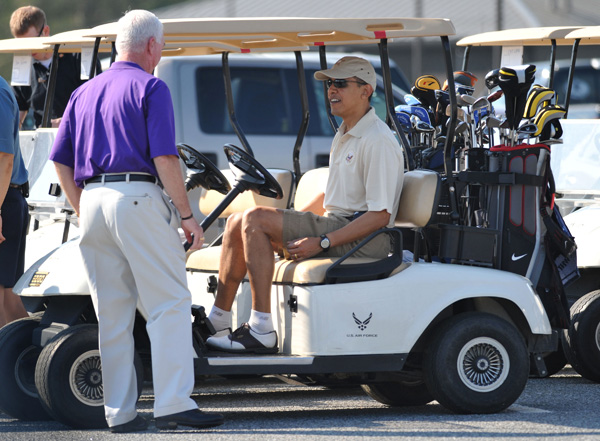
"Obama's Golf Shorts: Should Grown Men Wear Shorts? (PHOTOS, POLL)."

HuffPo gets in on what has long been a big topic here at Althouse. (Click the "men in shorts" tag below. And read what I said in the comments here about the guy seated next to me on the airplane yesterday.)

Here you see our President dressed for golf the way PGA Tour members are forbidden to dress. (Can you even picture Tiger Woods in shorts? No. And you're not supposed to.)


Come on! You're not a little kid! In fact, you are the President of the United States. Presidents golf in long pants!


IN THE COMMENTS: John Stodder says:
The reason I disagree with Ann on shorts on men is that I don't think it is a man's job to look attractive all the time, especially when engaged in leisure pursuits. Women do need to try harder in this area than men, and that might be unfair, but it won't do to try to apply the same attractiveness-at-all-times standard to both sexes.

The president, however, is never engaged in leisure pursuits, even when he is taking a break, so long as there is a camera anywhere nearby. So he does have a higher standard to reach. Higher yet because he's an avowed metrosexual.

But above all, if you wear shorts, you should not be nervously pulling at the seam to enclose it around the thigh as Obama seems to be doing. If there is any danger of your shorts exposing your beet salad to the world, they're either too short or too loose.

Sunday, November 30, 2008

"I could hear little Muscovites recite a similar pledge to their hammer-and-sickle flag with equal solemnity."

The Rev. George M. Docherty -- who died on Thanksgiving, at the age of 97 -- sermonized about the Pledge of Allegiance:
[He] was summoned from his native Scotland in 1950 to become pastor of the historic church in downtown Washington, which Abraham Lincoln attended when he was president in the 1860s. Each year on the Sunday closest to Lincoln's birthday, Feb. 12, the church had a special service that was traditionally attended by the president.

On Feb. 7, 1954, with President Dwight D. Eisenhower sitting in Lincoln's pew, Rev. Docherty urged that the pledge to the flag be amended, saying, "To omit the words 'under God' in the Pledge of Allegiance is to omit the definitive factor in the American way of life."

He borrowed the phrase from the Gettysburg Address, in which Lincoln said, "this Nation, under God, shall have a new birth of freedom."

Rev. Docherty's inspiration for the sermon came from his son's schoolroom experience of reciting the Pledge of Allegiance, which was written in 1892 by Baptist minister Francis Bellamy. When Rev. Docherty realized that it had no reference to God, he later said, "I had found my sermon."

Without mentioning a deity, Rev. Docherty said, the pledge could just as easily apply to the communist Soviet Union: "I could hear little Muscovites recite a similar pledge to their hammer-and-sickle flag with equal solemnity."...

But in 1954, with Eisenhower in the congregation and the threat of communism in the air, Rev. Docherty's message immediately resounded on Capitol Hill. Bills were introduced in Congress that week, and Eisenhower signed the "under God" act into law within four months....

"An atheistic American is a contradiction in terms," he said in his sermon. "If you deny the Christian ethic, you fall short of the American ideal of life."
Those words may grate on some liberals' ears. Remember the oral argument in the Supreme Court case challenging the constitutionality of the words "under God" in the Pledge?
Michael A. Newdow stood before the justices of the Supreme Court on Wednesday, pointed to one of the courtroom's two American flags and declared: ''I am an atheist. I don't believe in God.''...

Earlier, Dr. Newdow responded to Justice Stephen G. Breyer's suggestion that ''under God'' had acquired such a broad meaning and ''civic context'' that ''it's meant to include virtually everybody, and the few whom it doesn't include don't have to take the pledge.''

''I don't think that I can include 'under God' to mean 'no God,' '' Dr. Newdow replied. ''I deny the existence of God.'' He added, ''Government needs to stay out of this business altogether.''...

[The 9th Circuit court] ruled last year that the addition of ''under God'' turned the pledge into a ''profession of religious belief'' and made it constitutionally unsuitable for daily recitation in the public schools. Congress added the phrase at the height of the cold war in an effort to distinguish the American system from ''Godless Communism.''
But Docherty was no arch conservative. From the first link:
During his 26 years as pastor, he became better known for his liberal social activism than for his quest to alter the Pledge of Allegiance. He promoted racial equality and led outreach efforts to feed and educate the city's hungry and poor. His church was often a staging point for civil rights and antiwar demonstrations, and the Rev. Martin Luther King Jr. preached from its pulpit. Rev. Docherty was with King on the Edmund Pettus Bridge during the "Bloody Sunday" civil rights march in Selma, Ala., in 1965.

Sunday, September 28, 2008

Did Eisenhower advise his son to commit suicide?

John S.D. Eisenhower has a NYT op-ed opining that presidential sons should not be permitted to serve in combat duty. He recounts his own experience, as a soldier assigned to combat duty in Korea in 1952, as his father was about to win the presidency:
As the time for my deployment approached, I discussed my intentions with my father. We met at the Blackstone Hotel in Chicago, just after the Republican convention, and I explained my position. My father, as a professional officer himself, understood and accepted it. However, he had a firm condition: under no circumstances must I ever be captured. He would accept the risk of my being killed or wounded, but if the Chinese Communists or North Koreans ever took me prisoner, and threatened blackmail, he could be forced to resign the presidency. I agreed to that condition wholeheartedly. I would take my life before being captured.

On looking back through the years, however, I now feel that I was being unfair and selfish and that my father was being far too conciliatory in giving me such permission. On the other hand, I don’t think that the Army should ever have given me an option in the matter.
Conciliatory in giving me such permission. There's a phrase. Did Eisenhower advise his son to commit suicide? I'm trying to flesh out that conversation. Ike said he'd have to resign the presidency if his son John were captured and the Chinese Communists or North Koreans threatened blackmail, and John said that since he'd never advance in the military if he turned down a combat assignment, he would promise that if he were ever about to taken prisoner, he would kill himself first. And Ike's response was not, no, you would become a prisoner, with a life no more valuable that that of any other prisoners, but, because the American people will not know whether my love for you is affecting my judgment, I will need to resign the presidency. No, Ike said something like: Okay, then, suit yourself, go to combat, advance your career, but I have the ultimate career advancement here, son, the presidency, and I'm not letting you screw that up for me. You are on the hook, you little bastard. You promised to commit suicide. Don't forget!

Perhaps you would flesh out the Blackstone Hotel scenario differently. Meanwhile, John Eisenhower, who actually knows what was said, pads out his op-ed with material about how the President's son might increase the danger to those who serve alongside him, but this is a matter for military authorities to weigh (as was done in the case of Prince Harry, who mentioned in the article). Eisenhower has no expertise about about these risks and how the military authorities handle them today in Iraq and Afghanistan. His expertise is only about the mind of a one President, over half a century ago, whose relationship to his son is left opaque.

Eisenhower concludes:
No matter what the young person’s desires or career needs are, they are of little importance compared with ensuring that our leaders are able to stay focused on the important business of the nation — and not worrying about the fate of a child a world away.
The fate of a child? We don't send children to war. They are men and women, and all of them -- almost all of them -- have people who love them.

I want the President to have the strength of mind to think of all of them as valuable in the same way their own offspring are valuable. Let the President worry about their fate. If having his actual son fighting makes him reweigh the cost of war, perhaps he lacks the competence to govern. And this is certainly not to say that Dwight Eisenhower lacked the competence to govern. Look closely at that Blackstone Hotel story. It doesn't say that Ike thought his judgment would be skewed. The implication is that Ike worried that his credibility would be questioned, and only in the blackmail situation.

And what, if anything, do John Eisenhower -- and the NYT -- mean to imply about John McCain, who was taken prisoner when his father was a military commander and who considered but rejected suicide?

Wednesday, September 17, 2008

5 old presidential campaign ads.

For LBJ, Ford, Ike, JFK, and Dukakis. I love the variation in style, which, in each case, belongs so clearly to its decade.


I don't agree with John Dickerson that these are all great ads. I didn't remember that Dukakis put out that "heartbeat away" ad. Man, that was in poor taste. The Ford one was poignantly pathetic. The JFK ad was incredibly boring. The Ike ad was similarly boring but fascinating to us today because of the very old-fashioned presentation of the woman's role. That leaves Johnson's anti-Goldwater ad. I loved that one.

Friday, February 15, 2008

"Andrew, people my age are too young to remember Bill Clinton. All we have is George W. Bush. The office of the President to us is a mockery."

From from an email Andrew Sullivan published today. I hope the 21-year-old emailer has his hopes 'n' dreams fulfilled. Barack Obama is making him feel that the time is near when he will feel proud of his President, and: "Most people my age have never felt proud of our President." But I had to laugh at the idea that mocking the President began in the year 2001. Bill Clinton was not a figure of fun? The first Bush? Reagan? Carter? Ford? Nixon? LBJ? JFK? Eisenhower? That's as far back as I personally can remember. I won't say most people my age have never felt proud of our President. But I never have. And I don't think that's so terrible. Don't worship leaders. Let the mockery flow on. Even if a guy you like who seems pretty good makes it to the White House.

Wednesday, February 6, 2008

Come on, everybody, pay attention to Wisconsin.

Ours — on the 19th — is the next big primary. The Cap Times marshals the historical evidence of the importance of the Wisconsin primary:
  • As upstart contender Franklin Roosevelt did when he beat previous party nominee Al Smith in the 1932 Wisconsin Democratic primary.
  • As Willkie did with his audacious but failed 1944 bid.
  • As backers of Gen. Douglas MacArthur did when they tried unsuccessfully to build a boomlet for the Milwaukee native with an unsuccessful Republican primary bid in 1948.
  • As backers of Dwight Eisenhower did when they upset the campaign of conservative Robert Taft in the state and created an opening for the general to enter the contest for the Republican nomination of 1952.
  • As Massachusetts Sen. John Kennedy did when the state put him on track for the party nod in 1960.
  • As Minnesota Sen. Eugene McCarthy did when his anti-Vietnam War challenge to President Lyndon Johnson forced the incumbent to quit on the eve of Wisconsin's 1968 Democratic primary.
  • As South Dakota Sen. George McGovern did when the state gave him a critical Democratic primary win in 1972.
  • As liberal Mo Udall did when he narrowly failed to derail Jimmy Carter's bandwagon in the Wisconsin Democratic primary of 1976.
  • As liberal John Anderson and moderate George H.W. Bush did when they tried to block conservative Ronald Reagan's candidacy in the intense Republican primary of 1980.
  • As Mike Dukakis and Jesse Jackson did when they fought the essential battle of the 1988 Democratic nomination race in Wisconsin.
  • As Bill Clinton did when he used a slim win in the state to prevent challenger Jerry Brown from threatening his "comeback kid" status in the campaign for the 1992 Democratic nomination.
If you need something to fill your empty hours as you wait for the 19th, may I recommend the documentary "Primary," which shows John F. Kennedy campaigning here in Wisconsin in 1960, fighting off his rival Hubert Humphrey. This is a very low key but highly-regarded film by Robert Drew. It's nowhere near as fun as "The War Room" and "Journeys with George," but it's specifically about a primary, and it takes place in Wisconsin and it's got John F. Kennedy.

ADDED: A test to see if you know your blogger: Is Althouse voting in the Wisconsin primary? If so, will she choose to vote in the Republican or the Democratic primary? If she votes in the Republican primary, who will she vote for? If she votes in the Democratic primary, who will she vote for?

AND: Another question. Assume you're a filmmaker, making a documentary about one of the candidates in the 2008 election season. Which one do you wish you'd picked? That is, knowing what you know now, which campaign would have yielded up the footage for your idea of the best documentary?

Saturday, January 13, 2007

Ford did more to end the Cold War than did Reagan.

According to Gerald Ford in old interviews The Grand Rapids Press is now free to release.
Ford said Reagan, who challenged him unsuccessfully for the GOP nomination in 1976, was "a great spokesman for attractive political objectives" such as a balanced budget and defeating communism, "but when it came to implementation, his record never matched his words."

Reagan was "probably the least well-informed on the details of running the government of any president I knew," Ford said. In a separate interview, he said Reagan "was just a poor manager, and you can't be president and do a good job unless you manage."

Ford contended his own negotiation of the Helsinki accords on human rights did more to win the Cold War than Reagan's military buildup. Other key factors were the Marshall Plan that helped rebuild Europe after World War II and the establishment of NATO, he said.
He also said Carter -- who challenged him successfully in 1976 -- was "a disaster." Who did he like? Eisenhower. And Nixon wasn't so bad.

Monday, June 27, 2005

The dreaded Justice Kennedy.

Here's a front-page NYT piece on Justice Kennedy, whose nomination to the Court was sold to conservatives as "Bork without the beard" and who, 18 years laters, has conservatives fuming about impeaching him.
For more than a decade, Justice Kennedy has infuriated the right, writing decisions in cases that struck down prayer at public school graduations, upheld abortion rights, gave constitutional protections to pornography and gay sex and banned the death penalty for juveniles.

With talk of a possible court resignation to follow the term that ends Monday, Justice Kennedy is looming in many conservatives' minds as just the kind of painful mistake they hope President Bush avoids. Showing few sharp edges in life or in law, the justice emerged as a consensus third choice, after President Ronald Reagan's first two selections failed. Demanding more ideological clarity in what could be the first Republican selection in 14 years, the right is now mobilized with a cry: "No more Tony Kennedys."
I thought the cry was "No more Souters." But Souter, appointed by the first President Bush, veered all the way to the liberal side of the Court. Kennedy just took up the middle position. It's not enough, I suppose, to avoid a Souter. You've got to avoid a Kennedy.

I tend to think that if O'Connor retires, vacating one of the center spots, the new Justice will feel drawn to play the centrist role -- and if he does not, someone else will move toward the center. There's a certain small group dynamic going on here.

But there is a more pervasive problem that has dogged conservatives over the years:
Ever since the elevation of Earl Warren, Republican presidents have picked justices who disappoint the Republican faithful: William J. Brennan Jr. (President Dwight D. Eisenhower), Harry A. Blackmun (President Richard M. Nixon), John Paul Stevens (President Gerald R. Ford), Sandra Day O'Connor (President Reagan) and David H. Souter (the first President Bush).

One result is rage at what [rejected Reagan nominee Robert] Bork sees as subverted democracy. Even though Republicans keep winning elections, he said, the court "can say that the majority may not rule" in areas where permissiveness reigns, including abortion, gay rights and pornography. Calling most justices "judicial oligarchs," Mr. Bork said they reflected "the intelligentsia's attitude, which is to the cultural left of the American people."

Some conservatives blame the judicial selection pool, which is largely confined to graduates of elite law schools that they describe as liberal (Justice Kennedy studied law at Harvard). Some say the Senate confirmation process weeds out strong conservatives. Many critics argue that justices drift left after reaching the court, in the hopes of pleasing "liberal elites."
Much more in the article about Kennedy. And much more carping by Bork.

Myself, I like Justice Kennedy. He's a moderate who takes some strong positions on individual liberty.

Wednesday, September 1, 2004

Day 3 of the Republican Convention.

Here I go again. As before, I'll keep all my commentary in one post and use numbered paragraphs to indicate the updates.


1. A Baptist choir sings a terrific version of the National Anthem (even if they did quite clearly sing "Whore the land of the free..."). The Greek Orthodox Archbishop Demetrios, wearing beautiful vestments, gives a beautiful invocation. Hawaii Governor Linda Lingle gives some introductory remarks. She's wearing a lei, and Chris complains about it. I defend it as an emblem of her state. Chris rejects the defense: "Would the governor of Wisconsin wear a big cheesehead hat?"


2. Senator Rick Santorum: a boo is heard in the room here in Madison. He has a smug, wise-guy attitude, and I don't think I'm saying that solely because I disagree with his attitude about gay rights. "The torch of marriage is dying out." Do we want the federal government to pay for marriage counseling? Even if it is religious? That's a hard question. He has a good line: "[Kerry] says he is concerned about the separation of church and state. Senator Kerry should worry more about the separation of children from their fathers."


3. Wisconsin, for some reason, and I don't object, is recognized to make a motion to proclaim Dick Cheney the VP candidate by acclaimation. "And the motion is agreed to." A little "Cheney" chant breaks out.


4. I caught up to the live feed and I needed to let TiVo get back out in front of me to re-enable fast-forwarding, so I went upstairs to fold laundry, and I put on the upstairs TV--the TiVo-less Sony Wega (where the colors are always so comparatively crisp)--and I caught a little of Wolf Blitzer, Judy Woodruff, and Jeff Greenfield on CNN. And what were they punditizing about? It was practically word-for-word taken from this Instapundit post, from way back this morning, about manipulating the Iowa markets!


5. Representative Paul Ryan from Wisconsin. You can tell he's from Wisconsin because he clearly pronounces Wisconsin "Wi - SCON - sin," not, as I say even after 20 years here, "Wis - CON - sin." [ADDED: They're really playing up to Wisconsin tonight, aren't they? It must be something in the polls.]


6. I think it's a good sign that there is so much amateurish material. The party really isn't that slick. So much bad music! The faux interviews with community leaders. That lame comic segment with Barney the dog (who at one point had a debate with a white French poodle puppet dog named Fifi Kerry). I think 20 years from now the political convention will be a seamlessly acted entertainment extravaganza that everyone will watch and enjoy. But right now, we still live in the real world, because everything's a little bit pathetically ragged.


7. The tribute to Reagan. Beautiful. Many beautiful images. Reagan's voice: "We got America to stand tall again."


8. Is there some rule that every woman has to wear a light blue suit?


9. Finally, Zell Miller. It seems silly to say that and an indication of how much filler we've had to put up with tonight. I like Zell Miller and think he's a good speaker. He's speaking quickly for some reason. "My family is more important than my party." Only Bush is good enough for his family, he asserts. Then he reels back to the story of his life: he's a little boy, FDR is President, there's an "overriding public danger." He brings up Wendell Wilkie, with whom he clearly identifies. He's making a plea to overcome partisanship in a time of danger. He condemns the Democrats of today for putting their partisan politics above the nation's security. His voice trembles with anger as he says: "Nothing makes this Marine madder than someone calling America's troops occupiers rather than liberators! Tell that to the one half of Europe that was free because Franklin Roosevelt led an army of liberators, not occupiers!" Similarly, Eisenhower and Reagan. The soldier, not the protester, has given us our freedom. Don't dare to think of being President if you don't think of our soldiers as liberators! But the leaders of the Democratic party see America as the problem! They blame America. They believed in Carter's pacifism. "And no pair has been more wrong, more loudly, more often than the two senators from Massachusetts, Ted Kennedy and John Kerry!" Miller is unleashed. His opposition to his own party erupts here tonight. Kerry voted against so many arms programs, so what would he mean to be Commander in Chief of? "Spitballs?" Kerry would wait for the UN to approve of military action: "Kerry would let Paris decide when America needs defending." He would "outsource our national security." His opposition to Kerry slams down heavily. John Kerry would give terrorists "a yes/no/maybe bowl of mush." Bush would clamp down hard and not let go! He admires that Bush believes God "is not indifferent to America." He's like an old-fashioned preacher. He speaks with straight conviction, with almost a defiant sneer on his face. It's very effective!


10. Lynn Cheney introduces her husband, who, as a teenager in Casper, Wyoming, did not, like the other kids, cruise back and forth between root beer stands. He did not do the twist. She knew he was the guy for her. Imagine Dick Cheney as the love of your life! That's the way it is for them. Who are we to question love? Now, here he is. The grinding, grim flatness of Dick Cheney is just what it is to be Dick Cheney. He is what he is. It doesn't play to the big hall terribly well, especially not after the great revivalist Miller, but what did you expect? Perhaps even less. He lays it out. And you can take it or leave it. He's not doing the twist. He's Dick Cheney.


11. "A Senator can be wrong for twenty years without consequence to the nation, but a President always casts the deciding vote." Cheney is warming up as he lays into John Kerry. He's amusing himself. He chuckles: "Senator Kerry's liveliest disagreement is with himself. ... Senator Kerry says he sees two Americas. It makes the whole thing mutual. America sees two Kerrys." A man in the audience is seen rhythmically waving two flip-flops.

Monday, July 26, 2004

A little convention simulblogging.

I don't really want to watch the phony display that is a political party convention, but others in my household have turned it on, as I sit here with my laptop. So I'm blogging by accident. Al Gore just spoke in his strange, overheated way. I say he reminds me of the kind of guy in an old movie who would be trying to marry W.C. Fields's daughter. Og Oggilby. John says you should blog that. I'm thinking, who thinks about Og Oggilby?


Next, there's a horrid version of "Proud Mary" (the Tina Turner version, not the Creedence Clearwater version), with terrible new words: "working for the people every night and day," etc.


Now, they've lined up all the women. Barbara Mikulski is yelling out the words on the teleprompter, while every other Democratic woman Senator, including Hillary Clinton, stands in a line behind her. Nearly all wear colorful pantsuits and clasp their hands in front of them. Why must people--like Mikulski right now--speaking in a large auditorium always use an oratorical yell, as if there were no microphones? It's so irritating when you're sitting at home. When women seek power, by the way, it's not about power for themselves, it's about power to make a difference, here at home ... and abroad!


Now a huge group of children, making no effort to sing in tune, sing "This Land Is Your Land." The Senate women are still on stage, because, of course, what goes with children better than women? They clap along with the kids and smile and smile.


Time for seniors now. An elderly woman doctor, piped in from Little Rock, enunciates her way through a teleprompter speech. Kerry will be great for seniors because he'll help with a prescription drug benefit.


More music, and once again it's back to the sixties: "Everyday People." At least they don't change the words this time:

I am no better and neither are you

We are the same whatever we do

You love me you hate me you know me and then

You can't figure out the bag I'm in.


Yes, that's right: you were for the war, and then you were against the war. I can't figure out the bag you're in. And what a comfort it is to go back to the good old days when we did apply our mental efforts to the determination of what bag people were in.


Whoops, now it's "Tennessee Waltz." Because we want the votes of the pre-Boomers too. Or is it the rural voters we're trying to extend a hand to now? Or is it just Tennessee, that state Al Gore so famously lost last time around?


Governor Richardson now. Another speaker who seems not to notice there is a microphone. His attempt to shout to the last row makes his voice unpleasantly harsh. John (my son) says: "It's not just the tone of his voice. He sounds like the school principal giving a speech."


A little film about Carter. Carter in the flesh emerges. He served in the military, he informs us, and I slip back into my semi-coma, as it's clear where this is going. He served under two Presidents, Truman and Eisenhower, who had themselves served in the military, and because of this they had the proper judgment about how to use the military, judgment that is sorely lacking now under Bush. And presumably under Clinton, but let's not mention that. (And was Carter for Dole?) And let's not even think about what we would say about this principle of military service if a woman candidate seeks the Presidency some time in the future. This year, the principle will be treated as an eternal verity.


Rep. Stephanie Tubbs Jones, wearing a hot pink suit jacket, takes the podium, and reminds me of how everyone who has spoken tonight has delivered a sequence of stock phrases. Has there been one fresh expression? Did you know that we want an America that is stronger and more united? Did you happen to realize that we should seize the promise of the future?


They play the original Chuck Berry recording of Johnny B. Goode. Happy people in the audience dance and clap as if rock 'n roll was invented yesterday.


Tammy Baldwin! A cheer goes up in Madison. The local kids are gathered in the NItty Gritty restaurant to watch her on TV together. [Someone who attended comes in wearing a button that says: "Dated Dean, Married Kerry."] Tammy looks pretty and emotes her way through the speech like Reese Witherspoon in "Election."


Rep. Bob Menendez is speaking. Someone who wasn't in the room back when John made that comment about Gov. Richardson observes, "That guy sounds like the school principal." Menendez pronounces "nuclear" "nucular."


Glenn Close is called upon to talk about 9/11, Hollywood-style: "It all began on an ordinary, cloudless day ..." A mother of a 9/11 victim reads a speech from a piece of paper. There are shots of people looking appropriately grief-stricken in the audience. A sixteen-year-old boy plays "Amazing Grace" beautifully on the violin and everyone in the crowd holds up a cigarette lighter flame.


Rev. David Alson, who served in the military with Kerry, gives a rousing speech. He wears a striped suit that has a wicked moiré effect on TV.


Hillary Clinton arrives as a saxophone plays "New York State of Mind." She's wearing a light yellow pantsuit and the official jewelry of the Democratic Convention: a pearl choker. Blah blah blah health care blah blah drug prices blah blah stem cell research. She highlights the names of the wives of Kerry and Edwards. She talks about 9/11 in terms of its effect on her. I thought she was only going to speak for 5 minutes. I guess she's caught some of Bill's tendency to run overtime.


And out comes Bill Clinton, and the Fleetwood Mac music kicks in, so people can feel fully nostalgically thrilled to get that old 1992 feeling again. Bill looks slim and well-tanned and has a neat short haircut that has been tinted blond. (Are people noticing this? It's quite clear. You can see he's left some white at the temples, and the contrast is clear. He's gone blond!) Ah! Clinton is an immensely engaging speaker. (Is Al Gore still there, watching in some back room or back at his hotel? Is he regretting not using Clinton in his own campaign?) The most interesting thing Clinton says is that he's jealous of Edwards. He sees himself in Edwards.


Oh, enough of all this. Time to watch "The Daily Show." No, it's a rerun. We'll have to wait until tomorrow for their convention coverage. Time to shut off the TV. End of post. Really.


P.S. Thanks to Instapundit for linking to this while I was still in the middle of writing it!

Friday, March 5, 2004

Yes, I'm back from lunch, and I've read the Times. And I've got eight observations:

1. Go ahead and hunt the protected-species eagle, because that fox is cute.


2. Who wouldn't want Hirb to give them a bath?

3. A question actually posed by a NYT writer: "Why shouldn't movie moguls get their groove on wearing $2,300 sweaters handmade in Scotland and adorned with elegant motifs like skulls with Mickey Mouse ears, marijuana plants or French phrases inviting observers to perform on one's person acts whose names cannot be printed here?"

4. Kudos to Neil MacFarquhar for thinking of an adjective to precede "clad" other than "scantily." For decades, writers have searched their minds for an alternative and now, finally, a solution: "skimpily clad." (Read the article, too, to learn how "Abdel Hakim, a strapping young Saudi, kissed Kawthar, a raven-haired Tunisian beauty, and all hell broke loose." It's about reality TV in the Mideastern milieu.)

5. When friends couple for purely economic reasons: a letter expanding on the current marriage debate. I raised some similar points here. Can two platonic friends marry just so one can get the other's health insurance benefits? Sure, if they are a man and a woman.

6. Goodbye to Stephen Sprouse, who "served guests his famous Bloody Marys in measuring cups and [whose] address book consisted of writing phone numbers on his arms with his ever-handy felt marker."


7. Harsh but hilarious words from Warren Burger, pre-Supreme Court:

[In 1961:] "I'm getting so I don't read what these 'phonies' on the S.Ct. write ... The horrible thing is that the Eisenhower appointees are doing most of the damage."

"Phonies"? I wonder if he was a big fan of "The Catcher in the Rye."

[Later:] "Last Monday's effluvia of the Nine Great Minds is worse than most. ...As I watch this batch of mediocrities function I fear for the Republic. It would be hard to add up two total Supreme Court-caliber men out of the whole nine of them."

"Effluvia"? Hey, I used to have the word "effluvia" over there in my blog description but I changed it to "various random items" to avoid being offputting when somebody said they had to look it up.

8. Six width-of-the-puzzle answers in the puzzle! Thanks, Will.