Pages

Labels

Showing posts with label Picasso. Show all posts

Monday, January 14, 2013

"Must you always be out in that ghastly clown suit, running around annoying people?"

Says Pretty Alice to the Harlequin in Harlan Ellison's "Repent Harlequin!' Said The Ticktockman," which I read on the urging of commenter Icepick because of the way it reflected on the recent news stories about Aaron Swartz, David Gregory, and the Boston ban on drinking games.

I downloaded this Orson Scott Card collection — "Masterpieces: The Best Science Fiction of the 20th Century" — which included "Repent Harlequin," because I wanted to understand this harlequin/ticktockman distinction, and lo and behold here's the harlequin — actually, what do you expect? he's a harlequin — wearing a clown suit, when just 5 days ago, the bloggism of the day was clown suits. We were pimping clown suits.


It's weird how these themes seem to coagulate on their own.


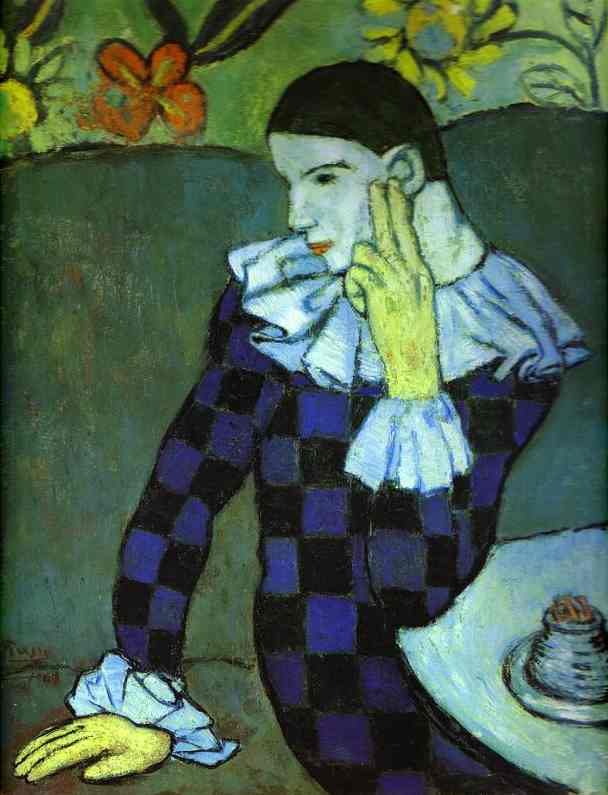
IN THE COMMENTS: Astro said points out that my Picasso clown isn't a harlequin. I need to be better about specifying the Commedia dell'arte characters. Here's a Picasso harlequin (on the right):

Tuesday, December 11, 2012

2 passages read recently on what makes an artist.

I've been rereading Tom Wolfe's "The Painted Word" in Kindle the last couple days, and I ran across a great passage that shed light on something in that collection of essays I keep pushing, David Rakoff's "Half Empty."

First, Rakoff:
An artist is something you are, not something you do.

I first encountered this Seussian syllogism in a used-book store, where I spent an extra thirty minutes fake-browsing just so I might continue to eavesdrop on the cashier, who was expounding to his friend about Johnny Got His Gun, Dalton Trumbo’s classic antiwar novel. The cashier had a theory about the book’s protagonist, Johnny, wounded and blinded and amputated to such an extent that, while sentient, he was little more than an unresponsive trunk of meat with a rich inner life.
“So I asked myself: If this guy was Picasso, would he have been any less of an artist or less of a genius just because he couldn’t paint? And my thinking is no, he wouldn’t.” I lacked the bravery to challenge him more openly than a muttered “Oh, brother” from the stacks, choosing instead to ridicule and sell him out years later, here in print. But it’s the same reasoning: indolence as proof positive of prodigious gifts. You can arguably invent Cubism and be the very embodiment of Modernism if you get a kick out of that sort of thing. But you hardly need to, Armless Picasso. Artists are artists whether they produce or not. None of it requires much more than hanging out. 
And hanging out can be marvelous. But hanging out does not make one an artist. A secondhand wardrobe does not make one an artist. Neither do a hair-trigger temper, melancholic nature, propensity for tears, hating your parents, nor even HIV—I hate to say it—none of these make one an artist. They can help, but just as being gay does not make one witty (you can suck a mile of cock, as my friend Sarah Thyre puts it, it still won’t make you Oscar Wilde, believe me), the only thing that makes one an artist is making art. And that requires the precise opposite of hanging out; a deeply lonely and unglamorous task of tolerating oneself long enough to push something out.
Here's Wolfe:
The Conceptualists liked to propound the following question: Suppose the greatest artist in the history of the world, impoverished and unknown at the time, had been sitting at a table in the old Automat at Union Square, cadging some free water and hoping to cop a leftover crust of toasted corn muffin or a few abandoned translucent chartreuse waxed beans or some other item of that amazing range of Yellow Food the Automat went in for— and suddenly he got the inspiration for the greatest work of art in the history of the world. Possessing not even so much as a pencil or a burnt match, he dipped his forefinger into the glass of water and began recording this greatest of all inspirations, this high point in the history of man as a sentient being, on a paper napkin, with New York tap water as his paint. In a matter of seconds, of course, the water had diffused through the paper and the grand design vanished, whereupon the greatest artist in the history of the world slumped to the table and died of a broken heart, and the manager came over, and he thought that here was nothing more than a dead wino with a wet napkin. Now, the question is: Would that have been the greatest work of art in the history of the world or not? The Conceptualists would answer: Of course, it was. It’s not permanence and materials, all that Winsor & Newton paint and other crap, that are at the heart of art, but two things only: Genius and the process of creation! Later they decided that Genius might as well take a walk, too.

Tuesday, October 16, 2012

Art heist in Rotterdam.

Stolen: Pablo Picasso’s 1971 “Harlequin Head”; Claude Monet’s 1901 “Waterloo Bridge, London” and “Charing Cross Bridge, London”; Henri Matisse’s 1919 “Reading Girl in White and Yellow”; Paul Gauguin’s 1898 “Girl in Front of Open Window”; Meyer de Haan’s “Self-Portrait,” around 1890, and Lucian Freud’s 2002 work “Woman with Eyes Closed.”
Marinello said the thieves have limited options available, such as seeking a ransom from the owners, the museum or the insurers. They could conceivably sell the paintings in the criminal market too, though any sale would likely be a small fraction of their potential auction value.
The problem selling these things is obviously not protection enough to keep thieves from bothering.


IN THE COMMENTS: chickelit said:
From the link: the idea that an unscrupulous private investor might have commissioned the works’ theft was far-fetched. 'That’s something that comes from Hollywood movies,' he said.

Should they blame a Hollywood video or lax security?

Thursday, September 6, 2012

The law-and-fashion news.

"Designer Christian Louboutin can claim trademark protection for the red outsole on his women's shoes, but not if the rest of the shoe is also red, a federal appellate panel ruled yesterday, allowing rival Yves Saint-Laurent to continue selling an entirely red shoe."
Louboutin's iconic high-end, red-soled shoes, introduced in 1992, have been spotted on celebrities including Sarah Jessica Parker, Victoria Beckham and Rihanna. The shoes sell for up to $1,000 a pair.

YSL's shoes are entirely red, including their outsoles, and are part of a line of similarly monochrome shoes, also in purple, green and yellow....

[The district judge had said] that a color, being an essential element of fashion design, could not be trademarked, despite the strong connection in the public mind between red soles and Louboutins. The judge compared the suit to Pablo Picasso suing Claude Monet to assert a trademark for a particular shade of blue....

However, the [appellate] panel found that the "evidentiary record further demonstrates that the Louboutin mark is closely associated with contrast," not just the red color, and that the trademark must be narrowed to cover only situations where the red sole of a shoe contrasts with a differently colored upper part.
So maybe you can have a trademark in a particular color. (I note that Tiffany, which has a particular shade of blue, filed an amicus brief supporting Louboutin.) But Louboutin didn't own red or even red soles. What distinctively said Louboutin was red soles contrasting to the rest of the shoe.

The Louboutin side of the argument thus won something important upsetting the trial judge's per se rule against fashion-industry trademarks in a color.

Thursday, December 29, 2011

Former Madison Mayor Dave Cieslewicz advocates blowing up a public sculpture.

He writes:
Blow it up. That’s right. Attach some dynamite to the base of the darn thing and launch it. We could make a big party out of it... People could gather to watch the event from a safe distance...
I wonder what Cieslewicz thought about the Taliban blowing up the Bamiyan Buddhas?
"They drilled holes into the torsos of the two statues and then placed dynamite charges inside the holes to blow them up."
Do you feel glee at the notion of blowing up a work of art that you find ugly? Should the people of a particular place have the power to destroy a work of art if they hate it? I supported moving one famous sculpture that was an arrogant and hated imposition on the people who had to live with it.

As for the particular hated sculpture Cieslewicz wants to blow up — I like it. I think it's smart and amusing — an obelisk that is "ruined" to the point where we can see that it is composed of footballs — set outside the football stadium.
It’d be one thing if it had been Pablo Picasso trying to force his vision on us. But who the heck is Donald Lipski? I doubt seriously that Madison will be embarrassed someday as the town that didn’t appreciate Lipski.

So, if the public hates it, don’t force it down their throats.
Why would you say "don’t force it down their throats" about something that's obviously a phallic symbol? Why exactly does the obelisk upset you? Before exploding this thing, I urge you to submit to a Freudian session of deep (throat) thought. Throats... Lipski... are the lips key?

Think, Madison, think. Why does this sculpture — "Nail's Tales" — bother you? Why does it make you think of explosions?

By the way, when Chicago's monumental Picasso sculpture was unveiled in 1967, Mayor Richard J. Daley said: "We dedicate this celebrated work this morning with the belief that what is strange to us today will be familiar tomorrow." Various politicians complained that the thing should be removed.  Ald. John J. Hoellen wanted it replaced by a statue of "Mr. Cub . . . Ernie Banks."

In the philistine tradition of Alderman Hoellen, Cieslewicz recommends replacing the obelisk with a statue of Donna Shalala.

ADDED: I posted about Our Football Obelisk back in 2008... with my photograph of it:

Our Football Obelisk

Tuesday, October 18, 2011

"Sotheby's to sell real drawing by fake artist."

"The London auction house said Monday it is offering a drawing by the talented but fictional American abstract expressionist Nat Tate."

You can see the drawing — "Bridge No. 114" — and read about the creation of Nat Tate by writer William Boyd here.
It all started in 1998. I was on the editorial board of Modern Painters magazine, then a very classy and influential art quarterly, and one day in a meeting the editor of the magazine, Karen Wright, wondered out loud if there was a way we could introduce some fiction into the mix of artists' profiles, exhibition reviews and general essays in which the magazine specialised. I don't know what made me speak out but I said, without really thinking: "Why don't I invent an artist?" And so Nat Tate was born.
So Boyd wrote his story, making Tate an Abstract Expressionist who gets depressed about his art after meeting Picasso* and ends up burning all his artwork and committing suicide.** Boyd allowed his fictional story to be published as a glossy art book with illustrations of artwork, and it was presented as if it were about a real artist. That it, it was a joke — the launch party was on an April Fool's Day 1998 — or, if you prefer, a hoax. People fell for it. The truth was revealed. Boyd professes himself hurt that it was called a hoax and not a joke. (Contemplate the hoax/joke distinction.)

Dogged by the accusations of hoax, Boyd conceived closure:
If this fictional artist could sell an artwork for real money then the Nat Tate story would have reached some kind of apotheosis and consummation. So I "found" another Nat Tate drawing – one from his famous bridge sequence... Sotheby's had form when it came to selling art by fictional artists, having successfully auctioned a Bruno Hat painting some years previously. Hat was a spoof artist that a group of bright young things had invented in 1929 and staged an exhibition of his work in a London town-house.... Hook consulted with colleagues and in due course I was told the sale was on...
Presumably, the form attends to all the incipient legal issues. If you go looking for closure, you surely don't want to touch off litigation. But the notion of closure is also fictional, no? I hadn't remembered the 12-year old story, and now I'm propagating it.

Actually, I like the idea of a fictional artist, and the artwork itself is real. (I've read "The Recognitions" by William Gaddis — "a masterwork about art and forgery, and the increasingly thin line between the counterfeit and the fake.") In the blogosphere, boring, humorless people express outrage when pranksters and artists experiment with "sockpuppets." It's too hard to play in this complex world we've made for ourselves. (Why did we go to all this trouble to exclude play?!)

But Boyd duly anticipates outrage. The proceeds from the sale of "Bridge No. 114" will go to a charity. Artist's Benevolent Institution. Wouldn't it be funny if that the name of William Boyd's bank account? No, you're not laughing? You're one of the killjoys!
_____________________________

*And Braque. Seriously, why kill yourself over Braque? What cherry on the top of a depression sundae is Braque? I'd have to read the book to tell you. There, I just bought the book. I'll tell you later. You, the 2 people who read this blog and want to know how Braque augmented Picasso in the emotional arc toward a fictional suicide.

** He uses the same suicide method — jumping off the Staten Island ferry — used by Spalding Gray. I hope Gray didn't read this book, looking, perhaps for inspiration.

ADDED: From Boyd's book:
... Nat felt vastly more at ease with Braque than with Picasso and gladly accepted when Braque offered to show him around his studio. Braque was then reworking his painting La Terrasse, which he had begun some eleven years earlier, a fact that Tate found astonishing, not to say incomprehensible. He was also deeply moved and captivated by some of the smaller elongated landscapes and seascapes in the studio. Apparently Tate ventured the opinion that they reminded him of van Gogh’s late landscapes. After gently correcting Tate’s pronunciation (‘Van Go? Non, mon ami, jamais’), Braque commented that he ‘regarded van Gogh as a great painter of night.’ The observation seemed to trouble Nat unduly, as if it was prophetic or gnomic in some sinister way... There is a photograph of the fête champêtre that Nat and Barkasian had with Braque and his family and friends during that visit, taken by Barkasian, one assumes, as he is absent from the picture. Braque himself sits at the centre of the table, dappled with autumn sunshine, while the women of the household fuss over the food and the placement. Nat stands close to the master, on his left, a plate in his hand, almost as if he is about to serve him. But his gaze is unfocused, he looks out of frame, at something in the middle distance, or perhaps just lost in his darkening thoughts. Nothing would ever be the same again.
So what was it about Braque that could drive you to suicide? His douchebag pronunciation of "Van Gogh"? His high school French? (I can talk French like that: Oui, mon ami, toujours!) Or was it the fact that — unlike an Abstract Expressionist — he fussed over a painting for 11 years, and — unlike an Abstract Expressionist — he maintained a calm and pretty domestic life? Dammit, that's it! I can't take it anymore!

Friday, February 19, 2010

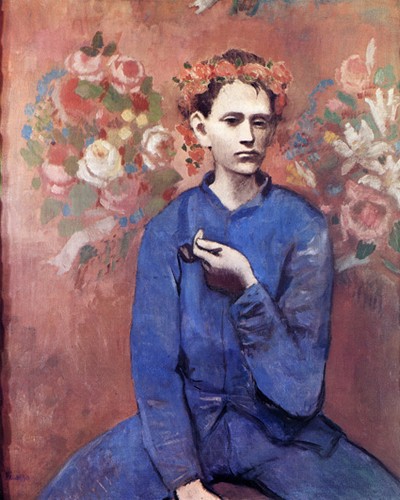
Did the skater Johnny Weir deliberately allude to Picasso's "Boy with a Pipe"?

After skating in the Olympics last night, Johnny Weir got a wreath of roses, which he wore on his head as he waited for his scores:

DSC07962

And here is the famous painting:

At the Red Stripe Nightclub...

DSC07737

... you can frame your involvement with the people you encounter.

Monday, February 15, 2010

Picasso's "Devil," painted on corrugated cardboard.

"Devil" by Picasso

We were amused by the pop-up penis.

IN THE COMMENTS: Julius Ray Hoffman said:
That thing is haunting. At first I thought it was ridiculous, maybe even a joke. Then it kept popping up out of my subconscious... OWL. PENIS. CARDBOARD. PICASSO. OWL. Now every time I scroll down the Althouse main page to see if any of my Rightist-baiting trollish comments have had their intended effect, I encounter that thing and each time I feel like I have been flicked on my forehead by its cardboard pop-up penis. OWL. PENIS. CARDBOARD. PICASSO. 
Ha ha. You'll never think of corrugated cardboard the same way again. Ribbed, for her pleasure.

Sunday, February 14, 2010

Camouflaging myself in a Matisse...

DSC07740

... doing a picture-in-picture Picasso...

DSC07736

... stopping for that train-in-a-fireplace Magritte...

DSC07699

... and getting lost amid the dimly lit glass cases in glass cases in the surrealist passages.

DSC07709

(These are just some more of my pictures from the Art Institute of Chicago. We've moved on to Lafayette, West Lafayette, and back through Chicago, and — almost to Madison — we're picking up free WiFi (and cheap cheeseburgers) at a McDonald's near Beloit.)

Friday, February 12, 2010

Sculptural space.

DSC07681

DSC07678

DSC07677

DSC07676

(Art by Giacometti and Picasso, in the new Modern Wing of the Art Institute of Chicago.)

Monday, January 25, 2010

"Woman puts the 'ass' in Picasso at Met."

Teaser on the front page at the Daily News for this article about a woman falling into a big Rose Period Picasso and ripping it.

Sunday, January 4, 2009

Is living in the city bad for your brain?

Some science-y crap:
Just being in an urban environment, they have found, impairs our basic mental processes. After spending a few minutes on a crowded city street, the brain is less able to hold things in memory, and suffers from reduced self-control. While it's long been recognized that city life is exhausting -- that's why Picasso left Paris -- this new research suggests that cities actually dull our thinking, sometimes dramatically so.

"The mind is a limited machine,"says Marc Berman, a psychologist at the University of Michigan and lead author of a new study that measured the cognitive deficits caused by a short urban walk. "And we're beginning to understand the different ways that a city can exceed those limitations."...

Consider everything your brain has to keep track of as you walk down a busy thoroughfare like Newbury Street. There are the crowded sidewalks full of distracted pedestrians who have to be avoided; the hazardous crosswalks that require the brain to monitor the flow of traffic. (The brain is a wary machine, always looking out for potential threats.) There's the confusing urban grid, which forces people to think continually about where they're going and how to get there.

The reason such seemingly trivial mental tasks leave us depleted is that they exploit one of the crucial weak spots of the brain. A city is so overstuffed with stimuli that we need to constantly redirect our attention so that we aren't distracted by irrelevant things, like a flashing neon sign or the cellphone conversation of a nearby passenger on the bus. This sort of controlled perception -- we are telling the mind what to pay attention to -- takes energy and effort. The mind is like a powerful supercomputer, but the act of paying attention consumes much of its processing power....

But the density of city life doesn't just make it harder to focus: It also interferes with our self-control. In that stroll down Newbury, the brain is also assaulted with temptations -- caramel lattes, iPods, discounted cashmere sweaters, and high-heeled shoes. Resisting these temptations requires us to flex the prefrontal cortex, a nub of brain just behind the eyes. Unfortunately, this is the same brain area that's responsible for directed attention, which means that it's already been depleted from walking around the city.
But what is life for, if not to walk around a complicated city, receiving and responding to the stimulation? Do you have something better to do? If you leave the city, you won't be living in a beautiful mansion, with a beautiful garden and a sun-filled studio where you're painting Picassos. Will you?

Is the brain in the city impaired or is it just used? Now, it's true, our brains evolved in a non-urban environment. But does that mean these brains of ours are hurt whenever we use them for things they didn't evolve by doing? You'd have to also say that our brains are hurt by reading, by climate-controlled interiors, by the knowledge of the news of what's happening in other countries, by YouTube....


Let it be a good city!

Thursday, October 30, 2008

Picasso pumpkin.

From a collection of carved pumpkins, I like "Picasso's Dream":


It took me a while to see it, and I am a big fan of negative space and Picasso's "Dream" has long been one of my favorite paintings. A delightful feeling of belated recognition.

Tuesday, August 12, 2008

The Chicago Picasso.

Picasso sculpture, Chicago

With dancers.

(Info on the sculpture in Daley Plaza: here. Enlargement of the photo: here.)

Tuesday, May 13, 2008

Robert Rauschenberg has died.

Links to obituaries to follow.

Here's an old post of mine about him, from back in 2004:
Robert Rauschenberg answers some questions from Deborah Solomon in today's NYT:
Aren't you having another show now at Yale?

Yes. I am not happy with it. It was organized by the gay studies department, whatever that is. It's not an approach that makes sense. I refused to give them permission to reproduce the works in a catalog.
Hmmm.... a little more info would be nice! There's this description:
"Robert Rauschenberg: Gifts to Terry Van Brunt'' features about 40 pieces that Rauschenberg gave as presents to his former lover, Terry Van Brunt. ... Jonathan Katz, an associate professor at Yale who launched the gay and lesbian studies program there in 2002, organized the exhibit.

"Rauschenberg himself does not want the work talked about in a gay context,'' Katz said. "But I am not responsible to the artist's wishes. I am responsible to the work.''

The collection includes "Bob's Face With Fly,'' a self-portrait that shows a fly on Rauschenberg's face, and "Terry's Briefcase Piece,'' a briefcase that was painted and collaged. Katz believes the exhibit is important because it shows how Rauschenberg's personal life has shaped his work.
Meanwhile, back in the NYT interview, Rauschenberg is presenting himself as impersonally as possible. He speaks of painting from photographs. Asked “What sort of photographs do you prefer?,” he asserts that he “likes photographs of anything uninteresting. Maybe just two doors on a wall.” Asked “What is so great about the ordinary anyhow?, he answers, “I find the quietness in the ordinary much more satisfying." Asked if at 78, he thinks about dying, he says “No. Not at all” and tells a hackneyed anecdote about someone else. Asked why he left New York in 1970 to go live by the ocean in Florida, he alludes to a feeling of responsibility about “everybody … leaving their spouses,” then says a fortuneteller told him “it wasn't my fault but that I should go to sunshine and water” and he “was pleased with that.” He gives as the secret to happiness “enjoy[ing] something simple, like just looking at the ocean.”


ADDED: Here's the NYT obit — a very big one. Excerpt:
“Everyone was trying to give up European aesthetics,” he recalled, meaning Picasso, the Surrealists and Matisse. “That was the struggle, and it was reflected in the fear of collectors and critics. John Cage said that fear in life is the fear of change. If I may add to that: nothing can avoid changing. It’s the only thing you can count on. Because life doesn’t have any other possibility, everyone can be measured by his adaptability to change.”

Cage acquired a painting from the Betty Parsons show [in 1951]. Aside from that, Mr. Rauschenberg sold absolutely nothing. Grateful, he agreed to host Cage at his loft. As Mr. Rauschenberg liked to tell the story, the only place to sit was on a mattress. Cage started to itch. He called Mr. Rauschenberg afterward to tell him that his mattress must have bedbugs and that, as Cage was going away for a while, Mr. Rauschenberg could stay at his place. Mr. Rauschenberg accepted the offer. In return, he decided he would touch up the painting Cage had acquired, as a kind of thank you, painting it all-black, being in the midst of his new, all-black period. When Cage returned, he was not amused.

“We both thought, ‘Here was somebody crazier than I am,’ ” Mr. Rauschenberg recalled. In 1952 Mr. Rauschenberg switched to all-white paintings, which were, in retrospect, spiritually akin to Cage’s famous silent piece of music, during which a pianist sits for 4 minutes and 33 seconds at the keyboard without making a sound. Mr. Rauschenberg’s paintings, like the music, in a sense became both Rorschachs and backdrops for ambient, random events like passing shadows. “I always thought of the white paintings as being not passive but very — well, hypersensitive,” he told an interviewer in 1963. “So that people could look at them and almost see how many people were in the room by the shadows cast, or what time of day it was.”

Wednesday, March 2, 2005

"Artstar."

I love the idea of a reality show for artists.
"In the 1970's when I started in the art world, no self-respecting artist would have stood in line to try to get on a television show," said Jeffrey Deitch, whose gallery, Deitch Projects, is helping to create an art-reality show called "Artstar." "It never would have happened."
Back in the 50s and 60s, ordinary people got excited about art and followed the celebrity artist like Jackson Pollock and Andy Warhol. And Picasso was still around, with all his star quality. But ordinary people haven't followed art in recent decades. So art needs a reality show to make it relevant again. Artists lining up in SoHo to participate in the show is a nice follow up to the big Christo stunt in the park. Even if the art isn't all that great, it's good to make art popular again!

And maybe the show is good for the artists. Why assume the current system for selecting artists is better than a contest?
[M]any of the artists who were braving the icy wind on Wooster Street Monday morning said that if trying to break into the art world through television was a little silly, it was no sillier than many of the other ways that artists try to attract attention in the highly competitive New York art world.

"It's so much about luck," said Arnulfo Toro, 28, who recently quit a job working as a painter for Jeff Koons's studio, where he said he was dissatisfied by the pay. "You can be really bad and get the go-ahead and be really good and go nowhere. We all need a godfather to give us a start." But despite camping out in sleeping bags beginning at 6 in the morning to get a place in line, neither Mr. Arnulfo, a painter, nor his friend, Peter Knutson, 30, a sculptor, made the cut yesterday to a group of 32 semifinalists.
Finally, just as a matter of good TV: art gives us something to look at and TV is a visual medium. I note that the best episode ever of "The Apprentice" involved selecting and promoting an artist.