In the Netherlands.
Nice repurposing! I like it.
Showing posts with label prison. Show all posts
Showing posts with label prison. Show all posts
Monday, February 25, 2013

Saturday, February 23, 2013
"I feel like I just won the Academy Award. If an artist can offend so many people that he has to go to prison..."
"... to protect society, that's really saying something. Most shock artists dream of this kind of attention, without the prison part."
Ira Isaacs, sentenced last month by a federal judge — this is in the United States— for 4 years, for violating obscenity law. The Huffington Post — considered a liberal website, and, again, this is in the United States — began its article about the sentencing with a joke: "Looks like someone's career went down the toilet." (The movies included the simulated consumption of feces.)
There is no shame anymore. And yet there still are obscenity trials. Absurd.
I'm finding this story now because I happened across an account to the trial in an article published last March at Reason.com: "Porn So Icky That It Can't Be Obscene" (by Jacob Sullum), describing the argument made at trial, which describes the argument made by Isaacs's lawyer:
Ira Isaacs, sentenced last month by a federal judge — this is in the United States— for 4 years, for violating obscenity law. The Huffington Post — considered a liberal website, and, again, this is in the United States — began its article about the sentencing with a joke: "Looks like someone's career went down the toilet." (The movies included the simulated consumption of feces.)
There is no shame anymore. And yet there still are obscenity trials. Absurd.
I'm finding this story now because I happened across an account to the trial in an article published last March at Reason.com: "Porn So Icky That It Can't Be Obscene" (by Jacob Sullum), describing the argument made at trial, which describes the argument made by Isaacs's lawyer:
"My intent is to be a shock artist in the movies I made," [Isaacs] testified, "to challenge the viewer in thinking about art differently... to think about things they'd never thought about before." Similarly, [his lawyer Roger] Diamond argued that the films have political value as a protest against the government's arbitrary limits on expression, illustrating the "reality that we may not have the total freedom the rest of the world thinks we have."Sullum wrote:
I will be impressed if Isaacs, who faces a possible penalty of 20 years in prison, can pull off this feat of legal jujitsu, transforming the very qualities that make his movies objectionable into their redeeming value — especially since at least some of the jurors... found the evidence against him literally unwatchable. But if the jurors want to blame someone for making them sit through this assault on their sensibilities, they should not blame Isaacs. They should blame the Justice Department, which initiated the case during the Bush administration, and the Supreme Court, which established the absurdly subjective test they are now supposed to apply. Will they take seriously Isaacs' references to Marcel Duchamp, Robert Rauschenberg, Kiki Smith, and Piero Manzoni, or will they dismiss his artistic name dropping as a desperate attempt to give his masturbation aids a high-minded purpose?But here's some up-to-date news from 2 days ago: Minutes before Isaacs was to turn himself in to the federal Bureau of Prisons, Isaacs go a call from his lawyer saying "don't go." The judge had approved his motion for bail pending appeal.
Isaacs told XBIZ that today's events were so surreal he had felt like he was in an episode of the "Twilight Zone" or a Quentin Tarantino movie....
"Last night, I was thinking it would be my last night of freedom," he said. "I really thought that this would be it; that I would be sleeping in prison the following night... and that would continue for a very long time."We'll see what happens in the 9th Circuit Court of Appeals and — if we're lucky — the Supreme Court.
Sunday, February 17, 2013
Ramzi Yousef, convicted after the 1993 WTC bombing, sues for relief from solitary confinement.
He'll never get out of prison, but — after 15 years — should he get out of solitary confinement? But that's not the question asked in a lawsuit. To win the lawsuit, a court has to deprive government of the choice to treat him like that.
Colin Dayan, a humanities professor at Vanderbilt University who has studied solitary confinement in Arizona, said many prison administrations use isolation without regard to psychological damage to inmates.After his arrest, Yousef — who expected the death penalty — told FBI agents that he had intended "to topple one tower into the other, and cause a total of 250,000 civilian deaths."
"You no longer know what's real," she said. "You can't speak to anyone; you can't touch anyone: your senses no longer have any outlet. You have delusions and become psychotic. Your mind deteriorates."
Tuesday, February 5, 2013
Saturday, January 26, 2013
Joseph Brodsky "used to appall his students by requiring them to memorize something like a thousand lines each semester."
"He felt he was preparing them for the future; they might need such verses later in life. His own biography provided a stirring example of the virtues of mental husbandry. He’d been grateful for every scrap of poetry he had in his head during his enforced exile in the Arctic, banished there by a Soviet government that did not know what to do with his genius and that, in a symbolic embrace of a national policy of brain drain, expelled him from the country in 1972."
From "Why We Should Memorize," by Brad Leithauser.
(In 1972, Brodsky became the poet in residence at the University of Michigan. I was a student there at the time and remember a grand assembly with Brodsky received as a great hero.)
From "Why We Should Memorize," by Brad Leithauser.
(In 1972, Brodsky became the poet in residence at the University of Michigan. I was a student there at the time and remember a grand assembly with Brodsky received as a great hero.)
Sunday, January 13, 2013
"I'm amused that right after 'potato, my penis droops' up pops Quayle."
I say, in the laughing-in-bed first-post-of-the-morning.
Quayle is a regular commenter here, but — who knows, on the internet? — it might be Dan Quayle.

Quayle responds: "I carry the blood of polygamists in my veins. So one should expect that sort of thing, I guess." He adds: "I took the name from my great grandfather, pictured here surrounded by some new friends."

That's a photograph of taken at the Utah Penitentiary in 1889, showing men arrested under the Edmunds-Tucker Act, explained here. Included in the photo is John C. Bennett, who "taught a doctrine of 'spiritual wifery'":
Here's John C. Bennett in happier days...

... posing like Napoleon:

Quayle is a regular commenter here, but — who knows, on the internet? — it might be Dan Quayle.

Quayle responds: "I carry the blood of polygamists in my veins. So one should expect that sort of thing, I guess." He adds: "I took the name from my great grandfather, pictured here surrounded by some new friends."
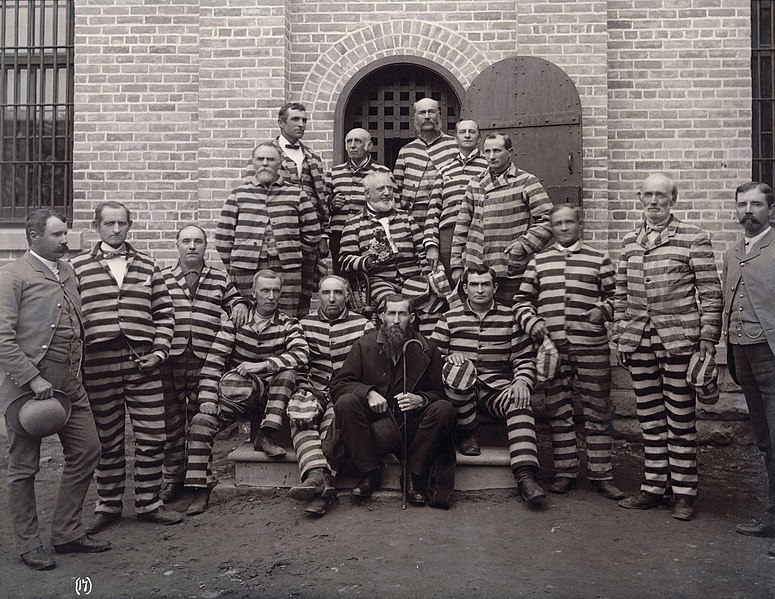
That's a photograph of taken at the Utah Penitentiary in 1889, showing men arrested under the Edmunds-Tucker Act, explained here. Included in the photo is John C. Bennett, who "taught a doctrine of 'spiritual wifery'":
He and associates sought to have illicit sexual relationships with women by telling them that they were married "spiritually," even if they had never been married formally, and that the Prophet approved the arrangement.That wasn't the correct doctrine, and Bennett got excommunicated, and then he "toured the country speaking against the Latter-day Saints and published a bitter anti-Mormon exposé charging the Saints with licentiousness."
Here's John C. Bennett in happier days...
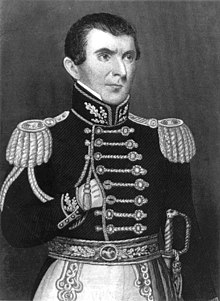
... posing like Napoleon:

Sunday, January 6, 2013
"We have done everything possible to make the presidency less venerated."
Says José Mujica, the president of Uruguay, who lives "a run-down house on Montevideo’s outskirts with no servants at all... never wears a tie and donates about 90 percent of his salary, largely to a program for expanding housing for the poor." That leaves him with $800 a moth.
Quoting the Roman court-philosopher Seneca, Mr. Mujica said, “It is not the man who has too little, but the man who craves more, who is poor.”...
Before Mr. Mujica became a gardener of chrysanthemums, he was a leader of the Tupamaros, the urban guerrilla group that drew inspiration from the Cuban revolution, carrying out armed bank robberies and kidnappings on Montevideo’s streets....
He spent 14 years in prison, including more than a decade in solitary confinement, often in a hole in the ground. During that time, he would go more than a year without bathing, and his companions, he said, were a tiny frog and rats with whom he shared crumbs of bread....
Mr. Mujica rarely speaks about his time in prison. Seated at a table in his garden, sipping his mate, he said it gave him time to reflect. “I learned that one can always start again,” he said.
Sunday, December 30, 2012
"What I learned about beauty from my 56 hours in jail."
I hope you learned not to do that duck-lips thing with your mouth that you did in the "Self-portrait from the day before the incident." But no, it's stuff like:
Look, don't even get started with the chapstick. It's addictive:
You'll wake up thinking about it:
These women were endlessly resourceful: colored pencils for eyeliner, lip liner, and eye shadow (yeah, it fucking hurts to apply). If you bend every other prong of the standard-issue comb, it becomes a makeshift brush....
The worst thing about my short time in jail? Honestly? Besides the indignity and the shitty food and the crushing boredom and the derision from the staff and the self-loathing just being there obviously inspired? Chapped lips.That sets up a hilarious lampooning by a commenter. Excerpt:
OK, maybe I’m being a little facetious, but I was parched. My lips were cracked and bleeding, spoiled with a steady diet of Fresh Sugar lip treatment. Licking my lips only made it worse, but I couldn’t help it — it was Pavlovian. It sounds stupid, but I remember that agony more clearly than anything else. When my cellmate shared her makeshift chapstick (shave gel mixed with something pink that I never actually identified) with me, I practically kissed her.
We broke our inkpins and blew the black ink out into our small cups of vasaline, then took a small 2 inched toothbrush to apply... some girls lined their eyes with Sharpies, meant to label our personal property. We made lip gloss with color out of red Kool-Aid or red jello and neosporin. We had clear toothpaste gel that did everything but brush your teeth, and we used this for everything from hair gel to adhesives for our pictures and calanders... We took our Gold Bond Foot Powder and dripped coffee and red Kool-Aid in our cups to try and create eyeshadow and blush....Another commenter offers a tip she learned in school:
This sounds gross, but my 8th grade science teacher told the class that he just used his own ear wax as lip balm...I love when science teachers challenge their students.
The worst part is that he wasn't even mentioning this as like a survival technique....
Look, don't even get started with the chapstick. It's addictive:
You'll wake up thinking about it:
Friday, November 30, 2012
"Back in 1984, Congress gave authorities the power to let people out of federal prison early, in extraordinary circumstances..."
"... like if inmates were gravely ill or dying. But a new report says the Federal Bureau of Prisons blocks all but a few inmates from taking advantage of 'compassionate release.'"
Michael Mahoney made one of those requests. He was convicted of selling drugs to an undercover officer back in 1984, went to prison, got out and went on to build a new life for himself.
But he bought a gun for protection, not understanding he couldn't have one as a convicted felon. When he reported the weapon stolen, Mahoney was sent back to prison on a mandatory 15-year sentence. Behind bars, he started getting sick: hepatitis C, then non-Hodgkin's lymphoma, with tumors growing everywhere.
"He just wanted to come on home and eat barbecue and, you know, die at home, be in his own bed," says his older sister, Dixie Taylor.
Thursday, September 20, 2012
The history of calories and scientific eating.
Martin Bruegel takes us back to the late 1800s:
Bruegel notes the obvious: People enjoy eating and they eat what they like. You can give them more scientific information, but how can you tell them what to like? Bruegel, who seems to be French, ends with drippy sympathy for the poor Americans who suffer in "an era of stagnant wages, dystopian politics and cultural anomie" and chomp cheeseburgers as their last best hope for pleasure. He says "we" shouldn't blame "the poor" — who are "we" and how does he know we're not poor? — but should blame our "culture that relies ever more on unhealthy foods to breathe meaning and purpose into everyday life."
Sowe they are not chomping cheeseburgers simply for sensual pleasure — they're searching for meaning and purpose in their paltry, crushed little lives. Let me paraphrase: If life is spiritually and economically small, there is meaning in getting physically large.
In 1888, the American chemist Wilbur O. Atwater devised a series of formulas that would help people get the most energy from the least food. Economics and physiology would be joined in what he called “the pecuniary economy of food.” Atwater pioneered a movement that came to be known as “scientific eating.”It didn't work, except in adjusting the menu in prisons, where money was saved. People wanted their pleasures. How does that historical experience apply today — as McDonald's begins posting calorie information? Our food is already cheap, and if you're eating in a restaurant, you're not going to find anything significantly cheaper than McDonald's. That 19th century experience was about saving money, and it's that pasta and sugared drinks approach to eating that is making us fat. I bet a switch to red wine and red meat would work as a weight-loss diet for most adults who've gotten fat eating McDonald's style.
The notion appealed to French physicians, who had been looking for ways to improve working-class health and budgets. They believed that these households spent too much on meat and alcohol. Their program of “rational eating” aimed to instruct the poor to keep food expenses within the limits of their (modest) budgets. They urged the substitution of protein-rich legumes for red meat, pasta for sausages, and sugared beverages for wine.
These reformers believed that ignorance was the problem and information the solution. Nutrition facts were put next to the items on the menu cards in factory canteens and in working-class restaurants. Scales at the entrance to eating places helped customers to monitor their weight. A menu board, listing carefully calibrated culinary options, would allow workers to assemble nutritious meals from a set of limited options.
Bruegel notes the obvious: People enjoy eating and they eat what they like. You can give them more scientific information, but how can you tell them what to like? Bruegel, who seems to be French, ends with drippy sympathy for the poor Americans who suffer in "an era of stagnant wages, dystopian politics and cultural anomie" and chomp cheeseburgers as their last best hope for pleasure. He says "we" shouldn't blame "the poor" — who are "we" and how does he know we're not poor? — but should blame our "culture that relies ever more on unhealthy foods to breathe meaning and purpose into everyday life."
So
Tuesday, September 11, 2012
"I have said repeatedly that I intend to close Guantanamo, and I will follow through on that."
Said Obama in November 2008, quoted in a new item in Gawker, reporting that another Guantanamo detainee has died. No, not the detainee who was released to Saudi Arabia (for rehabilitation) and who, after "rehabilitation," went to Yemen to do leadership work with al Qaeda. The Obama administration just deliberately killed him.
This death in Guantanamo was one of the presumably more dangerous individuals, who were never processed out of the place:
This death in Guantanamo was one of the presumably more dangerous individuals, who were never processed out of the place:
Officials are still awaiting a cause of death, but we do know that this is the ninth prisoner to die at Guantanamo. Six of those deaths were the result of suicide.If you keep people anywhere long enough, they will die. One way or another. Prison suicide, however, should be prevented, even amongst persons who are believed to be more dangerous than those we set free... and then drone-attack.
Monday, August 27, 2012
The "American Taliban" John Walker Lindh seeks more religious freedom in prison.
He's serving a 20-year sentence in the federal prison in Terre Haute, Indiana, and the request is for more group prayer — his sect "requires group prayer if it is possible" — and he also objects to needing to pray in his prison cell because he's too close to the toilet. He's represented by the ACLU, which characterizes the prison's rules as discriminating against religion (and not merely denying a special privilege to religion):
"This is an open unit where prisoners are basically out all day," said ACLU legal director Ken Falk, noting that inmates are allowed to play basketball and board games, watch television and converse as long as they speak English so the guards can understand.The government, citing a "radical, all-Arabic sermon" by Lindh, argues "that religious activities led by Muslim inmates are being used as a vehicle for radicalization and violence in the CMU."
"They can do basically any peaceful activity except praying," he said. "It makes no sense to say this is one activity we're going to prohibit in the name of security."
Saturday, July 21, 2012
"A Crimson-faced Harvard Alumni Assn. says it regrets allowing [Ted] Kaczynski to use its so-called Red Book to update his profile."
"There, Kaczynski lists his occupation as 'prisoner' and includes the following as among his awards: 'Eight life sentences, issued by the United States District Court for the Eastern District of California, 1998.' He blithely gave his address as the federal prison in Florence, Colo."
ADDED: I don't see what's blithe or even inappropriate about this. It's grimly factual. Harvard should not censor the flow of information about its alumni. Take responsibility for it all.
ADDED: I don't see what's blithe or even inappropriate about this. It's grimly factual. Harvard should not censor the flow of information about its alumni. Take responsibility for it all.
Friday, July 13, 2012
"For the bridge [of 'You've Lost That Lovin' Feelin''], Phil experimented on the piano with a 'Hang On Sloopy' riff. It was brilliant."
That would be Phil Spector, as described by the songwriter Barry Mann, who says:
I love the picture of Mann and Weil at the link. It's exactly the way I like to think songwriting teams of that era looked. It makes me want to get a shag rug and some index cards and lie down on the floor with my bare feet up on the sofa where Meade is stretched out, dressed in white (including white crew socks), strumming out some chords on the guitar. And I come up with lines about something beautiful dying or whatever and then our crazy friend comes in and bangs out the intro to "Louie Louie" or "Mony Mony" or "I Want Candy" and suddenly that's the bridge and I'm jotting on the index cards "We had a love...a love...a love you don't find every day..."
I built a melody on the riff while Cynthia shouted out lyrics: "Baby, baby, I get down on my knees for you" and so on. When we met the Righteous Brothers a few days later, we were nervous they might not like it.Cynthia is co-writer Cynthia Weil, who says:
Bill and Bobby [Hatfield, The Righteous Brothers] stood at the piano while Barry played and sang the melody and Phil sang harmony. At the end, there was dead silence. Bill said, "Sounds good — for the Everly Brothers." At first he didn't hear the soul. So Phil asked them to try it.Phil snapped, eh? Well, look out. Phil Spector is in prison right now, for killing a woman. Had you forgotten?
Mr. Mann: But Phil wanted Bill to sing the verses alone, with Bobby joining on the chorus.
Ms. Weil: They had always sung together, and Bobby wasn't happy. He said to Phil, "What am I supposed to do while the big guy is singing?" Phil snapped, "You can go to the bank."
I love the picture of Mann and Weil at the link. It's exactly the way I like to think songwriting teams of that era looked. It makes me want to get a shag rug and some index cards and lie down on the floor with my bare feet up on the sofa where Meade is stretched out, dressed in white (including white crew socks), strumming out some chords on the guitar. And I come up with lines about something beautiful dying or whatever and then our crazy friend comes in and bangs out the intro to "Louie Louie" or "Mony Mony" or "I Want Candy" and suddenly that's the bridge and I'm jotting on the index cards "We had a love...a love...a love you don't find every day..."
Wednesday, June 27, 2012
Post-gastric-bypass surgery, prisoner needed much more time to eat and now he's suing for $80 million.
At Rikers Island, they only give you 4 minutes to eat, but in his condition, Michael Isola needed to chew and swallow slowly. Speed-eating led to vomiting and — he says — the separation of his stomach from his intestine. And extreme weight loss.
Sunday, May 20, 2012
Wednesday, May 16, 2012
What happens if you're out on a cruise ship, and someone accuses you of rape?
You might spend the cruise in the brig:
This is one reason I would avoid cruise ships. It's a little city out there. What is the government in that little city? You take it for granted, but you know there will be crime. Rape and accusations of rape must happen all the time. The cruise ship company obviously has its lawyers and its policies and must want to handle these things well enough that news like this never comes out, but obviously, there will be some screwups. I assume Royal Caribbean offered these men a generous settlement, but they want more. The publicity is awful. And yet, people will still pay money to ride those floating cities.
The men, both Orthodox Jews from Israel,... say that after climbing into their beds the first night, they were awakened at 5 a.m. by crew members who made them get dressed “in prison garments issued by Royal Caribbean.”Yes, it's a lawsuit. They're only asking for $100 million.
Without explanation, the staffers paraded [Eviator] Mor and [David] Amsalem “through public areas of the ship to a lock-up facility,” court papers state.
Several hours later, they were told they had been accused of raping an “unidentified woman” who later recanted her allegation and who was examined by a doctor who determined she hadn’t been sexually assaulted.
“Notwithstanding the woman’s recantation and the doctor’s conclusion . . . Royal Caribbean’s arresting agents refused to release plaintiffs or to modify the conditions of their imprisonment,” according to the lawsuit.
This is one reason I would avoid cruise ships. It's a little city out there. What is the government in that little city? You take it for granted, but you know there will be crime. Rape and accusations of rape must happen all the time. The cruise ship company obviously has its lawyers and its policies and must want to handle these things well enough that news like this never comes out, but obviously, there will be some screwups. I assume Royal Caribbean offered these men a generous settlement, but they want more. The publicity is awful. And yet, people will still pay money to ride those floating cities.
Wednesday, May 9, 2012
We need to talk about Keith Judd.

He's the prisoner who won 41% of the vote in the West Virginia Democratic primary.
ADDED: "Why felon Keith Judd did so well against Obama in West Virginia."
The president angered voters with new Environmental Protection Agency policies, which some see as a “war on coal” and have stalled mining permits for the state’s coal mining industry...
Race likely plays some role here. In the 2008 primary, 2 in 10 white West Virginia voters said race was an important factor in their votes, second only to Mississippi. Those voters went for Clinton 8 in 10 times....
Potentially more interesting are the results from North Carolina, where 20 percent of Democratic primary voters chose “no preference” over the president.
Thursday, April 12, 2012
Saturday, March 24, 2012
"Freedom, in Shin's mind, was just another word for grilled meat."
The amazing story of Shin Dong-hyuk, who was born in a North Korean forced labor camp, and escaped at the age of 23:
In the garment factory, the superintendent wanted Shin to inform on an important new prisoner. Park Yong Chul, short and stout, with a shock of white hair, had lived abroad....
Much of what Park talked about, especially at the beginning, was difficult for Shin to understand or care about. What delighted him—what he kept begging Park for—were stories about food and eating. These were the stories that kept Shin up at night fantasizing about a better life. Freedom, in Shin's mind, was just another word for grilled meat.
Intoxicated by what he heard, Shin made perhaps the first free decision of his life. He chose not to snitch. And he soon began thinking about escape.
Subscribe to:
Posts (Atom)
 :.
:.

