Pages

Labels

Showing posts with label potatoes. Show all posts

Sunday, February 3, 2013

"He just looked unusual - stunning really.... He was fresh and he had a very soft sort of American accent."

Writes Kathy Etchingham meeting her long-ago boyfriend Jimi Hendrix (who was not a star at the time).
[One evening] Etchingham was trying to make mashed potato and not doing a very good job of it.

"He comes along and tastes them with a fork and says they're all lumpy," she recalls. "I knew he couldn't cook himself and that's how the argument started. It ended with my screaming and shouting, throwing the plates on the floor and marching out."

Etchingham spent the night at a friend's and Hendrix missed her so much that he sat down to write one of his biggest hits, The Wind Cries Mary.

Mary is Etchingham's middle name and the guitarist would sometimes use it to wind her up.
"The Wind Cries Mary" is about an argument over mashed potatoes!

***
A broom is drearily sweeping
Up the broken pieces of yesterday’s life potatoes
Somewhere a queen is weeping
Somewhere a king has no wife
And the wind, it cries Mary

Sunday, January 13, 2013

"I'm amused that right after 'potato, my penis droops' up pops Quayle."

I say, in the laughing-in-bed first-post-of-the-morning. 

Quayle is a regular commenter here, but — who knows, on the internet? — it might be Dan Quayle.


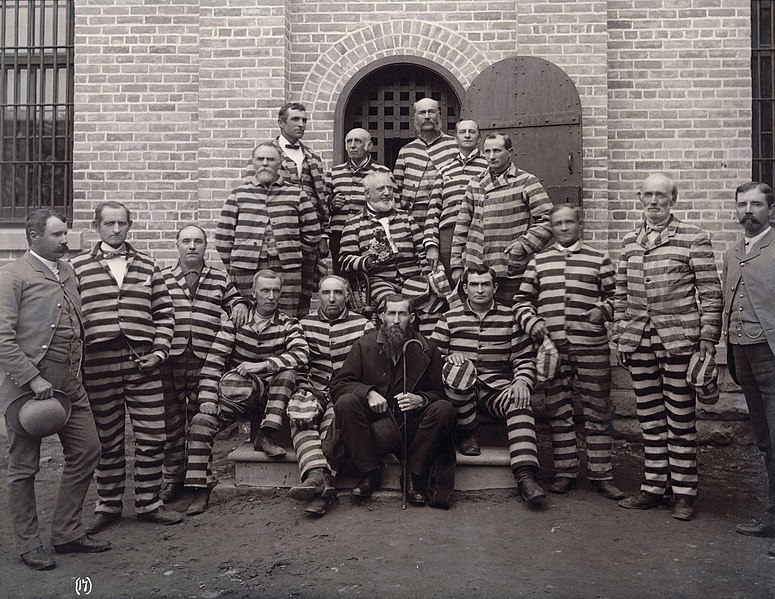
Quayle responds: "I carry the blood of polygamists in my veins. So one should expect that sort of thing, I guess." He adds: "I took the name from my great grandfather, pictured here surrounded by some new friends."


That's a photograph of taken at the Utah Penitentiary in 1889, showing men arrested under the Edmunds-Tucker Act, explained here. Included in the photo is John C. Bennett, who "taught a doctrine of 'spiritual wifery'":
He and associates sought to have illicit sexual relationships with women by telling them that they were married "spiritually," even if they had never been married formally, and that the Prophet approved the arrangement.
That wasn't the correct doctrine, and Bennett got excommunicated, and then he "toured the country speaking against the Latter-day Saints and published a bitter anti-Mormon exposé charging the Saints with licentiousness."

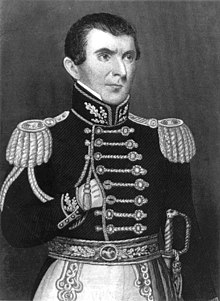
Here's John C. Bennett in happier days...


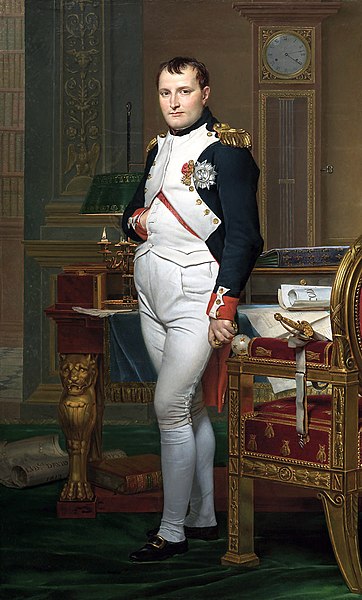
... posing like Napoleon:

"That's how you laughed in the middle of the night."

Said Meade, and I said: "Then Chip Ahoy must have been in my dream."

Because I was just reading his comment: "Melody and Rose broke up the Sweedish contractors and threw change in the tip jar and put on her warm magic apron."

And I laughed not because that is nonsense, but because it's a quite brilliant contribution to a conversation that was pretty far along at that point, including betamax3000's extended interpretation of "The White Album." Beta had said:
Like the White Album perhaps Althouse is telling us there are secret messages to be found, backwards.

"Sweetly up broke voice, her rose melody."

"Upon magic human warm her of little."

"Out tipped change."
It all began with a sentence from "The Great Gatsby," which was about — not a woman laughing — a woman singing. But women laugh all the time in "The Great Gatsby." For example: "She looked at me and laughed pointlessly."

"These 'Gatsby' posts are becoming the new café around here" — "café" posts are open threads  — I say as I drink my coffee and contemplate today's Gatsby sentence, which I'd said will be "I knew the other clerks and young bond-salesmen by their first names, and lunched with them in dark, crowded restaurants on little pig sausages and mashed potatoes and coffee."

I picked that sentence after searching my Kindle copy of "Gatsby" for "potato" after betamax3000 said:
Yesterday was "gulp down the incomparable milk of wonder," today is "tipped out a little of her warm human magic." Is it getting hot in here or is it just me?
And that was funny, because — before getting out of bed this morning — I'd been toying with the idea of saying: In that "Melody rose" sentence, Fitzgerald intended us to think of semen when we read about "warm human magic" that tipped out of the vessel that is the woman.
 

And betamax added:
My God: if we get to the sentence involving Daisy, the potato and the gardener I just don't know what is going to happen.
Which is what had me looking for "potato" in "Gatsby," not finding it, and suspecting that betamax was making a canny reference to "Lady Chatterly's Lover." I buy "Lady Chatterly's Lover" in Kindle just so I can search for "potato"! My literary pursuits are a tad — a tot — bizarre. I find:
"No; my heart's as numb as a potato, my penis droops and never lifts its head up, I dare rather cut him clean off than say 'shit!' in front of my mother or my aunt... they are real ladies, mind you; and I'm not really intelligent, I'm only a 'mental-lifer.'"
And:
"I don't want to fuck you at all. My heart's as cold as cold potatoes just now."

Sunday, August 26, 2012

"So if you were to pick one up, you'd be like, 'Oh! This is a homemade Mounds bar.' "

"Basically it's coconut and sugar dipped in chocolate"... but it's not, because it's got potatoes, and it's a needham, the food from Maine that you haven't heard of... or have you?
The origin of needhams is hazy, but lore centers around the late 1800s and a Rev. Needham....

I don't taste the potato, but [some guy in Maine] says that's the idea.

"It's less about tasting potato," he says, "and more about that it's just not really gummy and cloyingly sweet."
This is one article in a series over at NPR — "Americandy: Sweet Land Of Liberty'We're taking a cross-country tour of candies from around the U.S., sampling hometown sweets that deliver a nostalgic sugar rush." I was just looking at the NPR home page and said out loud: "Whatever happened to NPR? It's pretty much irrelevant politically, and all the news seems to be soft news about nice things that feel good to people who don't want to hear about politics. Maybe it's something about what works on the radio." And the next thing you know, I was swept into an article about using Maine potatoes to concoct some Mounds-like candy that not so gummy and sweet, and then on to a whole series of articles about local candy: Buffalo Sponge, Chukar Cherries, Valomilks, etc. etc.

Monday, April 23, 2012

"Somehow I get the feeling that when young Ann Althouse refused to eat the carrots on her dinner plate, her parents just sighed and got out the Cap'n Crunch."

Roy Edroso cuts and pastes some of my very best material onto his blog, but leaves me out of his Village Voice column "Dog Soldiers: Rightbloggers Meld with Mitt over Obama Mutt Meal Story." He just doesn't know how to "meld" my material with his "rightbloggers" shtick. It's too meta (and meat-a) for him to grind up into the usual sausages the folk at VV use to metaphorically masturbate.

But I must correct Mr. Edroso. There are 5 errors in the statement "when young Ann Althouse refused to eat the carrots on her dinner plate, her parents just sighed and got out the Cap'n Crunch."


1. "Cap'n Crunch is a product line of sweetened corn and oat breakfast cereals introduced in 1963," and I was already 12 in 1963.  My sweetened corn cereal of choice was Corn Pops, born in 1951, like me. Here I am explaining my cereal preference to 2 guys including a guy who looks like my dad and has a name like some guy in my adopted home town, Guy Madison.

2. Since carrots were never cooked in my 1950s childhood home, but were served raw, I liked them. Now, if it were something like spinach, which my mother always served with slices of hard-boiled egg on top, I would have avoided it, perhaps, along with the other kids in the family, with some simple commentary like "ew, spinach."

3. My parents never sighed about anything like this. At most, they would inform us that we were saying something that wasn't good "dinner conversation" and they would continuing modeling what was to their ear good dinner conversation.

4. My parents wouldn't get up from the dining table and go back into the kitchen to get different food if we didn't want to eat what we were served. They might say something like "That's dinner" and then move on, in the usual fashion, to good dinner conversation.

5. I was left to my own devices at the dinner table, devices I pursued silently and without parental comment or intervention of any kind: I drank milk, I ate plenty of potatoes, and I sprinkled sugar — copiously — on the wedge of iceberg lettuce. Later, after I was excused from the table — we said "May I be excused?" — I ate all the ice cream I wanted.

IN THE COMMENTS: At Roy's, Halloween Jack says:
Althouse probably thinks of her blogging self as a shorter, snappier Maureen Dowd, but she doesn't have the detached hollowness at the heart of MoDo's mean-girl act; she's usually petty, often smug, and when she gets like this, downright creepy. 

If it were a dinner party and she started in on this, people would probably laugh at first, mostly out of politeness, but a strained silence would ensue as she went on and was obviously getting into it. Then she realizes that not only is everyone else silent but almost everyone is averting their gaze; she clears her throat, murmurs "Well, anyway," and drains her wine glass. The guests can hand-wave it away as an odd tic (although one or two might reach for their list of handy excuses on the occasion of subsequent invitations), but on the blog it sits there, generating a veritable miasma like the stench of garbage left in a warm apartment for a week. 

Fortunately from her perspective, unfortunately from anyone else's, she's got her regulars to reinforce her behavior, with Meade piping in with a HuffPo piece about the amount of lead in the White House lawn, and she'll have a virtual dinner party at which she's always the toast of the town.
Enjoy the party!

Saturday, April 21, 2012

"In France, they’d be unpacking their glorious foods and beverages. En famille! Not so here."

"We tend to like to plump down on a chair or a towel and feel the sun move from one point to the next. Or, in the inevitable quest for romance, we walk the shoreline, holding hands, thinking this is forever thoughts."

And by plump, she really means plump, based on the 7th photograph. Plump and well-oiled.

Reading between the lines, as I always do on Nina's posts — is there another way to read? — I'm sure I see that the people in France know how to live and we Americans do not.
Many people love to just stand in the water to cool off and that’s fun to watch too. Humankind, lusting for that refreshing moment when the waves gently tickle your legs or splash against your buttocks. Conversations in the water.
Plunge, why don't you, Americans? Get in over your ass, like the French!


Plump, the verb, has an "Ultimately imitative" etymology (according to the OED):
Compare Middle Dutch plumpen (Dutch plompen), Middle Low German plumpen (German regional (Low German) plumpen), all in sense ‘to fall or plunge into water with a plumping sound’, Middle High German plumpen to make a plumping noise ( < Middle Low German; German plumpen), plumpfen, pflumpfen to fall with a thud (German plumpfen (now rare)), Old Swedish plompa to plump, to fall with impact (Swedish plumpa), Danish plumpe to flop, plump, to let fall.

Compare other more or less imitative verbs with final -ump , e.g. bump v.1, dump v.1, stump v.1, thump v., etc.

Comparison has sometimes been made with Romance derivatives of classical Latin plumbāre to weight with lead (see plumb v.; compare plunge v.), but the similarity between the Romance and Germanic words seems no more than coincidental.
Let's plump and bump and stump and thump and dump. Up to our buttocks.

Plump, the adjective, originally meant "Rude, unrefined; intellectually dull, obtuse." (Full and rounded and fleshy and swollen — that's  a later meaning.) It goes back to the Middle Dutch plomp, meaning  "plump, squat, ponderous, rude, clumsy."

Buttock is a word formed from "butt" and "-ock," "ock" being a diminutive. The OED defines "buttock" as "One of the two protuberances of the rump (of men and beasts)." Ah! Another -ump word: rump.

Protuberance is "A thing which protrudes from something else; a rounded projection or swelling; a knob, a bump." Again we bump up against bump. Protuberance goes back to some Latin words having to do with swelling and pushing forth, which is interesting in connection with the American, reticent, barely bumped, unbare rumps Nina was writing about.

Me, I'm seeing the tuber in protuberance. A tuber is:
An underground structure consisting of a solid thickened portion or outgrowth of a stem or rhizome, of a more or less rounded form, and bearing ‘eyes’ or buds from which new plants may arise; a familiar example is the potato.
Oh, Americans, you potatoes, with eyes that do not see! Solid, thickened, underground! Arise! Awake! Consider... the French.

At this point, everyone at Meadhouse jumps up and sings "La Marseillaise." It looks like this.

Come on, children. To the beach!

Saturday, April 14, 2012

"The other day I gave her mash and fishfingers for dinner — something quite boring — and her response was 'That’s impressive,' so she has a sense of humor, too."

An English dad describes the experience of living with a 4-year-old genius. 

ADDED: Confession: I had to Google to make sure "mash" referred to potatoes. The process of doing blog tags confronted me with the part of my brain — of whatever size IQ, I don't know — that has been dealing with English food. Long ago, "mash" got mushed with "mushy peas," and I'd never had the push to straighten that out until just now. But, thanks to Wikipedia, I've set my head straight. "Mash" is just mashed potatoes. And "bangers and mash" — which sounds dirty — is just sausages and mashed potatoes, which I think are "impressive."
The term "bangers" is attributed to the fact that sausages, particularly the kind made during World War II under rationing, were made with water so they were more likely to explode under high heat if not cooked carefully; modern sausages do not have this attribute.
Wikipedia kindly includes some pop culture references, including Peter Sellers singing to Sophia Loren, about how he's unsatisfied with her "macaroni" and would like her to "give us a bash at the bangers and mash me mother used to make," which you can listen to on one of those YouTube videos where all you look at is the record spinning. Sellers and Loren do their best to exclude any double entendre that those lyrics may seem to convey in writing.

There's also a Radiohead number called "Bangers + Mash," which has lyrics that begin "You bit me, bit me, bit me, ow," which is something Peter Sellers never sang to Sophia Loren.

Times change, which reminds me of my favorite "banger" song: "Lieutenant Custard & His Banger of Time," which involves a time-travel sausage. Please be careful with this!

Sunday, March 4, 2012

Everything Mark Twain wanted to eat...

... when he arrived home in the United States of America after traveling around in France and Italy in 1870:
Radishes. Baked apples, with cream Fried oysters; stewed oysters. Frogs. American coffee, with real cream. American butter. Fried chicken, Southern style. Porter-house steak. Saratoga potatoes. Broiled chicken, American style. Hot biscuits, Southern style. Hot wheat-bread, Southern style. Hot buckwheat cakes. American toast. Clear maple syrup. Virginia bacon, broiled. Blue points, on the half shell. Cherry-stone clams. San Francisco mussels, steamed. Oyster soup. Clam Soup. Philadelphia Terapin soup. Oysters roasted in shell-Northern style. Soft-shell crabs. Connecticut shad. Baltimore perch. Brook trout, from Sierra Nevadas. Lake trout, from Tahoe. Sheep-head and croakers, from New Orleans. Black bass from the Mississippi. American roast beef. Roast turkey, Thanksgiving style. Cranberry sauce. Celery. Roast wild turkey. Woodcock. Canvas-back-duck, from Baltimore. Prairie hens, from Illinois. Missouri partridges, broiled. 'Possum. Coon. Boston bacon and beans. Bacon and greens, Southern style. Hominy. Boiled onions. Turnips. Pumpkin. Squash. Asparagus. Butter beans. Sweet potatoes. Lettuce. Succotash. String beans. Mashed potatoes. Catsup. Boiled potatoes, in their skins. New potatoes, minus the skins. Early rose potatoes, roasted in the ashes, Southern style, served hot. Sliced tomatoes, with sugar or vinegar. Stewed tomatoes. Green corn, cut from the ear and served with butter and pepper. Green corn, on the ear. Hot corn-pone, with chitlings, Southern style. Hot hoe-cake, Southern style. Hot egg-bread, Southern style. Hot light-bread, Southern style. Buttermilk. Iced sweet milk. Apple dumplings, with real cream. Apple pie. Apple fritters. Apple puffs, Southern style. Peach cobbler, Southern style Peach pie. American mince pie. Pumpkin pie. Squash pie. All sorts of American pastry.

Fresh American fruits of all sorts, including strawberries which are not to be doled out as if they were jewelry, but in a more liberal way. Ice-water--not prepared in the ineffectual goblet, but in the sincere and capable refrigerator.
Funny about the frogs! I thought that's what they ate in France that we think is yucky.

(Via Eve Tushnet.)

ADDED: I've redone the text so it looks the way it appears in my Kindle version of 300 works of Mark Twain. It's not written in list/poem form. It still, however, says "Prairie liens, from Illinois," which Nichevo, in the comments, surmises is a misscanned Prairie hens, from Illinois. Ah, yes, here's an article about "The 'Prairie Hens' of Illinois" with the subtitle "Mark Twain’s favorite birds ... to eat." I'm going to correct the text above.

Monday, January 2, 2012

At the Fingerling Café...


... talk about whatever you want. Football... anything.

Wednesday, July 6, 2011

"Want to see a corpse on a can of Pringles?"

(Via Overlawyered.) A. Barton Hinkle rankles at "those graphic new cigarette warnings Washington regulators unveiled last week."
"We'll begin ... studies to make sure that we are keeping people sensitized," says Health and Human Services Secretary Kathleen Sibelius. "What may seem quite shocking at the beginning, people get used to quite quickly." So if people build up a tolerance for the repulsive, the FDA will amp the dial up to grotesque....
The old warnings — informing buyers that cigarettes cause cancer, and so forth — conveyed information. The new labels are designed to provoke a reaction in that lizard part of your brain that thoughts never reach. A warning on a ladder that reads, "Caution: Improper use could lead to serious injury from falling" conveys information. A graphic photo of a compound tibia fracture conveys only sentiment.
Only sentiment... I disagree. Vividly pictured information is still information, even if it offends your taste. Years ago, if I remember correctly, the radical feminist Catharine MacKinnon argued that free speech rights shouldn't cover pornography, because it didn't convey any ideas. It was a sensation... designed to provoke a reaction in that lizard part of your brain that thoughts never reach. Those are Hinkle's words, not MacKinnon's. I don't think she said "lizard part of your brain"... though she might well have said "lizard part."

[INSERTION: "40 years ago: The Lizard King breaks on through to the other side." Did you forget to remember Jim Morrison 3 days ago?]

But, of course, the government doesn't need free speech protection to say what it wants to say to us. It's the government. The question is only whether it can require a private business to carry its message (or its delivery of sensation straight to that lizard part of your brain that thoughts never reach). The messages that already appear on cigarette packs give you the short answer: It can. The better question is: Do we want our government reaching past our intellect, into our deepest instincts, injecting its vision of how we ought to behave?

Well, of course, government actors are always trying to manipulate us on an emotional level in the hope that we'll vote for them or tolerate a war or a tax and so forth. I think the key is to become conscious and critical of those manipulations (and every day, I work at that, in public writing, to model and encourage awareness and resistance). Perhaps an even better question than whether we want the government to manipulate us emotionally is: Do we want the government to manipulate us emotionally with respect to the decisions we make about what to do with our bodies?

Phrased at that level of generality, the photos of cancerous lungs on cigarette packs (trying to get us not to smoke) are like the photos of aborted fetuses (trying to get us not to have abortions). Except we haven't seen the government go graphic with an anti-abortion message, and it's not as easy to think of a commercial product to stick the message on. Something for women. Tampons?

Hinkle's mind drifts to food:
[I]t's reasonable to ask when the federal government will start showing us disgusting pictures on packages of food, in which Washington also takes a keen interest. Indeed, someone asked Sibelius that very question during a press conference about the cigarette labels. Her response was evasive. Food labels are voluntary, she said. And tobacco is unique because smoking is "the No. 1 cause of preventable death."

It won't be No. 1 forever. Obesity is gaining ground fast. Sibelius says smoking imposes "$200 billion a year in health costs." According to the Centers for Disease Control and Prevention, obesity costs the U.S. about $150 billion....

Two days after Washington unveiled its new warning labels for cigarette packages, the New England Journal of Medicine published a study reporting that our food choices influence our weight more than exercise does. And potato chips pack on the pounds faster than any other food, including candy and desserts.
Hence the question about a corpse on a can of Pringles.

ADDED: Want to see a corpse in a can of Pringles?

Tuesday, July 5, 2011

"I honestly believed that 'character witnesses' were witnesses who were brought in to lend character to a trial, like a clown or an eccentric scientist."

Things people are embarrassed they didn't know.

Some of these things are embarrassing not to know, but in some cases, I think these people should be embarrassed to be embarrassed. It's not embarrassing not to know the difference between a sweet potato and a yam. It's more embarrassing to make a point of distinguishing the two. People call sweet potatoes "yams," and a "true" yam is something else. So what? At some point the misnomer becomes an alternate name. How many technical plant names do you worry about getting right?

At an early age, I developed the fear of being embarrassed about not knowing things, so I would steer clear even of asking about things I thought it might be embarrassing not to know. And by early age, I mean about 6. I did not like adults laughing at me when I got things wrong. Decades later, I realized they were just enjoying cuteness. Ah, the amusement I denied them as I denied myself information.

Embarrassment is way overrated. As Bob Dylan said:
King Kong, little elves
On the rooftops they dance
Valentino-type tangos
While the makeup man’s hands
Shut the eyes of the dead
Not to embarrass anyone
Farewell Angelina
The sky is embarrassed
And I must be gone

Monday, January 24, 2011

"The average person thinks... this body is made of cigarettes and coffees and cakes and pies and doughnuts and french fries."


Jack LaLanne. The Good Lord Above has taken his wonderful body back, after 96 years of trying to talk us into get in shape.
“People thought I was a charlatan and a nut,” he remembered. “The doctors were against me — they said that working out with weights would give people heart attacks and they would lose their sex drive.”
Lots more Jack LaLanne video here. Here's one you probably don't need. And here he is with his dog Happy ("Right in the mouth with the foot he's putting"):

Wednesday, January 19, 2011