

"Coolidge made a virtue of inaction. 'Give administration a chance to catch up with legislation,' he told his colleagues in the Massachusetts Senate. 'It is much more important to kill bad bills than to pass good ones,' he wrote to his father as early as 1910. Congress always says, 'Do.' Coolidge replied, 'Do not do,' or, at least, 'Do less.' Whereas other presidents made themselves omnipresent, Coolidge held back. At the time, and subsequently, many have deemed the Coolidge method laziness. Upon examination, however, the inaction reflects strength. In politics as in business, it is often harder, after all, not to do. Coolidge is our great refrainer."
From the new biography "Coolidge," by Amity Shlaes.
Were you, like me, struck by the word "administration" in "Give administration a chance to catch up with legislation"? Did you think there was a missing "the" and have to stop and think? We're so used to the entity called "the Administration" that it's hard to see "administration" as the counterpart to "legislation." Or — more disturbing — our go-to word for what the executive branch is "enforcement."
Showing posts with label nothing. Show all posts
Showing posts with label nothing. Show all posts
Friday, February 15, 2013

Wednesday, January 16, 2013
"I'm an atheist... Eric is in the ground, rotting."
"I know it sounds horrible to say that, but that is where he is. How is that a better place?"
"I was searching frantically for anything that would help me get through this... But everything I found had to do with God: putting your faith in God, believing that God had some sort of plan. I found nothing to help me."Nothing to help me.
Saturday, January 5, 2013
"The only building in sight was a small block of yellow brick sitting on the edge of the waste land, a sort of compact Main Street ministering to it, and contiguous to absolutely nothing."
The Waste Land... I think of T.S. Eliot's poem, which was published in 1922. Coincidentally, "The Great Gatsby" — the source of the sentence quoted above — is a story that takes place in 1922. F. Scott Fitzgerald began planning "The Great Gatsby" in 1922, and the book was published in 1925. I'm forced to think this sentence is a shout-out to Eliot.
The waste land sits in the middle of a sentence about a building sitting on the edge of that waste land. It's an expansive vista, with one lone building. The building is called a "block," as if it's a child's toy, and it's all alone, because it's the only building in sight. We, the readers, are placed at a vantage point from which we can see this cityscape as a desolate plain, upon which there's that one block. But it's yellow. That's jazzy and hopeful.
What's going on with that building? We're not going to find out in this sentence, and whatever's around it is like a waste land, because we don't talk about the context in this Gatsby project, which is all about taking one sentence out of context, but of course we know there's a great book all around it, and that sentence is not sitting like a yellow block on the edge of a waste land.
I've been ignoring the second half of the sentence for too long. Let's examine the post-waste land segment. Our yellow block is on the edge of a waste land. If it's an edge, could there not be interesting things somewhere else? No. We're told that it's contiguous to absolutely nothing. I'm having a bit of a hard time understanding how the building can be on an edge when everything around it is nothing — absolutely nothing — especially since there's Main Street in the picture too. A sort of compact Main Street ministering to it.
That's a mystery, so I take it we need to get the message: There is a mystery here. Why does a lone yellow-brick building exist in a void and yet receive ministering?
The words building, block, yellow, brick, sitting, edge, waste, sort, compact, main, minister, contiguous, and absolute do not appear in the poem "The Waste Land." Sight and small appear, but not importantly. Land, street, and nothing are all significant:
As Bob Dylan says: "You’ve been through all of F. Scott Fitzgerald’s books/You’re very well read/It’s well known" and "And Ezra Pound and T. S. Eliot/Fighting in the captain’s tower/While calypso singers laugh at them/And fishermen hold flowers."
But you're probably wondering by now, what about that yellow brick? Maybe Fitzgerald was thinking about the yellow brick road in the "The Wizard of Oz" or that Elton John song.
The waste land sits in the middle of a sentence about a building sitting on the edge of that waste land. It's an expansive vista, with one lone building. The building is called a "block," as if it's a child's toy, and it's all alone, because it's the only building in sight. We, the readers, are placed at a vantage point from which we can see this cityscape as a desolate plain, upon which there's that one block. But it's yellow. That's jazzy and hopeful.
What's going on with that building? We're not going to find out in this sentence, and whatever's around it is like a waste land, because we don't talk about the context in this Gatsby project, which is all about taking one sentence out of context, but of course we know there's a great book all around it, and that sentence is not sitting like a yellow block on the edge of a waste land.
I've been ignoring the second half of the sentence for too long. Let's examine the post-waste land segment. Our yellow block is on the edge of a waste land. If it's an edge, could there not be interesting things somewhere else? No. We're told that it's contiguous to absolutely nothing. I'm having a bit of a hard time understanding how the building can be on an edge when everything around it is nothing — absolutely nothing — especially since there's Main Street in the picture too. A sort of compact Main Street ministering to it.
That's a mystery, so I take it we need to get the message: There is a mystery here. Why does a lone yellow-brick building exist in a void and yet receive ministering?
The words building, block, yellow, brick, sitting, edge, waste, sort, compact, main, minister, contiguous, and absolute do not appear in the poem "The Waste Land." Sight and small appear, but not importantly. Land, street, and nothing are all significant:
April is the cruellest month, breeding/Lilacs out of the dead land...So the poem begins. And very near the end:
I sat upon the shoreStreet:
Fishing, with the arid plain behind me
Shall I at least set my lands in order?
"What shall I do now? What shall I do?Nothing:
I shall rush out as I am, and walk the street
With my hair down, so. What shall we do to-morrow?
What shall we ever do?"
“What is that noise?”I really have no idea if F. Scott Fitzgerald was thinking about T.S. Eliot.
The wind under the door.
“What is that noise now? What is the wind doing?”
Nothing again nothing.
“Do
You know nothing? Do you see nothing? Do you remember
Nothing?”
I remember
Those are pearls that were his eyes.
“Are you alive, or not? Is there nothing in your head?”
As Bob Dylan says: "You’ve been through all of F. Scott Fitzgerald’s books/You’re very well read/It’s well known" and "And Ezra Pound and T. S. Eliot/Fighting in the captain’s tower/While calypso singers laugh at them/And fishermen hold flowers."
But you're probably wondering by now, what about that yellow brick? Maybe Fitzgerald was thinking about the yellow brick road in the "The Wizard of Oz" or that Elton John song.
Saturday, December 1, 2012
"How did you suppress your sexual feelings?"
"I think they are natural. If I tried to suppress them I'd be storing up trouble for myself in the future. So I acknowledge to myself: 'Yes, that is a beautiful girl'. The thing that stood by me was: 'God created it, but you are not allowed to play with it!'"
Interviews with 4 priests about celibacy. I was a little troubled by the "it," but there's much more here than that. For example:
Do you remember the first time, as a child, you had the insight nothing is something?
Interviews with 4 priests about celibacy. I was a little troubled by the "it," but there's much more here than that. For example:
Being celibate means you are always able to be open to one more relationship. If you are in a relationship with another person, to a degree that has to be exclusive; other people have to be kept out.That is very profound and is helpful in ways not limited to those who have taken a vow of celibacy.
Do you remember the first time, as a child, you had the insight nothing is something?
Thursday, October 25, 2012
What's the point?
Drudge has everyone pointing:

(Click to enlarge.)
"'HE'S A BULLSHITTER'" goes to a Weekly Standard item, quoting Obama:
But it is odd to imagine a 6-year-old child thinking "Well, that’s a bullshitter, I can tell." He was paraphrasing. Come on.
There's nothing here!
Now, quit pointing.
Quit pointing at nothing.

(Click to enlarge.)
"'HE'S A BULLSHITTER'" goes to a Weekly Standard item, quoting Obama:
As we left the Oval Office, executive editor Eric Bates told Obama that he had asked his six-year-old if there was anything she wanted him to say to the president. … [S]he said, ‘Tell him: You can do it.’ Obama grinned. … ‘You know, kids have good instincts,’ Obama offered. ‘They look at the other guy and say, “Well, that’s a bullshitter, I can tell.”’Nothing wrong with the word "bullshitter" in casual speech, and nothing special about a politician characterizing another politician as a bullshitter. It takes one to know one, and these politicians are all bullshitters. How could they be otherwise? What major-party candidate has ever not been a bullshitter?
But it is odd to imagine a 6-year-old child thinking "Well, that’s a bullshitter, I can tell." He was paraphrasing. Come on.
There's nothing here!
Now, quit pointing.
Quit pointing at nothing.
"I have to suspend my brain and mingle the subtle essence of my mind with this air..."
"... which is of the like nature, in order clearly to penetrate the things of heaven. I should have discovered nothing, had I remained on the ground to consider from below the things that are above; for the earth by its force attracts the sap of the mind to itself. It's just the same with the watercress."
Socrates, in "The Clouds," by Aristophanes.
Socrates, in "The Clouds," by Aristophanes.
"A strange sort of Nothing is destroying everything!"
"Maybe our whole land is in danger. What can we do?"
"The Emptiest Candidate in Presidential Election History: Mitt Romney truly believes in nothing."
They've got nothing on him, so they call him nothing. Ah, well, Obama's opponents call him Zero. that makes it Nothing vs. Zero.
***
Too much of nothing
Can turn a man into a liar
It can cause one man to sleep on nails
And another man to eat fire
Ev’rybody’s doin’ somethin’
I heard it in a dream
But when there’s too much of nothing
It just makes a fella mean
***
"I have heard what the prophets say who prophesy lies in my name. They say, ‘I had a dream! I had a dream!’ How long will this continue in the hearts of these lying prophets, who prophesy the delusions of their own minds?"
Monday, September 3, 2012
"The right rallied on Labor Day to celebrate 'National Empty Chair Day'..."
"... a show of solidarity with Clint Eastwood after his infamous address to an invisible President Barack Obama at the Republican National Convention last week."
Seems to me the world is full of empty chairs. How is any given chair supposed to acquire the meaning intended if meaning is intended? And contrariwise, isn't it unfair to all the other chairs that are just hanging around being chairs and not meaning to say anything?
AND: This has got me thinking about horror vacui:
Seems to me the world is full of empty chairs. How is any given chair supposed to acquire the meaning intended if meaning is intended? And contrariwise, isn't it unfair to all the other chairs that are just hanging around being chairs and not meaning to say anything?
AND: This has got me thinking about horror vacui:
In visual art, horror vacui (/ˈhɔrər ˈvɑːkjuːaɪ/; from Latin "fear of empty space", which might be represented by white spots), also cenophobia (/sɛnəˈfoʊbɪə/, from Greek "fear of the empty"), is the filling of the entire surface of a space or an artwork with detail.Perhaps I'm letting my education and affluence show, but I think empty is good. An unfilled space is complete in itself and yet also an opportunity. I think the horror vacui is somewhat male, and I am speaking from a vagina'd perspective.
The term is associated with the Italian art critic and scholar Mario Praz, who used it to describe the suffocating atmosphere and clutter of interior design in the Victorian age....
Research suggests there is currently an inverse relationship between horror vacui and value perception, and commercial designers are advised to favour minimalism in shop window displays and advertising to appeal to affluent and well-educated consumers, on the premise that horror vacui appeals more to poorer and less-educated audiences.
Friday, July 27, 2012
Today at the Orpheum.
The State Street landmark has gone dark.

One of 2 building permit signs in the window says: "Remove all components of Stage Door theater." The Stage Door theater is the claustrophobic place around in the back where I've seen quite a few movies over the years, not the original, ornate theater that rarely showed things I wanted to see (or that I wanted to see but couldn't see under better conditions). But somehow I can only remember one movie I ever saw at the Stage Door theater: "Sling Blade."

The old marquee gives shade to the dobro-and-harmonica player. "Marquee" is a funny word. It originally meant "A tent large enough to hold many people (now usually one used for social or commercial functions)." The OED has that going back to 1690. The meaning we know — which is "chiefly U.S." — is "A canopy projecting over the main entrance to a building; spec. such a canopy at a theatre, cinema, etc., on which details of the entertainment or performers are displayed." That only goes back to 1926. For some reason, one of the examples given in the OED, from 1993, is:
One of 2 building permit signs in the window says: "Remove all components of Stage Door theater." The Stage Door theater is the claustrophobic place around in the back where I've seen quite a few movies over the years, not the original, ornate theater that rarely showed things I wanted to see (or that I wanted to see but couldn't see under better conditions). But somehow I can only remember one movie I ever saw at the Stage Door theater: "Sling Blade."
The old marquee gives shade to the dobro-and-harmonica player. "Marquee" is a funny word. It originally meant "A tent large enough to hold many people (now usually one used for social or commercial functions)." The OED has that going back to 1690. The meaning we know — which is "chiefly U.S." — is "A canopy projecting over the main entrance to a building; spec. such a canopy at a theatre, cinema, etc., on which details of the entertainment or performers are displayed." That only goes back to 1926. For some reason, one of the examples given in the OED, from 1993, is:
Daily Tel. 15 July 21/3 At the Hubbard Dianetics Foundation there's an electric marquee that goes through this routine: Low Self Esteem? Failed Marriage? Tired Of Losing? Relationship Difficulties? Come In Now!The marquee at the Orpheum today is pushing nothing. Which is always a good show.
Saturday, July 21, 2012
"No one pretends that better laws would prevent all tragedies, but if that were the standard, then we wouldn't pass any laws at all."
On NPR last evening, the topic was the Aurora movie-theater murders, and the NPR host, Robert Siegel, invited WaPo's E.J. Dionne to comment on "mass shootings, guns and politics." Siegel quoted something Dionne had written, that events like this cause "our whole public reasoning process [to go] haywire." That is, other people go crazy and can't think straight, so let's check out the quality of Dionne's thinking.
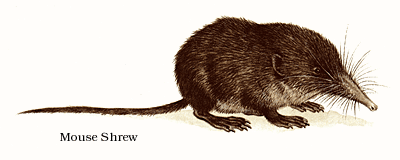
I'm fascinated by this notion that we do sometimes pass laws and therefore that means that we should pass laws. The resistance to passing laws is some nasty dysfunction caused by a nefarious interest group — here, the NRA — but good people want to do something. This do something orientation is characteristic of the modern liberal mind. I heard Dionne saying that on the radio yesterday evening, but it came back to me as I was reading about rabies and marveling at the crazy — desperate — ideas for a cure: "you burn a hair from the dog that bit you and insert the ashes into the wound... [a] maggot from a dead dog's body... a linen cloth soaked with menstrual blood of a female dog... [c]hicken excrement, 'if it is of a red color'... [a]shes from the tail of a shrew-mouse...."
When is it that reasoning goes haywire? After Dionne presented his patchwork of liberal logic, the host called upon David Brooks. (Don't say NPR doesn't balance liberals and conservatives!) He said...
Brooks concludes:
Now, how will the very very thoughtful E.J. Dionne deal with Brooks's argument from evidence! and data! He's got to demonstrate that he's one of the smart people, the non-haywire people, your betters who proposed open and thorough debate about solutions to problems (after the bogeymen are kicked out of the room):

What I mean by that is that the NRA and the rest of the gun lobby have such a firm hold on our political system that no one can bring up the notion, which we bring up with every other kind of tragedy, that maybe we can do better. Maybe there are laws we could pass that would prevent something like this.Maybe we can do better.... laws can't solve everything... but if that were the standard, then we wouldn't pass any laws at all... so... so, what? Since we do sometimes pass laws, we must think that laws can sometimes help when there's a problem. And there's a problem, so... so... what? Let's open this up. Let's talk about it. E.J. Dionne is afraid we'll just knee-jerk do nothing, instead of knee-jerk propose gun control... I mean think and think with thoughtful contemplation and talk about and around and through and through and arrive at the solution that immediately popped into E.J. Dionne's mind.
No one pretends that better laws would prevent all tragedies, but if that were the standard, then we wouldn't pass any laws at all. We have the most permissive gun laws pretty much in the industrialized world. And I hope, but I have no confidence, that we won't make the same mistake again.
I'd like to think that one time, we could say: Oh, let's open this up. Let's talk about the assault weapons ban. Let's talk about ways in which we might reduce the chances that someone with mental problems might get a gun. And I'm just worried that we're going to revert right back to our usual sort of giving and saying, well, the gun lobby controls Washington, so we can never do anything about things like this.
I'm fascinated by this notion that we do sometimes pass laws and therefore that means that we should pass laws. The resistance to passing laws is some nasty dysfunction caused by a nefarious interest group — here, the NRA — but good people want to do something. This do something orientation is characteristic of the modern liberal mind. I heard Dionne saying that on the radio yesterday evening, but it came back to me as I was reading about rabies and marveling at the crazy — desperate — ideas for a cure: "you burn a hair from the dog that bit you and insert the ashes into the wound... [a] maggot from a dead dog's body... a linen cloth soaked with menstrual blood of a female dog... [c]hicken excrement, 'if it is of a red color'... [a]shes from the tail of a shrew-mouse...."
When is it that reasoning goes haywire? After Dionne presented his patchwork of liberal logic, the host called upon David Brooks. (Don't say NPR doesn't balance liberals and conservatives!) He said...
Well, I'm no fan of the NRA, I'm not really an opponent of gun control or an assault weapon ban...That sounds like a necessary preface for the NPR listeners, but I'm going to give Brooks credit for subtly deactivating the bogeyman Dionne inserted into his call to action, because Brooks continues with:
... but, you know, public policy is based on evidence and data and whether it would work.Brooks is displaying the pin with which he is about to puncture the liberal's inflated self-image.
This is one of the most studied things in criminology. And the weight of the evidence is pretty clear that there's no relationship between gun control and violent crime. Areas with higher gun control do not have less violent crime. Over the last few years, the number of new guns entering the country has been about four million a year.So you've got to look at evidence, not your instinctive notions about what just might work. Put down that shrew mouse's tail now, E.J.
At the same time, violent crime has plummeted by about 41 percent a year.Brooks's "evidence and data" dump seemed really powerful until he got to that implausible percentage. What is it, 41% a decade, I don't know what to make of this point-counterpoint style radio presentation. There are no links to click on, so I'm just forced to be suspicious of Brooks's I've-got-the-facts posturing. [ADDED: Meade suggests that the percentage of decline has increased by 41% a year.]
Brooks concludes:
So I'm not necessarily opposed to the policy, I don't really think it would matter in violent crime generally, and I really don't think it would matter too much in the case of lunatics or whatever who are committed to this sort of pre-planned massacre.So Brooks retreats to reassuring the NPR audience: He's not opposed to gun control, he just doesn't think it would work. He began with the assertion that "public policy is based on evidence and data and whether it would work," explained why he didn't think it would work, but nevertheless won't oppose the policy. Brooks isn't a conservative by my standard. I think to be conservative, you should have the instinctive orientation: do nothing. You have to convince us what you've got there is better than nothing. And what have you got there? A bucket of red chickenshit? A dog's tampon?!!
Now, how will the very very thoughtful E.J. Dionne deal with Brooks's argument from evidence! and data! He's got to demonstrate that he's one of the smart people, the non-haywire people, your betters who proposed open and thorough debate about solutions to problems (after the bogeymen are kicked out of the room):
DIONNE: If we had better background checks, yes we'll miss some lunatics, but with real background checks, we could reduce the number of lunatics who get guns. And there's also a spillover. If you have permissive laws in one state - as Mayor Bloomberg has shown, Mayor Bloomberg of New York, who has proposed a lot of very practical remedies, not sweeping remedies but practical remedies - he's shown how loose laws in one state can send guns into a state that may have stricter laws. So I don't think we should throw up our hands and say it's impossible...And there you have it, the liberal mind at work, in real time.
BROOKS: Yeah, one area of agreement, I do think people who have history of mental health issues, and this came up with the Loughner case, that...
SIEGEL: The shooting of Gabby Giffords...
BROOKS: That should show up when you're trying to buy a gun. And legally, that's supposed to happen, but it doesn't always happen.
SIEGEL: We don't know all that much about the suspect. So far no indication that any such record would have shown up. We just don't know yet.
DIONNE: Right, and my argument is not that you can prevent every one of these things, but when I heard this this morning, like everybody else, I was, you know, sick about it. And I just thought that every time this happens, people say, well, there are very particular factors in this case, so let's not talk about gun control, gun control wouldn't solve it. Well, maybe it would, or maybe it wouldn't in a particular case, but it would prevent some of these things in the future.
Thursday, July 19, 2012
"It sends the wrong message to distraught farmers when the Agriculture Secretary suggests that the best response is to pray."
"For a Cabinet official to recommend prayer as a solution or call attention to his own devotions may violate the Constitution’s prohibition against establishment of religion. Most important, though, is that prayer doesn’t work. But if you want to test the power of prayer yourself, consider this. Apparently Secretary Vilsack’s been praying for rain every day; how’s that working out?"
Says the Council for Secular Humanism. They're wrong about the Establishment Clause, and I think the phrase "may violate" indicates that they know it. But they do have a point about government officials talking about prayer... or is that nothing more than the same point you could make about anybody praying? All that praying for things that don't happen generates evidence that prayer doesn't work.
I know the religion-based answers to that last point. (God answers prayers in ways other than granting the thing prayed-for, etc.) But I think it's different when a government official bandies religion about. A short, respectful reference to God or to prayer is standard rhetoric that isn't out of place in politician-speak. Did Vilsack go too far with "I get on my knees every day. And I’m saying an extra prayer now. If I had a rain prayer or a rain dance I could do, I would do it”?
It's not like he's trying to excuse himself for failing to do something he could do. I know government officials frequently act as though they could control the great forces of nature/human behavior/the economy, so I'd rather see the open acknowledgment that there's nothing to be done, which is basically what Vilsack is saying.
Now, if that means praying is nothing, maybe religionists should be offended. Also, "rain dance" might be offensive to Native Americans. Come on, everyone, let's get offended.
Says the Council for Secular Humanism. They're wrong about the Establishment Clause, and I think the phrase "may violate" indicates that they know it. But they do have a point about government officials talking about prayer... or is that nothing more than the same point you could make about anybody praying? All that praying for things that don't happen generates evidence that prayer doesn't work.
I know the religion-based answers to that last point. (God answers prayers in ways other than granting the thing prayed-for, etc.) But I think it's different when a government official bandies religion about. A short, respectful reference to God or to prayer is standard rhetoric that isn't out of place in politician-speak. Did Vilsack go too far with "I get on my knees every day. And I’m saying an extra prayer now. If I had a rain prayer or a rain dance I could do, I would do it”?
It's not like he's trying to excuse himself for failing to do something he could do. I know government officials frequently act as though they could control the great forces of nature/human behavior/the economy, so I'd rather see the open acknowledgment that there's nothing to be done, which is basically what Vilsack is saying.
Now, if that means praying is nothing, maybe religionists should be offended. Also, "rain dance" might be offensive to Native Americans. Come on, everyone, let's get offended.
Thursday, March 22, 2012
"Clintonville noises: City's equipment fails to tape mystery booms."
"The city set up audio and video recorders overnight Wednesday but didn’t capture anything. There was at least one loud boom at 5 a.m. The booms started Sunday. Residents describe them as sounding like thunder, fireworks or someone slamming a heavy door."
They hear things, but then when officials set up recording equipment, nothing is recorded. I said it yesterday: I think it's nothing.
Or does your mind travel in the other direction? Failure to record the booms is evidence of the supernatural, like the way Dracula isn't reflected in a mirror?
They hear things, but then when officials set up recording equipment, nothing is recorded. I said it yesterday: I think it's nothing.
Or does your mind travel in the other direction? Failure to record the booms is evidence of the supernatural, like the way Dracula isn't reflected in a mirror?
Karl: Well, the mirror thing, he can't look in mirrors, can he?
Steve: Well he can look in mirrors but he can't see himself in a mirror.
Karl: That still doesn't work.
Ricky: It doesn't work at all Karl.
Karl: His centre parting is always really neat.
Steve: His centre parting is always really neat?
Ricky: (laughs) How does he do it if he can't look in the mirror.... I love the flaw in the Dracula film is that his centre parting is too neat, how did he do it without a mirror.... You know there aren't really vampires in that sense.
Karl: Yeah, yeah.
Ricky: Yeah but it still annoyed you that his centre parting was too neat.
Karl: Well if you're gonna do it, d'you know what I mean.
Ricky: I'd like to see him with a fringe sort of pushed forward and maybe a hood up "alright, I've come to suck your blood n' that, alright".
Steve: Yeah, just bits of tissue paper all over his face where he's cut himself shaving.
Ricky: "Oh, I can't see in bloody mirror, it's annoying me", I'd love to see that, a little Manc Drac, that would be great wouldn't it, Mancula, Count Mancula, "alright, you got any rave, you got any rave music, you got any Oasis", that would be brilliant, "he came from Manchester, please welcome Mancula", that would be great wouldn't it, his hair's a mess, "well I can't see in mirror".
Wednesday, February 29, 2012
Thursday, February 2, 2012
At the No Photograph Café...
This is an open thread with no photograph. I'm sorry. You should see what it's like here in Wisconsin. There's nothing to photograph. We're stuck in this slough of not-winter in mid-winter. Please! Chat with me. Dissipate the bleakness!
Thursday, October 6, 2011
"Restoring 2006 levels of policy uncertainty would yield an additional 2.5 million jobs over 18 months."
Impressive.
And yet the government is always scrambling to help us out with new policies. And only today, Obama said:
And yet the government is always scrambling to help us out with new policies. And only today, Obama said:
“If Congress does nothing, then it’s not a matter of me running against them. I think the American people will run them out of town, I would love nothing more than to see Congress act so aggressively that I can’t campaign against them as a do-nothing Congress.”Reconsider the amazing value of nothing.
Wednesday, September 7, 2011
What can the Wisconsin Supreme Court do to restore the public's confidence that this court is really a court?
Chief Justice Shirley Abrahamson sent out a memo offering some ideas about restoring decorum (and public confidence), including opening judicial conferences to the public:
The Chief Justice also proposes:
Another proposal of the Chief's:
The Chief Justice would also like a separate "tribunal (not composed of Justices)" to make the final call on whether a Justice should recuse himself in a case and a process of replacing recused Justices with "a judge be selected at random." Obviously, you can see the potential for wresting the majority out of the hands of the 4 conservatives the people of Wisconsin have elected to the court. Imagine the endless strategic fighting over recusals!
Sorry to be so cynical. I can't help it, and I don't have a better solution to restoring the prestige of the Wisconsin Supreme Court.
IN THE COMMENTS: bagoh20 said:
The presumption should be that all conferences are open.As I said when we discussed this earlier, I don't see how this could be fair to the parties or how it is consistent with the idea deciding cases according to the legal texts and precedents (rather than policy preferences and political orientation). You'd have judges looking more like legislators, which is exactly what they shouldn't do if they want to look judicial.a. The open conference could be held in the hearing room.
b. The open conference could be held in the closed conference room and streamed to the public.
The Chief Justice also proposes:
An expert on small group dynamics could be retained at no expense to the taxpayers to work with each Justice for ways in which the Justice can work in a more constructive manner....Who would choose this expert? Would this be a variation on the demand — made by Justice Bradley after the "chokehold" incident — that Justice Prosser submit to "anger management" therapy? Yes, now all the Justices would submit, but submit to whom? What biases and preferences would this outsider bring to the project? (Sorry, I just can't picture anybody being neutrally professional anymore.)
Another proposal of the Chief's:
An internal operating procedure or rule could be adopted that 4 Justices not be considered a quorum or a binding majority that can direct action by the Chief Justice or Court staff unless all Justices have been advised of the "meeting/conference" and all Justices have had the ability to participate in the "meeting/conference" and in the decision making.That would empower the 3-justice minority to control the 4-justice majority. It's hard to picture this court in this state having that kind of trust. (I'm thinking of how hard it was for the 4 conservative justices to find and interact with the 3 liberal justices on the day of the "chokehold" incident and also the way the Democratic minority thwarted the operation of the state senate last winter by hiding out in Illinois. The "fleebagger" strategy was only feasible because of a supermajority quorum rule.)
The Chief Justice would also like a separate "tribunal (not composed of Justices)" to make the final call on whether a Justice should recuse himself in a case and a process of replacing recused Justices with "a judge be selected at random." Obviously, you can see the potential for wresting the majority out of the hands of the 4 conservatives the people of Wisconsin have elected to the court. Imagine the endless strategic fighting over recusals!
Sorry to be so cynical. I can't help it, and I don't have a better solution to restoring the prestige of the Wisconsin Supreme Court.
IN THE COMMENTS: bagoh20 said:
All they can do to make it better is shut up and get to work, but there is huge toolbox of things they can do to make it worse....
Althouse, isn't your philosophy that just doing nothing is often the best course? I happen to agree, and it's part of my business philosophy too.Yes! Nothing! I recommend nothing. Think about "better than nothing" as being, in reality, a high standard.
Monday, September 5, 2011
The end of the Post Office?
Is it unthinkable?

... of collapsing entirely... and yet they still haven't eliminated Saturday delivery?
Why not let this propped-up competitor to FedEx and UPS (and the internet) fall? There would be losers but there would also be winners.

Why are we so afraid to find out? Remember what Rahm says:
"You never want a serious crisis to go to waste. And what I mean by that is an opportunity to do things you think you could not do before."
ADDED: My postman just delivered a 615-page catalog from Restoration Hardware. Why was that a feasible business move for Restoration Hardware? I've never mail-ordered anything from them. Why is the government subsidizing this inefficiency? If I were interested in buying something from RH, I would go to their website. Instead, I have to lug this heavy object to the garbage can/recycle bin? Think of the carbon footprint. I do! But I don't believe the government believes the climate change hype. Because they never act like they do.
IN THE COMMENTS: Paddy O said:
The United States Postal Service has long lived on the financial edge, but it has never been as close to the precipice as it is today: the agency is so low on cash that it will not be able to make a $5.5 billion payment due this month and may have to shut down entirely this winter unless Congress takes emergency action to stabilize its finances.Why not close it down? Isn't it strange that it's on the brink — or really over the brink... in that Wile E. Coyote way...
... of collapsing entirely... and yet they still haven't eliminated Saturday delivery?
[D]ecades of contractual promises made to unionized workers, including no-layoff clauses, are increasing the post office’s costs. Labor represents 80 percent of the agency’s expenses, compared with 53 percent at United Parcel Service and 32 percent at FedEx, its two biggest private competitors. Postal workers also receive more generous health benefits than most other federal employees....My preference is always: do nothing. That's the presumption you need to overcome. It's good for government and it's good for your individual life too. (For decades, my personal motto has been: Better than nothing is a high standard.)
“The situation is dire,” said Thomas R. Carper, the Delaware Democrat who is chairman of the Senate subcommittee that oversees the postal service. “If we do nothing, if we don’t react in a smart, appropriate way, the postal service could literally close later this year. That’s not the kind of development we need to inject into a weak, uneven economic recovery.”
Why not let this propped-up competitor to FedEx and UPS (and the internet) fall? There would be losers but there would also be winners.

Why are we so afraid to find out? Remember what Rahm says:
"You never want a serious crisis to go to waste. And what I mean by that is an opportunity to do things you think you could not do before."
ADDED: My postman just delivered a 615-page catalog from Restoration Hardware. Why was that a feasible business move for Restoration Hardware? I've never mail-ordered anything from them. Why is the government subsidizing this inefficiency? If I were interested in buying something from RH, I would go to their website. Instead, I have to lug this heavy object to the garbage can/recycle bin? Think of the carbon footprint. I do! But I don't believe the government believes the climate change hype. Because they never act like they do.
IN THE COMMENTS: Paddy O said:
Ann, watch out. Don't mess with the mail. I shouldn't even be talking to you, but I'm telling you as a friend. Here's how it's going to happen: you may be walking. Maybe on a crisp, autumn day just like today. When a mail truck will slow beside you, and a door will open, and a mailman you know, maybe even trust, will offer to give you a lift. And no one will ever see you again!
Subscribe to:
Posts (Atom)
 :.
:.
