Pages

Labels

Showing posts with label Nixon. Show all posts

Saturday, February 2, 2013

Obama, skeet-shooting last August.

The photographic evidence — responding to skepticism — uploaded at the presidential Flickr page today:

P080412PS-0464

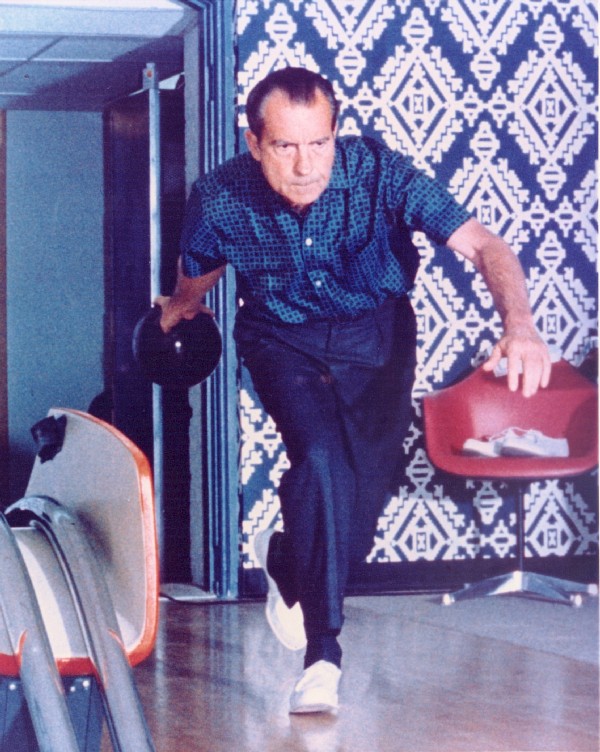
IN THE COMMENTS: mccullough said: "Cool picture. I want a poster of it to put next to my poster of Nixon bowling."


ADDED: White House coins the term "skeeters" to make fun of people don't believe Obama goes skeet shooting all the time at Camp David.

Tuesday, January 22, 2013

Linda Greenhouse and Reva Siegel "say one of the things that really politicized the abortion issue was the efforts of those working to re-elect President Richard Nixon in 1972."

"His aides, including future Republican presidential candidate Patrick Buchanan, wanted to lure Northern Catholic voters, who had traditionally voted Democratic, over to the Republican Party."
Nixon "was strongly advised by his strategists ... to make a play for a Northern urban Catholic Democratic vote," says Greenhouse. "A kind of Northern strategy that mirrored the Southern strategy."

In fact, up until then, top Republicans tended to be more in favor of abortion rights than Democrats, including, for much of his first term, Nixon himself....

So, taking his aides' advice, Nixon switched sides on abortion, even reversing an earlier relaxation of an abortion ban in military facilities.
Wednesday, January 9, 2013

How should we celebrate the 100th birthday of Richard M. Nixon?

It's today.

Ideas:

1. Tell us your favorite thing about Richard Nixon. (It's his birthday. No need to trot out all the usual hatred.)

2. When you encounter someone today, instead of saying "hi," do that 2-arms-raised-with-V-for-victory-fingers gesture.


3. For lunch: Ketchup on your cottage cheese.

4. Work Nixon phrases into conversations, e.g. "the lift of a driving dream."

5. When you put on your coat, call attention to the fact that it's a "cloth coat," as if that's remarkable, as if anyone would ever expect anyone these days to have a fur. If people look at you funny, double down by calling it "a respectable Republican cloth coat." If somebody gets the jump on you and calls their coat a "cloth coat" first, show that you get it by saying, "As I always say, you'd look good in anything."

6. At some point today, when you're with someone who never kneels to pray, insist that they get down on their knees and pray with you.

7. Wearing a dark suit and wingtips, take a walk on the beach.

8. Secretly record all your conversations. (Or is everyone already doing that?)

9. If anyone happens to say "pardon me," say: "Pursuant to the pardon power conferred upon me by Article II, Section II, I grant a full, free, and absolute pardon unto you for all offenses."

10. When you leave a room, turn to anyone who remains in it — or even to an empty room — and proclaim: "I leave you gentlemen now. But as I leave you I want you to know, you won't have [your name] to kick around any more."

11. This is special for lawprofs and other law folk. If anyone mentions Rehnquist, act like they got the name wrong, and faux-correct them with "Renchburg."

12. From Ron in the comments: Play ping pong. Watch Dr. StrangeKissinger. Just for the hell of it say, "Sock it to me?" Just for today call your closest friend "Spiro." Play Checkers.

13. If you find yourself in the kitchen with somebody, strike up a debate and at some point, start needling them about being a Communist.

Monday, December 31, 2012

What's Happening to Hillary? Only a clod would say the clot is a plot!

Here are Senators Lindsey Graham and Dianne Feinstein, interviewed by Chris Wallace (yesterday, on "Fox News Sunday"):
WALLACE: Senator Graham, how important is it for Secretary of State Clinton to testify under oath before she leaves office about the Benghazi terror attack?...

GRAHAM: Absolutely essential that she'd testify....

WALLACE: Some of your Republican colleagues say they are prepared to hold off the confirmation of John Kerry as secretary of state, until Secretary Clinton testifies as secretary, before she leaves office.

GRAHAM: That's going to happen. I've been told by Senator Kerry he wants that approach also. He needs to hear what she says so he can make comments about, I agree with her/I don't agree with her. It makes sense to have her go first.

WALLACE: Do you agree with that, Senator Feinstein, that she needs to testify first, as an -- and have you been assured she will testify, though it has been 3 1/2 months since Benghazi and she still has never really answered questions, about Benghazi, her role before, during, after the attack? Do you have reason to believe she'll testify as secretary?

FEINSTEIN: She has said she will and I believe she will. You know, she's had a very real accident and she's recovering from it, and, she will be back. I gather, her first day, of work may well be next week. So, I think that's good news.
With all that assurance that Hillary Clinton would testify, later that day, we heard the news that Hillary Clinton had entered the hospital with a blood clot. We weren't told the site of said blood clot. Was it her brain (recently concussed)? Was it her leg (where she had a blood clot back in 1998)? The former is a big deal, the latter, not so much. Why not specify the site, since it make such a big difference, medically? Oh, but we're told we must not display any skepticism, any hint of suspicion that the SOS is trying to avoid having to testify about Benghazi. The woman is ill. Only a clod would say a clot was a plot.

Here's medical expert Kent Sepkowitz:
Unlike the relatively bland “concussion after fainting” pronouncement from earlier this month, this terse press release from her spokesman smells a little fishy. First it is odd that we are not told where the clot is—usually the clot, referred to as thrombophlebitis, occurs in the leg, a condition suffered by former president Richard Nixon after leaving the White House. 
Maybe you can remember — if not, guess! — how sensitive we were to Nixon's phlebitis, which conveniently flared up in the midst of Watergate. Ha! That bastard thinks he can get our sympathy. Pathetic! (That's what I said at the time.)
The clot [in the leg] can be uncomfortable but is only dangerous and even life threatening if it breaks free and travels downstream into the lung—a pulmonary embolus, in medical parlance.... Given that Clinton already has had this condition and those who have had one episode have a predilection to recurrence, the lack of a reminder of the 1998 clot from her press people seems a strange oversight.

Another problem with the “concussion then clot” story is this—the concussion, if indeed it came after a faint, should not directly predispose Clinton to a clot....

Alternatively, is it possible that the clot in question is one in the lining of the brain that can form after head trauma.... But anticoagulation is never given to persons with clots around the brain. They are either watched without intervention or surgically evacuated. So this possible explanation is out.

We are left with a story that is not easy to connect up with sparse information from the inside crowd, who could easily deflate speculation with two or three more measly facts. The National Enquirer has already declared Clinton to be suffering from a brain tumor, linking her observed weight gain, possibly from treatment for the putative cancer, and not-exactly-explained need to leave Obama’s Cabinet to the grim diagnosis. Such a story no longer seems to me as implausible as it did after the faint and concussion reports.
The suppression of informationthe site of the clot — suggests 2 radically different theories: 1. fakery/exaggeration to evade testimony, or 2. something horribly serious. I read Sepkowitz to exclude the middle ground.

UPDATE: Email from CNN says: "Secretary of State Hillary Clinton has a blood clot between her brain and skull behind her right ear, her doctors said." This seems to be the option that Sepkowitz excluded because "anticoagulation is never given to persons with clots around the brain." If that's correct, then something is still, to use Sepkowitz's word, fishy.

UPDATE 2: Here's the Washington Post, on January 1st, noting the site of the clot and saying "The conventional treatment is an anticoagulant drug for at least six months." So that directly contradictions Sepkowitz's statement that "anticoagulation is never given to persons with clots around the brain."

AND: I've got a bit more to say here

Wednesday, December 19, 2012

Republicans used to stress "law and order," and Democrats — sounding more educated and compassionate — said we needed to look at the "root causes" of crime.

Back in, say, the Nixon era, we Nixon-hating types used "law-and-order" as an adjective expressing contempt. We might say, for example, "Governor Reagan is a law-and-order idiot."

Remember when Nixon caught flak for saying — about Charles Manson — "Here is a man who was guilty, directly or indirectly, of eight murders without reason.... Here is a man, yet, who, as far as the news media coverage was concerned, appeared to be rather a glamorous figure..."?

Nowadays, everyone's for law and order. The disagreement is only over the nature of the order. The Democrats don't react to mass murder with pleas to understand mental illness, economic strains, and cultural malaise anymore. They offer tougher laws (in the form of gun control).

Meanwhile, the mentally ill live on the streets or — once they've acted out — are incapacitated in prisons, and one hears very little concern about it from Democrats.

Monday, December 17, 2012

"What a liar" — famously muttered into an open mike.

It's the one thing I've always remembered about Daniel K. Inouye.

Dead now, at age 88.

Inouye was a World War II hero and Medal of Honor winner who lost an arm to a German hand grenade during a battle in Italy. He became the first Japanese-American to serve in Congress, when he was elected to the House in 1959, the year Hawaii became a state. He won election to the Senate three years later and served there longer than anyone in American history except Robert Byrd of West Virginia, who died in 2010 after 51 years in the Senate....

In 1968, President Lyndon Johnson urged Vice President Hubert Humphrey, who had won the Democratic nomination for president, to select Inouye as his running mate. Johnson told Humphrey that Inouye's World War II injuries would silence Humphrey's critics on the Vietnam War.

"He answers Vietnam with that empty sleeve. He answers your problems with (Republican presidential candidate Richard) Nixon with that empty sleeve," Johnson said.

But Inouye was not interested.

Monday, November 19, 2012

4 reasons why Republicans don't need to feel that bad.

Chris Cillizza link-grabbingly scrounges up some hope for the seemingly hopeless:
1. The party’s superstars are coming of age.... Sen. Marco Rubio (Fla.), New Jersey Gov. Chris Christie, Louisiana Gov. Bobby Jindal and Rep. Paul Ryan (Wis.) — all of whom have significantly more star power than Romney....

2. There are a historic number of GOP governors.... [including 2 Hispanics]...

3. The electoral map is bad, but not that bad....

4. History is on their side. Presidential politics in the post-World War II era tend to be defined by the pendulum effect....
On #4, I still remember the Newsweek cover that followed the 1964 election: a sick/dying/beaten-up elephant in bed. Having supported Goldwater and grasped something of the value of conservatism, I found the image truly disturbing. And I was old enough to think somewhat deeply about it. Conservatism would never get its message across now. LBJ would distribute endless gifts and the people would never be willing to hand them back. And yet, 4 years later, Richard Nixon, the loser from 4 years earlier, would arrive — the "new Nixon" — and he seemed fresh, a source of hope.

Just my luck, though, I'd leaped leftward by then. Not that I could vote. On Election Day, I was 2 months shy of my 18th birthday, which wasn't as intensely frustrating as it sounds. In those days, you had to be 21 to vote. In an amazing run of bad luck, beginning in 1972 — when, irritatingly, all the 18-to-20-year-olds got in on voting too — I voted for 5 losing presidential candidates before my choice won. There have been 5 presidential election since that one, and I've supported the winner in 3 of them. In all of those 11 elections, there was only one man who won twice with me voting for him both times. That is, I've only voted for one 2-term President and stuck with him for the reelection.

Monday, October 15, 2012

The NYT kept the Libya hearing off the front page because "It’s three weeks before the election and it’s a politicized thing..."

Why, yes, it is a politicized thing, isn't it? Oh... you didn't mean your coverage of the news, did you? The NYT managing editor Dean Baquet was explaining to the NYT public editor why the decision was made to go with the 6 stories they did put on the front page...
... one on affirmative action at universities, one on Lance Armstrong’s drug allegations, two related to the presidential election, one on taped phone calls at JPMorgan Chase, and one on a Tennessee woman who died of meningitis.
Baquet said: “I didn’t think there was anything significantly new in it.” And: “There were six better stories."
They put the story on page 3.

To be fair: The NYT put the original news of the Watergate break-in on an inside page. Was it page 18? Sorry, I'm not finding that fact as easily as I think I should. I did come up with the information that when Deep Throat/Mark Felt wanted to communicate with the Washington Post, Bob "Woodward’s home-delivered New York Times would arrive with an inked circle on Page 20."

So the myth of the inside pages of the New York Times looms large in the annals of presidential scandal.

Is the Libya scandal as big as Watergate? The substance of it may be much worse than Watergate, and the Obama administration seems not to have heeded the old Watergate lesson that it's the cover-up that gets you, but if Obama loses the election, that will limit the dimension of the scandal. If he wins the election — especially if it's very close or contested in some way — Republicans may work themselves into a frenzy going after Obama. Remember that Richard Nixon was reelected after the Watergate scandal broke. The break-in was 5 months before the election, and the first stories had come out. The next 2 years were hell for Nixon, and he was drummed out of office. And Nixon had won by a landslide.

Wednesday, September 19, 2012

The gap in the Romney "secret" video: Corn says "the recording device inadvertently turned off"...

... according to his unnamed source who, he says "noticed this quickly and turned it back one [sic]. The source estimates that one to two minutes, maybe less, of recording was missed."

Really only 2 minutes? You sure it wasn't 18 minutes? Could the name of the source be Rosemary?

Tuesday, September 4, 2012

"What America needs most today is what it once had, but has lost — the lift of a driving dream."

That old quote sprang to mind just now, as I was thinking about whether Barack Obama will be able to reinvigorate the electorate with his old rhetoric when he does his convention speech this week. The quote is from — did you remember? — Richard Nixon.

We used to love to scoff at him for thinking he had anything to do with "the lift of a driving dream." But Barack Obama got us — some of us — to internalize the association between him and dreams. Can he — should he — do it again? To dream, you've got to sleep, and "what America needs most today" — and any day — is to be awake... vigilant.

Tuesday, August 21, 2012

When's the last time the worse looking of the 2 major party candidates won the Presidency?

A question I raise in the comments to this morning's body fat post.

Here's a list of all the candidates through American history. I'd say the answer to my question is 1976. But Jimmy Carter had a big smile that people responded to, and Ford had reached the presidency via Richard Nixon, who was quite unattractive, and people saw Nixon through Ford. That is, I could wriggle out of conceding that the "last time" was as recently as 1976. But what's the point? We get stopped at the next notch, 1972. Nixon was distinctly less pretty than George McGovern. Nixon was also less pretty than Hubert Humphrey in 1968, not that Humphrey was at all cute. 1964 was also a clear case of the uglier guy winning, LBJ being perhaps the ugliest President ever, and Barry Goldwater looking quite good. One more step back and we get to 1960, the strongest case I remember seeing beauty boosting a candidate across the line. And everyone talked about it (and still talks about it).

It's interesting that after that 1960 beauty contest, we got our spate of the uglier candidate winning. Why? The ugliest man ascended to the Presidency after the assassination of the handsome idol, and it was not odd that he was elected shortly thereafter. It took almost 20 years for us to revert to choosing the handsomer man, but ever since — more than 3 decades — we've chosen beauty.

This year, the GOP has made a strong choice in the beauty contest. It's not clear who's handsomer. Of course, it's clear if we average in the VP component, but the VP beauty boost is an iffy proposition. It didn't work — at least not enough — for John McCain or John Kerry. But I'm thinking if only Gerald Ford had picked someone prettier than Bob Dole....

Wednesday, August 8, 2012

"I don't care about Chick Fil A or gay marriage. I do care about observing my friends engaging in groupthink right there in front of me...."

Writes Chip Ahoy, in the Chick-fil-A thread a few posts down.
Don't like that. It's a very unsightly thing to behold, everyone standing around agreeing that some old man who expressed a traditional opinion personifies HATE. Every happy gathering becomes some kind of mini political caucus where lines of thought are stroked and combed. I must toss a screwdriver into that. But in the end I am enjoying the company of other people less and less. It's not that I don't respect different opinions, it's that I don't respect poorly developed opinions and spoon-fed opinions, it's seeing my friends' personalities subsumed to the most radical expressions. So I go to a party and the conversation is whatever the present day activists out there say is is and gone are any unique points of view or any unique expressions. Conversations with the DNC, conversations with the most political active, not conversations with my friends, they are all mouthpieces now.
And then:
I just realized how to deal with that. Comically turn the speaker into into the person they sound like but pick an egregious example. "Tell me Debbie Wasserman Schultz, I'm very curious about this, what did that owner of Chick Fil A say exactly?" Just acknowledge that you're speaking to someone else.

Inquire thoughtfully, "Who should I put on to respond?"

Since we're using other peoples' words, other peoples' thoughts.
Ha ha. That reminds me: Back in the 1970s, one time — one time! — I defended Richard Nixon for something, and for quite a while after that, my then-husband thought it was funny to call me "Baruch."

Wednesday, June 13, 2012

"Why our food is making us fat" — It's Nixon's fault!

"The story begins in 1971."
Richard Nixon was facing re-election. The Vietnam war was threatening his popularity at home, but just as big an issue with voters was the soaring cost of food. If Nixon was to survive, he needed food prices to go down, and that required getting a very powerful lobby on board – the farmers. Nixon appointed Earl Butz, an academic from the farming heartland of Indiana, to broker a compromise. Butz, an agriculture expert, had a radical plan that would transform the food we eat, and in doing so, the shape of the human race....

Sunday, June 10, 2012

"40 years after Watergate, Nixon was far worse than we thought..."

Woodward and Bernstein reminisce about their long-ago journalistic triumph that led the President to resign.

But was Nixon far worse than they portrayed him at the time? At the time, they did what they could to make him look as bad as possible, and there was no new media to push back.

Here's an idea for a blog project. Beginning on June 17th — June 17, 1972 was the day of the break-in — let's tap the Washington Post archive and blog the Nixon and Watergate stories from exactly 40 years ago. What would we bloggers have said each day?

But it's not a realistic project, because if bloggers had been around at the time, the events would have played out differently every step of the way. It's one of my pet beliefs about blogging that Nixon would not have resigned.

Monday, May 21, 2012

"Friends, Romans, countrymen..."

This amused me. Cowboy style. I ran across it because I was looking for the text to the famous Mark Antony speech, which I'd been forced to memorize in junior high school, many decades ago. (Here's Marlon Brando doing it, not amusingly.) And what got me testing my own memory was something I'd just read about Barack Obama, which someone had emailed me, a propos of the recent "born in Kenya" dustup. It's a GQ article from November 2009 called "Barack Obama's Work in Progress."
Over the past few years, we’ve gotten to know our president as a lot of different things: campaigner, lawyer, father, basketballer. But what if Obama’s first and truest calling—his desire to write—explains more about him than anything else? Robert Draper recounts the untold story of the first man since Teddy Roosevelt to serve as author in chief.
I haven't combed through that whole article looking for the Kenya connections, but I noticed this bit about Shakespeare:
Sometime in 2002, the young state senator pays a daytime visit to the Chicago Shakespeare Theater. The artistic director, Barbara Gaines, is happy to show the politician around. Watching the carpenters erect the set, he asks Gaines which play is about to be performed. “Julius Caesar,” she tells him.

At first, Obama doesn’t say anything. Then, in a very soft voice, he begins to recite some twenty lines from the play. As he does so, he places his hand on his heart, as if stricken by the words’ transcendent beauty.

The director is agog. She has never heard an elected official quote Shakespeare in such a way.
Now, wait a minute. Who, upon mention of "Julius Caesar," doesn't start going "Friends, Romans, countrymen, lend me you ears..."? If it was some other 20 lines from the play, I might be impressed. The fact that he went on for 20 lines is sort of cool as a demonstration of memory. It's more than I can do without missing some words, but then, I learned it during the LBJ administration. But who goes on for 20 lines, putting on a memory show? Maybe you would if you saw that you were getting the director of the Chicago Shakespeare Theater agog.

And would you put your hand on your heart? (Cf., Obama not putting his hand over his heart during the National Anthem.)

Back to GQ:
Later, she tells a co-worker, “I just had the most amazing experience. I met the first politician to have the soul of a poet.” (The first, she means, since Abe Lincoln, who quoted lines from Macbeth less than a week before his assassination: I think our country sinks beneath the yoke…)
The soul of a poet. Doesn't anyone remember Eugene McCarthy?


Many women loved this Senator from Minnesota, who challenged LBJ in 1968, and the poetry was part of it. My maternal grandmother loved him because he was a poet. 1968 — there was a year. Bobby Kennedy pushes Senator McCarthy — the good Senator McCarthy — aside, LBJ declines to run, Martin Luther King is shot down, 2 months later Bobby follows him, and Nixon becomes inevitable.

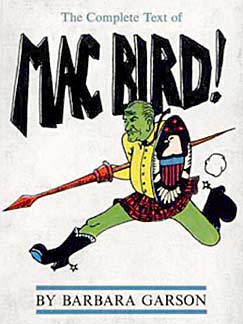
By the way, speaking of MacBeth and LBJ, they made a play back then: MacBird!


The playwright, Barbara Garson said:
"People used to ask me then, 'Do you really think Johnson killed Kennedy?'... I never took that seriously. I used to say to people, 'If he did, it's the least of his crimes.' It was not what the play was about. The plot was a given."

Tuesday, March 27, 2012

The complicated story of Linda Lovelace — soon to be 2 motion pictures.

The star of "Deep Throat" — which is the most profitable movie ever made – led a fascinating life that tracked so many of the cultural trends we lived through. Of course, she got none of the $600 million the $30,000, hour-long movie made. That had to be annoying. But she was the face (and neck) of the porn that suddenly everyone felt they could actually go see. The Nixon administration prosecuted the filmmakers for obscenity. You've got bad old Nixon coming after you. What a strange combination of glamor and squalor!

Her follow-up films flopped, and she became a heavy cocaine user in the mid-1970s, then she made the God move: "God had changed her life." When the 80s came around, she threw in her lot with the feminists:
In 1980, with feminists increasingly attacking pornography as demeaning to women, Lovelace found a new opportunity to grab the limelight.

In an autobiography entitled Ordeal, she claimed that [Chuck] Traynor had physically and mentally abused her throughout their marriage, forcing her into pornography literally at gunpoint.

Her husband had had her gang-raped by five men, she said, and kept her a prisoner ‘just as much as if I was in Alcatraz’. He would never let her out of his sight, spying through the keyhole when she was in the bathroom and listening to her telephone calls with a .45 automatic pistol pointed at her.

Traynor would use his gun again when she was filming porn scenes, she added. ‘Chuck kept a gun in his pocket and would click the trigger, letting me know what would happen if I did not look convincing,’ she said.
Pushed onward by Gloria Steinem and Andrea Dworkin, who, at the time, had the agenda of merging pornography and rape, Lovelace spoke on college campuses and at government hearings, saying things like: "When you see the movie Deep Throat, you are watching me being raped... It is a crime that movie is still showing. There was a gun to my head the entire time."

Still later, she claimed the feminists had exploited her. (Was she not the victim of the century?) She was especially outraged that she didn't get an invitation to Gloria Steinem's wedding. Then her breasts turned on her:
During a double mastectomy brought on by botched silicone injections years earlier, doctors discovered her liver was collapsing from hepatitis, which she had in turn contracted from a blood transfusion after a 1970 car crash.
A victim of medical treatments then too. She got in another car crash on the way to kidney dialysis in 2002 and died 2 weeks later.

What an awful story. Clearly, there are at least 2 ways to tell this tale. In one of the movies, Sarah Jessica Parker plays the role of Gloria Steinem. This film "has the backing of Lovelace’s grown-up children, Dominic and Lindsay — and of Catharine MacKinnon, a feminist lawyer who campaigned with Lovelace to ban porn films. Prof MacKinnon describes her old comrade as 'sweet, strong, smart and real.'" The other film is supposedly "darker," and it has Matt Dillon as Chuck Traynor.

We'll see what comes of all this. Meanwhile, click through to the article, which has some photos of Linda Lovelace through the years. Lovelace had a sad life, so maybe it's wrong to laugh, but you might have to laugh at the feminist makeover they did on her for her "Ordeal" book tour. Not that there's anything wrong with looking like that, but it's just so impossible that she came to that look on her own. So stereotypical! Quick! Deploy the aviator spectacles!

Tuesday, February 28, 2012

"Walkergate."

"The Democratic Party of Wisconsin released the first of what will likely be a barrage of recall-themed advertisements Monday, as the anticipated recall elections of Gov. Scott Walker and five Republican politicians loom ahead."


I see they've toned down the rhetoric for the recall. During last year's protests, Walker was Hitler. Now, he's just Nixon. Good to see the old civility agenda kicking in at last!
UW-Madison Professor James L. Baughman [says] the comparison is a stretch.

“With Watergate, Nixon’s undoing was knowing more than he let on in the cover up,” Baughman said. “I don’t think they have that on Walker. I’m troubled by the idea of the analogy.”

[Democratic Party of Wisconsin spokesperson Graeme] Zielinski defended the advertisement, saying there is plenty of evidence Walker has been hiding criminal activity and his denials are not believable.

Despite his reservations, Baughman admitted, “It’s a clever ad. Maybe it’ll work.”
You know what's especially clever? Making dishonesty your theme... dishonestly! The people of Wisconsin love that kind of playfulness with the truth. It gets us thinking. Very stimulating. Nice work, Democrats. So ironically Nixonworthy.

IN THE COMMENTS: purplepenquin said...
The Democratic Party of Wisconsin ran advertisements last year that said Walker was Hitler?!?

Shame on them for doing so...does anyone have a link to those ads? I can't believe this is the first I've heard about it.
I don't know if the Democratic Party ran ads, but at the protests, there were many, many signs comparing Walker to Hitler. It was a standard meme at the protests. The protesters displaying signs were not shunned or corrected by other protesters. It was the norm. Meade and I would approach individuals with Hitler signs and ask them to explain, and invariably, they defended the comparison.

For example, this woman, holding a sign depicting Walker with a Hitler mustache and hair, questioned by Meade, snips that Walker is "like Hitler." Here's a young woman with a sign depicting Walker as Hitler, who, asked to explain, says "He doesn't do nice things." Here's an "Adolf Walker" sign with a swastika. Here's a protester with the sense to cover her face:

P1060646

But you're right in your sarcasm, purplepenquin. The Democratic Party did not select this material for glossy advertisements to send out all over the state. But this is the way it looked, day after day, in Madison, Wisconsin. This is how the protesters related to each other and created the passion and fervor that led to weeks of drum-beating and chanting in the rotunda. Hitler has been scaled back to Nixon for more general Wisconsin purposes.

Saturday, February 25, 2012

"The vocabulary of class warfare may have begun on the left—a very socialist left..."

"... but in mainstream American politics it didn’t gain much traction until the Republicans took it up."
Framing the struggle as cultural and tribal rather than as economic, they proved to be more effective class warriors than the Democrats. Richard Nixon won over the “silent majority” by casting intellectuals, student radicals, and the media as enemies of those he awkwardly termed “the so-called unimportant people.” Ronald Reagan called out “welfare queens” for bilking the government. The Bushes brought down their opponents by igniting incipient racial and cultural resentments. Michael Dukakis fell to the vicious Willie Horton ad. The infamous Swift Boat attacks on John Kerry impugned his war heroism; an ad showing him windsurfing off Nantucket became an emblem of unseemly privilege.
 So what's Obama supposed to do?