There's much more to know about the history of Brazil, which is our "History of" country today.
Showing posts with label Brazil. Show all posts
Friday, January 25, 2013
Brazil had its own monarchy for 90 years.
This is Maria I, AKA Maria the Pious and Maria the Mad:

There's much more to know about the history of Brazil, which is our "History of" country today.
Friday, January 11, 2013
"Artist found burned to death on top of his masterpiece."
"Artist Jorge Selaron may have taken his own life by setting himself on fire on the very steps of his masterpiece, a brilliantly colored public staircase that became a symbol of Rio de Janeiro..."
The stairs, his life's work, were declared city patrimony in 2005, when Selaron was made an honorary carioca, as Rio residents are called. The steps have been featured in Snoop Dogg's "Beautiful" and U2's "Walk On" music videos, as well as part of the video that Brazil made for their 2016 Olympic bid.Here's the Snoop Dogg video. Here's the U2.
Labels:
art,
Bono,
Brazil,
Snoop Dogg,
suicide
Monday, November 12, 2012
"Whether dogs like Harley actually need a romantic curtained-off suite to breed seems beside the point."
"Some dog owners simply like the concept of a love motel for their amorous pets and are willing to pay about $50 for each session, which Animalle will happily arrange."
Animalle Mundo Pet, an eight-story enterprise in an upscale district in this city... introduced its dog motel alongside aisles featuring items like beef-flavored Dog Beer (nonalcoholic), a dog spa with a Japanese ofuro soaking tub, and canine apparel emblazoned with the symbols of the local soccer clubs....
Saturday, March 19, 2011
As 3 women push him into war, President Obama goes to Brazil, with 5 women, to see Brazil's female President, who gives him the cold shoulder.
"One of the main reasons for my trip is to strengthen economic partnerships abroad so that we create good jobs at home," Obama said, using what could be a stock justification for any presidential trip. I'm not buying it. In times of crisis, the President belongs in the White House.
The NYT channels the insipid campaign 2012 PR:
Ugh. I can't believe I'm reading this on the same day I'm reading about 3 women prodding him into action in Libya. Accompanying him on his trip to South America are: his wife, Michelle Obama; his daughters, Sasha and Malia; his mother-in-law, Marian Robinson; and his daughters’ godmother, Eleanor Kaye Wilson. 5 women.
And why is he going to Brazil?
first date bilateral get-acquainted meeting didn't go too well. One world leader is playing this relationship for powerful imagery, and it's not Obama. He must feel so used. He went all the way to South America, and all he got was a lousy indoor stage show. No massive, multiracial crowd scene, no presser with Dilma.
I'm picturing Obama banging on a closed door yelling "Dilma!" — like this.
The NYT channels the insipid campaign 2012 PR:
Mr. Obama’s visit has also been billed as way for him to connect more generally with Latin Americans, especially in Brazil, a multiracial society where he has been wildly popular since his presidential campaign. But the White House’s plans to stage a speech in a plaza where thousands of Brazilians could see him were aborted in favor of one indoors, at the Teatro Municipal in Rio de Janeiro on Sunday, because of the Secret Service’s security concerns.Oh, the theater — the teatro — didn't even work out. Obama in Brazil was supposed to look like Obama in Berlin. The photo-op... botched. My advice: You're President. The security in the White House is ideal. The imagery is ideal. Be President.
Ugh. I can't believe I'm reading this on the same day I'm reading about 3 women prodding him into action in Libya. Accompanying him on his trip to South America are: his wife, Michelle Obama; his daughters, Sasha and Malia; his mother-in-law, Marian Robinson; and his daughters’ godmother, Eleanor Kaye Wilson. 5 women.
And why is he going to Brazil?
The Brazilians under the new presidency of Dilma Rousseff, Brazil’s first female president, are eager to build closer economic and political ties to the Obama administration.Females, females, females!
But their occasional differences on the international stage were reflected on Thursday night when Brazil was one of five nations to abstain in the vote of the United Nations Security Council to authorize force against Libya.There's imagery for you: The male, emasculated by female abstention.
After a bilateral get-acquainted meeting with Ms. Rousseff, Mr. Obama was to [blah blah]...Looks like that
“She has been very positive about the type of relationship that she wants to pursue with the United States,” said Ben Rhodes, a deputy national security adviser, in a briefing before the trip.
But the Obama-Rousseff relationship-building got off to an inauspicious start when, before Mr. Obama boarded Air Force One, came word that Ms. Rousseff was refusing to hold the scheduled joint press conference with Mr. Obama here on Saturday after their first meeting.
I'm picturing Obama banging on a closed door yelling "Dilma!" — like this.
Tuesday, October 5, 2010
I cover the clown news.
3 items today:
1. Tiririca — "Grumpy" — the Brazilian clown just got elected federal deputy for Sao Paulo. Ad copy: "What does a federal deputy do? Truly, I don't know. But vote for me and I will find out for you."
2. And speaking of "you," the Delaware Senate Candidate Christine O'Donnell, known for her spooky assertion "I am you," is in trouble for claiming that her father was Bozo. TPM has untangled the web of possible lies. Why would you claim to be the offspring of Bozo if you weren't?
3. Clowns stage a protest against the anti-clown bigotry. "It's very unfair to portray us as evil. I have always been a clown, I have grown up around clowns, my father and my grandfather were clowns and we are not evil."
1. Tiririca — "Grumpy" — the Brazilian clown just got elected federal deputy for Sao Paulo. Ad copy: "What does a federal deputy do? Truly, I don't know. But vote for me and I will find out for you."
2. And speaking of "you," the Delaware Senate Candidate Christine O'Donnell, known for her spooky assertion "I am you," is in trouble for claiming that her father was Bozo. TPM has untangled the web of possible lies. Why would you claim to be the offspring of Bozo if you weren't?
3. Clowns stage a protest against the anti-clown bigotry. "It's very unfair to portray us as evil. I have always been a clown, I have grown up around clowns, my father and my grandfather were clowns and we are not evil."
Labels:
Brazil,
Christine O'Donnell,
clowns,
evil,
lying,
protest,
theme parks,
TPM
Tuesday, August 12, 2008
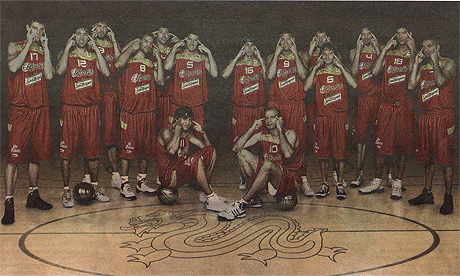
Spain's Olympic basketball team, posing for an ad, making "Chinese" eyes.
The Guardian reports:
No one involved in the advert appears to have considered it inappropriate nor contemplated the manner in which it could be interpreted in China and elsewhere. No offence was intended by the advert, but whether the Chinese see it that way is a different matter and it is likely to provoke more criticism at a delicate time for Spanish sport.Oh, the problem of gestures that seem OK in one country but are terribly offensive in another! How are we to keep track of them all?
And don't make that OK gesture in Brazil, by the way.
UPDATE, August 13: The I.O.C. calls the ad "inappropriate."
“If anyone feels offended by it, we totally apologize for it,” the Spanish star Pau Gasol said. “We never meant anything offensive by it.”
Emmanuelle Moreau, a spokeswoman for the International Olympic Committee, said in an e-mail message: “We understand that the Spanish team intended no offense and has apologized. The matter rests there as far as the I.O.C. is concerned.”...
The Spanish Coach, Aito García Reneses, declined to apologize for the picture, which he said he had not seen. He did not appear in the picture. He said the intention was a joke.
Thursday, January 31, 2008
"Sperm cells created from female embryo."
The Telegraph reports, adding that "it may be possible for lesbian couples to have their own biological children."
Or any 2 women. They don't have to be lesbians.
It's just that we — some of us! — feel sympathetic to the desire of a lesbian couple to have a child that is biologically related to both of them.
But any 2 women could have a baby together — once the technology advances so that sperm cells could be made from a woman's bone marrow.
And face it: A woman could be impregnated with her own sperm.
But right now, at this stage of the technology, a female embryo is being destroyed to create a sperm cell. One doctor calls this procedure "double-damned," but — what did you think? — he (she?) doesn't mean that it will provoke God:
Or any 2 women. They don't have to be lesbians.
It's just that we — some of us! — feel sympathetic to the desire of a lesbian couple to have a child that is biologically related to both of them.
But any 2 women could have a baby together — once the technology advances so that sperm cells could be made from a woman's bone marrow.
And face it: A woman could be impregnated with her own sperm.
But right now, at this stage of the technology, a female embryo is being destroyed to create a sperm cell. One doctor calls this procedure "double-damned," but — what did you think? — he (she?) doesn't mean that it will provoke God:
... Dr Robin Lovell-Badge, a stem cell and sex determination expert at the National Institute for Medical Research, Mill Hill, London, doubts it will work: “The presence of two X chromosomes is incompatible with this. Moreover they need genes from the Y chromosome to go through meiosis. So they are at least double-damned.”I don’t know how people will look at this ethically. You might want to think about it. You know, yourself. Whether it actually is ethical. It's not just a matter of how "people" "look at" it.
In Brazil, a team led by Dr Irina Kerkis of the Butantan Institute in Saõ Paulo claims to have made both sperm and eggs from cultures of male mouse embryonic stem cells in the journal Cloning and Stem Cells.
The researchers have not yet shown that their male eggs can be fertilised to produce viable offspring, but they are thinking about possibilities for same-sex human reproduction.
If all these experiments pan out, then the stage would also be set for a gay man to donate skin cells that could be used to make eggs, which could then be fertilised by his partner’s sperm and placed into the uterus of a surrogate mother.
“I think it is possible,” says Kerkis, “but I don’t know how people will look at this ethically.”
Labels:
Brazil,
children,
Donna Brazile,
ethics,
homosexuality,
medicine,
religion
Sunday, January 14, 2007
"Men are still resisting and clearly prefer the rounder, fleshier type. But women want to be free and powerful..."
"...and one way to reject submission is to adopt these international standards that have nothing to do with Brazilian society." That's one attempt -- by a historian, Mary del Priore -- to explain the changing standard of beauty in Brazil. It's a strange idea -- isn't it? -- that the natural feminine body is a sort of enslavement and that anorexia is a way to power. It's surely not limited to Brazil, but the Brazilian manifestation of it is so stark:
So, anyway, what do you think, are Brazilian women undercutting themselves, missing out on this nicely accommodating old standard of beauty to take on the rigors of the "international" standard of beauty, or is there actually something oppressive about the old standard?
Experts also agree that Brazilian men, whatever their class or race, have been much slower to accept slenderness as a gauge of feminine beauty. When they are looking for a sexual partner, Brazilian men are consistent and clear in saying that they prefer women who are fleshy in the rear — “popozuda” is the wonderfully euphonious slang term used here — and have pronounced curves.Sometimes even transferring their own tissue from top to bottom. Now, that is something. That's amazing. And "popozuda" -- what a cool word.
In the past, that standard was so firmly established that some Brazilian women resorted to breast reduction or buttock augmentation surgery, sometimes even transferring their own tissue from top to bottom.
So, anyway, what do you think, are Brazilian women undercutting themselves, missing out on this nicely accommodating old standard of beauty to take on the rigors of the "international" standard of beauty, or is there actually something oppressive about the old standard?
Labels:
Brazil,
Donna Brazile
Thursday, October 19, 2006
"The whole idea is . . . that I did something that he did not like, but at the time he did not say anything."
Says the priest who admits to what ex-Congressman Mark Foley said he did.
"We had some kind of friendship. I was very friendly with him and his family," said [Anthony] Mercieca. "Then almost forty years passed without him saying anything. . . . And now because he got caught he recited these things."Oh, those priests, with their subtle reasoning.
In Brazil "they skinny dip all the time and no one gets scandalized. It is part of the culture. It is natural," Mercieca said. "They don't make an issue out of a skinny dip in the park or a massage."
"It was not what you call intercourse. . . . There was no rape or anything. . . . Maybe light touches here or there," said Mercieca.
Labels:
Brazil,
Donna Brazile,
rape,
thinness
Sunday, July 9, 2006
Some hipness and squareness about John Roberts.
Hey! I spot my name in today's NYT in an article by Linda Greenhouse called "His Hipness, John G. Roberts." Let's see:
Here's the missing link. I started off the conversation this way:
She wrote:
Greenhouse ends the opening passage to her article -- the part I've quoted -- with:
The NYT piece isn't about blogging phenomena, though. It's about judging John Roberts. The part about our little boxing/hockey conversation is followed by some quotes about Roberts' writing by usual suspect quotemeisters Erwin Chemerinsky (Roberts' "prose style is clear and easy to follow") and Akhil Amar (praising the "elegance and economy" and "occasionally snappy line"). This leads to a discussion about whether Roberts is really a judicial "minimalist." No overarching conclusions there.
The piece rolls toward a conclusion with the observation that Roberts doesn't much like quoting law review articles (a quality shared by most judges, I'd say). Here, the key quote is from Harvard lawprof David Barron: "It's as if the answers to all questions are already there, completely internal to the court, to be teased out of the existing cases."
...including the lawprof blogger. So bring on the judicial metaphors and rhetoric... I need bloggables.
Oh, but the term is over. No new material! We'll have to go back over the old. In fact, I'm running a series of seminars over the rest of the summer here at the law school in which we hash over one case each Tuesday. I'm taking over the first slot, which I'd previously given to someone else, who has an out-of-town opportunity to pursue. I'm the emergency fill-in. I'll be doing the hallucinogenic tea case, which happens to be the first case Akhil Amar talks about in illustrating Roberts' penchant for the "occasionally snappy line":
WRITING in April for a unanimous Supreme Court, Chief Justice John G. Roberts Jr. found that the police in Brigham City, Utah, acted properly in entering a home without a warrant after they peered through a window and saw a fight in progress that had left one man spitting blood.There is a hot link in that passage, but it's for "University of Wisconsin" and it just goes to a page of hits for a search within the NYT site for "University of Wisconsin." How about a link to the post? Come on, Times! You've got to do internet properly. It's not Greenhouse's fault, but really, that approach to links is unbelievably obtuse.
"The role of a police officer includes preventing violence and restoring order, not simply rendering first aid to casualties," the chief justice said, rejecting the argument that the police should have waited until the altercation ended more conclusively. "An officer is not like a boxing (or hockey) referee, poised to stop a bout only if it becomes too one-sided," he explained.
The chief justice's sports imagery galvanized the legal blogs. Some found his boxing reference inapt. "The whole point of boxing is fighting!" wrote a participant on the Althouse blog, run by Ann Althouse, a law professor at the University of Wisconsin.
Others took issue with the hockey reference. "Given all the padding that hockey players wear, being punched by an opponent hardly is more significant than being hit by a toddler," one said.
Finally, another writer took a step back and observed that "this shows another side of Roberts as a good writer: displaying some wry humor and hipness."
Here's the missing link. I started off the conversation this way:
We're familiar with the way a referee in a boxing can stop a fight if it becomes too one-sided. Why throw in "(or hockey)"? It not only clutters the sentence, it makes the concept harder to grasp. I don't even know about hockey referees stopping one-sided games. Since Roberts is known for the high quality of his writing style, I've got to think that parenthetical really adds something. But what?The quote "The whole point of boxing is fighting!" is not mine. It's by what Greenhouse called "a participant on the Althouse blog, run by Ann Althouse." In other words, a commenter. Actually, it's Joan H. -- here's her blog .
Is it that in hockey fights break out, and the refs don't stop them unless they're one-sided, and it's actually more like the police situation because the fighting isn't legitimate in the first place, but some people might think the police should ignore fights unless someone is outmatched? In that case, hockey is a more apt analogy in light of the argument that the search was unreasonable.
She wrote:
Fighting is tolerated in the NHL, and referees often let the players involved work out their frustrations as long as neither party is getting beaten to a pulp and the other team members are staying out of the fray. Most fights are just scuffles, and are to be expected in a game in which shoving your opponents out of the way is legitimate.The second quote -- "Given all the padding that hockey players wear, being punched by an opponent hardly is more significant than being hit by a toddler" -- is by Dave Friedman. The "wry humor and hipness" one is from paulfrommpls. Here's his blog.
I think the hockey analogy is better just for that reason, and can't understand why boxing was included at all. The whole point of boxing is the fighting! In hockey, fighting is always penalized, whether or not the refs break it up, just as it should be in life. I think Roberts included the boxing reference because frankly there aren't so many hockey fans around these days.
Greenhouse ends the opening passage to her article -- the part I've quoted -- with:
It is no surprise that the new chief justice's every vote is being tabulated and scrutinized. But so is his every metaphor.Well, the attention to the metaphor is partly in the nature of blogging. It was a nice specific, textual thing to talk about. I love when something like that pops out in a Supreme Court case (or somewhere else in the news). It's one of those things that says bloggable to me. Indeed, I'm scrutinizing the writing in the NYT right now because it said bloggable to me... which it would have said even without calling my name (which gets my attention big time).
The NYT piece isn't about blogging phenomena, though. It's about judging John Roberts. The part about our little boxing/hockey conversation is followed by some quotes about Roberts' writing by usual suspect quotemeisters Erwin Chemerinsky (Roberts' "prose style is clear and easy to follow") and Akhil Amar (praising the "elegance and economy" and "occasionally snappy line"). This leads to a discussion about whether Roberts is really a judicial "minimalist." No overarching conclusions there.
The piece rolls toward a conclusion with the observation that Roberts doesn't much like quoting law review articles (a quality shared by most judges, I'd say). Here, the key quote is from Harvard lawprof David Barron: "It's as if the answers to all questions are already there, completely internal to the court, to be teased out of the existing cases."
Relying on precedent as the only source of law is an approach with strengths and weaknesses, Professor Barron said, noting that on the one hand, precedent can be a smokescreen, "a rhetorical device to hide the inevitable policy making," while on the other, "it has its own constraining effects," making a judge less likely to embrace dramatic change in the status quo.True enough, but it's an observation that you can make about nearly any judge. This rhetoric about rhetorical devices is the stock in trade of the law professor...
...including the lawprof blogger. So bring on the judicial metaphors and rhetoric... I need bloggables.
Oh, but the term is over. No new material! We'll have to go back over the old. In fact, I'm running a series of seminars over the rest of the summer here at the law school in which we hash over one case each Tuesday. I'm taking over the first slot, which I'd previously given to someone else, who has an out-of-town opportunity to pursue. I'm the emergency fill-in. I'll be doing the hallucinogenic tea case, which happens to be the first case Akhil Amar talks about in illustrating Roberts' penchant for the "occasionally snappy line":
[Amar point to] a majority opinion that rejected the government's application of federal narcotics law to stop a Brazil-based religious group from importing a hallucinogenic tea for use in its rituals. "The government's argument echoes the classic rejoinder of bureaucrats throughout history: If I make an exception for you, I'll have to make one for everybody, so no exceptions," the chief justice wrote.Ah, good place to end a rambling blog post about hipness! We've got your hallucinogenic drugs and that hippie irritation with the government and all its rules, man.
Labels:
blogging,
Brazil,
Donna Brazile,
drugs,
hippies,
John Roberts,
law,
law school,
Linda Greenhouse,
metaphor,
minimalism,
religion,
Supreme Court,
tea,
Utah
Sunday, June 18, 2006
"Now perhaps there's been a chance to reattach the original democratic, liberal values to the flag that come from the 19th century..."
How hard -- and rightly so -- it's been for Germans to wave their flag.
"To the old generation, the flag symbolized aggressive nationalism, or even some continuity with the Third Reich, even if the Third Reich didn't use that flag," said Paul Nolte, a professor of contemporary history at Berlin's Free University...
The new display of pride is almost strenuously nonnationalistic. There are even German cars that show the German flag on one side and some other flag — the Brazilian one seems popular, perhaps because Brazil is a likely opponent if the German team makes it to the [World Cup] finals — on the other side.
Labels:
Brazil,
Donna Brazile
Tuesday, February 21, 2006
Just[ices] say yes to hallucinogenic tea.
The Supreme Court is back from a long break today, with Samuel Alito on the bench for the first time. There's a new opinion, in the hallucinogenic tea case:
I'll read the case and have more later. Here is my earlier post on the oral argument in the case:
UPDATE: I’ve read the case, which is called Gonzales v. O Centro Espirita Beneficente Uniao Do Vegetal. The government said it has a compelling interest in the uniform application of the federal law, but Roberts slapped that down:
The Court tweaks the government for relying so heavily on interests represented by the Controlled Substances Act:
Justices, in their first religious freedom decision under Chief Justice John Roberts, moved decisively to keep the government out of a church's religious practice. Federal drug agents should have been barred from confiscating the hoasca tea of the Brazil-based church, Roberts wrote in the decision.
The tea, which contains an illegal drug known as DMT, is considered sacred to members of O Centro Espirita Beneficiente Uniao do Vegetal, which has a blend of Christian beliefs and South American traditions. Members believe they can understand God only by drinking the tea, which is consumed twice a month at four-hour ceremonies.
I'll read the case and have more later. Here is my earlier post on the oral argument in the case:
A religious group wants to use a drug -- hoasca -- and argues that the Religious Freedom Restoration Act entitles it to an exemption from the Controlled Sustances Act. Under RFRA, the federal government must have a compelling state interest to impose a substantial burden on the free exercise of religion. The government claims an interest in preventing the drug from being diverted into other uses:Today's opinion is unanimous (with, Alito, of course, not participating). It's written by the new Chief Justice, so I'm especially interested in reading it. I so devoutly hope to find his opinions sublimely crisp."Your approach is totally categorical,'' Roberts told government lawyer Edwin Kneedler during a one-hour argument session in Washington. If a religious group used only one drop of the drug a year, : "your position would still be the same,'' Roberts said....Interesting! I suppose people will compare this to last term's medical marijuana case, Raich, in which the Court (including Scalia) was quite deferential to the claim that the government needs to be able to pervasively regulate a drug. But Raich was about the scope of Congress's power as against the power of the states. Today's case is about two different federal statutes, one coming after the other and capable of limiting it. The question isn't how much constitutional power Congress has, but what Congress actually did in its two statutes. If it didn't want to cut special exemptions to religious groups, it shouldn't have passed the Religious Freedom Restoration Act. If it didn't want RFRA to apply to drugs, it could have written an exception into it. But in fact, RFRA was enacted in response to a Supreme Court case that was about the failure to give special treatment to the religious use of a drug, so it's especially apt that it should apply here.
Justice Antonin Scalia, who wrote the 1990 decision, pointed to an exception Congress made for peyote in American Indian religious ceremonies.
"It's a demonstration you can make exceptions without the sky falling,'' Scalia said.
Justice John Paul Stevens followed up by asking whether the use of peyote indicated that "maybe it's not all that compelling.''
Of the nine justices, Anthony Kennedy offered the strongest support for the government's position.
"It seems to me at the very least there should be a presumption that there is a compelling interest,'' Kennedy told Nancy Hollander, the church's lawyer....
Several justices, including Scalia and Roberts, questioned Hollander's contention that hoasca is exempted under the 1971 United Nations Convention on Psychotropic Substances, which aims to bar trade in illicit drugs. The U.S. is among more than 160 signatories to that treaty.
Both Scalia and Roberts, however, said Congress has the authority to override a treaty through domestic law.
"Isn't it well established that statutes trump treaties?'' Scalia asked.
UPDATE: I’ve read the case, which is called Gonzales v. O Centro Espirita Beneficente Uniao Do Vegetal. The government said it has a compelling interest in the uniform application of the federal law, but Roberts slapped that down:
The Government’s argument echoes the classic rejoinder of bureaucrats throughout history: If I make an exception for you, I’ll have to make one for everybody, so no exceptions. But RFRA operates by mandating consideration, under the compelling interest test, of exceptions to “rule[s] of general applicability.” Congress determined that the legislated test “is a workable test for striking sensible balances between religious liberty and competing prior governmental interests.”…There was also an argument that the government has a compelling interest in complying with the international Convention on Psychotropic Substances, which, the Court held, did in fact cover hoasca. But the government failed to present any evidence of what detriment would occur if this small group were given an exemption.
We do not doubt that there may be instances in which a need for uniformity precludes the recognition of exceptions to generally applicable laws under RFRA. But it would have been surprising to find that this was such a case, given the longstanding exemption from the Controlled Substances Act for religious use of peyote, and the fact that the very reason Congress enacted RFRA was to respond to a decision denying a claimed right to sacramental use of a controlled substance.
The Court tweaks the government for relying so heavily on interests represented by the Controlled Substances Act:
Congress had a reason for enacting RFRA, too. Congress recognized that “laws ‘neutral’ toward religion may burden religious exercise as surely as laws intended to interfere with religious exercise,” and legislated the compelling interest test as the means for the courts to “strik[e] sensible balances between religious liberty and competing prior governmental interests.”I must say that I find this case quite amusing! Congress catered to religious interest groups by passing RFRA and thereby disagreeing with the way the Smith Court had read exemptions out of the Constitution's Free Exercise Clause. The Court had tried to constrain the judicial role, but Congress then forced that role on the courts with a statute. And now the Court is taking the statute seriously. They are deferring to Congress by accepting the old activist role of making case-by-case accommodations. How deliciously ironic.
We have no cause to pretend that the task assigned by Congress to the courts under RFRA is an easy one. Indeed, the very sort of difficulties highlighted by the Government here were cited by this Court in deciding that the approach later mandated by Congress under RFRA was not required as a matter of constitutional law under the Free Exercise Clause. But Congress has determined that courts should strike sensible balances, pursuant to a compelling interest test that requires the Government to address the particular practice at issue.
Friday, November 25, 2005
Sunday, August 22, 2004
"Next blog."
I love the new Blogger tool bar, especially the "next blog" feature. It's like channel surfing on TV. There's a certain pleasure to switching to the next blog and the next blog aimlessly. It's more fun than channel surfing really, because it is so unpredictable and most of the places you go are so tiny. Yet each place is a person somewhere, someone sweet or smart or nutty or ordinary. It could be anywhere in the world, especially Brazil, and it might not even say where it is, but you might be able to tell from a picture that it's right in your own home town. Often you encounter a blog with only one post, the very germ of a blog. I'm struck by how charming everyone seems: Today was a lot of fun at church. .... I inked a drawing! ... Met Steph's new kitties and they are absolutely adorable...
Labels:
Brazil,
Donna Brazile
Saturday, March 27, 2004
But what movie did you see? I saw Eternal Sunshine of the Spotless Mind, the first movie I've gone out to see since House of Sand and Fog, which long time (or archive) readers of this blog know I saw back in January, in the first week of blogging. Fog ... Sunshine ... is there some kind of weather theme to your movie selections?
So was Eternal Sunshine "the best movie of the decade" as Slate would have it? That hardly seemed possible and of course it wasn't. It was bearable, but then I'm impatient. I prefer TV--including watching DVDs--because I don't like being stuck in the theater. Some things need to be seen on the big screen, but ES isn't one of them. It has a music video look that would do better on TV I think. There is a bluish pall over the whole thing, broken only by Kate Winslet's hair, orange sweatshirt, and a few other things. Okay, that's a color idea. I think color movies should have color ideas, but I think it is a video screen, not a movie screen idea.
Other random things I'll say about Eternal Sunshine of the Spotless Mind:
1. Mark Ruffalo seemed to have the Rick Moranis role.
2. Kirsten Dunst looks like my mother looked as a young woman--not counting the hair.
3. Kate Winslet modeled her American accent after a particular American actress--a la Nicole Kidman doing Meg Ryan in To Die For--but I couldn't figure out which one. Email me if you do.
4. This movie is a powerful date movie, because it teaches the lesson that for all its flaws, the relationship you are in is the great love of your life that you must cling to desperately no matter how intent you may have been to rid yourself of every last vestige of it. Don't leave: you'll be sorry!
5. Romantic movie clichés that were done reasonably well: running about in the lapping waves shows how in love people are, a kooky young woman can show a man who doesn't know what life is what life is, romping in snow is reaching one's human potential.
6. As far as mess-with-your-brain movies go, I can think of three I like better than Eternal Sunshine: Total Recall, Brazil, and Being John Malkovich. There are probably others, but I just can't think of them.
7. With Kate Winslet in the picture, I couldn't help thinking about Titanic a few times, like when Jim Carrey was desperately pulling her along through hallways and when she (in the Leonardo diCaprio position) was dragging Carrey out on the ice to show him how to let lose and start to live (it was like that arms-spread on the prow scene).
End of random observations about Eternal Sunshine of the Spotless Mind.
So was Eternal Sunshine "the best movie of the decade" as Slate would have it? That hardly seemed possible and of course it wasn't. It was bearable, but then I'm impatient. I prefer TV--including watching DVDs--because I don't like being stuck in the theater. Some things need to be seen on the big screen, but ES isn't one of them. It has a music video look that would do better on TV I think. There is a bluish pall over the whole thing, broken only by Kate Winslet's hair, orange sweatshirt, and a few other things. Okay, that's a color idea. I think color movies should have color ideas, but I think it is a video screen, not a movie screen idea.
Other random things I'll say about Eternal Sunshine of the Spotless Mind:
1. Mark Ruffalo seemed to have the Rick Moranis role.
2. Kirsten Dunst looks like my mother looked as a young woman--not counting the hair.
3. Kate Winslet modeled her American accent after a particular American actress--a la Nicole Kidman doing Meg Ryan in To Die For--but I couldn't figure out which one. Email me if you do.
4. This movie is a powerful date movie, because it teaches the lesson that for all its flaws, the relationship you are in is the great love of your life that you must cling to desperately no matter how intent you may have been to rid yourself of every last vestige of it. Don't leave: you'll be sorry!
5. Romantic movie clichés that were done reasonably well: running about in the lapping waves shows how in love people are, a kooky young woman can show a man who doesn't know what life is what life is, romping in snow is reaching one's human potential.
6. As far as mess-with-your-brain movies go, I can think of three I like better than Eternal Sunshine: Total Recall, Brazil, and Being John Malkovich. There are probably others, but I just can't think of them.
7. With Kate Winslet in the picture, I couldn't help thinking about Titanic a few times, like when Jim Carrey was desperately pulling her along through hallways and when she (in the Leonardo diCaprio position) was dragging Carrey out on the ice to show him how to let lose and start to live (it was like that arms-spread on the prow scene).
End of random observations about Eternal Sunshine of the Spotless Mind.
Labels:
blogging,
Brazil,
Donna Brazile,
ice,
Kate Winslet,
movies,
Nicole Kidman,
Titanic
Subscribe to:
Posts (Atom)