Pages

Labels

Showing posts with label elephant. Show all posts

Wednesday, January 2, 2013

"Alexander the Great arrived in the area of Afghanistan in 330 BC after defeating Darius III of Persia a year earlier at the Battle of Gaugamela."

"His army faced very strong resistance in the Afghan tribal areas where he is said to have commented that Afghanistan is 'easy to march into, hard to march out of.'"

"Afghanistan was conquered by the Maurya Empire, which was led by Chandragupta Maurya from Magadha... [A]s he was going to war with the generals of Alexander, a wild elephant of great bulk presented itself before him of its own accord, and, as if tamed down to gentleness, took him on its back, and became his guide in the war, and conspicuous in fields of battle."

"Arab armies carrying the banner of Islam came out of the west to defeat the Sasanians in 642 CE and then they marched with confidence to the east. On the western periphery of the Afghan area the princes of Herat and Seistan gave way to rule by Arab governors but in the east, in the mountains, cities submitted only to rise in revolt and the hastily converted returned to their old beliefs once the armies passed."

"From the 16th century to the early 18th century, Afghanistan was divided in to three major areas.... The Kandahar region in the south served as a buffer zone between the powerful Mughals and Safavids, and the native Afghans often switched support from one side to the other."

"King Amanullah Khan moved to end his country's traditional isolation in the years following the Third Anglo-Afghan war. He established diplomatic relations with most major countries and, following a 1927 tour of Europe and Turkey (during which he noted the modernization and secularization advanced by Atatürk), introduced several reforms intended to modernize Afghanistan."

"Amid charges of corruption and malfeasance against the royal family and poor economic conditions created by the severe 1971–72 drought, former Prime Minister Mohammad Sardar Daoud Khan seized power in a non-violent coup on July 17, 1973, while Zahir Shah was receiving treatment for eye problems and therapy for lumbago in Italy."

"In response to the Soviet occupation of Afghanistan, the Carter administration and Reagan administration in the U.S. began arming the Mujahideen.... The 10-year Soviet occupation resulted in the killings of between 600,000 and two million Afghans, mostly civilians."

"The Taliban started shelling Kabul in early 1995 but were defeated by forces of the Islamic State government under Ahmad Shah Massoud... [W]hile trying to consolidate control over northern and western Afghanistan, [the Taliban] committed systematic massacres against civilians.... Bin Laden's so-called 055 Brigade was responsible for mass-killings of Afghan civilians.... [E]yewitnesses in many villages describ[ed] Arab fighters carrying long knives used for slitting throats and skinning people.... Of roughly 45,000 Pakistani, Taliban and Al Qaeda soldiers fighting against the forces of Massoud only 14,000 were Afghans."

"In early 2001 Massoud addressed the European Parliament in Brussels asking the international community to provide humanitarian help to the people of Afghanistan. He stated that the Taliban and Al Qaeda had introduced 'a very wrong perception of Islam' and that without the support of Pakistan the Taliban would not be able to sustain their military campaign for up to a year. On this visit to Europe he also warned that his intelligence had gathered information about a large-scale attack on U.S. soil being imminent."

***

And so we continue to the 2d day of this 206 day project, reading the "History of..." Wikipedia page for the 206 countries of the world. Yesterday's country, like many of the countries we'll encounter (in alphabetical order), was Abkhazia, much more obscure to us than today's country, a place we've been hearing about continually for the past decade. And yet, how much do we really know about Afghanistan? I've extracted a handful of sentences, all from before this last decade, in an effort to create a faint sense how little we know.

Saturday, December 29, 2012

"Animal activists have been attacking our family, our company, and our employees for decades because they oppose animals in circuses."

"These defendants attempted to destroy our family-owned business with a hired plaintiff who made statements that the court did not believe.... This settlement is a vindication not just for the company but also for the dedicated men and women who spend their lives working and caring for all the animals with Ringling Bros. in the face of such targeted, malicious rhetoric."

The ASPCA pays $9.3 million to get out of this case, which continues against the other defendants, the Humane Society of the United States, the Fund for Animals, Animal Welfare Institute, Animal Protection Institute United with Born Free USA, various lawyers, and a former Ringling employee named Tom Rider.

Saturday, October 6, 2012

Monday, September 24, 2012

The chameleon work

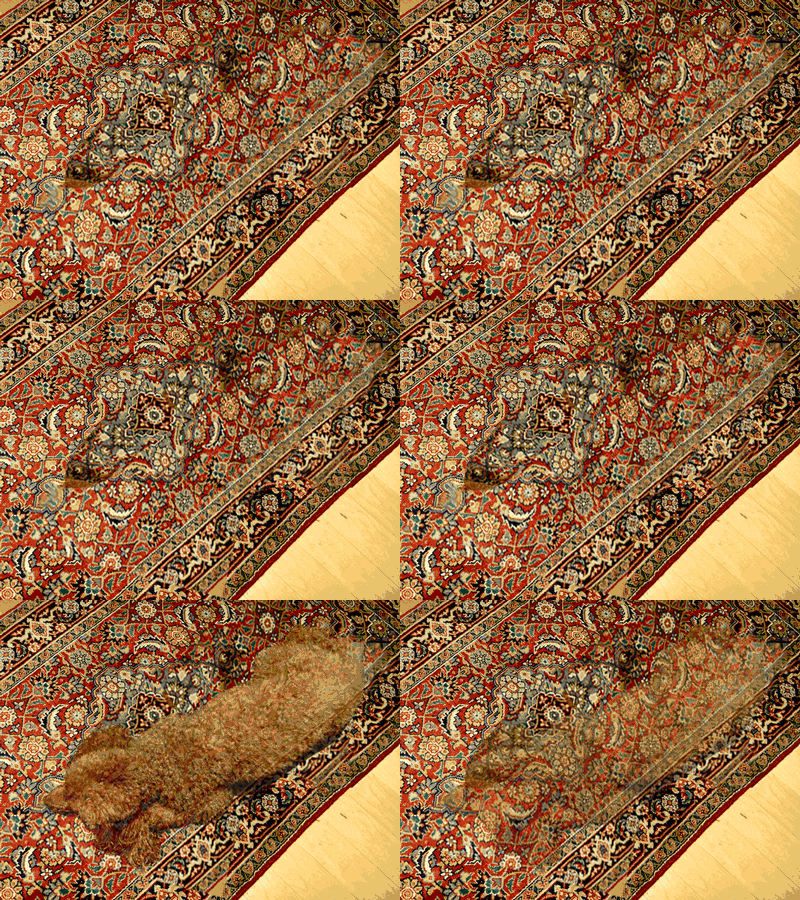
... of the illustrious Chip Ahoy, who explains his methodology for taking my photographs and perceiving the animal hiding therein. He found the chameleon in the hot peppers I displayed today:


It's that curled tail that gave it away! Chip points us back to the old poodle in the carpet:


The very well disguised elephant in the blue tile wall:


And my personal favorite, the giraffe in the woods:

Friday, April 6, 2012

Woolly...

... mammoth.

(Note to CNN editors: "broadcasted" is not a word. Or is it... now?)

Wednesday, September 1, 2010

"All programs on Discovery Health-TLC must stop encouraging the birth of any more parasitic human infants and the false heroics behind those actions."

"In those programs' places, programs encouraging human sterilization and infertility must be pushed. All former pro-birth programs must now push in the direction of stopping human birth, not encouraging it."

The hostage-takers manifesto.

ADDED: The guy seems pretty clearly crazy, and I hope no one dies and he gets the help he needs, because this manifesto — PDF —  is hilarious, but if anyone dies, it might be wrong to laugh.
Saving the environment and the remaning species diversity of the planet is now your mindset. Nothing is more important than saving them. The Lions, Tigers, Giraffes, Elephants, Froggies, Turtles, Apes, Raccoons, Beetles, Ants, Sharks, Bears, and, of course, the Squirrels.
Of course, the Squirrels. That's such a childish list of animals, and not just because of "Froggies." These are the animals in a children's picture book or Noah's Ark toy.
The humans? The planet does not need humans. You MUST KNOW the human population is behind all the pollution and problems in the world....
I disagree. Around my city, geese are crapping everything up. I notice that no birds got on Lee's list of favored creatures.
These are the demands and sayings of Lee.
How religion-y, and yet he hates religion:
Civilization must be exposed for the filth it is. That, and all its disgusting religious-cultural roots and greed. Broadcast this message until the pollution in the planet is reversed and the human population goes down! 
He hates everything that human beings have produced. It's all filth. Even the ideas. He gets his ideas from a gorilla:
The Discovery Channel and it's affiliate channels MUST have daily television programs at prime time slots based on Daniel Quinn's "My Ishmael" pages 207-212 where solutions to save the planet would be done in the same way as the Industrial Revolution was done, by people building on each other's inventive ideas.
Here's the book. A gorilla tells us what to do. Example from the pages cited:
We could pension off our teachers, close schools, and open up the city to our children. Let them learn anything they want. We could take that risk....
Quinn has been hyped by Oprah Winfrey: Here's an Oprah interview with  Quinn:
WINFREY: You say that y--hundreds of years from now, children will look back on our society and call us monsters. Why?

Mr. QUINN: I think so. Yeah, because we're g--we're--we continue to take and take and take and consume and consume and consume everything in sight. And in 100 years, if--if there are still people around to think about it, we're going to look back and say, `My God, these were terribly greedy people. What kind of people were they? They were hard to understand, who had no thought for us, for the future of--of the human race.'

WINFREY: How are we monsters? In what ways are we devouring the world?...
ADDED: The man was killed. The hostages all survived.
[T]he suspect had "metalic canisters" strapped to his chest and back. When Lee was struck by police bullets, one of the canisters "popped." Police have not confirmed if the canisters were a bomb, but Manger said the "device may have gone off" when he was shot.

Thursday, September 10, 2009

"The American way of eating has become the elephant in the room in the debate over health care."

Ha ha. Get it? The elephant? That's you, reader. You're fat, says Michael Pollan. And you are a big — a huuuuge — part of the problem the government needs to solve. Pollan links to a study that supposedly shows that the reason we spend twice as much on health care as Europeans is because we are so grotesquely tubby. How can the government come between you and your food?
Cheap food is going to be popular as long as the social and environmental costs of that food are charged to the future. There’s lots of money to be made selling fast food and then treating the diseases that fast food causes. One of the leading products of the American food industry has become patients for the American health care industry.
Greedy corporations are making you fat and costing the health care system money. They are so greedy that — how awful! — they are selling food cheap. Expensive food also makes you fat, of course, but it's less obvious who's making money selling expensive food and thus harder to blame the evil corporations. 
The market for prescription drugs and medical devices to manage Type 2 diabetes, which the Centers for Disease Control estimates will afflict one in three Americans born after 2000, is one of the brighter spots in the American economy. As things stand, the health care industry finds it more profitable to treat chronic diseases than to prevent them. There’s more money in amputating the limbs of diabetics than in counseling them on diet and exercise.
Oh, here are the money-mad limb-hackers Obama was warning us about. Now, what I want to know is what is so terrible about the fact that most of the health-care money is spent treating diseases? Why should healthy people be consuming a bigger portion of the money? It's a good thing that people are left alone to take care of themselves and that health care professionals are used to do the things we can't do for ourselves. Of course, it would be nice if people didn't get diseases, and maybe a lot more of us could have long, disease-free lives, with little consumption of health-care resources if only we did more prevention. But would it change anything to give people ample free sessions with professionals who tell us to do what we already know we ought to do? The doctors actually don't have a clue how to get us to stop overeating (or — as if it would help — push us into a vigorous exercise program).

Pollan gets an economic theory going. He says health insurance companies drop customers after they get diseases, but if new law prevents this and requires them to charge all customers the same rates, then, they will have a strong new interest in preserving health and, allied with government, will stimulate the creation of government programs, policies, and laws aimed at stopping us from eating so damned much.
When health insurers can no longer evade much of the cost of treating the collateral damage of the American diet, the movement to reform the food system — everything from farm policy to food marketing and school lunches — will acquire a powerful and wealthy ally, something it hasn’t really ever had before....

In the same way much of the health insurance industry threw its weight behind the campaign against smoking, we can expect it to support, and perhaps even help pay for, public education efforts like New York City’s bold new ad campaign against drinking soda. At the moment, a federal campaign to discourage the consumption of sweetened soft drinks is a political nonstarter, but few things could do more to slow the rise of Type 2 diabetes among adolescents than to reduce their soda consumption, which represents 15 percent of their caloric intake.
"Bold new ad campaign"? Nicely, the NYT includes a link. Here's the ad:


It's a run-of-the-mill public service ad? What is bold about it? Picking on one product? Using tax money to pay for it? Oh, I see, it "graphically depicts globs of human fat gushing from a sideways drink bottle." I couldn't tell by looking at it. So shoving disgusting images in our face is bold. How admirably edgy of New York City. What's next? Pictures of ugly fat people slobbering over hamburgers? Something like this?


Throw all the taxpayer money you want into preventive care and raise the price on our too-cheap food. Blare nauseating ads at us. But we will still eat. We already care and we already don't want to be fat. We're not fat because corporations are greedy or because you can't get a free appointment with a nutritionist. We're fat because of the deep, innate appetite that saved our ancestors from famine and motivated them to eat whatever they could find to survive. We are here thanks to those profound desires, and life is all too easy these days. The unfortunate consequence of the beautiful amplitude of modern life is that we grow too big.

IN THE COMMENTS: Bissage said:
It’s funny that some people look at that ad and see “globs of human fat gushing from a sideways drink bottle.”

Not me.

I see a dog’s head with a dagger in it, a penis, and the word “sex."

Makes me want to consume alcohol, but I don’t know why.

Sunday, May 24, 2009

We crossed the Ohio River into Kentucky and ended up in the town of Augusta.

There's a somber after-the-flood feeling:

DSC00533

(The great flood was in 1997.)

There were beautiful old historical buildings — like the Rosemary Clooney homestead — but many moldy and dilapidated places.

People worked on their gardens, though. Sometimes in an incomprehensibly manic style:

DSC00541

That's a goldfish pond with fountains at the extreme left.

And the people seemed pretty friendly:

DSC00539

And, yes, I asked the man in the elephant mask if I could take his picture. He said: "Sure, let me put the beer down," and I said, "No, the beer is fine."

Saturday, October 25, 2008

"They should have picked a more ominous name, like KAOS or SPECTRE, instead of squirrel food."

"Something really scary. They are the biggest nut-based threat to America since Mr. Peanut tried to assassinate the GOP elephant to impress the Morton Salt girl.”

Stephen Colbert has a problem with the name ACORN.

Thursday, June 26, 2008

Bizarre! The URL for the David Stout article about the D.C. gun case now goes to the Linda Greenhouse article on the same subject.

And the David Stout article is nowhere to be found. Here's the URL in question. I'm hyperaware of this switch, because I just wrote a long blog post that criticized the way Stout wrote about the Supreme Court, and I expressly doubted that Linda Greenhouse would have written it like that:
... I wonder how Stout knows Scalia "clearly takes pride in his writing as well as his reasoning." Did the use of the words "frivolous" and "bizarre" somehow imply that pride or is the evidence elsewhere and we're just supposed to know it?....

Oh, no! Reading Stout (and Liptak) today, I'm nagged by the question What would Greenhouse have written? Would Linda Greenhouse have inserted commentary about Scalia pride?
Not to be outdone, Justice Stevens called the majority’s interpretation of the Second Amendment “overwrought and novel” and said it “calls to mind the parable of the six blind men and the elephant”...
Would Linda Greenhouse have imputed that competitive motivation to Stevens's choice of words? Stout's writing has something of the problem that plagued Jeffrey Toobin's book "The Nine." For narrative effect, the Court is portrayed as a psychodrama.
I'm not saying they changed it because of what I wrote. But that is curious, freakish, odd, peculiar, strange, unusual, and weird.

And Greenhouse notably and admirably avoids the Court-as-psychodrama problem.

"It is not a right to keep and carry any weapon whatsoever in any manner whatsoever and for whatever purpose."

Writes Justice Scalia, for the majority, in the D.C. guns case, accoring to David Stout's report in the NYT [UPDATE: The link no longer goes to the David Stout article, which I can't find on line at all anymore!]
Justice Antonin Scalia, writing for the majority in the landmark 5-to-4 decision, said the Constitution does not allow “the absolute prohibition of handguns held and used for self-defense in the home.”...

But the court held that the individual right to possess a gun “for traditionally lawful purposes, such as self-defense within the home” is not unlimited....

The ruling does not mean, for instance, that laws against carrying concealed weapons are to be swept aside. Furthermore, Justice Scalia wrote, “The court’s opinion should not be taken to cast doubt on longstanding prohibitions on the possession of firearms by felons and the mentally ill, or laws forbidding the carrying of firearms in sensitive places such as schools and government buildings, or laws imposing conditions and qualifications on the commercial sale of arms.”...

“The amendment’s prefatory clause announces a purpose, but does not limit or expand the scope of the second clause,” wrote Justice Scalia. “The operative clause’s text and history demonstrate that it connotes an individual right to keep and bear arms.”

Not at all, Justice Stevens countered, asserting that the majority “stakes its holding on a strained and unpersuasive reading of the amendment’s text.”
Stout informs us that Scalia "clearly takes pride in his writing as well as his reasoning" and in the same sentence writes that he applied "adjectives like 'frivolous' and 'bizarre'" to the dissenting opinion.

I wonder what "adjectives like 'frivolous' and 'bizarre'" Scalia used. Empty-headed? Featherbrained? flighty? Frothy? Giddy? Harebrained? Lighthearted? Scatterbrained? Silly? Gaga? Birdbrained? Dizzy? Cranky? Curious? Eccentric? Erratic? Freakish? Idiosyncratic? Odd? Outlandish? Peculiar? Quaint? Queer? Quirky? Singular? Strange? Unnatural? Unusual? Weird? Kooky? Screwball?

Oh... you mean he actually used the words "frivolous" and "bizarre"? I see.

Well, then I wonder how Stout knows Scalia "clearly takes pride in his writing as well as his reasoning." Did the use of the words "frivolous" and "bizarre" somehow imply that pride or is the evidence elsewhere and we're just supposed to know it? (Or do you just not want to plug his book?)

Oh, no! Reading Stout (and Liptak) today, I'm nagged by the question What would Greenhouse have written? Would Linda Greenhouse have inserted commentary about Scalia pride?
Not to be outdone, Justice Stevens called the majority’s interpretation of the Second Amendment “overwrought and novel” and said it “calls to mind the parable of the six blind men and the elephant”...
Would Linda Greenhouse have imputed that competitive motivation to Stevens's choice of words? Stout's writing has something of the problem that plagued Jeffrey Toobin's book "The Nine." For narrative effect, the Court is portrayed as a psychodrama. [UPDATE: Since my link now goes to the Linda Greenhouse report, you can read it and answer my question! The answer is: No.]

***

Stout tells us how McCain and Obama reacted to the case:
“I applaud this decision as well as the overturning of the District of Columbia’s ban on handguns and limitations on the ability to use firearms for self-defense,” Mr. McCain said in a statement, which contained a reminder that his Democratic nominee, Senator Barack Obama of Illinois, refused to join him in signing an amicus brief in support of overturning the district’s law.

Indeed, Mr. Obama’s view, expressed in a statement, was more nuanced than Mr. McCain’s.
More nuanced!
“I have always believed that the Second Amendment protects the right of individuals to bear arms, but I also identify with the need for crime-ravaged communities to save their children from the violence that plagues our streets through common-sense, effective safety measures,” Mr. Obama said, predicting that the ruling would provide needed guidance for lawmakers.
Is that nuance or the same point Scalia acknowledged, that the rights don't preclude regulation? What I think is telling in Obama's statement is the mismatch between concern about "crime-ravaged communities" and "violence" on the one hand and, on the other, the desire for "safety measures."

Wednesday, February 27, 2008

"For sale: private fantasyland of global megastar turned reclusive weirdo."

"Sprawling 2,800-acre grounds include 'artistic' statues of nude children, waxworks of old men handing out toffees, a miniature steam train and generous accommodation for elephants. Ferris wheel included (might need oiling)."

Do you need to be a rich weirdo to buy Neverland? Or could Neverland become a some sort of resort or Gracelandish tourist attraction?

Saturday, February 23, 2008

"If the point of the story was to allege that McCain had an affair with a lobbyist..."

Clark Hoyt, the NYT public editor, examines the journalistic ethics of the McCain story published last Thursday:
“If the point of the story was to allege that McCain had an affair with a lobbyist, we’d have owed readers more compelling evidence than the conviction of senior staff members,” [NYT executive editor Bill Keller said.] “But that was not the point of the story. The point of the story was that he behaved in such a way that his close aides felt the relationship constituted reckless behavior and feared it would ruin his career.”

I think that ignores the scarlet elephant in the room. A newspaper cannot begin a story about the all-but-certain Republican presidential nominee with the suggestion of an extramarital affair with an attractive lobbyist 31 years his junior and expect readers to focus on anything other than what most of them did. And if a newspaper is going to suggest an improper sexual affair, whether editors think that is the central point or not, it owes readers more proof than The Times was able to provide.
"Ignores" is putting it way too mildly. It's a ludicrous argument. It would mean that editors could purvey all sorts of trash as long as it is embedded it in a larger story. And when we get outraged, they could look down their noses and insult us about our poor reading comprehension.

Here's Jeff Jarvis on the subject:
[Keller] tries to tell us that we’re concentrating on the wrong thing here, that we don’t see what the real story is....

Do they have no news judgment? The lede in this story was obvious to everyone but the Times...

That the editors of the Times don’t see that is incredible — that is to say, not credible.
More at the link, but I've boiled it down to make it clear that Jarvis thinks Keller is dissembling.

Saturday, December 29, 2007

Exiting through the door marked 2007.

The NYT Magazine has its annual "Lives They Lived" issue, with short essays on a wide range of individuals who died in the past year.

A blogger gets a farewell essay this year. Steve Gilliard:
Though Gilliard, unlike many bloggers, always used his real name, few readers knew much about him. They didn’t know, for instance, that at age 39 he had open-heart surgery to repair an infected valve. They didn’t know he lived alone in a small apartment in East Harlem. And, although Gilliard often wrote about race and alluded to his own perspective, a lot of readers never realized he was black....

The paradox of Gilliard’s existence is a familiar story on the blogs, where people often adapt avatars that are more like the selves they imagine being. Online, he was vicious and uncompromising. In person, Gilly, as his close friends called him, was reserved and enigmatic.... He lamented that he didn’t know what it was to “wake up naked in a strange bed,” but, he wrote, “at 35, I’ve figured out that this is it, at least for now. Anything I do, any life I make, is going to revolve around words and computers and strange, bright people.”

[T]he few dozen mostly white bloggers who came to Harlem for the funeral saw for the first time the stark urban setting of Gilliard’s childhood, while his parents and relatives groped to understand what kind of work he had been doing at that computer and why scores of people had come so far to see him off.
There was Brett Somers, one of "The Match Game" celebrities:
She wasn’t Mae West, 80 trying to act 20, or an embalmed Gabor, but rather, with her Elton John glasses and Toni Tennille hairdo and saucy answers, an average-looking menopausal woman with a healthy regard for sex. In one of the most memorable broadcasts, Somers’s husband, Jack Klugman, was on the panel and seemed to be rushing the host, Gene Rayburn, along, as if to say that he and Somers had something better to do.
There was Mary Crisp:
Crisp testified before a Congressional committee on behalf of the Equal Rights Amendment in 1973 without really thinking about it much supporting the E.R.A. had been a Republican Party position for nearly 35 years. (The Democrats had been more split, some worrying that the amendment would wipe out hard-won but ultimately counterproductive laws protecting women from things like working overtime or lifting heavy objects.) But in 1978, Crisp ran head-on into the new insurgent right, which had built its grass-roots strength on issues like opposition to the E.R.A. and abortion. Once it became clear that Reagan was going to be the party nominee, she knew her time was just about up...

The Republican Party made Crisp nonexistent at the convention she had helped organize. Her name vanished from the program. She left her Detroit hotel clutching a big pink stuffed elephant inscribed, “Go Mary!” which, alas, she could not fit into the airport taxi.
There was Robert Adler, the guy who invented the object some people hold in their hand more than any other object.

Two animals got recognized — a parrot and a chimpanzee — because they almost, maybe, cared about talking to us.

And here's a list of the famous people who died in 2007. As usual, it's a diverse group of people thrown together by the happenstance of death occurring around the same time. It excludes those who died too close to the publication date — but Benazir Bhutto made it — and those — it could be you or I — who die in the last few days of the year. We do have 3 days left. The new list starts with January, so, the spiffy look of the list is more important than acknowledging those who slipped into eternity through the closing door of the previous year.
Denny Doherty, 66, Mamas and Papas singer....

Frankie Laine, 93, hit-making crooner....

Anna Nicole Smith, 39, famous for being famous....

Kurt Vonnegut, 84, novelist who caught the imagination of his age.....

Don Herbert, 89, "Mr. Wizard" to science buffs....

Tammy Faye Bakker, 65, emotive evangelist....

Michelangelo Antonioni, 94, Italian movie auteur.

Ingmar Bergman, 89, master filmmaker....

Luciano Pavarotti, 71, tenor of his generation....

Joey Bishop, 89, last of the Rat Pack....

Norman Mailer, 84, towering writer with matching ego...

Evel Knievel, 69, legendary daredevil...

Ike Turner, 76, R&B singer and former husband of Tina Turner.
Don't you picture them traveling together into the afterlife? Didn't I see a movie with a diverse group of recently dead persons making the passage? I remember them in black and white, on a small boat, and arguing. Let's check this list:
1. Between Two Worlds (1944)... passengers on a shrouded luxury liner visit with The Examiner, who hears their cases and tickets them for their next destination, depending on who they were and how they died....
Close. It's a boat, but it sounds too large.
2. A Matter Of Life And Death... (1946).... the differences between Brits and Yanks—when the latter arrive in heaven, they stampede straight to the Coke machine....
I'm sure I never saw that, judging from the clip at the link, with David Niven sitting on the escalator to heaven.
3. Black Orpheus (1959)... following the rhythm of Carnival and the belief that the barrier between life and death can be easily, almost playfully circumnavigated, for those with the right attitude and the right paperwork.
This is one of those classics I always felt I should see back in the days when I was fulfilling the obligation of seeing all the classics. But I've never seen it.
4. Defending Your Life (1991)... After dying, mortals go to a big, bland city full of big, bland courtrooms, where their lives are examined to see whether they've conquered fear enough to be ready for the next stage of existence....
This is a pretty good Albert Brooks movie with Meryl Streep that got many viewings chez Althouse in the 1990s. It always irritated me that getting into heaven was an entirely 1990s American idea of self-actualization. "Self-actualization" isn't the right word, though, is it? People stopped saying "self-actualization" more than 15 years ago, I think. It sounds self-indulgent, but nevertheless more challenging than "self-fulfillment," which is what we'd say now. Imagine access to heaven depending on whether you'd fulfilled yourself on earth.
5. Afterlife (1998)... government workers... operate out of a run-down rural facility where the newly dead spend a week among peeling paint and bargain-basement furniture, selecting the memory from life that means the most to them. Then the facility staff recreates those memories on film for the dearly departed, who take nothing but that memory when they move on to whatever comes next.
This is an elegant movie, focusing on what is being left behind and not the arrival in the next world. We see a strange little place of transition.
6. Corpse Bride (2005)... the dead seem to hang out in skeletal or zombie form in a big Burtony goth-tinged paradise full of aggressively animated "inanimate" objects and spontaneous song-and-dance routines.
Not what I'm trying to think of, but it sounds cool.
7. Beetlejuice (1988)... recently dead couple Alec Baldwin and Geena Davis wind up haunting their old house... Davis and Baldwin have to acclimate via a handbook titled Handbook For The Recently Deceased, and because they’re held in place by an apathetic, overworked, hostile bureaucracy full of people whose bodies clearly and comically display the marks of their ugly deaths.
Excellent. I've seen this one many times. But it's not the one I'm trying to remember. Perhaps I'm thinking of an old "Twilight Zone."
8. The Rapture (1991)... Michael Tolkin’s oddball meditation on apocalypticism. After Mimi Rogers, suffering in the desert waiting for the second coming, performs a mercy killing on her daughter, she winds up on a featureless, vaguely otherworldly plain.
I remember Siskel and Ebert raving over this one back then.
9. Carousel (1956)... starts off with Gordon MacRae already dead and reaping his eternal reward, as part of a crew hanging up glittering stars in a space that might represent the sky, but which more resembles the auditorium in a particularly well-funded high school during a “Starlight Express”-themed prom.
That's not it.
10. Flatliners (1990).... the afterlife is a terrific place, full of Elysian fields or giant naked boobs, depending on the proclivities of the people who go there.
Fine-tune your fantasies, people, before it's too late. Make sure it's something you won't find tedious after a billion years.
11. What Dreams May Come (1998)... heaven ... has kindly guides to help newcomers adapt and understand the next phase of their existences, and it even adapts itself to its inhabitants' personal interests and tastes....
This was an early CGI film that was enough to make me never want to see another CGI film. And I only saw the trailer for it.
12. Don't Tempt Me (2001)... Heaven is a deserted, black-and-white version of vintage Paris where everyone speaks French, and a deserving soul like Victoria Abril gets her own private ’30s nightclub where hundreds of illusory patrons hang on every note she sings and beg for more...
In the audience, perhaps, Denny Doherty, Frankie Lane, Ike Turner, and Luciano Pavarotti.


Monday, November 26, 2007

"There is an intensity and intimacy to Giuliani that can be unsettling."

"He has an authoritarian streak, as well as a penchant for secrecy and dependence on loyalists, that may remind voters of the current chief executive."

Newsweek sinks its talons into Rudy Giuliani.

ADDED: On Giuliani's relationship to Bernard Kerik:
Giuliani's loyalty to his last police commissioner, Bernard Kerik, bordered on the blind. The two men had come to know each other when Kerik, acting as an off-duty cop, drove Giuliani during his first mayoral campaign in 1989 (Giuliani lost to Dinkins). Kerik was the sort of diamond in the rough Giuliani appreciated—a tough street cop who got things done. Giuliani has insisted that he did not know about Kerik's questionable dealings with two businessmen with alleged mob connections. City hall records reviewed by NEWSWEEK suggest that the mayor may have been briefed on some of these problems just before Kerik was appointed commissioner. But Giuliani has said he has no memory, and his tight palace guard remains close-mouthed. ("There were mistakes made with Bernie Kerik," Giuliani said earlier this month, adding that Kerik's wrongdoing should not outweigh his crimefighting successes.)

That's quite mild — from a big cover story in a prominent newsweekly that seems aimed at digging up all the dirt on Giuliani.

There's a reminder of Giuliani's use of government power to retaliate against a museum that exhibited art that offended him:
He was outraged at an art show at the Brooklyn Museum called "Sensation." The exhibits included a picture of a black Virgin Mary surrounded by bits of pornography and a pile of elephant dung. Giuliani ordered the museum to shut down the show or lose its city subsidy. He lost in the courts; the show went on.

Newsweek connects this to his support of a priest charged with accused of molestation and characterizes Giuliani's "moralism" as uneven and " tribal" ("tribal" because the priest was from his neighborhood).

Friday, October 5, 2007

"Why do we wear pins? Because our country is under attack!"

Sean Hannity raves. And everyone's talking about the fact that Barack Obama stopped wearing his American flag lapel pin. We're hot for our symbols and we love to talk about what they mean. (It's so much easier than talking about the substantive issues. Can you compare the health care plans of the candidates?)

And speaking of symbols: This Is Your Elephant on Drugs.

Tuesday, September 18, 2007

"He likens the mind’s subterranean moral machinery to an elephant, and conscious moral reasoning to a small rider on the elephant’s back."

How morality may have evolved:
In... "The Happiness Hypothesis," Jonathan Haidt, a moral psychologist at the University of Virginia, has been constructing a broad evolutionary view of morality.... driven by two separate mental systems, one ancient and one modern, though the mind is scarcely aware of the difference. The ancient system, which he calls moral intuition, is based on the emotion-laden moral behaviors that evolved before the development of language. The modern system — he calls it moral judgment — came after language, when people became able to articulate why something was right or wrong.

The emotional responses of moral intuition occur instantaneously — they are primitive gut reactions that evolved to generate split-second decisions and enhance survival in a dangerous world. Moral judgment, on the other hand, comes later, as the conscious mind develops a plausible rationalization for the decision already arrived at through moral intuition.
Read the whole thing. And take the tests. I did. The tests compare your answers to the answers of political conservatives and liberals, and, for me, supported my belief that I am in the middle. (I'm not sure whether my test results were classified as conservative or liberal. You're asked several questions in the beginning, about social issues, economics, and national security. Since I go left, middle, and right, respectively, on those questions, I don't know where my answers counted.)

Thursday, July 19, 2007

Obama ≈ JFK?

Ted Sorenson is saying that.

And see: Giuliani ≈ Nixon.


Somebody seems to have plugged in a new column-generating machine.

What's next? Hillary ≈ Jimmy Carter?

Maybe it's all a reaction to the elephant in the room: Thompson ≈ Reagan.