Pages

Labels

Showing posts with label bald. Show all posts

Sunday, October 14, 2012

Shameful, lowly race-baiting... but who's doing it?

So somebody got a picture of the back of a man — no face, no name — in a T-shirt that says — on the back — "Put the White Back in the White House." BuzzFeed posts the photo with the information that it's a "Getty Images" photo. So we don't even get the name of the photographer. We're told "The Getty Images photo was taken at a Romney/Ryan campaign event in Lancaster, Ohio on Friday." We can't see much of the context. Who's around this guy?

Why put this picture up? Well, obviously, it gets hits for BuzzFeed, which doesn't need any more motivation than that. It does need the utter lack of ethics and decency it takes to throw something this unfair into the public debate. The BuzzFeed staffer who did this post is Andrew Kaczynski, whom we've seen before. (He was behind "Paul Ryan Gets Testy and Walks Out of Interview.") Presumably, he's doing his job of attracting links, and I'm exacerbating the dynamic by linking. But I'm doing this because I have recently criticized Romney supporters for injecting race into presidential politics.

I said it was a mistake for Rush Limbaugh and others to play that Obamaphone lady over and over. Even with no mention of race, I thought the recording was used — with deniability — to stir up racial feelings. My post — "Just How Racist Is the 'Obama Phone' Video?" — got very strong pushback from commenters. People did not want to acknowledge that race had been injected at all. I participated in the comments at first. For example:
Look, those of you who don't see the racial problem are already probably going to vote for Romney. For Romney to win, he has to influence people in the middle who are sensitive to this kind of racial ugliness. You may say my sensitivity is set to[o] high, but I'm saying that I believe the people with my level of sensitivity are much more likely to determine the outcome of the election.
But my commenters fought on, passionately, which showed, I think, how deeply they — like me —  object to racial material. The objection took different forms. I was saying don't use powerful material when it will feel racial to some people, and they were resisting seeing it as racial. Within our disagreement, there was an intense agreement: We object to racial material.

Back to that T-shirt. Who should be condemned here? There's that bald-headed, no name guy. I assume he is a Romney opponent. The reasons for that assumption are oozingly obvious. (Here, Robert Stacy McCain spells them out for you.) He deserves condemnation, whether he's for or against Romney. The photographer deserves condemnation if he has thrown this crap into the public space without giving us a name, a shot of the man's face, or even a broader shot of the people around him. We are deprived of the context we need to think about whether other people at the rally saw it, approved, laughed, shunned him, confronted him.

But Buzzfeed and all the Romney opponents who chose to link to Buzzfeed should be ashamed. They lowered themselves. They saw an opportunity go racial and they took it. Here's Caroline Bankoff at New York Magazine:
This photo of the not-so-subtle look, taken at Friday's campaign rally in Lancaster, Ohio, doesn't really require further description. 
It sure as hell does require further description! Who was that bald man? How long was that shirt-back displayed? Is this a false-flag effort to smear Romney? And why don't you care? Just go ahead and stir up racial fears and ugliness, Caroline Bankoff. Shame on you and everyone else who slavered at the opportunity to serve up this racial obscenity.

Saturday, September 1, 2012

Bill Maher defends Eastwood: "He went up there without a net, on a tightrope... he did a bit with just an empty chair and killed."

"He committed to it, it was consistent, and it worked."

Maher is speaking as a standup comedian, knowing how hard it is. Halfway through the video clip at the link, Jason Alexander — wearing William Shatner's toupee — breaks in to say famous people could "urinate" on themselves and people would accept it as a good routine. Maher says no, at most they'd give you 1 minute to get funny; Eastwood worked that comic routine 10 minutes, successfully, and that was impressive. And Maher loathes Eastwood's political position. So that's impressive.

Also on last night's show, Maher talked to Dinesh D'Souza about his movie "2016: Obama’s America."

Thursday, April 19, 2012

"Shaving your balding head is like breaking up with someone before he or she can break up with you."

"Or like marching into your boss’s office and saying: 'You can’t fire me. I quit.'"
After all, nothing screams “gradual decline” like thinning or retreating hair. It’s a constant voice of anxiety whining, “It’s only going to get worse!” But with a shaved head, it can’t get any worse. There’s no voice of anxiety. You’ve already gone ahead and chosen the nuclear option.

Saturday, January 1, 2011

Pictured on the front page of the NYT: "Scott Walker, the governor elect, brings his lunch to work."


It's not still on the front page. That was a few hours ago. A nice image of Walker, don't you think? Flattering because he's eating lunch at his desk. It's not conventionally flattering to catch the bald spot like that, but it's politically flattering to have him bending over his work. (On the other hand, what's the big deal? I eat lunch while working almost every day. Don't you? Breakfast too, and often dinner. But I like to see my public servant working, and it's nice of the NYT to offer political support to a new governor who doesn't represent the newspaper's political preference.

Here's the article:
Mr. Walker, who has said publicly that he hopes to force public employees’ wages and benefits “into line” with everyone else’s, urged leaders against the session, saying he needed “maximum flexibility” to handle the state’s coming budgets, but Democrats argued that the contracts were not particularly beneficial to workers anyway (they included no raises and furlough time that amounted to a pay cut)....

State workers here are predicting a flood of retirements by those who will not want to bear the uncertainty of it all, and particularly the prospect of shrinking pension benefits. Some employees were already talking about moving elsewhere, getting new jobs, retiring.
I'm one of those state employees. Should I retire? (I'll be 60 on January 12th.) Is that the way to get while the getting is good?

Saturday, November 6, 2010

In the middle of writing about pessimism, David Rakoff finds out that the burning pain in his shoulder, that pinched nerve...

... is a tumor. Here he is — bald and hilarious — talking about his book. Watch for the reference to the Roberts Court...

The Daily Show With Jon StewartMon - Thurs 11p / 10c
David Rakoff
www.thedailyshow.com
Daily Show Full EpisodesPolitical HumorRally to Restore Sanity

You can buy the book — "Half Empty" — here. I highly recommend the audio version. His reading style is very funny — and also easy to sleep to (which is 2/3 of the reason why I buy audiobooks).

I discovered that book after watching David Sedaris on "The Daily Show" and going off to buy "Squirrel Seeks Chipmunk" — which you can buy here. Again, the audiobook is highly recommended — but "Squirrel Seeks Chipmunk" isn't easy to sleep to because it's tricked up with a lot of music... and also actors read some of the stories and actors try so hard. It's wakefulness-provoking.

Monday, October 11, 2010

Mitch Daniels? Not glamorous?

Via Instapundit, Michael Barone profiles Mitch Daniels and ends on a predictable downbeat:
You can almost see the green eyeshade as he speaks. It's been noted that Daniels is short, balding (with a combover), that he speaks with just a bit of a Southern country twang (he moved to Indiana from Tennessee and Georgia at age 10): hardly a glamorous candidate.
I say he defines the new glamour!

Sunday, July 11, 2010

"I will respect both French law and Muslim law by taking off what I have on my head and not showing my hair."

Cennet Doganay, a religious/rebellious teenager, shaves her head.
France decided to ban all religious symbols in state schools, including large Christian crucifxes, Sikh turbans and Jewish skullcaps.

As the law was introduced in September, schools were told not to automatically exclude pupils who arrived wearing headscarves, but to try and avert a showdown through dialogue.
Doganay says: "I respect the law but the law doesn't respect me." She's good at expression, both in saying that and in the dramatic action of adopted the shaved-head look.

ADDED: After blogging that I saw that the story is dated October 1, 2004. That surprised me, because I clicked there from the current BBC.com "most popular" stories, specifically on the "most shared" list. There must be something in the news now that is making people look back to that story. Probably the debate over a ban on wearing burqas in public, going on now:
President Nicolas Sarkozy describes the full Islamic veil as "a sign of enslavement and debasement". Immigration minister Eric Besson calls it a "walking coffin". Even the usually restrained prime minister François Fillon accuses wearers of "hijacking Islam" and displaying a "dark sectarian image".

This kind of melodramatic language will dominate the debate currently being carried out in the national assembly in Paris as deputies consider a banning bill.... What's the point of it all? There are only around 2,000 women in France who actually wear a burqa (the cloak that covers a woman from head to foot) or a niqab (the more genuinely Islamic veil that conceals a woman's face). If the bill is passed next week, and then approved by the senate in September, then all can expect a nominal fine of €150 if they're caught wearing the garments. "Re-education" about republican values and civic responsibility is a more likely sanction....

Sarkozy and his allies say a ban will reinforce France's secular values, or laicité, with an extension of the legislation that saw all religious symbols, including the Islamic headscarf, banned in state schools in 2004. In reality, it will help the increasingly unpopular head of state to win votes....

Wednesday, July 7, 2010

Is Drudge is trying to say something about hair...

My email informant says "It looks like Biden is about to swat that pesky Lohan."


I'm seeing a hair theme. The Lohan photo is obviously hair-centric. She's young and beautiful... and  deeply troubled and going to jail. The 2 older characters pictured in juxtaposition with her are possibly troubled, but not deeply, and they're not going to jail. They do not find themselves under the thumb of government power. They are the thumb. (Lindsay! Look out for that thumb!) But they are hair-challenged. Surely, they'd trade it all for fabulous hair. Biden has his long, sad history of hair transplants. And Hillary's hair has been a big topic as long as we've known her. And it looks particularly awful in that picture. That photograph seems to say: This is why older women are required to cut their hair short. She's raising a glass of white wine... as if she doesn't even care anymore. She's laughing. Biden is yelling. Lohan is swooning. Now, I'm seeing much more than a message about hair. It's about how the oldsters are crushing the young in America today.

Sunday, June 20, 2010

Was Carly Fiorina, talking about Barbara Boxer's hair, guilty of what Robin Givhan calls "style bullying"?

Givhan writes:
[S]tyle encompasses far more than good looks. In fact, it trumps beauty because it's rooted in deep cultural knowledge and self-confidence. Style is an expression of choices -- a declaration of individuality. And thus, the lack of it is not a matter of poor genetic luck. It is, a particularly judgmental soul could argue, your fault....

[I]t can make others feel terribly old-fashioned and parochial by comparison.... Women -- and men -- use style as a tool of intimidation, self-promotion and belittlement all the time. U.S. Senate candidate Carly Fiorina's off-topic remark about Sen. Barbara Boxer's hair caused quite the explosion when it was captured by a live microphone. Fiorina quipped that Boxer's hair was "so yesterday." Fiorina has said she was quoting a friend, but her tone oozed delight in the observation as she happily repeated it...

Fiorina's words weren't, by any means, vulgar or angry. Indeed, she had the cutting tone of a gossipy girlfriend who knows a thing or two about hair travails. But as she gently fingered her own chic pixie, while relaying an insulting description of Boxer's hair, the polite smile never faded from her face -- until she realized her microphone was on. She bore all the earmarks of a style bully.
Givhan concludes that Fiorina was making an indirect but effective political argument that Boxer is out of step with the times. But let's take a closer look at what was really going on. Rewatch the short clip and think about whether what we are really seeing is a woman "ooz[ing] delight" because she thought her hair was "chic" — a "chic pixie" — and the other woman's hair really was so much worse. Does Fiorina even agree with the friend she quotes? Watch carefully, and keep in mind that Carly Fiorina was only quite recently bald (as a consequence of cancer treatment):


It's a bit hard to tell unless you look for it, but I'm looking after hearing a friend, a cancer survivor who lost her own hair, insist that what we are seeing is a cancer survivor's humorous attitude about hair. I now think that Fiorina stopped in the middle of an anecdote when someone off camera signaled for her to shut up, but that if she had gone on, she would have made a self-effacing/sarcastic wisecrack about her own hair along the lines of: Oh, yes, because my hair is so today, if by "today," you mean not utterly bald.

The gesture she makes at her own hair, just before she clams up, is not, I think, a mean girl's I'm-so-gorgeous primp. It's comic business that would have fit amusingly with the wisecrack that was never cracked. My friend, a woman who, like Fiorina, has recently regrown hair, feels sure she has the ability to recognize a shared dark humor about hair that women who have not gone through the experience don't pick up on. Hair is a big deal to women, and our ears perk up when we hear talk about other women's hair. Givhan explores that with good sensibility, but I think she, like many others, is judging Fiorina without a full understanding of the context.

On the other hand, Fiorina's private psychodrama is a bit beside the point when she's running for the Senate. She's got to get these things right and not give her opponents material to use against her. In that light, it doesn't matter what the explanation is, because she's running for office, and she needs to do that competently.

And speaking of context, this is funny:

Monday, September 28, 2009

"Is obsession with death a guy thing?"


Is obsession with death a bald guy thing?

Just kidding. To stave off the fear of death? Or is that not a problem for me, because I'm a girl?

Watch for the way Critchley says "love" and then sniffs. It's right at the end of the clip. That's a big clue.

Carry on.

Sunday, December 28, 2008

"It’s a little creepy to see this ancient bald man in knickers."

Let me blog Guy Trebay's amusing rant about famous people who need to change their style. The whole thing is good, but what tipped the scales to bloggable for me was the prime men in shorts material:
“People pick on Madonna unfairly,” [said Joe Levy, the editor of Blender], speaking of the star’s fanatical self-transformations.

It is certainly true that, in her role as seeker and radical self-improver, Madonna has provided a shiny alternative to a pop landscape that, without her, would doom audiences of the world to the likes of Sarah McLachlan, Shakira or, shiver, Angus Young.

Mr. Young, in case you’d forgotten, or never knew, is a guitarist and founder of the Australian metal band AC/DC. And he has been performing in the same stage garb for almost his entire career.

That is to say he has been wearing knickers and a schoolboy cap for twice as long as Miley Cyrus, the tween moppet, has been alive and honing a hapless sex-kitten routine.

Mr. Levy put it this way: “It’s a little creepy to see this ancient bald man in knickers.”
Angus Young? More like Angus Old. But Angus can do what he likes. I'm not going to invoke my "Men in Shorts" rule against Angus Young.

Sunday, November 9, 2008

Sir Archy, archy, and blogging cockroach.

In the early morning hours yesterday, this blog received a visit from our ghost commenter Sir Archy -- dead these 260 Years and more. As a ghost, he had something to say about Barack Obama's first press conference, in which the prez-elect claimed to have spoken to all the living Presidents and quipped "I didn’t want to get into a Nancy Reagan thing about doing any séances." (That quip -- for which Obama's had to apologize -- would surely have inspired warm chuckles in a law faculty room.)

In the comments, Amba said about Sir Archy: "I get him mixed up with the cockroach." By "the cockroach, she means our delightful insect commenter blogging cockroach. (Click the "blogging cockroach" tag below to see old posts with writings by the industrious arthropod.)

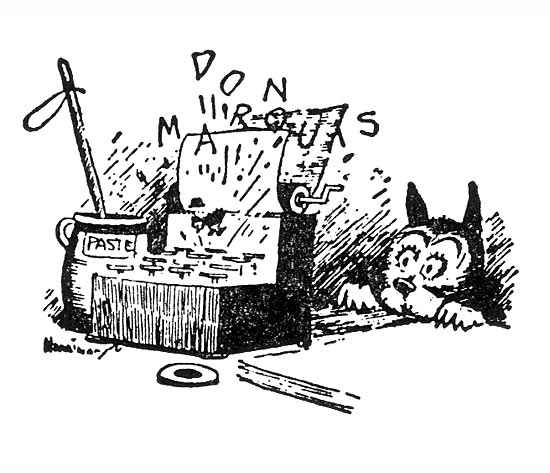
Amba adds: "I wonder if they aren't the same person, though, and 'Archy' is a clue." She's thinking -- I happen to know -- of archy of archy and mehitabel, the literary creations of Don Marquis:
Archy is a cockroach with the soul of a poet, and Mehitabel is an alley cat with a celebrated past -- she claims she was Cleopatra in a previous life....

"expression is the need of my soul," declares Archy, who labored as a free-verse poet in an earlier incarnation. At night, alone, he dives furiously on the keys of Don Marquis' typewriter to describe a cockroach's view of the world, rich with cynicism and humor. It's difficult enough to operate the typewriter's return bar to get a fresh line of paper; all of Archy's dispatches are written lowercase, and without punctuation, because he is unable to hit both shift and letter keys to produce a capital letter.

"boss i am disappointed in some of your readers," he writes, weary of having to explain the mechanics of his literary output. " ... they are always interested in technical details when the main question is whether the stuff is literature or not."
Marquis' George Herriman's ink drawings are sublime. See, here is archy putting in the immense athletic effort needed to type a short column:
Now, blogging cockroach is surely a tribute to Marquis' archy, and we appreciate his explanation of the the mechanics of his literary output by computer even as we contemplate whether the stuff is literature or not. (Perhaps someone can make a drawing in the Marquis style of blogging cockroach at the computer or photoshop this drawing somehow.)

But Amba's question is whether Sir Archy is named to connect him to the cockroach. (Bonus points if you you do that drawing/photoshop and replace mehitabel with Sir Archy.) Are these writers one and the same (and, if so, are they also anybody else that we see around here)?

Well, the cockroach saw Amba's musings and dropped by the comments thread. Here is what he wrote:
well all i can say is that there are some
advantages to being a cockroach
one of them is i don t have to worry
about my hair or clothes anymore

having the transmigrated soul of a composer
i can look back at all the troubles i had
when i was a music professor
to buy the right suits and keep my shirts ironed etc
in those days they paid us a pittance
and so i drove a 56 studebaker
but had to wear a suit on campus every day
which cost me as much as the damn studebaker
i hated clothes
not to mention haircuts
i was actually kinda glad to go bald
except maybe for the combover
which frightened away my female students
damn
but now i don t worry about any of that
and other than molting now and then
life is simple
and i sure don t want to mess it up
with a powdered wig

but having spent a little time
on the astral plane myself
i can tell you archy s right about seances etc
you just settle in and some idiot
comes and bothers you
about something really stupid
reminded me of office hours
anyway one day my ex wife showed up
wondering where the key to the
safe deposit box was
now some exes hire private detectives
but mine hired a medium
tells you a lot
anyway i screamed let me out of here
let me slouch somewhere to be born
and presto the next ticket said

cockroach
cambridge mass

so here i am
maybe i ll tell you about the safe
deposit box next time

So here's another clue for you all:


Plus, cambridge mass... Harvard/MIT? Some bald professor with a penchant for nudism?

ADDED: And at last night's Crossroads Café, Chip Ahoy said:
What I know about the Kennedy administration was learned by reading.

Smithsonian used to be so interesting. My favorite part was letters from the readers remarking on articles. What an erudite bunch. It ran a couple of pages. Then they got another new editor who cut that section back to just a few letters and to about half a page. That told me all I needed to know about the new editors attitude toward his readers.

Then they ran an article in relation to the John Kennedy assassination anniversary. Readers were asked where they were when the event occurred. That series of letters then ran for several pages. All the remarks were about how glorious the age of Camelot was, how idealistic, youthful, energetic, positive, and optimistic everyone was. How amazing incredibly beautiful the time was. Every single one glowed with praise and rued a lost past.

Except for one. A response from Tom Clancy. He had a wee on their little party. He remarked the administration wasn't all that remarkable. He reminded readers of several notable failures and obvious shortcomings. He suggested had the administration lasted, it would not be remembered so fondly. This caused me adore Tom Clancy, even though he's a schmuck.

I was so put off by the whole thing, the rebuff to the readers, the hard leftist turn, the ceaseless pontificating, the whole desktop publishing look, I ended the subscription I held since junior high school.

It occurred to me though, reading through all those responses, those writers, were recalling an idealized, sanitized youthful optimism -- their own youths. Their optimism was entirely of their own making and had little to do with facts on the ground. As is their present pessimism.

And now, I'm seeing that phenomenon occurring again right before my eyes. I'm going to enjoy this. As an observer. But this will not affect my own naturally occurring cheerful optimism nor my own self-indulgent satanic pessimism. I'm just going to watch my wonderful country, the less wonderful world, willfully create their own optimism. Myth making. That's what is happening. Observe a new myth. This is how it's created. Begin by overlooking faults, dismissing them, excusing them. Next exaggerate any gain, whatever actual good there is, suddenly is really REALLY, REALLY everlastingly good. Yay! Dance! Glee! Canonize! Deify. Mythologize. Expect comparisons to Camelot, and know then you're in the arena of myth. But know also, this is all occurring within the minds of the mythologists.

But know also, optimism is very real. Just as real an uplifter as pessimism interprets into very real and actual drag. Therefore, I choose to enjoy the optimism in my fellow Americans, no matter how ridiculous it is. I could go for another Camelot myself, even though I know it's all occurring entirely within the minds of all you silly dumkopfs, present company excepted, of course. I vastly prefer my fellow citizens as silly little shits, than as obnoxious unbearable cnuts. <--- See what I did there? Letter transposition. Disguises a word unacceptable in polite mixed company, one worse even than the s word before it. This completes my remarks about ridiculously delusional self-constructed optimistic mythos. And now for something entirely different. Here's what I made for lunch.

Sorry you couldn't be here, I'm sure you'd have been wonderful lunch dates.
Go to Chip's lunch link for all the steps, but here's his last pic:


That brought the cockroach over:
yes chip ahoy that was a beautiful lunch
i adore hummus
if you don t eat those lettuce leaves completely
and leave the remains on the plate
or better yet drop one on the floor
well i ll have a beautiful lunch too

now about the beautiful
kennedy administration
i was a young grad student
when camelot happened
the main thing i remember
is seeing kennedy getting off
an airplane looking really snappy
or hot as they say today
and thinking man that guy
must get some action
then i thought naw
he s the president of the u s
that s really sick to think those thoughts
hoo boy was i wrong
And here's what Tom Clancy wrote:
I never voted for the guy. I was only 13 when he got elected. I was a junior in high school when Kennedy got whacked. I was in the Waverly Theater on Green Mount Avenue in Baltimore watching Shirley MacLame and Jack Lemmon. I had a half-day of school. It was a Friday. I heard it on the way coming out of the movie. The ticket-taker said the president got shot. Then followed four days of nothing but a dead president. They didn't even show the Colts play. He was the president of the United States, so I didn't want him murdered. I wanted him to lose the next election. I mean, what did he accomplish? He has been canonized by the media, which I think is a bit unseemly. He was a handsome guy. He had great style. He meant well. It was Lyndon Johnson who got the civil rights movement rolling. He was a patriot and he put his life at risk in World War II, and that's something to be admired, but I don't see anything historically significant that he did other than the space program. For the space program, I'd buy him a beer.

ADDED: Thanks to Jeff with one "f" for correcting me about the ink drawings. I love George Herriman -- and even blogged about him back here. Mehitabel's resemblance to Krazy Kat is clear... clearer than Sir Archy's resemblance to blogging cockroach.

AND: Dear, sweet Palladian has sent me the illustration I wanted!

Thursday, September 25, 2008

"The tattoo community sees them as posers. It’s like going out in the 1960s to buy a Beatles wig."

Said Bob Baxter, the editor of the tattoo journal Skin & Ink, of people who get hand or neck tattoos before they've inked up the rest of their bodies.

Why I love this quote:

1. Everything's a "community" these days. There's no escape. The tattoo community. The rugged individualist community. The loner community.

2. Who knew you had to earn your neck tattoo? I'd have thought getting a neck tattoo as opposed to, say, one of those peeping-over-the-pantyline tattoos was a real demonstration of commitment. Ten (or more) years ago I stood in line at the University Bookstore behind a pretty young woman who had a tattoo on her neck of an old-fashioned, claw-footed bathtub -- complete with the extended pipe and shower-head. "Poseur" is not the word that crossed my mind.

3. The simile. It's so inapt! The whole point of a wig is that you don't have to have the hair. It's the equivalent of a fake tattoo. But in another respect, a wig is out there. What man dares to wear a wig? Look at all the men who, balding, shave their heads. They miss their hair, but they still won't wear a wig. In the 60s, guys who wanted the Beatle look but needed a professional style some of the time would comb the front part down as well as they could and not go so long that they couldn't comb it up and over.

4. When I think of an actual wig, I think of Andy Warhol -- look at him here. He was doing something men still won't do. I know there are men who dress up like women and use lady's wigs for that, and there are plenty of women who rely on wigs, but where is the men in men's wigs community, eh?

Sunday, September 21, 2008

Why men shave their heads.

Christina Reihill writes:
While the idea of the modern man as a hairless metrosexual more interested in manicures than motors challenges my notions of a heterosexual man, I'm more interested in the state of play between the sexes in our hyper-sexualised, pornified culture.

As young girls are told that it's empowering to pursue men aggressively and young men are learning to lie back and take it, I wonder how these acts of aggressive connection affects the psyche....

On Freud's map, this redefining of male sexuality could be seen as men searching for the mother in them and/or acting out their sexual envy towards woman.

Just as women express penis envy, is this men saying we're not lying back and taking it?

What are we watching and possibly not seeing in the bald head, bullet-proof imagery in today's "anything goes" culture? What is the symbolism in men shaving their heads?

Staying with Freud and his symbolic grammar -- the head represents the penis, while head hair is recognised as semen.

Extending the logic of these associations, long hair expresses unrestrained sexuality, while hair removal makes a statement around sexual restraint, as in celibacy or castration.
What is restrained about exposing the penis? You had to do that hair=semen move to make this theory work.

Sunday, July 13, 2008

So here's the new New Yorker cover.


Get it?

Obama says:
"I have no response to that."
The campaign adds:
The New Yorker may think, as one of their staff explained to us, that their cover is a satirical lampoon of the caricature Senator Obama's right-wing critics have tried to create. But most readers will see it as tasteless and offensive.

And we agree.

The artist is Barry Blitt, and I have to say that I think the cover is a hilarious spoof of the fears and lies about Obama. Michelle and Barack are in the Oval Office, doing a celebratory fist bump. There's an Osama Bin Laden portrait on the wall and a burning flag in the fireplace. He's a Muslim and she's a revolutionary. Of course, Obama has to push it aside and can scarcely laugh about it.

Or, maybe, I don't know... maybe it would work to laugh. He's been awfully uptight about things lately. And laughing conveys the instant recognition that it's absurd. Why be surly about it? McCain's supposed to be the cranky guy...

IN THE COMMENTS: ricpic says:
Fears and lies my foot!

The dead on truth about these two America haters.

Congrats Blitt.

And congrats to the Hillary camp inside The New Yorker.
It's that last line that's making me frontpage this.

ADDED: Taylor Marsh asks whether The New Yorker would treat John McCain the same way:
Picture a drawing showing a very old man in a wheelchair, his hospital gown adorned with medals... babe of a wife pushing him, as his first wife wipes drool off of McCain's mouth... while Cindy McCain stops to open packages from Chanel. No, I didn't think so either.

Wait. Who's the "babe of a wife" if not Cindy? I don't get the specifics, but I see the point. I think it would be out of bounds because it would be so unappealing. The New Yorker doesn't put drooling disabled persons on the cover. And the Michelle and Barack image has a transgressive, radical chic edge to it, that I suspect excites the magazine's audience.

IN THE COMMENTS: Christopher Althouse Cohen said (about Obama):
He's always been dead serious about everything. Has he ever said anything funny?
Perhaps not. Did you notice how unamused he looked in that interview in which his daughters were so lighthearted? Remember when he got pissy about Maureen Dowd saying that his ears stick out? ("I just want to put you on notice... I was teased relentlessly when I was a kid about my big ears.") His supporters may picture him bringing a youthful spirit into the White House, but look at him. He's actually quite stodgy and censorious. Turn off that television.

Now, this will constitute the "turning the page" that people seem to want so badly, since George Bush likes to joke around. The George Bush page was pushing the envelope. (Is that a mixed metaphor?) I still can't get my mind around the picture of him saying "Goodbye from the world's biggest polluter" and then "punch[ing] the air while grinning widely, as the rest of those present including Gordon Brown and Nicolas Sarkozy looked on in shock."

Victoria writes:
[Obama] doesn't poke fun at himself, doesn't use a light touch in his speeches, doesn't seem relaxed at the podium EVER.

It's gotten so that I wonder how he will acquit himself at the annual Smith Dinner....

I can't imagine, simply cannot for a second imagine Obama making fun of his background, his race, or mention his pastor and his rants during the Al Smith dinner.

What a dour, touchy time we will have, if he's elected.
Blake said:
Nah. He'll be the Margaret Dumont to our Marx Brothers.

He'll have a terrible time, tho'.
Good point! He'll be great fun for the comedians. He's a perfect straight man.

Paco Wové said:
When I saw it, I rolled my eyes and thought, Oh, God, it's the New Yorker trying to be all transgressive again....

Oh, yeah, remember all the mileage they got out of this:


From an interview with Spiegelman:
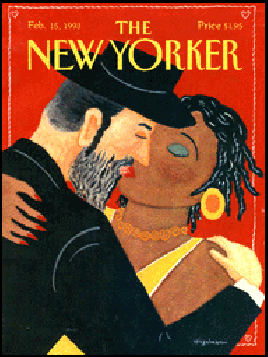
Q: [O]nyour controversial 1993 Valentine's Day New Yorker cover in which, during the conflict between Hasidim and African Americans in Brooklyn, you portray a Hasidic man and a black woman embracing. Values and worlds colliding, meeting.

AS: It didn't come as a shock to me that this got people to sit up and take notice. I'm interested in visual signs...

Q: How does that apply to the New Yorker cover?

AS: The signs are highly recognizable. The sign for Hasid is clear and unavoidable, without the usual anti-Semitic physiognomy that goes with it. The sign for African-American woman is equally unavoidable, without entering into Aunt Jemima stereotypes or anything of the kind. Then there's this other sign that has to do with the Valentine's Card-the kiss, the field of red with the lacy decoration around it, all of it weaving together separate meanings. The irony is you have these two groups that are at each other's throats at each other's lips instead. That's supposed to conjure up carnality and yet Valentine's Day, the image of Valentine's Day, isn't about carnality but a kind of benign romantic love. All those things course through this image and the impossibility of it is what's so entertaining for me. What got people most upset that week was not other magazines with the usual S&M imagery-chains and whips, leather and hurt-but something quite benign on the surface, playing with signs. Reverend Dougherty, a representative of the black community in Crown Heights, was very upset I used a black woman: one more time, he said, a white man was oppressing a black woman. Why didn't I have a black man and a Hasidic woman, he asked on the radio. Maybe he's a good reverend, I don't know, but he's a rotten art director. A Hasidic man is a lot easier to recognize than a woman with a handkerchief on her head. In terms of visual signs you've got one thing that works and one thing that doesn't. Even more important, I answered him, if I had used a black man and Hasidic woman, you'd be complaining I was once again showing the black man as a rapist and defiler of white woman. This shows me the problem has nothing to do with the signs being shown but the reverberation of those signs in people's heads. The same thing happened in op-ed articles. There was an op-ed in the New York Times in which a woman who was very upset about the New Yorker cover writes about the Jew's lascivious lips. Another person, equally upset in the Washington Post, described the Jew's prim lips. Now you know I can't draw lips that are simultaneously lascivious and prim; I'm limited.

Q: Sure you can.

AS: I did. I just drew lips.

Speaking of reading the signs, and back to the comments, George says:
He's wearing a dress.

She's in pants.

And if you hold the cover up to a mirror, it reads 'Rekroy Wen' which means "Kill Whitey" in Tshivenda, the language of Barack's homeland.

The cover date "July 21" is the anniversary of the founding the KIPRP, the Kenyan Islamic People's Revolutionary Party.

He's also crushing the throat of a bald eagle.

Wake up, America!!

Monday, July 7, 2008

What do we know about Barack Obama, the "community organizer"?

I'd really like to understand more about what Barack Obama did under the heading "community organizer," so I jumped to read the front-page NYT article by Serge Kovaleski, "In Organizing, Obama Led While Finding His Place."
The year was 1985 and Gerald Kellman, a community organizer, was interviewing an applicant named Barack Obama to work in the demoralized landscape of poor neighborhoods on this city’s South Side...

It is clear that the benefit of those years to Mr. Obama dwarfs what he accomplished. Mr. Kellman said that Mr. Obama had built the organization’s following among needy residents and black ministers, but “on issues, we made very little progress, nothing that would change poverty on the South Side of Chicago.”
The article calls attention to a deficiency in Obama's memoir:
Mr. Obama recounted that he helped arrange a bus trip to the housing authority headquarters where residents [of the Altgeld Gardens housing project] had demanded a meeting with the executive director and a pledge that residential units would be tested for asbestos. As television cameras rolled, the residents were promised testing and a meeting.

“I changed as a result of that bus trip, in a fundamental way,” Mr. Obama wrote. It was the kind of action that “hints at what might be possible and therefore spurs you on.”

What Mr. Obama does not mention in his book is that residents of the nearby Ida B. Wells housing project, and some at Altgeld itself, had already been challenging the housing authority on asbestos. A local newspaper had also taken up the issue....

Hazel Johnson, an environmental activist at Altgeld, said that she started to raise the asbestos issue with the housing authority in 1979, but that it had failed to act. Ms. Johnson and [Linda] Randle pointed out that only some of the asbestos was removed from pipes at Altgeld, but not until 1989, a year after Mr. Obama left for Harvard. (An Obama campaign spokesman, Ben LaBolt, said, “The book is meant to be an autobiography about Obama’s experiences, not a history of social and environmental activism in Chicago.”)

Meanwhile, the residents’ meeting with the housing authority’s executive director was a debacle, an illustration of the setbacks faced by Mr. Obama and other organizers.
You can read the description of the debacle in the article.
Mr. Obama had risen to executive director of the Developing Communities group, but the demanding hours, small victories and low pay took a toll on him, and he decided to leave.

“ ‘We are not making large-scale change, and I want to be involved in doing that,’ ” Mr. Kellman said Mr. Obama had told him....

Mr. Obama had mused to friends in Chicago about one day working for unions or becoming a preacher, a journalist or even a fiction writer. While there, he wrote short stories based on people he had encountered. “The stories were beautifully crafted and evocative,” said Mr. Kruglik.
A preacher, a journalist, or a fiction writer? All of those things — along with politics — have to do with crafted and evocative language. It sounds as though Obama learned what he core skill was and — I'm guessing now — realized he operated better at some distance from the raucous, demanding people.

I'd love to see the transcript of Kovaleski's whole interview with Kellman. What details underlie the phrase "took a toll on him"?

Here's an article covering much of the same ground that ran in The Nation in April 2007:
After a transient youth and an earnest search for identity, Obama also found a home--a community with which he continued relationships, a church and a political identity. He honed his talent for listening, learned pragmatic strategy, practiced bringing varied people together and developed a faith in ordinary citizens that still influences his campaign message. He discovered the importance of personal storytelling in politics (and wrote short stories that refined his style).
Please, can we read the stories?
Often by confronting officials with insistent citizens--rather than exploiting personal connections, as traditional black Democrats proposed--Obama and DCP protected community interests regarding landfills and helped win employment training services, playgrounds, after-school programs, school reforms and other public amenities....

But Obama grew restless and eventually went to Harvard Law School. "He said you can only go so far in organizing. You help people get some solutions, but it's never as big as wiping away problems," says Michael Evans, a DCP organizer after Obama left. "It wasn't end-all. He wanted to be part of the end-all, to get things done."....

Obama's politics of transcendent unity, which has appealed to many voters, has its roots in his work as a "bridge builder," in the words of the Rev. Anthony Van Zanten, overcoming the gulf within DCP between Catholic and Protestant churches. But this vision of harmony also reflects Obama's distaste for conflict.

"Personality-wise, Barack did not like direct confrontation," Kellman says. "He was a very nice young man, very polite. It was a stretch for him to do Alinsky techniques. He was more comfortable in dialogue with people. But challenging power was not an issue for him. Lack of civility was."

Obama's organizing history may give few clues about what policies he would pursue as President, but Obama the presidential candidate still shows his roots--a faith in ordinary citizens, a quest for common ground and a pragmatic inclination toward defining issues in winnable ways.
ADDED: And here, literary critic Andrew Delbanco opines on Obama's writing style. (It was worth writing this article if only to use the great title: "Deconstructing Barry.") Quoting a passage from "Dreams From My Father," he says:
This is a young writer (he was around 30 when he wrote Dreams) strutting his stuff. Sometimes he overwrites, as when he describes police cars cruising past groups of sullen black teens in "barracuda silence" or compares a row of scrappy trees to "hair swept across a bald man's head." He has a habit--almost a tic--of throwing in a cinematic flourish when none is needed: "a spotted, mangy cat" runs among weeds with a crumbling housing project in the background; a torn poster-photo of the recently dead Chicago mayor, Harold Washington, tumbles down a windswept street.
Yes, reading the book, I was often distracted by the thought that it was "creative writing." But Delbanco likes the book, in which he detects "a theme... the fall from paradise." There is the race-blind childhood in Hawaii and the gradual detection of the role played by race.

Delbanco moves on to "The Audacity of Hope":
[T]he voice of the writer is fundamentally the same as the one we hear in Dreams. There is the same internal counterpoise in the sentences: "Most evangelicals are more tolerant than the media would have us believe, most secularists more spiritual" ... "most rich people want the poor to succeed, and most of the poor are more self-critical and hold higher aspirations than the popular culture allows." When he scans the human landscape, Obama tends to notice contradictory individuals more than coherent interest groups....

This is the writing of someone trying to map a route through a world where choices are less often between good and bad than between competing goods. Though it lacks the sensual immediacy of the earlier book, the language is open and unresolved, the sentences organized around pairs of sentiments or arguments that exert equal force against each other--a reflection of ongoing thinking rather than a statement of settled thoughts.