Pages

Labels

Showing posts with label gold. Show all posts

Friday, January 11, 2013

"The Charmin corporate Twitter account got in on it with a surprisingly trenchant commentary on the disposability of American currency."

That's the way Slate — displaying the winners of its design-a-$1-trillion-coin contest — refers to the symbolism here:


"Surprisingly trenchant commentary." Come on! I like delicate toilet paper, but why the delicacy talking about toilet paper? What, exactly, is the commentary? I assumed it was: American currency is something you may as well wipe your ass with. But then I thought the idea was: Uh, oh, we just pooped ourselves.

Maybe you're wracking your brain for a way to use the old "Don't Squeeze the Charmin" slogan, but that was the 1960s. The current slogans — if I am to believe the Charmin Wikipedia page — are: "Enjoy the Charmin experience" and "Enjoy The Go." Enjoy the go?! Put that on the coin. Hell, make that the national motto. "In God We Trust" is getting old. It's divisive. And, frankly, it's unfair to God.

"Enjoy the Go"... I looked it up to see how they were playing this slogan in the commercials:


The relief. The calm. The clean. The comfort.

See? That's the way you'll feel after that $1-trillion is deposited in the toilet bank. This image evokes Sigmund Freud:
Freud suggested that children in the anal stage of development regard the release of their feces as a gift to the parent — a gift that can be given or withheld. Children will release the feces if given sufficient love and withhold them if not. In Freudian thought, fecal matter becomes a type of currency in the parent-child relationship, which can be withheld or dispensed, thus giving the child a sense of control. The word currency is appropriate in this context; Freud assumed that the human unconscious makes a symbolic equation between feces and money. In a 1911 paper on dreams in folklore, he noted that according to ancient Eastern mythology, “gold is the excrement of hell” (Freud & Oppenheim, 1911/1958, p. 157).
Hell!

(I'm riffing on the toilet paper topic topic Meade introduced late last night. That was Meade — did you notice? — not me.)

Monday, August 29, 2011

At the Glittering Water Café...


... you can sparkle all night.

ADDED: Chip Ahoy adds a Rocky touch...


... a double Rocky touch, right? I see 2 pop culture references.

Friday, September 25, 2009

"People laugh at metal detectorists. I've had people go past and go, 'Beep, beep, he’s after pennies.' Well no, we're out there to find this kind of stuff, and it is out there."

Terry Herbert, the greatest detectorist of them all.
Since the July day when his detector picked up traces of the hoard beneath a field in Staffordshire, a Midlands county that was at the center of the ancient Anglo-Saxon kingdom of Mercia, Mr. Herbert said, he has been seeing piles of gold in his sleep. Awake, he has quietly celebrated his triumph over all the people who mocked him in the years when a typical day’s finds amounted to little but scrap....

He said that on the day of his discovery he reworked a mantra that he regularly used for good luck. “I have this phrase that I say sometimes — ‘Spirits of yesterday, take me where the coins appear’ — but on that day I changed ‘coins’ to ‘gold.’ I don’t know why I said it that day, but I think somebody was listening.”


Thursday, July 2, 2009

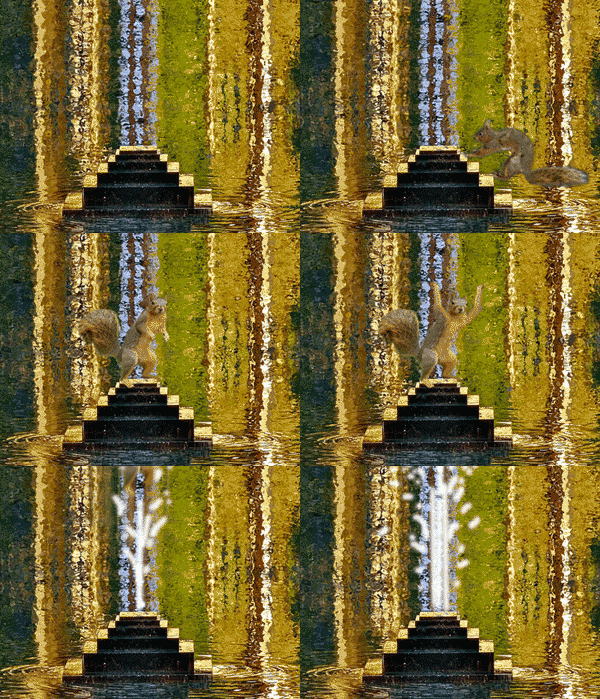
At the Golden Reflection Café...

Pavilion reflection

... your thoughts are mere fluff sitting lightly on water.

Monday, December 22, 2008

"We, the miners of Waldo and Althouse in Oregon Territory, being in convention assembled..."

"... for the purpose of making rules to regulate our rights as miners, do hereby on the first day of April, 1852, ordain and adopt the following rules and regulations to govern this camp":
That 50 cubic yards shall constitute a claim on the bed of the creek extending to high water on each side.

That 40 feet shall constitute a bank or bar claim on the face extending back to the hill or mountain.

That all claims not worked when workable, after five days, be forfeited or jumpable.

That all disputes arising from mining claims shall be settled by arbitration, and the decision shall be final.

Thursday, October 9, 2008

The Gold Liquid Café.

DSC_0283_2_2

It's time to unwind. Drink something gold. Tell me what you're thinking about.

Friday, July 14, 2006

"It's a large, hallucinatory square of spectacular gold filigree."

"Adele looks almost as if she has inserted her head into one of those carnival cutouts, her thin face partly cast in shadow, obscured by the glare. Her lips are parted, eyelids heavy, cheeks pink."

The Klimt portrait of Adele Bloch-Bauer is now on view at the Neue Galerie.

That description gives me an idea for a new effect that could be added to Apple's Photo Booth, which currently allows you to take a picture of yourself -- as you idle away the minutes in front of your computer -- with an effect like this:

Photo Booth

Monday, June 19, 2006

The most ever paid for a painting: $135 million.

And it's for a Klimt painting. A Klimt! I mean -- wow! -- it's pretty. Look at all the gold.


Museum Associates/Agence France-Presse - Getty Images

Speaking of prettiness, the purchaser's money comes from cosmetics.

Actually, the purchase and the price make a lot of sense. The buyer, Ronald S. Lauder, is the founder of the Neue Galerie, "a tiny museum at Fifth Avenue and 86th Street devoted entirely to German and Austrian fine and decorative arts." The painting exactly fits the place and is one of the artist's greatest paintings. Lauder had to convince the owner to sell. And the owner, the niece of the woman in the portrait (Adele Bloch-Bauer), fought a long and hard to obtain the painting from the Austrian government, which, she successfully argued, had obtained it by way of the Nazis.

Friday, August 26, 2005

Sunday, May 9, 2004

Look, $17,000 flip-flops.

This is not some satirical piece about a gift Teresa Heinz Kerry could buy for her husband, it's an actual pair of diamond and gold flip-flops, pictured in a NYT article about how interested people are these days in really expensive luxury goods.


But actually, the store that sells the flip-flops only has one pair like this, and the rest, of which there are only a few, are more in the $3,000 price range. And really, these shoes cost no more than the price of an ad in the NYT. So they don't even need to be sold: they worked to get a write-up in the Times--and they'll keep working, attracting people into the store to look at them. The store never needs to sell them--and it can even retrieve the gold and diamonds in the end. And if someone ever does buy them, it won't be because they are addled by dollar signs, it will be because they are entranced and amused by them sort of like the way people feel about this.


But maybe you aren't amused by Meret Oppenheim's Fur-lined Teacup. And maybe you actually do want some expensive shoes. Surely, you don't want diamond and gold flip-flops! May I suggest the most beautiful shoe currently available:


Sunday, February 22, 2004

More on the gold and sandstone analogy. My son John writes:
You wrote: "Gold is, obviously, not like marriage, because people have an interest in accumulating quantities of gold, but each person can only have one other person in the marriage market."

Well, let's assume for the sake of argument that we are interested in viewing marriage in terms of possibly "devaluing marriage" in some kind of a quantitative way. (I don't agree with this quantitative way of looking at marriage, but if that's what people like Banuchi want to do, then they should be argued with on those terms.) In that case, not only you are you right that gay marriage wouldn't seem to devalue marriage very much, but couldn't we also say that divorce devalues marriage a lot more? 50% of marriages end in divorce, so I assume that the number of divorcees is much larger than the number of gay married people that there would be if gay marriage were legal. Now, let's assume for the sake of argument that divorce and gay marriage are equally severe breaches of Traditional Morality. We would then need to say that divorce threatens marriage a lot more than gay marriage would. You said that "each person can only have one other person in the marriage market"--well, this doesn't quite apply to divorce, since one person can get divorced many times. If someone gets divorced five times, then that person has chipped away at the institution of marriage five times; this is in contrast to the gay person who gets married once, thereby chipping away at marriage only once.

(Maybe gays would be more likely to get divorced, because they're radicals who want to erode traditional institutions. Or maybe they'd be less likely to get divorced: maybe they'd value marriage more, in the way that someone living in the desert for years might go on to value water more than other people do. This is an empirical question that we don't yet have the data to answer.)

...So, anyway, my point is that the true conservative who genuinely wants to speak in quantitative terms about preserving the puritanical monolith called Marriage should be focusing on the current horrors of divorce instead of the potential dangers of gay marriage. (None of this matters anyway, since marriage doesn't work like gold, for the reasons you pointed out. But the conservatives should be argued with on their own terms.)
Great points. Let me add that anyone who invoke the Traditional-Morality-Attack-On-Marriage argument has a real problem if they say it's okay to make an exception in the case of divorce but not okay to make another exception. You can't rest very solidly on a foundational principle if you tolerate exceptions for the things you and the people you identify with might want to do and then refuse to make exceptions for the things that only other people might want to do. That is the most unprincipled thing of all. Better to be completely flexible than to stand on inflexible principle only when it serves your own purposes.

Saturday, February 21, 2004

What do you want, a medal? Let me offer Banuchi a more apt analogy than his gold and sandstone, so it will make more sense to be concerned with how government labels something: marriage is like a medal. If the government had a medal that had previously been given only to soldiers who had been wounded in battle while saving the life of another, and it then starts giving the medal to all soldiers wounded in battle, the soldiers who met the higher standard would suffer a devaluation of their medal.

But why should government be involved in giving out medals for the quality of our personal relationships? But let's say we think that government should be giving out medals to honor people's relationships and that marriage is the highest honor to be paid. Shouldn't government have to apply a more substantive standard for handing out honors than just the sex of the proposed recipients? Government does not and cannot examine what is really deeply valuable about a relationship. That would be an outrageous intrusion. All that is left then is to honor people because of their genitalia.

So the new analogy--which I think is better than any other analogy I've seen--is also defective. The devalued medal had once designated a particularly worthy performance in battle, and now no longer communicates that the person who received the medal had that additional distinction. The label marriage, when restricted to different sex couples, isn't needed to communicate that a couple in fact has the distinction of having two kinds of genitalia. If people could marry without the two sex requirement, we'd still be able to detect which couples met the man + woman standard. What we would lose is the government's expression of the belief that higher honor is due. People need to think clearly about not just whether that belief is correct but about whether government ought to be expressing it.
For the annals of bad analogies. After the NYT wrote an editorial favoring gay marriage, the Executive Director of the New York Christian Coalition, Rev. Bill Banuchi, wrote in to offer an analogy to show how recognizing gay marriage hurts traditional marriage:
If I have an ounce of gold and the government suddenly announces that sandstone will now be called gold and valued equally, what will happen to the value of my gold? It will crash, and so will the economy.

So will it be with gay marriage. Marriage will be further devalued, and so will our entire social order.
I suspect the Times chose this letter because it is such a monumentally bad analogy. Gold is, obviously, not like marriage, because people have an interest in accumulating quantities of gold, but each person can only have one other person in the marriage market. Once you have your one, you have no interest in whether someone else also has one. You have no interest in maintaining the scarcity of marriage, because there is no less value in your relationship to another person if other people also have relationships. In fact, you're better off if other people are also securely paired off, because then rivals for your spouse are less likely to interfere with your relationship. Preserving the scarcity of a traded good like gold may bolster its price, but there is no equivalent point where you "sell" your marriage.

Banuchi's attitude toward government labeling also doesn't make sense. If the government were to say "sandstone will now be called gold and valued equally," as long as I could see the two products and choose my vendor, I would still buy the real gold. Who would buy sandstone at the price of gold? In fact, people would stop buying sandstone at all if government fixed its price at the same level as gold! If somehow people did want to buy sandstone at the price of gold, it must be because they have found some amazing quality to standstone that inspires them to buy it. Thus, Banuchi may think that a gay relationship is like a worthless stone compared to gold, but if people are choosing it over heterosexual marriage when both impose the same obligations, it must be because they have found real value in it. It would not be the government labeling that caused that value to come into being, but the experiences of the people engaging in the relationship.

UPDATE: If you read this earlier, you might have seen that I had "diamonds" instead of gold at one point. That was caused by bad editing. I was going to offer Banuchi the tip that he'd have a better analogy if he used diamonds and cubic zirconium instead of gold and sandstone, because there would be some potential to mistake one for the other. That got too complicated and I'd meant to take it out. Sorry.