

"He felt he was preparing them for the future; they might need such verses later in life. His own biography provided a stirring example of the virtues of mental husbandry. He’d been grateful for every scrap of poetry he had in his head during his enforced exile in the Arctic, banished there by a Soviet government that did not know what to do with his genius and that, in a symbolic embrace of a national policy of brain drain, expelled him from the country in 1972."
From "Why We Should Memorize," by Brad Leithauser.
(In 1972, Brodsky became the poet in residence at the University of Michigan. I was a student there at the time and remember a grand assembly with Brodsky received as a great hero.)
Showing posts with label memorization. Show all posts
Showing posts with label memorization. Show all posts
Saturday, January 26, 2013

Monday, May 21, 2012
"Friends, Romans, countrymen..."
This amused me. Cowboy style. I ran across it because I was looking for the text to the famous Mark Antony speech, which I'd been forced to memorize in junior high school, many decades ago. (Here's Marlon Brando doing it, not amusingly.) And what got me testing my own memory was something I'd just read about Barack Obama, which someone had emailed me, a propos of the recent "born in Kenya" dustup. It's a GQ article from November 2009 called "Barack Obama's Work in Progress."
And would you put your hand on your heart? (Cf., Obama not putting his hand over his heart during the National Anthem.)
Back to GQ:
Many women loved this Senator from Minnesota, who challenged LBJ in 1968, and the poetry was part of it. My maternal grandmother loved him because he was a poet. 1968 — there was a year. Bobby Kennedy pushes Senator McCarthy — the good Senator McCarthy — aside, LBJ declines to run, Martin Luther King is shot down, 2 months later Bobby follows him, and Nixon becomes inevitable.
By the way, speaking of MacBeth and LBJ, they made a play back then: MacBird!

The playwright, Barbara Garson said:
Over the past few years, we’ve gotten to know our president as a lot of different things: campaigner, lawyer, father, basketballer. But what if Obama’s first and truest calling—his desire to write—explains more about him than anything else? Robert Draper recounts the untold story of the first man since Teddy Roosevelt to serve as author in chief.I haven't combed through that whole article looking for the Kenya connections, but I noticed this bit about Shakespeare:
Sometime in 2002, the young state senator pays a daytime visit to the Chicago Shakespeare Theater. The artistic director, Barbara Gaines, is happy to show the politician around. Watching the carpenters erect the set, he asks Gaines which play is about to be performed. “Julius Caesar,” she tells him.Now, wait a minute. Who, upon mention of "Julius Caesar," doesn't start going "Friends, Romans, countrymen, lend me you ears..."? If it was some other 20 lines from the play, I might be impressed. The fact that he went on for 20 lines is sort of cool as a demonstration of memory. It's more than I can do without missing some words, but then, I learned it during the LBJ administration. But who goes on for 20 lines, putting on a memory show? Maybe you would if you saw that you were getting the director of the Chicago Shakespeare Theater agog.
At first, Obama doesn’t say anything. Then, in a very soft voice, he begins to recite some twenty lines from the play. As he does so, he places his hand on his heart, as if stricken by the words’ transcendent beauty.
The director is agog. She has never heard an elected official quote Shakespeare in such a way.
And would you put your hand on your heart? (Cf., Obama not putting his hand over his heart during the National Anthem.)
Back to GQ:
Later, she tells a co-worker, “I just had the most amazing experience. I met the first politician to have the soul of a poet.” (The first, she means, since Abe Lincoln, who quoted lines from Macbeth less than a week before his assassination: I think our country sinks beneath the yoke…)The soul of a poet. Doesn't anyone remember Eugene McCarthy?
Many women loved this Senator from Minnesota, who challenged LBJ in 1968, and the poetry was part of it. My maternal grandmother loved him because he was a poet. 1968 — there was a year. Bobby Kennedy pushes Senator McCarthy — the good Senator McCarthy — aside, LBJ declines to run, Martin Luther King is shot down, 2 months later Bobby follows him, and Nixon becomes inevitable.
By the way, speaking of MacBeth and LBJ, they made a play back then: MacBird!
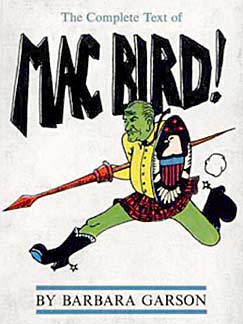
The playwright, Barbara Garson said:
"People used to ask me then, 'Do you really think Johnson killed Kennedy?'... I never took that seriously. I used to say to people, 'If he did, it's the least of his crimes.' It was not what the play was about. The plot was a given."
Thursday, July 14, 2011
Obama lied about a central fact about his own life which he used — powerfully — to push health care reform.
"Book Challenges Obama on Mother’s Deathbed Fight," says the NYT, which, of course, isn't generally inclined to cast unnecessary aspersions on this President. "Lied" is my paraphrasing. The NYT wrote "mischaracterized."
Fake false but accurate?!
But I don't accept that the President could have an innocently false memory about this story, which he milked dramatically, as Byron York describes here:
During his presidential campaign and subsequent battle over a health care law, Mr. Obama quieted crowds with the story of his mother’s fight with her insurer over whether her cancer was a pre-existing condition that disqualified her from coverage.The book came out in early May. The reason this article is hitting the front page today is that the NYT has been trying to extract a response from Obama.
In offering the story as an argument for ending pre-existing condition exclusions by health insurers, the president left the clear impression that his mother’s fight was over health benefits for medical expenses.
But in “A Singular Woman: The Untold Story of Barack Obama’s Mother,” author Janny Scott quotes from correspondence from the president’s mother to assert that the 1995 dispute concerned a Cigna disability insurance policy and that her actual health insurer had apparently reimbursed most of her medical expenses without argument....
On Wednesday, in response to repeated requests for comment that The Times first made in mid-June, shortly after the book’s release....It took repeated requests for the NYT to get an answer to such an important question?!
... a White House spokesman chose not to dispute either Ms. Scott’s account or Mr. Obama’s memory, while arguing that Mr. Obama’s broader point remained salient.
“We have not reviewed the letters or other material on which the author bases her account,” said Nicholas Papas, the spokesman. “The president has told this story based on his recollection of events that took place more than 15 years ago.”This is the standard response of the memoirist: These are my memories. This is how I remember it. Even if I am mistaken, there is truth in the way this story has become part of me. (That notion is expressed beautifully in the interview at the end of the audiobook version of the thoroughly delightful "The Life and Times of the Thunderbolt Kid: A Memoir.")
But I don't accept that the President could have an innocently false memory about this story, which he milked dramatically, as Byron York describes here:
"I remember in the last month of her life, she wasn't thinking about how to get well, she wasn't thinking about coming to terms with her own mortality, she was thinking about whether or not insurance was going to cover the medical bills and whether our family would be bankrupt as a consequence," Obama said in September 2007.Those terrible, heartless corporations have been a theme of the Obama presidency. He has been trying to structure American brains around that idea, so he can win acceptance of policies that most Americans don't want, and that story of his personal agony played an important role in pushing through an immense federal power.
"She was in her hospital room looking at insurance forms because the insurance company said that maybe she had a pre-existing condition and maybe they wouldn't have to reimburse her for her medical bills," Obama added in January 2008.
"The insurance companies were saying, 'Maybe there's a pre-existing condition and we don't have to pay your medical bills,' " Obama said in a debate with Republican opponent Sen. John McCain in October 2008.
Sunday, September 20, 2009
"I must have read the novel a hundred times, and could recite lengthy passages from memory, without exactly understanding everything."
Says Kenneth Anderson about "Brave New World."
I don't think I've read anything 100 times — except maybe the Sermon on the Mount and Marbury v. Madison. Have you? Do whole passages reside in your memory simply because you've read them so many times? ("It is emphatically the province and duty of the judicial department...") Or have you made a point of memorizing pages of text? ("Think not that I am come to destroy the law...")
Anderson, responding to my quoting of Aldous Huxley, gives us his favorite Aldous Huxley quote:
I don't think I've read anything 100 times — except maybe the Sermon on the Mount and Marbury v. Madison. Have you? Do whole passages reside in your memory simply because you've read them so many times? ("It is emphatically the province and duty of the judicial department...") Or have you made a point of memorizing pages of text? ("Think not that I am come to destroy the law...")
Anderson, responding to my quoting of Aldous Huxley, gives us his favorite Aldous Huxley quote:
I have been told by an eminent academic critic that I am a sad symptom of the failure of an intellectual class in time of crisis. The implication being, I suppose, that the professor and his colleagues are hilarious symptoms of success. The benefactors of humanity deserve due honor and commemoration. Let us build a Pantheon for professors. It should be located among the ruins of one of the gutted cities of Europe or Japan, and over the entrance to the ossuary I would inscribe, in letters six or seven feet high, the simple words: Sacred to the memory of the world's educators. SI MONUMENTUM REQUIRIS, CIRCUMSPICE.I put the link there for the Latin, which is the punchline. Punchlines in Latin, knocking educators. That in itself is funny.
Subscribe to:
Posts (Atom)
 :.
:.
