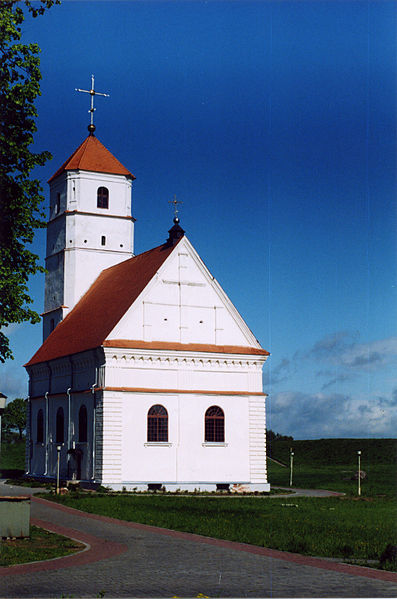
Since the Union of Horodlo of 1413, local nobility was assimilated into the traditional clan system by means of the formal procedure of adoption by the szlacht... Initially mostly Ruthenian and Orthodox, with time most of them became polonized. This was especially true for major magnate families... whose personal fortunes and properties often surpassed those of the royal families and were huge enough to be called a state within a state. Many of them founded their own cities... with settlers from other parts of Europe. Indeed there were Scots, Germans and Dutch people inhabitating major towns of the area, as well as several Italian artists who had been "imported" to the lands of modern Belarus by the magnates.Have you thought about Belarus, today's "History of" country?
Showing posts with label Lithuania. Show all posts
Thursday, January 17, 2013
"Throughout their existence as a separate culture, Ruthenians formed in most cases rural population, with the power held by local szlachta and boyars..."
"... often of Lithuanian, Polish or Russian descent. As in the rest of Central and Eastern Europe, the trade and commerce was mostly monopolized by Jews, who formed a significant part of the urban population."
Labels:
Belarus,
history,
Lithuania,
Poland,
the History of
Sunday, June 27, 2010
Algirdas Brazauskas — "He was an honest man, a charismatic leader and outstanding politician."
"The memory of the first president of independent Lithuania will remain in the hearts of the people."

IN THE COMMENTS: bagoh20 begins with some decent-enough generic snark:
No matter who the subject, I find it hard to consider "outstanding politician" to be anything but an insult. I'm a bigot about politicians.But it is not right for this occasion. Irene brings the gravitas:
Brazauskas was no ordinary, career politician. He became a politician as a result of extraordinary times. He was a courageous man who inspired the citizens to stand up to an awesome power.
Lithuania was under the Soviet yoke between 1944 and 1991. A documentary, Red Terror on the Amber Coast exposes these times. There now is a museum in the capital, Vilnius, dedicated to preserving the history of the Soviet genocide.
Many members of my family fled Lithuania in June 1944. Those who did not get out were deported to reeducation camps in the Gulag.
Subscribe to:
Posts (Atom)