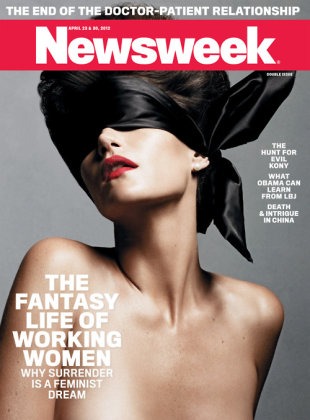
5 or 10 years ago, it was a routine, almost daily practice for me to wander around a bookstore and so I always knew what was on the covers of the usual magazines like Newsweek. You could catch my eye. Nowadays, my daily glancing about is done on line, and crafty editors can't grab me with striking covers. But I did notice this:

Now, that's really silly. Who is this "working woman"? I guess by "working woman," Newsweek means a fashion model. And for all the striving to convey sexuality, the particular woman — with her plank chest and clothes-hanger shoulders — epitomizes abstemiousness, not lust of any kind. Anyway, had I seen that on the newsstand, I would have laughed at the embarrassingly striving effort to lure me into checking out the article. Don't I want to know "Why Surrender Is a Feminist Dream"? Uh,
no. I was with the radical feminists back in the late 1980s/early 1990s when it seemed very important to take "The Story of O" seriously. And to despise Katie Roiphe, by the way. Who is the author of the Newsweek cover story, though her name isn't on the cover.
Why did the feminists attack Roiphe back then? The daughter of a famous feminist,
she'd come out with a book "The Morning After: Fear, Sex and Feminism" when she was only 26, undermining the work of feminists who'd strained to expand the category of behavior to which the term "rape" attaches:
Writing for The New Yorker, Katha Pollitt delivered a scathing review of The Morning After, writing, "It is a careless and irresponsible performance, poorly argued and full of misrepresentations, slapdash research, and gossip. She may be, as she implies, the rare grad student who has actually read 'Clarissa,' but when it comes to rape and harassment she has not done her homework."
Oh, but that was nearly 20 years ago. I haven't been keeping track of Katie Roiphe since then, though I see I have a tag for her. I don't remember mentioning her on the blog before, but obviously I have. Anyway, she's getting cranked through the Tina-Brownified Newsweek that I'm not going to read, but I did notice
the Virginia Heffernan attack on Roiphe's cover story:
Tina, my onetime boss, from whom in the late 1990s I learned the dark arts of buzz production...
Were vibrators involved?
... loves to seduce and betray female writers. And she's got skills. As she once proudly told the editorial team at her short-lived magazine Talk, she likes to ask lady writers to deliver humiliating "personal histories" that feature self-loathing and lurid intimate disclosures, on the promise that they can publish anonymously.
Once the droning, predictable, scandalous articles are done—Daphne Merkin likes to be spanked!!!!!—Tina appeals to the writer's vanity. The article is terse and fearless and elegant! You're Joan Didion! (always Joan Didion). You must put your name on this!
Disgrace. You want to know about gender politics during this trumped-up "war on women"? That's one way power is wielded between women—the alpha girl feigns sympathy to get her henchwoman to confess or act out and then sits back and sneers—and it's no joke.
I'm cutting a lot here. Please read the whole thing. Roiphe, per Heffernan, "sneers" at the "older, suburban, possibly Midwestern woman" who is titillated by this popular new porn book "Shades of Grey," and this supposedly entertaining sneering is leveraged by Roiphe's own sexual confessions:
Tina has forced Roiphe into this uncomfortable pose, and in public (does any woman really want to boast, "I'm more twisted and accustomed to sexual violence than anyone!"), and Roiphe comparably trusses up Newsweek readers. Over a series of bad-faith and gibberish paragraphs, she sets up the reader as a hayseed who is turned on by lite porn because she's never seen how they do it in Berlin or whatever; or—worse still—so unsuccessfully feminine and so outside of the charmed circle of female literary power that she's satisfied by regular guys who don't hit her.
The real sadism, it seems, comes from the powerful editor (Brown) who once oppressed Heffernan, who longs to get the upper hand at long last. Now, that's lurid (but not at all sexy, unless you're way more into the world of publishing newsrags than I am).
Anyway, I'm reading Heffernan, because I wandered by Slate this morning and saw a piece that successfully caught my eye with the title "
Why Is Virginia Heffernan Being Sexist Toward Katie Roiphe?" It was written by a character with the silly name J. Bryan Lowder. He says:
Heffernan suggests that Roiphe has been “humiliated” by the article, but, by my reading, it’s the former who’s actually out to humiliate the latter in some twisted form of victim-blaming. It’s as if Heffernan is saying, “Tina Brown editorially raped you, Katie Roiphe, so why don’t you just slink away in disgrace!”
Key words:
by my reading. Heffernan had her reading and you, J. Bryan, have yours. And your reading is that her reading is not the right reading. Readings, readings, readings. If it's all readings, we can choose which one to read, can't we? And Heffernan is more readable. And she's got the inside experience with Brown. Meanwhile — I just got to the end of J. Bryan's cryin' and I see he's "a former student and research assistant of Roiphe’s." Ha. I stand by my choice of readings.

 :.
