

Roger Ebert is fooled by what is a very funny parody of Werner Herzog (which you should get if you've seen the movie "Grizzly Man"):
Looking (unsuccessfully) for the relevant clip from "Grizzly Man" — "I believe the common character of the universe is not harmony, but hostility, chaos and murder" — I found this video made by a guy who finds that when he reads Anton Chekov short stories, he hears the words in his head in Werner Herzog's voice:
(The words are from the Chekov story "Gusev.")
Showing posts with label Roger Ebert. Show all posts
Showing posts with label Roger Ebert. Show all posts
Saturday, November 26, 2011

Monday, September 26, 2011
Roger Ebert, quoting John Waters: "If you go home with someone and they don't have books, don't f**k them."
A stark tweet.
In the future, all the books will be ebooks, and it will be so much harder for Ebert and Waters to discern who deserves their sexual ministrations.
ADDED: One thing about books on the shelf is that you can check out the titles and form a rough opinion of the person. But that assumes the person really does read those books and that they don't have a hidden stash of books that — if you saw the titles — would send you running out the door.
What book, spotted on a prospective lover's shelf, would make you turn away and walk out the door?
In the future, all the books will be ebooks, and it will be so much harder for Ebert and Waters to discern who deserves their sexual ministrations.
ADDED: One thing about books on the shelf is that you can check out the titles and form a rough opinion of the person. But that assumes the person really does read those books and that they don't have a hidden stash of books that — if you saw the titles — would send you running out the door.
What book, spotted on a prospective lover's shelf, would make you turn away and walk out the door?
Friday, April 15, 2011
Finally, a way to get liberals to abandon their romantic obsession with high-speed trains.
It's the "Atlas Shrugged" movie! Roger Ebert haaaaates it and mocks the obsession with trains:
Yes, although airplanes exist in this future, trains are where it’s at. When I was 6, my Aunt Martha brought me to Chicago to attend the great Railroad Fair of 1948, at which the nation’s rail companies celebrated the wonders that were on the way. They didn’t quite foresee mass air transportation. "Atlas Shrugged" seems to buy into the fair’s glowing vision of the future of trains. Rarely, perhaps never, has television news covered the laying of new railroad track with the breathless urgency of the news channels shown in this movie.Thank you, Roger Ebert! I agree. We have planes now. To be enthusiastic about trains is to be like your Aunt Martha, really fossilized.
Wednesday, October 27, 2010
"Nobody taught me to regard women as sex objects. I always did."
"Most men do. And truth to tell, most women regard men as sex objects. We regard many other aspects of another person, but sex is the elephant in the room."
Roger Ebert, writing — in an ungainly fashion — about Hugh Hefner.
Roger Ebert, writing — in an ungainly fashion — about Hugh Hefner.
Thursday, September 16, 2010
So the Joaquin Phoenix "I'm Still Here" thing was an act, which everybody pretty much knew...
... except Roger Ebert (kind of), who gave it a terrible review, which everyone else did too. So now, the director (Casey Affleck) is trying to claw his way back into respectability by taking the stage to tell us it was a Borat-ish fake, except that no one cares anymore, because the film wasn't entertaining, partly because it made the few people who saw it feel bad about the druggy dissolution of a once-great actor.
Well, so maybe it could become entertaining now that Affleck has unburdened us of the sadness we felt to see Phoenix fall — a burden, Affleck had to know, hit people with the additional weight of reminding them of the death of Joaquin's brother River — and we know that Joaquin is acting!
But when Joaquin was traveling about making the film, clips leaked out, people suspected it was an act, and the clips weren't funny then, which I suspect is why they decided to put the film together in a way that deprived the audience of the ability to confirm that it was an act. Make it a puzzle. Stir people up. But that didn't work.
It's so pathetic to try to get a second chance at attracting attention to your movie. But we're all glad, I take it, that Joaquin's okay. Now, will somebody give the actor a script?
Well, so maybe it could become entertaining now that Affleck has unburdened us of the sadness we felt to see Phoenix fall — a burden, Affleck had to know, hit people with the additional weight of reminding them of the death of Joaquin's brother River — and we know that Joaquin is acting!
But when Joaquin was traveling about making the film, clips leaked out, people suspected it was an act, and the clips weren't funny then, which I suspect is why they decided to put the film together in a way that deprived the audience of the ability to confirm that it was an act. Make it a puzzle. Stir people up. But that didn't work.
It's so pathetic to try to get a second chance at attracting attention to your movie. But we're all glad, I take it, that Joaquin's okay. Now, will somebody give the actor a script?
Saturday, August 21, 2010
Friday, July 2, 2010
"At this moment, 4,547 comments have rained down upon me for that blog entry."
"I'm informed by Wayne Hepner, who turned them into a text file: 'It's more than Anna Karenina, David Copperfield and The Brothers Karamazov.' I would rather have reread all three than vet that thread. Still, they were a good set of comments for the most part. Perhaps 300 supported my position. The rest were united in opposition."
That's Roger Ebert talking about a blog post of his called "Video games can never be art."
The reason I'm noticing this brouhaha is that, checking my Site Meter, I saw I was getting a ton of traffic from Bing on a search for "roger ebert apologizes." I wanted to know what was stirring people up today, and kind of sorry they were dropping by my blog only to be disappointed to find something I wrote back in October 2008 called "Roger Ebert apologizes for reviewing the first 8 minutes of a movie."
Funnily, Ebert's new post begins:
AND: "I would rather have reread all three than vet that thread" insults the 3 novels doesn't it?
That's Roger Ebert talking about a blog post of his called "Video games can never be art."
The reason I'm noticing this brouhaha is that, checking my Site Meter, I saw I was getting a ton of traffic from Bing on a search for "roger ebert apologizes." I wanted to know what was stirring people up today, and kind of sorry they were dropping by my blog only to be disappointed to find something I wrote back in October 2008 called "Roger Ebert apologizes for reviewing the first 8 minutes of a movie."
Funnily, Ebert's new post begins:
I was a fool for mentioning video games in the first place. I would never express an opinion on a movie I hadn't seen.I think my old post does have some relevance: It calls that second sentence into question. I can see a lawyerly way to defend it, but it's pretty weasely.
AND: "I would rather have reread all three than vet that thread" insults the 3 novels doesn't it?
Sunday, May 30, 2010
"Facebook has no charms for me. It looks inward. Twitter looks outward..."
From an essay by Roger Ebert about how the internet rewires our brains. A lot of the essay is about the importance of stepping away from the computer and reading our way through actual books — long books that you read straight through in a linear fashion (which ends up being long novels, which just happen to be something he loves doing anyway). But I was struck by the Facebook/Twitter point. We spend a lot of time on the internet, but we do different things here, so it's not just a matter of what The Internet does to our brains.
In fact, Reading Books isn't just one distinctive activity. Ebert writes about books as if book = Victorian novel. But some of us like reading nonfiction, including books that don't require linear reading at all. You can dip back and forth in a book and read snippets in very much the same style as web-surfing. When I'm reading books, I like a stack of books of different kinds. I might read a few pages in one, then switch to another, maybe rotate through the whole pile, very similar to the way I'd open up a set of tabs in my browser and cycle through them. And I like reference books and essay collections — e.g., a collection of movie reviews — that are best read by jumping around.
By the same token, on the internet, there are different ways to read. As Ebert's Facebook/Twitter point shows, reading is deeply interwoven with writing and with the feeling of interacting with other people. Sitting by yourself with a long book is quite unnatural by comparison. I think it could be said that the internet takes our urge to read and reintegrates us with society. It's more like the natural world that we evolved to live in: there should be the constant potential for interruptions and distractions; we should be giving and receiving communication to and from other people who are alive now and able to respond to us. In that light, long books distort our brains, and the internet brings us back to human society.
And being on the internet isn't just one distinctive activity. Some people like Facebook and some like Twitter. Me, I love blogging. I've done the other 2, but blogging suits me best — in part because I have so many commenters who come here and make this feel like the lively coffeehouse or salon I always hoped I could find in real life. Ebert says Facebook looks inward, and he prefers Twitter, but isn't it funny that if Facebook is really inward, it's more like the long novels that Ebert uses as an antidote to the internet experience? Ebert twits like mad — his Twitter feed is excellent — but maybe he's using it, in part, as a change of pace from those Victorian novels.
We can, each of us, design our own mix of experiences — in nature, in face-to-face human encounters, with books, with pen and paper, and using computers to read and write. We balance and offset. We seek pleasure and satisfaction and power and wisdom. We begin where we begin. One individual begins with too few real-life friends and a love of thick novels, another begins with a chattering schoolgirl clique and a Facebook page. Add something to that and then to that. Inward, outward/outward, inward. Make life better, in your own way.
In fact, Reading Books isn't just one distinctive activity. Ebert writes about books as if book = Victorian novel. But some of us like reading nonfiction, including books that don't require linear reading at all. You can dip back and forth in a book and read snippets in very much the same style as web-surfing. When I'm reading books, I like a stack of books of different kinds. I might read a few pages in one, then switch to another, maybe rotate through the whole pile, very similar to the way I'd open up a set of tabs in my browser and cycle through them. And I like reference books and essay collections — e.g., a collection of movie reviews — that are best read by jumping around.
By the same token, on the internet, there are different ways to read. As Ebert's Facebook/Twitter point shows, reading is deeply interwoven with writing and with the feeling of interacting with other people. Sitting by yourself with a long book is quite unnatural by comparison. I think it could be said that the internet takes our urge to read and reintegrates us with society. It's more like the natural world that we evolved to live in: there should be the constant potential for interruptions and distractions; we should be giving and receiving communication to and from other people who are alive now and able to respond to us. In that light, long books distort our brains, and the internet brings us back to human society.
And being on the internet isn't just one distinctive activity. Some people like Facebook and some like Twitter. Me, I love blogging. I've done the other 2, but blogging suits me best — in part because I have so many commenters who come here and make this feel like the lively coffeehouse or salon I always hoped I could find in real life. Ebert says Facebook looks inward, and he prefers Twitter, but isn't it funny that if Facebook is really inward, it's more like the long novels that Ebert uses as an antidote to the internet experience? Ebert twits like mad — his Twitter feed is excellent — but maybe he's using it, in part, as a change of pace from those Victorian novels.
We can, each of us, design our own mix of experiences — in nature, in face-to-face human encounters, with books, with pen and paper, and using computers to read and write. We balance and offset. We seek pleasure and satisfaction and power and wisdom. We begin where we begin. One individual begins with too few real-life friends and a love of thick novels, another begins with a chattering schoolgirl clique and a Facebook page. Add something to that and then to that. Inward, outward/outward, inward. Make life better, in your own way.
Saturday, May 29, 2010
"Is there the slightest possibility that SATC2 is actually satirizing the shallow absurdity of its protagonists..."
"... but a large fraction of its audience has not realized that they are the target of its mockery?"
Answer: no.
Answer: no.
Monday, May 3, 2010
Why Roger Ebert hates 3D and why I hate when the top story at Slate right now takes me to a 3-day-old article in Newsweek.
Okay. Roger Ebert hates 3D because:
But I didn't go to Slate last night to read Newsweek, and I don't think the top story at Slate should be 3 days old, whether it's really a Slate article or not.
What has happened to Slate? For years and years, I went there every day. Lately, I've noticed that I avoid the place, and I'd been wondering why. That Newsweek thing really irritated me, but it's not just that. When I go there I find a a list of tempting titles — must clicks. But click and be disappointed. I've been through that too many times. Now, I scan the teasers and just think: They're trying to make me click. Like I'm in some kind of battle with them and I win by refusing to click.
I don't go to the movies much either. Ads for movies feel the same way. They're trying to make meclick give them $10.
3-D is a waste of a perfectly good dimension. Hollywood's current crazy stampede toward it is suicidal. It adds nothing essential to the moviegoing experience. For some, it is an annoying distraction. For others, it creates nausea and headaches. It is driven largely to sell expensive projection equipment and add a $5 to $7.50 surcharge on already expensive movie tickets. Its image is noticeably darker than standard 2-D. It is unsuitable for grown-up films of any seriousness. It limits the freedom of directors to make films as they choose. For moviegoers in the PG-13 and R ranges, it only rarely provides an experience worth paying a premium for.I agree. Fine.
But I didn't go to Slate last night to read Newsweek, and I don't think the top story at Slate should be 3 days old, whether it's really a Slate article or not.
What has happened to Slate? For years and years, I went there every day. Lately, I've noticed that I avoid the place, and I'd been wondering why. That Newsweek thing really irritated me, but it's not just that. When I go there I find a a list of tempting titles — must clicks. But click and be disappointed. I've been through that too many times. Now, I scan the teasers and just think: They're trying to make me click. Like I'm in some kind of battle with them and I win by refusing to click.
I don't go to the movies much either. Ads for movies feel the same way. They're trying to make me
Tuesday, March 2, 2010
"I write about the TeePees because it's so sad how they've been manipulated to oppose their own best interests."
Says Roger Ebert, who tweets about politics now and does not, on Twitter, eschew the cruder term "teabaggers" for participants in the Tea Party movement.
That movie also uses the expression "shopping for others." I remember that, but remembering that doesn't tell me that it's become a term for something people are really doing these days. [ADDED: I see that the link within that link now goes to the absence of a YouTube clip from the movie. It was a scene in which Pecker, a budding young photographer, and his friend go into a store and put embarrassing items in other people's shopping carts when they're not looking. Pecker then takes pictures of their reactions at the checkout counter.]
Anyway, I welcome Roger Ebert to the Tweet-o-sphere. It's great when an excellent, interesting writer takes to the 140-character art form. Follow him here. I am.
When Ebert tweeted that he was unaware of the term's pornographic connotation, Big Hollywood countered that he had referred to such a context in past movie reviews.Ha. It must have been "Pecker." I love that movie. Yeah. Here's Retracto the Correction Alpaca calling gotcha on Ebert — complete with "Pecker"-clip. Frankly, I can see how someone could have reviewed "Pecker" and even talked about the teabagging in "Pecker" — which is pretty silly — and not realize that the word had moved beyond that context into the general parlance and was implied by the term that is now used to mock tea partiers.
That movie also uses the expression "shopping for others." I remember that, but remembering that doesn't tell me that it's become a term for something people are really doing these days. [ADDED: I see that the link within that link now goes to the absence of a YouTube clip from the movie. It was a scene in which Pecker, a budding young photographer, and his friend go into a store and put embarrassing items in other people's shopping carts when they're not looking. Pecker then takes pictures of their reactions at the checkout counter.]
Anyway, I welcome Roger Ebert to the Tweet-o-sphere. It's great when an excellent, interesting writer takes to the 140-character art form. Follow him here. I am.
Wednesday, June 24, 2009
Smoking and the $93,000 stamp.
The print run was destroyed — but a few stamps escaped — because Audrey Hepburn's son did not like that cigarette holder in her mouth.

That happened in Germany. Here in America we just airbrush the cigarette out of the old celebrity photos:

Roger Ebert:
IN THE COMMENTS: Sofa King picks up on the cue to photoshop:

And kristinintexas found this startling revelation that Bette Davis was not holding a cigarette in the original photograph. (Her fur coat, however, was downgraded to cloth.)
But, of course, Bette Davis was big on smoking, and so Chip Ahoy gives us "Bette Restored:


That happened in Germany. Here in America we just airbrush the cigarette out of the old celebrity photos:

Roger Ebert:
Depriving Bette Davis of her cigarette reminds me of Soviet revisionism, when disgraced party officials disappeared from official photographs. Might as well strip away the toupees of Fred Astaire and Jimmy Stewart. I was first alerted to this travesty by a reader, Wendell Openshaw of San Diego, who wrote me: "Do you share my revulsion for this attempt to revise history and distort a great screen persona for political purposes? It is political correctness and revisionist history run amok. Next it will be John Wayne holding a bouquet instead of a Winchester!"
IN THE COMMENTS: Sofa King picks up on the cue to photoshop:
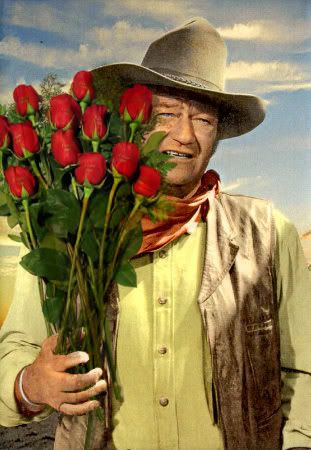
And kristinintexas found this startling revelation that Bette Davis was not holding a cigarette in the original photograph. (Her fur coat, however, was downgraded to cloth.)
But, of course, Bette Davis was big on smoking, and so Chip Ahoy gives us "Bette Restored:
Thursday, October 23, 2008
Roger Ebert apologizes for reviewing the first 8 minutes of a movie.
Bleh! Apologies! Defend yourself, man. Walking out is an important form of judgment.
Saturday, May 31, 2008
Movies seen and not seen.
Yesterday at the Sundance theater here in Madison, Wisconsin, it was opening night for the "Sex and the City" movie. Women were swarming around and inside the place. Some arrived in groups of 4 and wearing short, tight dresses. The "caffe" area that, at Sundance, replaces the concession stand, had a party atmosphere. Were they serving drinks? I think they were.
But we weren't there to see "Sex and the City." We were there to see "The Fall." Unlike the ladies in little dresses, we did not dress like characters in the movie. That is, we did not wear loincloths or red masks with rectangular eye holes or helmets or diaphanous gowns. But we were just as eager to take in the show on opening night.
Here's the trailer that got me:
Watching the trailer again, I can see that it absolutely accurately represents what is in that movie, so if you like that, go see it. If you don't, don't. Here's the Roger Ebert review that the trailer summarizes in one word ("Magnificent"). And here are a few more Ebert words:
The movie has gotten mixed reviews. To the extent that these say the story isn't coherent, I think they are wrong. Pay close attention and you'll see how it makes sense. You have an impoverished 5-year-old child who is listening to a story told by a suicidal, drug-addicted man. The fantasy sequences are the combination of his words and her visualization. The story takes place in the early days of Hollywood and filmmaking is a theme. The man is in the hospital because he was paralyzed in a fall doing a movie stunt, and in putting a story into words he is like a screenplay writer and the girl is like the director, so the slippage between his story and her imagination tells of the writer's loss of control of his story as it is made into a movie. The little girl is in the hospital because she fell out of an orange tree doing her work as a migrant picker. In her eagerness to see the man's story in her head, she's a movie fan.
ADDED: Importantly, this movie was made without CGI. They made models like this:
Better get that explosion right the first time. I hate CGI — I feel visceral revulsion to it. The beauty of "The Fall" is clearly film beauty, not computer tricks.
But we weren't there to see "Sex and the City." We were there to see "The Fall." Unlike the ladies in little dresses, we did not dress like characters in the movie. That is, we did not wear loincloths or red masks with rectangular eye holes or helmets or diaphanous gowns. But we were just as eager to take in the show on opening night.
Here's the trailer that got me:
Watching the trailer again, I can see that it absolutely accurately represents what is in that movie, so if you like that, go see it. If you don't, don't. Here's the Roger Ebert review that the trailer summarizes in one word ("Magnificent"). And here are a few more Ebert words:
Either you are drawn into the world of this movie or you are not. It is preposterous, of course, but I vote with Werner Herzog, who says if we do not find new images, we will perish. Here a line of bowmen shoot hundreds of arrows into the air. So many of them fall into the back of the escaped slave that he falls backward and the weight of his body is supported by them, as on a bed of nails with dozens of foot-long arrows. There is scene of the monkey Otis chasing a butterfly through impossible architecture.The monkey belongs to Charles Darwin, who's out on a quest with the Black Bandit, an Italian anarchist, an escaped slave, and a Indian (whom the man has described as an American Indian but the girl has pictured as a man from India). The alternating sequences of fantasy and storytelling reminded me of "The Princess Bride." And there's a satisfying ending that reminded me of [click for spoiler].
The movie has gotten mixed reviews. To the extent that these say the story isn't coherent, I think they are wrong. Pay close attention and you'll see how it makes sense. You have an impoverished 5-year-old child who is listening to a story told by a suicidal, drug-addicted man. The fantasy sequences are the combination of his words and her visualization. The story takes place in the early days of Hollywood and filmmaking is a theme. The man is in the hospital because he was paralyzed in a fall doing a movie stunt, and in putting a story into words he is like a screenplay writer and the girl is like the director, so the slippage between his story and her imagination tells of the writer's loss of control of his story as it is made into a movie. The little girl is in the hospital because she fell out of an orange tree doing her work as a migrant picker. In her eagerness to see the man's story in her head, she's a movie fan.
ADDED: Importantly, this movie was made without CGI. They made models like this:
Better get that explosion right the first time. I hate CGI — I feel visceral revulsion to it. The beauty of "The Fall" is clearly film beauty, not computer tricks.
Tuesday, July 5, 2005
Have you seen "War of the Worlds"?
Chris (my 22 year old son) just saw it and gives it the highest praise. Dialogue:
ME: Does it connect with political stuff -- the war on terror...?Also, we discussed the negative Roger Ebert review, and I speculated that Ebert marked it down because he picked up a right wing vibe.
CHRIS: Yes, because it's set in the present day, and at one point the little girl asks, "Are they terrorists?"
ME: So, is it left wing?
CHRIS: No.
ME: Is it right wing?
CHRIS: I don't think it's right wing, because the people who made it are probably liberals, but I think right wing people could really get into it. If you're really into the war on terrorism, you could probably get into it as symbolic of the war on terrorism, because it shows the American military trying to fight against the aliens, and it has a teenage son who wants to join the American military in the fight against the aliens.
ME: And he's a positive character?
CHRIS: Yeah, he's the main son... he's Tom Cruise's son.
ME (noticeably typing): Is there anything else you'd like to say?
CHRIS: It's a real experience to watch the movie.
ME: That's what you want to say "it's a real experience to watch the movie"?
CHRIS: Yeah. I saw it on the Ultra-Screen and I was sitting pretty close to the front, so it was like an IMAX.
Subscribe to:
Posts (Atom)
 :.
:.
