

"... is that the bad press that surrounded the short-lived reduction in alcohol content will lead to a slump in demand for the product...."
Can you see why? Explanation at the link for why Beam, Inc. could not deal with increased demand by simply raising the price.
Showing posts with label drinking. Show all posts
Showing posts with label drinking. Show all posts
Monday, February 18, 2013

Sunday, February 17, 2013
"A woman in a Third Avenue West apartment was reported trying to catch bugs that weren’t there...."
Time to get back to the old Inter Lake police blotter news:
An Appleway Drive boy reported his mother was drunk and trying to kick him out. She told officers she was kicking him out due to his drinking and drug activity....
An officer assisted a man crawling in the middle of East First Street....
The Columbia Falls Police Department received a report from a confused First Avenue West North resident who said a man tried to come into the house and give the resident a $1,000 ticket, but didn’t say what kind. The resident told the man “I’m not interested” and shut the door.
Sunday, February 3, 2013
The notion that the National Anthem is too hard to sing, so it's better to lip-sync.
Argument replete with sympathy for Beyonce and video of bad singing by "seasoned professionals."
I completely disagree with this argument. It's the difficulty that makes the performance thrilling. It's the risk of failure that makes it daring. And by the way, it's a song about fighting a war, which is not a risk-free enterprise. No safety net there. It's not like these seasoned professionals are drafted to sing the old song. The fact that it's also an old drinking song — mentioned in the linked article — counts on the side of throwing caution to the wind and overcoming inhibitions and leaving the consequences — the shame — for the morrow.... in the land of the freeeeeeeeeeeeeeeeeeeeeeeeeee....
I completely disagree with this argument. It's the difficulty that makes the performance thrilling. It's the risk of failure that makes it daring. And by the way, it's a song about fighting a war, which is not a risk-free enterprise. No safety net there. It's not like these seasoned professionals are drafted to sing the old song. The fact that it's also an old drinking song — mentioned in the linked article — counts on the side of throwing caution to the wind and overcoming inhibitions and leaving the consequences — the shame — for the morrow.... in the land of the freeeeeeeeeeeeeeeeeeeeeeeeeee....
Wednesday, January 16, 2013
"A breeze blew through the room, blew curtains in at one end and out the other like pale flags..."
"... twisting them up toward the frosted wedding-cake of the ceiling, and then rippled over the wine-colored rug, making a shadow on it as wind does on the sea."
More wind, water, and light. We've gotten used to it here in this windy, watery, light-and-dark world of the Gatsby project. This sentence seems like a made up imitation of a sentence from "The Great Gatsby," but I assure you it's there.
All that's happening here is a breeze blowing through the room, but we have a traffic jam of metaphor: flags, wedding-cake, and wine. What are we supposed to see here? And good lord, it's a room. Must we really believe that something cataclysmic is going on when a breeze blows the curtains? Maybe we should. Maybe all sorts of crazy stuff happens in a room and it is like an epic storm at sea.
The wine-colored rug stands in for the sea, so I have to assume that we're supposed to think of the "wine-dark sea" we hear about, repeatedly, in Homer's Iliad and Odyssey. It is an epic, contained in that room. The dark shadows ripple, turning the wine-rug into sea, so I guess the ceiling is the sky. I guess that's a fancy white ceiling with all sorts of fancy woodwork, resembling the ornamentation on a wedding cake. The curtains swirling around the wedding-cake textures are cloud-like, I suppose. So fabric and wood make the erstwhile cake-like ceiling into stormy sky and curtain-driven shadows make the otherwise wine-like carpet into roiling sea.
It's a tempestuous room, containing a marriage. Raise a toast and let's feed each other cake.
More wind, water, and light. We've gotten used to it here in this windy, watery, light-and-dark world of the Gatsby project. This sentence seems like a made up imitation of a sentence from "The Great Gatsby," but I assure you it's there.
All that's happening here is a breeze blowing through the room, but we have a traffic jam of metaphor: flags, wedding-cake, and wine. What are we supposed to see here? And good lord, it's a room. Must we really believe that something cataclysmic is going on when a breeze blows the curtains? Maybe we should. Maybe all sorts of crazy stuff happens in a room and it is like an epic storm at sea.
The wine-colored rug stands in for the sea, so I have to assume that we're supposed to think of the "wine-dark sea" we hear about, repeatedly, in Homer's Iliad and Odyssey. It is an epic, contained in that room. The dark shadows ripple, turning the wine-rug into sea, so I guess the ceiling is the sky. I guess that's a fancy white ceiling with all sorts of fancy woodwork, resembling the ornamentation on a wedding cake. The curtains swirling around the wedding-cake textures are cloud-like, I suppose. So fabric and wood make the erstwhile cake-like ceiling into stormy sky and curtain-driven shadows make the otherwise wine-like carpet into roiling sea.
It's a tempestuous room, containing a marriage. Raise a toast and let's feed each other cake.
"I think the businesses that bring these men in should also be accountable for not providing opportunities that keep them busy outside of work."
"They should check their employees before hiring (if they don't already) and get rid of those who commit ANY kind of aggression toward women or men. Their social responsibility goes beyond the gate or the door. Maybe the answer is for the towns like Williston to heavily tax the companies so that they can afford to police the men the companies employ. If business doesn't see itself more broadly as a player in the overall health of our society, government needs to step in."
That's a reader comment at the NYT article about all the single men working out in the oil fields of North Dakota, which we've been talking about over in this earlier thread. Please go to that thread to talk about the article more generally. I'm opening up this new thread for discussion of the proposition that business should be responsible for the after-work activities of their employers, that the tendency of men to go out after work looking for female companionship calls for the heavy taxation of business, that individuals looking for sexual relationships in their own free time ought to be conceptualized as an issue of collective "health," that overall societal health requires big "players," and that if businesses don't want to see themselves as the players, they leave a gap that government must fill.
That's a reader comment at the NYT article about all the single men working out in the oil fields of North Dakota, which we've been talking about over in this earlier thread. Please go to that thread to talk about the article more generally. I'm opening up this new thread for discussion of the proposition that business should be responsible for the after-work activities of their employers, that the tendency of men to go out after work looking for female companionship calls for the heavy taxation of business, that individuals looking for sexual relationships in their own free time ought to be conceptualized as an issue of collective "health," that overall societal health requires big "players," and that if businesses don't want to see themselves as the players, they leave a gap that government must fill.
A single-malt whiskey from Waco, Texas beats all the Scottish competition blind-judged by British experts.
Single-malt whiskey distilling is now a big deal in the United States... despite the impediment of "a federal law, enacted in 1938, requiring that they be at least partly aged in previously unused oak barrels."
Unfortunately, malted barley is delicate and prone to lose its flavor in new oak, which is why Scottish distillers prefer barrels that once held sherry, port or bourbon.That's America! Full of innovation and ingenuity... and stupid, overreaching federal regulation.
To compensate, American distillers often start with a more robust, flavorful mash than a typical Scotch, which can better stand up to new oak, flavor that continues to shine through after the whiskey is bottled.
They also rely on America’s higher temperatures, and bigger temperature swings, to speed the aging process. “A hot day in Scotland is 75 degrees,” said Mr. Tate, of [contest winner] Balcones. “Seventy-five degrees isn’t even a hot day in January here.”
As a result, even Balcones, despite its peat and smoky notes, is unlikely to be confused with an Islay Scotch. “A lot of what we do is riffing on old traditions in new ways,” Mr. Tate said....
Tuesday, January 15, 2013
"We know that all kinds of bad things can happen to somebody that gets to that level of intoxication."
"It’s almost a matter of dumb luck as to which bad thing’s going to happen. You’re going to get hit by a car, you’re going to pass out and choke on your own vomit, you’re going to stumble into somebody’s house, you’re going to pass out in the bushes. These things happen in Madison, and they happen with a good deal of regularity. And this case just ended up in probably the worst possible outcome one could imagine."
Sunday, January 13, 2013
"Madison City Council quietly abandons effort to create code of conduct for members."
The most amusing lines come from Alder Lauren Cnare: "We could have come up with a set of guidelines that would have helped people behave in situations that are sort of gray" and "I think it's over until something happens again."
The something that happened this time, sending the council into a tizzy about codification, was that one alder allegedly did something sexual to another alder the morning after a long night drinking together.
The something that happened this time, sending the council into a tizzy about codification, was that one alder allegedly did something sexual to another alder the morning after a long night drinking together.
"We need more harlequins, fewer ticktockmen."
Said Icepick in last night's thread about Boston banning drinking games in bars. He began:
Icepick advises:
That story was published in 1965, when the phrase "where it's at" was quite the thing.
ADDED: I just bought "Masterpieces: The Best Science Fiction of the 20th Century," which contains "Repent Harlequin!"
I recently read "The Scouring of the Shire" chapter from Return of the King. It was disturbing how much the Shire under (ultimately) Saruman's direction sounded like modern America. The country is being run by over-officious jerks, and the American people are putting up with it. Land of the free no more....And then:
We need more harlequins, fewer ticktockmen.A link goes to the Harlan Ellison story "Repent Harlequin!' Said The Ticktockman."
Icepick advises:
Professor, I believe you need some more tags. One for over-officiousness, and perhaps tags for harlequins (see Swartz, for example) and for ticktockmen (anything with Bloomberg).Ellison begins his story with a quote from Thoreau's "Civil Disobedience":
The mass of men serve the state thus, not as men mainly, but as machines, with their bodies. They are the standing army, and the militia, jailors, constables, posse comitatus, etc. In most cases there is no free exercise whatever of the judgment or of the moral sense; but they put themselves on a level with wood and earth and stones; and wooden men can perhaps be manufactured that will serve the purposes as well. Such command no more respect than men of straw or a lump of dirt. They have the same sort of worth only as horses and dogs. Yet such as these even are commonly esteemed good citizens. Others as most legislators, politicians, lawyers, ministers, and office-holders serve the state chiefly with their heads; and, as they rarely make any moral distinctions, they are as likely to serve the Devil, without intending it, as God. A very few, as heroes, patriots, martyrs, reformers in the great sense, and men, serve the state with their consciences also, and so necessarily resist it for the most part; and they are commonly treated as enemies by it.Ellison introduces that quote with: "There are always those who ask, what is it all about? For those who need to ask, for those who need points sharply made, who need to know 'where it's at,' this...."
That story was published in 1965, when the phrase "where it's at" was quite the thing.
ADDED: I just bought "Masterpieces: The Best Science Fiction of the 20th Century," which contains "Repent Harlequin!"
Saturday, January 12, 2013
"Boston’s becoming a town devoid of nightspot fun as some bars in the city eliminate board games and water pong..."
"... fearful that city regulators will come crashing in and accuse the pubs of sponsoring drinking games."
“If two friends at a bar say, ‘I’ll buy your next beer if you make this shot on the dartboard,’ the bar may have to go before a board. It’s silly how arbitrary it can be,” said Chris Mitchell, general manager of the Better Off Bowling league, who has seen the bar crackdown firsthand.
Tuesday, January 1, 2013
"Every Friday five crates of oranges and lemons arrived from a fruiterer in New York..."
"... every Monday these same oranges and lemons left his back door in a pyramid of pulpless halves."
I warned you I was going to do this. Come on. Play along. (And, no, I wasn't thinking about Andy Kaufman when I dreamed this up. It was all a riff on that Baz Luhrmann trailer for the new "Great Gatsby" movie.)
So, now, let's talk about oranges and lemons. The phrase "oranges and lemons" appears twice in the sentence, unchanged, even as the oranges and lemons themselves are changed. That's the whole action of the sentence, the transformation of oranges and lemons in one form into oranges and lemons in another form. Here they are on Friday, in crates, and here they are on Monday in "a pyramid." That is, they have become, in that alluded-to time period — the weekend — a pile of garbage. But the pile is called "a pyramid," A pyramid! We're called upon to think of the grand erections of pharaohs, in comparison to crates from the lowly little character with the silly-sounding occupation "fruiterer."
Are the crates even stacked up? There's the absurd and obviously false notion that the fruit has been improved by whatever it was that went on in that house over the weekend. That absurdity calls upon us to think about the people who arrived and left, the people who ate all that fruit. But of course, they didn't eat it. They drank it. The pulp was extracted for use in alcoholic mixtures, and if the fruit emerged from the weekend as "pulpless halves," then, we may infer, so did the people. We don't hesitate to keep calling them human, yet we see the inaptness of calling the mere rinds "lemons and oranges." Even if you could conceptualize the big pile of rinds as a pyramid, you'd easily perceive it as garbage. Since that perception is easy, we have energy left to think about what is more difficult. Who are these people?
I warned you I was going to do this. Come on. Play along. (And, no, I wasn't thinking about Andy Kaufman when I dreamed this up. It was all a riff on that Baz Luhrmann trailer for the new "Great Gatsby" movie.)
So, now, let's talk about oranges and lemons. The phrase "oranges and lemons" appears twice in the sentence, unchanged, even as the oranges and lemons themselves are changed. That's the whole action of the sentence, the transformation of oranges and lemons in one form into oranges and lemons in another form. Here they are on Friday, in crates, and here they are on Monday in "a pyramid." That is, they have become, in that alluded-to time period — the weekend — a pile of garbage. But the pile is called "a pyramid," A pyramid! We're called upon to think of the grand erections of pharaohs, in comparison to crates from the lowly little character with the silly-sounding occupation "fruiterer."
Are the crates even stacked up? There's the absurd and obviously false notion that the fruit has been improved by whatever it was that went on in that house over the weekend. That absurdity calls upon us to think about the people who arrived and left, the people who ate all that fruit. But of course, they didn't eat it. They drank it. The pulp was extracted for use in alcoholic mixtures, and if the fruit emerged from the weekend as "pulpless halves," then, we may infer, so did the people. We don't hesitate to keep calling them human, yet we see the inaptness of calling the mere rinds "lemons and oranges." Even if you could conceptualize the big pile of rinds as a pyramid, you'd easily perceive it as garbage. Since that perception is easy, we have energy left to think about what is more difficult. Who are these people?
The History of Abkhazia.
"According to The Georgian Chronicles, the first inhabitants of what is now Abkhazia and the whole western Georgia were Egrosians, the descedants of Egros son of Togarmah, grandson of Japhet, son of Noah, who came from the land known as Arian-Kartli."

"... Abkhazia was conquered by Mithridates VI Eupator of Pontus between c. 110 and 63 BC, and then taken by the Roman commander Pompey."
"[T]he kingdoms of Abkhazia and Georgia [were united] into a single Georgian feudal state... reach[ing] the apex of its strength and prestige under the queen Tamar (1184–1213)."
"Towards the end of the 17th century, the principality of Abkhazia broke up into several fiefdoms, depriving many areas of any centralized authority. The region became a theatre of widespread slave trade and piracy. "
"In the Russian revolution of 1905, most Abkhaz remained largely loyal to the Russian rule, while Georgians tended to oppose it. As a reward for their allegiance, tsar Nicholas II officially forgave the Abkhaz for their opposition in the 19th century and removed their status of a 'guilty people' in 1907."
"On 24 October 2008 the railroad bridge of Shamgon-Tagiloni, connecting the city of Zugdidi in Georgia with the Abkhazian Gali district (populated mainly by Georgians) was destroyed. According to Georgian and French sources it was done by Russian army; Abkhazian sources maintained it was a Georgian diversion."
And so begins the new year project on this blog, which is to proceed, alphabetically, through the 206 countries of the world, and to read the "History of" page in Wikipedia. The idea is to have had it go through our head, at least once, something of what happened in each place. It is fitting that we start with Abkhazia, which may be an unfamiliar name. Much has happened there! It's touching to see that, to confront one's own persistent, nagging ignorance. But we are all fortunate to have woken up again this morning, still a human being on Planet Earth, and I want to perform a ritual — for the next 206 days — of adding a slight glimmer of awareness of those other human beings who live or who have lived over the long expanses of time and place.
It's apt that we encounter Noah on New Year's Day, Noah being our earliest example of an individual overindulging in alcohol.

ADDED: I found a nice Flicker stream of photos from Abkhazia. I recommend beginning here — at Stalin's bathroom — and then clicking to the "newer"/"older" button to see more.

"... Abkhazia was conquered by Mithridates VI Eupator of Pontus between c. 110 and 63 BC, and then taken by the Roman commander Pompey."
"[T]he kingdoms of Abkhazia and Georgia [were united] into a single Georgian feudal state... reach[ing] the apex of its strength and prestige under the queen Tamar (1184–1213)."
"Towards the end of the 17th century, the principality of Abkhazia broke up into several fiefdoms, depriving many areas of any centralized authority. The region became a theatre of widespread slave trade and piracy. "
"In the Russian revolution of 1905, most Abkhaz remained largely loyal to the Russian rule, while Georgians tended to oppose it. As a reward for their allegiance, tsar Nicholas II officially forgave the Abkhaz for their opposition in the 19th century and removed their status of a 'guilty people' in 1907."
"On 24 October 2008 the railroad bridge of Shamgon-Tagiloni, connecting the city of Zugdidi in Georgia with the Abkhazian Gali district (populated mainly by Georgians) was destroyed. According to Georgian and French sources it was done by Russian army; Abkhazian sources maintained it was a Georgian diversion."
***
And so begins the new year project on this blog, which is to proceed, alphabetically, through the 206 countries of the world, and to read the "History of" page in Wikipedia. The idea is to have had it go through our head, at least once, something of what happened in each place. It is fitting that we start with Abkhazia, which may be an unfamiliar name. Much has happened there! It's touching to see that, to confront one's own persistent, nagging ignorance. But we are all fortunate to have woken up again this morning, still a human being on Planet Earth, and I want to perform a ritual — for the next 206 days — of adding a slight glimmer of awareness of those other human beings who live or who have lived over the long expanses of time and place.
***
It's apt that we encounter Noah on New Year's Day, Noah being our earliest example of an individual overindulging in alcohol.
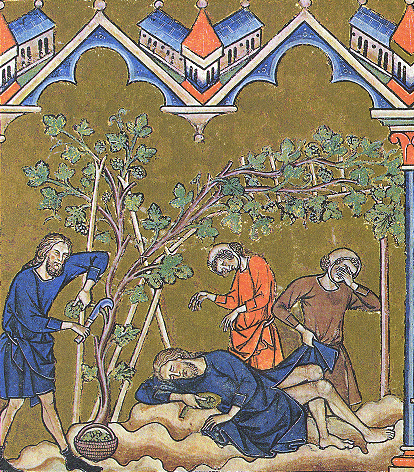
ADDED: I found a nice Flicker stream of photos from Abkhazia. I recommend beginning here — at Stalin's bathroom — and then clicking to the "newer"/"older" button to see more.
Wednesday, December 19, 2012
"Bork, he was the biggest bleeding-heart liberal of us all."
An old University of Chicago Law School anecdote.
And here's a letter Robert Bork wrote to the Wall Street Journal in 2005:
And here's a letter Robert Bork wrote to the Wall Street Journal in 2005:
Eric Felten’s essay on the dry martini is itself near-perfect (“Don’t Forget the Vermouth,” Leisure & Arts, Pursuits, Dec. 10). His allusion to constitutional jurisprudence is faulty, however, since neither in law nor martinis can we know the subjective “original intent” of the Founding Fathers. As to martinis, the intent may have been to ease man’s passage through this vale of tears or, less admirably, to employ the tactic of “candy is dandy, but liquor is quicker.”
What counts in mixology is the “original understanding” of the martini’s essence by those who first consumed it. The essence remains unaltered but allows proportions to evolve as circumstances change. Mr. Felten’s “near-perfect martini” is the same in principle as the “original-understanding martini” and therefore its legitimate descendant. Such latter-day travesties as the chocolate martini and the raspberry martini, on the other hand, are the work of activist bartenders.
Mr. Felten lapses into heresy only once. He prefers the olive to the lemon peel because the former is a “snack.” Dropping a snack into a classic drink is like garnishing filet mignon with ketchup. The correct response when offered an olive is, “When I want a salad, I’ll ask for it.”
Monday, December 17, 2012
"There's no way. There's no way he could have gone for a gun. He hated guns. He was afraid of guns. He was scared of guns."
"I'm sure he was drunk... A lot of people get drunk in Madison."
I was a UW student. I saw how people can drink downtown and stumble home. And people will stumble around and be confused and stupid and drunk but they don't get shot. They don't get shot by police officers, but they could. It could have been anybody....
"I hope the community will never forget this.... And I hope that they will remember this every time that they have to call the police."
Friday, December 14, 2012
"The ten most overrated things in the world [SLIDESHOW]."
Let me guess. Is one of the things internet slideshows? Top 10 lists?
ADDED: After reading the comments (and writing some), I've gotten to the point where I can give the first 3 of my top 10 most overrated things in the world:
Noted author and essayist Christopher Hitchens once said that the four most overrated things in life are champagne, lobsters, anal sex and picnics.First sentence at the link. So much better than anything in the slide show that you've got to click through. I miss Christopher Hitchens. He wasn't overrated.
ADDED: After reading the comments (and writing some), I've gotten to the point where I can give the first 3 of my top 10 most overrated things in the world:
1. Sitting in an audience, listening/watching something on a stage/screen.
2. Working at some fucking job.
3. Bruce Springsteen.
Thursday, November 15, 2012
At the Wine Beaker Café...

... drink up and chat all night!
IN THE COMMENTS: Jimmy said: "Those aren't beakers they are Erlenmeyer flasks." I knew I had the wrong word and I tried — a little! — to get the right word. If I hadn't drunk an 2 Erlenmeyer flasks of wine, maybe I would have tried harder. (The flasks only held a modest glassful, despite the appearance given by the camera angle.)
Tuesday, November 13, 2012
"We used to stay at home and drink Drambuie and eat cheese and play Scrabble."
"He loved to win at cards, and I always made a point of losing by the time we went to bed."
Said Valerie Eliot, the second wife of T.S. Eliot. "He was made for marriage, he was a natural for it, a loving creature, and great fun, too." She died last week at the age of 86. He died in 1965 at the age of 76.
Said Valerie Eliot, the second wife of T.S. Eliot. "He was made for marriage, he was a natural for it, a loving creature, and great fun, too." She died last week at the age of 86. He died in 1965 at the age of 76.
After her husband’s death, Mrs. Eliot was wounded by criticism that he had been cold and self-absorbed, that he had been an anti-Semite, that his treatment of his first wife had been ruthlessly self-serving. She rarely responded publicly, though the release in 1994 of a movie about Eliot’s first marriage, “Tom & Viv,” starring Willem Dafoe and Miranda Richardson, prompted her to [defend] her husband on every front, even producing copies of letters to refute the film’s unflattering assertions, including a scene in which Vivienne pours melted chocolate into the Faber & Faber mailbox after being unable to get into the office.It was all about ice cream and chocolate and cheese and Drambuie and Scrabble and cards and... poetry!
The doors at Faber were always open, Mrs. Eliot said, so the chocolate story was a fabrication.
“What Tom did like was vanilla ice cream with chocolate sauce,” she added. “He was eating it in a restaurant once and a man opposite said, ‘I can’t understand how a poet like you can eat that stuff.’ Tom, with hardly a pause, said, ‘Ah, but you’re not a poet,’ and went on eating.”
Wednesday, November 7, 2012
"1,583 COMMENTS."
Hey! Thanks for all the comments on last night's election live-blog, from which I absented myself after a post at 8:04, noting the obviousness of Romney's impending loss of Wisconsin. I'd started the live-blog (at 5:12) saying "I'm thinking it will all be about Wisconsin" and "I'm Wisconsincentric." I really was.
I came back at 10:04 to say I was "distancing myself from the political fray, reconnecting to my old aversion to politics." And that's quite true. That's my instinct. When it's over, it's over, and it's been such a long campaign season. Time to stop obsessively looking at all the little numbers, take note of the one big number — 303 (or is it 332?) — and widen one's horizons.
What was I doing during those 2 hours? I had the TV on, and I was sitting back playing solitaire on my iPad (which is something I do when I want to listen without getting distracted into my own thoughts). I was calmly waiting for the inevitable to crystalize. I was adjusting to the new political reality in America.
I knew readers were having it out in the comments. Some were taunting and gloating. Some were telling us what they were drinking. There was an occasional "Where's Ann?"
I came back at 10:04 to say I was "distancing myself from the political fray, reconnecting to my old aversion to politics." And that's quite true. That's my instinct. When it's over, it's over, and it's been such a long campaign season. Time to stop obsessively looking at all the little numbers, take note of the one big number — 303 (or is it 332?) — and widen one's horizons.
What was I doing during those 2 hours? I had the TV on, and I was sitting back playing solitaire on my iPad (which is something I do when I want to listen without getting distracted into my own thoughts). I was calmly waiting for the inevitable to crystalize. I was adjusting to the new political reality in America.
I knew readers were having it out in the comments. Some were taunting and gloating. Some were telling us what they were drinking. There was an occasional "Where's Ann?"
I'm going to be very curious to hear what Althouse has to say tomorrow about her two-hour AWOL right in the heart of election night. Very odd, to say the least.That last one was Palladian, who himself was away from the comments for a good long while (and who was drinking Ardbeg Uigeadail).
She always does this when she "live blogs", starts strong and craps out somewhere in the middle.
Thursday, October 18, 2012
Monday, October 8, 2012
How do you live without your stomach?
I was wondering, after reading about this poor young woman who had her stomach removed to save her life after she drank a cocktail that contained liquid nitrogen:
"This girl is the victim of an irresponsible alcohol industry that's now competing on gimmicks. People should not be playing chemistry in public houses. This is a very, very cold substance and it is similar to subjecting your oesophagus and stomach to frost bite."...
[L]iquid nitrogen - which vapourises at -196C - has been increasingly used in recent years in the preparation of drinks. It is used to chill glasses and is a crowd-pleaser thanks to the dramatic-looking water vapour it releases at room temperature.I found this article "Life without my stomach" about a women who, at the age of 27, opted to have her stomach removed because she had the gene for a form of stomach cancer that would kill her if she waited for it actually to develop, which was 90% likely, given the gene. So, then, how do you eat?
As my stomach had been cut out, part of my small intestine was joined directly to my stomach in what is called a Roux-en-Y reconstruction. Without a stomach, my food passed directly from my oesophagus into my small intestine.Sometimes adhesions cause intense pain and she has to stop eating and drinking and take painkillers and, if the pain doesn't end, go to the hospital. "I can't say this doesn't worry me; I really don't want to be a sick person." She's not yet able to live independently, and she wonders about having children, but only because the condition is genetic. "And, in response to the question as to whether I regret my decision to have my stomach removed, my answer is simple – no way."
With time, I was told, the body would adapt; the small intestine would make a small pouch where food could be stored a little longer (mimicking the stomach), before it continued on its way. It is one of the human body's remarkable survival mechanisms.
Weighing about eight stone, I could not afford to lose much weight. The doctors were concerned about this, so I went home with a feeding tube inserted into my bowel. It was attached to my body just above, and to the left, of my belly button with three little stitches and a plastic triangle. I was to hook it up to a machine each night, which would drip food into my bowel, bypassing the area on which I was operated. I never liked feeding that way because I always woke up feeling really full.
But I didn't have to rely on this for long. Soon, I was also managing to eat small amounts, which meant that I had to eat often. After experimenting, I found I could eat whatever I wanted, and it didn't seem as if there were any particular foods that were going to upset me. I have always enjoyed eating healthily, so I was happy I could still take pleasure in a bowl of fruit and yogurt in the morning.
Given that I was eating so well, it was not long before my feeding tube was removed. To this day, I am really lucky in that I can eat any foods I want. The only difference now is that I eat slightly smaller portions....
Subscribe to:
Posts (Atom)
 :.
:.
