Pages

Labels

Showing posts with label museums. Show all posts

Wednesday, January 23, 2013

Roman Empire-era stones, long thought to be gaming pieces, turn out to be ass-wipers.

Or that's the new theory in the British Medical Journal. It's not as if there's ancient poop on them. They've just decided to present them differently. Instead of hey, kids, the Romans played checkers, it's hey, kids, can you imagine wiping yourself with a rock. And the kids all go EEEWWW!!! which the adults take as a sign of gratitude for the trip to the Fishbourne Roman Palace museum in West Sussex, England.

The museum curator,  Dr. Rob Symmons, said: "I love the idea we've had these in the museum for 50 years being largely ignored and now they are suddenly engaging items you can relate to."

I wonder what other museum labels could be tweaked to pique the imagination of the younger generation.
"They would have probably been quite scratchy to use and I doubt they would be as comfortable as using toilet (paper)," Symmons said. "But in the Roman era it was that or very little else."
Like the Romans were cavemen! From Bill Bryson's wonderful book "At Home: A Short History of Private Life":
The Romans were particularly attached to the combining of evacuation and conversation. Their public latrines generally had twenty seats or more in intimate proximity, and people used them as unselfconsciously as modern people ride a bus. (To answer an inevitable question, a channel of water ran across the floor in front of each row of seats; users dipped sponges attached to sticks into the water for purposes of wiping.) 
Maybe the stones were for taking a first pass, and the sponging followed. But let's not picture this dry scraping. The Romans had water galore. They were up to their asses in water. Bryson writes:
The Romans loved water altogether—one house at Pompeii had thirty taps—and their network of aqueducts provided their principal cities with a superabundance of fresh water. The delivery rate to Rome worked out at an intensely lavish three hundred gallons per head per day, seven or eight times more than the average Roman needs today.
I'm going to posit that the Romans would find our reliance on paper pathetic and Symmons's sniffing untoward.

Wednesday, October 31, 2012

Owlsing in the browls.

An image from the Rijksmuseum, which has a fine website, where I was browsing in the owls... owlsing in the browls...


I really don't know what's up with these ice-skating owls. I just like them.

Friday, July 20, 2012

"So what, for instance, might something like a Yodaville National Park, or Urban Target Complex National Monument, look like?"

"How would it be managed, touristed, explored, mapped, and understood? What sorts of trails and interpretive centers might it host? Alternatively, in much the same way that the Unabomber's cabin is currently on display at the Newseum in Washington D.C., could Yodaville somehow, someday, become part of a distributed collection of sites owned and operated by the Smithsonian, the National Building Museum, or, for that matter, UNESCO, in the latter case with Arizona's simulated battlegrounds joining Greek temples as world heritage sites?"

BLDGBLOG.

Wednesday, July 11, 2012

At the Althouse Café...

... you can talk all night.

No photographs today. Sorry. Here's a portal to Amazon, in case you want to buy something and simultaneously show appreciation for this blog.

Please use the comments section to talk about whatever you like.

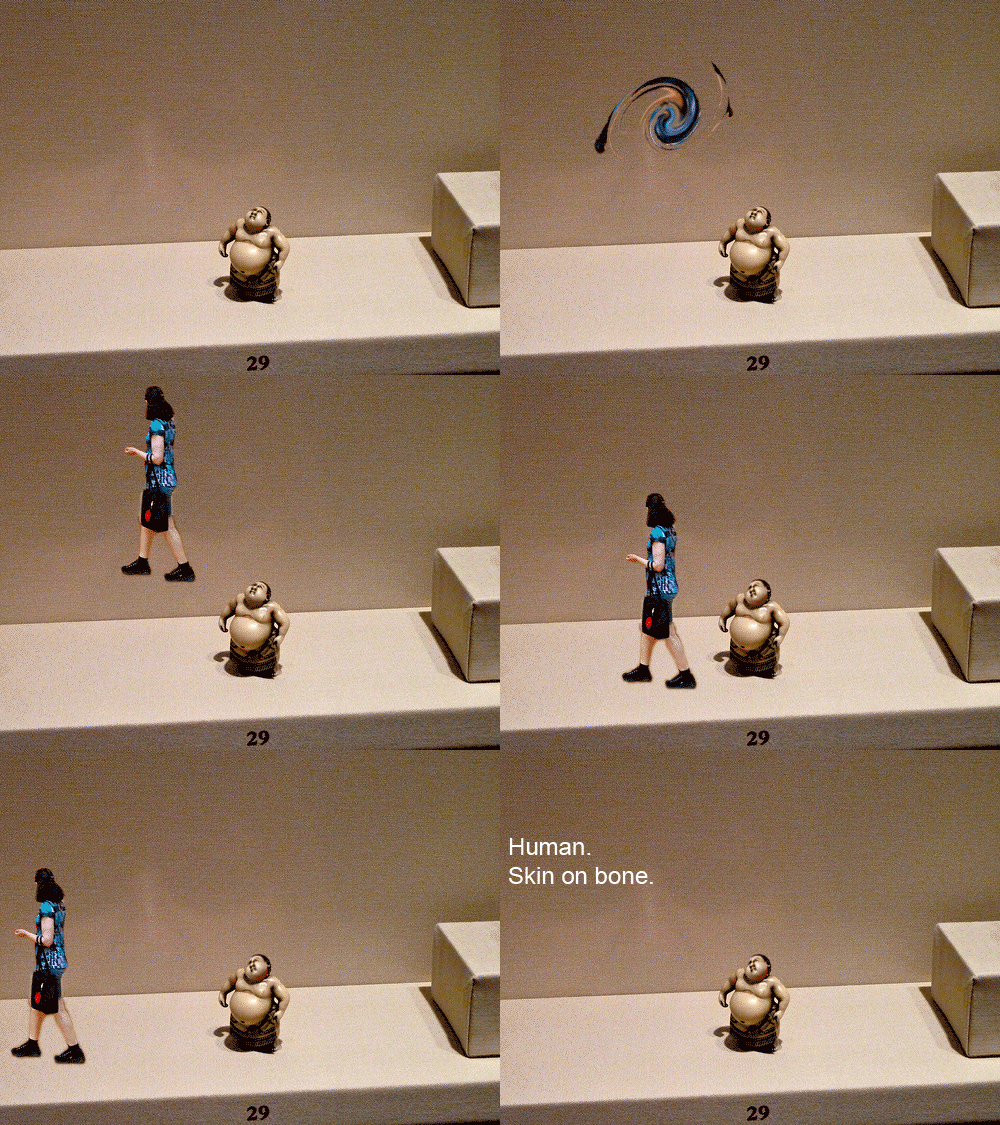
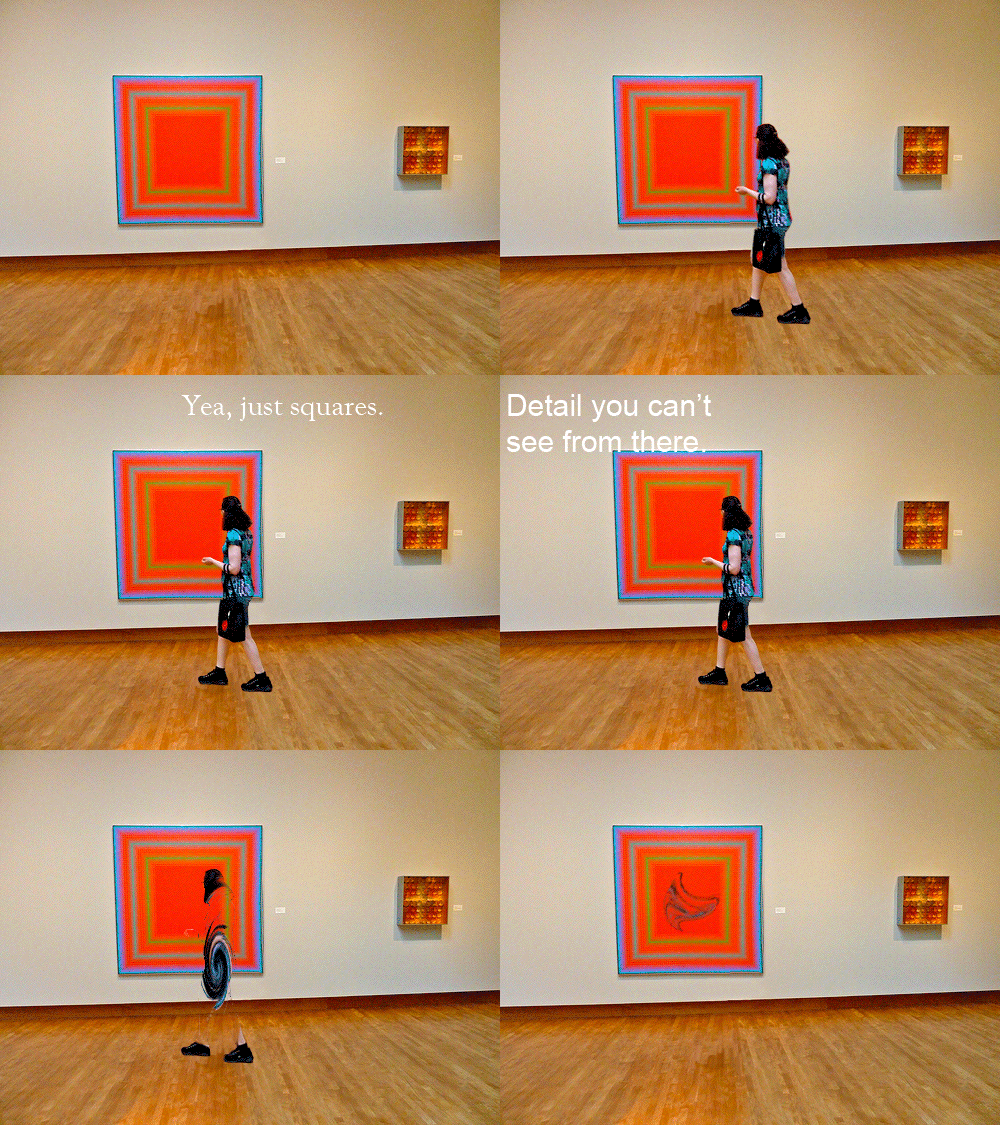
On the other side of the vortex...

Chip Ahoy follows my advice to "keep looking"...


... and he found the other side of that vortex.


There are portals everywhere!

Saturday, May 19, 2012

In the empty museum...

Untitled

Untitled

... I guess I was the only one with no place better to be.

Tuesday, March 13, 2012

One year ago at the Wisconsin protests: Protesters redirect hopes to the Wisconsin Supreme Court election.

"April 5, keep hope alive, vote Kloppenburg."

I photographed damage
done to the door plates and hinges by the protesters.

And the Smithsonian sends a curator to Madison to select protests signs "to document, in general, occasions when American citizens interact with their government and petition... for change."

And Meade removes another war monument desecration — the "Solidarity" T-shirt on the Heg statue.

I do my "won — duh! — in the rotunda" poem.

Friday, March 2, 2012

The fake-but-accurate story — smearing Paul Ryan and Ron Johnson — that appeared in Madison's Cap Times last Saturday.

The Cap Times reveals that it published, then took down a story that "falsely said that U.S. Rep. Paul Ryan and U.S. Sen. Ron Johnson were joining state Rep. Steve Nass, R-town of La Grange, in pressuring the Smithsonian’s National Museum of American History to purge its archives of posters from last year’s protests at the Capitol in Madison."
The story was based on a news release that purportedly came from Nass’ office, but was in fact fabricated by Madison labor cartoonist Mike Konopacki [who] sent the fake release to a staff member who then forwarded it to Associate Editor John Nichols, who wrote the story.

The release seemed plausible because on Wednesday, The Capital Times reported that the University of Wisconsin-Extension’s School for Workers abruptly called off an event called “Art in Protest” connected to the Capitol protests after a Nass aide told its organizers that it would be in poor taste. The organizers said publicly that they called off “Art in Protest” for a “variety of reasons” and that “now is not the best time” for it, but the story paraphrased two informed sources anonymously saying that Nass’ office threatened the school’s funding.

Konopacki helped organize the canceled event, and in that story, he was quoted as saying: “I understand why the School for Workers had to make this move. They're in survival mode. But I'm outraged. This is an attack on freedom of speech and freedom of expression, and is an attack on academic freedom.”

Nichols wrote a short story based on the fake release and made follow-up calls to flesh out the story, but began to have doubts when he discovered that other sources had not heard about the release.

Questioned about the release, Konopacki revealed that he created it using Photoshop. He said he intended it as a prank (in an initial email he said he “wanted to point out the hypocrisy between allowing Wisconsin protest art in the Smithsonian but not at the Pyle Center” where “Art in Protest” would have taken place), but is apologetic about the confusion it created.
The Cap Times took the embarrassing and libelous story down after 40 minutes.

By the way, John Nichols has a new book: "Uprising: How Wisconsin Renewed the Politics of Protest, from Madison to Wall Street." Meade and I have been reading it.

ADDED: In his book, Nichols is highly critical of the media for getting the story of the Wisconsin protests wrong. Excerpt:
While it was easy to laugh at Fox, it was harder to comprehend the coverage of events in Wisconsin by the New York Times. The Times can and does produce terrific reporting on a variety of fronts. In many senses, it remains the last bastion of old-school “newspaper of record” seriousness in a media landscape that is littered with the carcasses of once-great news-rooms, thus making it more important—and influential—in today’s news landscape than ever before in its history. The Times even has something that’s lacking at virtually every other print, broadcast, or digital news outlet in America today: a solid labor writer in the person of Steven Greenhouse. Unfortunately, he was not dispatched to Wisconsin to cover the story. The Times reporters who did come to Wisconsin brought with them some of major media’s worst misconceptions and biases with regard to unions and working-class people. And in so doing they became a part of the story, reinforcing Governor Walker’s intransigence.

Walker is a media junkie.... he reads, listens to, and watches media with an eye for how different outlets are interpreting and reacting to stories....

The Times... blew an even bigger piece of the Wisconsin story several weeks later. When Republican legislators used backroom maneuvers to pass Walker’s bill, the Times reported that the fight was “over.” But the editors in New York forgot to tell the people of Wisconsin....

The hundreds of thousands of Wisconsinites who rallied at their capitol and in communities across the state said by their very presence that they were no longer going to accept the official “line” from old-media outlets that failed them—and new media outlets that simply compounded the sins of the fathers by aggregating and amplifying the folly of media outlets that have replaced reporting with stenography to power. What dawned on Wisconsinites and their allies in other states was that the problem was not simply the overt bias of a Limbaugh or an O’Reilly but the overt ignorance of media outlets that imagined Americans no longer approved of organized labor—and would never ever stand in solidarity with a trade-union movement that was arguing for public services, public utilities, and public schools.

When media outlets got around to conducting polls on the issues that arose in the Wisconsin struggle, they found that, to paraphrase the old Firesign Theatre routine, everything they “knew” was wrong. A CBS News/New York Times survey, conducted shortly after Wisconsin exploded, revealed that six in ten Americans opposed the elimination of collective bargaining rights for public sector union workers, while 56 percent were opposed to the cutting of pay or benefits to reduce state budget deficits. The USA Today/Gallup survey released two weeks after Governor Walker made his proposal indicated that 61 percent of Americans were opposed to legislation that would take away the collective bargaining rights of unionized government workers. Only one in three of those surveyed backed any move to undermine protections for labor.

... Many was the day when an absurdly ill-conceived or simply inaccurate report on the front page of the Walker-supporting Wisconsin State Journal newspaper had been deconstructed by Sly and his guests before Madisonians had trudged out their front doors to find the offending publication in the snowbank where it had landed.

Thursday, December 30, 2010

"Am I the only person left in the world who worries about spilling his coffee on his laptop?"

2 years ago.

ADDED: I ran across that after reading the colloquy between AllenS and Meade in the comments to the post about Brett's fuzzy penis:
AllenS: Jenn Sterger (the woman) was hired because of some sexy pictures of her in Sports Illustrated mag, that Brent Musberger thought would be a good matchup for the male dominated football sports sceen. Jenn and Brent are just as much at fault here. I'm thinking of sending the woman a picture of my penis also. Could I borrow the fish bowl lens?...

Meade: It's a fish eye lens. Fish eye. It's for taking shots of massive objects or scenes which a normal lens can't take all in. A fish bowl lens would be for taking shots of tiny things. Like Brett Favre's... ability to make good judgments.
AllenS: Ok, ok. Can I borrow the lens that makes stuff look bigger?
But, in fact, the fisheye works really well to make something look large if you get the camera lens right up at it. Lots of other stuff is including in the picture, arrayed all around and looking comparatively small. Frankly — and this is not an offer to AllenS — it would be really interesting to take pictures of naked men and get the extreme closeup on the genitalia with a well-composed and interesting background. I went looking through my old posts with the "fisheye" tag to find some that prove my point.

The second picture here of the fisheye dog makes this point very well. Get right up to the nose. The scenery in the background isn't as interesting as I'd want for my proposed compositions, but you can see how tiny Meade looks in the background (when in fact he was quite close by). Here's another photograph that illustrates the point, albeit with the female body:

Cambodian sculpture at the Met

That's from the Khmer Dynasty room at the Metropolitan Museum in NYC. Here's the effect of the lens looking at the room from the other side:

Cambodian sculpture at the Met

Here's some male and female nudity, to be fair:

Museum of Natural History

That's the Museum of Natural History — not Brett and Jenn. You may recognize that couple from the movie "Election" — which is a great cautionary tale about the inadvisability of cheating on... many things (including your spouse).

And then — searching through the fisheye pictures — I found something that was extremely important to me: the purple tree, which had this.

"Do you guys TRY to not get laid?"

Saturday, December 11, 2010

Why did the Madison, Wisconsin arts center remove a photograph from its display "Living with HIV/AIDS: Perspectives Through the Lens"?

It's not like the HIV-themed, ants-on-Jesus video recently removed from the Smithsonian Institution's "Difference and Desire" show. Here in Madison, the sensitivities are quite different:
... "Stripped" features a nude male model seated in a chair with a handful of pill bottles covering his lap. Only his chest, arms and thighs are shown....

Thousands of school- and preschool-aged children walk through the hallway known as the Playhouse Gallery each week on their way to Overture shows, and officials were concerned that "a little kid could connect sickness with genitals" by looking at "Stripped," [Overture spokesman Rob] Chappell said.

Two other black and white photos by Oren — one portraying a nude male torso embraced by four male arms and the other showing a nude male covered by a pile of books — remain on the gallery's walls.

"It's the sickness attached to the genitals that we decided could be misinterpreted by a little kid," Chappell said. "It was never the topic that was an issue. We don't see any reason to shield kids from the fact that HIV exists, or that people with HIV are normal people and can express themselves through photography or any other way."
We don't want children to connect sickness with genitals.

Thursday, December 2, 2010

"Norman Rockwell would get the boot... if I believed in pulling everything that I'm offended by: I can't stand the view of America that he presents..."

"... which I feel insults a huge number of us non-mainstream folks. But I didn't call for the Smithsonian American Art Museum to pull the Rockwell show that runs through Jan. 2, just down the hall from 'Hide/Seek.' Rockwell and his admirers got to have their say, and his detractors, including me, got to rant about how much they hated his art. Censorship would have prevented that discussion, and that's why we don't allow it."

Writes Blake Gopnik about the ants-on-Jesus to-do.

Rush Limbaugh reacted:
Now, what is there to hate about Norman Rockwell? Very simply answered question: pro-America. Classic Americana. If you hate Norman Rockwell, you hate the flag. If you hate Norman Rockwell, you hate biscuits and gravy. If you hate Norman Rockwell, you hate breakfast. If you hate Norman Rockwell, you hate farms. If you hate Norman Rockwell, you hate grandmother. If you hate Norman Rockwell, you hate the family. What in the world is there to hate about Norman Rockwell?
Ha. I remember when everyone hated Norman Rockwell... and not just because he was regarded as an excessively literal illustrator and not a real artist.

(And by "everyone," I mean that in the sense that everyone voted against Nixon.)

Tuesday, November 30, 2010

"If they’ve got money to squander like this – of a crucifix being eaten by ants, of Ellen DeGeneres grabbing her breasts, men in chains, naked brothers kissing..."

"... then I think we should look at their budget," said Georgia Rep. Jack Kingston, a member of the House Appropriations Committee, scaring the Smithsonian Institution into taking down the ants-on-Jesus video. Cowed, the Institution nevertheless defended the artist, whose "intention was to depict the suffering of an AIDS victim." The museum assures us it had no "intention to offend."

Wednesday, August 25, 2010

"Kim Jong Il, the supreme commander of the Korean People’s Army, deeply concerned over the soldiers’ diet."

The title of a painting from an exhibit called "“Flowers for Kim Il Sung: Art and Architecture from the Democratic People’s Republic of Korea.... in Vienna.
By presenting it uncritically, the Vienna museum is subtly legitimizing the world’s cruelest regime....

Like most socialist realism, this “art” is devoid of complexity. Whatever talents the North Korean painters may possess are tragically subordinated to Stalinist politics and stultifying adulation of the Dear Leader. The descriptions of the artwork underline its utterly bland, primitive, and unenlightening character: “The leaders’ closeness to the people is repeatedly emphasized,” reads the press release. “Red, internationally recognized as being symbolic of socialism, is employed most frequently.” My tour guide’s attempt to distinguish the works from those produced in other Communist societies by labeling it “Idealistic Realism” only underscored the lengths to which the MAK has had to go in order to justify the exhibition....


Could one imagine, in the 1930s, an English gallery featuring Nazi art in such undiscerning fashion?...
What about a Viennese gallery? You'd think Austria would be more sensitive.... about its own reputation.

The article, by James Kirchick, ends with this great George Orwell quote: "All art is propaganda. On the other hand, not all propaganda is art." (By the way, Orwell is calling himself a propagandist there, is he not?)