In Cuba, today's "History of" country.
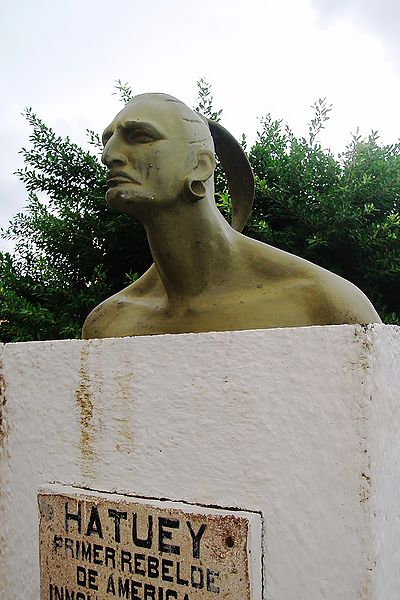
... Costa Rica was by and large unappreciated and overlooked by the Spanish Crown and left to develop on its own. The small landowners' relative poverty, the lack of a large indigenous labor force, the population's ethnic and linguistic homogeneity, and Costa Rica's isolation from the Spanish colonial centers in Mexico and the Andes all contributed to the development of an autonomous and individualistic agrarian society. Even the Governor had to farm his own crops and tend to his own garden due to the poverty that he lived in. An egalitarian tradition also arose. Costa Rica became a "rural democracy" with no oppressed mestizo or indigenous class.(In the "History of" project on this blog, we're going through the Wikipedia "History of" pages for all the 206 countries in the world, in alphabetical order.)
I wandered down by the PentagonWhat did she know of Andorra? What do you know?
This newspaper clipping in hand
I said, "I want to see everyone
In McNamara’s band."
I said, "Look what they did in Andorra,
They put us all to shame.
The least is first, the biggest is last,
Let’s get there just the same."
Andorra is the last independent survivor of the Marca Hispanica, the buffer states created by Charlemagne to keep the Islamic Moors from advancing into Christian France.This isn't Malvina's cute little child of a place that doesn't know war. It owes its existence to a French strategic defense.
Tradition holds that Charlemagne granted a charter to the Andorran people in return for their fighting the Moors. In the 9th century, Charlemagne's grandson, Charles the Bald, named the Count of Urgell as overlord of Andorra. A descendant of the count later gave the lands to the Diocese of Urgell, headed by Bishop of Urgell.4 hams!
In the 11th century, fearing military action by neighboring lords, the bishop placed himself under the protection of the Lord of Caboet, a Catalan nobleman. Later, the Count of Foix became heir to the Lord of Caboet through marriage, and a dispute arose between the French Count and the Catalan bishop over Andorra..
In 1278, the conflict was resolved by the signing of a pareage (pariatges).... The pareage, a feudal institution recognizing the principle of equality of rights shared by two rulers.... In return, Andorra pays an annual tribute or questia to the co-rulers consisting of four hams, forty loaves of bread, and some wine.
In 1793, the French revolutionary government refused the traditional Andorran tribute as smacking of feudalism and renounced its suzerainty, despite the wish of the Andorrans to enjoy French protection and avoid being under exclusively Spanish influence....
During World War II, Andorra remained neutral and was an important smuggling route from Spain into France. The French Resistance used Andorra as part of their route to get downed airmen out of France....
In 1958, Andorra declared peace with Germany, having been forgotten on the Treaty of Versailles that ended World War I and, the conflict being extended by the lack of a peace treaty, remaining legally at war.


Berber territory was annexed by the Roman Empire in AD 24. Increases in urbanization and in the area under cultivation during Roman rule caused wholesale dislocations of Berber society, and Berber opposition to the Roman presence was nearly constant....Colonization by the French began in 1830.
Christianity arrived in the 2nd century AD. By the end of the 4th century, the settled areas had become Christianized, and some Berber tribes had converted en masse....
The 8th and 11th centuries AD, brought Islam and the Arabic language....
In the central Maghrib, the Abdalwadid founded a dynasty at Tlemcen in Algeria. For more than 300 years, until the region came under Ottoman suzerainty in the 16th century, the Zayanids kept a tenuous hold in the central Maghrib. Many coastal cities asserted their autonomy as municipal republics governed by merchant oligarchies, tribal chieftains from the surrounding countryside, or the privateers who operated out of their ports. Nonetheless, Tlemcen, the “pearl of the Maghrib,” prospered as a commercial center.
The final triumph of the 700-year Christian reconquest of Spain was marked by the fall of Granada in 1492. Christian Spain imposed its influence on the Maghrib coast by constructing fortified outposts and collecting tribute. But Spain never sought to extend its North African conquests much beyond a few modest enclaves. Privateering was an age-old practice in the Mediterranean, and North African rulers engaged in it increasingly in the late 16th and early 17th centuries because it was so lucrative. Algeria became the privateering city-state par excellence.....
Algeria and surrounding areas, collectively known as the Barbary States, were responsible for piracy in the Mediterranean Sea, as well as the enslaving of Christians, actions which brought them into the First and Second Barbary War with the United States of America.
Viewed by the Europeans with condescension at best and contempt at worst, the Algerians endured 132 years of colonial subjugation. From 1856, native Muslims and Jews were viewed as French subjects, but not French citizens.Abdelaziz Bouteflika became president in 1999 and "concentrated on restoring security and stability." He remains president to this day.
However, in 1865, Napoleon III allowed them to apply for full French citizenship, a measure that few took, since it involved renouncing the right to be governed by sharia law in personal matters, and was considered a kind of apostasy; in 1870, French citizenship was made automatic for Jewish natives, a move which largely angered the Muslims, who began to consider the Jews as the accomplices of the colonial power. Nonetheless, this period saw progress in health, some infrastructures, and the overall expansion of the economy of Algeria, as well as the formation of new social classes, which, after exposure to ideas of equality and political liberty, would help propel the country to independence. During the years of French domination, the struggles to survive, to co-exist, to gain equality, and to achieve independence shaped a large part of the Algerian national identity....
A new generation of Islamic leadership emerged in Algeria at the time of World War I and grew to maturity during the 1920s and 1930s. Various groups were formed in opposition to French rule....
The Algerian War of Independence (1954–1962), brutal and long, was the most recent major turning point in the country's history. Although often fratricidal, it ultimately united Algerians and seared the value of independence and the philosophy of anticolonialism into the national consciousness....
Between 350,000 and 1 million Algerians are estimated to have died during the war, and more than 2 million, out of a total Muslim population of 9 or 10 million, were made into refugees or forcibly relocated into government-controlled camps. Much of the countryside and agriculture was devastated, along with the modern economy, which had been dominated by urban European settlers (the pied-noirs). French sources estimated that at least 70,000 Muslim civilians were killed or abducted and presumed killed, by the [Front de Libération Nationale] during the Algerian War. Citizens of European ethnicity... and Jews were also subjected to ethnic cleansing. These nearly one million people of mostly French descent were forced to flee the country at independence due to the unbridgeable rifts opened by the civil war and threats from units of the victorious FLN; along with them fled Algerians of Jewish descent and those Muslim Algerians who had supported a French Algeria (harkis). 30-150,000 pro-French Muslims were also allegedly killed in Algeria by FLN in post-war reprisals....
On 19 June 1965, Houari Boumédienne deposed Ahmed Ben Bella in a military coup d'état that was both swift and bloodless....
Boumédienne’s death on December 27, 1978 set off a struggle within the FLN to choose a successor....
After the violent 1988 October Riots, a new constitution was adopted in 1989 that allowed the formation of political associations other than the FLN....
Among the scores of parties that sprang up under the new constitution, the militant Islamic Salvation Front (FIS) was the most successful....
In 1996 a referendum introduced changes to the constitution, enhancing presidential powers and banning Islamist parties.

Since 2007 and the start of the financial crisis, bullfighting has come under pressure in Spain because of public subsidy cuts, slashing the number of fights by more than a third. Catalonia stopped bullfighting in September, after its regional Parliament voted to ban it.
But in November, the conservative Popular Party, led by Mariano Rajoy, returned to power after almost eight years of Socialist government. Mr. Rajoy is himself an aficionado of the sport and his party has long spearheaded efforts to enshrine bullfighting in the national cultural patrimony.
Just Roca, 56, a specialist in sexology... compares the campaign against nudity to a parallel proposal to ban the wearing of the Muslim women’s veil, often called the burqa, in public places, as several nearby cities in the Catalonia region have done and as the Barcelona City Council is considering. Mr. Roca called both measures forms of segregation. “It’s like ‘No Negroes,’ ” he said. Just as politicians fear that a burqa-clad woman has something to hide, he said, “they imagine an undressed person has something to hide, too."
After the Spain trip brought the first extended bad press of her time as first lady, the White House, and some of its allies in the press, pushed back by claiming Mrs. Obama will still be much in demand. News accounts suggested her "sky-high popularity," her role as "cultural and fashion icon" and her "incredible force" will boost Democrats across the country.Key words: "of her time as first lady." Michelle Obama got bad press galore during the 2008 campaign. She got her image readjusted — feminized, really. She became the wonderful mom, fashion icon, and purveyor of vegetables. You can just imagine how much she liked doing that. But as she stretched out within the hyper-feminine role imposed on her, she got into the manifestation of femininity that rubs people the wrong way. Too much shopping and free-spending on superficial, materialistic pleasures. It's the classic feminine protest against confinement in a feminine role. Don't like it? Then don't limit powerful women that way. But if Michelle Obama isn't limited, most people won't like her. We saw that in 2008. I mean, I liked her, but it didn't play well generally.

After the interviewer presses him a couple times on the point and tries to focus him on the fact that Prime Minister Zapatero isn't from Mexico and isn't a drug lord either McCain comes back at her saying, "All I can tell you is that I have a clear record of working with leaders in the Hemisphere that are friends with us and standing up to those who are not. And that's judged on the basis of the importance of our relationship with Latin America and the entire region."I've listened to the audio, and what Marshall is missing is that when the interviewer says "But what about Europe?" it sounds as though she says "But what about you?" That's why McCain says "What about me, what?"
Then there's a moment of awkward pause before she says. "But what about Europe? I'm talking about the President of Spain."
McCain: "What about me, what?["]
Interviewer: "Are you willing to meet with him if you're elected president?"
McCain: "I am wiling to meet with any leader who is dedicated to the same principles and philosophy that we are for humans rights, democracy and freedom. And I will stand up to those who do not."
At this point, the interviewer gets tongue-tied presumably because she can't get over McCain not knowing what Spain is.
McCain foreign policy adviser Randy Sheunemann said McCain's answer was intentional.In other words, bumbling as it sounds, he meant to do that.
"The questioner asked several times about Senator McCain's willingness to meet Zapatero (and id'd him in the question so there is no doubt Senator McCain knew exactly to whom the question referred). Senator McCain refused to commit to a White House meeting with President Zapatero in this interview," he said in an e-mail....
Asked to explain McCain's apparent shift in tone and position since April, Scheunemann gave almost no ground.
"In this week's interview, Senator McCain did not rule in or rule out a White House meeting with President Zapatero, a NATO ally," he said in an e-mail. "If elected, he will meet with a wide range of allies in a wide variety of venues but is not going to spell out scheduling and meeting location specifics in advance. He also is not going to make reckless promises to meet America's adversaries. It's called keeping your options open, unlike Senator Obama, who has publicly committed to meeting some of the world's worst dictators unconditionally in his first year in office."

Of all the major American artists, Allen has experienced one of the cruelest and most violent whipsaws of fortune, of tumbling from audience adulation to mass approbation.Wow, quite a tumble!
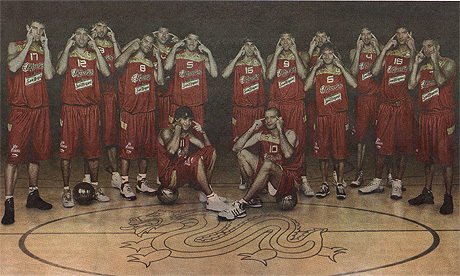
No one involved in the advert appears to have considered it inappropriate nor contemplated the manner in which it could be interpreted in China and elsewhere. No offence was intended by the advert, but whether the Chinese see it that way is a different matter and it is likely to provoke more criticism at a delicate time for Spanish sport.Oh, the problem of gestures that seem OK in one country but are terribly offensive in another! How are we to keep track of them all?
“If anyone feels offended by it, we totally apologize for it,” the Spanish star Pau Gasol said. “We never meant anything offensive by it.”
Emmanuelle Moreau, a spokeswoman for the International Olympic Committee, said in an e-mail message: “We understand that the Spanish team intended no offense and has apologized. The matter rests there as far as the I.O.C. is concerned.”...
The Spanish Coach, Aito García Reneses, declined to apologize for the picture, which he said he had not seen. He did not appear in the picture. He said the intention was a joke.
Declaiming from atop her white horse, her legs now conspicuously parted as she straddles the jittery, stamping animal, she invokes God and country, blood and honor, life and death, bringing to mind at once Joan of Arc, Henry V, Winston Churchill and Tony Blair in one gaspingly unbelievable, cinematically climactic moment. The queenly body quakes as history and fantasy explode.This movie is getting a lot of bad reviews, possibly from people who don't get or don't appreciate what it's trying to do. Let's check in with Steven D. Greydanus of Decent Films Guide:
A lurid sort of Christopher Hitchens vision of history pervades Elizabeth: The Golden Age, Shekhar Kapur’s sequel to his 1998 art-house hit Elizabeth.Christopher Hitchens? He's everywhere. (Omnipresent.)
The earlier film, which made a star of Cate Blanchett as the eponymous Virgin Queen, celebrated the triumph of bright, happy Elizabethan Protestantism over the dark, unwholesome Catholic world of Bloody Mary. Even so, that film’s church-bashing was tame compared that of this sequel, in which everything bad, evil and corrupt in the world ultimately is ultimately the bitter fruit of Religion. And by Religion, I mean Catholicism....Wait. Isn't Spain al Qaeda?
In attacking England, Philip [II of Spain] is convinced that he’s on a mission from God: “England is enslaved to the devil,” he declares. “We must set her free.” Certain that God is on his side as he leads his nation into a holy war that becomes a debacle, Philip couldn’t be a blacker, nuttier Hollywood villain if his middle initial were W.
Other flirtations with topicality in this pre-election year include assassins and conspirators praying secretly in a foreign language while plotting their murderous attacks, and the Machiavellian Sir Francis Walsingham (returning Geoffrey Rush) torturing a captured conspirator during an interrogation. (Tom Hollander, who costarred with Rush in the Pirates of the Caribbean sequels, is running around somewhere in this picture, an odd juxtaposition in another film that ends with a sea battle with cannons.)Sex, religion, politics, pirates... Let's go to the movies!
The film does go on to concede that the Spanish have other grievances against the English besides religion, such as the Queen’s tolerant stance on English pirates like Walter Raleigh (Clive Owen) raiding Spanish ships.

 :.

