

Showing posts with label breastfeeding. Show all posts
Showing posts with label breastfeeding. Show all posts
Saturday, February 9, 2013

Friday, January 25, 2013
"Weird things happen when you take price out of the equation for consumers. For one thing, they stop looking for the best price."
Yes. Obvious. I know. But this is NPR talking, which is what struck me.
(The topic is the breast pumps that must be paid for by health insurance companies under Obamacare.)
(The topic is the breast pumps that must be paid for by health insurance companies under Obamacare.)
Friday, January 11, 2013
"The ordinary people were not happy. They loathed the Emperor's interference in every detail of their daily lives."
"Why should they be forbidden to bake ginger-bread just because Joseph thought it bad for the stomach? Why the Imperial edict demanding the breast-feeding of infants? Why the banning of corsets? From these and a thousand other petty regulations, enforced by a secret police, it looked to the Austrians as though Joseph were trying to reform their characters as well as their institutions. Only a few weeks before Joseph's death, the director of the Imperial Police reported to him: 'All classes, and even those who have the greatest respect for the sovereign, are discontented and indignant.'"
From the History of Austria. Joseph II, who ruled from 1780 to 1790.

Austria is our "History of" country today, as we proceed through the 206 countries of the world using the Wikipedia summaries. So much has happened in Austria over the ages. The "History of" project cannot begin to summarize the summary. I merely offer up a snippet, one thing that struck me as something that might have particular resonance. But it is only one of many things. For example, from 25,000 BC:

From the History of Austria. Joseph II, who ruled from 1780 to 1790.

Austria is our "History of" country today, as we proceed through the 206 countries of the world using the Wikipedia summaries. So much has happened in Austria over the ages. The "History of" project cannot begin to summarize the summary. I merely offer up a snippet, one thing that struck me as something that might have particular resonance. But it is only one of many things. For example, from 25,000 BC:

Saturday, January 5, 2013
"The breast pump industry is booming, thanks to Obamacare."
"Tucked within the Affordable Care Act is a provision requiring insurance companies to cover 'the costs of renting breastfeeding equipment'..."
Let's say, now that we're all becoming so involved in the overall economics of healthcare, that we wanted to boost the health of the babies in the insurance pool by making every mother breastfeed (unless she can't and gets a doctor's excuse note). You couldn't simple mandate breastfeeding, because it's too intimately concerned with the woman's body. You'd be violating her rights, but you wouldn't even reach that legal question, because it would be too politically ugly to go there. How about imposing higher health-care premiums for women who have babies, then choose not to breastfeed? That's also unpleasant. And how would you spy on women to check what they were doing? You could slap some big tax on baby formula, but that punishes even the women who can't breastfeed, and it nudges people to buy some alternative product — milk being an obvious substitution.
So make the pumps free so the manipulation feels good.
And here's a business sector that will do fabulously well: the pump-makers. The politicians score triply: 1. Female service to baby health is harnessed, 2. Women feel happy about getting things, and 3. A business booms.
ADDED: Times have really changed:
“The law states that we must provide rental pumps,” said UnitedHealthcare spokesman Matthew Stearns. “These pumps are hospital-grade, and they are larger, harder to clean and more expensive than personalized pumps for women. We are providing women the option of getting a personal pump in lieu of renting the more-expensive pump.”People will do what is incentivized. If breastfeeding is — as we've been told — extremely beneficial to the new baby (and the old baby?), then we ought to want to encourage women to do it. We can't force them to do it, but what we can do is make it easier. I'm very interested in the way the health-care law is going to be a mechanism for manipulating human behavior. By requiring the offering of something that feels like a gift, the government manages the moods of women who would be outraged — rightly outraged — to be told they must breastfeed.
Let's say, now that we're all becoming so involved in the overall economics of healthcare, that we wanted to boost the health of the babies in the insurance pool by making every mother breastfeed (unless she can't and gets a doctor's excuse note). You couldn't simple mandate breastfeeding, because it's too intimately concerned with the woman's body. You'd be violating her rights, but you wouldn't even reach that legal question, because it would be too politically ugly to go there. How about imposing higher health-care premiums for women who have babies, then choose not to breastfeed? That's also unpleasant. And how would you spy on women to check what they were doing? You could slap some big tax on baby formula, but that punishes even the women who can't breastfeed, and it nudges people to buy some alternative product — milk being an obvious substitution.
So make the pumps free so the manipulation feels good.
And here's a business sector that will do fabulously well: the pump-makers. The politicians score triply: 1. Female service to baby health is harnessed, 2. Women feel happy about getting things, and 3. A business booms.
ADDED: Times have really changed:
I remember in the early 70s, Ms. Magazine, in its early days, constantly attacked La Leche League, a pro-breastfeeding group. It was considered anti-feminist at the time to encourage women to breastfeed. Breastfeeding promoters had an ulterior motive (according to Ms.): keeping women at home.The pump is a device to obscure this criticism. It represents a weird kind of freedom. This human organism needs your body, frequently, but you can get your distance if you attach yourself, diligently and efficiently, to the electrical suction machine. The aesthetics of breastfeeding are radically transformed. The leisure and the ease of natural breastfeeding while tending to various household tasks are superseded by a busy schedule stacked with duties — going to work, getting through work while slotting in the regular suctioning of the mammaries, getting home, taking care of all the same household tasks, and slotting in some time to bond with the child. Was this worth it? Hey, don't be glum. Here's a present for you: A milk-extraction machine. Happy?
Saturday, October 27, 2012
Woman found guilty of giving cannibis to her baby... via breast milk.
In New Zealand, where the senior court official said: "Child abuse is family violence in these circumstances, and it is clear this baby and its mother needed help."
Friday, June 1, 2012
"Pennsylvania man was arrested yesterday after he confessed to hiding a video camera above the desk of a female coworker..."
"... so that he could secretly film her pumping breast milk, police report."
... He is pictured above in a photo from his Facebook page that appears to show him drinking a margarita from a glass shaped like a female torso that is outfitted in a pink bikini.
Friday, May 11, 2012
Let's talk about the "Are You Mom Enough?" Time magazine cover.
Alexandra Petra has a WaPo column titled "Time magazine and our mommy porn fixation", and I'm going to make you click through to it if you want to look at the cover, because if you're going to call that cover "mommy porn," why isn't it also child porn? I'm not going to display the picture here.
(It's a 5 or 6 year old boy sucking on the naked breast of an adult woman.)
ADDED: How old is that child actually? This article says it's "26-year-old mother Jamie Lynne Grumet" with "her near-four-year-old son." Sorry, he looked older to me. I guess the breast milk is promoting growth... or maybe she's tiny.
(It's a 5 or 6 year old boy sucking on the naked breast of an adult woman.)
ADDED: How old is that child actually? This article says it's "26-year-old mother Jamie Lynne Grumet" with "her near-four-year-old son." Sorry, he looked older to me. I guess the breast milk is promoting growth... or maybe she's tiny.
Ms Grumet told Time she also breastfeeds Aram's five-year-old adopted brother, Samuel, and recalls how she was breastfed by her own mother until the age of six.So there you have it. Breastfeeding not just for infants and toddlers, but for children who have surpassed toddlerhood. As for the child porn/pedophilia issue I've raised (in response to Petra's rhetoric):
"There are people who tell me they're going to call social services on me or that it's child molestation," Ms Grumet tells Time. "People have to realise this is biologically normal. It's not socially normal. The more people see it, the more it'll become normal in our culture."
Thursday, March 1, 2012
Men who take paternity leave without doing at least half of the baby care.
That would be nearly all of them, if we are to believe this study:
Only three of 109 male faculty members surveyed reported that they did half or more of the care, while 70 of 73 women reported doing at least half. On average, both men and women professors reported that the mother did more than half the work for all 25 of the child care tasks. This result holds even when the male professor's wife works full-time.Was breastfeeding included as one of the tasks? That would skew results. Also, these were professors. Professors are comfortable taking leave time away from work.
The female professors also reported higher average enjoyment scores than males on 24 of the 25 child care tasks. (The sole exception was managing the division of labor for parenting tasks, which men disliked less than women.)First of all, maybe those women are maintaining their self-esteem by getting into the frame of mind where they think about themselves as loving what they are doing. Also, that management-oriented man might be managing her moods, taking care of her, and that might not have been counted as one of the "child care tasks."
Interestingly, the report suggests that paternity leave be eliminated, because men are using it to further their careers, thereby creating greater inequity for women who actually take time off.Well, you can't do that. That would be illegal sex discrimination. But let's assume you could do it. Does it make sense? Let's give this advantage only to women, because, in the great majority of the cases, women will use it for the "right" reason and men will, as men tend to do, find ways to take selfish advantage of the opportunity. That's horrible sterotyping, which is why it's illegal, but quite aside from that, I don't like incentivizing the female professors' failure to take advantage of time off from teaching to work on their scholarship. And I don't like giving up on the ongoing project of mothers and fathers working out childcare arrangements together. And it's none of the employer's business how a man and a woman structure their activities within the home.
Friday, July 29, 2011
"This is the size I wanted them to look at 19!"
There should be more stories like this about regretting breast implants. A very young woman is making a decision that binds the much older version of herself. Eh! I guess that's the way life is about all sorts of things. Time only goes in one direction. (Although I did once read a very cool book where the amazing realization in the end was that time actually goes in the other direction. I'd name the book, but the spoiler would ruin it.)
Anyway, the implant-regretter in the linked news item is mostly sad about breast feeding. I'm wondering what these implanted breasts look like 20 or 30 or 40 years later. I imagine young women thinking they won't care what their breasts look like when they are 40 or 50 or 60. But as the voice of the future, let me say: You will!
Anyway, the implant-regretter in the linked news item is mostly sad about breast feeding. I'm wondering what these implanted breasts look like 20 or 30 or 40 years later. I imagine young women thinking they won't care what their breasts look like when they are 40 or 50 or 60. But as the voice of the future, let me say: You will!
Tuesday, January 18, 2011
"I am working to make a delicious Wisconsin human cheddar."
"I purchased the milk from [a woman who] shipped it to me in ice, from Wisconsin... I found [her] on an online marketplace for breast milk – where women regularly arrange to sell and donate their milk. It’s pretty interesting, women set the price of their breast milk depending on if they provide blood work, and also the health of their diet."
Via Metafilter.
This remind me of Ricky Gervais and that rice pudding. From his Newsweek list of things that annoy him:
Via Metafilter.
This remind me of Ricky Gervais and that rice pudding. From his Newsweek list of things that annoy him:
People who think they're "eccentric." What does that mean? You wear lots of different hats? You ride a funny-colored bike? That makes you eccentric? A friend of mine moved out to the country, and the woman next door came round; she was sort of hippie-ish, very long hair, back to nature, all that stuff. And she says, "I've made you a rice pudding, and I've made it with breast milk, because, you know, waste not, want not!" So my friend took it, threw it away, washed the dish and gave it back. He said to her, "Thanks, that was great!" I couldn't believe it. I told him that he should've said, "No, there is no way I'm eating that. Definitely not. Do not bring me any other bodily-function puddings."That's the cleaned-up-for-Newsweek version. Get the podcast, Series 5 Episode 2. I don't have a complete transcript, but Wikipedia quotes:
Ricky: Surely you draw the line there, of a stranger’s breastmilk.ADDED: The A.V. Club says:
Steve: Oh yeah yeah, no absolutely… any kind of jizz flan....
Ricky: Here’s a cum sandwich. It doesn’t matter if it’s natural, it’s fucking disgusting.
Of course, anyone looking to whip up some human cheese should definitely hit up the Dairy State for the breast milk, but that’s not the argument here. No, the real question is: Is cheese really the best place to start the “human milk” dairy product revolution?
Monday, August 10, 2009
Let's talk about that "breastfeeding doll."
Lisa Belkin writes about "Bebe Gloton," the doll that makes a sucky noise and mouth movement when placed next to plastic flower-shapes that are positioned at nipple level on a shirt to be worn by a little girl (or — I might add — boy):
Here's video showing the doll — and The Today Show's Hoda Kotb and Kathie Lee Gifford — in action:
I think it's pretty tame, actually. In any case, little girls (and boys!) who see their mothers breastfeeding younger siblings are likely to put their dolls up to their nipples and pretend to breastfeed. You don't need the additional technology to get that effect. My main objection to the doll is that it is annoying. I'd try not to buy kids toys that make irritating sounds. Leave more to the imagination.
And speaking of annoying sounds... Hoda Kotb and Kathie Lee Gifford... yeesh!
Dr. Ronald Cohen, medical director for the Mother’s Milk Bank in San Jose as well as director of the intermediate intensive care nursery at Lucile Packard Children’s Hospital at Stanford University, told ABC News, “My take is that anything which reminds young girls that their bodies are something other, and more, than sex objects, is a very good thing.” In the next sentence he added: “On the other hand, encouraging young girls to want to have babies at a very young age may not be so great.”Don't all baby dolls do that?!
Here's video showing the doll — and The Today Show's Hoda Kotb and Kathie Lee Gifford — in action:
I think it's pretty tame, actually. In any case, little girls (and boys!) who see their mothers breastfeeding younger siblings are likely to put their dolls up to their nipples and pretend to breastfeed. You don't need the additional technology to get that effect. My main objection to the doll is that it is annoying. I'd try not to buy kids toys that make irritating sounds. Leave more to the imagination.
And speaking of annoying sounds... Hoda Kotb and Kathie Lee Gifford... yeesh!
Friday, July 24, 2009
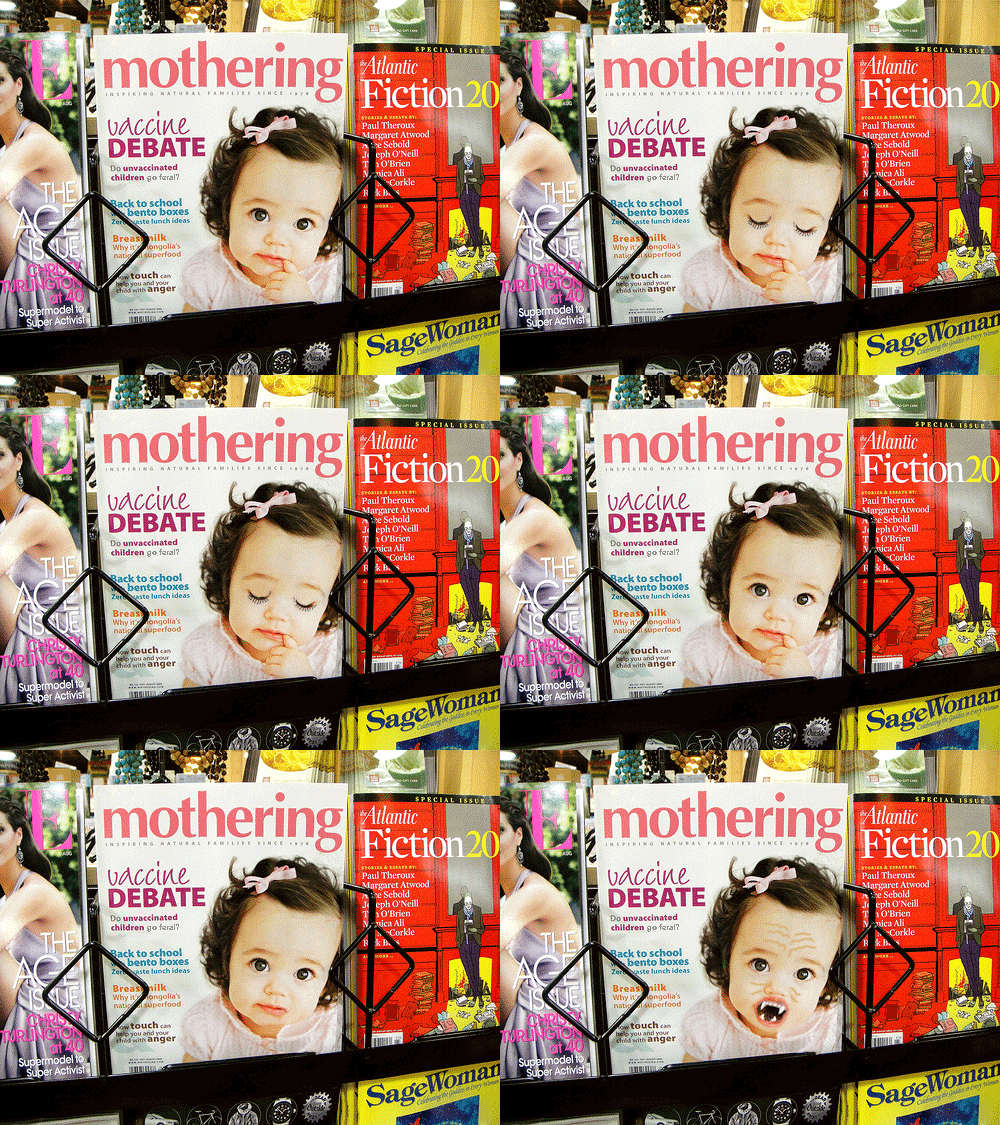
This magazine cover freaked me out.

Each element of it freaked me out more than the next. There's the big debate about whether it's okay for you not to get your child vaccinated because of the way other people's children are taking responsibility for keeping diseases out of the way of your precious bundle of purity. There are those bento box lunches. Breast milk and Mongolia. "How touch can help you and your child with anger."
And then there's that cover baby with the giant forehead. Photoshopped? But why? To convey braininess? Braininess in a baby who is looking to you for answers... questioning you... do you know enough about vaccination dangers, elite food packaging, breast milk in those distant places where people must be so wise and pure, and touch, come on, touch me — how?! — touch me or I might become enraged in ways that you — you with your tiny brain — cannot possibly imagine.
IN THE COMMENTS: rhhardin said:
Each element of it freaked me out more than the next.
That's a favorite, up there with "fills a much needed gap."
LOL. You got me there.
And Chip Ahoy says he's freaked out too:
Wednesday, April 29, 2009
Monday, March 30, 2009
Monday, March 2, 2009
Monday, February 16, 2009
Sunday, May 20, 2007
"The phrase Memory Almost Full came into mind, then I realised I'd seen it on a phone - you know, you must delete something."
The Guardian has a nice piece on Paul McCartney, who is about to release a record called "Memory Almost Full," with songs covering his life story and his anticipation of death:
Anyway, this Mr. Bellamy character sounds like the same guy as "The Fool on the Hill," which was a Paul song.
Speaking of The White Album:
At times, he appears to argue with himself about how autobiographical the songs are. Take Mr Bellamy, which is about a man in a desperate situation - refusing to come down from the roof of his house because he's happier up there with "nobody here to spoil the view, interfere with my plans ... I like it up here without you" - newspapers have suggested this is about his state of mind. But that's too easy, he says - for starters, he began writing this album when he and Mills were happily married, and anyway, this is a character-led vignette, a Beatles-esque short story.Hmm... well, I think writers start writing things about a marriage going bad before it actually does, either because somewhere in their head they realize where things will go or because in the process of writing they are analyzing a situation and become persuaded that what looks good on the surface is not actually good. But quite apart from that, outsiders don't know whether people who now appear happily married are still or ever were happily married. Happily married is the sort of thing you pretend to be. Happy is the sort of thing you pretend to be. Now, when people look unhappy, you can believe it -- though not always. These songwriter types -- and other sorts of poets and artists -- have reason to play the forlorn, angsty role. But, surely, some of them are sincere.
Anyway, this Mr. Bellamy character sounds like the same guy as "The Fool on the Hill," which was a Paul song.
"The common denominator is me. Even if I try and write, 'Desmond and Molly had a barrow in the market place', inevitably I come through the song."Yes, as a lightweight nitwit, Paul detractors would say. No, that's not me saying that. I'm imagining other people. I'd give a lot of credit to Paul for choosing "Ob-La-Di, Ob-La-Da" as his example, because he must know that it was conspicuously voted the Worst Song Ever. Personally, I think it's a cool song. For one thing, they repeatedly sing the word "bra" completely out of context just for fun (like "tit" in "Girl"). For another, the sex roles get reversed in the end. ("Desmond stays at home and does his pretty face.") But the main thing I like about it is that it is where it is in a sequence of songs on a great album that can't be thought of without all of its parts exactly how and where they are. (A feeling people won't have anymore in the future because of digitized music, and maybe you've already lost it.)
Speaking of The White Album:
Nowadays, when he tours, he feels at ease with his audience. "It's funny, a couple of American tours ago, I was singing Blackbird and I started to chat to the audience much more. I'm very confident like that now. I remembered stuff that I'd forgotten for 30 years in explaining it. I get a therapy session with the audience, and I go, 'Hold on, I remember what that came from, it was a Bach thing that George and I used to play'."They really should identify the Bach piece! Hey, I got the answer in 2 seconds from Wikipedia:
He gets up to fetch a guitar from beside the Wurlitzer and starts playing the Bach. "Is this in tune? Yes. So that's the Bach. See, that's the bastardisation of it, and then this is how it evolves into Blackbird." He plays beautifully to demonstrate the transition.
McCartney revealed on PBS's Great Performances (Paul McCartney: Chaos and Creation at Abbey Road), aired in 2006, that the guitar accompaniment for Blackbird was inspired by Bach's Bouree, a well known classical guitar piece. As kids, he and George Harrison tried to learn Bouree as a "show off" piece. Bouree is distinguished by melody and bass notes played simultaneously on the upper and lower strings. McCartney adapted a segment of Bouree as the opening of "Blackbird," and carried the musical idea throughout the song.Back to the Guardian:
[T]here are things he doesn't want to revisit. His divorce from Mills has not only been horribly public and extended, it has also involved a series of leaked allegations about McCartney's behaviour. The model family man has been portrayed by Mills as selfish, self-obsessed and violent - she has alleged that he refused to allow her to use a bedpan to save her crawling to the lavatory on her one leg, that he discouraged her from breastfeeding their daughter, Beatrice, because he wanted her breasts to himself, that he was a drunken pot addict who had hit her in an alcoholic rage.Think about how everything you're doing now in your marriage could be restated in divorce allegations. Aren't you a monster?
You know what people want to do to you at the moment, I say. No, he replies. And I reach over and give him a big hug. McCartney smiles. "People actually do that. I get a lorra that off people. I get people I don't even know saying, 'Look, mate'," and he gives himself a sympathetic pat on the arm. "A lot of people come up to you and offer their support. A lot of people have been through similar circumstances and feel they have to communicate it to you.""A lorra that"... if it means "a lot of," why did they write "a lot of" all those other times? The English!
"[T]here is a tunnel and there is a light and I will get there, and meantime I really enjoy my work and my family. I see people worse off than me, so I can put it in perspective. There's a thing we always used to quote in the 60s when things were rough: 'I walked down a street and I cried because I had no shoes, then I saw a man with no feet.' " It was an Indian parable, and that is one of the lines I live by."See, I told you! People used to always say that in the 60s! It's just a way to say "It could be worse," but "It could be worse" lacks the gruesome imagery.
Wednesday, October 4, 2006
Breastfeeding doesn't make kids smarter.
It's just that smarter mothers tend to breastfeed their kids. Why has it taken three-quarters of a century to puncture this myth, when the methodology -- described at the link -- was so easy?
Friday, September 1, 2006
Breastmilk-pumping.
Did you know some women use a device that pumps out their breastmilk while they are driving? That seems so wrong. But what do you think of all these other efforts women make to keep up with breastfeeding when they are separated from their babies? From my own experience with breastfeeding, I can't imagine wanting to keep it up once I'd gone back to work. The idea of using a mechanical pump is so unpleasant, and the milk seems too intimate to leave in the office refrigerator. (The picture at the link shows bags of milk -- cutesily labelled "My Mommy's Milk" -- on a freezer rack next to a box of black bean enchiladas.) And there's a huge problem -- not mentioned in the article -- that I'll just sum up in one word: leakage.
But apparently, a lot of women are working and pumping these days. I guess if you don't now, you're supposed to feel bad. It's hard enough to be a working mother without having people upping the standard of what it takes to do it passably well.
But as for the women who want to do it... they'd like more active accommodation by their employers. In pursuit of this goal, the linked NYT article takes the equality tack: Professional women are nicely accommodated by employers who offer posh "lactation rooms" and lots of time but working class women are stuck using the bathroom during their regular breaks. Are you softened up for some legislation yet?
I think we could support giving women more of a choice whether to stay home and breastfeed or go back to work and continue to breastfeed. There is so much pressure on women! It's hard to go through pregnancy and childbirth and to take care of an infant. Breastfeeding a pretty simple part of this if you have your baby close by. But you may need to go back to work or want to go back to work. I strongly support that. And I support the pumping approach if you can do it. And of course the employer should accommodate the physical needs you will have. But it's a much harder question whether there should be laws that allow you to sue if you think your employer hasn't helped you enough. But of all the things we ought to do to make life easier for mothers, we should quit making them feel like they have to go through the pumping routine. It's hard to work and have an infant at home. It's going to be harder if you have to pump breastmilk throughout the day while you're trying to pay attention to your work -- regardless of how accommodating the employer is. Frankly, quite aside from the pumping task, I would not want to have to try to concentrate on work with my breasts acting up continually.
Now, before you pile on in the comments, let me restate my point. I think it's fine and admirable for women to pump breastmilk in the workplace, and employers should voluntarily accommodate them, but legislation may not be needed, we shouldn't put pressure on women to keep up breastfeeding when they go back to work, and women who decide they don't want to do it should feel perfectly justified in their decision.
But apparently, a lot of women are working and pumping these days. I guess if you don't now, you're supposed to feel bad. It's hard enough to be a working mother without having people upping the standard of what it takes to do it passably well.
But as for the women who want to do it... they'd like more active accommodation by their employers. In pursuit of this goal, the linked NYT article takes the equality tack: Professional women are nicely accommodated by employers who offer posh "lactation rooms" and lots of time but working class women are stuck using the bathroom during their regular breaks. Are you softened up for some legislation yet?
[F]ederal law offers no protection to mothers who express milk on the job — despite the efforts of Representative Carolyn B. Maloney, Democrat of New York, who has introduced such legislation. “I can’t understand why this doesn’t move,” she said. “This is pro-family, pro-health, pro-economy.”One solution that's not mentioned is giving women longer maternity leaves so they can breastfeed the baby directly. But that, ironically, would violate the Equal Protection Clause! Maternity leaves in excess of the pregnancy disability period of eight weeks -- unless an equal period is given to new fathers -- is unconstitutional sex discrimination. That's the plain implication of the Supreme Court's opinion in Nevada v. Hibbs -- upholding the Family and Medical Leave Act as an exercise of Congress's Fourteenth Amendment power -- as I pointed out in a law review article (PDF):
Meanwhile, states are stepping in. Twelve states have passed laws protecting pumping mothers — Oklahoma’s law, the newest, will take effect in November. But like Oklahoma’s, which merely states that an employer “may provide reasonable break time” and “may make a reasonable effort” to provide privacy, most are merely symbolic.
There was no recognition in Hibbs that a state might, without engaging in mere sex stereotypes, genuinely think that more than eight weeks are needed to recover from pregnancy and childbirth or might, quite apart from stereotypes about who ought to take care of a baby, want to facilitate breast-feeding for a period longer than eight weeks.When I was writing that article, I asked a colleague why no one brought up breastfeeding. She didn't have any ideas about why the states wouldn't use breastfeeding to account for treating men and women differently when it comes to giving leave to new parents (a key issue in Hibbs). But, she said, women's groups have not worked for breastfeeding leaves because it runs counter to their goal of pushing for requiring employers to accommodate breastfeeding employees. And, I would add, it conflicts with a preference for keeping women in the workplace. If a state offered more new parent leave to women in order to breastfeed, women's groups might construe it as an attempt to promote traditional sex roles, with the woman staying home with the baby. Can you tell the difference between a benefit and discrimination there? [ADDED: I should clarify that only government action violates the Equal Protection Clause, so that if the state is not the employer and if the new statutory law did not require longer leave for women, it would be possible to redo the statutory law that limits private employers.]
[FOOTNOTE} See Liz Galst, Babies Aren’t the Only Beneficiaries of Breast-Feeding, N.Y. TIMES, June 22, 2003, § 15, at 4 (noting the developing scientific evidence indicating that breastfeeding offers greater health benefits to children as well as to mothers). It is puzzling that there is no mention in the briefs or in the opinions of the issue of breast-feeding, which entails a real physical difference that can justify treating new mothers differently from fathers. The importance of accommodating breast-feeding women in the workplace should not make it seem invidious to support a new mother who wants to take a longer leave to procure this health benefit for herself and the infant, instead of struggling with breast-pumping or bringing the infant into the workplace. That medical research is developing in this area suggests the value of leaving room for experimentation with maternal leave policies.
I think we could support giving women more of a choice whether to stay home and breastfeed or go back to work and continue to breastfeed. There is so much pressure on women! It's hard to go through pregnancy and childbirth and to take care of an infant. Breastfeeding a pretty simple part of this if you have your baby close by. But you may need to go back to work or want to go back to work. I strongly support that. And I support the pumping approach if you can do it. And of course the employer should accommodate the physical needs you will have. But it's a much harder question whether there should be laws that allow you to sue if you think your employer hasn't helped you enough. But of all the things we ought to do to make life easier for mothers, we should quit making them feel like they have to go through the pumping routine. It's hard to work and have an infant at home. It's going to be harder if you have to pump breastmilk throughout the day while you're trying to pay attention to your work -- regardless of how accommodating the employer is. Frankly, quite aside from the pumping task, I would not want to have to try to concentrate on work with my breasts acting up continually.
Now, before you pile on in the comments, let me restate my point. I think it's fine and admirable for women to pump breastmilk in the workplace, and employers should voluntarily accommodate them, but legislation may not be needed, we shouldn't put pressure on women to keep up breastfeeding when they go back to work, and women who decide they don't want to do it should feel perfectly justified in their decision.
Sunday, December 4, 2005
"Taking a shower, washing your hair, drinking cold water, opening the window, watching television and even reading a book."
Things not to do after having a baby.
For my part, I refused to be a prisoner to tradition and blithely ignored these taboos. And Dong Ayi did not exactly complain when I took a shower or opened the window or drank iced water.Even if the rules seem absurd, they do serve many purposes. Look at how these rules intricately connected the new mother to her traditional culture, enforced elaborate special care for the mother, and guaranteed an extended celebration of the arrival of the baby. Of course, the modern new mother can resist and make fun, but at the same time, she appreciates the beauty and function of the traditional ways.
She would just fix me with a baleful glare... a silent warning of the error of my ways....
Food was another small battleground over which we skirmished.
The Chinese firmly believe that certain foods are beneficial after childbirth, particularly purple rice porridge with dates, pig trotter soup and black chicken broth.
On one memorable occasion, my in-laws even produced deep-fried pork-fat soup, which was surprisingly good.
The problem was that Dong Ayi firmly opposed my favourite foods: namely coffee, chocolate and bananas.
"Not for breastfeeding mothers," she said, banning them from my diet, "they're bad for Daniel's health."
I took the route of least resistance and meekly agreed, though I would visit friends' houses for clandestine coffee and secret bananas.
Subscribe to:
Posts (Atom)
 :.
:.
