
Showing posts with label Language Log. Show all posts
Showing posts with label Language Log. Show all posts
Wednesday, January 9, 2013

Tuesday, December 4, 2012
"Jerky 'sex scion' cops to Central Park lewdness."
Hard to read headline. You have to figure out that "cops" is a verb.
(I think this is what they mean by "crash blossoms" over at Language Log.)
(I think this is what they mean by "crash blossoms" over at Language Log.)
Friday, November 9, 2012
"We are all the other now."
A paradoxical iteration of the "We are all X (now)" trope, which I'm noticing just now, on a morning when I happened already to have deployed the "We are all X (now)" trope. (What I said was: "We are all little fucking internet douchebag pussies now." Yes, I actually said that. There was a context to it all, and yet it's startlingly truthy out of context.)
Saturday, November 3, 2012
Friday, November 2, 2012
"There's never been a day in the last four years I've been proud to be his vice president."
The Weekly Standard (linked by Drudge) thinks it has a hilarious Biden gaffe, but they've misheard/mistranscribed it. You have to have an ear for the "working class"-style mushing of syllables, but he's saying "There's never been a day in the last four years I haven't been proud to be his vice president." The boldface is spoken: I 'n' been.
IN THE COMMENTS: rhhardin says:
UPDATE: Language Log responds!
IN THE COMMENTS: rhhardin says:
I've listened to the audio at 0.35 speed and it's a precise "I've."...I disagree.
It's an east-coast kind of "n" ... sort of almost "i uh" like the "no" in "uh uh."rhhardin says:
"n" is voiced and there's no voicing in Biden's 've part.I note that I grew up in Delaware and I feel I understand the implied "n." And rh gives us his slowed down audio with repetition. I've listened, and I hear a sound after the "I" that I'm sure is the negative. There's this southern Jersey/northern Delaware/Philadelphia dropping of a sound that I can her. There's a muddled verb after the "I" that I just know. Rh says "Call in Language Log," and I will send an email. I think they will believe me. And not just for political reasons.
UPDATE: Language Log responds!
Thursday, August 2, 2012
"There's a special place in purgatory reserved for scientists who make bold claims based on tiny effects of uncertain origin..."
"... and an extra-long sentence is imposed on those who also keep their data secret, publishing only hard-to-interpret summaries of statistical modeling."
The flames that purify their scientific souls will rise from the lake of lava that eternally consumes the journalists who further exaggerate their dubious claims. Those fires, alas, await Drew P. Cingel and S. Shyam Sundar, the authors of "Texting, techspeak, and tweens: The relationship between text messaging and English grammar skills", New Media & Society 5/11/2012....(Via Volokh.)
Saturday, June 30, 2012
"I believe in an America where millions of Americans believe in an America that's the America millions of Americans believe in."
"That's the America I love."
Said Mitt Romney according to Doonesbury, which made fun of it, and Language Log's Geoffrey K. Pullum was initially inclined to mock, and then thought about it, and realized he agreed with it.
One thing that gave him second thoughts is that his co-blogger Mark Liberman had already processed the quote, using the sublime technique of sentence diagramming. Which is nice.
But the more important basis for second thinking is that when you get to Liberman's old post, you find out that Romney didn't even speak those words. Mark Steyn did, and he was purporting to paraphrase Romney, for humorous effect. Pullum found out he was laughing at Steyn and Steyn was trying to make us laugh, and suddenly the quote wasn't funny anymore. Pullum, the liberal, was initially enjoying laughing at Romney — and his vapid dorkiness — and then he found out he was laughing at something a big right-winger — Steyn — had intended as a joke. Hey, that's not funny!
Pullum regains his sense of self-liberalism and goes into 4th of July mode:
Said Mitt Romney according to Doonesbury, which made fun of it, and Language Log's Geoffrey K. Pullum was initially inclined to mock, and then thought about it, and realized he agreed with it.
One thing that gave him second thoughts is that his co-blogger Mark Liberman had already processed the quote, using the sublime technique of sentence diagramming. Which is nice.
But the more important basis for second thinking is that when you get to Liberman's old post, you find out that Romney didn't even speak those words. Mark Steyn did, and he was purporting to paraphrase Romney, for humorous effect. Pullum found out he was laughing at Steyn and Steyn was trying to make us laugh, and suddenly the quote wasn't funny anymore. Pullum, the liberal, was initially enjoying laughing at Romney — and his vapid dorkiness — and then he found out he was laughing at something a big right-winger — Steyn — had intended as a joke. Hey, that's not funny!
Pullum regains his sense of self-liberalism and goes into 4th of July mode:
It's nearly the 4th of July.... I love being back in America. It's like slipping into an old pair of shoes that really fit.... I don't think I can find anything mistaken in the passage. I think I believe in that America too. God bless it, anyway.His post ends with a note that it's completely rewritten, because he apparently had originally assumed Romney did say those words, hadn't seen Liberman's old post, and went the mockery.
Wednesday, June 13, 2012
Monday, June 4, 2012
Tuesday, May 22, 2012
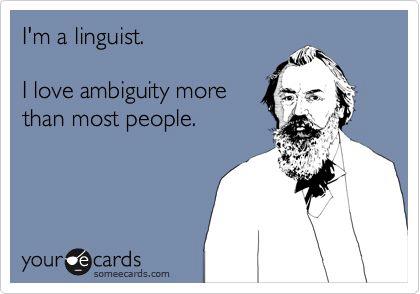
Monday, February 20, 2012
Thursday, January 5, 2012
"Occupy protesters offered lesson in free speech."
Is that headline supposed to mean the protesters are giving a lesson or getting a lesson? Surprisingly, it's the latter:
"Many Occupy L.A. protesters arrested during demonstrations in recent months are being offered a unique chance to avoid court trials: pay $355 to a private company for a lesson in free speech...."Naturally, part of my surprise was due to the prospect of citizens being required to fork over money to a private business, which would teach them about the limits to their constitutional rights, in exchange for a reprieve from the legal repercussions of civil disobedience. But I was also surprised to find that, contrary to my breezy reading of the headline in which I'd parsed the phrase Occupy protesters as the subject of the verb offered in the active voice, I should have read offered as being in the passive voice, with the protesters being the recipients of free-speech lessons rather than the purveyors of those lessons.
Saturday, December 17, 2011
"China is known for its fake Apple stores, fake Starbucks, and fake practically everything else."
"In this instance, it would seem that Mayor Wang is determined to make his English castle town a consummate fake."
There's also the idea of not having the experience at all, just getting a false memory of a vacation injected into your brain. That was Philip K. Dick's idea in "We Can Remember It For You Wholesale":
Beijing's suburban Miyun County is going to build a large European-style town within five years and no one will be allowed to speak Chinese there, said the county mayor.Is this absurd fakery or the wave of the future? Why do we subject ourselves to the rigors of travel to faraway places? Perhaps the real question is: Why even build the fake village? It's nearly possible...
Wang Haichen said a local village would be turned into a 67-hectare English castle with 16 courtyards of unique houses. It will offer visitors souvenir passports and ban Chinese speaking to create the illusion of being abroad....
There's also the idea of not having the experience at all, just getting a false memory of a vacation injected into your brain. That was Philip K. Dick's idea in "We Can Remember It For You Wholesale":
I will go, he said to himself. Before I die I’ll see Mars.The story is only 17-pages long — read it in this book — so it's a lot faster than that Arnold Schwarzenegger movie, but perhaps, in the future, we'll have Arnold Schwarzenegger movies injected directly into our brains....
It was, of course, impossible, and he knew this even as he dreamed. But the daylight, the mundane noise of his wife now brushing her hair before the bedroom mirror – everything conspired to remind him of what he was. A miserable little salaried employee, he said to himself with bitterness.
We can't let him run around. He knows too much.
Friday, November 11, 2011
Friday, September 10, 2010
"Ann Althouse for president?"
What is Language Log talking about now?
You know, I just got done telling you (close) readers that I've never been interested in any sort of leadership position. I'm the independent individualist type. I'm all about autonomy, not making everybody else's problems my problems.
And I don't do elaborate charts with numbers, so I don't know what Language Log is talking about. I'm into language.... log.
You know, I just got done telling you (close) readers that I've never been interested in any sort of leadership position. I'm the independent individualist type. I'm all about autonomy, not making everybody else's problems my problems.
And I don't do elaborate charts with numbers, so I don't know what Language Log is talking about. I'm into language.... log.
Wednesday, September 8, 2010
Sunday, August 8, 2010
Thursday, June 3, 2010
When the audience has a laugh leader.
Mark Liberman at Language Log complains about an "inappropriate" laugh leader in an audience at a Chekhov play:
But I am very interested in laugh leading. When I go to the movies or a play, I find that I myself am a laugh leader. It don't laugh loudly, but I am the first person to laugh at a lot of things, and I get other people laughing. I'm not trying to go first. It's just that a lot of Americans — especially at high-art type movies and plays — are too polite or insecure about laughing. They'll sit there silently while all sorts of subtly funny things are happening as if they need to laugh lines and broad comedy to give them confidence. People seem to be unsure of their own perceptions or just numbed to nonobvious comedy.
A good laugh leader can lubricate the audience and intensify the pleasure of witnessing a performance with others. Of course, a bad laugh leader is a problem, especially if there are live actors on stage. But it's that fear of laughing first and laughing wrongly that holds so many people back and puts a premium on good laugh leading.
There was someone in the back of the theater with a loud and infectious laugh, who didn't laugh at any of the obviously funny lines, but instead laughed — maybe a hundred times — at a selection of lines that is not easy to characterize....In the comments, Richard Bell said:
The laugher's interventions mostly seemed to me to be points where a character changed the subject, or said something that was unexpected in the context of the previous discourse, or said or did something awkward or socially uneasy....
But there were other theories. One person thought that the laugher might have been a friend of a couple of the actors, who reacted whenever one of them entered the on-stage conversation. Another theory was that the laugher was reacting when the actors made certain expressive faces. These are obviously overlapping theories, and many others might be devised as well.
Is it possible this laugher was the one person who best understood and reacted to Chekhov's special comic gift? What you have suggested is, in fact, a pretty good description of Chekhovian comedy. His characters don't really listen to each other. Someone once said there is no dialogue in Chekhov; only interrupted monologues. They change the subject because they don't know what the subject is; they have not been listening.Now, Liberman says the laugh leader was "loud" and goes on to describe the actors seemingly reacting negatively to the laughing. So, it seems as though the laughing was bad in some special way that makes Bell's comment an incomplete response.
But I am very interested in laugh leading. When I go to the movies or a play, I find that I myself am a laugh leader. It don't laugh loudly, but I am the first person to laugh at a lot of things, and I get other people laughing. I'm not trying to go first. It's just that a lot of Americans — especially at high-art type movies and plays — are too polite or insecure about laughing. They'll sit there silently while all sorts of subtly funny things are happening as if they need to laugh lines and broad comedy to give them confidence. People seem to be unsure of their own perceptions or just numbed to nonobvious comedy.
A good laugh leader can lubricate the audience and intensify the pleasure of witnessing a performance with others. Of course, a bad laugh leader is a problem, especially if there are live actors on stage. But it's that fear of laughing first and laughing wrongly that holds so many people back and puts a premium on good laugh leading.
Tuesday, May 18, 2010
Saturday, May 8, 2010
"A nice" or "an ice"?
Think you can hear the difference?
I hope so, because I need people to hear the difference between "Ann Althouse" and "an Althouse." I feel so indeterminate sometimes.
I hope so, because I need people to hear the difference between "Ann Althouse" and "an Althouse." I feel so indeterminate sometimes.
Subscribe to:
Posts (Atom)
 :.
:.
