Freaky pic:

Stand back or squint to achieve the best effect.
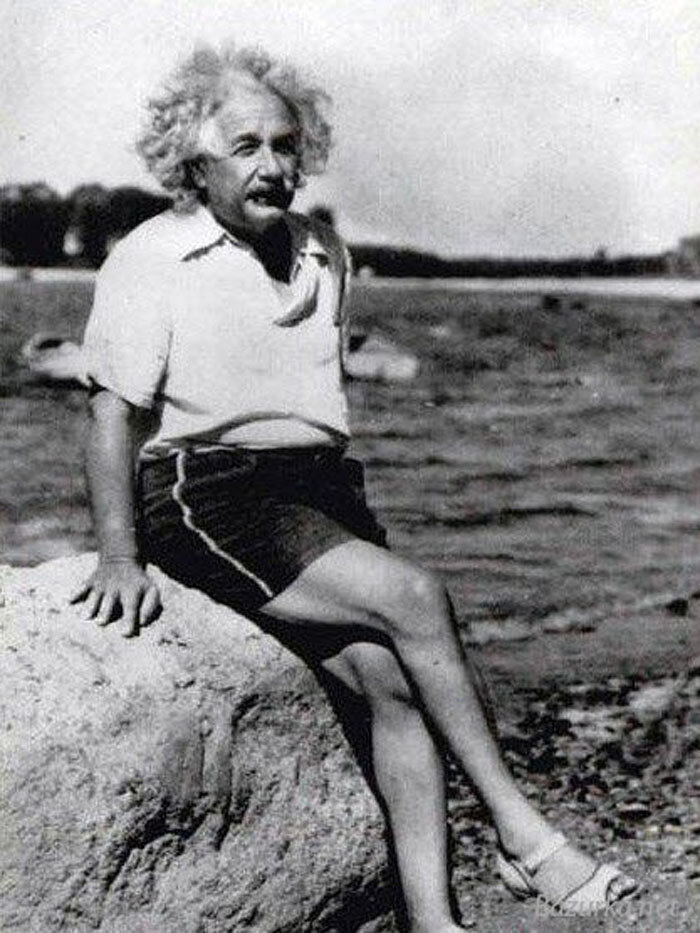
And here's Einstein in shorts:
Bonus:

"The trend is not limited to top earners," Reuters notes. "It has been detected among households earning around $80,000 per year." But $80,000 goes a lot further in the middle of the country than it does in New York or San Francisco. A husband has to be fairly affluent for his wife to be able to afford to stay home: "Only a few households can afford to give up a good second income."...Oh, my. I'm not going to try to say everything that's wrong with that. I'll just say:
Marriage and male responsibility for families were once the norm at all levels of American society. Feminism was supposed to liberate women from dependency on men. Instead it has helped to create a two-tiered culture in which the norm is for women to be "chained to a desk," but those who hit the jackpot in the mating game can realistically aspire to escape that status. Nice going, ladies. Happy International Women's Day.
We are excited to see someone ask, "Will you marry me?", whether on bended knee or in text splashed across a stadium Jumbotron. Certainly it would not have the same effect to see "Will you enter into a registered domestic partnership with me?". Groucho Marx's one-liner, "Marriage is a wonderful institution... but who wants to live in an institution?" would lack its punch if the word "marriage" were replaced with the alternative phrase. So too with Shakespeare's "A young man married is a man that's marr'd," Lincoln's "Marriage is neither heaven no hell, it is simply purgatory," and Sinatra's "A man doesn't know what happiness is until he's married. By then it's too late." We see tropes like "marrying for love" versus "marrying for money" played out again and again in our films and literature because of the recognized importance of the marriage relationship. Had Marilyn Monroe's film been called How to Register a Domestic Partnership with a Millionaire, it would not have conveyed the same meaning as did her famous movie....You get the idea. The judges are old. I mean... marriage — even just the word — matters.
Although there are no transgender characters on the series, Drian Juarez, project manager for the Transgender Economic Empowerment Program at Los Angeles's Gay and Lesbian Center, finds the promo exploitive [sic]. In a statement released to the press, Juarez says, "What is clearly intended to be a humorous promotional ad for the show depicts the two lead characters, dressed as women, standing at a urinal. Sadly, it’s very common for people to promote fear of sharing the bathroom with transgender people as a means to further their prejudice. We’re frequently portrayed as sexual predators using the bathroom to make sexual advances."Here's the ad:
"We've seen a lot of offensive things on TV over the years, but this really takes the cake... The so-called 'comedy' of Work It is based on the premise that male-bodied people who unsuccessfully attempt to present themselves as women are worthy of ridicule. The problem is that most transgender women find themselves in this situation, at least temporarily, during their transition process. And due to the prohibitively high costs of transition-related medical care and widespread insurance inequities, many may be visibly transgender for their entire lives."Speaking of what takes the cake, the best comedy movie ever made uses the same premise of 2 heterosexual men who dress as women. Is this premise to be avoided because it has something to do with an actual problem actual experienced by some people who may be sympathetic?
As a performer, Mr. Curtis drew first and foremost on his startlingly good looks. With his dark, curly hair, worn in a sculptural style later imitated by Elvis Presley, and plucked eyebrows framing pale blue eyes and wide, full lips, Mr. Curtis embodied a new kind of feminized male beauty that came into vogue in the early 1950s. A vigorous heterosexual in his widely publicized (not least by himself) private life, he was often cast in roles that drew on a perceived ambiguity: his full-drag impersonation of a female jazz musician in “Some Like It Hot,” a slave who attracts the interest of a Roman senator (Laurence Olivier) in Stanley Kubrick’s “Spartacus” (1960), a man attracted to a mysterious blond (Debbie Reynolds) who turns out to be the reincarnation of his male best friend in Vincente Minnelli’s “Goodbye Charlie” (1964).
[W]hat I can't fucking abide is this idea that some dumb kid is going to see Danny on the screen... and realize that this is a way to get approval, attention, and acceptance. Taking the Danny route means putting all the scary things about gay people and stuffing them into a tiny little asterisk, while magnifying all the childish, feminine, negligible things -- all the things that put you in the category of not mattering -- and expanding them so that they cover your whole personality, with just a tiny little asterisk of things that we can, as a culture, forgive. As long as we don't have to see them, think about them, or otherwise confront them in a way which isn't hilariously powerless....
Maybe Danny's the Marilyn Monroe of the show and knows that fulfilling an archetype this insanely well is actually a power play. I can see that, actually. I just don't like what it does to everybody else -- also, now that I think of it, a problem with people like Marilyn, who excel at putting on the face like that.

No one combined critical regard, popular celebrity, and radical chic politics with quite the same insouciance as did Mailer. From the late 1940s until the 1980s, he showed himself to be extraordinarily deft at persuading credulous intellectuals to collaborate in his megalomania. Although he modeled his persona on some of the less attractive features of Ernest Hemingway—booze, boxing, bullfighting, and broads—he managed to update that pathetic, shopworn machismo with some significant postwar embellishments: reefer, radicalism, and Reich, for starters. The glittering example of Mailer’s commercial success was obviously the cynosure that many aspiring writers set out to follow: his neat trick was to combine cachet with large amounts of cash....It bothers me that Kimball does not acknowledge Kate Millet's attack. She set a generation of feminists — including me — against him. His name was poison for me for years, and I read "Executioner's Song" because I was writing about the death penalty theme, but the whole time I held Norman Mailer at a distance. (Writing this post, I initially forgot I'd read one of his books!) I was suspicious. I saw his respect for Gary Gilmore's sexual vigor, and I could still hear Kate Millet's denouncement echoing in my ears.
An American Dream was the infamous novel in which the hero, Stephen Rojack, a savvy, tough-guy intellectual—just like Norman Mailer, you see—starts out by strangling his wife. He then walks downstairs and buggers his wife’s accommodating German maid, a former Nazi who declares, “I do not know why you have trouble with your wife. You are an absolute genius, Mr. Rojack.”
(Buggery—another “B” to put alongside booze, boxing, bullfighting, and broads—was to become an obsession with Mailer.) There are numerous Mailerian fingerprints in the novel. President Kennedy (“Jack”) calls to convey his condolences; Rojack’s wife is rumored to have had affairs with men high up in the British, American, and Soviet spy agencies; even Marilyn Monroe—who was to become another of Mailer’s notorious obsessions—makes a posthumous cameo appearance: when Rojack fantasizes about having a telephone conversation with a dead character, he reports that “the girls are swell. Marilyn says to say hello.” But the chief point of the book is that Rojack gets away with the murder. Such, Mailer wants us to believe, is the real if unacknowledged “American dream.”
[Novelist William] Styron recalled that at the time Mailer said to him: “God, I wish I had the courage to stab a woman like that. That was a real gutsy act.” That tells one all one needs to know about Norman Mailer’s idea of “courage.”
What is perhaps most alarming about Mailer’s violence against his wife was that it seems to have titillated more than it repelled his circle of friends. In any event it brought very little condemnation. “Among ‘uptown intellectuals,’” Irving Howe wrote “there was this feeling of shock and dismay, and I don’t remember anyone judging him. The feeling was that he’d been driven to this by compulsiveness, by madness. He was seen as a victim.” Readers who wonder how stabbing his wife could make Mailer a “victim”—and who ask themselves, further, what Mailer’s being a victim would then make Adele—clearly do not have what it takes to be an “uptown intellectual.”
I think when a woman goes through an abortion, even legalized abortion, she goes through hell. There’s no use hoping otherwise. For what is she doing? Sometimes she has to be saying to herself, “You’re killing the memory of a beautiful fuck.” I don’t think abortion is a great strain when the act was some miserable little screech, or some squeak oozed up through the trapdoor, a little rat which got in, a worm who slithered under the threshold. That sort of abortion costs a woman little more than discomfort. Unless there are medical consequences years later.But Kimball should know that feminists — no matter how pro-abortion — hate that too.
But if a woman has a great fuck, and then has to abort, it embitters her.

I believe there is something irrevocably ruinous about a culture in which women are expected to go around with their lips in a permanent state of shiny readiness, a perennial Marilyn Monroe moue of glistening sexual receptivity, hinting at the possibility that they, like Monroe, sleep fetchingly in the nude.Click on the link at your own risk. It's long, name-dropping, and philosophicalish.
This volume contains what Lawrence himself called "philosophicalish" essays written in the decade 1915-25. The topics range from politics to nature, from religion to education; the tone from lighthearted humor to mordant wit, to spiritual meditation. For all these contrasts, however, the essays share many of the underlying themes of the mature Lawrence: "Be thyself" could be the volume's motto. As far as possible, this edition restores what Lawrence wrote before typists, editors, and compositors made the extensive alterations that have been followed in all previous editions of the texts--on occasion entire passages removed by mistake or for reasons of censorship have been recovered.Required observation: Lawrence was a blogger!


The narration sounds like a terrible Norman Mailer rip-off except that it’s Mr. Mailer himself, professor emeritus of the University of Marilyn Blather. Like so many smart people recruited for documentaries, he drops his sense of humor and intones in that portentous, “would”-heavy way typical of programs about American culture. (“The mayo packet would change American drive-through cuisine forever.”)He may be humorless, but it sounds like there are laughs to be had. And pictures of Marilyn.
Be glad for it and don't be afraid of being afraid. It can only help. Relax and enjoy it.
They describe themselves as asexual, and they call their condition normal, not the result of confused sexual orientation, a fear of intimacy or a temporary lapse of desire. They would like the world to understand that they can live their entire lives happily without ever having sex."People think they need to convert you" -- that reminds me of the scene on the yacht in "Some Like It Hot," where Marilyn Monroe is trying to help Tony Curtis (who's just pretending).
"People think they need to convert you," said Cijay Morgan, 42, a telephone saleswoman in Edmonton, Alberta, and a self-professed asexual. "They can understand if you don't like country music or onion rings or if you aren't interested in learning how to whistle, but they can't accept someone not wanting sex. What they don't understand is that a lot of asexuals don't wish to be quote-unquote fixed."
“The crowd was cheering. There was one woman who told us her budget was $500. Finally she bid $950 on pantyhose. When she got it she not only screamed, she cried — and the crowd was cheering.”

 :.
:.


