Wow. I'm just seeing this now. How awkward. I was embarrassed to watch the clip. Jack Nicholson — the greatest actor of the modern era (or something) — comes out as if he's going to announce the award, observes that it's traditionally one presenter who does the announcement, then throws it to a White House feed where it's Michelle Obama, dressed up in her ball gown, in the company of White House toadies in tuxes. And then "Lincoln" doesn't even win, so we don't get the stunning climax of all of history that was what the producers may have thought they were setting up.
Abysmal.
IN THE COMMENTS: Drago said: "Those aren't 'toadies.' Those are the military aides assigned to the President. They have no choice but to be there when 'directed.' And those aren't 'tuxes,' those are military dress uniforms." I stand corrected. I'm sorry. I was going to watch the video again to check that detail but there was no scroll bar on the video and I could not put up with watching it in real time. Why were military personnel used as props for an entertainment industry awards show?
Showing posts with label Lincoln. Show all posts
Showing posts with label Lincoln. Show all posts
Monday, February 25, 2013

Sunday, February 17, 2013
Tony Kushner thinks it's fine for a movie to "manipulate a small detail in the service of a greater historical truth."
"History doesn’t always organize itself according to the rules of drama. It’s ridiculous. It’s like saying that Lincoln didn’t have green socks, he had blue socks."
The green/blue sock equivalent ridiculousness in Kushner's screenplay was having Connecticut vote against the abolition of slavery when in fact it voted for.
The green/blue sock equivalent ridiculousness in Kushner's screenplay was having Connecticut vote against the abolition of slavery when in fact it voted for.
Thursday, February 7, 2013
"Lincoln" smears Connecticut.
"I could not believe my own eyes and ears," said Connecticut Congressman Joe Courtney. "Placing the State of Connecticut on the wrong side of the historic and divisive fight over slavery is a distortion of easily verifiable facts."
By coincidence, Shakespeare is getting some negative press this week, after bones found under a parking lot in England were determined to have belonged to Richard III, the last of the Plantagenet dynasty, supplanted by the Tudors, whom Shakespeare had reason to flatter as he portrayed Richard III as a villain.
"It is historical fiction -- a noble genre going back to Shakespeare and well before -- not history," [said Columbia University historian Eric Foner].And yet we're pressured to go see that movie because of the way it explains history.
By coincidence, Shakespeare is getting some negative press this week, after bones found under a parking lot in England were determined to have belonged to Richard III, the last of the Plantagenet dynasty, supplanted by the Tudors, whom Shakespeare had reason to flatter as he portrayed Richard III as a villain.
No “bunch-backed toad,” no “slave of nature and the son of hell,” no “bottled spider,” the exhumed Richard is enjoying a remake as a physically challenged fellow with spinal curvature who might have starred in last year’s London Paralympics if given the chance.Imagine a movie about Lincoln that does not cater to the tastes of the present-day dynasty. There's plenty of old material to rake over. He wasn't called "bunch-backed toad" or a "bottled spider," but he was called "The obscene ape of Illinois." And:
Alas he got clobbered several times with a halberd (presumably wielded by a halberdier ignoring late 15th century safety regulations), and may have suffered the ignominy of being sodomized with an unlicensed dagger while being carried naked on horseback to Leicester. ....
“I’ve spoken to scoliosis experts and they say acute scoliosis like that was painful,” Philippa Langley, a Richard III enthusiast, told The Guardian. “So we know that he was working through the pain barrier every day just to do his job.... He had an incredibly powerful, strong work ethic. This man never stopped. He was on a horse every day, fighting skirmishes, doing everything they had to do.”
The illustrious Honest Old Abe has continued during the last week to make a fool of himself and to mortify and shame the intelligent people of this great nation. His speeches have demonstrated the fact that although originally a Herculean rail splitter and more lately a whimsical story teller and side splitter, he is no more capable of becoming a statesman, nay, even a moderate one, than the braying ass can become a noble lion. People now marvel how it came to pass that Mr. Lincoln should have been selected as the representative man of any party. His weak, wishy-washy, namby-pamby efforts, imbecile in matter, disgusting in manner, have made us the laughing stock of the whole world. The European powers will despise us because we have no better material out of which to make a President. The truth is, Lincoln is only a moderate lawyer and in the larger cities of the Union could pass for no more than a facetious pettifogger. Take him from his vocation and he loses even these small characteristics and indulges in simple twaddle which would disgrace a well bred school boy.
Saturday, January 19, 2013
"I don’t think we should talk about Lincoln’s underwear..."
"It’s not appropriate for someone so iconic. Even in the bedroom, Lincoln is never shown in his pajamas. He’s in his shirt and pants."
Joanna Johnston, movie costume designer.
"But even the President of the United States/Sometimes must have to stand naked."
Bob Dylan.
"How many Bob Dylan songs have the word 'naked' and how many of them can you name?" I challenge Meade with a Bob Dylan test, as I tend to do when I've done a search at bobdylan.com (as I did for the "It's Alright Ma" quote, above).
Meade immediately says "even the President of the United States sometimes must have to stand naked," then none of the others — not even "You see somebody naked and you say who is that man?" — and makes 2 wrong guesses:

Beards. Fidel Castro made a beard as off limits to an American president — in spite of Lincoln — as Hitler made the mustache. And here I want to go back to that "Becoming Adolf" article by Rich Cohen that were were talking about a couple days ago:
Pick one:


Joanna Johnston, movie costume designer.
***
"But even the President of the United States/Sometimes must have to stand naked."
Bob Dylan.
***
"How many Bob Dylan songs have the word 'naked' and how many of them can you name?" I challenge Meade with a Bob Dylan test, as I tend to do when I've done a search at bobdylan.com (as I did for the "It's Alright Ma" quote, above).
Meade immediately says "even the President of the United States sometimes must have to stand naked," then none of the others — not even "You see somebody naked and you say who is that man?" — and makes 2 wrong guesses:
MEADE: "'Mr. Tambourine Man'... just to dance beneath the naked sky..."In "Motorpsycho Nightmare," Bob Dylan is just trying to get some sleep — no sign that he's sleeping naked — when Rita — "Lookin’ just like Tony Perkins" (i.e., the murderer in "Psycho") importunes him to take a shower. He's freaked out: "Oh, no! no! I’ve been through this [movie] before." Afraid of getting knifed to death, but unwilling to run off unless her father (the farmer) throws him out (because he promised the farmer he'd milk the cows in the morning), his sees his only option as saying "something to strike him very weird." What he says is: "I like Fidel Castro and his beard."
ME: "That's 'diamond sky.'"
MEADE: "The one where the farmer is chasing him out of his house."
ME: "'Motorpsycho Nightmare?' No."
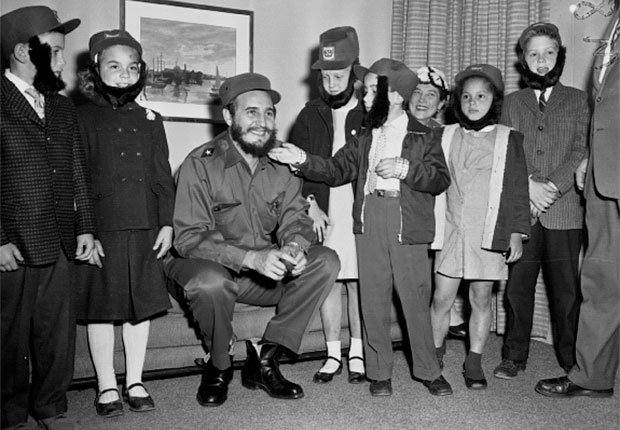
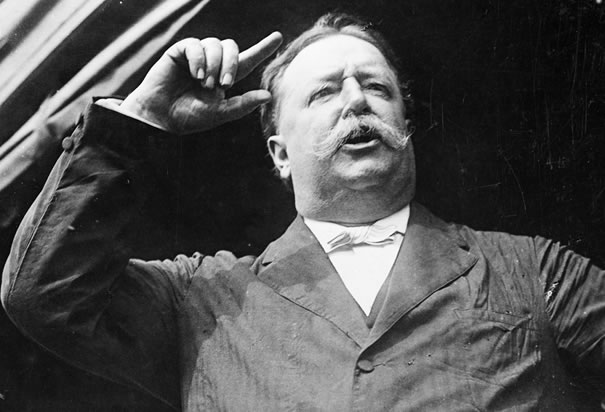
Beards. Fidel Castro made a beard as off limits to an American president — in spite of Lincoln — as Hitler made the mustache. And here I want to go back to that "Becoming Adolf" article by Rich Cohen that were were talking about a couple days ago:
[Y]ou could not wear any kind of mustache after [WWII], because, running from Hitler, you might run into Stalin. Hitler plus Stalin ended the career of the mustache in Western political life. Before the war, all kinds of American presidents wore a mustache and/or beard. You had John Quincy Adams, with his muttonchops...Are we going to decide who deserves out trust based on they look? Come on, Abe. Lose the beard. Okay.
You had Abe Lincoln, whose facial hair...
... like his politics, was the opposite of Hitler's: beard full, lip bare. You had James Garfield, who had the sort of vast rabbinical beard into which whole pages of legislation could vanish.
You had Rutherford B. Hayes...
Grover Cleveland...
... and Teddy Roosevelt, whose asthma and elephant gun were just a frame for his mustache.
You had William Howard Taft — the man wore a Walrus!
After the war, the few American politicians who still wore a mustache were those who had made their name before Hitler and so had been grandfathered in. Like Thomas Dewey.
Dewey was Eliot Spitzer. He was a prosecutor in New York in the 1930s (and later governor), the only guy with the guts to take on the Mob. For Dewey, the rise of Hitler was a fashion disaster. Because Dewey wore a neat little mustache. Dewey ran for president twice — losing to F.D.R., losing to Truman. In my opinion, without the mustache, the headline in the Chicago Daily Tribune (Dewey Defeats Truman) turns true. One of the few prominent American politicians to wear facial hair in recent memory is Al Gore, who grew a Grizzly Adams beard after he lost to George Bush, in 2000. The appearance of this beard was taken to mean either (1) Gore would never again run for office, or (2) Gore had gone completely mental.
The decision to grow a mustache or a beard is all by itself reason to keep a man away from the nuclear trigger.
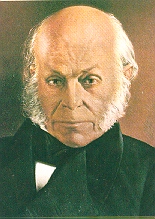

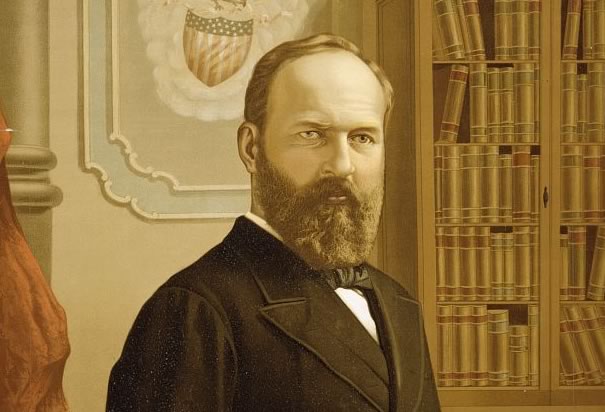


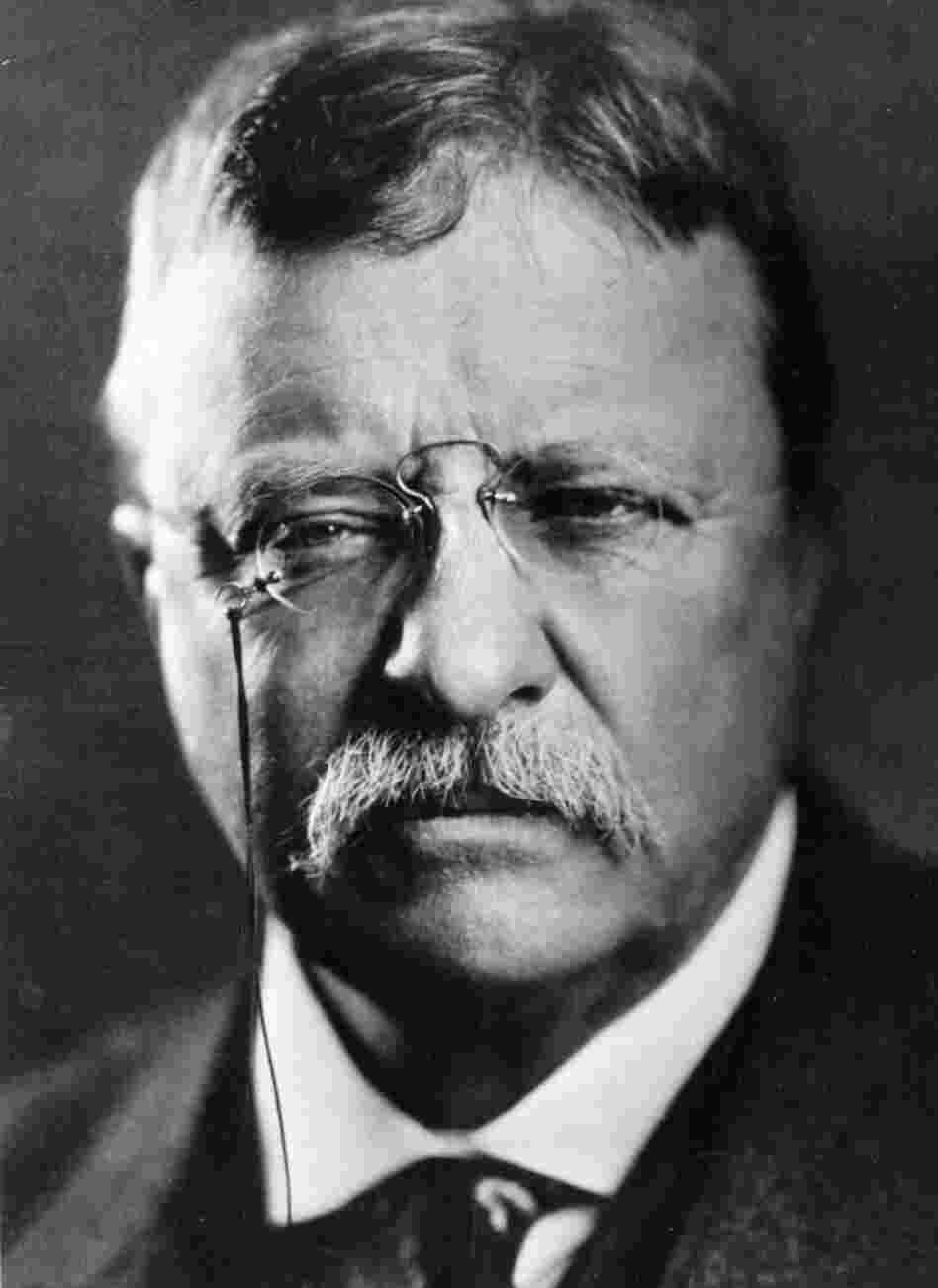


Pick one:


Tuesday, January 15, 2013
"I successfully edited Wikipedia!"
Meade exclaims. It's his first time. It was over there in the page on The Gettysburg Address (which I linked to earlier today, as perhaps you noticed). His edit is in the third paragraph, which, before his edit, read:
The topic was the 2d amendment and, more generally, what rights are. Responding to TheBookPolice who'd asserted that rights are "100% about the government telling people what they can and can't do," Meade said:
Beginning with the now-iconic phrase "Four score and seven years ago," referring to the Declaration of Independence during the American Revolution in 1776, Lincoln examined the founding principles of the United States in the context of the Civil War, and memorialized the sacrifices of those who gave their lives at Gettysburg and extolled virtues for the listeners (and the nation) to ensure the survival of America's representative democracy, that the "government of the people, by the people, for the people, shall not perish from the earth."Meade took out the "the" before that last quote. Have you ever noticed that there's no "the" before "government" (even as there is a "the" before each of the 3 "people"s)?
... we here highly resolve... that government of the people, by the people, for the people, shall not perish from the earth.Do you see what a big difference a "the" would make in that sentence? Meade had gotten into a back-and-forth over at the Isthmus forum (a site dominated by typical Madisonians, i.e., left/liberals).
The topic was the 2d amendment and, more generally, what rights are. Responding to TheBookPolice who'd asserted that rights are "100% about the government telling people what they can and can't do," Meade said:
Thank you but you have that exactly backwards, TheBookPolice. Check your high school Civics textbook. The amendments in the Bill of Rights are all about protecting the people from the power of the government. I know that concept can be a little difficult for Liberals and Progressives to grasp, seeing as how they begin with a fundamental utopian assumption in government we trust. But government - even a democracy - can become corrupt, coercive, authoritarian, and tyrannical. So if you look at the text of, say, the 2nd amendment, you'll see that it is addressing the government, not the people. The people's right shall not be infringed. Infringed by the people? No, of course not. The right shall not be infringed by the government. Take a closer look at the entire "Bill of Rights" and I think you will see that the first ten amendments to the constitution are completely about restricting government from infringing the people's rights.TheBookPolice dragged in the Gettysburg Address:
Abraham Lincoln described the government of the United States as being "of the people, for the people, and by the people." Sounds to me like we're all in this together. You on the other hand seem to treat the government as a panther stalking the outskirts of your jungle village, waiting for the opportunity to snatch a wandering child unawares.And Meade came up with this "the" point, which I'd never thought about before:
Tell me: who makes up the government you fear so much?
That's just it, Police -- I don't fear the government at all. Thanks to the constitution. And thanks, in particular, to the first ten amendments.Lincoln was not talking about preserving the entity that is The Government, that might overstep its bounds and oppress us. He was talking about preserving government by the people, that is, preserving democracy. Or that's how it's sunk in for me.
Now take a closer look at the text of the Lincoln speech you alluded to. Notice: he does not put the article, "the" before "government" and yet he uses it each of the three times he repeats "people".
Let that sink in for a minute.
Sunday, December 30, 2012
Obama seems amenable to the NRA idea of armed guards in schools.
On today's "Meet the Press": David Gregory asked him what he thought of having "armed guards at every school in the country," adding "That's what the NRA believes. They told me last week that could work." Obama said:
Obama went on to say that he was going to follow "the old adage of Abraham Lincoln's":
By the way, when did Washington folk acquire the habit of tacking "in this town" onto every other sentence? And don't you think there's an interesting difference between "opinion" and "sentiment"?
Further evidence that liberals have given up on demonizing LaPierre came from Dianne Feinstein on "Fox News Sunday" today. She's going to introduce a bill banning assault weapons and magazines that hold more than 10 rounds of ammunition, and moderator Chris Wallace asked her "Why is that more effective than the NRA proposal to put armed guards in every school?" She said:
You know, I am not going to prejudge the recommendations that are given to me. I am skeptical that the only answer is putting more guns in schools. And I think the vast majority of the American people are skeptical that that somehow is going to solve our problem.Of course, we are also skeptical that gun control is going to solve our problem. My only point here is that Obama didn't denounce the idea and treat it as crazy, which seemed to be the left/liberal spin last week after NRA CEO Wayne LaPierre made the proposal. Obama is saying that the idea deserves consideration. And to say you doubt that it's the "only answer" is to imply that it may belong in a package of items that together are the answer. In fact, later, he said: "I'm going to be putting forward a package..."
Obama went on to say that he was going to follow "the old adage of Abraham Lincoln's":
That with public opinion there's nothing you can't do and without public opinion there's very little you can get done in this town.That's a paraphrase. What Lincoln actually said was: "In this and like communities, public sentiment is everything. With public sentiment, nothing can fail; without it nothing can succeed. Consequently he who moulds public sentiment, goes deeper than he who enacts statutes or pronounces decisions. He makes statutes and decisions possible or impossible to be executed." I'll leave it to you to decide who's the better wordsmith.
By the way, when did Washington folk acquire the habit of tacking "in this town" onto every other sentence? And don't you think there's an interesting difference between "opinion" and "sentiment"?
Further evidence that liberals have given up on demonizing LaPierre came from Dianne Feinstein on "Fox News Sunday" today. She's going to introduce a bill banning assault weapons and magazines that hold more than 10 rounds of ammunition, and moderator Chris Wallace asked her "Why is that more effective than the NRA proposal to put armed guards in every school?" She said:
Well, in the first place, 1/3 of America's public schools does have armed guards.Ha! No wonder the spin has shifted. You can't call it sheer lunacy if it's happening in 1/3 of the schools already. Too bad the liberal sentiment molders didn't check the facts first. Too bad they had a hair trigger.
Wednesday, December 26, 2012
Friday, December 21, 2012
The monster in Peggy Noonan's childhood closet was... Abraham Lincoln!
Writing about childhood fears (post-Newtown), she reveals:
One night when the moon was bright and the wind was moving the trees, I looked from my bed into the shadowed closet . . . and suddenly the clothes and the things on the shelf above had transformed themselves into Abraham Lincoln, in top hat and shawl, staring at me and waiting to be shot. That fear came every night for years. At some point a neighbor saw my nervousness or overheard my obsession, asked what was wrong, came to my house, opened my closet and announced triumphantly "See? Lincoln isn't there!" I knew she meant well, but how dumb can you get? Lincoln only came at night.She also talks about a child who was afraid of ET, so I was expecting a parade of Spielberg characters tormenting kids: the "Jaws" shark, a T-Rex, TinTin, Oskar Schindler... But here's where she's going with this:
Newtown, like 9/11, reminds us of "the mystery of being alone in the world as it is and as we are." The world is imperfect, broken, "with cracks running through it." A central fact of our lives... is that "We are all vulnerable. Anything can happen to anybody at any time."...
We attempt to respond to tragedies politically.... But there is no security from existence itself. The only answer is to "plunge into" life. "We have to engage in life and take it on with all the risks it entails, or we won't be alive at all."
Friday, November 16, 2012
"I find it difficult to believe that Lincoln was banging anybody."
Tony Kushner explains why his "Lincoln" screenplay doesn't include any material about his possible nonheterosexuality. Moreover:
"I absolutely believe that the Lincoln’s marriage was a real marriage. These two people loved each other.... It wouldn’t be the first time that a gay man and a straight woman hooked up and had a great marriage. But I don’t know. I really don’t know. And I think that’s what we have to say about it. We keep the door open and people should talk about it. I don’t feel, finally, that my politics are entirely determined by the fact that I’m a gay man."I love the subtle dig implicit in the word "entirely."
Thursday, November 15, 2012
"Back there America was put on the cross, died and was resurrected."
"The godawful truth of that would be the all-encompassing template behind everything that I would write."
Bob Dylan, quoted at Lancaster.com by staff writer Jack Brubaker, on the occasion of the Spielberg movie about Lincoln, in which Tommy Lee Jones plays Thaddeus Stevens, who was "one of Lancaster's most famous sons." The Dylan quote was in Bob's 2004 memoir "Chronicles, Volume One" — hey, where's Volume 2? — in which he writes about the effect of reading a biography of Thaddeus Stevens.
Bob Dylan, quoted at Lancaster.com by staff writer Jack Brubaker, on the occasion of the Spielberg movie about Lincoln, in which Tommy Lee Jones plays Thaddeus Stevens, who was "one of Lancaster's most famous sons." The Dylan quote was in Bob's 2004 memoir "Chronicles, Volume One" — hey, where's Volume 2? — in which he writes about the effect of reading a biography of Thaddeus Stevens.
Saturday, November 10, 2012
Daniel Day-Lewis voices Lincoln with "a high-pitched, wavering tone that has been likened to both a 14-year-old boy and Mr Burns."
People are complaining... but they're complaining about historical accuracy!
Here's a new trailer, including some of Day-Lewis's vocalizations. I don't have a problem with the presumably historically grounded high-pitched voice. But what's the point of going realistic about the sound of Lincoln's voice when everything else about the movie seems all theatrical and pretentious, including the lines Day-Lewis must speak with that voice? "I am the President of the United States clothed with enormous power!"
Harold Holzer, a Lincoln scholar, told CBS News: “Lincoln died long before audio recording was possible so we have no hints about what he really sounded like, except the reminiscences of his contemporaries. The most frequent things we read are that he had a nasal, high voice that somehow miraculously floated over large crowds.”Day-Lewis said "said the voice materialised 'in my mind’s ear'" and "If I hear a voice, I tend to believe that I hear it for good reason.”
Here's a new trailer, including some of Day-Lewis's vocalizations. I don't have a problem with the presumably historically grounded high-pitched voice. But what's the point of going realistic about the sound of Lincoln's voice when everything else about the movie seems all theatrical and pretentious, including the lines Day-Lewis must speak with that voice? "I am the President of the United States clothed with enormous power!"
Sunday, October 28, 2012
The NYT illustrates its endorsement of Obama with a photo of Abe Lincoln.
There's something so tragically lame about this:

To be fair, it clicks through to a gallery of past endorsements that makes it glaringly clear that the Times always endorses the Democratic candidate. You have to scroll back over a half century to get a different result.
But keep scrolling. Once you get down past mid-20th century, there are plenty of Republicans mixed in, and if you'll scroll down to the bottom, you'll get to that famous face they selected to illustrate today's editorial, Abraham Lincoln. A Republican.
The Times endorsed Lincoln in 1860 and again, when he ran for reelection, in 1864. The photo used in today's Obama endorsement is the 1864 Lincoln. How much the man aged in 4 years! Here is the 1860 Lincoln:

The 1860 endorsement — PDF — is a fascinating read:
The 2 photos of Barack Obama, 2008 and 2012, differ much less from each other than the 2 pics of Lincoln. And the old 2008 endorsement doesn't contain any vivid writing telling us what sort of mind is produced by the the work of community organizing and how Obama will govern in the manner of a community organizer.

To be fair, it clicks through to a gallery of past endorsements that makes it glaringly clear that the Times always endorses the Democratic candidate. You have to scroll back over a half century to get a different result.
But keep scrolling. Once you get down past mid-20th century, there are plenty of Republicans mixed in, and if you'll scroll down to the bottom, you'll get to that famous face they selected to illustrate today's editorial, Abraham Lincoln. A Republican.
The Times endorsed Lincoln in 1860 and again, when he ran for reelection, in 1864. The photo used in today's Obama endorsement is the 1864 Lincoln. How much the man aged in 4 years! Here is the 1860 Lincoln:

The 1860 endorsement — PDF — is a fascinating read:
It will not be easy... for Mr. Lincoln to do much mischief, even if he should be disposed. We have great confidence in his pacific and conciliatory disposition. He seems to us much more like to be too good-natured and tolerant towards his opponents, than not enough so. Rail-splitting is not an exciting occupation. It does not tend to cultivate the angry passions of the heart...The rail-splitting metaphor is then worked into the opinion that Lincoln will govern as a moderate pragmatist.
The 2 photos of Barack Obama, 2008 and 2012, differ much less from each other than the 2 pics of Lincoln. And the old 2008 endorsement doesn't contain any vivid writing telling us what sort of mind is produced by the the work of community organizing and how Obama will govern in the manner of a community organizer.
Wednesday, August 22, 2012
At the Cautiously Spontaneous Café...

... it's an open thread for all your reflections.
(The photo is from Fargo.)
Sunday, April 15, 2012
Dressing like Abe Lincoln and kissing a baby — it's Scott Walker's challenger for the Republican slot in the recall election.
It's Arthur Kohl-Riggs, whom we encountered at yesterday's Tax Day rally:

You may recognize him from many of the videos Meade and I made during last year's protests, though I didn't identify him by name back then. Here are 2. Here's an article about how he got on the primary ballot and why he's doing it:
You may recognize him from many of the videos Meade and I made during last year's protests, though I didn't identify him by name back then. Here are 2. Here's an article about how he got on the primary ballot and why he's doing it:
I find it hard to believe that Walker has to win a primary and become a party nominee. I would have thought he'd be on the recall election ballot as the incumbent. I can see in the state constitution (PDF) that the incumbent is "deemed to have filed for the recall election," and:
Arthur Kohl-Riggs, a scruffy-haired 23-year-old political activist who used to serve pizza at the Children’s Museum in Madison until a few weeks ago, says he is not a "fake Republican."...
He describes himself as a “progressive Republican,” following the political lines of former Wisconsin Sen. Robert "Fighting Bob" La Follette and Abraham Lincoln....
And the reason Kohl-Riggs wants his name on the GOP ballot is because he wants to force Republicans to vote for Gov. Scott Walker in the primary instead of meddling in the Democratic primary, he said.
For any partisan office, a recall primary shall be held for each political party which is by law entitled to a separate ballot and from which more than one candidate competes for the party’s nomination in the recall election. The person receiving the highest number of votes in the recall primary for each political party shall be that party’s candidate in the recall election. Independent candidates and candidates representing political parties not entitled by law to a separate ballot shall be shown on the ballot for the recall election only.Here's the relevant statute (PDF):
(e) For any partisan office, a recall primary shall be held for each political party which is entitled to a separate ballot under s. 5.62 (1) (b) or (2) and from which more than one candidate competes for the party’s nomination in the recall election. The primary ballot shall be prepared in accordance with s. 5.62, insofar as applicable. The person receiving the highest number of votes in the recall primary for each political party shall be that party’s candidate in the recall election. Independent candidates shall be shown on the ballot for the recall election only.I think it's bizarre and maddening that the people of Wisconsin, having voted Walker into a 4-year term of office now must vote again, not just once, but twice. I understand the concern that Walker supporters might try to skew the Democratic primary — though it's not easy to see which way they'd want to skew it — but I think a lot of people are really sick of having to keep voting and revoting to keep what we've already voted for (and sick of having to pay for all of it).
Wednesday, March 14, 2012
Monday, February 20, 2012
"Oh, it's Presidents Day. Some people have the day off."
My outburst, on glancing at my Twitter feed this morning. Excuse me for not sufficiently valuing the generic President of the United States, but I remember when we knew exactly which day Abraham Lincoln was born on and that it was a different day from the one George Washington was born on. We had Lincoln's Birthday and Washington's Birthday, and we paid tribute to them separately and individually. I'm not trying to be an insufferable old fogy here doing a back-in-my-day routine, but without a day off, which I don't have, Presidents Day means nothing to me. It seems to me we talk about Presidents — past, present, and future — every damned day. How about a day when we don't think about the government?
Here's a Talking Heads song: "Don't Worry About the Government."
Here's a Talking Heads song: "Don't Worry About the Government."
I see the states, across this big nationHere's a Bob Dylan lyric: "I'm on the pavement, thinking about the government."
I see the laws made in Washington, D.C.
I think of the ones I consider my favorites
I think of the people that are working for me
Tuesday, December 6, 2011
Wednesday, November 30, 2011
Friday, November 18, 2011
LIFE's sexiest photographs.
A nice collection. My favorite as a photograph is Jayne Mansfield. The sexiest, in my personal opinion, is "Clint Eastwood... bare-chested and bandaged after a brutal beating...."
And for those of you who were sad that I laughed at Raquel Welch yesterday — in her uncomfortable dancing singer guise — she's looking much more at ease here in a roller derby outfit — possibly because it's a still photograph.
Speaking of photography, here's a question I thought of yesterday and realized I couldn't answer: Who was the first U.S. President to be photographed? It's easy to think of photos of Abraham Lincoln, but was there anyone before him? It turns out to be crucial how you ask the question. You'll get a different answer if you look at the list of Presidents in the order that they served and find which is the first of them to have been photographed than if you look for the oldest date on a photograph of a U.S. President.
Do you even have a rough idea of when the earliest photographs were taken? Clue: it was not during the Civil War. Do you know the date of the earliest photographic portrait of a human being? You can see this person at 0:55 in this video, which collects many photographic firsts. The man looks like someone you would find — I would find — attractive if he walked down the street today. And at 1:12, you'll see the earliest-born person that we have a photograph of. Try to guess the year she was born before you look.
ADDED: By coincidence, it's Louis Daguerre's birthday, and Google has a doodle for him today:

And for those of you who were sad that I laughed at Raquel Welch yesterday — in her uncomfortable dancing singer guise — she's looking much more at ease here in a roller derby outfit — possibly because it's a still photograph.
Speaking of photography, here's a question I thought of yesterday and realized I couldn't answer: Who was the first U.S. President to be photographed? It's easy to think of photos of Abraham Lincoln, but was there anyone before him? It turns out to be crucial how you ask the question. You'll get a different answer if you look at the list of Presidents in the order that they served and find which is the first of them to have been photographed than if you look for the oldest date on a photograph of a U.S. President.
Do you even have a rough idea of when the earliest photographs were taken? Clue: it was not during the Civil War. Do you know the date of the earliest photographic portrait of a human being? You can see this person at 0:55 in this video, which collects many photographic firsts. The man looks like someone you would find — I would find — attractive if he walked down the street today. And at 1:12, you'll see the earliest-born person that we have a photograph of. Try to guess the year she was born before you look.
ADDED: By coincidence, it's Louis Daguerre's birthday, and Google has a doodle for him today:

Sunday, September 11, 2011
President Bush, reading Lincoln's letter at the 9/11 ceremony in NYC.
"I feel how weak and fruitless must be any words of mine which should attempt to beguile you from the grief of a loss so overwhelming. But I cannot refrain from tendering to you the consolation that may be found in the thanks of the Republic they died to save. I pray that our Heavenly Father may assuage the anguish of your bereavement, and leave you only the cherished memory of the loved and lost, and the solemn pride that must be yours, to have laid so costly a sacrifice upon the altar of Freedom."
Subscribe to:
Posts (Atom)
 :.
:.
