Pages

Labels

Showing posts with label railroads. Show all posts

Saturday, January 26, 2013

"When we pulled out into the winter night and the real snow, our snow, began to stretch out beside us..."

"... and twinkle against the windows, and the dim lights of small Wisconsin stations moved by, a sharp wild brace came suddenly into the air."

To diagram that sentence — today's sentence from "The Great Gatsby" — begin with: brace | came. The subject of the sentence is brace, and the predicate is came. You've got a long clause beginning the sentence which has 3 parts to it — one with a we | pulled subject and verb, one with snow as a subject and the verb began tied to stretch and twinkle, and one with lights and moved. There is also a pair of "into" phrases — "into the winter night" and "into the air" — near the beginning and at the very end of the sentence.

You could easily get on the wrong track reading this sentence and think the real snow is part of what we pulled out into, especially with no comma after night, but the real snow, our snow is the subject of the next phrase. We don't pull out into the snow, only into the night. The snow then takes over the action, stretching out beside us. That's a little sexy, like the snow is in bed with us. But then we see that we must be on a train and the snow is out there in the night, on the other side of the windows. The snow twinkles against the window. It's a kind of light, twinkling. It's tiny lights that mingle with dim lights, the tiny lights of small Wisconsin stations. The stations move by — that's the illusion as we move forward on this train into Wisconsin, into the real snow, our snow, the snow that's like a lover in bed with us, with tiny twinkly lights all around.

Did you get that thrill? It was a sharp wild brace that came suddenly into the air. Orgasmic!

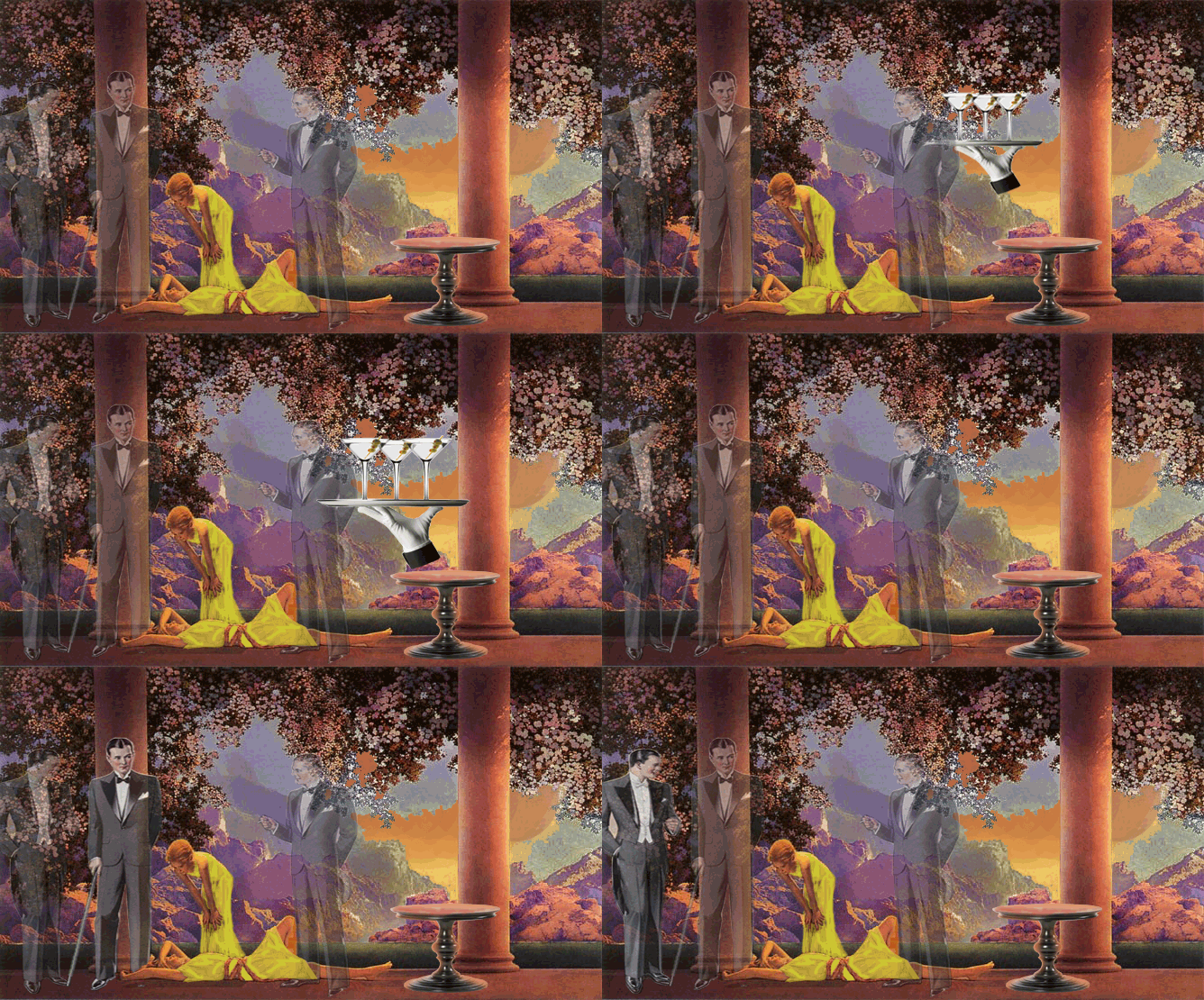
ADDED: Speaking of thrills, here's Chip Ahoy's animation of the "Gatsby" sentence I revealed to be my favorite, 3 days ago:


"A tray of cocktails floated at us through the twilight, and we sat down at a table with the two girls in yellow and three men, each one introduced to us as Mr. Mumble."

Monday, December 31, 2012

How to read a book a day for a year.

Choose short/easy/audio books.

Actually, I read a book a day and have for years — but it's an audiobook, and most of this reading is done while asleep.

Do you have an reading-related New Year's resolutions? Let's think up some reading projects for the new year. We don't necessarily have to do them. Let's just contemplate them. I've already thought of 2, one of which I plan to do. First:
Maybe a good project would be those "History of..." pages, not just for their most common words — WAR! — but to have had it run through your head, at least once, what happened in all of those places. Do you know how many pages we are talking about? The number of members in the United Nations is not the right answer, but do you know that number? It's 193. Wikipedia lists 206 sovereign states (including those with disputed sovereignty).

Let's make a New Year's resolution: Each day, read one Wikipedia "History of..." page. Will you join me? We'll go in alphabetical order, and I'll prompt you with blog posts.
That will start on New Year's day. Don't worry, I'll make it amusing. Second:
What I like [about "The Great Gatsby"] is that each sentence is good, on its own. Seriously. Test it out. "As my train emerged from the tunnel into sunlight, only the hot whistles of the National Biscuit Company broke the simmering hush at noon." Every sentence is a writer's inspiration....

I feel like starting a blog devoted to individual sentences in "The Great Gatsby," chosen randomly, and continuing until all the sentences have been used up.
With commentary, of course. For example, here's my commentary on the hot-whistle-simmering-hush sentence (responding to a commenter who complained that "trains do not 'emerge' from tunnels. They blast, speed, rip, explode, hurtle. E.B. White and Orwell would have hated the verb 'emerge'):
Now, one reason the train can't "blast" or "explode" from the tunnel — and by the way, oh, you men, with your cocks — is that the "only" sound was the "hot whistle." Otherwise, there was a "hush." That's all very surreal, no? Why didn't the train make any noise? It emerged, because it wasn't a screaming cock blasting through a vagina tunnel, as happens in your (presumably) E.B. White-approved works of fiction. Why was the train silent, why were the whistles hot, why was the hush simmering, why was it noon, why were the whistles biscuit whistles, and why wasn't it the biscuit, rather than the whistle, that was hot?

Sunday, December 30, 2012

"A deranged woman who told cops she detests Muslims broke into a maniacal fit of laughter as she was charged with a hate crime Saturday..."

"... three days after she allegedly shoved an Indian immigrant to his death in front of a Queens train."
“Tell your client this is not funny,” Queens Criminal Court Judge Gia Morris thundered, speaking to defense lawyer Dietrich Epperson. “This is not appropriate.”...

Before she was ordered held without bail, prosecutors revealed [Erika Menendez, 31] has expressed no remorse — and even bragged about smoking pot and having sex with her “man in Brooklyn” after the murderous deed.

The deranged drifter - who witnesses said was mumbling to herself but never said a word to Sen before the fatal shove - ran downstairs from the elevated tracks after the attack....

A wild-eyed Menendez seemed startled as she was led out of the stationhouse in handcuffs, en route to her arraignment, about 8:30 p.m. Saturday....

“I know her. ... You could tell that something was not right, like she needed medication or something,” said [one doorman at her mother's apartment building]. “It’s just very sad what happened.”...
“When she didn't take her medication, she got wacko,” said [another doorman].
There are no guns to propose banning, and we're not going to ban subway trains or enclose the platforms in elaborate sliding panels. Maybe something more needs to be done to institutionalize the mentally ill or to supervise the taking of anti-psychotic medication. But one must observe that this subway pushing comes less than a month after an earlier subway pushing in NYC, one that receive a great deal of publicity. There are many murders, but some get more media than others.

A subway pushing is one of those riveting events that the media fixate upon. That becomes an idea vividly imprinted on millions of brains, which intensifies as they head down into the subway, see the platform, the platform's edge, the people standing near it, and hear the sound of the train coming into the station. Emotion is stirred. Most people either ignore that idea, or it's an idea that makes them step from the platform's edge and try to get a wall behind them or keep an eye out for odd movements. But some people are mentally ill. The idea rages up into a powerful impulse, the train is pulling into the station, and they can't resist.

The media reports are — I must assume — a causal factor in the creation of a murderous impulse that some people are not going to be able to control. And yet, the media have their own irresistible impulse to publish these highly stimulating stories, an impulse which, by linking, I am stimulating.

Thursday, August 23, 2012

"Drinking on top of the Ellicott City sign."

Tweeted — a last tweet — along with a pic of "bare feet dangling over the edge of the bridge as they sat just above the words 'Ellicott City,' painted on the side of the bridge that is a portal to the community."

Tuesday, July 10, 2012

In CNBC's new "Top States For Business" rankings, Wisconsin goes from #25 to #17.

One year later, one year greater.

Interestingly, the "greatest improvement [is] in the category of infrastructure and transportation, where the state jumped from 22nd to 6th in the country." This, under the Governor who said no to all that federal money for the high-speed rail, who, by the way, says "we are on the right track." The right track is, apparently, not a railroad track.

Thursday, June 14, 2012

The streetcar boondoggle.

Randal O'Toole explains in detail. (PDF, via Forbes.) To put it briefly: Buses do better for far less money.
Streetcars are the latest urban planning fad, stimulated partly by the Obama administration’s preference for funding transportation projects that promote “livability” (meaning living without automobiles) rather than mobility or cost-effective transportation. Toward that end, the administration wants to eliminate cost-effectiveness requirements for federal transportation grants, instead allowing non-cost-effective grants for projects promoting so-called livability. In anticipation of this change, numerous cities are preparing to apply for federal funds to build streetcar lines....

Rail transit proponents rely heavily on a myth that many people will ride railcars who won’t ride buses. They use the term “quality transit” as a euphemism for rail transit, implying that buses are not quality transit. Apparently, “livability” not only means you don’t have to have a car, but you don’t have to lower yourself by taking a bus either. Taxpayers are supposed to cater to such snobs by providing them with rail alternatives that cost many times more than buses.

Friday, June 8, 2012

"Put me in a room with a pad and a pencil and set me up against a hundred people with a hundred computers - I'll outcreate every goddamn sonofabitch in the room."

Said Ray Bradbury, in a 1998 interview, quoted in a new NYT op-ed, by the writer Tim Kreider, who says:
[Bradbury] opposed the kind of technology that deadened imagination, the modernity that would trash the past, the kind of intellectualism that tried to centrifuge out awe and beauty. He famously did not care to drive or fly, but he was a passionate proponent of space travel, not because of its practical benefits but because he saw it as the great spiritual endeavor of the age, our generation’s cathedral building, a bid for immortality among the stars.

His visions of a better world weren’t high-tech but archaic, bucolic. In “Fahrenheit,” Montag remembers “a farm he had visited when he was very young, one of the rare few times he had discovered that somewhere behind the seven veils of unreality, beyond the walls of parlors and the tin moat of the city, cows chewed cud and pigs sat in warm ponds at noon and dogs barked after white sheep on a hill.” His utopia isn’t some flying city or exotic planet but prewar, small-town America — specifically, Waukeagan, Ill., circa 1928, a town of porch swings and bandshells, dandelion wine stored up in cool cellars and fire balloons on the Fourth of July. His Martians are not alien like Heinlein’s or futuristically evolved like Welles’s but a premodern people akin to the ancient Egyptians or American Indians (or a boy’s idealized conception of them), our superiors not technologically but spiritually. He was, like most of my favorite artists, a misanthropic humanist.
That's nice. I respect the art and aesthetics. But back away from the government. Do not lay your hands on the people's money to pay for your nostalgic, utopian trips to Mars. Keep dreaming your dreams and penning your stories, but do not use tax money to make these things real. Trips to Mars belong in the same category with the high-speed rail.

Wednesday, June 6, 2012

California voters have "buyers' remorse" over over a $68.4 billion high-speed "train to nowhere."

"The project is still $54.9 billion short of what is needed, raising fears that the state will be unable to find the funds to finish later sections, and could be left with a futuristic rail line linking minor cities and farming communities."
A new poll shows almost three fifths would oppose the bullet train and halt public borrowing if given another chance to vote.

Almost seven in 10 said that, if the train ever does run between Los Angeles and San Francisco, they would "never or hardly ever" use it.

Not a single person said they would use it more than once a week, and only 33 per cent said they would prefer the bullet train over a one hour plane journey or seven hour drive. The cost of a ticket, estimated at $123 each way, also put many off. Jerry Brown, California's Democrat governor, has championed the project as a way to create jobs and is backed by unions.
Democratic governor... backed by unions... Meanwhile, in Wisconsin, we rejected the Democratic gubernatorial candidate who wanted the high-speed train. We rejected him in November 2010, and we re-rejected him yesterday.

Here's Tom Barrett in October 2010, just before his first loss to Scott Walker, touting high-speed rail — "a defining issue" — where "Wisconsin was the biggest winner" — bigger even than California — in getting an offer of federal money to pay for a leg of a rail system.


And here is one of the most effective political ads I've ever experienced, the ad from Scott Walker, in late summer of 2010, rejecting the high-speed rail:

Wednesday, May 23, 2012

"Tom Barrett wants to spend $100 million on a trolley for Milwaukee..."

It's the new Scott Walker video.

He's hitting the train button again. Here's his ad from August 2010, aimed at the high-speed rail line between Madison and Milwaukee: "I will put a stop to this boondoggle the day I take office." This was the single issue that got my vote back then.

And Walker beat Tom Barrett and won his 4-year term. But we're back, less than 2 years later, deciding between Walker and Tom Barrett again. It's the boondoggle known as the recall, and it's costing Wisconsin taxpayers $18 million.

"I gave my word that I would treat the taxpayer’s money as my own," says Scott Walker in an op-ed published today in the Cap Times. He says a bunch of other things, making his case for June 5th election.

The Cap Times also has an op-ed from Tom Barrett, who says he is "pulling up a lawn chair and listening and talking with people" while Scott Walker is "flying around the country raising money and playing right-wing rock star to the extreme conservative elite."

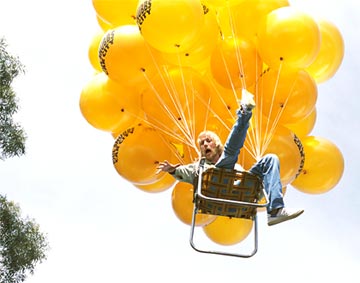
Yeah, Scott, stop flying around and get into that lawn chair like Tom Barrett. And Tom, I know it's rough getting around without trolley or train-tracks everywhere you go, but come on... lawn chair?


ADDED: Please take the folksinger viewpoint into account:


Saturday, May 19, 2012

"Not even a busted state fisc can stop Jerry Brown's train to nowhere."

"Transportation experts warn that the 500-mile bullet train from San Francisco to Los Angeles could cost more than $100 billion, though the Governor pegs the price at a mere $68 billion. The state has $12.3 billion in pocket, $9 billion from the state and $3.3 billion from the feds, but Mr. Brown hasn't a clue where he'll get the rest...."
Mr. Brown is hoping that Washington will pony up more than $50 billion, but the feds have committed only $3.3 billion so far—and Republicans intend to claw it back if they take the Senate and White House this fall. If that happens, the state won't have enough money to complete its first 130-mile segment in the lightly populated Central Valley, which in any event wouldn't be operable since the state can't afford to electrify the tracks....
What a disaster! Remember a year and a half ago, when Wisconsin elected a new governor who said he'd kill the high-speed rail deal? I was a single-issue voter for Scott Walker then, and that was my issue. Here's a newspaper article from December 2010: "High-speed rail funds scatter to other states... California gets lion's share."
Wisconsin will keep only a fraction of the $810 million it won in federal high-speed rail money.... California is the big winner, with up to $624 million....

[Exiting Democratic Governor Jim] Doyle called the loss of the high-speed rail funds a "tragic moment for the state of Wisconsin. Eight hundred and ten million dollars that would have gone to create thousands of jobs in Wisconsin will now create jobs in other states... I obviously am deeply saddened to see us take a major step backward."
Ha. It's been so not tragic.
"My congratulations to the workers in California and Florida. As a result of this decision, you will have a merry Christmas," Milwaukee Mayor Tom Barrett said at a news conference. "I'm just sad the same won't happen here in Wisconsin."
Tom Barrett is, of course, the Democratic Party candidate in the recall election against Scott Walker, but back then, he'd just lost the regular election to Walker. The recall election is in 2 weeks. I wonder if he's been asked about these old statements about the damned train and how lucky California was to get that federal cash infusion Scott Walker spurned.

Saturday, May 5, 2012

Oh! I forgot to watch the recall candidates debate!

Forgot even to tape it. I did notice at one point that there was a debate and made a mental note to tape it. I had the motivation of wanting to tell you all about it, but I forgot. It was a Friday night. Did anyone watch?

Well, I'm sure it's on line. Yeah, here. And we can always check out the Wisconsin State Journal report:
Milwaukee Mayor Tom Barrett, former Dane County Executive Kathleen Falk, State Sen. Kathleen Vinehout, D-Alma, and Secretary of State Doug La Follette appeared at Wisconsin Public Television's Madison studios for their last debate before Tuesday's primary. The winner earns a shot at unseating Walker in a general recall election June 5....

The Democratic gubernatorial hopefuls were careful not to jab each other too hard Friday and risk alienating each other's supporters; the nominee will need a united front going into June. Instead they spent most of the evening trotting out well-rehearsed talking points against Walker.
Trotting out well-rehearsed talking points and not attacking each other? Then there was no test of who would do better actually wrangling with Walker.
But Barrett accused the governor of caring more about traveling around the country and parlaying his reputation as conservative superstar into loads of out-of-state campaign contributions.

"I'll stay here in Wisconsin to work and retain jobs," he said. "I won't be a rock star to the far-right movement."
That's a relief! I'm sure Barrett will be quite the non-rock-star — of the left or the right.  That's his pitch: I'm very bland. How that retains jobs, I have no idea. He's not even offering to grow jobs (as Walker did). Just retain them, okay?

Meanwhile, Falk said:
"No one will work harder than I to get people back working."
So she'll work hard. No Walkeresque claim of creating job, nor even a Barretty assurance of retaining jobs. Just working really really hard.  It's the diligence, the very earnest diligence that matters so much. Diligence and good grammar. No one will work harder than I [will].

They also talked about restoring civility, because you know how Scott Walker caused that terrible outbreak of uncouthness:
"That's what's missing in Madison right now," he said. "The basic human respect is gone."

Falk likened the state to a broken family. Sometimes, she said, it takes a mother with a firm, strong hand to bring it together again.
Oh, no! Falk is playing the gender card.
"We need a mom and I'm anxious to be that mom and bring us back together," Falk said.
Oh, no! Ha ha. That's laying it on really thick. I'm live-blogging my reading of the article, so I hadn't seen that when I was making fun of her "No one will work harder than I" idea for building economy. I was going to say it sounded like a school girl running for class president. I was even going to break out the Tracy Flick comparison...


I decided not to. My feminist scruples won out and I decided not to lay a gender template on that striving overachievement attitude. But then she outright played the gender game. So Tracy Flick must be noted. It's simple pop culture literacy to cite Tracy Flick. I'd just plain not be doing my job as a blogger if I didn't embed that.

Now, I'd like to embed something comparable for Barrett, because I'm not endorsing anyone. But what pop culture reference could I make? He said himself that he's not going to be a "rock star," and that's actually pretty comical in itself. You know, you have somebody who has zero capacity to be something, and he assures you that he'll refrain from being that.  What's the pop culture reference for that?

ME: "Can you think of someone who was in a famous rock band, but was totally in the background, like somebody completely boring and schlubby, where you'd be all look at the bassist, why is that guy in the band?"

MEADE: Maybe Phil Lesh.

ME: No, he's too cool.

MEADE: Phil Lesh is cool?


So... the candidates were asked how they'd restore the public workers' collective bargaining rights:
Barrett promised to use "any vehicle I can to get to the destination," but said he'd start with a special legislative session shortly after taking office.
That reminds me. Speaking of "any vehicle"... I note that they didn't even mention one thing that Doug La Follette said at the debate. Here at Meadhouse, we've been laughing for days about this:
... La Follette says he would "fly to Washington, D.C." to try to reclaim funding for high-speed rail that Walker nixed....
Meade said: "Fly to Washington! Why doesn't he take the train? There's a train to Washington."

I said: "Well, let's be fair. Maybe he has little wings and he can fly. Make Way for Douglings...."

Friday, February 3, 2012

"If they began this project where they want it to go — between San Francisco and Los Angeles..."

"... they would run into so much opposition from the environmentalists, and from local politicians influenced by the environmentalists, that the delays could take the high-speed rail advocates beyond the time limit for using the federal subsidy money. But the green fanatics have not yet taken over politically out in the San Joaquin Valley."

Writes Thomas Sowell about the high-speed rail line between Fresno and Bakersfield, California.
In other words, they are going to start wasting money out in the valley, so that they will be able to waste more money later on, along the coast. This may not make any sense economically, but it can make sense politically for Jerry Brown and Barack Obama.

Sunday, January 29, 2012

The moon base is to conservatives what high-speed rail is to liberals.

It's an extremely expensive project that springs out of a man's boyhood passions. You're begging for a toy, and I'm one of the smart, grounded mommies who know how to say no.

Sunday, November 20, 2011

Russ Feingold: "The big lie is beginning. The big lie is that this is an out-of-state movement...."

He was speaking about the movement to recall Scott Walker at a rally in Madison, Wisconsin yesterday.


"The big lie"? The "big lie" is a lie that has "a certain force of credibility" precisely because it is so big:
[T]he broad masses of a nation are always more easily corrupted in the deeper strata of their emotional nature than consciously or voluntarily; and thus in the primitive simplicity of their minds they more readily fall victims to the big lie than the small lie, since they themselves often tell small lies in little matters but would be ashamed to resort to large-scale falsehoods. It would never come into their heads to fabricate colossal untruths, and they would not believe that others could have the impudence to distort the truth so infamously. Even though the facts which prove this to be so may be brought clearly to their minds, they will still doubt and waver and will continue to think that there may be some other explanation. For the grossly impudent lie always leaves traces behind it, even after it has been nailed down, a fact which is known to all expert liars in this world and to all who conspire together in the art of lying.
Those aren't Feingold's words. Those are the words of Adolf Hitler, which Feingold evoked when he used the historically resonant expression "the big lie." In accusing his opponents of employing "the big lie," Feingold is likening them to Hitler.

Let me remind you that the Wisconsin protesters have been equating Scott Walker with Hitler since last winter.  From last March, here's a protester explaining why Scott Walker is like Hitler. Here's another explanation, from a woman with a sign portraying Scott Walker as Hitler. Here's a photo I took last February. I vividly remember this woman:

P1060646

I asked her if she thought Scott Walker was like Hitler...
... and she said "Yes." So I said, "Are you saying that you think fascism could come to America," and she said, "It's what's happening."
Russ Feingold is a very intelligent and informed man. His allusion to Hitler is subtle, not — I think — accidental. He's sounding the deep chord. His speech continues:
"How can they even say it with a straight face? This movement is so grass-roots, so red-and-white Wisconsin, that it is absolutely ridiculous to say that."
Can you look at this picture of a truck parked on the Capitol Square during yesterday's rally and maintain a straight face?


It says: "Kentucky/West Virginia/Indiana." (And here's a golden oldie from last March: "Chicago is up in the house... Everyone left is from Chicago.")

Feingold continues:
Now, we've got a great football team. They may not be #1, except for a couple little problems there, but they're darned close, but when it comes to grass-roots activism that is all Badger, we are #1.
All right. Quite aside from the truth of the assertion that the recall movement is totally in-state and grass-roots, how can he say "Now, we've got a great football team. They may not be #1"? We've got a great football team that is most certainly #1, but it's not in Madison, Wisconsin. It's in Green Bay. You can even hear an audience member yell out "Two!" in a prompt that Feingold could have heard. But it's a Madison, Wisconsin crowd, and Feingold is Madison-focused. He used the expression "red-and-white Wisconsin" as if the colors of the University of Wisconsin—Madison were the state colors. Red-and-white Wisconsin? What about green-gold-and-white Wisconsin? Feingold is unwittingly displaying that he is out of touch with the rest of the state — which voted him out of the U.S. Senate in 2010, despite his vast popularity in Madison.

And this is the state that voted in Scott Walker. The people of Madison never supported him, but they weren't in synch with the majority of the state in 2010. Now, it's a year later, and the people of Madison want to force another election, using the recall mechanism from the Wisconsin constitution, which doesn't limit the reasons why we might recall a governor. Russ Feingold addressed the question of when recalls are justified:
Our law says you can be recalled if you simply attack the people of the State of Wisconsin, and that is what this is all about. 
The state constitution says no such thing. "Attack the people"? It is for us, the people of Wisconsin, to decide when and why we want to use the recall device. There's no attack-the-people standard, whatever that's supposed to mean. Feingold attempts to infuse meaning into his made-up standard:
Now, I'm going to be the first to say I don't believe you should do recalls just any old time. I don't think that's a good idea. I think it could be damaging. 
I agree!
For example, I don't think it would be a valid basis to recall Walker because he ruined our chances to have a railroad system. I mean that was totally dumb. It was $800 million from the federal government that he just threw away. 
He just threw it away. Isn't it shocking to think of federal money like that? The federal government is deeply in debt. There is no money to throw away. Once the federal government offers money for some specific purpose it may seem to acquire reality, and if you are completely fixated on what you want for yourself, you may think, I'd better snap that up now or I'm going to lose it, but that's a delusion. There is no money. And if we'd taken the money for the railroad line (to connect Madison to Milwaukee), we would have been on the hook — as a state — for endless additional expenses over the years.

But according to Feingold, the railroad "was our future." It's not right to recall Scott Walker over that, however, Feingold says, because "he said he was going to do that." (That is true. It's why I voted for Walker.) What Walker didn't say, and what is therefore the reason to recall him, Feingold says, "was that he was going to go at the basic collective bargaining rights and voting rights of every citizen in this state. That's a big deal. That goes to the foundation of who we are."

Now, Walker didn't go after "the basic collective bargaining rights... of every citizen in this state." He only went after some of the collective bargaining rights of some public employees. And he didn't go after the "voting rights of every citizen in this state" — only the "rights" of citizens who haven't yet acquired a state-issued photo ID.

But Feingold is stirring up the crowd. And the fact is, he's a great speaker. He ends: "Where do I sign?" and signs a recall petition.

Our recall procedure requires an election with an opposition candidate, and what's the point of going through the collection of all these signatures unless the governor can be ousted? Who will oppose Scott Walker? The only candidate with a real chance, it seems, is Russ Feingold, but Russ says he's not running. That's what he's saying now, before the signatures are collected. I happen to believe that if there is a recall election, Feingold will run. But that is a subject for another post.
Tuesday, November 1, 2011

California's high-speed rail project nearly triples in cost — to $98.5 billion.

And the new projected completion date is 2033, not 2020.
Gov. Jerry Brown on Tuesday was expected to endorse the long-awaited plan, the first major update to the project in two years and the last before the federal deadline to begin construction next year. But state legislators, who were already skeptical, will tear through the plan starting Tuesday before deciding whether to start building, or to kill the project.
Obviously, they need to kill the project. Speaking of governors, remember this guy?


That's the ad — from August 2010 — that clinched my vote for Scott Walker.

Saturday, September 17, 2011

"Many people say I want to kill myself because I do this."

"People can say what they want. I do it because I want to be cured."

Electric therapy, via lying on railroad tracks, in Indonesia, where "many practice a form of Islam that is mixed with superstition and traditional beliefs, including voodoo-like treatments to ward off spells and illnesses." So... it's not New Age. It's Old Age.