After Michelle Obama got criticized for horning in on the Oscars, her communications director issues that as a response.
I loathe that kind of PR — so saccharine and insincere. Look at all the assertions crammed into that sentence. 1. MO is a movie lover. 2. MO was honored. 3. MO was honored as a movie lover. 4. MO presented the award in order to celebrate the artists. 5. Hollywood movie people are artists. 6. Artists do art for the purpose of inspiring everybody. 7. Hollywood movies are made for the purpose of inspiring people. 8. Hollywood movies actually succeeding in inspiring all of us. 9. Young people are especially inspired by movies.
It's such an inane load of nonsense that it seems low and peevish of me to point out so many distinct elements. It was only ever intended to waft over you as a vague fog of a feeling that something appropriately lofty and bland has been said. That's the only relevant meaning.
Oh, wait. Look at this. Something else is being said. We have here a professor of women’s history from Ohio University who has delved into the study of First Ladies. This comes not from the PR department but from academia. Professor Katherine Jellison says: "I get the feeling that she is for the first time maybe really relaxing and enjoying her celebrityhood."
For the first time in my adult lifetime, I’m really proud of my celebrityhood...
Showing posts with label art. Show all posts
Showing posts with label art. Show all posts
Tuesday, February 26, 2013

Monday, February 18, 2013
"When people think of Roy [Lichtenstein], they think of those cartoon images from the early ‘60s."
"But he had another close to 40 years after that working on other imagery," Said the late artist's second wife Dorothy, adding that Roy "was not a fan of comics and cartoons" which "seemed about as far away from the artistic image as you can get." It's because of the disconnect from art that he found it appealing to "transform" comics "into a formal painting."
You appropriate the stuff, and you disparage it. Is that right? It's an old debate about Lichtenstein, but there's a big new show at a museum, so you might want to talk about it.
What was the later work like? One thing he did was take an officially high art work like Van Gogh's bedroom at Arles and redo it:


He liked cranking something through his art-machine. Van Gogh/comics/whatever. Why trash the comics artists? It just seems peevish. Discourteous. Now, Roy's dead and the widow is speaking for him. Something icky about all that.
You appropriate the stuff, and you disparage it. Is that right? It's an old debate about Lichtenstein, but there's a big new show at a museum, so you might want to talk about it.
What was the later work like? One thing he did was take an officially high art work like Van Gogh's bedroom at Arles and redo it:

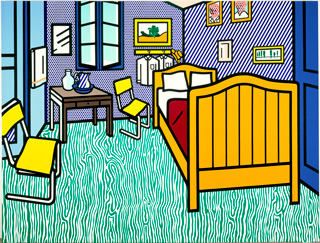
He liked cranking something through his art-machine. Van Gogh/comics/whatever. Why trash the comics artists? It just seems peevish. Discourteous. Now, Roy's dead and the widow is speaking for him. Something icky about all that.
"The community feels that this art was given to us, for free, and it's now been taken away to be sold for huge profit. I'm very angry about the Banksy going - we want our Banksy back!"
"The street art was stencilled onto the side of a Poundland shop in Wood Green in 2012 but disappeared last week." The chunk of wall has now been removed and is up for auction where it's expected to sell for over half a million dollars.
But if removing these things is frowned upon by the very people who love it and imbue it with value, then it's not worth so much. I could picture the artist seeing this kind of wrangling over the commerce and preservation to be part of the artwork and part of the publicity game around the artwork. No one item is of real value to him. It's about giving things away, and the artwork itself depicts a child engaged in slave labor. It's all about the art. The people's emotional attachment to it and their despair as they lose it are all part of the art.
Or so I presume. Sorry, I haven't really been following the Banksy thing. It's the sort of thing I would normally be interested in, but somehow I've averted my eyes from this character. Here's his Wikipedia page if you need to catch up on him or correct me on my mispresumptions.
Poundland say they are not behind the removal of the artwork, which was behind a protective perspex screen when it was taken. A spokesman said: 'We're not responsible for either selling or removing the Banksy mural. We're currently investigating.'There's a legal and a moral issue here. I assume that it was a crime to put the art on the wall and that whoever owns the wall owns the graffiti and can sell it. If these works are worth so much money and it was my wall, I'd want to have it removed before somebody stole it or damaged it. You'd think other graffiti artists would be tempted to paint over it.
A Met Police spokesman said the removal has not been reported as a crime.
But if removing these things is frowned upon by the very people who love it and imbue it with value, then it's not worth so much. I could picture the artist seeing this kind of wrangling over the commerce and preservation to be part of the artwork and part of the publicity game around the artwork. No one item is of real value to him. It's about giving things away, and the artwork itself depicts a child engaged in slave labor. It's all about the art. The people's emotional attachment to it and their despair as they lose it are all part of the art.
Or so I presume. Sorry, I haven't really been following the Banksy thing. It's the sort of thing I would normally be interested in, but somehow I've averted my eyes from this character. Here's his Wikipedia page if you need to catch up on him or correct me on my mispresumptions.
Wednesday, February 13, 2013
Saturday, February 9, 2013
"Bush, of course, is not a formally trained painter, raising the question of whether he is an outsider artist."
"[Jack] Fischer, who exhibits outsider art, which is made by artists who are self-taught or work outside the mainstream art world, said that Bush 'in a sense' fit the definition because he was never interested in having his work looked at or shown."
IN THE COMMENTS: john said:
The Jack Fischer Gallery has a nice-looking website. You can check out the artists here. Sympathy to the man's family.
IN THE COMMENTS: john said:
If he is the same Jack Fischer, art critic, who died in San Francisco yesterday, then his Hitler/Bush comparison must have been his dying words.Chuck Currie said:
John - One and the same Jack Fischer dead at 59.Let's be careful. I didn't highlight the Hitler point, but there is no sign that Fischer said Bush was in some moral or political fashion like Hitler. He was contacted, apparently because his gallery specializes in outsider art, and he said:
So it's not true that only the good die young.
"What immediately comes to mind is Hitler's paintings and the immediate brouhaha that that caused... There's this peculiar sort of interest in a famous figure having painted."In fact, it is the first thing you think of. Maybe you should refrain from blurting it out. Another thing you can do, once you've thought of that, is to point out that Hitler tried to be an artist and failed. Then he became a politician. When that failed, he committed suicide. Bush became a businessman first, had some success, parlayed that into politics, and when his term ended — as a matter of law, not failure — he graciously disappeared into retirement and took up painting for reasons other than a desire to be recognized as an artist.
The Jack Fischer Gallery has a nice-looking website. You can check out the artists here. Sympathy to the man's family.
"I have completed the task the Lord hath assignedeth me of creating the templates and instructions for a simple Valentine's Day pop-up card."
"So now I am released of my duty to humankind," says Chip Ahoy in yesterday's café, The Faithful Dog:
The templates are so simple it's embarrassing.
Nevertheless, here are some 30 or so photos that show a step by step process any child can follow. The 3 little files are png files to drag and drop. They fit an 8.5 X 11 sheet of card stock, to print, but you will not need the templates, just use the idea instead. They are put there for your human comfort.
And I tell you what, if you were to take a moment and fashion such a card for your sweetie, it will be the best card they ever receive and I'm not kidding. It will be treasured, I learned, and saved. Forever. When the person dies their survivors will go through their things, and go, "no wait, what? what? this person got Valentines cards like this when they were alive? That's awesome! Man, I wish I had friends who gave me cards like this."
And it's a simple one too. Part 2 Doubles the awesomeness of this card, and Part 3 intensifies that!The super-clear photo instructions are entertaining even for those of us who would never hand-make a card, even for those who don't send cards of any kind, and even those who have a Valentine's-equivalent-of-Scrooge-like attitude about Valentine's Day.
Friday, February 8, 2013
Paintings by George Bush of his feet in the bathtub and his back in the shower.
Part of what we are seeing because a Bush family account was hacked. I wasn't going to link to the hacking, but I'm fascinated by George Bush as a painter. (Via Metafilter.)
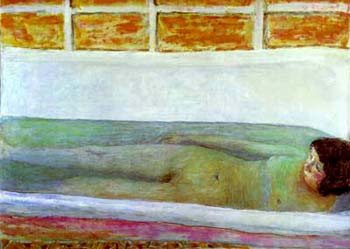
The feet-in-the-bath pic brought to mind the wonderful paintings Pierre Bonnard made of his wife in the bathtub:


The feet-in-the-bath pic brought to mind the wonderful paintings Pierre Bonnard made of his wife in the bathtub:

Monday, February 4, 2013
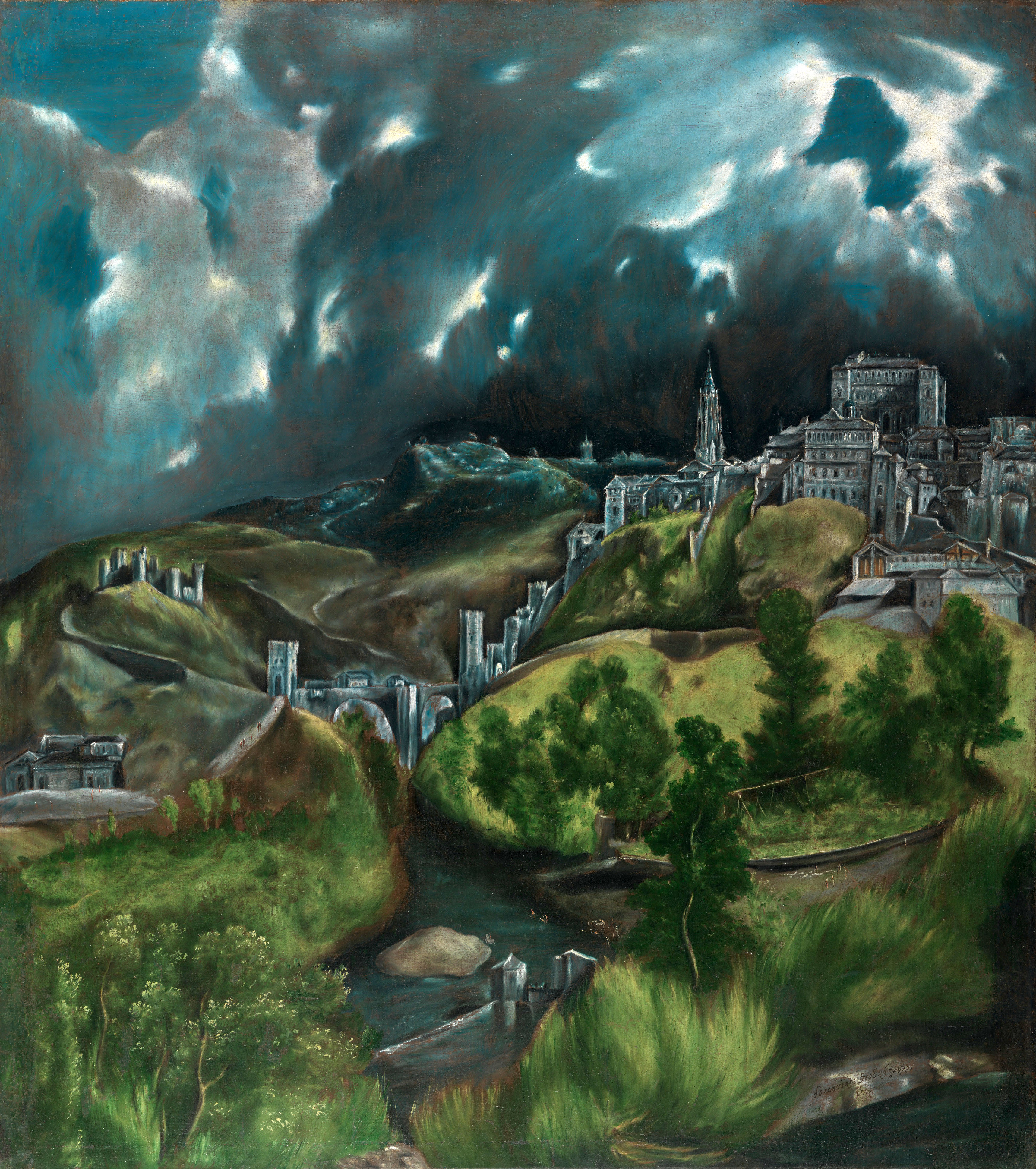
"I see it as a night scene by El Greco: a hundred houses, at once conventional and grotesque, crouching under a sullen, overhanging sky and a lustreless moon.
This is the picture — I assume — that F. Scott Fitzgerald had in his head...

... when he wrote that sentence, which is today's sentence from "The Great Gatsby." (Every day we isolate and talk about one sentence from "The Great Gatsby.")
El Greco painted that "View of Toledo" circa 1600. That seems too long ago for a man to have been painting like that. It's hard to understand how that could have happened. But maybe you are thinking: Toledo!? Was that part of the Ohio Inquisition we were just talking about?
I'll remind you once again of the look for the light question that almost always works in "Gatsby" sentences. Here we've got the absence of light. After last night, when Gatsby was his own light source...

(GIF by Chip Ahoy.)
.... tonight we have the moon and it is lustreless.
Lustre is a lovely word, evoking lust, though its lineage is different. Lust comes from the Germanic, and lustre comes from the Latin and is all about illumination. "The quality or condition of shining by reflected light; sheen, refulgence; gloss," says the OED. But here there is no light to the moon. Lustreless. It's a night scene. There are houses, here in America, not off in Spain, but you get the picture. It's like that El Greco. And in case you don't see it clearly — F. Scott Fitzgerald has a bunch of adjectives to make the point: conventional, grotesque, crouching, sullen, overhanging, and — as noted — lustreless.
Even as there is contradiction in depriving the moon of its light, we've got contradiction in conventional and grotesque. It's an ordinary scene, houses on a landscape at night. But see it as grotesque. Put your El Greco distortion glasses on. Did you know that the etymology of the word grotesque has to do with painting and that, like El Greco's painting, it goes back to 1600?
... when he wrote that sentence, which is today's sentence from "The Great Gatsby." (Every day we isolate and talk about one sentence from "The Great Gatsby.")
El Greco painted that "View of Toledo" circa 1600. That seems too long ago for a man to have been painting like that. It's hard to understand how that could have happened. But maybe you are thinking: Toledo!? Was that part of the Ohio Inquisition we were just talking about?
I'll remind you once again of the look for the light question that almost always works in "Gatsby" sentences. Here we've got the absence of light. After last night, when Gatsby was his own light source...
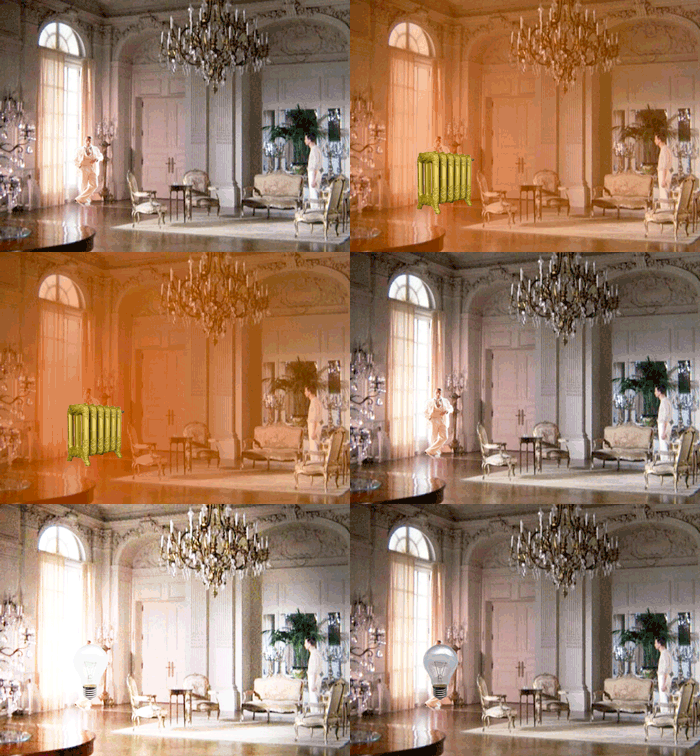
(GIF by Chip Ahoy.)
.... tonight we have the moon and it is lustreless.
Lustre is a lovely word, evoking lust, though its lineage is different. Lust comes from the Germanic, and lustre comes from the Latin and is all about illumination. "The quality or condition of shining by reflected light; sheen, refulgence; gloss," says the OED. But here there is no light to the moon. Lustreless. It's a night scene. There are houses, here in America, not off in Spain, but you get the picture. It's like that El Greco. And in case you don't see it clearly — F. Scott Fitzgerald has a bunch of adjectives to make the point: conventional, grotesque, crouching, sullen, overhanging, and — as noted — lustreless.
Even as there is contradiction in depriving the moon of its light, we've got contradiction in conventional and grotesque. It's an ordinary scene, houses on a landscape at night. But see it as grotesque. Put your El Greco distortion glasses on. Did you know that the etymology of the word grotesque has to do with painting and that, like El Greco's painting, it goes back to 1600?
c.1600s, originally a noun (1560s), from Middle French crotesque (16c., Modern French grotesque), from Italian grottesco, literally "of a cave," from grotta (see grotto). The usual explanation is that the word first was used of paintings found on the walls of basements of Roman ruins (Italian pittura grottesca), which OED finds "intrinsically plausible." Originally "fanciful, fantastic," sense became pejorative after mid-18c.Grotesque was a happier concept 300 years ago. Who knows what happened in grottoes back then?
Saturday, February 2, 2013
On the death of Barney the dog, George Bush reveals a portrait he painted of his "faithful friend."
"Barney was by my side during our eight years in the White House... He never discussed politics and was always a faithful friend. Laura and I will miss our pal."

I like the "43" signature. Did you know the Bush had taken up oil painting? I'd missed the snarky notes about it last summer, like this from ArtFagCity:
And then there was this, last October: "George W. Bush Painting Dogs All Day, Becoming ‘Agoraphobic,’ Is Skeptical Of Romney’s Chances, New Profile Of Bush Fam Reveals."

A hug for President Bush today. And I think the painting is very good. Of course, there will always be Bush haters. Can't stop the Bush haters from hating their Chimpy McHitler.
You know, Hitler painted.


I like the "43" signature. Did you know the Bush had taken up oil painting? I'd missed the snarky notes about it last summer, like this from ArtFagCity:
This is all the information we have: at a hospital fundraiser in Memphis Monday night, former President George W. Bush mentioned his new hobby, oil painting. He told the crowd he’s “kinda stuck” to painting dogs. Tragically, there are no pictures. [The Daily Beast] Relatedly, we’ll totally pay you if you find pictures of George W. Bush’s dog paintings.I guess Bush knew his dog was dying — it was 12 years old and had lymphoma — and he intended to show his first artwork when the time came to announce the dog's death.
And then there was this, last October: "George W. Bush Painting Dogs All Day, Becoming ‘Agoraphobic,’ Is Skeptical Of Romney’s Chances, New Profile Of Bush Fam Reveals."
The mag describes a Bush that is hiding away from the public eye, with one unnamed person observing: “He’s become increasingly agoraphobic… he doesn’t like people, he never did, he doesn’t now.”He doesn’t like people, he never did, he doesn’t now.... So says an unnamed person.
The profile also says: “The most unpopular president in recent political history, W. left a record of big-government spending and intractable wars that remains difficult even for allies to defend … W. remains convinced history will vindicate him...."

A hug for President Bush today. And I think the painting is very good. Of course, there will always be Bush haters. Can't stop the Bush haters from hating their Chimpy McHitler.
You know, Hitler painted.

Friday, February 1, 2013
"Confusion over sources or indifference to them can be a paradoxical strength..."
"... if we could tag the sources of all our knowledge, we would be overwhelmed with often irrelevant information," writes Oliver Sacks in an essay about memory.
Indifference to source allows us to assimilate what we read, what we are told, what others say and think and write and paint, as intensely and richly as if they were primary experiences. It allows us to see and hear with other eyes and ears, to enter into other minds, to assimilate the art and science and religion of the whole culture, to enter into and contribute to the common mind, the general commonwealth of knowledge. This sort of sharing and participation, this communion, would not be possible if all our knowledge, our memories, were tagged and identified, seen as private, exclusively ours. Memory is dialogic and arises not only from direct experience but from the intercourse of many minds.
Thursday, January 31, 2013
"And Guy sank upon a couch of flowers/In an ice-ribbed underworld..."
"Awash in blossoming gold from a new sun/Tumbling out dark long-ago clouds..."
Maurice Sendak's last work.
Maurice Sendak's last work.
Thursday, January 24, 2013
Tuesday, January 22, 2013
"On buffet tables, garnished with glistening hors d’œuvre, spiced baked hams crowded against salads of harlequin designs and pastry pigs and turkeys bewitched to a dark gold."
That's today's sentence from "The Great Gatsby" (in the practically inexplicable Gatsby project).
I must say this sentence almost makes me angry, and I'm going to calm myself by diagramming it...
Another calming method I use when ingesting a Gatsby sentence is: Look for the light. Or: Look for the interplay of light and darkness. (I was just explaining that yesterday.)
In today's sentence, we've got "glistening" for the light (located in the hors d’œuvre), and "bewitched to a dark gold" for the darkness. It's interestingly mysterious that the darkness gets to be gold — a metal that normally is seen as glistening, especially when compared to hors d’œuvre, which... WTF?... are they greasy? Is there a spotlight aimed at them? It's also interesting that there's some bewitching going on, but that just seems to be a goofball way of referring to cooking, the cooking of turkeys and pastry pigs. Now, you know, about 9 days ago, I got all bent out of shape over F. Scott calling pork pig. But here it's quite possible that he's not talking about some cut of pork bewitched to a dark gold, but something pastry (with pork) molded into the shape of a pig.

So I'm not going to let that get my...

Are we through yet? Or is something in this insane undertaking requiring me to help you come to terms with the "salads of harlequin designs"? I found some crazy-ass salads Googling "harlequin salad." Like:

But we're looking for salads of harlequin designs, and I'm sorry, but there's just no design there. Mom and her ilk are simply using the word "harlequin" to mean multicolored. Harlequin design has got to refer to a much more distinctive diamond shape pattern typical of the Commedia dell'Arte character. Like this:

So I'm picturing some mound of edible material with criss-crossing strips of pimento. Ah! Here: "Fancy Salads of the Big Hotels." That book is from 1921, one year before the events in "The Great Gatsby" are supposed to take place. And here's Robert Salad:
Bewitching!
I must say this sentence almost makes me angry, and I'm going to calm myself by diagramming it...
hams | crowdedOkay. That's it! That's the action in this sentence. Hams crowded. Got that?
Another calming method I use when ingesting a Gatsby sentence is: Look for the light. Or: Look for the interplay of light and darkness. (I was just explaining that yesterday.)
In today's sentence, we've got "glistening" for the light (located in the hors d’œuvre), and "bewitched to a dark gold" for the darkness. It's interestingly mysterious that the darkness gets to be gold — a metal that normally is seen as glistening, especially when compared to hors d’œuvre, which... WTF?... are they greasy? Is there a spotlight aimed at them? It's also interesting that there's some bewitching going on, but that just seems to be a goofball way of referring to cooking, the cooking of turkeys and pastry pigs. Now, you know, about 9 days ago, I got all bent out of shape over F. Scott calling pork pig. But here it's quite possible that he's not talking about some cut of pork bewitched to a dark gold, but something pastry (with pork) molded into the shape of a pig.

So I'm not going to let that get my...

Are we through yet? Or is something in this insane undertaking requiring me to help you come to terms with the "salads of harlequin designs"? I found some crazy-ass salads Googling "harlequin salad." Like:
1 can of peasAnd here's a photograph of something called "Mom Dill's Harlequin Salad":
1 can of sliced beets, diced
1/2 cup Miracle Whip
1 chopped onion (optional)
Dice beets and onions and mix all together and refrigerate until cold. I usually quadruple the recipe because it goes fast.
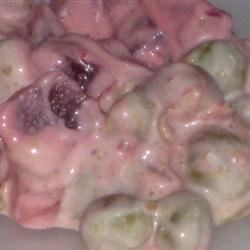
But we're looking for salads of harlequin designs, and I'm sorry, but there's just no design there. Mom and her ilk are simply using the word "harlequin" to mean multicolored. Harlequin design has got to refer to a much more distinctive diamond shape pattern typical of the Commedia dell'Arte character. Like this:

So I'm picturing some mound of edible material with criss-crossing strips of pimento. Ah! Here: "Fancy Salads of the Big Hotels." That book is from 1921, one year before the events in "The Great Gatsby" are supposed to take place. And here's Robert Salad:
Place two slices of tomato on half a heart of romaine, and on top place two rings of green pepper. Lay a slice of hard boiled eggs in each of the rings and decorate with diamond shaped dice of pimento.I know. It's really no less disgusting than Mom's concoction. But were we supposed to be licking our chops over this? It's a sentence read in isolation, but I'm guessing we were supposed to think this spread was extravagant and yet... we're happy to stay home with Mom and her ilk after the 4 buckets of Miracle Whip with canned goods have disappeared, down the various household gullets.
Bewitching!
Tuesday, January 15, 2013
"The pollen piece looks like a yellow painting... but it’s much, much more."
"It’s not a yellow pigment, which is very important for me. It’s the potential beginning of millions of plants. It’s the semen for the plants. And this I was interested in. It has an appearance, maybe, like a painting, but the sun is not a round ball. It’s much, much more. The sky is not a blue painting. For me, these things were somehow very important. I would have stayed as a doctor, if art was only about this color or that color."
Monday, January 14, 2013
"Must you always be out in that ghastly clown suit, running around annoying people?"
Says Pretty Alice to the Harlequin in Harlan Ellison's "Repent Harlequin!' Said The Ticktockman," which I read on the urging of commenter Icepick because of the way it reflected on the recent news stories about Aaron Swartz, David Gregory, and the Boston ban on drinking games.
I downloaded this Orson Scott Card collection — "Masterpieces: The Best Science Fiction of the 20th Century" — which included "Repent Harlequin," because I wanted to understand this harlequin/ticktockman distinction, and lo and behold here's the harlequin — actually, what do you expect? he's a harlequin — wearing a clown suit, when just 5 days ago, the bloggism of the day was clown suits. We were pimping clown suits.

It's weird how these themes seem to coagulate on their own.
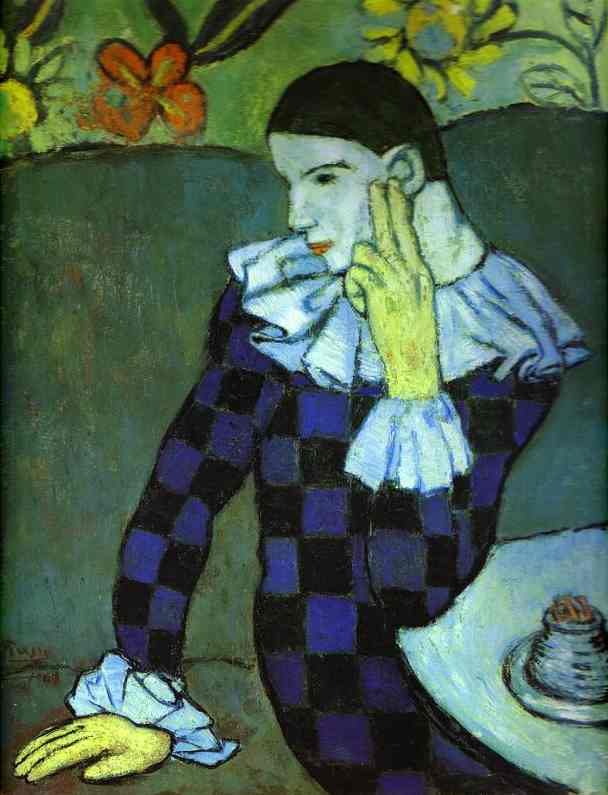
IN THE COMMENTS: Astro said points out that my Picasso clown isn't a harlequin. I need to be better about specifying the Commedia dell'arte characters. Here's a Picasso harlequin (on the right):

I downloaded this Orson Scott Card collection — "Masterpieces: The Best Science Fiction of the 20th Century" — which included "Repent Harlequin," because I wanted to understand this harlequin/ticktockman distinction, and lo and behold here's the harlequin — actually, what do you expect? he's a harlequin — wearing a clown suit, when just 5 days ago, the bloggism of the day was clown suits. We were pimping clown suits.
It's weird how these themes seem to coagulate on their own.
IN THE COMMENTS: Astro said points out that my Picasso clown isn't a harlequin. I need to be better about specifying the Commedia dell'arte characters. Here's a Picasso harlequin (on the right):

Friday, January 11, 2013
"Some time ago a stranger asked me to make his portrait... So I did. I sent him the image and I never heard back from him again since that moment."
"Artist found burned to death on top of his masterpiece."
"Artist Jorge Selaron may have taken his own life by setting himself on fire on the very steps of his masterpiece, a brilliantly colored public staircase that became a symbol of Rio de Janeiro..."
The stairs, his life's work, were declared city patrimony in 2005, when Selaron was made an honorary carioca, as Rio residents are called. The steps have been featured in Snoop Dogg's "Beautiful" and U2's "Walk On" music videos, as well as part of the video that Brazil made for their 2016 Olympic bid.Here's the Snoop Dogg video. Here's the U2.
Friday, January 4, 2013
"I don’t know whether this world has a meaning that transcends it."
"But I know that I cannot know that meaning and that it is impossible for me just now to know it."

Today, the "History of" project brings us to...
Algeria, where human beings have lived for at least 1.8 million years. There are prehistoric rock paintings in the Tassili n'Ajjer range. Like this:

The indigenous people have been called Berbers since 4000 BC, and they have been joined over the years by invaders of the Phoenician, Roman, Vandal, Byzantine, Arab, Turkish, and French kind.

Today, the "History of" project brings us to...
Algeria, where human beings have lived for at least 1.8 million years. There are prehistoric rock paintings in the Tassili n'Ajjer range. Like this:

The indigenous people have been called Berbers since 4000 BC, and they have been joined over the years by invaders of the Phoenician, Roman, Vandal, Byzantine, Arab, Turkish, and French kind.
Berber territory was annexed by the Roman Empire in AD 24. Increases in urbanization and in the area under cultivation during Roman rule caused wholesale dislocations of Berber society, and Berber opposition to the Roman presence was nearly constant....Colonization by the French began in 1830.
Christianity arrived in the 2nd century AD. By the end of the 4th century, the settled areas had become Christianized, and some Berber tribes had converted en masse....
The 8th and 11th centuries AD, brought Islam and the Arabic language....
In the central Maghrib, the Abdalwadid founded a dynasty at Tlemcen in Algeria. For more than 300 years, until the region came under Ottoman suzerainty in the 16th century, the Zayanids kept a tenuous hold in the central Maghrib. Many coastal cities asserted their autonomy as municipal republics governed by merchant oligarchies, tribal chieftains from the surrounding countryside, or the privateers who operated out of their ports. Nonetheless, Tlemcen, the “pearl of the Maghrib,” prospered as a commercial center.
The final triumph of the 700-year Christian reconquest of Spain was marked by the fall of Granada in 1492. Christian Spain imposed its influence on the Maghrib coast by constructing fortified outposts and collecting tribute. But Spain never sought to extend its North African conquests much beyond a few modest enclaves. Privateering was an age-old practice in the Mediterranean, and North African rulers engaged in it increasingly in the late 16th and early 17th centuries because it was so lucrative. Algeria became the privateering city-state par excellence.....
Algeria and surrounding areas, collectively known as the Barbary States, were responsible for piracy in the Mediterranean Sea, as well as the enslaving of Christians, actions which brought them into the First and Second Barbary War with the United States of America.
Viewed by the Europeans with condescension at best and contempt at worst, the Algerians endured 132 years of colonial subjugation. From 1856, native Muslims and Jews were viewed as French subjects, but not French citizens.Abdelaziz Bouteflika became president in 1999 and "concentrated on restoring security and stability." He remains president to this day.
However, in 1865, Napoleon III allowed them to apply for full French citizenship, a measure that few took, since it involved renouncing the right to be governed by sharia law in personal matters, and was considered a kind of apostasy; in 1870, French citizenship was made automatic for Jewish natives, a move which largely angered the Muslims, who began to consider the Jews as the accomplices of the colonial power. Nonetheless, this period saw progress in health, some infrastructures, and the overall expansion of the economy of Algeria, as well as the formation of new social classes, which, after exposure to ideas of equality and political liberty, would help propel the country to independence. During the years of French domination, the struggles to survive, to co-exist, to gain equality, and to achieve independence shaped a large part of the Algerian national identity....
A new generation of Islamic leadership emerged in Algeria at the time of World War I and grew to maturity during the 1920s and 1930s. Various groups were formed in opposition to French rule....
The Algerian War of Independence (1954–1962), brutal and long, was the most recent major turning point in the country's history. Although often fratricidal, it ultimately united Algerians and seared the value of independence and the philosophy of anticolonialism into the national consciousness....
Between 350,000 and 1 million Algerians are estimated to have died during the war, and more than 2 million, out of a total Muslim population of 9 or 10 million, were made into refugees or forcibly relocated into government-controlled camps. Much of the countryside and agriculture was devastated, along with the modern economy, which had been dominated by urban European settlers (the pied-noirs). French sources estimated that at least 70,000 Muslim civilians were killed or abducted and presumed killed, by the [Front de Libération Nationale] during the Algerian War. Citizens of European ethnicity... and Jews were also subjected to ethnic cleansing. These nearly one million people of mostly French descent were forced to flee the country at independence due to the unbridgeable rifts opened by the civil war and threats from units of the victorious FLN; along with them fled Algerians of Jewish descent and those Muslim Algerians who had supported a French Algeria (harkis). 30-150,000 pro-French Muslims were also allegedly killed in Algeria by FLN in post-war reprisals....
On 19 June 1965, Houari Boumédienne deposed Ahmed Ben Bella in a military coup d'état that was both swift and bloodless....
Boumédienne’s death on December 27, 1978 set off a struggle within the FLN to choose a successor....
After the violent 1988 October Riots, a new constitution was adopted in 1989 that allowed the formation of political associations other than the FLN....
Among the scores of parties that sprang up under the new constitution, the militant Islamic Salvation Front (FIS) was the most successful....
In 1996 a referendum introduced changes to the constitution, enhancing presidential powers and banning Islamist parties.

Saturday, December 29, 2012
Subscribe to:
Posts (Atom)
 :.
:.

